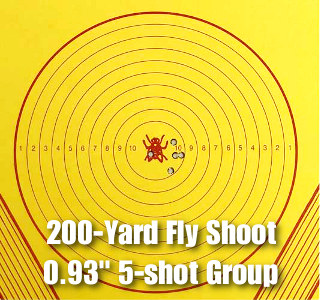
Australian John Lavaring recently shot a group at 200 yards that would make most centerfire shooters proud. The five-shot group, with all shots in the center 10-ring, measured just 0.93 inches. That works out to 0.44 MOA at 200 — mighty impressive for a .22 LR. Recorded at a Rimfire Fly Shoot benchrest event in Canberra, Australia, this 200-yard target set two new Australian SSAA National records! John was using ELEY Tenex ammunition.
Congratulations to John Lavaring for a spectacular demonstration of how well a rimfire rig can shoot — even at 200 yards. We rarely shoot our .22 LR rifles past 50 meters. Maybe it’s time to start a Rimfire ELR series, with targets at 200 or even 300 yards. What do you think of the Rimfire ELR idea? Leave comments below.
Anschutz 54 Benchrest Rig
The rifle was a Anchutz model 54 Match in a custom benchrest stock. John’s record-setting rig features a barrel block, which you can see forward of the action. Scope is a Bausch & Lomb BR model. We don’t have the round count on Lavaring’s barrel, but good rimfire benchrest rifles can often get 10,000 rounds (or more) of accurate life.
Rimfire Ballistics at 200 Yards
Some folks may be wondering about .22 LR ballistics at 200 yards. Well, with a 25-yard zero, the 200-yard drop for John’s 40gr Tenex ammo is 54 inches, assuming 0.145 G1 BC and 1085 fps muzzle velocity per ELEY website. And at 200 yards, a 10 mph crosswind will push that little bullet 15.3 inches! We’re told the winds were pretty tricky when Lavary shot his record group. This makes his achievement all the more impressive — we have to admire John’s wind-reading ability.
This ELEY ammo has proven to be exceptionally accurate. Here is a short video showing TEN rounds of Tenex shot from a machine rest with target at 50 meters.
Do you own an M1 Garand? Or perhaps you’re thinking of ordering a Garand, now that the CMP recently received 99,000 of these classic battle rifles — returns from Turkey and the Philippines. An M1 Garand is a great addition to anyone’s personal firearms collection. It is a piece of living history — plus it can be used in Vintage Military rifle matchers. Here are some resources for M1 Garand owners. There are marksmanship tips, plus helpful advice on maintaining your M1 Garand.
Rifle Marksmanship with the M1 Garand Rifle
The film was made in 1942/43 for the War Department. It shows shooting positions and holding techniques for the M1 Garand. This informative video will help both novice Garand shooters as well as experts seeking a “refresher course”. The film focuses on the M1 Garand but the techniques can be applied to any rifle. The narration sounds a bit “corny” by today’s standards, but focus on the techniques shown and you’ll learn plenty.
M1 Service and Maintenance
Shooting Sports USA has published an excellent article on Service and Maintenance of M1 Garand Rifles. This covers basic cleaning and servicing and also explains how to upgrade the performance of your Garands. READ Article HERE.
This popular Tips and Tricks Video has been viewed over 500,000 Times on YouTube.
Recommended M1 Garand Manual
Among the many M1 Garand manuals available, we recommend the CMP’s U.S. Rifle, Caliber .30, M1: ‘Read This First’ Manual. This booklet covers take-down, reassembly, cleaning, lubrication, and operation. The manual comes with CMP rifles or can be purchased for $3.50 from the CMP eStore. The author of Garand Tips & Tricks says: “It’s one of the best firearms manuals I’ve seen and I highly recommend it.” The CMP also offers many other M1 Garand print resources including:
OK, admit it — you’ve always wondered how they get those color swirls and camo patterns in McMillan stocks. (You’ll be surprised at the answer). And how does McMillan manage to inlet stocks so precisely for so many different action types?
McMillan Stocks is one of the leading fiberglass stock producers, cranking out 8,000-10,000 stocks every year for hunters, target shooters, and members of the military. McMillan employs state-of-the-art, high-tech machinery. At the same time, many processes are still done by hand — such as applying colors to the stocks.
In the videos below, Kelly McMillan hosts Bob Beck of Extreme Outer Limits TV in a tour of the McMillan stock-making facility. We think all avid “gun guys” will be fascinated by these high-quality videos.
McMillan Custom Stock Production
The first video shows the stock-building operation from start to finish — You’ll see the lay-up, color application, molding, and “stuffing”. Watch carefully at 0:16 to see colors being applied.
The National Shooting Sports Foundation (NSSF) has developed a series of infographics to help the public, particularly non-hunters, better understand hunting and hunters. According to the NSSF, nearly 80 percent of today’s population approves of legal hunting, yet misunderstanding of hunting and hunters persists. These NSSF infographics help explain how wildlife is strategically managed with regulations, seasons and permit rules, all with hunters’ support. Hunters also directly support land preservation via programs financed through licensing fees and firearms excise taxes.
By ensuring sustainability of species, hunters help the continuing health and vitality of the natural world. To help illustrate this, NSSF spotlights things “You may be Surprised to know about hunting,” highlighted in these informative infographics. Click the graphics below to learn more about each topic.
Thomas Haugland, a Shooters’ Forum member from Norway, is a long-range target shooter and hunter. He has created an interesting video showing how to gauge wind velocities by watching trees, grass, and other natural vegetation. The video commentary is in English, but the units of wind speed (and distance) are metric. Haugland explains: “This is not a full tutorial, but rather a short heads-up to make you draw the lines between the dots yourself”. Here are some conversions that will help when watching the video:
.5 m/s = 1.1 mph | 1 m/s = 2.2 mph | 2 m/s = 4.5 mph
3 m/s = 6.7 mph | 4 m/s = 8.9 mph | 5 m/s =11.2 mph
Shown above is David Tubb, the legendary 11-time National High Power Champion, posing with a very serious rifle used in the Extreme Long Range (ELR) game. David has jumped into the Extreme Long Range discipline in a very big way, producing a .375-caliber, long-barreled ELR version of his famous Tubb rifle, called the Adaptive Target Rifle (ATR). A version of this rifle, piloted by David’s son-in-law Nate Stallter, set the current ELR World Record in January 2018. See video below for a full report.
This video shows Team TUBB setting a new ELR World Record of 2011 Yards using the Tubb Adaptive Target Rifle in .375 CheyTac. Nate Stallter nailed three shots at over one mile — 1768 yards. Then Nate broke his own record, going 3 for 3 at 2011 yards. ELR Central hosted this match, held at the Front Sight gun range, Pahrump, NV on January 21, 2018.
David Tubb will Be Working with Chase Stroud
David has been working with Chase Stroud, a talented young Texan who has competed in tactical rifle competitions and worked with Team Applied Ballistics on ELR projects. Chase has long respected Tubb’s shooting ability as well as his design/engineering talent in developing successful rifle platforms, such as the ground-breaking Tubb 2000.
Recently, Chase had the opportunity to shoot long range with David Tubb. David crafted a left-hand ATR rifle for Chase who will be working with David in the future. Posting on Facebook, Stroud wrote:
“Growing up as a kid I taught myself to shoot long distance from David’s videos. David Tubb was my idol then and still is now. Never in my wildest dreams did I think I would share the line with him much less get to represent his product in the long range community. A literal dream come true for me….
Yesterday we shot some video for the new Tubb ATR system. After pressing him for years he made me a [left-hand ATR] and it shot unreal using his absolute ammo. I thank you … David. It’s time to get some practice under my belt and start shooting again…”
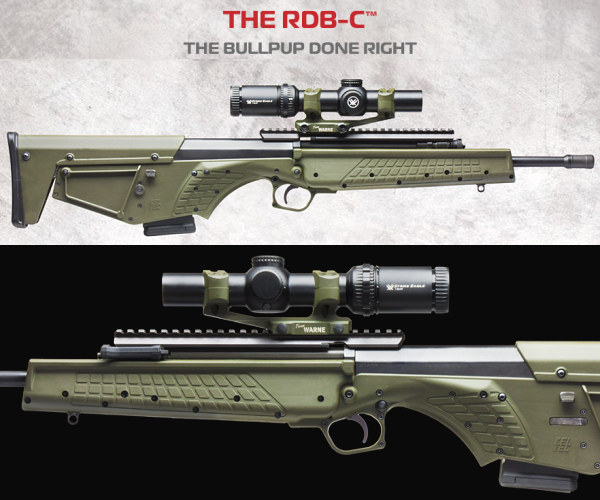
KelTec offers a semi-auto bullpup rifle which it claims is “Left Coast Compliant”. Presumably, this “featureless” rifle can be sold in California because it does not have a pistol grip, or other “evil” features disfavored by gun-phobic California politicians. This rig, the KelTec RDB-C “Hunter”, has been offered in .223 Remington and 6.5 Grendel*.
We actually like the looks of the new KelTec RDB-C, which was first introduced in 2016. The ergonomics seem sensible, and this rifle should be easy to stow and transport. KelTec also says that the cartridge ejection system is user-friendly: “[The] downward shell ejection system eliminates the side ejection disadvantage of ordinary bullpups. The result is brass and gas that eject out of your line of sight making it a truly ambidextrous, high performance rifle for everyone.”
KelTec also includes a gas pressure control with the RDB-C. This lets you control the cycling rate to suit different types of ammo. That’s smart. KelTec explains: “The RDB is also adjustable for a wide variety of ammunition and makes for an excellent suppressor host.”
6.5 Grendel Version Tested in 2016
*When the RDB-C rifle was introduced in 2016, KelTec listed 6.5 Grendel as a chambering, along with .223 Rem. One YouTube video shows a 6.5 Grendel RDB-C reviewed and then test-fired. Watch video at 14:00 time-mark. However, this 6.5 Grendel chambering is NOT currently listed on KelTec’s website.
Believe it or not, here is a cartridge that makes a .338 Lapua Magnum look like a toy. The 14.5x114mm cartridge was designed as a MG and rifle-fired anti-materiel round. To translate from the metric system to caliber and inches, the round is a mammoth .57 caliber which measures 4.49 inches to the case mouth, and 6.13 inches overall. That jumbo-sized case holds a whopping 655 grains of powder. Commonly-loaded projectiles weigh 920-1030 grains. The 993gr armor-piercing projectile has a muzzle velocity of approximately 1006 meters per second (3300 fps) and can penetrate 30-32 millimeters of RHA steel at a range of 500 meters.
The top photo comes from Elardus De Lang, a Forum member who works at the Truvelo Manufacturers Armoury in South Africa. Elardus also provided an impressive video showing the massive 14.5x114mm being shot from prone with a Truvelo-built bolt-action rifle. Elardus tells us: “Here is a video, with a slow-motion ending, of our 14.5x114mm anti-materiel rifle being fired in our indoor testing facility. This caliber is a true beast! It propels a 993gr Armor-Piercing Incendiary bullet to 3300 fps, burning 480 grains of powder in the process. [This shows] that rifles of that power level can actually be shootable. The concussion indoors is something to experience……every shot feels like you are being punched in the face, and the heat from the muzzle flash actually hits you like a wave!”
14.5x114mm Cartridge Design and Dimensions
The 14.5×114mm has 42.53 ml (655 grains H2O) cartridge case capacity. The exterior shape of the case was designed to promote reliable case feeding and extraction in bolt action rifles and machine guns alike, under extreme conditions. Cartridges typically use lacquered steel cases, but some countries also use brass cases.
All dimensions are in millimeters (mm). Americans would define the shoulder angle at alpha/2, or 22.5 degrees. The common rifling twist rate for this cartridge is 455 mm (1:17.91″) with eight lands/grooves. According to official guidelines, the 14.5×114mm can handle up to 360 MPa (52,213 psi) piezo pressure.
14.5x114mm Cartridge History
The 14.5×114mm (.57 Cal) is a heavy machine gun and anti-materiel rifle cartridge used by the Soviet Union, the former Warsaw Pact, modern Russia, and other countries. It was originally developed for the PTRS and PTRD anti-tank rifles, but was later used as the basis for the KPV heavy machine gun that formed the basis of the ZPU series anti-aircraft guns that is also the main armament of the BTR series of armoured personnel carriers from the BTR-60 to the BTR-80 and for heavy anti-material sniper rifles. The cartridge was designed in 1939 and first issued in 1941.
Fans of Heavy Artillery should head over to the updated and enhanced Fifty Caliber Shooters Association (FCSA) Image Gallery website. There you’ll find photo collections and animated slide-shows (there also a separate Video Collection) On the photo gallery page, you’ll find a map. Click on any gray range link to see images from that venue. There are also a series of articles covering FCSA competition along with the “care and feeding” of the big 50-caliber rifles.
The FCSA will host its 1000/600 Yard World Championship July 5 through 7, 2018 at the Whittington Center in Raton, New Mexico. This will follow the 2018 King of 2 Miles Competition at Raton, which runs July 2-4, 2018. CLICK HERE to Register for FCSA 2018 Championship.
About the FCSA
Founded in 1985, the FCSA is an international organization with members in 22 countries. Headquartered in Monroe, Utah, the FCSA has a membership of approximately 4000. While the FCSA provides a service to military and law enforcement with research and instruction as well as an active liaison in both communities, the primary charter of the FCSA is the promotion of the sporting use of the 50 BMG cartridge and its wildcat derivatives. The FCSA and its members have lead the way in refining .50-caliber cartridges, rifles, and 1000-yard plus shooting know-how. Members enjoy a quarterly magazine, a suppliers directory, a very active website, and access to literally the best repository of 50 BMG information on the planet. If you are interested in Mr. John Browning’s big 50, you should seriously consider joining the FCSA.
Story tip by EdLongrange. We welcome reader submissions.
We are sad to announce that pro shooter and USPSA past President Michael Voigt has died after a battle with cancer. Michael passed away peacefully at home on March 24th in Corona, California. He is survived by his wife, Maggie Reese Voigt and his daughters. Michael has been one of the world’s top action shooters for the past 30+ years. Michael won dozens of major titles during his three decades of pistol, shotgun, and rifle competition. Voigt’s notable titles include: IPSC World Individual Championship (3 times), IPSC World Team Championship (7 times), IPSC Continental Shotgun title (2 times), and IPSC Continental Handgun title (2 times). He also won the USPSA Multi-Gun title numerous times.
Michael was President of the United States Practical Shooting Association (USPSA) from 2000 to 2012. After 12 years leading USPSA, he then devoted his time and talents to advancing the firearms industry and training elite military and law enforcement forces around the world. The USPSA noted: “Michael has been a friend and mentor to many of us and has always been there to coach or help anyone along the way, he will be truly missed.”
As a National and World Champion shooter, Michael has been featured on 3-Gun Nation television series, NBC Sports, Versus, Pursuit, Sportsman’s and Outdoor Channel. He was one of the original Team Safariland competitive shooters and served on the team for 25 years along with Team Surefire.
Here is Michael Voigt with his wife, Maggie Reese Voigt.
Michael’s wife, Maggie, also a pro shooter, posted this message on Facebook: “Dear Friends, my heart is broken. The love of my life, my soulmate, my precious husband Michael Voigt passed away after a long battle with cancer. We have been together for 11 years… I know we will be together forever.” Services and interment will be held Saturday, April 14th at 3:00 pm at Rose Hills Memorial Park, 3888 Workman Mill Road, Whittier, CA 90601. All are welcome to attend. Maggie added: “In lieu of flowers, I ask that you support the great passion of his life by donating to the USPSA Junior Program.”
Michael Voigt shared his knowledge in many ways, including this video.
Rest in Peace, Michael, we will miss you…


 Anschutz 54 Benchrest Rig

 OK, admit it — you’ve always wondered how they get those color swirls and camo patterns in McMillan stocks. (You’ll be surprised at the answer). And how does McMillan manage to inlet stocks so precisely for so many different action types?




 Fans of Heavy Artillery should head over to the updated and enhanced


