Kelly McMillan recently released a Video Podcast featuring some very talented shooters including the legendary David Tubb. While Kelly has broadcast scores of audio interviews on his Taking Stock Radio Show, this is something even better — you can see Kelly’s guests on camera during the 68-minute-long Video Podcast:
David Tubb Talks Cartridge Design, ELR, and Much More
The show starts off with legendary marksman, David Tubb, winner of 11 NRA National High Power Rifle Championships as well as multiple National Long Range championships. Kelly notes: “Our first guest, David Tubb, is arguably the … winningest, competitive rifleman in history. Trophies aside, though, David’s biggest contribution to our shooting sports is his innovative mind. The underlying essence behind his company, Superior Shooting Systems, is the continued advancement of the ‘human factor’ in the shooting sports.” During this segment David addresses many topics, including cartridge design (6XC and 6.5 Creedmoor), ballistics, Extreme Long Range (ELR) shooting, optics, stocks and more.
Regina Milkovich — Top PRS and Tactical Competitor Facebook Photo and courtesy WellArmedWomen.
Kelly’s next guest is Regina Milkovich, the first woman in history to win a major practical/tactical precision rifle match outright. (Regina was the overall winner of the 2016 NorCal Tactical Bolt Rifle Challenge.) Regina has been successful in many disciplines, and is now active in the Precision Rifle Series (PRS). Starting at the 44:50 time-mark in the video, Regina shows off her current PRS rifle, chambered for the 6XC cartridge. It features a McMillan stock, Defiance Action, Vortex Razor Gen 2 scope, and Timney trigger. Tactical shooters will want to watch this segment. Regina reviews the many accessories she uses both on and off the rifle. She shows the support bags she favors and discusses how the right choice of equipment can help improve your scores.
“[This is] one of my all-time favorite pictures” Regina told us. “It was taken in Vegas at a Sin City Precision match a couple of years ago.” Facebook photo.
Kelly also chats with Buzz Miller, an industry product development specialist who has worked with large gun-makers including FN USA, and Taurus. Buzz talks about how new gun designs are conceived, proto-typed, tested, and introduced into the marketplace. Buzz also discusses customer service among other topics. The main Buzz Miller segment begins at the 41:20 time-mark.
This helpful video from our friend Kirsten Joy Weiss explains how to avoid “scope bite”. This can occur when the scope, on recoil, moves back to contact your forehead, brow, or eye socket area. That’s not fun. While common sense tells us to avoid “scope bite” — sooner or later this happens to most shooters. One viewer noted: “I have come close. I had a Win Model 70 in .375 H & H Mag and I was shooting over a large rock in a strange position. The scope hit my eye glasses hard enough to bend the wire frames and cause a little pain on the bridge of the nose from the nose piece. [That] made a believer out of me.”
Kirsten offers a good basic principle — she suggests that you mount your rifle-scope so that the ocular (eyepiece) of the scope is positioned at least three inches or more from your eyeball when you hold the rifle in your normal shooting position. From a technical standpoint, optical eye relief is a property of the scope, so you want to purchase an optic that offers sufficient optical eye relief (meaning that it allows you to see the full circle of light with your head at least three inches from the eyepiece). Then you need to position the optic optimally for your head/eye position when shooting the rifle — with at least three inches of eyeball-to-scope separation (i.e. physical eye relief).
NOTE: You should mount the scope to provide adequate eyeball-to-scope separation for the actual position(s) you will be shooting most of the time. For an F-TR rig, this will be prone. For a hunting rifle, your most common position could be sitting or standing. Your head position will vary based on the position. You can’t assume the scope placement is correct just because it seems OK when you are testing or zeroing the gun from the bench. When shooting from a prone or kneeling position you may find your eye considerably closer to the eyepiece.
High-contrast targets make aiming (and seeing your bullet impacts) easier. EZ2C Targets, a family business in Pennsylvania, has developed a series of very bright, high-contrast targets printed with eye-popping fluorescent red/orange and Deep Black Inks. These are available from the EZ2C online store. A set of 11″x17″ Hi-Viz targets printed on quality white paper costs $8.50 for either 25 or 40 sheets, depending on design. A wide variety of designs are available — Bulleyes, Grids, Silhouettes, and Diamonds as well as many specialty targets. There are also 20 types of 3.5″ x 3.5″ Mini stick-on targets. These are printed with deep Black Ink on Fluorescent Red Self-Adhesive Label Stock.
EZ2C Fun Challenge Targets
EZ2C’s Battleship Target (Style 22) would be great for precision rifles at 100 or 200 yards. The red circles are about 3/4″ in diameter. That’s 0.36 MOA at 200 yards. That’s a good test for an accurate rifle (and for any shooting pals who boast that their guns can shoot “1/4 MOA all day long”.) The Dartboard target is great for a two-man shooting competition. You can shoot the numbers in order, or for more challenge, shoot the red rings (for each number), from the outer diameter to the middle. Just as in a real darts game, there are many variations.
Here are some other EZ2C Targets. The pistol diagnosis target (second from left) shows how to correct your aim and hold, based on where your errant shots fall. The decreasing dots target is a fun challenge for rimfire cross-training. Set it at 200 yards for centerfire.
Get Customized Targets for Your Club or Business
EZ2C targets can be customized with the name/logo of your gun club or business. This is an excellent way to promote your organization or store. Here’s a suggestion — have your gun club print up customized targets to award as prizes at shooting matches.
Nikon has a new line of First Focal Plane (FFP) riflescopes designed for tactical and PRS shooters. The very affordable BLACK FX1000 series includes 4-16×50mm and 6-24×50mm variants, with the choice of FX-MOA or FX-MRAD reticles. The FX1000 line features 30mm main body tube, high speed 10 MIL or 25 MOA turrets (with nice, tactile clicks), integral zero stop, and Nikon No Fault Lifetime Repair/Replacement on the entire riflescope. Most important thing — all FX1000 scope are under $800.
Burris, Bushnell, and Vortex should be concerned. We expect that Nikon will be stealing market share with the new, sub-$800 FX1000 line-up. This is solid choice for PRS production class, which is limited to $3000.00 total for rifle AND optic.
This Video Shows the Key Features of Nikon FX1000 Series FFP Scopes
Nikon offers 4-16×50mm and 6-24×50mm FX1000 models. The 4-16×50mm scopes provide 90 MOA/25 MRAD elevation adjustment range while the 6-24×50mm optics provide 60 MOA/17 MRAD elevation.
The BLACK FX1000 riflescopes are built on 30mm tubes from aircraft grade aluminum alloy with Type-III hard anodizing for ruggedness and durability. Waterproof, fog-proof and shock-proof, all BLACK FX1000 models are backed by Nikon’s lifetime, No Fault repair/replacement policy.
Here the 6.5 Guys interview Jeremy Bentham, a PRS Competitor who helped design the New FX1000 series scopes:
Nikon’s new FX1000 optics feature “high-speed” turrets (10 Mil or 25 MOA) with nice, tactile clicks. PRS shooter Jeremy Bentham designed the new reticles which are clear and easy-to-use. The 4-16x50mm model is $649.95 while the 6-24x50mm is $799.95 MSRP. These represent outstanding value for a big name, life-time warranty product.
The classic John Moses Browning-designed Model 1911 pistol was created for the .45 ACP cartridge. Many believe the M1911 represents the pinnacle of .45 ACP pistol performance. The 1911 has served the nation in combat, and even today, full-size, hot-rod model 1911-type pistols dominate the top classes at action pistol shooting competitions (though typically shooting smaller caliber cartridges).
Which raises the question — does it make sense to shoot a down-sized .1911-type pistol with a smaller, lighter-recoiling cartridge? Browning, the company named after genius inventor J.M. Browning, thinks so. In 2014, Browning introduced an 85%-scale version of the 1911 that shoots the .380 ACP, another cartridge that Mr. Browning favored. What happens when the Model 1911 is reduced to 85 percent of its original size and paired with the .380 ACP cartridge?
WATCH: Check Out This Cool Animation to See How the 1911-380 Works:
This gun, with its polymer composite frame, is a LOT lighter than an all-steel 1911. The Browning 1911-380 tips the scales at a mere 17.5 ounces. Gun reviewers have praised Browning’s new 1911-380, saying that it functions great and fits well in the hand. NRA America’s 1st Freedom Editor Frank Winn states: “This is precisely where the [1911-380] Black Label .380 ACP excels so dramatically — as a transitional pistol. The 85-percent scaling caters to those with smaller hands and less grip strength. In every test we conducted, on paper, on steel (plates to 35 yards), and through defensive and competitive drills, the Black Label performed flawlessly.” Testers have praised the pointability and function of the down-sized 1911. It operates like a full-sized 1911*, and the “take-down” procedure is the same. This video shows the features of Browning’s 1911-380.
To be honest, we think this is sort of sacrilege. We like the full-size 1911 and we love the original .45 ACP cartridge. That classic fat round is accurate, easy-to-reload, and makes nice big holes in paper. One could also ask, if you want to shoot a .380 ACP, why not shoot it from another J.M. Browning design, the lovely little Model 1908. This beautiful design also served the U.S. Military, and it’s still one of the best-looking semi-auto pistols ever made. The NRA’s Frank Winn notes: “A revamped Browning design (based on the Colt M1903 “Pocket Hammerless”) became the M1908, the first mature, successful .380 ACP handgun. In 42 years of manufacture, several hundred thousand were sold.”
So, much as we applaud innovation, we’ll stick to the original, full-size 1911. If we want to shoot the little .380 ACP cartridge, we’ll do so with J.M. Browning’s lovely little M1908, or another great .380 ACP pistol, the Sig P230/232. This editor owns a sweet Sig P230 in stainless. It is thin, handsome, durable, and easy to carry. It’s also an appreciating asset.
* The Browning 1911-380 has one main functional difference — it has a magazine disconnect. this means “with the magazine removed, the hammer won’t fall, even with all safeties disengaged”. LINK.
For a few years now, Lyman has offered the Case Prep Xpress, an all-in-one case prep center that chamfers necks (inside and out), cleans and uniforms primer pockets, brushes the inside of case-necks, and uniforms flash holes. The unit can also ream out the crimps on military brass. However, the Lyman Case Prep Xpress does NOT trim cases.
The Lyman Case Prep Xpress comes with all the necessary tools (listed above), so you don’t have to purchase extra accessories. The five (5) gear-driven heads on the unit are powered by a high torque, low-speed motor ideal for case prep operations. Lyman’s Case Prep Xpress features handy storage areas for accessories, a removable brass shavings dump pan, and a handy clean-up brush.
Sinclair Int’l video clearly illustrates all case prep functions. Worth watching.
In the 5 years that this product has been on the market it has been a strong seller. If you’re prepping hundreds of cases, this unit will save considerable time and reduce hand/finger fatigue. While the Case Prep Xpress is not as sturdy as the metal-bodied Hornady prep center, the Lyman unit offers a lot of functionality for the money ($115-$125 normal price, and sometimes around $100 on sale).
Lyman Case Prep Xpress Pros and Cons
GOOD Features
Quite Affordable (under $120)
Compatible with RCBS and Redding Tool-heads
Removable Bin for Shavings
Four Brush Sizes: .25, .30, .38, .45
Compact Footprint
Not-So-Good Features
Tool-heads Not Particularly Sharp
No Case Trim Function
No Flash-hole Uniformer
No Top Dust-Cover
Only 1-Year Warranty
Reviews by Verified Purchasers
“Case prep is the most tedious and boring aspect for hand loading in my opinion. The process center makes all the steps in prepping the case very quick and with consistent results. It has reduced the time required to do these steps with separate tools by easily 50% if not more. Highly recommended.” — Brandon G.
“Quiet and capable. Worth every penny. I adapted a Lee Cutter and Lock Stud, to cut case lengths, and I can fly through my brass. I can do so much more brass without getting the sore, cramped-up hands.” — Dean Ellis
“This unit has plenty of torque, and my unit is very quiet. This unit will also work with tools made by RCBS and Hornady, or anything else with 8-32 threads. My Redding tools (specifically, my primer pocket uniformers) do in fact fit on this machine. This unit is certainly worth the money, and will revolutionize the way you reload by saving you massive amounts of time and wear on your hands/fingers.” — Mule
“A simple machine to perform complex solutions. I was up and running in about 10 minutes flat. This thing has made my life of reloading so much easier. I do wish there was a trimmer included, but I have a manual one from L.E. Wilson.” — Richard Niles
You can find Lyman’s Case Prep Xpress for under $100.00 at Amazon and under $120.00 at Brownells, making it much less expensive than the larger Hornady Case Prep Center, which runs over $450.00. The Hornady unit is beefier, and will trim cases. However, we think the compact Lyman unit makes sense for guys who already have a good case trimmer, such as a Forster or Wilson. The Lyman Case Prep Xpress is hundreds of dollars less than the Hornady prep center. The money you save will buy lots of bullets and brass.
Case Prep Xpress $99.99 at Amazon
The Lyman Case Prep Xpress is sold by most of the big vendors. The best current price we found was at Amazon, which sells the Lyman unit for $99.99, with free shipping.
Gear Review Tip from Edlongrange. We welcome reader submissions.
The U.S. Army Marksmanship Unit (USAMU) has produced an excellent series of videos, which collectively cover the Basic Rifleman’s Course. If you are getting started in high power shooting, or want to improve your position shooting skills, this series is well worth watching. And these videos are not just for service rifle shooters — even bench shooters can benefit from these videos, particularly Part 5, which explains how to estimate wind speed and direction. The lead instructor for these videos is SFC Brandon Green, the 2015 National High Power Champion, and Service Rifle Champion at the 2017 CMP Trophy Matches. When SFC Green talks, you should listen. This man is one of the greatest marksmen in the nation’s history.
Part 5 — Wind and Weather Estimation (Very Useful for All Shooters)
Note: This video includes a hit location “target analysis” in the first 6 minutes.
Part 4 — Minute of Angle Explained
Part 3 — Ballistics and Zeroing
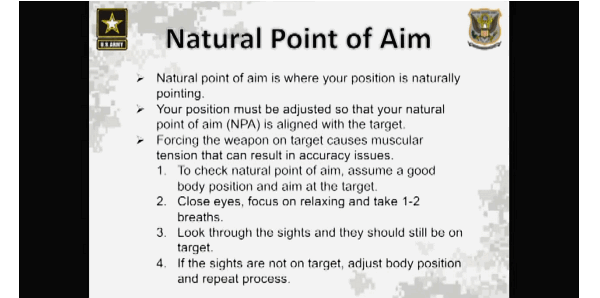
Part 2 — Positions, Sight Alignment, and Natural Point of Aim (Very Useful)
Part 1 — Aiming and Sight Picture
SFC Brandon Green (left above) set four new National Records at Camp Perry this year.
Story tip from Precision Shooting Journal on Facebook.
This statement was released by the NRA Institute for Legislative Action:
The National Rifle Association Institute for Legislative Action (NRA-ILA) applauded on Wednesday the passage of H.R. 4909, the “STOP School Violence Act of 2018″. This bi-partisan legislation provides funding for training students, teachers, school administrators, and local law enforcement to identify early warning signs that a person is a threat to themselves or others. The bill passed the U.S. House of Representatives on a vote of 407-10.
“This important bill will help stop school violence before it happens,” said Chris W. Cox, executive director, NRA-ILA. “Identifying individuals at risk for violence is a critical part of securing our schools. This bill will give communities the tools they need to stop school violence through early intervention.”
In addition to providing funding for training, the STOP School Violence Act, introduced by Florida Rep. John Rutherford, will also provide funds to implement school threat assessment procedures, and create a coordinated violence prevention reporting system.
“We must improve security in our schools and this legislation will help make that happen. We look forward to seeing it pass quickly in the Senate so President Trump can sign it into law,” Cox concluded.
Parallel Stop School Violence Act in U.S. Senate
A similar bill has been introduced in the Senate by Sen. Orrin Hatch (R-Utah). The NRA supports both the House and Senate bills. Senator Hatch explains his legisation in this video:
The National Rifle Association thanks Rep. John Rutherford, Judiciary Chairman Bob Goodlatte, Speaker Paul Ryan and the House Republican leadership for their support on this issue.
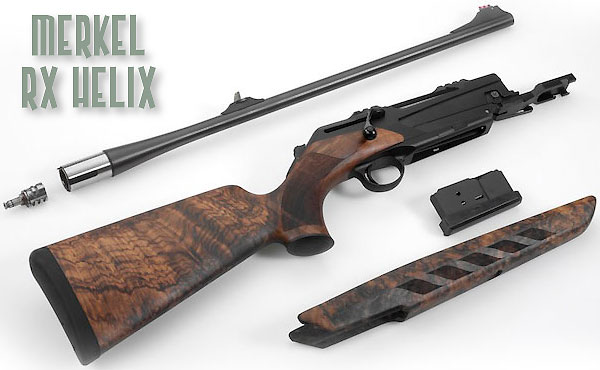
EDITOR: Our story on the Strasser RS14 straight-pull rifle created quite a stir. So, we thought we’d serve up another straight-pull feature — this time the German-crafted Merkel RX Helix. We shot the Helix a few years back during Media Day at the Range. One notable difference between the German Merkel and the Austrian Strasser is the bolt travel. During cycling, the Merkel bolt stays completely inside the action (see video below at 00:30). By contrast the Strasser bolt moves pretty far back, outside the action. For some folks that makes the Helix better for fast follow-up shots. All we can say is that Merkles and Strassers BOTH cycle way faster than conventional bolt-action rifles.
Merkel RX Helix Range Report
One of the most innovative rifles we have ever shot was the Merkel RX Helix, a very impressive piece of rifle engineering. Merkel claims the RX Helix is the fastest-cycling centerfire bolt action in the world. We can’t confirm that claim, but the Helix certainly cycles faster than any other centerfire bolt-gun this Editor has ever tried. (Yes, a Fortner biathlon action can be worked more rapidly, but that’s a rimfire). Both Jason and I really liked Merkel’s RX Helix. It balances well, the action is smooth, the wood is gorgeous, and the overall design thinking that went into this German-engineered take-down rifle is very impressive. The Helix’s universal-sized action lets you shoot anything from a .222 Rem to a .300 Win Mag with the same gun. And — get this — you can really swap barrels (and change bolt heads) in a couple of minutes with no tools, employing a dead-simple bolt-release lever concealed under the push-button-released removable forearm. (Watch VIDEO BELOW to see Barrel Swap procedure).
Rotary 7-Lug Bolt
While the RX Helix is a straight-pull rifle, it retains the strength and safety of a rotary bolt head with seven locking lugs that seat in a barrel extension. Unlike a Blaser, the RX Helix has a fully-enclosed action housing. That’s an important safety feature. Moreover, since the RX Helix employs a closed action, the bolt body doesn’t travel outside that action. This means the shooter can maintain his cheekweld with an eye on the target as he cycles the bolt.
The RX Helix’s linear (back and forth) bolt-handle motion is transmitted to the bolt head through a 1:2 ratio “transmission” gearing system. This allows smooth and fast cycling without the rotational or tipping movement found on other straight-pull, bolt-action rifles, such as the Blaser.
The Merkel linear-movement action cycles exceptionally fast, which allows for faster follow-up shots — a good thing if you’re hunting dangerous game. The RX Helix features a manual cocking lever on the tang and a direct trigger system. And here’s good news for southpaws — though Merkel does not make a dedicated left-hand version, lefties can very easily use their right hand to work the bolt while maintaining cheekweld. That may sound awkward, but with practice, it’s actually pretty efficient.
Fast, Easy Disassembly and Barrel Exchanges
The video below shows how the Helix can be disassembled (for cleaning or transport) in a matter of seconds WITHOUT TOOLS. The forearm slips off with the push of a button. A short lever on the left side of the action holds the barrel. Simply rotate the lever and the barrel (with bolt head) slips off. That’s it — in 30 seconds the rifle is apart, and you don’t even need an allen wrench as with a Blaser.
The RX Helix has a universal action length that covers calibers from .222 Rem to .300 Win Mag. Changing calibers (or chamberings) takes less than a minute with the appropriate barrel, bolt-head and magazine. Weaver rails are integrated into the action, and iron sights with three-dot rear and one-dot front fiber-optic inserts are standard.
The RX Helix is available with a standard black finish as well as four levels of design—Arabesque, Wild Boar, Spirit, and Deluxe. An all-carbon-fiber version is also available either with or without a carbon-wrapped barrel. The RX Helix comes in a wide range of popular calibers including .222 Rem, .223 Rem, .243 Win, 6.5×55 SE, .270 Win, 7×64, .308 Win, .30-06 Sprg., 8×57 IS, 9.3×62, 7mm Rem Mag and .300 Win Mag. Barrel lengths vary according to caliber, and barrels, bolt-heads and magazines are available for caliber changes. EuroOptic.com sells the Merkel RX Helix with Grade 2 wood for $3,785.00.
If you watch just one episode of Shooting USA TV this year, it should probably be this week’s hour-long SHOT Show Special. Tonight, March 14, 2017, enjoy a full hour of SHOT Show coverage. Jim Scoutten’s team of gun journalists work hard every January, bringing you highlights from the gun industry’s largest trade show. Jim, son John Scoutten, and other staffers prowled the 12 miles of aisles in the Sands Convention Center in Las Vegas, visiting many of the 1,600+ exhibitors. This episode provides a “first look” at the new guns, optics, and gear introduced for 2018. Click HERE to learn more about this week’s 2018 SHOT Show episode.
2018 SHOT Show Highlights: Ruger Precision Rimfire, Sig P365, M1A in 6.5 Creedmoor, MR-10 Bolt Action Comp Rifle, Colt Competition 1911, and a whole lot more.
Shooting USA Hour AIR TIMES
Shooting USA’s SHOT Show Special will air for a full hour on Wednesday, March 14, 2016 on the Outdoor Channel. Here are the air times, but you should check your local schedule. Look for Shooting USA TV on the Outdoor Channel.
Wednesday Night Schedule:
Eastern Time – 9:00 PM
Central Time – 8:00 PM
Mountain Time – Check Listings
Pacific Time – 9:00 PM
Here are some of the 50+ new products featured on the SHOT Show Special:







 You can find Lyman’s Case Prep Xpress for


 Rotary 7-Lug Bolt