Can you form a wildcat cartridge such as the 6 Dasher without expending primer, powders, and bullets? Absolutely. Using the hydro-forming method you can form improved cases in your workshop with no firing whatsoever, so there is no wear on your precious barrel. Watch this video to see how it’s done:
6 Dasher Case Hydro-Forming Demonstration:
Forum member Wes J. (aka P1ZombieKiller) has produced a helpful video showing how to form Dasher cases use the Hornady Hydraulic forming die kit. This includes a two-part die (body and piston), and a special shell holder. To form the case, you insert a primer in your virgin brass, top the case off with with a fluid (water or alcohol), then run the case up into the Hydro-forming die. A few stout whacks with a hammer and your case is 95% formed.
Hydro-Forming Procedure Step-by-Step:
1. Insert spent primer in new 6mmBR brass case.
2. Fill with water or alcohol (Wes prefers alcohol).
3. Wipe excess fluid off case.
4. Place case in special Hornady shell-holder (no primer hole).
5. Run case up into Hydraulic forming die.
6. Smack top piston of forming die 3-4 times with rubber mallet or dead-blow hammer.
7. Inspect case, re-fill and repeat if necessary.
8. Drain alcohol (or water) into container.
9. Remove primer (and save for re-use).
10. Blow-dry formed case. Inspect and measure formed case.
Wes achieves very uniform cartridge OALs with this method. He measured ten (10) hydro-formed 6 Dasher cases and got these results: two @ 1.536″; 2 @ 1.537″; and 6 @ 1.538″.
Three or Four Whacks Produces a 95%-Formed Case
With a Hornady hydro-forming die, hydraulic pressure does the job of blowing out the shoulders of your improved case. The process is relatively simple. Place a spent primer in the bottom of a new piece of brass. Fill the case with water, and then slip it into a special Hornady shell-holder with no hole in the middle. Then you run the case up into the forming die. Now comes the fun part. You gently insert a plunger (hydraulic ram) from the top, and give it three or four stiff whacks with a mallet (or better yet, a dead-blow hammer). Remove the plunger and you have a 95% formed case, ready to load.
Hornady supplies a shell holder made specifically for the hydro die; there’s no hole in the bottom of it. Just insert a spent primer into the primer pocket and you’re ready to go. The spent primer combined with the solid shell holder, keeps the water from seeping out of the primer pocket. The primer pushes out a little bit during this process, but it’s impossible for it to come out because of the way the shell holder is designed. The shell holder has a grove which allows the case to slide out of the shell holder even when the primer protrudes a bit.
Story tip from Boyd Allen. We welcome reader submissions.
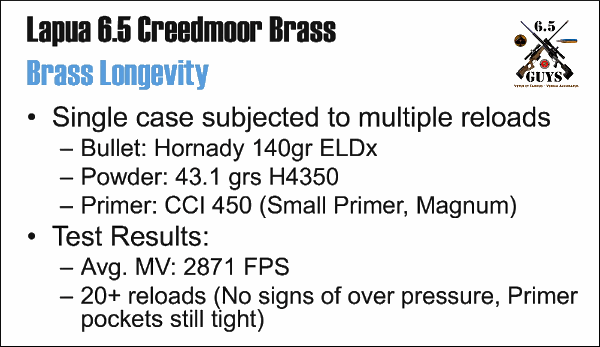
The verdict is in — Lapua’s new 6.5 Creedmoor brass is ultra-tough and very consistent. So sayeth the 6.5 Guys, who recently field-tested the brass, loading it to very stout levels. Even after 20 reloadings, the Lapua 6.5 CM brass held up extremely well. This brass, with its small primer pocket and small flash hole, really does out-perform other 6.5 Creedmoor brass offerings. Yes the Lapua brass is pricey, but it outlasts the alternatives, and, if the 6.5 Guys test is any indication, you can run higher velocities with this brass compared to other brands. Watch the 6.5 Guys Lapua brass test in this video:
If you have a 6.5 Creedmoor rifle, or are considering getting a gun chambered for this cartridge, we strongly recommend you watch the full 6.5 Guys Video. Ed and Steve spent a lot of time conducting this test, and the video includes helpful summaries of their findings.
The Evolution of the 6.5 Creedmoor
Over the last few years the 6.5 Creedmoor cartridge has become increasingly popular among precision rifle enthusiasts. However, availability of brass cases was limited to only a few manufacturers. In early 2017 Lapua introduced to the market its own 6.5 Creedmoor case with a unique twist — the case has a small rifle primer pocket and small flash hole — like the 6mmBR Norma and 6.5×47 Lapua.
Lapua 6.5 Creedmoor Brass — Test Protocol
The 6.5 Guys tested a box of Lapua 6.5 Creedmoor cartridge brass supplied by Graf & Sons. The project involved two phases. First the 6.5 Guys weighed and measured the cases to assess weight uniformity and dimensional consistency (which was impressive). Then came phase II — the “torture test”. The 6.5 Guys loaded the brass with a very stout charge of H4350 pushing 140gr Hornady ELD bullets*. The brass was loaded and shot over 20 times. This durability test was conducted to see how many repeated firings and resizing/reloading cycles the brass could handle. Remarkably, after 20+ loadings, the brass was still holding up — no “blown-out” primer pockets. This stuff is tough. The 6.5 Guys note: “You can go at least 20 reloadings without a split neck…but brass spring-back may be another issue.”
After 20 Load Cycles — Going to the Extreme
Once the Lapua cases had been shot 20+ times, the 6.5 Guys tried something more extreme. They stuffed the brass with a very hot load — a powder charge weight well beyond a sensible maximum. Even with this “beyond max” load, the Lapua brass held up but there was some evidence of pressure on the primers: “You do see some cratering on the primer with a Remington 700 that you don’t see with a Defiance action, but nothing to indicate a potential pierced primer.”
WARNING: The 6.5 Guys deliberately used a very stout load for testing. Do not attempt to duplicate. This load was shot in a faster-than-average barrel with a chamber set up for long 140gr bullets. You may not be able to achieve similar velocities — maybe not even close. As with all hand-loading, always start low and work up charges in small increments.
6.5 Creedmoor vs. 6.5×47 Lapua — Battle of the Middle-Weights
With this new brass, does the 6.5 Creedmoor enjoy an edge over the 6.5×47 Lapua? The 6.5 Guys answer: “That’s hard to say. From a market share standpoint, the 6.5 CM is more popular in the USA. From a technical perspective, 6.5×47 Lapua offers near identical performance with better barrel life. But from our tests, you can drive a 140-grain bullet much faster with 6.5 Creedmoor than you ever can (safely) with a 6.5×47 Lapua. That’s our non-answer answer….”
The 6.5 Guys concluded that the 6.5 Creedmoor will enjoy a velocity advantage: “We’ve had a number of discussions with RBros and other folks about this. It appears that 6.5×47 still has the edge as far as barrel life. But it also looks like you can push a 140gr bullet pretty fast with the 6.5 CM — speeds that are not obtainable with the 6.5×47 Lapua.”
* Why were the Hornady 140gr ELDs chosen for testing? The 6.5 Guys wanted a bullet in the 140gr weight range. Beyond that, the choice was fortuitous. Ed explained: “Our bullet selection was quite scientific — we sat down at my reloading bench and looked around. Saw the Hornady 140 ELD Match and decided to roll with that.”
Vortex Optics and Hornady have joined forces to create what may be the most remarkable new bullet technology in the past 20 years. Vortex has adapted a miniature video system to fit inside the tips of rifle bullets. The micro-sized camera/transmitter was originally developed for miniature spy drones. Vortex cleverly figured out to make these tiny little video cameras work when carried on a spinning projectile launched from a rifle.
The revolutionary bullet-cam is the equivalent of the camera in the nose of a “smart” bomb or missile, but micro-miniaturized. This new technology allows you to literally watch your bullet fly into the target. For long-range shots with extended flight times, the view is mesmerizing. Hunters should be very excited. With the Bullet-Cam, you can record the “shot of a lifetime” on a trophy hunt. One has to commend Vortex for achieving this electro-optical breakthrough. Kudos also to Hornady for incorporating the micro-optics into shootable ammunition.
Vortex Video Shows New Bullet-Cam in Action:
A live feed from the Bullet-Cam streams right to your device for instant viewing. Once the Bullet-Cam hits the target, recording stops and the video is automatically uploaded to the VTX Cloud where it can be shared to social media.
Software Indexing Magic Creates Stable, Viewable Image
How is the image viewable though the bullet is spinning at thousands of RPM? The answer is surprisingly simple — and achieved through software. The bullet RPM is referenced by a microprocessor, so the camera’s software simply snaps a picture of the target every few micro-seconds, when the target is in exactly the same orientation. The lens is spinning, but it only captures visual data once every rotation (i.e. image capture is rotationally-indexed). This “stream of stills” is then blended into the video feed. What the viewer sees is a stable movie as though the camera was mounted on a non-rotating, fin-stabilized projectile. This rotationally-sequenced image-capture process made the whole project possible. We’re told that the Pentagon was so impressed with the technology that it is looking to fit Bullet-Cams into a variety of spin-stabilized ordnance, including artillery shells and large-caliber (.50 BMG) sniper rounds.
Vortex Engineer Ian Klemm, a top F-TR shooter, helped develop the innovative Bullet-Cam. Ian says: “Our goal with … Vortex products is to allow our customers to see things clearly from all vantage points. When it comes to bullet impact though, shooters have had to relay on traditional optics to determine accuracy from long distances. We were determined to provide an additional point of view (POV) to improve precision and overall performance. [We want] shooters to have the most advanced tools in the industry, to achieve the most accurate shots. With the Bullet-Cam you will always know if you are way off or dead on.”
Ten Bucks Per Shot — Great for Hunters
Considering the technology involved, the Bullet-Cam product is suprisingly affordable. A box of ten (10) cam-equipped cartridges is only $99.99. So, for about ten bucks per shot, you can actually see your shots fly downrange and into the target. That’s something that’s never been possible with sporting ammunition. This new technology unlocks a whole new world for precision shooters. And for hunters — the Bullet-Cam literally allows you to record the shot of a lifetime on a trophy animal. You can then share that memorable experience via Facebook, Twitter or other social media.
M1 Garand Springfield Armory July 1941 production. Facebook photo by Shinnosuke Tanaka.
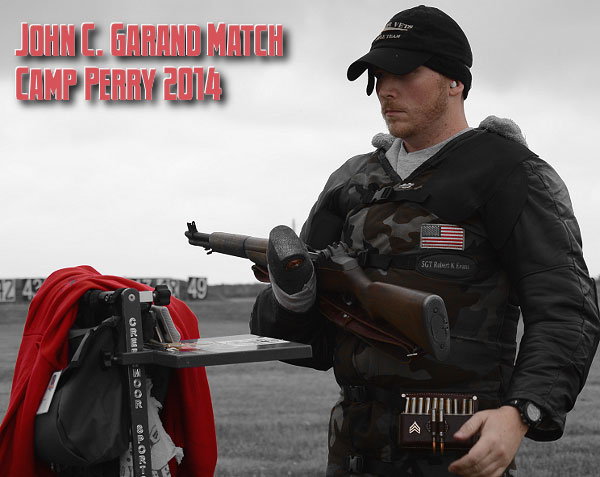
My father carried a Garand in WWII. That was reason enough for me to want one. But I also loved the look, feel, and heft of this classic American battle rifle. And the unique “Ping” of the ejected en-bloc clip is music to the ears of Garand fans. Some folks own a Garand for the history, while others enjoy competing with this old war-horse. Around the country there are regular competition series for Garand shooters, and the CMP’s John C. Garand Match is one of the most popular events at Camp Perry every year. This year’s Perry Garand Match will be held Saturday, 22 July 2017.
The CMP also has a John C. Garand Match each June as part of the D-Day Competition at the Talladega Marksmanship Park. Here’s a video from the inaugural Talladega D-Day Event in 2015.
Watch Prone Stage from the Inaugural Talladega D-Day Match in 2015
M1 Garand Manual
Recommended M1 Garand Manual
Among the many M1 Garand manuals available, we recommend the CMP’s U.S. Rifle, Caliber .30, M1: ‘Read This First’ Manual. This booklet covers take-down, reassembly, cleaning, lubrication, and operation. The manual, included with CMP rifles, is available for $3.25 from the CMP eStore. The author of Garand Tips & Tricks says: “It’s one of the best firearms manuals I’ve seen. I highly recommend it.”
M1 Garand Slow-Motion Shooting Video
What really happens when an M1 Garand fires the final round and the En-Bloc clip ejects with the distinctive “Ping”? Well thanks to ForgottenWeapons.com, you can see for yourself in super-slow-motion. The entire cycling process of a Garand has been captured using a high-speed camera running at 2000 frames per second (about sixty times normal rate). Watch the clip eject at the 00:27 time-mark. It makes an acrobatic exit, spinning 90° counter-clockwise and then tumbling end over end.
2000 frame per second video shows M1 Garand ejecting spent cartridges and En-bloc clip.
M1 Garand History
Jean Cantius Garand, also known as John C. Garand, was a Canadian designer of firearms who created the M1 Garand, a semi-automatic rifle that was widely used by the U.S. Army and U.S. Marine Corps during World War II and the Korean War. The U.S. government employed Garand as an engineer with the Springfield Armory from 1919 until he retired in 1953. At Springfield Armory Garand was tasked with designing a basic gas-actuated self-loading infantry rifle and carbine that would eject the spent cartridge and reload a new round. It took fifteen years to perfect the M1 prototype model to meet all the U.S. Army specifications. The resulting Semiautomatic, Caliber .30, M1 Rifle was patented by Garand in 1932, approved by the U.S. Army on January 9, 1936, and went into mass production in 1940. It replaced the bolt-action M1903 Springfield and became the standard infantry rifle known as the Garand Rifle. During the World War II, over four million M1 rifles were manufactured.
In this excellent video from SilencerCo.com, NFL Pro Bowl Tackle Fletcher Cox works with LG Outfitters to stalk and harvest Nilgai Antelope using a suppressed rifle. “Nilgai are pretty special animals — they’re from India. Originally brought down by the King Ranch in the 1930s, they’ve just gone nomadic and they’re all over South Texas.” — Leeroy Gonzales, LG Outfitters.
Click below to watch the video.
“Hunting goes back to the way you approach things. You’ve gotta have a game plan.”
As all committed hunters know, the majority of the hunt is in the preparation. Selecting your gear, choosing the perfect location, waking up before dawn, posting up to patiently wait…
Fletcher Cox is all too familiar with putting time and effort into perfecting his craft and honing the execution. As a Pro Bowl defensive tackle for the Philadelphia Eagles, Cox knows that dedication and practice make for the best possible outcome.
Fletcher Cox confirms his Zero before the hunt.
Only the split-second trigger pull is the actual act of the harvest. The rest? That’s the game plan. Here (1:42) Fletcher Cox makes a successful shot on a Nilgai: “We got meat on the ground boys…”
Every serious shooter should have some kind of anti-cant device fitted to his or her rifle. When you tilt your rifle to one side or the other from shot to shot, even a little bit, this can alter your point of impact. Unless the direction and angle of tilt (or cant) is exactly the same for each shot, canting your rifle will open up your groups. And the effects of inconsistent cant* become more extreme the farther you shoot. READ MORE about rifle canting.
Jackson Hole Shooting Experience Instructional Video features scope-mounted Wheeler level.
In this video, Bryce Bergen of Long Range Shooters of Utah explains the key reasons you should fit a bubble level (anti-cant device, ACI) to your rifle. Bergen explains why inconsistent canting alters impact at long range. Bergen also offers tips on mounting your anti-cant device and working with bipods.
You don’t need to spend a lot of money on your bubble level. While there are fancy levels that cost more than $130.00, you can get a functional level for a tenth that cost. This Discovery scope level is CNC-machined to close tolerances for a good fit. It is available with three diameters to fit scopes with 1″, 30mm, or 34mm main tubes. The 1″ version is just $12.99 while the 30mm model is $13.95 and the large 34mm version is $15.95. This unit will do the job, and user reviews are very positive.
Scope-Mount Vs. Rail-Mounted Levels
Some “experts” recommend a scope-mounted bubble level rather than a rail-mounted level. The reason is that you can easily orient the position of a scope-mounted level. With the scope’s vertical cross-hair aligned with a plumb line, simply rotate the bubble level mount until the bubble is centered. It’s not so easy to adjust a rail-mounted level. If your rail is slightly off, or if the rail-mounted anti-cant device doesn’t sit perfectly horizontal when clamped on the rail, the bubble may not center in the view port.
Combo Anti-Cant + Angle Degree Indicator System Flatline Ops sells a smart, scope-mounted leveling device with an optional vertical Strong Arm™ accessory for mounting an Angle-Degree-Indicator (ADI), which allows the shooter to make quick “true range” corrections for up-angle and down-angle shots.
As a combined unit, the Accu/Level™ (fitted with Strong Arm and ADI) is a great set-up for the tactical shooter or long-range hunter. The bubble level rotates inward for protection, then kicks out to the left for easy visibility. The ADI is held in plain view on the left, under the bubble level. On LongRangeHunting.com, Jim See explains how the Accu/Level works in the field and how he employed the ACI during a hunt. CLICK HERE for Accu/Level™ Field Test.
We like the combined Level + ADI system that Flatline Ops has developed. But it is very expensive: The 30mm Accu/Level™ costs $139.99 and the Strong Arm (for ADI mounting) is $58.99. So you’ve got two hundred bucks invested before adding the $110.00 ADI. That’s a significant chunk of change that could be invested in your scope instead.
* By itself, canting the rifle does not hurt accuracy as long as the angle is exactly the same for every shot. Many sling/irons shooters, including David Tubb, cant their rifles. With scoped rifles, if you do prefer a cant, you should mount the scope so that the cross-hairs are plumb with your rifle at your preferred cant angle. You want that vertical cross-hair straight up and down always. The key is to never change the cant of your rifle from shot to shot.
The new SEB Mini joystick (coaxial) pedestal rest has been a huge success. Sebastian (“Seb”) Lambang’s SEBRests.com team is shipping these out worldwide to meet demand. The great thing about the Mini is that it folds up into a small package, making it much easier to transport than a conventional coaxial front rest such as the Seb NEO or Farley. Shown above is an army of Minis getting ready to conquer the world (well at least the world of shooting).
Even though the Mini is compact and relatively light weight, it is very stable and gives up very little in performance to a full-sized joystick front rest such as the SEB NEO. At the Berger SW Nationals last month, our Systems Admin Jay Christopherson used a SEB Mini. Jay finished Second in F-Open Class just one point behind winner David Gosnell, thereby proving the SEB Mini is “competition ready”.
Jay reports: “I’m glad I had the SEB Mini — it worked great and was much easier to transport and carry from position to position.” Here’s a short video of Jay using the SEB Mini to drill a string of Xs with his .284 Winchester F-Open rifle.
New Carry Bag for SEB Mini
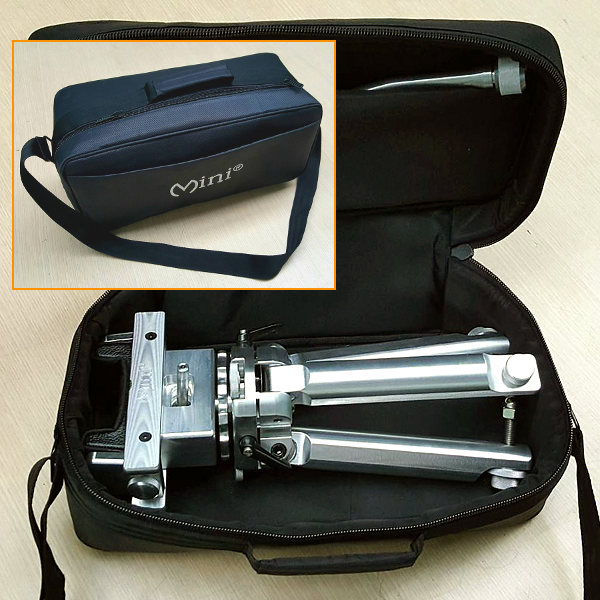
With the success of the SEB Mini, Seb Lambang has already started designing some new accessories. Here is a prototype carry package, the Mini Transporter. You can see this compact bag will hold a Mini even with big F-Class feet attached. Seb says: “I’m experimenting with soft case for Mini rest… Your thoughts?” We think Seb should certainly offer this case for sale. Post your thoughts in the comment section below.
SEB Mini with large disc feet attached still fits in bag.
It’s not easy to place a first shot on target at 1500 yards. You must measure the wind speed with precision, know your exact muzzle velocity, and have a sophisticated ballistics solver. In this short video from Ryansrangereport.com, the shooter manages a first-round hit on a steel silhouette at 1500 yards. He used a Kestrel 4500 NV Weather Meter with Applied Ballistics software to figure out the trajectory for his 6.5 Creedmoor rounds.
The Kestrel recorded a wind velocity, and the internal software calculated a solution of 17 Mils elevation (that’s 928 inches of drop) with 2.5 Mils windage. “Bang” — the shooter sends it, and 2.6 seconds later “Clang” he had a hit (flight time was 2.6 seconds). Bryan Litz observes: “This is the science of accuracy (in the form of an Applied Ballistics Kestrel) being put to good use at 1500 yards”.
Later in the video (1:05-1:15) the shooter places three rounds on steel at 1000 yards in just 10 seconds. The three shots all fall within 10″ or so — pretty impressive for rapid fire. The shooter reports: “[In my 6.5 Creedmoor] I’m using a 136gr Lapua Scenar L. This bullet has impressed me. It screams out of my barrel at 2940 fps and holds on all the way out to 1,500 yards.”
The rifle was built by Aaron Roberts of Roberts Precision Rifles (RPRifles.com). Chambered for the 6.5 Creedmoor, it features a Leupold Mark VI 3-18x44mm scope.
Roberts Precision Rifles
19515 Wied Rd. Suite D
Spring, Texas 77388
Phone: 281-651-5593
Email: rprifles @ gmail.com
We recommend you tune in to Shooting USA on the Outdoor Channel tonight. Tonight’s episode features both a Vintage Sniper Rifle competition and the GAP Grind, one of the most popular tactical matches. The show airs at 9:30 PM ET, 8:30 PM Central, 7:30 PM MTN, and 6:30 PM Pacific.
Vintage Sniper Rifle Match at Talladega
This week, Shooting USA features the Vintage Sniper Match at the CMP’s Talladega Marksmanship Park. This is a two-man team event, for shooter and spotter, using military rifles in service up to 1953. One added challenge is the time limit. The team has only 20 seconds to complete each shot — That’s 20 seconds for the spotter to read the conditions, and for the shooter to pull the trigger.
Guns of Grandfathers…
In this episode two USAMU marksmen, SGTs Daniel Crody and Robert Shoup, compete with an Springfield M 1903 A4 reproduction topped with a vintage optic. “For me it holds a little bit of sentimental value,” says SGT Crody. “I did have two grandfathers in World War II. It is definitely a pleasure holding a piece of history… and to be able to see and feel what these guys had as far as tools to operate with.”
Who can identify this rifle, with its unusual scope mount?
“It’s a match that brings a different type of competitor out. It brings a nostalgic competitor out. You’ll see World War II time-period rifles, sniper-type rifles that were used during World War II, Korean War era,” says the CMP’s Chief Executive Officer, Mark Johnson. “The optics are either original optics or current reproduction of old optics.”
GAP Grind on Shooting USA
Tonight’s Shooting USA episode also features the Bushnell GAP Grind, a tough tactical/practical match in Tennessee with 300 competitors. The Grind runs a Pro-Am format — new shooters partner with an experienced shooters for the two-day, 25-stage event. This year John Scoutten teamed up with new shooter Jen Hodson. Even with the challenges, Jen had a great time at the GAP Grind. “I will definitely be back!” says Jen, shown here:
Ramia Whitecotton Facebook photo.
On the first day of the Bushnell GAP Grind, teams are scored together. On the second day team members still work together but scores are logged individually. This is a difficult event with awkward positions, barriers, and other challenges. Targets vary in size, shape, and distance. One of the toughest targets is the 500-Yard Mover.
Here’s a very funny video that should put a smile on your face — especially if you’ve ever competed in action shooting events. This tongue-in-cheek video from the SuperSetCA team identifies seven (7) annoying/insufferable types of shooters you’ll find at shooting matches. You can’t help but chuckle watching this video. The satire is “dead on” — we’ve all met these kind of clowns at one time or another.
Among the personality types lampooned by the video are the “way too serious” type, the completely unprepared type, the “Hollywood” show-off, the “always an excuse” type, and of course the “I’m too old for this” competitor. As a shooter past age sixty, this Editor might even fall into that category — at least when it comes to “run and gun” games. When I’m asked to gallop around a range carrying heavy gear, yes I’ve been known to mutter: “I’m too [insert swear word] old for this….”
Here’s an extra challenge for you. According to the video’s producers, there are several TV and/or Movie references sprinkled throughout. Can you name them all (with run-times)? (Hint, look for Lethal Weapon and Matrix spoofs).


 Hydro-Forming Procedure Step-by-Step:
Hornady supplies a shell holder made specifically for the hydro die; there’s no hole in the bottom of it. Just insert a spent primer into the primer pocket and you’re ready to go. The spent primer combined with the solid shell holder, keeps the water from seeping out of the primer pocket. The primer pushes out a little bit during this process, but it’s impossible for it to come out because of the way the shell holder is designed. The shell holder has a grove which allows the case to slide out of the shell holder even when the primer protrudes a bit.







 It’s not easy to place a first shot on target at 1500 yards. You must measure the wind speed with precision, know your exact muzzle velocity, and have a sophisticated ballistics solver. In this short video from
 Guns of Grandfathers…


