Let’s face it, AR-platform rifles run dirty, at least compared to typical bolt-action rifles. The AR15 works by piping gas from the barrel back into the bolt carrier, causing the bolt to unlock and the carrier to move the bolt backward. The “exhaust gas” from the barrel contains soot and carbon. The carbon will form hard deposits on the bolt. In addition, the carbon can combine with lube on the bolt carrier to make a nasty, paste-like sludge. This can be particularly problematic when the black paste pollutes the ejector and extractor recess.
This Editor has inspected dozens of ARs over the years. Other than mag-related malfunctions, the most common cause of AR cycling problems I found was oily gunk in the extractor and ejector areas. Many AR owners overlook these critical areas. Look at an AR that hasn’t been cleaned properly and you’ll probably find black gunk (and small brass shavings) in the ejector and extractor recesses.
If you want to keep your black rifle running smoothly and reliably, you must clean it regularly and follow the correct maintenance procedures. Here are three videos that explain how to properly disassemble and clean AR-platform rifles.
Take-Down and Full Cleaning of AR15 by Jerry Miculek
Here ace shooter Jerry Miculek takes down and cleans an AR-platform rifle belonging to his daughter Lena. This is a good video because Lena’s rifle was “run hard and packed up dirty” so you can see where carbon and grease build up. This 35-minute video is very thorough. Jerry is one of the nation’s top action carbine shooters, so listen carefully to his advice on cleaning and lubrication.
How to Clean Your AR-Platform Rifle
This is a good basic video that shows the take-down and cleaning procedure for a typical AR15. It uses some fast-motion sequences to speed up the story. Check out this video if you don’t have the time to sit through the Miculek video above.
Cleaning and Lubricating AR15 Bolt Carrier Group
This video offers very specific advice on the bolt carrier group, which receives the dirty gas directly from the barrel. Be sure to check the extractor and ejector recesses. That’s where old lube, brass shavings, and carbon accumulate. Follow the directions in this video for lubrication, and don’t over-lubricate the bolt carrier — that will only capture more carbon.
.22 Plinkster runs of the most popular gun-centric YouTube channels. His videos have been watched by hundreds of thousands of firearms fans. Many of .22 Plinkster’s videos involve trick shots, such as shooting a .22LR through 100 balloons, but he also does serious reviews. He’s actually a very competent marksman who has shot a vast collection of .22 LR/22 WMR pistols and rifles, making him a qualified rimfire expert (as well as a trick-shot artist and showman).
Here are Four of our Favorite .22 Plinkster Firearms Reviews:
Savage A22, 22 Magnum (WMR) Rifle Field Test
The Savage A22 is the .22 WMR “big brother” to Savage’s popular A17 17 HMR rifle. In this video, .22 Plinkster demonstrates that the A22 is a very reliable semi-auto that can deliver near-1 MOA accuracy when the barrel is clean. This rifle retails for about $390.00.
Smith & Wesson Model 41 .22 LR Pistol Review
The S&W Model 41 is a classic American rimfire target pistol. Beautifully crafted, the Model 41 boasts a superb trigger, comfortable grip, and excellent accuracy. New or used, a Model 41 would be a fine addition to any firearms collection.
Volquartsen Scorpion .22 LR Pistol Review
The Scorpion demonstrated exceptional accuracy in the hands of .22 Plinkster. It comes with a large target-style grip. With a built-in compensator, the Scorpion stays on target with almost no muzzle rise. The comp can be easily switched out with a suppressor (See video at 3:00 time-mark).
S&W Victory Vs. Ruger Mark IV Pistol Shoot-Off
.22 Plinkster liked both pistols. He favored the grips on the Ruger while preferring the S&W’s trigger. He felt the Ruger’s iron sights were best for precision work, but he noted that the green dot fiber optic sights on the S&W Victory worked better for speed work.
Serious reloaders know that PMA Tool makes some of the best specialty reloading tools you can buy. To help folks get the most out of their PMA products, the company offers “how-to” videos. One such video features PMA’s great Micro-Adjust Case Trimmer. PMA owner Pat Reagin tells us: “We’ve had quite of bit of interest in the case trimmer, but a lot of guys want to see it in action. So we’ve created an intro video that shows how to adjust and use the trimmer in various modes.”
Watch Micro-Adjust Case Trimmer Video
The PMA Micro-Adjust Case trimmer indexes off the shoulder but it also provides precise control over neck length. You aren’t limited to a built-in, neck-length setting like some other shoulder-indexed trimmers. The PMA Micro-Adjust Trimming tool currently sells for $129.95 including one cartridge insert. The inserts, which can be purchased for $13.95 separately, can often work for a multiple cartridge types within the same family. For example, you can use the same insert for both .243 Win and .260 Rem. There is another insert that works with both 7mm-08 and .308 Win.
PMA Micro-Adjust Case Trimmer Features:
Indexes off shoulder for easy, consistent trim length.
Cases captured in no-scratch, Delrin™ inserts.
Fully rotating head with bearing for smooth operation and clean, square cuts.
Sharp carbide cutter for quick, smooth cuts with minimal burr.
Spring loaded head allows complete control of rate of feed.
How to use the PMA Micro-Adjust Case Trimmer
The trimmer indexes case off the case shoulder through the use of interchangeable Delrin™ inserts which capture the shoulder and neck of the case. This insert is contained in a spring-loaded tool head that rides on a linear bearing. The Micro-Adjust Trimmer can be used in three ways.
First, you can secure the case in a PMA caseholder chucked in a power drill, drill press, or lathe. You hold the trimming tool with your hand and feed in the spinning case. (This method is handy because if you leave the case in the holder, after you have trimmed to length, you can switch tools and chamfer the case-mouth using the same power source).
In the second method, the trimmer’s adjustment knob is removed (after locking the setting) and the cutting shaft is chucked in a drill, drill press. or lathe. Using this method, the case itself is held by hand and fed into the cutter. Lastly, the trimmer can be used manually, holding the case in one hand and the trimmer in the other. That’s the slowest method, but it works if you do not have power tools handy.
Applied Ballistics has produced a series of YouTube videos about precision long range shooting. Featuring ace long-range shooter and professional ballistician Bryan Litz, these videos address various topics of interest to long-range marksmen. This featured video looks at Long Range mistakes — Bryan Litz reveals the most common ballistics-related shooting errors at Long Range. And then Bryan explains how to improve your shooting (and wind reading) to eliminate those common errors.
Watch Applied Ballistics Video about Common Mistakes in Long Range Shooting:
Bryan Litz of Applied Ballistics often hears the question: “What are the main reasons people miss their target at long range?” To answer that question, in this video, Bryan explains the most important variables in Long Range shooting. Bryan says: “Probably the number one thing is range — you have to have a [precise] range to your target because your bullet is dropping, and to hit the target you need to correct for bullet drop.” Distance may be indicated on the target bay (or berm), but for open ranges you should ascertain distance-to-target with a quality laser rangefinder. Even when the distance to target is shown with a sign or marker, you may want to confirm the distance with your rangefinder. (You may be surprised — we’ve seen marked target distances at commercial ranges off by 25+ yards!) Bryan says: “Get a good laser range to the target and you’ll be within a couple yards”.
After distance to target, the most important variable is the wind. This is the most challenging factor because the wind is constantly changing. Bryan explains: “After 300 or 400 yards, the wind [will] move your shots off the target if you don’t correct for it. The best way to account for the wind is to measure it at your location with a Kestrel. The Kestrel can give you the speed and direction of the wind at your location, which can baseline your wind call for your long-range shot.” Bryan acknowledges that there will still be variables: “The wind isn’t always blowing the same downrange as at your location… and the wind is always changing”. Bryan notes that you need to account for variances in wind between the time you gauge the wind angle and velocity and the time you actually you take your shot.
If you watch just one episode of Shooting USA TV this year, it should probably be this week’s hour-long SHOT Show Special. Tonight, March 1, 2017, enjoy a full hour of SHOT Show coverage. Jim Scoutten’s team of gun journalists work hard every January, bringing you highlights from the gun industry’s largest trade show. Jim, son John Scoutten, and other staffers prowled the 12 miles of aisles in the Sands Convention Center in Las Vegas, visiting many of the 1,600+ exhibitors. This episode provides a “first look” at the new guns, optics, and gear introduced for 2017. Click HERE to learn more about this week’s SHOT Show episode.
2017 SHOT Show Highlights: Savage MSR Rifles, GA Precision Tempest Action, Smith & Wesson M&P 10 in 6.5 Creedmoor, Colt double-action Cobra, STI Match pistols and a whole lot more.
Shooting USA Hour AIR TIMES
Shooting USA’s SHOT Show Special will air for a full hour on Wednesday, March 1, 2016 on the Outdoor Channel. Here are the air times, but you should check your local schedule. Look for Shooting USA TV on the Outdoor Channel.
Wednesday Night Schedule:
Eastern Time – 9:30 PM; 1:00 AM (TH)
Central Time – 8:30 PM; Midnight (TH)
Mountain Time – 7:30 PM; 11:00 PM
Pacific Time – 6:30 PM; 10:00 PM
<
Here are some of the 50+ new products featured on the SHOT Show Special:
This Wednesday, February 22nd, Shooting USA TV features the Bushnell Brawl, a tactical competition that draws top long-range shooters from military, law enforcement and civilian shooting communities. The match is held at the famed Rifles Only range in Kingsville, Texas. The Brawl is a one-of-a-kind physical and mental challenge that tests shooters’ abilities to read wind, figure ballistics, and adapt to difficult shooting scenarios. There is even a helicopter stage.
Helicopter Stage at 2014 Bushnell Brawl in Texas:
Shooting from a helicopter, shooting off of a wire, and shooting from the physically demanding maze called the Mouse Trap. These are just a few of the unique courses of fire at the Bushnell Brawl, part of the PRS series. Over the course of two days, competitors tackle more than a dozen stages. In addition, Bushnell hosted a special one-day event for the new PRS Production Class. This new division should attract new shooters by limiting the cost of equipment — making PRS competition more affordable.
This image is from Bushnell Brawl Barricade Stage (SEE Video):
New PRS Production Division — Lowering the Cost of Entry
The Production Division is a new PRS classification. Under Production Division rules, the rifle must not exceed $2000.00, and rifle + scope combined must not exceed $3000.00. All other accessories, such as bipod, rear bag, and the sling, can be added at the shooter’s own discretion. Even with these cost limits, you can put together a great rig: “There’s a lot of gear out there that’s not that expensive,” says Production Division Match Director Jacob Bynum. For example, you can get the new Tikka T3X TAC A1 in 6.5 Creedmoor for $1798.00.
Shooting USA Hour on Wednesday Primetime
AIR TIMES BY TIME ZONE
Eastern Time: Wednesday 9:30PM, 1:00 AM
Central Time: Wednesday 8:30 PM, Midnight
Mountain Time: Wednesday 7:30 PM, 11:00 PM
Pacific Time: Wednesday 6:30 PM, 10:00 PM
Can you hit an egg at 600+ yards? We mean hit it reliably — not just by luck. To do that you’ll need good shooting skills and a very accurate rifle. How accurate? Well, a chicken egg is, on average, 2 1/4 inches (57 mm) long and 1 3/4 inches (44.5 mm) in diameter. That means to hit an egg (on demand) at 600 yards, you’ll need a rifle capable of 1/3-MOA accuracy (or better). Forum member DukeDuke has such a gun, and he demonstrated its egg-busting prowess in this short video. DukeDuke’s rifle is chambered in 6BRX (a 30° 6BR Improved) and it’s loaded with DTAC 115gr bullets pushed by Alliant Reloder 17. In the video, the eggs are placed on top of poles set 616 yards from the firing line.
See Egg Hit at 38 second mark…
As you can see in the video, that’s a heck of a nice shooting range where DukeDuke scrambled those eggs at 616 yards. The range is situated just outside of Lake Jackson, Texas. As for the gun… the action is a Rem 700 SA BDL, blueprinted and bedded in a Rem/HS Precision PSS stock. The 31″ barrel is 1:8″-twist Broughton. The “P3″ on the barrel stands for Porter’s Precision Products, Lake Jackson, TX. The rifle was built by Kenneth Porter. The load was 33.5 grains of RL-17 at 2950 fps, with 115gr DTAC bullets touching the lands. Cartridge OAL is 2.400″.
Do you own a Springfield M1A (or wish you did)? Then you should watch this 5-minute video from the American Gunsmithing Institute (AGI). This video shows the basics of the operation of the popular M1A rifle, the civilian version of the military M14. In this video, gunsmith John Bush field-strips the M1A and shows how the bolt, op rod, and trigger group fits together and operates. This video contains excerpts from the M1A Rifle Armorer’s Course, AGI Course #1584. The full Armorer’s Course is available on DVD from www.AmericanGunsmith.com.
Watch Highlights of AGI M1A Rifle Armorer’s Course:
Registration Opens for 2017 CMP Springfield M1A Match
The 11th annual Springfield Armory M1A Match will take place during the 2017 National Trophy Rifle Matches. The CMP will host the event on Saturday, July 22, following the John C. Garand Match. Competitors of all experience levels are encouraged to bring their M1A rifles to Camp Perry and compete. Registration for the match will open April 1, 2017, and is open to all individuals ages 12 and above, with an entry fee of $50 (junior $25).
The Springfield Armory M1A match began with one man’s idea and passion. Springfield Armory’s Mike Doy witnessed the waning of classic M1 Garand and M1A rifles from the competitive High Power firing lines. “I really wanted to get those M1A rifles out of safes and closets and back out onto the field. So 11 years ago, I promoted the idea of running an M1A-specific match at Camp Perry. That first year we had over 600 competitors and spectators.” Now the match offers some of the biggest pay-outs at Camp Perry. In recent years, Springfield Armory has donated over $25,000 worth of cash and prizes, including a $2,000 cash award to the overall winner.
Each week, Brownells releases a new product video. This week’s review spotlights Hornady match bullets and factory ammo of interest to PRS and tactical shooters. Hornady’s ELD Match ammunition is now offered in the popular 6.5 Creedmoor and 6mm Creedmoor chamberings, along with .223 Rem, 6.5 Grendel, 260 Rem, .308 Win, .30-06, .300 Win Mag, and .338 Lapua Mag. This ammo is loaded with Hornady’s ELD Match bullets which feature heat-resistant tips. The ELD bullet line offers impressive BCs at prices that are quite a bit more affordable than some other match bullets. For example, a 100-ct box of 130gr 6.5mm ELD Match bullets is $32.46 at Midsouth.
For 6.5 Creedmoor shooters, three bullet weights will be offered in factory-loaded 6.5 Creedmoor ELD Match ammo: 120 grain (SKU: 81491), 140 grain (SKU: 81500), and 147 grain (SKU: 81501). Hornady’s 6mm Creedmoor ELD Match ammo is offered in one weight, 108 grain (SKU: 81391).
The 6.5 Creedmoor and 6mm Creedmoor chamberings are very popular with PRS competitors. These cartridge types offer excellent accuracy, and a good ballistics with moderate recoil. Many factory rifles, such as the impressive new Tikka T3X A1, are offered in the 6.5mm chambering.
This video also features Hornady’s new Black Ammunition designed for gas guns. Offerings include 5.45x39mm, 6.5 Grendel, 6.8 SPC, 300 AAC BLK, 450 Bushmaster, and .308 Win. The 6.5 Grendel ammo attracted our attention. That chambering is inherently accurate and could be used successfully in an XTC match rifle or in the new PRS Gas Gun Series.
This an older video from the YouTube archives but we expect many readers have still not seen it yet. It definitely teaches an important lesson — never underestimate the destructive power of rifle-launched projectiles. What appears a “safe distance” from steel may actually be well within the danger zone.
In this video a rather ignorant (yet lucky) fellow demonstrates what NOT to do with a large-caliber rifle (a 50 BMG apparently). He shoots at a steel target about 70 yards away and a bullet fragment comes back directly at him. He was lucky enough that the ricochet just smacked his left ear muff. Another inch to the right and he could have lost his eye… or worse.
If you have ever done much action pistol shooting at close range on steel targets, you’ll know about the hazards of ricochets and bullet splashback. That’s why you should only shoot low-velocity rounds with soft lead or frangible bullets when shooting at relatively close range.


 This Wednesday, February 22nd,


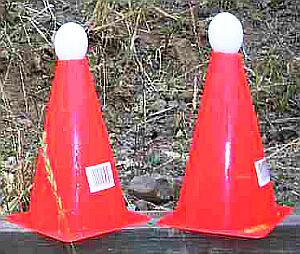 Can you hit an egg at 600+ yards? We mean hit it reliably — not just by luck. To do that you’ll need good shooting skills and a very accurate rifle. How accurate? Well, a chicken egg is, on average, 2 1/4 inches (57 mm) long and 1 3/4 inches (44.5 mm) in diameter. That means to hit an egg (on demand) at 600 yards, you’ll need a rifle capable of 1/3-MOA accuracy (or better). Forum member DukeDuke has such a gun, and he demonstrated its egg-busting prowess in this short video. DukeDuke’s rifle is chambered in 6BRX (a 30° 6BR Improved) and it’s loaded with DTAC 115gr bullets pushed by Alliant Reloder 17. In the video, the eggs are placed on top of poles set 616 yards from the firing line.