The 2017 Berger Southwest Nationals (SWN) are now history. This was a great match, with extremely close competition, and record-setting scores. For the first few days, conditions were very mild. That allowed the “top guns” to shoot “cleans” and even set a few new National records. In individual competition, there were familiar faces among the Top Ten, but also some rising stars. In the F-Open and Sling team events, two new squads topped some of the experienced “all-star” teams. Overall it was a great match — one of the most tightly contested ever. Even with 400 competitors, everything ran smoothly. For those who attended the 2017 Berger SW Nationals, this has been a truly memorable week at Ben Avery. F-Open and F-TR Final Results Posted HERE.
This is our final Berger SW Nationals video for 2017, with interviews with the three class winners: John Whidden (Sling), David Gosnell (F-Open), Donald Erpenbach (F-TR).
Top Five Competitors in Each Class
SLING
John Whidden, 1248-84X
Adrian Harris, 1243-74X
Allen Thomas, 1242-65X
Justin Skaret, 1242-59X
Erik Rhode, 1241-59X
F-OPEN
David Gosnell, 1247-84X
Jay Christopherson, 1246-74X
Keith Glasscock, 1245-79X
Pat Scully, 1243-71X
Dan Bramley, 1243-70X
F-TR
Donald Erpenbach, 1230-53X
James Crofts, 1225-43X
Alan Barnhart, 1224-32X
Ian Klemm, 1222-55X
Bryan Litz, 1222-49X
Bryan Litz congratulates Sling winner John Whidden. John is reigning National Long Range Rifle Champion.
Below are SWN F-Open Champion David Gosnell (left) and F-TR Winner Donald Erpenbach (right).
Record-Setting Performances in 2017
This year Ben Avery conditions were very good — calm mornings, and little wind in the afternoons for the first three days. With the very calm Day 1-3 conditions, we witnessed some spectacular individual and team performances. Lester Bruno shot a brilliant 200-23X at 600 Yards, setting a new National record. Ian Klemm set a new 60-shot, 600-yard National record of 599-38X. The Cluster Ducks set a new National F-Open Team Record for 800/900/1000 yards with their 1789-100X Score. And the talented North-by-Southwest F-TR squad set both a National Record and an overall SWN match record.
The North-by-Southwest team won the 2017 SWN F-TR team event in fine fashion, setting new National and range records in the process.
And here is Team Longshots, winner of the F-Open Team Title. Individual F-Open Champ David Gosnell is at far right. The winning Sling Team was Scotland Thistle.
Forum Admin Finishes a Very Close Second in F-Open
Hats off to AccurateShooter.com’s very own Systems Admin, Jay Christopherson. A talented tech expert, Jay runs our web servers and manages our Forum software. His skills and dedication keep the Forum running smoothly, even as we approach 35,000 members. Jay shot a brilliant match at Ben Avery this week, finishing second in F-Open, just one point behind F-Open winner David Gosnell. We’re proud of Jay, and we want to recognize his achievement. It’s interesting to note that Jay shot the entire match with the new SEB Mini rest, and he was using a Vortex 15-60x52mm Golden Eagle scope. Here’s a short video of Jay shooting his .284 Win rifle on Saturday.
The show’s over — it’s time to pack up the gear and head on home. We’re already looking forward to the 2018 Berger SWN. See you next year!
Big News for Berger Bullets
Big news in the Industry is that Berger Bullets is becoming part of the Nammo Group, parent of Lapua, Vihtavuori, SK and other companies. This major acquisition will combine Nammo’s resources and advanced engineering with Berger’s match-winning bullet designs and strong focus on competition. Yes, you can expect to see factory-loaded ammunition with Berger projectiles and premium Lapua brass. To learn more about the big Berger/Nammo deal, watch this interview with Berger President Erik Stecker.
Eric Stecker, Berger’s President, says the exact timing of the move has not yet been set, nor has the location been chosen. Arizona is high on the list of potential sites, but Berger is considering other states as well. Once the new factory location is determined, Eric says he expects the move to be completed “by December 2018 at the latest”.
If you shoot a pistol, you should watch this video. It covers the key fundamentals of handgun shooting: stance, arm position, grip, sight alignment, and trigger control. This excellent video features USAMU shooter SGT Shane Coley.
Arm/Elbow Position: You should not lock your elbows says SGT Coley: “Because my elbows are slightly bent, it allows the recoil to transfer into my shoulders, down my core, into my legs and to the ground, allowing me to maintain a flat-shooting gun … on multiple targets.”
Grip (Hand Position): SGT Coley explains how to divide the support between both hands: “In terms of grip pressure, I’m applying about 60% to my support hand, and 40% to my strong hand. This is because I need to maintain dexterity with my strong hand to operate the trigger at high rates of speed.”
Trigger Control: The placement of your finger on the trigger blade itself is very important notes Coley: “Putting too much (or not enough) of your finger on the trigger can cause you to pull or push your shots. When you squeeze the trigger, make sure to squeeze it all the way to the rear, in one smooth motion. A quick dry-fire drill to help you with this is to take an empty piece of brass and place it on the front of your slide. Aim at the target, and with the proper trigger control, you should be able to break the shot without the piece of brass falling.”
Pistol Pointers
On the web, you’ll find hundreds of pistol shooting videos — some good, some not helpful at all. In some of those “not helpful” videos the featured shooter has bad habits, or more often than not, he exhibits poor accuracy on target. You won’t find those kinds of shortcomings in this USAMU-sponsored video. SGT Coley doesn’t make foolish mistakes, nor does he exhibit bad habits when shooting. And his accuracy is outstanding. When you look for a pistol trainer — stick to someone like SGT Coley, who has solid fundamentals, the complete skill set, and superior accuracy. A trainer can’t teach a skill that he doesn’t understand himself.
If you’ve never visited the NRA Whittington Center outside Raton, New Mexico, it is well worth a visit. This new HD video shows the features of this unique facility where marksmen can shoot from 10 yards to two miles. Drone video footage gives you a “birds eye view” of the scenery and the ranges.
This is an excellent video. Well worth watching, with impressive aerial photography.
The Whittington Center hosts many major matches each year. Along with the training and range facilities, the Whittington Center has comfortable, modern cabins and RV camping zones for extended stays. Founded in 1973, the Center offers ranges for every kind of shooting discipline, along with a shotgun center, firearms museum, specialized firearms training, guided and unguided hunts, plus an adventure camp for younger shooters.
Applied Ballistics has created a series of YouTube videos about precision long range shooting. Featuring ace long-range shooter and professional ballistician Bryan Litz, these videos will address various topics of interest to long-range marksmen. In this video, the first in the series, Bryan Litz answers the question, “Just What Is Long Range Shooting?” Bryan discusses how we define “long range” and the key factors shooters need to consider.
Applied Ballistics Video — What Is Long Range Shooting?
Bryan states: “I don’t think there is a clear definition of where Long Range starts.” But he offers this practical guideline: “The way I think of it, any time you’re making major adjustments to your zero in order to hit a target, due to gravity drop and wind deflection, THEN you’re getting into ‘Long Range’. For example, if you are zeroed at 100 yards and need to shoot to 600 yards, you have many feet of elevation [drop] to account for, and to me, that’s where it becomes Long Range.”
Extended Long Range and the Transonic Zone
Bryan adds a second concept, namely “Extended Long Range”. Litz says that: “Extended Long Range starts whenever the bullet slows to its transonic range. As the bullet slows down to approach Mach 1, it starts to encounter transonic effects, which are more complex and difficult to account for, compared to the supersonic range where the bullet is relatively well-behaved.” Bryan notes that bullets start to encounter transonic effects at about 1340 fps, quite a bit faster than the speed of sound, which is about 1116 fps at sea level in normal conditions (59° F).
Here’s a comprehensive “reveal” of the latest and greatest rifle optics for 2017, thanks to our friends Ed and Steve, aka the 6.5 Guys. These two hard-working dudes visited dozens of product booths during SHOT Show, producing over 40 video interviews for 6.5guys.com. Below we’ve included the 6.5 Guys’ videos for Nightforce, Vortex, and Schmidt & Bender. Plus you’ll find links to other videos for Burris, Bushnell, Steiner, and U.S. Optics. Enjoy these videos, and for more great coverage of SHOT Show, visit the 6.5 Guys’ YouTube Channel.
NIGHTFORCE Optics — New for 2017
The big news at Nightforce’s SHOT Show booth was a new First Focal Plane (FFP) ATACR with a five times zoom range. The new 7-35x56mm ATACR offers tactical and long range shooters the ability to go from a wide field of view at seven power, all the way up to very high 35X magnification. That makes this one scope that can truly “do it all” — from short-range moving targets to 1000 yards and beyond.
VORTEX Optics — New for 2017
Vortex is releasing a new “Gen II” series of Viper PST riflescopes. The versatile Viper PST series can work for many disciplines — Target Shooting, 3-Gun, Hunting, or Precision Long Range. The new second generation PSTs offer many improvements.
NEW 2-10×32, 3-15×44, and 5-25×50: Vortex offers a wide magnification range with these three new PSTs. Each offers tall tactical turrets and side-focus parallax adjustment with integrated illumination. To ensure reliable return-to-zero, all new models feature the patented RZR Zero Stop from the Razor HD 5-20×50 riflescope. Reticles include Vortex’s new EBR-4 and EBR-2C with MOA or MRAD stadia to match your turrets. First Focal Plane reticles are available on select models.
SCHMIDT & BENDER — New for 2017
Schmidt & Bender had many premium riflescopes on display, none more impressive than the recently-introduced 5-45x56mm PM II “super-zoom” optic. This impressive (and razor-sharp) scope offers a remarkable 9X zoom ratio. That makes it suitable for a wide variety of shooting disciplines. A tactical competitor can dial back to 5-power for a wide field of view on close-in targets. Or, for 1000-yard shooting, crank the scope all the way up to 45-power. S&B says the scope is intended for “tactical ultra-long-range shooting”.
Also on display was the 5-25x56mm PM II Digital BT — this Bluetooth-enabled scope can project data from external devices, such as laser rangefinders, into the field of view. S&B is leading the way in the integration of optics and digital devices.
And There’s More — Burris, Bushnell, Steiner, and U.S. Optics
The 6.5 Guys also visited other optics makers including Burris, Bushnell, Steiner, and U.S. Optics. There were interesting offerings from all these scope manufacturers. Click the links below to watch four more 6.5 Guys videos covering new developments in the sport optics arena. The videos focus on products for tactical/practical and long-range shooting.
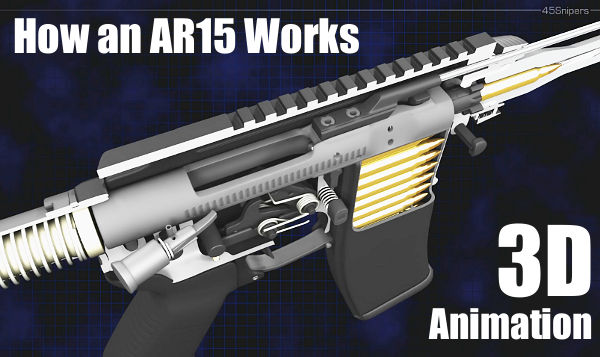
Ever wondered how the parts inside an AR15 work together? Just exactly how does the reciprocating bolt carrier feed rounds from the magazine? How do the elements in the trigger group work and reset after each shot? How does the gas system bleed gas from the barrel and operate the bolt carrier? These and other questions are answered in this eye-opening video from 45Snipers. Using “cutaway” 3D computer animation, this 5-minute video shows all features of an AR15 inside and out. This fascinating firearms animation allows the viewer to look inside the upper and lower receivers, into the bolt carrier, chamber, barrel, and magazine.
This video starts off slow and has annoying background music, but it is well worth watching if you own or shoot any AR-platform rifle. It illustrates all the key operations during the charging, loading, firing, and ejection processes. The cutaway animation shows how rounds are stripped from the magazine and then chambered. It then shows how every part of the trigger group works, and how the firing pin strikes the primer. You can even watch the bullet move down the barrel before the empty shell casing is removed from the chamber and tossed out the ejection port. Here are sample frames from the video:
Video find by Grant Ubl. We welcome reader submissions.
This Wednesday (February 1, 2017), Shooting USA TV features the GAP Grind Pro-Am held at the K&M Shooting Complex in Finger, TN. Conducted in association with the Precision Rifle Series (PRS), the GAP Grind features a Pro/Am format with professional and amateur competitors vying for individual glory and team honors.
Here is Shooting USA Host John Scoutten (in Blue/White shirt)
Lots of Action, with 20+ Stages
The GAP Grind is a notoriously challenging, “high tempo” match with minimal down-time between stages. Over the course of 20+ stages, competitors will fire 200+ shots at a variety of steel, paper, moving, and reactive targets out to 1,200 yards. Targets vary in size/difficulty based on the shooter’s position, distance, and time allotted. Most stages include “stressors” — i.e. time limits or required movement(s).
Ramia Whitecotton Facebook photo.
Josh Temnnen Facebook photo.
GAP Grind Hardware Shelley Giddings, a skilled shooter of both firearms and cameras, snapped these images of state-of-the-art tactical rifles at the 2014 GAP Grind. See more firearms images on Shelley’s Facebook Page.
Today, AR-platform rifles are hugely popular. Dozens of manufacturers sell AR-type rifles, in a wide variety of configurations and calibers. But before there were M16s and AR-15s, ArmaLite produced a 7.62×51 caliber rifle, the AR-10. Yes before there were millions of 5.56 black rifles, there was a .30-caliber big brother with reddish-brown furniture. Invented by Eugene (‘Gene’) Stoner for the Armalite company in the late 1950s, this is the father of all of today’s AR-platform rifles. Way ahead of its time, this remarkable, select-fire battle rifle weighed just 7.25 pounds as first developed.
If you’re curious about the AR-10, in this video, Jerry Miculek puts an original 1957-vintage AR-10 through its paces on the range. This extremely rare, early-production rifle was provided by Mr. Reed Knight and the Institute of Military Technology. (The gun in the video was actually produced in the Netherlands under license, see video at 4:40.) This AR-10 is the direct ancestor of the AR-15, M16, and many of the modern sporting rifles that we use today.
The AR-10 was slim and light, weighing in at around 7 pounds. Some folks might argue that the original “old-school” AR10 is actually better that some of today’s heavy, gadget-laden ARs. The AR-10’s charging “lever” was under the carry handle — that made it easier to manipulate with the gun raised in a firing position.
You’ll notice there is no “forward assist”. Inventor Gene Stoner did not believe a separate “bolt-pusher” was necessary. The forward assist was added to solve problems encountered in Viet Nam. Some critics say the forward assist “only takes a small problem and makes it a big problem.” For today’s competition ARs (that are never dragged through the mud) the forward assist probably is superfluous. It is rarely if ever needed.
Note also that the handguards are fairly slim and tapered. Today, six decades after the first AR-10 prototypes, we are now seeing these kind of slim handguards (made from aluminum or lightweight composites) used on “full race” ARs campaigned in 3-gun competition.
History of the AR-10
The AR-10 is a 7.62 mm battle rifle developed by Eugene Stoner in the late 1950s at ArmaLite, then a division of the Fairchild Aircraft Corporation. When first introduced in 1956, the AR-10 used an innovative straight-line barrel/stock design with phenolic composite and forged alloy parts resulting in a small arm significantly easier to control in automatic fire and over one pound lighter than other infantry rifles of the day. Over its production life, the original AR-10 was built in relatively small numbers, with fewer than 9,900 rifles assembled.
In 1957, the basic AR-10 design was substantially modified by ArmaLite to accommodate the .223 Remington cartridge, and given the designation AR-15. ArmaLite licensed the AR-10 and AR-15 designs to Colt Firearms. The AR-15 eventually became the M16 rifle.
AR-10 photos from Arms Izarra, a Spanish company specializing in de-militarized, collectible firearms. Interestingly, this particular AR-10 was produced in the Netherlands under license.
Kirsten Joy Weiss has created a useful video about Dry-Fire practice. Dry-Fire is a method of training without a live round in the chamber. Dry-Firing is effective, Kirsten explains, because “it eliminates all the extra noise and messages that you get when you fire a live round. Without recoil, without the sound of a shot going off etc., all you hear is the click of the trigger. This allows you to focus on your sight picture and your trigger press.” This the lastest installment in Kirsten’s ‘How to Shoot Awesomely’ series. Kisten says: “I hope it helps you, and keep on aiming true!”
The Benefits of Dry-Fire Training
If you are not doing Dry-Fire practice yet, then it’s time to start. Dry-Fire training is essential to the sling disciplines, and very useful for F-Class. Dennis DeMille, a national Service Rifle Champion, told us that, for every minute he spent in actual competition, he would spend hours practicing without ammunition. While in the USMC, Dennis would practice in the barracks, working on his hold and dry-firing:
“The most important thing is to spend time off the range practicing. Most of what I learned as a High Power shooter I learned without ammunition — just spending time dry firing and doing holding exercises. Holding exercises will really identify the weak parts of your position. The primary purpose of dry firing is to get you used to shooting an empty rifle. If you can shoot a loaded rifle the same way you shoot an empty rifle then eventually you will become a High Master.”
Dry-Fire Training Can Benefit Benchrest Shooters
What about benchrest? Well, we’ve found that Dry-Fire sessions can even benefit benchresters — it can help reveal flaws in your trigger technique, or inconsistencies in the way you address the rifle from shot to shot. With the gun set up with your front rest and rear bag, if you see the scope’s cross-hairs wiggle a lot when you pull the trigger, you need to work on your technique. Also, dry-fire practice can help you learn to work the bolt more smoothly so you don’t disturb the gun on the bags.
Shown is a new .338 Lapua Magnum rifle from Israel’s IWI. Impressively beefy rig.
For folks in the gun industry, the third Monday in January is the best day of the year. Held in conjunction with SHOT Show, Media Day at the Range lets us try out dozens of new rifles and pistols, as well as meet top gun designers and friends in the shooting sports. We saw some very interesting new products this year. Here are some of the most interesting “take-aways” from Media Day at the Range 2017 on January 16th.
Most Innovative — “The FIX” Rifle from Q
The star of Media Day, at least in the rifle category, was “The FIX”, a new modular rifle from the Q Team. This innovative rig features a totally unique bolt system with a 45° lift and a bolt housing that runs on rails (literally). This thing cycles fast and smoothly.
The trigger, set at 2.5 pounds, was one of the best we’ve ever tried on a centerfire factory rifle. One has to admire the engineering on “The FIX”. This new rifle has definitely “raised the bar” for tactical-style rifles. It’s different, it works, and it offers real advantages for both hunters and tactical style shooters.
Savage 10 with Ergonomic GRS Stock
Perhaps the most ergonomic rifle we shot all day was the new Savage GRS-10 in a stiff, composite GRS stock. European-crafted GRS stocks feature a very comfortable hand-grip, plus fully adjustable cheek-piece and adjustable length of pull. As shown this rifle is very affordable for PRS production-class competition.
To be frank, this Editor liked this rifle more than the Ruger Precision Rifle. A lot more. The GRS stock fit better, the Savage bolt cycled much more smoothly, the trigger was better, and the magazine seated more easily. If you don’t have to be “tacticool” with a metal stock, you should definitely consider this Savage. The new Savage GRS-10 will be offered in 6mm Creedmoor, 6.5 Creedmoor, and .308 Win chamberings. Here’s a video review by Guns America.
Blacktical Bolt-Action Rifles — The PRS Influence
We saw many new (or upgraded) PRS-style bolt action rifles in modular aluminum frames. There were offerings from Savage, Bergara, Tikka, and more. We’ll provide a more thorough run-down on these new guns next week. We really liked the new Tikka T3x TAC A1, while tactical shooters Ed and Steve (aka the 6.5 Guys) were impressed with the new Bergara: “Bergara has in-sourced chassis and triggers to produce very high quality offerings at a very competitive price. Handling, shooting and cycling the bolt on the $1150 MSRP Hunting and Match Rifle would lead one to believe the price tag was a mistake (maybe the first digit should have been a 2). We felt the same when we got behind the $1,699 Bergara Match Precision Rifle.”
Tikka T3x TAC A1
Bergara Match Precision
Pistols — The Sounds of Silence
The most interesting handgun on display was SilencerCo’s Maxim 9, which features an integral suppressor. It looks bulky but it felt relatively normal in the hand. The silencer did tame muzzle lift as well as reduce sound levels dramatically. This is an impressive piece of engineering.
There were many other pistols equipped with more conventional screw-on silencers. Here is a special edition Smith & Wesson M&P model.
Optics — High-End Models from Schmidt and Bender
There were many new optics on display at Media Day, none more impressive than the new 5-45x56mm PMII from Schidmt & Bender. Led by our good friend Kyle Brown, Schmidt & Bender USA had a strong presence at Range Day, with many optics models fitted to high-end tactical rifles. Jason Baney (shown below with Kyle), used one of these rifle/scope combos to make 5 of 5 hits on steel at 960 yards.
Jason Baney checks out the new 5-45x56mm PM II with help from Kyle Brown (left).
Meeting Old Friends
One of the great things about Media Day is the chance to re-connect with old friends. At the Winchester booth, it was great to see Kim Rhode, a six-time Olympic medalist (including three golds). She is the first Summer Olympian to win an individual medal at six consecutive summer games. Kim, a Californian, is leading efforts to challenge draconian new California laws that will severely restrict how ammo is distributed and sold in California. Kim said that, under the new ammo laws, she will not be able to obtain the special “International Loads” she shoots in competition. We wish Kim well in her efforts. We believe that California’s new laws restricting the purchase of ammunition are unconstitutional and, hopefully, will be challenged successfully in court.
Along with Kim we met with our friends Steve (L) and Ed (R), aka the 6.5 Guys, along with past Top Shot Champion Dustin Ellermann (in middle below).
World Record AR Speed-Shooting by Jerry Miculek
At the Smith & Wesson shooting bay, we watched the legendary Jerry Miculek set a world speed record for 10 rifle rounds total on three targets. Before a cheering gallery of fans, Jerry drilled multiple sub-two second runs using his S&W M&P 15T semi-auto rifle. The fastest split was a 1.59 (but we’re waiting for final confirmation on that). We’re told that’s definitely a new world record. Jerry may not be getting any younger, but he’s still blazing fast. Jerry calls this 10-shot drill “STL” or Share the Love.
Ammunition — Polymer Jacketed Pistol Bullets
One of the more notable, recent developments in pistol ammo has been synthetic jacketed bullets. With a total polymer shell over a lead core, these are safer when shooting steel targets because they do not fragment like conventional, jacketed bullets. With no exposed lead or copper, there’s minimal contact between these materials and the barrel, so there’s less copper and lead fouling. Moreover, according to Federal’s test engineers, the red Syntech coating produced 12% less friction in the barrel. Here is the American Eagle 9mm Luger 115gr Total Syntec Jacketed ammo provided by Beretta at Media Day.






 The Benefits of Dry-Fire Training


