This week, American Rifleman TV looks at the history and heritage of Remington, which celebrates its 200th Anniversary this year. Founded in 1816, Remington is the oldest continuously-operating gun manufacturer in the United States, and it still sells more sporting rifles and shotguns than any other American company. Remington has also developed more cartridges than any other U.S. company. If you want to learn more about this important arms-maker, watch tonight’s episode, which you can preview below.
Two Hundred Years of Gun-Making Remington Arms Company celebrates its 200th year in business in 2016. The Remington enterprise was founded in 1816 by Eliphalet Remington in Ilion, New York, as E. Remington and Sons. Remington is America’s oldest gun maker and is still the largest U.S. producer of shotguns and rifles. And it is the only American Company that sells firearms and ammunition under its own name. CLICK HERE for 200 facts about the 200-year-old company.
American Life in 1816
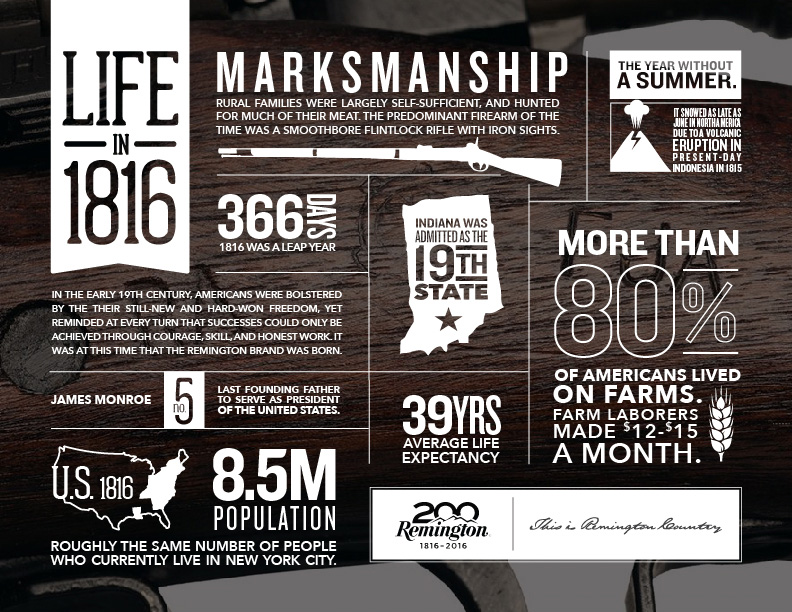
What was life like in America in 1816, two hundred years ago? This infographic offers some interesting facts. For example, average life expectancy was only 39 years, and a farm laborer earned just $12-$15 per month. Still want to go back to the “good old days”?
Our friend Kirsten Joy Weiss is a modern-day Annie Oakley. A very successful competitive shooter in the collegiate ranks, Kirsten now produces a popular YouTube Channel focusing on the “Joy of Shooting”. In her videos, Kirsten offers shooting tips and performs a variety of trick shots — such as splitting cards with a .22 LR rimfire. This young lady can shoot, that’s for sure.
In this video, Kirsten shoots at some tiny reactive targets — “Pop-Its”. These pea-sized targets “pop” audibly when hit. They make a very challenging target, even when bunched together. Kirsten secured three (3) Pop-Its with a clothespin, and then placed the clothespin in the ground.
It took a couple tries, but Kirsten did manage to light off a Pop-It or two. Kirsten reports: “Basically a small exploding target, Pop-Its, also known as ‘Bang Snaps’, snaps, snappers, party snaps, etc., are a fun firework trick noisemaker — but will they make a good target? Let’s put it to the test to see if these poppers are gun range-worthy targets. These little Pop-Its make for some challenging shots with reactive targets.” Enjoy the video:
Equipment Report: For this video, Kirsten shot Lapua .22 LR ammo in a Volquartsen Ultra-lite semi-auto .22 LR rimfire rifle, fitted with a C-More Red-Dot sight. She was using Oakley eye protection.
Here’s a significant new addition to our knowledge base for Long-Range shooting. Hornady has released a new Ballistics Calculator that employs bullet profiles derived from Doppler radar testing and 3D projectile modeling. Hornady’s Patent Pending 4DOF™ Ballistic Calculator provides trajectory solutions based on projectile Drag Coefficient (not static G1/G7 ballistic coefficients) along with the exact physical modeling of projectiles and their mass and aerodynamic properties. This new 4DOF (Four Degrees of Freedom) calculator also accounts for spin drift and the subtle VERTICAL effects of crosswinds.
We strongly recommend you watch this video from start to finish. In greater detail than is possible here, this video explains how the 4DOF System works, and why it is more sophisticated than other commercially-offered Ballistics calculators. There’s a LOT going on here…
Aerodynamic Jump from Crosswind Calculated
According to Hornady, the 4DOF Ballistics Calculator “is the first publicly-available program that will correctly calculate the vertical shift a bullet experiences as it encounters a crosswind.” This effect is called aerodynamic jump. The use of radar-derived drag profiles, correct projectile dynamics, aerodynamic jump, and spin drift enable the Hornady® 4DOF™ ballistic calculator to provide very sophisticated solutions. Hornady says its 4DOF solver is “the most accurate commercially available trajectory program … even at extreme ranges.”
“Current ballistic calculators provide three degrees of freedom in their approach — windage, elevation, and range — but treat the projectile as an inanimate lump flying through the air,” said Dave Emary, Hornady Chief Ballistician. “This program incorporates the projectile’s movement in the standard three degrees but also adds its movement about its center of gravity and subsequent angle relative to its line of flight, which is the fourth degree of freedom.”
Using Doppler radar, Hornady engineers have calculated exact drag versus velocity curves for each bullet in the 4DOF™ calculator library. This means the 4DOF™ calculator should provicde more precise long range solutions than calulators that rely on simple BC numbers or drag curves based with limited data collection points. Emary adds: “The Hornady 4DOF also accurately calculates angled shots by accounting for important conditions that [other ballistic] programs overlook.”
“This calculator doesn’t utilize BCs (Ballistic Coefficients) like other calculators,” added Jayden Quinlan, Hornady Ballistics Engineer. “Why compare the flight of your bullet to a standard G1 or G7 projectile when you can use your own projectile as the standard?” That makes sense, but users must remember that Hornady’s 4DOF projectile “library” includes mostly Hornady-made bullets. However, in addition to Hornady bullets, the 4DOF Calculator currently does list seven Berger projectiles, six Sierra projectiles, and one Lapua bullet type. For example, Sierra’s new 183gr 7mm MatchKing is listed, as is Berger’s 105gr 6mm Hybrid.
This Video Explains How to Use Hornady’s New 4DOF Ballistics Calculator
Using the 4DOF™ Ballistic Calculator:
The Hornady 4DOF Ballistic Calculator provides trajectory solutions based on projectile Drag Coefficient (not ballistic coefficients) along with exact physical modeling of the projectile and its mass and aerodynamic properties. Additionally, it calculates the vertical shift a bullet experiences as it encounters a crosswind, i.e. “aerodynamic jump”. The use of drag coefficients, projectile dynamics, aerodynamic jump, and spin drift enable the 4DOF Ballistic Calculator to accurately measure trajectories even at extreme ranges. It is ideal for both long range and moderate distances and is available for the low-drag precision bullets listed in the drop down menu of the calculator. For calculating trajectories of traditional hunting and varmint bullets using BCs (ballistic coefficients), you can use Hornady’s Standard Ballistics Calculator.
Gavin Gear of UltimateReloader.com recently reviewed Lee Precision’s new lever-operated, bench-mounted priming tool. The Lee Auto Bench Prime features a hopper-style primer feeder set at an angle. Gavin likes the tool, reporting that primers feed well and seat fully with very little effort. And switching from large to small primer size (or vice-versa) is quick and easy. Overall, Gavin says the Lee Auto Bench Prime has earned a place in his reloading room: “This is now my tool of choice for off-press priming. The Lee Auto Bench Prime is easier to use than a hand priming tool, and more efficient.”
Watch UltimateReloader.com’s Lee Auto Bench Prime Gear Review
Gavin tells us that the system worked well: “All in all, I’m really liking the LEE Auto Bench Prime. In the video, I prime both small primer .223 Rem brass and large primer .308 Win cases. I was impressed with how easy it was to seat the primers, and how quickly the process goes.”
How the Lee Auto Bench Prime Performs
Gavin had three important “take-aways” from his initial loading sessions with the Lee Auto Bench Prime:
1. I was surprised by the low effort needed to prime cases — it’s pretty amazing.
2. You can quickly and easily install shellholders and change primer sizes.
3. The folding primer tray works very well. It’s a great setup from my testing so far.
Are there any negatives with the tool? Gavin noted that, in the course of loading 100+ rounds, once or twice he had to tap the triangular tray to get the primer to feed: “That’s not a big deal, and may smooth out with time”.
Tool Costs Under $30.00
Available at Grafs.com for just $28.59, the Lee Auto Bench Prime tool is very affordable. It costs much less than competitive bench-mounted priming tools from Forster and RCBS.
NOTE: this tool requires dedicated Auto Prime shell holders (sold separately), but that’s a relatively small added expense. A set of Lee shell-holders (shown at right) costs less than $20.00 (street price).
Many of the world’s best F-Class shooters have traveled to Ottawa, Ontario, Canada this week to compete at the Canadian F-Class National Championships. F-Open ace Shiraz Balolia, who won back-to-back Canadian F-Open Championships in 2015 and 2014, will pursue a “three-peat” at Canada’s Connaught Ranges. There will be plenty of F-TR talent on hand as well, including Bryan Litz, reigning U.S. Mid-Range and Long-Range F-TR Champion. The first challenge for the shooters will be the weather, which can be notoriously wet and windy at Connaught. The weather forecast looks good for today and tomorrow, but thunderstorms (and rain) are predicted for Friday and Saturday.
U.S. F-TR Rifle Team Prepares for the Canadian Championships:
Shown above is the U.S. F-TR Rifle Team, which will compete in the F-TR division. In the America Match, teams from Canada, South Africa, and the United States will battle head-to-head for national honors.
Many Companies Help Sponsor U.S. F-TR Rifle Team
It takes significant resources to field a large shooting team in international competition. The U.S. F-TR Rifle team is fortunate to have many great sponsors helping the team with equipment and financial support. The team’s top-level “Gold Medal” sponsors, are, in alphabetical order: Berger Bullets, Gemtech, Kelbly’s, McMillan Fiberglass Stocks, Nightforce Optics, Pierce Engineering, and 5.11 Tactical. CLICK HERE for a list of all sponsors.
Tonight, August 10th, ShootingUSA TV covers the 2016 NRA Annual Convention, held this past May in Louisville, Kentucky. Host Jim Scoutten and his team spotlights hot new products, including Hornady ELD ammo, Busnell scopes, a Les Baer 1911, plus the Victory, a new .22LR pistol from Smith and Wesson. In this episode, Shooting USA also focuses on the important political issues facing the NRA this year.
Watch Preview of Shooting USA’s 2016 NRA Meeting Episode:
This year, the NRA’s Annual Meeting took place during a critical election year. More than NRA members came to Louisville, showing their support for Second Amendment rights. One of the NRA’s oldest members, 99-year-old Wayne Bird, said it’s important to stand up and be counted: “I’ve been a member of the NRA 78 years and I’m 99 years old. And ever since that time they have been fighting for our freedom, for our Second Amendment freedom….”
As part of the convention coverage, Shooting USA interviews top competitive shooters Jerry and Kay Miculek, and Smith & Wesson Team Captain Julie Golob. This week’s episode also includes a feature on the Colt Detective Special and the Scholastic Action Shooting Program (SASP) Championships at the CMP Talladega Marksmanship Park in Alabama.
Shooting USA Broadcast Times by Time Zone
Eastern Time: 9:00 PM, 12:30 AM, 3:00 AM (Thurs.)
Central Time: 8:00 PM, 11:30 PM, 2:00 AM (Thurs.)
Mountain Time: 7:00 PM, 10:30 PM, 1:00 AM (Thurs.)
Pacific Time: 6:00 PM, 9:30 PM, Midnight
In this video, Bryan Litz of Applied Ballistics talks about Density Altitude and the effect of atmospheric conditions on bullet flight. Bryan explains why you must accurately account for Density Altitude when figuring long-range trajectories.
Bryan tells us: “One of the important elements in calculating a fire solution for long-range shooting is understanding the effect of atmospherics. Temperature, pressure, and humidity all affect the air density that the bullet’s flying through. You can combine all those effects into one number (value) called ‘Density Altitude’. That means that you just have one number to track instead of three. But, ultimately, what you are doing is that you are describing to your ballistics solver the characteristics of the atmosphere that your bullet’s flying through so that the software can make the necessary adjustments and account for it in its calculations for drop and wind drift.”
Bryan adds: “Once you get past 500 or 600 yards you really need to start paying careful attention to atmospherics and account for them in your ballistic solutions”. You can learn more about Density Altitude in Bryan’s book, Applied Ballistics for Long Range Shooting (Third Edition).
General Scientific Definition of Density Altitude
Density altitude is the altitude relative to the standard atmosphere conditions (ISA) at which the air density would be equal to the indicated air density at the place of observation. Density altitude can be calculated from atmospheric pressure and temperature (assuming dry air). Here is the formula:
Air is more dense at lower elevations primarily because of gravity: “As gravity pulls the air towards the ground, [lower] molecules are subject to the additional weight of all the molecules above. This additional weight means the air pressure is highest at sea level, and diminishes with increases in elevation”.*
Both an increase in temperature, decrease in atmospheric pressure, and, to a much lesser degree, increase in humidity will cause an increase in density altitude. In hot and humid conditions, the density altitude at a particular location may be significantly higher than the true altitude.
For anyone interested in accurate rifles, this is absolutely a “must-watch” video. Watch blanks being cryogenically treated, then drilled and lathe-turned. Next comes the big stuff — the massive rifling machines that single-point-cut the rifling in a precise, time-consuming process. Following that you can see barrels being contoured, polished, and inspected (with air gauge and bore-scope). There is even a sequence showing chambers being cut.
Click Arrow to Watch Krieger Barrels Video:
Here is a time-line of the important barrel-making processes shown in the video. You may want to use the “Pause” button, or repeat some segments to get a better look at particular operations. The numbers on the left represent playback minutes and seconds.
Krieger Barrel-Making Processes Shown in Video:
00:24 – Cryogenic treatment of steel blanks
00:38 – Pre-contour Barrels on CNC lathe
01:14 – Drilling Barrels
01:28 – Finish Turning on CNC lathe
01:40 – Reaming
01:50 – Cut Rifling
02:12 – Hand Lapping
02:25 – Cut Rifling
22Plinkster Tours CCI/Speer Idaho Factory
Trickshot artist and YouTube host 22Plinkster recently got a chance to tour the CCI/Speer production facility in Lewiston, Idaho. This large plant produces both rimfire and centerfire ammunition. While touring the plant, 22Plinkster was allowed to capture video showing the creation of .22 LR rounds from start to finish. This is a fascinating video, well worth watching.
This revealing video shows all phases of .22 LR ammo production including cupping, drawing, annealing, washing, drying, head-stamping, priming, powder charging, bullet seating, crimping, waxing, inspection, and final packaging. If you’ve got ten minutes to spare, we really recommend you watch the video from start to finish. You’ll definitely learn some new things about rimfire ammo.
.22 Plinkster was literally up to his neck in ammo while touring the CCI/Speer Idaho ammo plant. He says: “This was truly a dream come true for me. I can’t thank the people at CCI and Speer enough for allowing me to do this. I couldn’t possibly show everything that went on at the factory. However, hopefully I showed you enough for you to grasp the concept of how rimfire [ammo] is made.”
Speer Brothers Brought Ammo Production to Lewiston
Here is an interesting historical footnote. Today’s large CCI/Speer operation in Idaho can be traced back to the companies founded by the Speer brothers. After settling in Lewiston in 1944, Vernon Speer started Speer Bullets. A few years later, in 1951, Vernon’s brother Dick (with partner Arvid Nelson) started Cascade Cartridges Inc., a producer of small-arms ammunition and primers. Yes, as you may suspect, Cascade Cartridges Inc. is now CCI, a Vista Outdoor company, and one of the largest manufacturers of primers and loaded ammunition. Today, the CCI/Speer Lewiston plant produces both Speer bullets and CCI-branded ammunition and primers. Vista Outdoor’s predecessor, ATK, acquired the plant in 2001. Vernon Speer died in 1979, and Dick Speer died in 1994.
In this video, Bryan Litz of Applied Ballistics explains how to choose a bullet for long-range shooting and explains what you should be looking for when developing a long-range load. Bryan notes that, with a new rifle build, the bullet you select may actually dictate your gun components. When starting from a “clean slate”, once you select a bullet, you will then pick a barrel, twist rate, and cartridge that are appropriate for that bullet. In choosing a long-range projectile, Bryan recommends you choose a high-BC bullet “that is known for precision”. Then you need to find an ultra-consistent, reliable load.
This video is worth watching. Bryan Litz makes some very good points.
Load Development — Why Consistency is Key (and Half-MOA May Be Good Enough)
After choosing a bullet for your long-range project, then you need to develop a load through testing. Bryan explains: “Once you’ve selected a bullet … and you have selected the components around that bullet, the most important thing to remember in hand-loading is consistency. You’re going to do some testing to see what combination of powder charge, powder type, and seating depth give you the best groups and lowest standard deviations in muzzle velocity.”
Bryan says that if you develop a load that can shoot consistent, half-minute groups in all conditions, you should be satisfied. Bryan says that many long-range shooters “spin their wheels” trying to achieve a quarter-MOA load. Often they give up and start all over with a new bullet, new powder, and even a new cartridge type. That wastes time, money, and energy.
Bryan cautions: “My advice for hand-loaders who are long-range shooters, is this: If you can get a load that is reliable and can shoot consistent, half-minute groups with low MV variation and you can shoot that load in any condition and it will work well, then STICK with THAT LOAD. Then focus on practicing, focus on the fundamentals of marksmanship. The consistency you develop over time by using the same ammunition will mean more to your success in long range shooting than refining a half-minute load down to a quarter-minute load.”
Bryan notes that, at very long range, shooting skills and wind-calling abilities count most: “Your ability to hit a 10″ target at 1000 yards doesn’t improve very much if you can make your rifle group a quarter-minute vs. a half a minute. What’s going to determine your hit percentage on a target like that is how well you can calculate an accurate firing solution and center your group on that target. A lot of people would be more effective if they focused on the fire solution and accurately centering the group on the target [rather than attempting to achieve smaller groups through continuous load development].”
Editor’s Note: We agree 100% with the points Bryan makes in this video. However, for certain disciplines, such as 600-yard benchrest, you WILL need a sub-half-MOA rifle to be competitive at major matches. Well-tuned, modern 600-yard benchrest rigs can shoot 1/4-MOA or better at 100 yards. Thankfully, with the powder, bullets, and barrels available now, 1/4-MOA precision (in good, stable conditions) is achievable with a 17-lb benchgun built by a good smith with premium components.


 Remington Arms Company celebrates its 200th year in business in 2016. The Remington enterprise was founded in 1816 by Eliphalet Remington in Ilion, New York, as E. Remington and Sons. Remington is America’s oldest gun maker and is still the largest U.S. producer of shotguns and rifles. And it is the only American Company that sells firearms and ammunition under its own name. CLICK HERE for 200 facts about the 200-year-old company.