On its YouTube Channel, the USAMU offers “Pro Tips” videos providing expert instruction on rifle marksmanship. One helpful video covers up/down angle shooting. In the video, SFC Emil Praslick III, one of America’s best long-range shooting coaches, explains how to determine up/down angle, and how to compensate for the angle using scope clicks. Praslick explains how gravity always works as a constant relative to the flat-ground distance to the target (which is distinct from the actual straight-line distance to target.)
The flat-ground distance is the actual distance over which the bullet will be affected by gravity. Use this as the basis for your elevation corrections. As Praslick explains, “this [flat-ground] distance will get less and less as the angle to the target increases [either up or down].” Once you know the straight-line distance to the target AND the exact angle of your shot, simple math lets you calculate the flat-ground distance to the target. Basically, to determine your flat-ground distance to target, you multiply the cosine of the shot angle by the measured straight-line distance to the target.
Application to Long-Range Hunting Since the effects of angles increase with distance, Praslick explains that: “Unless the angle is extremely severe, [a hunter] really won’t notice these effects at ranges of 200 yards or less.” However, for long shots, hunters definitely need to compensate when taking angled shots. Praslick recommends that hunters print out a small chart with the cosines of common angles (20°, 25°, 30° etc.). In addition, hunters need an accurate ballistic table for their rifle and particular ammo. This should show the elevation corrections (in MOA or clicks), for 200 yards to the maximum range at which you may take a shot.
SFC Emil Praslick III is an instructor/coach with the USAMU. He also has served as a coach and “wind guru” with numerous U.S. Teams in international competition, including the U.S. Palma Team, which recently participated in the World Long-Range Fullbore Rifle Championship in Australia. Praslick has also coached the U.S. F-Open Class Team.
It seems like every manufacturer has a new “tactical precision” rifle these days, and Mossberg is no exception. Mossberg offers the MVP-LC, which combines the Mossberg MVP receiver with a sleek, modern MDT LSS metal chassis with an AR-type buttstock that adjusts for length (11.25″ – 14.5″ LOP). The light-weight, tan-finished aluminum chassis features a V-shapped bedding area for the Mossberg MVP action. The MVP-LC’s LBA trigger is user-adjustable from 3 to 7 pounds pull weight.
GunTalk TV Video Review of Mossberg MVP LC:
The new rifle features the MDT LSS chassis system, Magpul furniture and magazine and Silencerco Saker muzzlebrake/QD mount. The rifle is available with optional Vortex HS-T 4-16X rifle scope.
Available in either .223 Rem or .308 Win, the MVP LC rifle will accept standard AR-15 and AR-10 magazines. The barrels are pretty short, 16.25″ for .223 Rem, or 18.5″ for .308 Win, but they do come with threaded SilencerCo Muzzle Brakes installed. Weight, without optics, is 8 lbs. for the .223 Rem version, 8.5 lbs. for the .308 version. We think the lighter .223 Rem model would make a nice “carry-around” varmint rifle. The current “street price” is $1099.99.
MVP-LC Featured in Shooting Illustrated
If you want to learn more about this rifle, check out Shooting Illustrated this month. Mossberg’s MVP-LC is the “cover girl” of the October issue; you’ll find a full report on this new tactical rifle with complete specs and lots of big photos.
FEATURES: Mossberg MVP bolt-action design compatible with standard AR magazines (AR15, LR308/SR25). MDT LSS light chassis aluminum stock. Magpul CTR Adjustable LOP Stock with A-frame profile to reduce snagging for height adjustment. Either a 16.25″ (.223 Rem) or 18.5″ (.308 Win) barrel threaded with SilcencerCo Saker Muzzle Brake (thread cap included). Includes LBA adjustable trigger system (3-7 lbs.), oversized bolt handle, Picatinny rail, adjustable bipod.
Hunting season is right around the corner. That means its time to inspect all your hunting gear, including your scope set-up. A proper scope installation involves more than just tensioning a set of rings — you need to consider the proper eye relief and head position.
In this NSSF video, Ryan Cleckner shows how to set up a scope on a hunting or tactical rifle. Ryan, a former U.S. Army Sniper Instructor, notes that many hunters spend a small fortune on equipment, but fail to set up their rifle to use the optics optimally. Cleckner likens this to someone who owns an expensive sports car, but never adjusts the seat or the mirrors.
Ryan notes that you want your head and neck to be able to rest naturally on the stock, without straining. You head should rest comfortably on the stock. If you have to consciously lift your head off the stock to see through the scope, then your set-up isn’t correct. Likewise, You shouldn’t have to push your head forward or pull it back to see a clear image through the scope. If you need to strain forward or pull back to get correct eye relief, then the scope’s fore/aft position in the rings needs to be altered. Watch the full video for more tips.
Tips on Mounting Your Scope and Adjusting Your Comb Height:
1. Normally, you want your scope mounted as low as possible, while allowing sufficient clearance for the front objective. (NOTE: Benchrest shooters may prefer a high mount for a variety of reasons.)
2. Once the scope height is set, you need to get your head to the correct level. This may require adding an accessory cheekpad, or raising the comb height if your rifle has an adjustable cheekpiece.
3. Start with the rifle in the position you use most often (standing, kneeling, or prone). If you shoot mostly prone, you need to get down on the ground. Close your eyes, and let you head rest naturally on the stock. Then open your eyes, and see if you are too low or too high. You may need to use a cheekpad to get your head higher on the stock.
4. If your scope has a flat on the bottom of the turret housing, this will help you level your scope. Just find a flat piece of metal that slides easily between the bottom of the scope and the rail. Slide that metal piece under the scope and then tilt it up so the flat on the bottom of the scope aligns parallel with the flats on the rail. Watch the video at 8:40 to see how this is done.
Video find by EdLongrange. We welcome reader submissions.
Frank Galli, aka “Lowlight”, is the head honcho of Sniper’s Hide. In the video below, Galli offers a series of shooting tips he calls the “Long Range Shooting W.T.F”. No that’s not what you think it is — no cuss words are involved. “W.T.F.” stands for Wind, Trajectory, and Fundamentals of Marksmanship. To shoot well, Frank says, you first must gauge the wind correctly. Second, you must know the trajectory of your load in your rifle — i.e. know your ballistics. If you want to hit a target at long range, you must start with a rock-solid zero, determine an accurate muzzle velocity, and know the Ballistic Coefficient of the bullet. Plug all that into a good ballistic program (along with elevation, temp, and air pressure) and you should have your point of impact (within a click or two) out to 1000 yards.
Watch Video for Tips about Wind-Reading, Ballistics, and Shooting Fundamentals:
The third element of “W.T.F” is “F” for “Fundamentals of Marksmanship”. This actually involves multiple factors — body position (relative to the rifle), finding your natural point of aim, proper head alignment behind the scope, pre-loading the bipod, breathing modulation, trigger control, follow through, recoil management and more. Frank addresses all these “fundamentals” in the second half of the video, starting at the 3:40 time-mark.
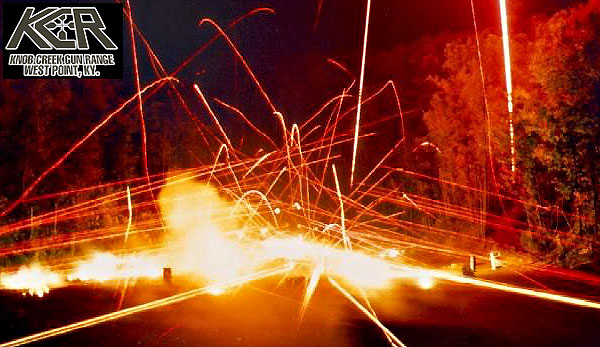
Twice a year, select-fire fans head to the Knob Creek Gun Range in West Point, Kentucky, for the nation’s largest Machine Gun Shoot. A bi-annual event, the Machine Gun Shoot is held in April and October. This year’s fall Machine Gun Shoot will take place October 9-11, 2015. The highlight of every Machine Gun Shoot is the Saturday Night event, where scores of guns send regular and tracer bullets down-range. An estimated 1.25 million rounds are fired each year during the October Night Shoot.
Click Triangle to Watch Knob Creek Machine Gun Shoot Video (Warning: Very Loud Audio)
This video was created by Top Shot Season 4 Champ Chris Cheng.
In recent years, Forster Co-Ax® presses have been somewhat hard to find, as demand has out-stripped supply. However, right now Grafs.com has Co-Ax presses in stock, at just $299.99 — that’s six percent off the regular price. This sale price includes a set of jaws, and includes ground shipping (in the lower 48), after a single $7.95 (per order) handling fee. If you’ve been hankering for a Co-Ax press, now is definitely a good time to buy.
If you are not yet familiar with the many unique features of the Forster Co-Ax, we recommend you watch the video embedded below. This shows how the press operates and highlights the design elements which set the Co-Ax apart from every other reloading press on the market.
Forster Co-Ax Press Video Review
This is a very thorough review of the Forster Co-Ax done by Rex Roach. This 14-minute video shows the key Co-Ax features, explaining how the floating case-holder jaws work (3:30 time-mark), how the dies are held in place (4:40 time-mark), how spent primers are captured (6:10 time-mark), and how to set the primer seating depth (10:00 time-mark). We’ve used a Co-Ax for years and we still learned a few new things by watching this detailed video. If you are considering purchasing a Co-Ax, definitely watch this video start to finish.
The Co-Ax case-holder features spring-loaded, floating jaws. These jaws have two sets of openings, small and large. This allows the system to adapt to various rim diameters. The jaw plates can simply be reversed to switch from small jaw to large jaw. In the photo above, the Co-Ax is configured with the large jaw openings in the center.
They knocked it, tossed it, even hammered with it — but they couldn’t kill a Nightforce NXS. In this remarkable torture test video, past Nightforce Exec Kyle Brown (with help from NF employee Sean Murphy), absolutely brutalizes a Nightforce NXS 5.5-22x56mm scope. Brown bangs the NXS on a concrete bench-top, throws it 50 yards downrange, knocks it on a hardwood beam multiple times, and then heaves it back again. We kid you not. To our eternal surprise, the Nightforce scope survives all that abuse and shoots fine. What did Timex once say — “Takes a licking and keeps on ticking”?
Video is Continuous — No Tricks
You’ve got to watch this video — it was shot with five cameras and runs with no “time-outs”, cutaways, or video tricks. What you see is what you get. This is one tough NXS. Thank you Kyle Brown and crew for taking the time to prove the durability of Nightforce Optics products.
The Kestrel weather meter is an invaluable tool for shooters. While the standard model Kestrels can record wind and atmospheric conditions, the advanced Kestrel 4500 Shooter’s Weather Meter with Applied Ballistics incorporates a built-in ballistics program developed by Bryan Litz of Applied Ballistics. This is a very powerful tool, but it can be a bit complicated to program at first.
In this detailed 22-minute video, John McQuay of 8541 Tactical shows how to input firearm specs, MV, and BC into a Kestrel 4500 NV (Applied Ballistics model). This handy unit combines a Kestrel Weather meter with a full-fledged ballistics computer.
Step-by-step the video shows how to set up all the important variables. The video shows how to input Muzzle Velocity, Bullet BC (G1 or G7), Zero Distance and the other key ballistics variables. In addition, the video explains how to input gun-specific data such as bore height, barrel twist rate, and barrel rifle twist direction (right-hand vs. left-hand). (Twist direction comes into play in long range spin drift calculations).
If you own a Kestrel 4500 NV (Applied Ballistics), we think you’ll find this video helpful — particularly when it comes to setting up some of the lesser-known data items. The video also offers tips on navigating through the menus most efficiently.
Legendary shooter Jerry Miculek holds multiple world records, and has amassed over 80 major championship titles. He is considered “one of the fastest trigger fingers” on the planet. In this video, Jerry puts his skills to the test, using a Barrett m82A1 .50 BMG in a timed speed run. Watch the video, starting at the 1:20 mark, to see this amazing speed run.
Watch Miculek Shoot .50 BMG Offhand. Action Starts at 1:20:
Jerry shoots six (6) .50 BMG rounds in under one second (0.98 to be precise). And Jerry did that standing (offhand) without a rest. What can you say… the man is a beast.
If you look carefully, in this frame you can see a .50-Cal bullet in flight forward of the muzzle brake.
Jerry was a bit apprehensive at first: “This is by far the most horsepower I’ve had in my hands ever in my life. So the learning curve is going to be kind of really abrupt.” But as he shoulders the big Barrett and gets ready to punch six rounds on the clock, Jerry gets enthusiastic: “This is going to be fun guys … six rounds .50 BMG … Time to rock and roll!”
After filming this video, Jerry did more drills with the Barrett and he actually brought down his split times. Jerry reports: “I managed to get it down to 0.16 splits and I outran the bolt a few times. You can actually see that in the closing slow-motion footage. You just can’t expect such a massive gun to cycle as quick as a 1911 or your M&P/ Glock type pistols unfortunately.”
In this video Larry Vickers tries his hand at long-range shooting, with assistance from Gunsite Instructor Walt Wilkinson, a .50-Cal Champion. Larry shoots an Accuracy International AX chambered in .338 Lapua Magnum, while Wilkinson pilots a .50 BMG Steyr HS-50 rig. Wilkinson mentors Vickers, covering the basics of long-range shooting from bipod. Over the course of the shooting session, Wilkinson debunks some common misconceptions while Larry attempts shots out to 1470 yards.
This video is fun to watch, but understand that this is intended more for tactical shooters who will be satisfied with one-MOA accuracy. Wilkinson says that, with the kind of tactical rifles being used, and factory ammo, achieving one-MOA groups at long range is a realistic goal: “A one-MOA gun… that’s what you’re looking for. In most cases, with the … environmental changes, the ammunition, and the rifle put together, a one MOA group is really what you should expect [at best].”


 On its YouTube Channel, the USAMU offers “Pro Tips” videos providing expert instruction on rifle marksmanship. One helpful video covers up/down angle shooting. In the video, SFC Emil Praslick III, one of America’s best long-range shooting coaches, explains how to determine up/down angle, and how to compensate for the angle using scope clicks. Praslick explains how gravity always works as a constant relative to the flat-ground distance to the target (which is distinct from the actual straight-line distance to target.)
 Since the effects of angles increase with distance, Praslick explains that: “Unless the angle is extremely severe, [a hunter] really won’t notice these effects at ranges of 200 yards or less.” However, for long shots, hunters definitely need to compensate when taking angled shots. Praslick recommends that hunters print out a small chart with the cosines of common angles (20°, 25°, 30° etc.). In addition, hunters need an accurate ballistic table for their rifle and particular ammo. This should show the elevation corrections (in MOA or clicks), for 200 yards to the maximum range at which you may take a shot.

 MVP-LC Featured in Shooting Illustrated

 In this NSSF video, Ryan Cleckner shows how to set up a scope on a hunting or tactical rifle. Ryan, a former U.S. Army Sniper Instructor, notes that many hunters spend a small fortune on equipment, but fail to set up their rifle to use the optics optimally. Cleckner likens this to someone who owns an expensive sports car, but never adjusts the seat or the mirrors.