Didn’t get enough of Camp Perry this summer? Then tune in to Shooting USA TV this evening. Tonight’s episode of Shooting USA television spotlights the National Matches and CMP events at Camp Perry, Ohio. The National Matches at Camp Perry are the World Series of American shooting sports, attracting the nation’s top pistol and rifle marksmen. There are individual competitions, such as the Vintage Sniper Match, or the M1 Garand Match featuring legendary firearms. Then there’s the National Trophy Infantry Team Match, known as the Rattle Battle among competitors, simulating an assault by an Infantry Squad. Catch this episode of Shooting USA on the Outdoor Channel. NOTE: This is a repeat broadcast including footage from the 2014 National Matches.
Tubb 2000 rifle, left-hand version. Note how the butt-plate is adjusted for cant, angle, and drop.
The 1903 Springfield on Tonight’s Show
Vintage military rifle fans take note — this week’s show also features an American classic, the U.S. Rifle, Model of 1903, better known as the 03 Springfield. While its design was initially borrowed, its accuracy, quality and service record proved to be a fine military bolt-action rifle in the trenches of WW I and on into World War II. “It was a beautifully made gun, extremely, extremely well balanced,” says Firearms Historian Garry James.
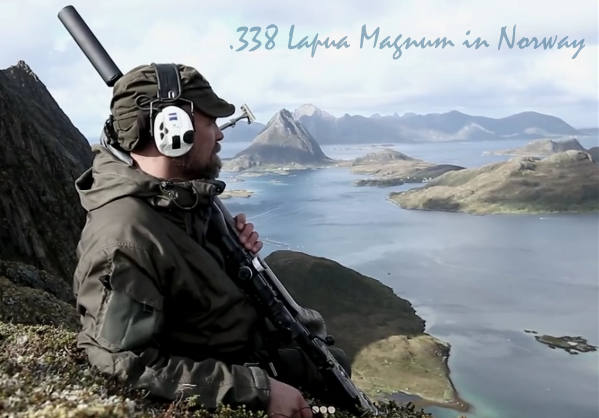
This is one of the finest shooting videos we’ve ever seen. Set in the scenic Fjordland of northern Norway, this high-quality 15-minute video is part Nat Geo travelog, part ballistics lesson, part gear review. We wish we had the opportunity to join Ulf Lindroth and Thomas Haugland on their remarkable shooting adventure. This video was originally created for Great Britain’s Fieldsports TV Channel.
This is an outstanding video, recommended for anyone interested in long-range hunting.
Long range shooters Lindroth and Haugland traveled to the Arctic Circle to field test a new .338 LM Blaser R8 (in GRS stock) fitted with a Zeiss Victory V8 4.8-35x60mm scope. (Ammo is Norma-brand .338 Lapua Magnum). The video shows how they confirm the ballistics of the Norma factory ammo in the Blaser R8 rifle system.
Ulf and Thomas initially test out the system confirming drop at multiple yardages, and then use the rifle for practical accuracy. Ulf says: “If you know your hunting will demand a long shot, and you want to push the limit but still be sure to make the first-shot kill… If you want to do an ethical hunt, if you want to push that limit, you have to do [this kind of testing].”
Ulf Lindroth (above) observed: “We shot [at 808 meters] observed the misses, clicked our way into the target, and now we have the true drop at that distance… in this air pressure, in this temperature. From there we can start working to find our TRUE trajectory. And when we have THAT… we can get serious about some target shooting.”
Applied Ballistics has created a new series of YouTube videos about precision long range shooting. Featuring ace long-range shooter and professional ballistician Bryan Litz, these videos address various topics of interest to long-range marksmen. In this week’s video, the second in the series, Bryan Litz examines the most common causes of ballistics shooting errors at Long Range.
Watch Applied Ballistics Video about Common Mistakes in Long Range Shooting:
Bryan Litz of Applied Ballistics often hears the question: “What are the main reasons people miss their target at long range?” To answer that question, in this video, Bryan explains the most important variables in Long Range shooting. Bryan says: “Probably the number one thing is range — you have to have a [precise] range to your target because your bullet is dropping, and to hit the target you need to correct for bullet drop.” Distance may be indicated on the target bay (or berm), but for open ranges you should ascertain distance-to-target with a quality laser rangefinder. Even when the distance to target is shown with a sign or marker, you may want to confirm the distance with your rangefinder. (You may be surprised — we’ve seen marked target distances at commercial ranges off by 25+ yards!) Bryan says: “Get a good laser range to the target and you’ll be within a couple yards”.
After distance to target, the most important variable is the wind. This is the most challenging factor because the wind is constantly changing. Bryan explains: “After 300 or 400 yards, the wind [will] move your shots off the target if you don’t correct for it. The best way to account for the wind is to measure it at your location with a Kestrel. The Kestrel can give you the speed and direction of the wind at your location, which can baseline your wind call for your long-range shot.” Bryan acknowledges that there will still be variables: “The wind isn’t always blowing the same downrange as at your location… and the wind is always changing”. Bryan notes that you need to account for variances in wind between the time you gauge the wind angle and velocity and the time you actually you take your shot.
Do you have some old, tired brass that needs a thorough cleaning — inside and out? Consider using an ultrasonic cleaning machine. When used with the proper solution, a good ultrasonic cleaning machine can quickly remove remove dust, carbon, oil, and powder residue from your cartridge brass. The ultrasonic process will clean the inside of the cases, and even the primer pockets. Tumbling works well too, but for really dirty brass, ultrasonic cleaning may be a wise choice.
Our friend Gavin Gear recently put an RCBS Ultrasonic cleaning machine through its paces using RCBS Ultrasonic Case Cleaning Solution (RCBS #87058). To provide a real challenge, Gavin used some very dull and greasy milsurp brass: “I bought a huge lot of military once-fired 7.52x51mm brass (fired in a machine gun) that I’ve been slowly prepping for my DPMS LR-308B AR-10 style rifle. Some of this brass was fully prepped (sized/de-primed, trimmed, case mouths chamfered, primer pockets reamed) but it was gunked up with lube and looking dingy.”
UltimateReloader.com Case Cleaning Video (7.5 minutes):
Gavin describes the cleaning exercise step-by-step on UltimateReloader.com. Read Gavin’s Cartridge Cleaning Article to learn how he mixed the solution, activated the heater, and cycled the machine for 30 minutes. As you can see in the video above, the results were impressive. If you have never cleaned brass with ultrasound before, you should definitely watch Gavin’s 7.5-minute video — it provides many useful tips and shows the cleaning operation in progress from start to finish.
The RCBS ultrasonic cleaning machine features a large 3-liter capacity, 60 watt transducer, and 100 watt ceramic heater. The RCBS ultrasonic machine can be found under $140.00, and this unit qualifies for RCBS Rebates ($10 off $50 purchase or $50 off $300.00 purchase). RCBS also sells 32 oz. bottles of cleaning concentrate that will make up to 10 gallons of Ultrasonic Solution.
Every week Brownells Merchandise Manager Paul Levy hosts a video featuring new products. We’ve seen these vid clips before, but three products in this week’s video really caught our attention. We like the new MTM Ammo Crate, and the new Durablue coating offers a great option for gun-owners who want a traditional-looking finish that is also durable. And for AR-10 owners, the gold-tone Titanium Nitride Bolt Carrier group promises smoother running with easier cleaning.
Products featured in this week’s video include:
MTM Ammo Crate. Wide, flat polymer box features O-ring seal for water resistance, and stackable shape for convenient storage. Integral handle makes for easy transport. Holds up to 85 lbs. of ammo, magazines, and any other type of supplies or gear. Available in 4½”- and 7¼”-deep models.
Titanium Nitride is an extremely robust, durable coating, and now it’s available on an AR-10 bolt carrier group. The new Prime Weaponry .308AR Titanium Nitride Bolt Carrier Group drops into AR-10 type .308 AR uppers. The tough gold-tone finish resists wear and corrosion, plus the slick surface speeds up the cleaning process.
Duracoat DuraBlue is a new spray-on coating that provides a deep, glossy finish like traditional bluing but without the worry of rust, scratches, or high cost. DuraBlue comes in an aerosol can or liquid form (for application with sprayer) in both glossy black and traditional blue. DuraBlue can be used on on all kinds of metal, even stainless steel and aluminum.
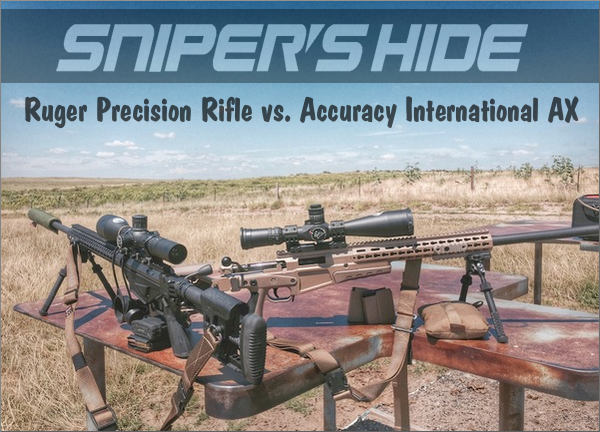
Sniper’s Hide has just released an interesting comparison test, running the $1150* Ruger Precision Rifle vs. a $7000 Accuracy International AX in a 450-yard “mad minute” drill. The goal was to see how many shots could be put on a 12″ steel target in one minute. Both rifles were chambered for the 6.5 Creedmoor and were fed with Hornady 140gr Amax ammo. The much cheaper Ruger did surprisingly well, though the AI AX did come out on top. Frank Galli, Head Honcho of Sniper’s Hide, got 19 rounds on target in one minute with the AI AX compared to 14 rounds with the Ruger.
Watch the “mad minute” face-off in this video:
Galli notes: “The target is 450 yards away, and, as noted in the video, we have winds gusting anywhere from 10 to 18 mph out on the Front Range of Colorado today. So my job is to not only hit the target as fast as possible, but to also manage the conditions.”
In Summary
Frank Galli says the Ruger offers a lot of bang for the buck:
“For those looking to get into competitive tactical shooting, like a PRS Event, there is absolutely no excuse. This rifle will allow you to be competitive, the only thing that would hold a person back is themselves. The more this rifle is shot, the more impressive it is. Would I trade my Accuracy International for one? Well, odd question, but no. However for those on a budget I would recommend the Ruger in a heartbeat.”
*MSRP for the Ruger Precision Rifle is $1399.00. Some dealers are posting prices as low as $1100.00, but $1150.00 seems typical.
In some areas of the country (California in particular), hunters are now forbidden to use bullets that contain lead. If you need a lead-free projectile for your deer rifle, consider Nosler’s E-Tip projectile. This has plenty of penetrating power and retained energy while complying with laws requiring “unleaded” ammunition. An “expansion chamber” behind the green polymer tip helps ensure reliable expansion with 95% weight retention. The video below shows a .30 Caliber 180gr lead-free E-Tip power through TWO 12-inch blocks of Ballistics Gel at 100 yards. This was fired from a .308 Winchester.
Watch 180gr eTip Penetration and Expansion in Ballistic Gelatin:
Nosler claims the E-Tip bullet has advantages over other solid copper hunting bullets: “Unlike the competitor’s one-piece designs, Nosler E-Tip bullets will not blow the petals off at extreme velocities nor will the low end expansion ever be questioned, as the minimum impact velocity is set at 1800 fps for standard calibers.” One hunter, posting on Facebook, gave the E-Tip high marks: “I have had the opportunity to take a pig with a 130 gr E-Tip from my .270 and they work flawlessly. My son took two pigs with his .300 Win Mag and 165gr E-Tips and they worked flawlessly as well.”
This video illustrates the design and construction of the Nosler eTip Bullet:
One Pistol, Two Barrels, Two Playing Cards — here’s a trick shot we just had to share. The talented Kirsten Joy Weiss does something we’ve never seen before, splitting TWO (2) playing cards with a unique, twin-barreled 1911-style pistol. Watch the video to see Kirsten pull off this double-barreled doozy of a trick, firing two bullets at the same time.
It took a few tries, but Kirsten makes the shot at the 3:14 time-mark:
Kirsten was enthusiastic about this unique trick: “Splitting two cards with two bullets fired at once? The double-barreled 1911 was just begging for a trick shot application. Arsenal Firearm’s 2011 A1 twin-barrel, 1911-style pistol is a heavy monster to wrangle, but a lot of fun to shoot!”
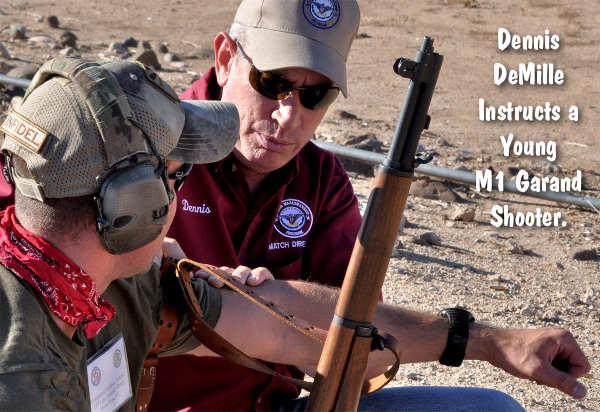
Dennis DeMille is a past Camp Perry National Champion, and he still one of the nation’s top Service Rifle shooters. Since retiring from the U.S. Marine Corps, Dennis has served as the General Manager of Creedmoor Sports. Some years back we had the chance to interview Dennis at the old Creedmoor offices in Oceanside, California. With his decades of competitive experience, Dennis has a wealth of knowledge. In this 3-minute interview, Dennis shares insights into the High Power shooting game. He discusses the most effective ways to train for competition, the fundamentals of good marksmanship, and how to recognize and perfect your natural point of aim. Dennis also offers solid advice on how to get the best “bang for your buck” when choosing shooting accessories for High Power and Across the Course competition.
The CMP’s National Trophy Infantry Team Match (NTIT) has been a staple at the National Matches since 1922. Also known as the “Rattle Battle,” the event is one of the most unique in the competitive rifling world — scoring is based on how many hits six-person teams can score on a bank of targets during a series of 50-second firing periods at four yardages. Teams begin the NTIT match with 384 rounds of ammunition, which they fire upon eight silhouette targets from 600, 500, 300 and 200 yards during successive 50-second periods. After each rapid-fire string, team members move forward (to the next-closest distance) carrying all equipment from firing line to firing line. The match emphasizes extremely fast, accurate fire and good communication among teammates. The Rattle Battle is always an exciting competition for spectators to watch. View NTIT match results on the CMP website.
Watch CMP ‘Rattle Battle’ Video — 50 Seconds of Rapid Fire…
The video shows the California Grizzlies, one of the top junior squads. The lead photo shows the U.S. Army Reserve (USAR) Team in action during the NTIT match. See more in USAR “Rattle Battle” Video.


 The 1903 Springfield on Tonight’s Show