The “Top Guns” of the tactical shooting world will be heading to the PRS Finale this upcoming weekend. This event, the culmination of the 2013 Precision Rifle Series, runs December 6-8, 2013 at the K&M Precision Rifle Training facility in Florida. The PRS Finale is a unique championship-style match for the nation’s best tactical shooters, competing with bolt-guns in four divisions: Pro, Semi-pro, Military, and Law Enforcement. To learn more about the PRS, visit PrecisionRifleSeries.com. You’ll find a good article on the ModernServiceWeapons.com (MSW) website, that outlines PRS rules, spotlights PRS match venues, and lists recommended gear. READ MSW PRS Article.
Below is a great video covering the 2012 PRS Finale from start to finish. Held at the Rifles Only range in Texas last December, the 2012 event drew 55 of the nation’s top tactical shooters, who competed for glory… and thousands of dollars worth of cash and prizes. If you like the tactical game, you’ll love this professionally-edited video. Because this video is over 29 minutes long, we’ve provided a timeline so you can quickly find the highlights:
AUDIO: Click Button to hear Rich Emmons Talk about the Precision Rifle Series.
Video TimeLine:
Registration:1:56
Chrono Work: 2:25
Night Briefing: 3:10
Day One: 4:00+
Running Wire: 5:15
Prone Mover: 6:48
Tower Challenge: 7:12
Net Challenge: 8:43
Tri-Level Barricade: 11:28
1/4-Miler Berzerker: 11:52
Mound Shot: 12:57
Platform: 13:14
Platform Mover: 13:42
5-Target Speed Dot: 14:26
The Rat Trap: 15:00
End of Day One Brief: 16:42
Day Two Start: 17:22
Ace Challenge: 17:30
Know Your Limits: 18:54
Non-Supported Engage: 19:25
Culverts Only: 20:25
Awards Ceremony: 23:15
Sponsor Credits: 26:50
Interviews with Competitors: 27:24
How did the PRS get started? Rich Emmons, PRS President, explains that the concept was to “accumulate ten or so matches and create a point series” that would determine “who was the best [tactical] rifle shooter in the country”. Rich says that: “It’s a points race, but it’s also a big Finale that brings the ‘best of the best’ all together in one ‘monster’ match.” The winner of the 2012 PRS Series was Wade Stuteville, who also took first in the 2012 Finale. Runner-up in the 2012 Series (with a third-place Finale finish) was Team GAP’s Chase Stroud. Jeff Badley of Team GAP finished third in the PRS 2012 Series (and second in the Finale). SEE 2012 PRS Pro Shooters Equipment List.
How to Get Started in Tactical Matches
If this fun and challenging tactical discipline appeals to you, head out to the range and get involved. Begin with local matches and develop your skill set. You don’t have to invest in $6000.00+ worth of rifle and optics. GAP’s George Gardner says you don’t need ultra-expensive gear: “The most important piece of gear is yourself. A one-minute rifle [can] win these matches every time… so you’ve got to bring it. You don’t get good overnight, so for someone trying to get into this, just shoot — you’ve got to get out there and shoot. My advice would be to get out and shoot one of these matches. It doesn’t matter how you place — just do it. You have to have a starting point. If you don’t start, you’ll never finish.”
Everyone should secure their firearms and valuables in a safe place. For most folks, that means getting the biggest, heaviest gun safe they can afford. There is another school of thought, namely “hiding in plain sight”. The theory here is that you hide valuables inside common, every-day items that would not attract the attention of thieves. A hollowed-out hardback book is a classic example.
Well here’s the “book safe” idea carried one better — an entire full-size book cabinet fitted with hidden storage. Some clever wood-workers have come up with custom-crafted cabinets with secret compartments. We first saw one of these cabinets on Glocktalk some months ago, and now matthew [at] archangelwoodworks.com has created a large, elaborate wooden bookcase that contains multiple secret compartments. The patent-pending QLine SafeGuard Shelving System “is available in your choice of wood or custom colors. Dimensions can be altered to suit your needs. Shelving or compartments are customizable for your specific application.” QLine Design also offers media centers and coffee tables with secret compartments. Watch the video to see a half-dozen secret shelves, drawers and vertical compartments built into the QLine SafeGuard bookcase. Watch all the way through — it gets more and more amazing….
Video Reveals Secret Compartments — Check it Out
Credit Steve of the Firearm Blog for finding this YouTube Video.
Smaller, Custom Cabinet with Secret Compartments
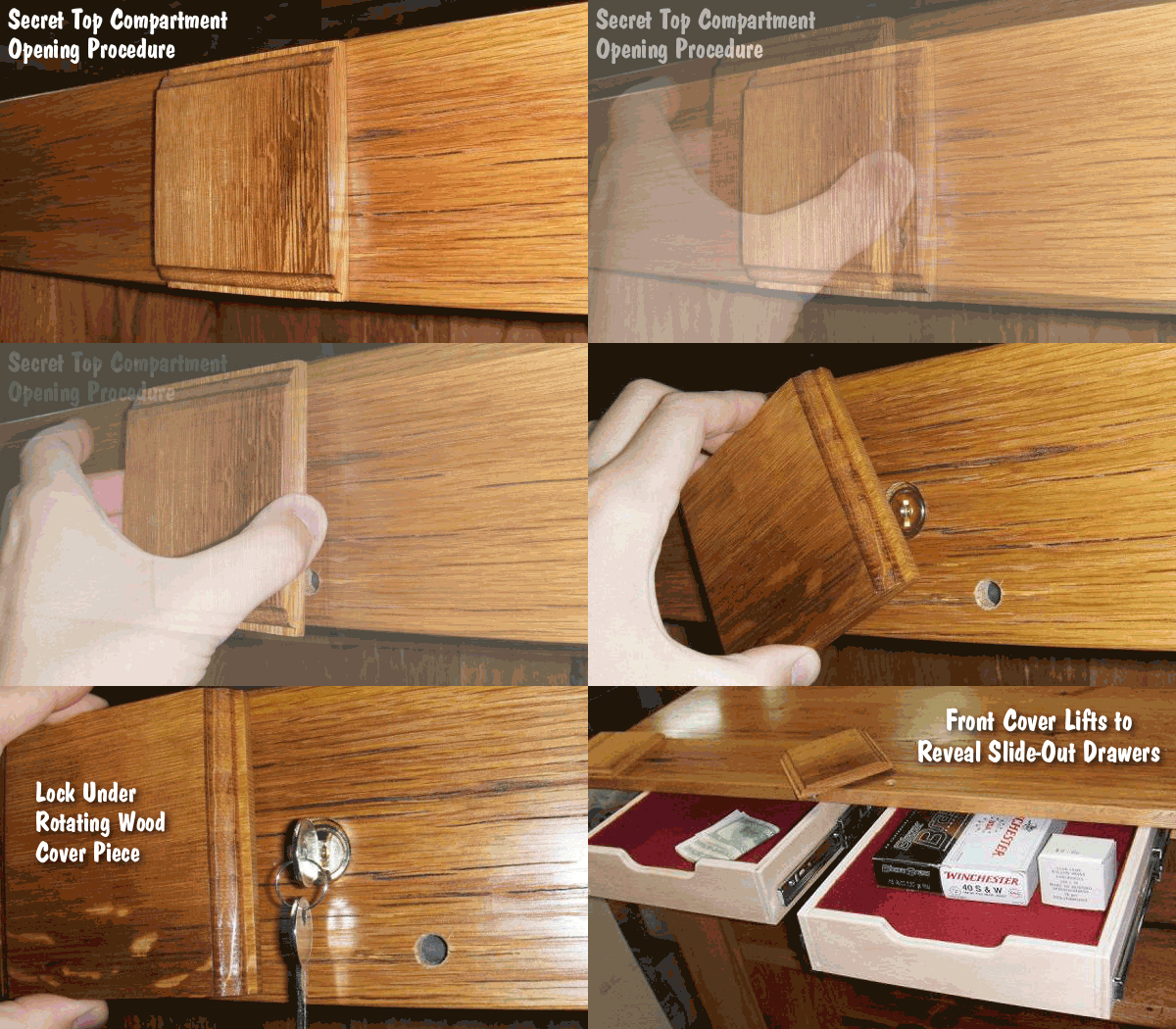
If you’d like to see a smaller cabinet with hidden compartments, check out Hidden in Plain Sight thread from 2012 on Glocktalk. That thread features a custom oak cabinet with a lock-secured secret shelf on the top and two hidden compartments on either side, with slide-out vertical drawers. We like the idea of hiding locks under movable wood covers — for an added measure of security.
EDITOR’S COMMENT: We still recommend a heavy, steel-walled quality gun safe for storage of firearms. A wood cabinet offers no fire protection, and “hidden in plain sight” systems are only useful until thieves get wise to the gambit. Still, clever engineering (and impressive word-working) went into the cabinets shown above. This style of cabinet could be a good option for storing smaller items such as knives, cameras, watches, and laptop computers if your regular gunsafe is already full to the brim.
When we first ran this video a couple years back, readers were amazed at the off-hand, rapid-fire shooting skills of this young, German hunter, armed with a Sauer 202 rifle.
Check out this video of a young German hunter, Franz Albrecht Öttingen-Spielberg. Shooting off-hand with a Sauer 202 bolt action, he makes multiple kills on wild boar running at full speed. Half way through the video, a pack of boar crosses right to left, running fast. You need slow motion to see all Franz’s hits as he engages one animal after another. He doesn’t hit with every shot, but a quick count shows that nearly half his shots, fired rapid-fire from a standing position, were solid takedowns. Notice how Franz “leads” his prey, moving the muzzle from right to left along the animals’ path.
Slow-Mo Video Reveals Knock-Down Power of 7mm Rem Magnum
Near the beginning of the video, slow-motion footage reveals bullet trace, and the bullet’s impact on a running boar. The shot takes the boar right at the top of the shoulder and the animal goes down in a heap. This is impressive shooting. The video shows what is possible with a skilled marksmen, a powerful cartridge (7mm Rem Magnum), and an accurate, smooth-cycling bolt gun.
Can a pumpkin be launched over a mile? Can a gourd go super-sonic? These vital questions will be answered on Thanksgiving Day as the Science Channel covers the annual Punkin Chunkin World Championship held in Sussex County, Delaware. The previous record, set in 2011 by the Second Amendment Too Air Cannon, is 4,329.37 feet, or 0.8199 miles (1443 yards). The heavy artillery will be out in force this year — trying to break that record, and maybe hit the mile mark in the process.
Each year, competitors roll out some amazing machines designed to propel pumpkins “farther, higher, faster”. The mighty air cannons are the distance kings, but the wild and crazy devices in the torsion, trebuchet, catapult, and centrifugal divisions are impressive to watch. Many of these fearsome-looking machines replicate the designs of medieval military siege weapons.
Team Builds $168,000 Air Cannon in Effort to Go Supersonic and Chunk One Mile
With the goal of launching a pumpkin one mile, considered the “Holy Grail” of Punkin Chunkin, the American Chunker team has developed one of the biggest, baddest air cannons ever. With a new 540-horsepower compressor pumping out 500 psi of pressure, the creators of this massive cannon hope to send a pumpkin supersonic. This cannon represents an investment of $168,000 and 2800 man-hours. State-of-the art sensors are used to gauge pressure and measure the pumpkin’s speed in flight. Will the team break the sound barrier? Watch the Science Channel special to find out.
Great Video on High-Tech Air Cannon (Amazing Stuff!)
To catch all the Punkin Chunkin action, tune your TVs to the Science Channel on Thanksgiving Day, November 28th. At 8:00 PM Eastern, the Science Channel devotes a full hour to America’s wildest display of agricultural artillery — Punkin Chunkin. This hour-long special TV event covers the 2013 World Punkin Chunkin Championship. This fun-filled event, held near Bridgeville, Delaware each November, draws up to 70,000 spectators, raising money for charity. The Punkin Chunkin special is hosted by Tory Bellici, Kari Byron, and Grant Imhara from Mythbusters. Like Big Guns? View Chunkin Air Cannons Gallery.
Are you ready for some football? Here’s a clever rimfire challenge target from MGM Targets. Trust us, this thing is a hoot to shoot. And having fun is still the best reason to go shooting, right?
On this $129.00 Football Target, the vertical spinner runs on a threaded, horizontal “drive shaft”. When you hit the top plate, the spinner moves to the left. When you hit the bottom plate, the spinner rotates in the opposite direction, moving to the right. The goal is to advance the spinner all the way to one end zone for a “touchdown”. This target lets two rimfire shooters compete head-to-head. For a two-man game, each competitor selects a target plate (upper or lower). They can then either fire simultaneously or take turns. Whoever drives the spinner to his end zone first wins. A solo shooter can also have fun, running the spinner in one direction, and then back the other way.
The MGM Football Target is based on a patented invention of Aaron Witmeyer, of Prineville, Oregon. This unique target rewards rapid, but accurate fire. You’ll find that once you’ve developed a rhythm, you can keep the spinner moving toward your goal pretty quickly. But miss a shot and your opponent can reverse the momentum — just like an interception on the gridiron. You can either start with the spinner centered up at the “50-yard line” or you can give a “head start” to a less experienced opponent by starting the spinner closer to the opponent’s end zone. This works great for parent vs. kid matches — giving the youngsters a head start. Made from AR400 steel, the MGM Football Spinner target is suitable for rimfire use only — don’t ever use centerfire ammo! After placing the 18″ X 17″ X 11″ target frame on the ground, you can use tent pegs to secure the frame’s lower cross-piece for extra stability.
Hey it’s the end of the work week, so we thought you guys might enjoy a little display of honest-to-goodness American .50-Cal firepower. Today’s video features the General Dynamics GAU-19/B Gatling, shown in a vehicle mount (Part 1) and helicopter side-mount (Part 2). The HumVee-mounted version of this bad boy delivers 1300 rounds per minute of .50 BMG ammo. The effect is awesome to behold. We wouldn’t want to be on the receiving end of a GAU. The original GAU-19/A had a selectable rate of fire — either 1,000 or 2,000 rounds per minute. The GAU-19/B, introduced in 2012, provides the same firepower in a much lighter platform, weighing 106 pounds (not counting ammo storage systems).
Tonight’s Episode of Shooting USA TV features the 2013 International Revolver Championship (IRC) from the Hogue Action Shooting Range located near Morro Bay, California. You can see another winning performance by Jerry Miculek. Hosted by the International Confederation of Revolver Enthusiasts (ICORE), this event draws hundreds of the world’s best wheelgunners. John Scoutten and Mike Irvine cover the action. The show airs on the Outdoor Channel at 3:30 pm and 8:30 pm Eastern Time (check local listings for other zones).
World’s Best Wheelgunners
The IRC, held May 31 through June 2, 2013, was the highlight of this year’s revolver shooting season. More than 240 of the world’s top revolver shooters negotiated their way through 12 stages of fire putting more than 70,000 rounds down range. Competition at the IRC is divided into three divisions: Classic, Iron Sights, and Open. Classic Division competitors use six shot revolvers and speed loaders, no moon clips allowed. In the Iron Sight Division, shooters are allowed up to eight rounds in the gun, with moon clips to speed reloads. Traditional iron sights are required. The Open Division includes eight-shot cylinders, moon clips, barrel porting, or compensators, and electronic optics.
Along with the adult classifications, the IRC features divisions for Junior shooters. The junior events are always crowd-pleasers. Some of these youngsters are definitely future champions in the making. The video below shows the 2009 IRC Junior Shoot-Off for the overall Junior Title.
Wouldn’t it be great if you could apply a durable, two-part, commercial-grade coating on gun parts, with the ease of “rattle can” spraying. Until recently, you had to have some pro-grade equipment to apply multi-stage coatings. Now that has changed thanks to a new “can-in-a-can” developed in Europe. DuraCoat® can now be applied, in your choice of nine colors, from a single, convenient rattle can. The secret is the new type of twin-chamber can construction. An inner chamber holds the DuraCoat hardener (catalyst), while an outer chamber contains the DuraCoat color coating liquid.
The “can-in-a-can” design keeps the two elements completely separate until you are ready to apply the coating. It’s really quite ingenious. Duracoat’s owner, Steve Lauer, found this innovative dual-chamber aerosol can design in Europe. We believe his company, Lauer Custom Weaponry is the first to introduce this spray can technology in the American gun coating market.
Video Shows How to Apply DuraCoat with New Twin-Chamber Aerosol Can
DuraCoat is a two-part coating system. Once the DuraCoat is mixed with the hardener, a chemical reaction occurs. That is why the two fluids must be kept separated until it’s time to coat a project. When you’re ready, you mix the two products by pushing a plunger in the bottom of the can. This is done by attaching a red button to the bottom of the can. Push down on the can and you’ll here a “pop” that indicates the hardener can migrate into the main chamber. Shake the can for a couple minutes and you are good to go (provided the product to be coated has been prepped properly.)
DuraCoat is Versatile
Duracoat can be used on carbon steel, stainless steel, aluminum, metal alloys, wood, plastic and many other surfaces. No baking or pre-heating is required. DuraCoat is not just a thin cosmetic layer like conventional paint. When properly applied, DuraCoat offers good abrasion resistance and very effective protection against corrosion. DuraCoat Aerosol is currently offered in nine (9) popular colors: Matte Black, Woodland Green, Parkerized Gray, OD Green, White, Combat Gray, Pink Lady, Magpul Flat Dark Earth, and Blackhawk Coyote Tan. View DuraCoat Color Chart.
Today marks the 238th anniversary of the founding of the U.S. Marine Corps. At Tun Tavern in Philadelphia on November 10, 1775, the Marine Corps was formed. At a ceremony marking the Marine’s “birthday”, (held at the Marine Corp Air Station in Yuma, AZ), Cpl. Uriel Avendano provided perspective: “The word Marine spans time, places, people, personalities and exploits. The faces of the Marines of the past tell the story of a tough, disciplined and proud people who loved the challenge and gave nothing but their best. Today the uniform has changed, but the motives remain the same… [O]ur duty remains the same. We are ready for anything, at any time and in any place.”
In the video below, Marines tell their own story. As well, the Commandant of the Marine Corps Gen. James F. Amos, and the Sgt. Maj. of the Marine Corps Micheal P. Barrett, speak to Marines and sailors about the timeless Marine qualities of courage and perseverance.
Here is a selection from the 238th Birthday Message by Marine Commandant Gen. Amos:
“For 238 years, the United States Marine Corps has proudly served our great nation with unfailing valor bolstered by the enduring fortitude of our fellow Marines, our families, and our friends…This is what unites us as Marines.”
“Marines of generations past built our reputation as the most disciplined and honorable warriors to ever set foot on a battlefield, and we have triumphed in every battle because our Corps has always focused on iron discipline and combat excellence. This is who we are…this is what we do! It matters not whether you carried an M-1, an M-14, or M-16. It matters not whether you fought on a lonely island in the Pacific, assaulted a citadel in the jungle, or marched up to Baghdad. It matters not whether you are a grunt, a pilot, or a loggie. What matters is that, when the chips were down and things got tough, your fellow Marines could count on you to stand and fight. … And fight you did!”
“This year we celebrate the anniversary of several epic battles in our celebrated history: the 70th anniversary of the 2d Marine Division landing on Tarawa, the 45th anniversary of the Battle of Hue City, and the 10th anniversary of the “March Up” to Baghdad. Marines who fought in these legendary battles each made their mark upon the history of our corps. They have passed a rich and illustrious legacy on to us — a much heralded reputation. It is ours to jealously guard, and it is up to us to make our own marks and thus proudly pass it on to the generations of Marines who will follow…. [T]here is no challenge we cannot overcome if we remain honorable and always faithful to our nation, our Constitution and each other. Happy birthday, Marines!”
Could your next metal scope rings, trigger guard, or muzzle brake be crafted with a 3D printing process? It’s possible. In fact, a wide variety of metal parts (even a complete handgun) can be printed using the latest 3D Direct Metal Laser Sintering (DMLS) process. The way this works is as follows: powdered metal is heated by a laser, causing the metal particles to fuse and solidify. This is progressively repeated, in vertically-stacked layers, until the entire metal part is complete. It’s like building a metal layer cake with the shape/size of each thin layer defined by a precise laser beam. The laser is guided by computer-controlled servos following a CAD “blueprint”.
This video demonstrates how metal parts are 3D printed using the DMLS process. This technology is offered by Solid Concepts, a leading rapid prototyping and manufacturing services company.
The Solid Concepts 1911 — World’s First 3D-Printed Metal Firearm
Solid Concepts has manufactured the world’s first 3D-printed metal gun using a laser sintering process and powdered metals. The gun, a .45 acp 1911 clone, has already handled 50 rounds of successful live-fire testing. A 1911 design was chosen because the “blueprint” is public domain. The gun is composed of thirty-three, 17-4 Stainless Steel and Inconel 625 components, crafted through the DMLS process. Even the carbon fiber-filled hand grips are 3D printed, using a Selective Laser Sintered (SLS) process.
Except for the springs, all the parts of this 1911 handgun were printed using the metal laser sintering process. Yes even the highly-polished slide, the barrel, the frame, and the hammer were printed. There are no forgings, castings, or conventionally-machined parts. With the exception of springs, all 30+ components in this prototype pistol were printed using Direct Metal Laser Sintering (DMLS) technology. Watch the video for a glimpse into the future of gun-making:
World’s First 3D-Printed Metal Gun Test Firing
Solid Concepts believes that its fully-functional, 3D-printed 1911 handgun proves the viability of 3D printing for gun parts, even highly-stressed components. Kent Firestone, V.P. of Additive Manufacturing at Solid Concepts, states: “We’re proving this is possible, the technology is at a place now where we can manufacture a gun with 3D metal printing. And we’re doing this legally. In fact, as far as we know, we’re the only 3D printing service provider with a Federal Firearms License (FFL). Now, if a qualifying customer needs a unique gun part in five days, we can deliver.”
Will we see complete 3D-printed metal guns on the market soon? That’s unlikely. It’s still more economical to produce complete guns the old-fashioned way. However, we may see 3D printing used for rapid prototyping. In addition, 3D metal printing has advantages for hard-to-machine parts with complex geometries. Solid Concepts reports that its 3D printed metal has fewer porosity issues than an investment cast part and better complexities than a machined part. It will be interesting to see what unfolds in the years ahead.


How to Get Started in Tactical Matches




 Can a pumpkin be launched over a mile? Can a gourd go super-sonic? These vital questions will be answered on Thanksgiving Day as the


 To catch all the Punkin Chunkin action, tune your TVs to the Science Channel on Thanksgiving Day, November 28th. At 8:00 PM Eastern, the Science Channel devotes a full hour to America’s wildest display of agricultural artillery — Punkin Chunkin. This hour-long special TV event covers the 2013 World Punkin Chunkin Championship. This fun-filled event, held near Bridgeville, Delaware each November, draws up to 70,000 spectators, raising money for charity. The Punkin Chunkin special is hosted by Tory Bellici, Kari Byron, and Grant Imhara from Mythbusters. Like Big Guns? View

 Hey it’s the end of the work week, so we thought you guys might enjoy a little display of honest-to-goodness American .50-Cal firepower. Today’s video features the General Dynamics


 Wouldn’t it be great if you could apply a durable, two-part, commercial-grade coating on gun parts, with the ease of “rattle can” spraying. Until recently, you had to have some pro-grade equipment to apply multi-stage coatings. Now that has changed thanks to a new “can-in-a-can” developed in Europe.
 DuraCoat is a two-part coating system. Once the DuraCoat is mixed with the hardener, a chemical reaction occurs. That is why the two fluids must be kept separated until it’s time to coat a project. When you’re ready, you mix the two products by pushing a plunger in the bottom of the can. This is done by attaching a red button to the bottom of the can. Push down on the can and you’ll here a “pop” that indicates the hardener can migrate into the main chamber. Shake the can for a couple minutes and you are good to go (provided the product to be coated has been prepped properly.)


