The Rimfire Challenge Shooting Association (RCSA) is now an official partner of the +ONE Movement, a mentorship program organized by the National Shooting Sports Foundation (NSSF). “RCSA is looking forward to a long relationship with NSSF,” stated RCSA Board President Peter Swenson.
NSSF +ONE programs encourage mentorship related to firearm safety, firearm basics, shooting sports, and hunting. The +ONE program focuses on peer-to-peer development in shooting sports and hunting.
About the Rimfire Challenge Shooting Association
Designed to introduce new shooters to shooting sports in an exciting, family-friendly format, Rimfire Challenge matches focus on competition with .22 LR rifles and pistols. Matches are open to shooters of all shooting experience levels, with events conducted at ranges nationwide. The annual RCSA World Championship takes place each October. See match action in the video below. The RCSA promotes rimfire competition nationwide, supports beginning competitors and clubs, and solicits support for rimfire events from industry businesses.
Watch Action from the 2023 Rimfire Challenge Championship at Cavern Cove Range in Alabama
Programs that inspire mentoring can make a huge difference. According to recent research, if just one out of three target shooters and hunters can introduce someone new to the shooting sports, we can help to secure a strong future for generations to come.
The NSSF encourages shooting sports enthusiasts and hunters to join the +ONE movement and invite someone to the range or afield. Learn more about the +ONE Movement by visiting LetsGoShooting.org and LetsGoHunting.org.
This article is Copyright 2023 AccurateShooter.com. No reproduction on any other site is permitted.
Do you have a friend or family member who is a first-time gun owner? Then show them this article. It provides important guidelines for new gun owners. There’s an Infographic printed below. And, there’s a helpful Firearm Storage and Safety Assessment Quiz. This walks gun owners through questions related to safe handling and storage of firearms. Here is Part One of the Quiz. If you click on this part, you can complete the entire Quiz and see how you score.
RCBS has released a special, limited-edition red, white and blue version of its popular Summit press to celebrate 10 years of the unique, small-footprint Summit. We have used RCBS Summit presses extensively and they has performed great, both in the shop and at the range. One of our testers even adapted his green Summit press to fit to a trailer hitch (see end of article).
The Summit single-stage reloading press has a cast iron frame surrounding a polished steel ram for smooth operation. The Summit’s unique C-Frame design allows it to be mounted virtually anywhere on your bench while being easily manipulated by both right- and left-handed users. With a 4.5″ opening, you have great full frontal access to your cases as there is no frame to obstruct your hands. Plus the Summit can be placed anywhere on your bench as there is no linkage below the press. And the shell-holder is stationary on the base making visual confirmation of powder charge level easy.
The Summit Press works with standard 7/8″-14 threaded dies, or 1-1/4″-12 with the reducing bushing removed. The ambidextrous design allows easy use by both right and left-handed loaders and the zero fitting ensures you can keep the press lubricated with your favorite lubricant.
Only 1,000 units of the Summit single-stage press will be made in the special red, white and blue Freedom Camo finish, making this 10th-anniversary run of presses instantly identifiable. The 10th Anniversary Summit Press comes with the short handle and features a tri-color Freedom Camo die plate. “The Summit Press has been a staple in our assortment for a decade,” said Justin Smith, RCBS Product Manager. “We wanted to do something special to mark 10 years of the Summit Press, and we thought making a red, white and blue Freedom Camo version … would be a fun way to do it.”
Like its classic green older brother, the 10th Anniversary Summit press readily accepts standard 7/8″-14 threaded dies for a wide range of cartridges, as well as 1-1/4″-12 threaded dies with the reducing bushing removed. CLICK HERE to learn more about the Summit Press, including the special 10th Anniversary edition. Currently you can order direct from RCBS for $379.99, but we expect other vendors to offer this 10th Anniversary Summit for considerably less.
RCBS Summit Mounted on Trailer Hitch For Loading Anywhere — No Bench Required
This story features a unique, American-designed rimfire rifle, chambered for the potent .17 HMR round. The current generation Browning T-Bolt has a tang-mounted ambidextrous safety, a choice of barrel contours, lengths, and finishes, and a variety of stock options. What sets the T-Bolt apart from other rimfire rifles is the way the action cycles. There is not a conventional bolt that requires four distinct motions (lift bolt handle up/pull back/move forward/rotate handle down). With the T-Bolt you simply pull the handle straight back to extract a round, then return it forward to chamber a new round from the Double Helix magazine. The cocking effort is divided between back pull and forward movement so the effort is relatively light and easy.
Among current rimfire rifles, the Browning T-Bolt ranks high for fit and finish. The bluing is very nice and the T-Bolt even boasts a gold-plated trigger shoe. Many different stock types have been offered in recent years including some very nice AA Maple stock models as shown below (click to zoom). These T-Bolt rifles exhibit very fine craftmanship. Current models are made in Japan under license to Browning.
Click image for full-screen T-Bolt photo with detail.
Browning T-Bolt Sporter AA Maple Model
RECEIVER – Steel; High polished finish; Drilled and tapped for scope mounts
BARREL – Medium Sporter; Blued finish; Free-floating; Semi-match chamber; Recessed crown
ACTION – Straight pull bolt action; Top-tang safety; Adjustable trigger
STOCK – AA Maple; Gloss finish; Checkered
FEATURES – Sling swivel studs installed
PRODUCTION – Limited quantities
T-Bolt Owner Talks about Function and Accuracy
“I have a Browning T-bolt in .17 HMR, but with the maple stock. It is probably my favorite .17 HMR rifle (also the most expensive). The rifle feels smaller than some of my other .17 HMR rifles. I think the length of pull is a little shorter. I do like the light weight and trim handling of the rifle and the straight-pull bolt can be cycled really quickly. Mine is quite accurate and will shoot one-inch groups at 100 yards with both Hornady ammo and the CCI A17 ammo.” — RexRay, Varminter.com Forum member.
Pros and Cons of the Browning T-Bolt
The T-Bolt has a reputation for good accuracy, provided you have a good lot of .17 HMR ammo (we recommend checking for bullet run-out before you shoot for groups). The straight-pull action works as advertised — it is fast, smooth, and easy-to-operate. The Double Helix magazine (covered below) is excellent. It is very compact yet ultra-reliable. Another plus is that the T-Bolt has been produced in many different versions, with a variety of stocks, and even a stainless action version.
What are the negatives? Some of the stocks have a somewhat short length-of-pull, but this is easily solved with spacers. The main complaint is the factory trigger — some owners say it is too heavy at about 4 pounds, though the break is clean. For varmint work, we could live with the stock trigger and put money saved into optics.
If you prefer a very light trigger, JARD makes a T-Bolt replacement trigger. Featuring an aluminum housing, the JARD T-Bolt trigger can be ordered with 12-, 16-, or 20-ounce pull weights. The JARD trigger offers a crisp, clean break significantly lighter than stock. But at $254.95 the JARD trigger is fairly expensive. Additionally there have been a couple complaints about slam fires at the lowest weights so we recommend the 20-ounce. Here is one owner review, from a Rimfire Central thread: “The new Browning T-Bolt is a great rifle in all aspects except for the trigger. In my case when I received my JARD trigger it was an almost drop-in installation with very little adjusting or fooling around. For me it made a decent little rifle a great little rifle.”
Browning Double Helix 10-Round Magazine
The T-Bolt’s patented 10-round rotary Double Helix™ magazine is a unique design that feeds very reliably and is easy to load. The Double Helix magazine uses a torsion drive spring and interlocking gear design to maintain correct timing and exact cartridge alignment for smooth, reliable feeding. The translucent gray body allows for easy verification of the number of remaining cartridges. We like the fact that the Double Helix provides TEN-round capacity while fitting nearly flush with the bottom of the action.
The Browning Double Helix rotary box magazine system is easy to load, easy to carry, and easy to use. The smooth, rounded exterior contours of the Double Helix, along with twin gripping grooves, tapered shape and a slightly extended baseplate design make insertion positive, while the spring-assisted drop-free magazine ejection feature allows for rapid magazine changes. T-bolt owners confirm that feeding and reliability is excellent — the magazine design puts cartridges in perfect alignment with the chamber.
Other Browning T-Bolt Variants
In recent years, Browning has produced T-Bolt rifles in a variety of models, with many different stock types and various barrel lengths/contours. Most of the photos above showcase the AA Maple Sporter T-Bolt, which is currently out of production, though still available from some dealers (if you search). We like the looks of the AA Maple T-Bolt, but there many other stock options including dark brown, Black, Green, and various camouflage finishes. Use the links below to see other T-Bolt configurations.
Current production T-Bolts are offered in four rimfire chamberings: .17 HMR, .22 LR, .22 Magnum, and .22 WMR. Barrel contours and lengths (from 2″ to 22″) vary from model to model. Shown below is the New-for-2024 T-Bolt Target SR (Suppressor Ready) and two other current models. Then we feature five notable discontinued T-Bolt rifle models. CLICK HERE to see all discontinued T-Bolt variants — many of which are still available if you search gun vendors.
.17 HMR Cartridge — Fast and Deadly on Small Varmints
We are big fans of the .17 HMR round. It’s just about perfect for ground squirrels, and is effective on prairie dogs out to about 200 yards. The three main .17 HMR producers have been CCI, Federal, and Hornady, but you will also see Browning and Remington .17 HMR ammo. Choose from 17gr or 20gr bullets — both work well in the varmint fields. A good source for all types of .17 HMR ammo is TargetSports USA.
Here is a Comparison Test of Multiple Types of .17 HMR Ammo
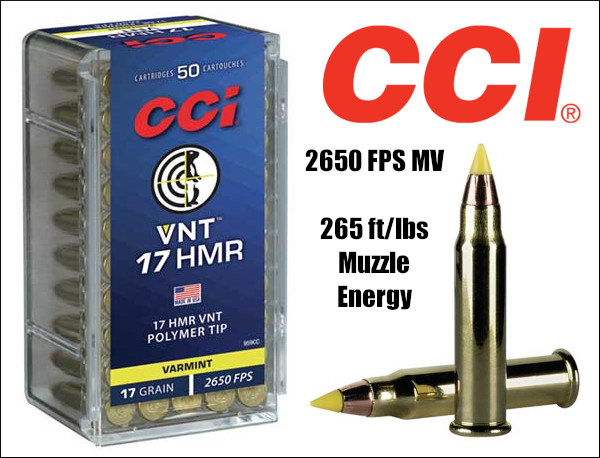
CCI .17 HMR TNT offers 2650 FPS Velocity
For varmint work we like CCI’s modern .17 HMR VNT ammo. This boasts class-leading 2650 FPS muzzle velocity. Engineered to combine good accuracy with high impact energy, this CCI TNT ammo features a 17gr polymer-tipped bullet designed for rapid expansion. We also like the Hornady .17 HMR Varmint Xpress ammo, rated at 2550 FPS with 17gr V-Max bullets.
Here is a video every shooter should watch. It reminds us that our sport demands 100% attention. Lose track of individuals down-range and the results could be tragic. This video will give you chills (starting at about the 0:25 mark). We need to remember to follow all the firearms safety rules, and apply them all the time. At the range, all it takes is one brief moment of inattention to create a life-threatening situation. Never assume the downrange area is safe. Use your own eyes and ears.
This video shows a competitor shooting a stage at an action pistol match. He starts when instructed by the Range Safety Officer (RSO). But unbeknownst to both RS0 and competitor, a volunteer is downrange working on targets. Watch carefully. At 0:27 the shooter sweeps left to right, engaging a paper silhouette target to his right. Then, at 0:30, as he begins a mag change, his head turns downrange. A few yards away is a white-shirted range worker! The shooter yells “Hey what’s going on?!”
What’s going on indeed… The RSO should have ensured that nobody was downrange before the shooter even stepped up to the firing line. If other competitors standing to the side had been alert, they might have seen the worker changing targets and called for a halt. And the target-worker himself — even if he was wearing earmuffs, he should have noticed that live fire had commenced just yards away…
We also have to wonder about the stage design. This set-up made it very difficult to see downrange. The white panels (see 0:10-0:20) definitely hid the target worker from view. In hindsight, given the way the stage was laid out, this was truly an “accident waiting to happen”. It’s fortunate that no one got injured in this incident. But this chilling video provides a lesson to all shooters — “Safety First”.
How could this “near-fatality” have been averted? Post your comments below.
Anschutz .22 LR rifle set up for F-Class competition. Photo courtesy Sportschieben Blog.
Here’s a fun new discipline that will grow in years ahead — Smallbore F-Class with .22 LR rimfire rifles. Rest-supported prone rimfire matches have been held around the world for quite some time, but only a few years ago was the discipline officially codified in the NRA Smallbore Rulebook. And the first-ever Smallbore F-Class National Championship was held in July 2018 in conjunction with the Smallbore Nationals at Camp Wa-Ke’-De in Bristol, Indiana. The Nationals involved multiple days of prone shooting at 50 meters and 100 yards. For more information read Hap Rocketto’s Shooting Sports USA Smallbore F-Class Report.
Smallbore F-Class competitors may shoot F-TR style with a bipod, or use a front rest. In the above photo from the inaugural NRA National Championship you can see a shooter with SEB Coaxial Rest at top, with a competitor using a low-profile bipod at bottom. Note the extended handle used to adjust bipod elevation. This is not a coaxial joystick, but rather a long handle attached to the mariner wheel.
Smallbore F-Class — The Future Looks Bright
With the high cost of centerfire ammunition, and the limited number of 1000-yard (or even 600-yard) ranges, we can envision that Rimfire F-Class will become a popular event at ranges across the country. Clubs don’t even need benches — just a 100-yard target bay and flat ground for the shooters. You can start with an inexpensive rimfire rig and Harris bipod. Then work up from there. Here is a custom rimfire F-TR style rig that belongs to F-Class ace and past centerfire F-TR National Champion James Crofts.
Rimfire F-Class and Fun Prone Matches with Front Rest or Bipods
Rimfire F-Class offers the fun of centerfire shooting at a much lower cost. Shooting is done prone with either a front rest or a bipod. You can shoot a relatively inexpensive rifle such as a CZ 457 MTR, or a custom build that has the same design features, weight, and ergonomics as a full-size F-TR or F-Open rifle. The choice is yours. We like shooting smallbore F-Class, because you can find decent .22 LR ammo for just $0.20 per round. By contrast, you’ll probably spend at least $1.20 per round for F-Class centerfire ammo (counting bullet, powder, primer, and part of the brass cost).
Top-Tier Vudoo V22-S Target Rifle for Rimfire F-Class
Vudoo Gun Works now offers an impressive .22 LR Single Shot Target Rifle that should prove ideal for rimfire F-Class (Open division). It features the new V22-S single-shot action, McMillan stock, and Flavio Fare BR-VS trigger.
Rimfire F-Class in the Canary Islands
This video comes from the Canary Islands, part of Spain. The voice-over is in Spanish but there are English sub-titles. The host explains: “In this video we summarize the main characteristics of this [shooting sport] that is practiced at 50 meters, 100 meters, and 200 meters with your .22 LR. Learn how to prepare your rimfire carbine and learn how to score your own targets by following our simple explanations. In another video we will delve into shooting techniques, shooting accessories and field accessories.”
Here is another rimfire F-Class video from the Canary Islands. This shows how the sport can be done with a variety of rimfire rifle types, even including a .22 LR AR clone. Some shooters are using a wide-base bipod, others are using normal Harris-type bipods, while others are using a large, benchrest-style front rest.
Rimfire F-Class-Style Local Fun Match in Oregon
In this video, F-Class John shoots an F-Class-style local fun match in Oregon. He is using a .22 LR rimfire rifle that has a full-size stock very similar to his custom F-Open centerfire rifles. This allows him to easily switch from centerfire F-Class to rimfire prone shooting with front rest and rear bag. The local fun match rules are a little different than an official F-Class match, but the shooting skills required are the same. Shooting this kind of local rimfire match allows John to keep his F-Class skills at a high level at a fraction of the cost of shooting centerfire F-Open.
Rimfire F-Class in Russia
NOTE: This video was filmed in Russia. The dialog is in Russian (without English subtitles), but it is still interesting to watch. Shooting F-Class with .22 LR ammo has become popular in Russia and other parts of Europe. You can have fun on a relatively short (200m) range with low-cost ammo.
Smallbore F-Class Course of Fire
The Smallbore F-Class Nationals was completed on paper targets at 50 yards and 100 yards. According to Shooting Sports USA: “The tournament ran during the any sight and metric phases of the 2018 NRA National Smallbore Rifle Championships, featuring a daily course of fire which mirrored the sling shooters, 40 shots at 50 meters on the A-50 target, a Metric Dewar, followed by 40 shots at 100 yards on the A-33 target. Although the international targets were shot throughout, the first two days were titled ‘conventional’ and the last two ‘metric’.”
The specifics of the match such as rifle requirements, rests, and sights may be found in the Provisional Smallbore Rifle F-Class Rules (Section 23), found on page 65 of the current NRA Smallbore Rifle rulebook. Any rules not covered in Section 23 will [reference] the normal rules of Sections 1 through 22.
Do you compete in rimfire benchrest, silhouette, or NRL22 matches? Then you’ll want to check out the Shooting Sports USA .22 LR Ammo Roundup on the SSUSA.org website. That article covers .22 LR ammunition from Lapua, ELEY, SK, RWS, Norma, Wolf, and Aquila. Notably there’s a detailed discussion of Lapua’s new Long Range and Super Long Range ammo. In addition, SSUSA confirms that SK ammo (made in Germany by Nammo, parent of Lapua) and Wolf Match Target ammo (made by ELEY) both offer quite good performance for a moderate price.
The article notes that there is a much wider range of .22 LR ammo types available now than a few years ago. It’s not just a choice between cheap products and high-end match ammo. As SSUSA explains: “It used to be that .22 LR was either quite expensive match grade ammo, or it was cheap plinking or hunting ammo. Today, competitors have choices in grades of .22 LR match ammunition to suit their pocketbook or firearms.” We’ve seen good results with relatively inexpensive Norma Tac-22, and the SSUSA article says that SK performs well above its price level.
Seven Brands of .22 LR MATCH AMMUNITION
Lapua Super Long Range and Long Range .22 LR
Lapua Super Long Range and Long Range ammunition comes from Finland, and is designed for the growing long-range rimfire disciplines with targets at 100-300 yards. Lapua says this ammo delivers very low ES and SD numbers. Our friend F-Class John has tested this ammo and confirmed it performs very well (SEE video above). “Each production lot of Lapua’s new rimfire products are test-fired in 50-round groups for dispersion”, Capstone’s Marketing Director, Geoff Esterline, said. “The results determine whether it makes Super Long Range or Long Range packaging.”
ELEY .22 LR Ammunition
ELEY has long been a top choice for .22 LR competition — both position shooting and benchrest. ELEY now offers 11 different varieties of .22 LR match ammunition, ranging in price from $7 (Benchrest Outlaw) to $20 (ELEY Tenex). If you compete in the rimfire benchrest, you should definitely try some ELEY ammo.
SK .22 LR Ammunition
Numerous .22 LR ammunition types are offered by SK, suitable for a variety of disciplines — from NRL22 to Biathlon. Generally cheaper than ELEY Match ammo, SK offers good “bang for the buck”. F-Class John says it performs great considering the price. The SSUSA article notes that: “German manufacturer SK has eight match-grade .22 LR offerings, including two for pistols, one for semi-automatic rifles, and one for frigid, wintertime conditions.”
RWS .22 LR Ammunition
Sometimes hard to locate at vendors in the USA, RWS is popular among European competition shooters. The top-tier RWS ammo is a choice of many competitive shooters. RWS currently offers nine Premium Line .22 LR varieties and three Professional Line offerings. The SSUSA tester noted that RWS Rifle Match ammo shot great in his Bergara BMR, shooting one-ragged-hole groups at 50 yards and about one MOA at 100 yards. That’s great performance for $10/box ammo.
Norma .22 LR Ammunition
Norma recently introduced XTREME LR-22, a new type of competition rimfire ammo with a radical new bullet. This unique, patented bullet design has a special base with a cone (see diagram). Norma claims that this “rocket tail” design reduces drag by creating less negative pressure at the back end of the bullet. It will be interesting to see how this new bullet design works in rimfire ELR competition.
Wolf .22 LR Ammunition
SSUSA says that Wolf Match Target is a top performer in the under-$10 per box category. This is because, according to SSUSA: “It is manufactured by ELEY in England (and loaded with Vihtavuori powder) and re-branded, if online information is correct.” Wolf Match Target is available from Target Sports USA for $74.99 per thousand ($0.15 per round).
Aguila .22 LR Ammunition
Made in Mexico, Aguila .22 LR rimfire ammo is the bargain item among the seven ammo-makers featured by SSUSA. It is widely available at very affordable prices.
We wouldn’t choose Aguila for a benchrest or three-position match, but it could be more than adequate for a local NRL-22 match or a steel-target competition at relatively short range. Aguila .22 LR ammunition starts at under $3.00 per box. And right now Midsouth offers a 2000-round Case of Aguila for just $114.99. That works out to just $2.87/box or six cents per round.
This story first ran in 2010. But to mark our long-standing friendships with shooter Joe Friedrich and chassis builder Gary Eliseo, we wanted to reprise the article for the new year, with 2024 just hours away. Joe’s Eliseo-chassis 6mmBR rifle delivered some of the most amazing accuracy with factory ammo we’ve ever seen, in any rifle, in any caliber.
Amazing Accuracy from 6mmBR Tubegun
What kind of accuracy do you think a tubegun can deliver with factory ammo — during barrel break-in? Perhaps 0.6″ at 100 yards, half-MOA if the conditions are perfect? Well you may want to change your preconceptions about tubeguns — and factory ammo. This Eliseo R5 repeater, smithed by John Pierce with a Pierce CM action and Broughton 5C barrel, shot the Lapua 90gr factory ammo into flat ONEs during the break-in session. A day later, in tricky 8-14 mph winds, the gun nailed a witnessed and software-measured 0.174″ 5-shot group using the 105gr factory ammo. That would be impressive for a “full-race” benchgun with precision handloads. For an across-the-course rifle shooting factory ammo, it’s pretty amazing.
Eliseo Tubegun Shoots in the Ones
This accurate rifle belongs to our friend (and designated expert trigger-puller) Joe Friedrich. During the initial break-in session, since his reloading dies had not yet arrived, Joe decided to start with some Lapua factory-loaded 6BR ammo he had on hand. After doing a few two-shot-and-clean cycles (with patches and nylon brush), Joe decided to try a 3-round group just to see if the Broughton barrel had some potential. To his astonishment, the Eliseo R5 put three rounds in 0.100″ (photo below left). Joe then cleaned the barrel again, shot a couple foulers and tried a 4-shot group. The results were just as stunning — 4 shots in a mere 0.104″ but three in virtually one hole (photo below right).
You Can’t Believe How This Gun Shoots
Joe called your Editor and said “You can’t believe how this gun shoots with factory ammo!”. So we arranged a photo session for the next afternoon, where I could verify the rifle’s accuracy. Well it turned out the conditions were way more challenging than when Joe broke in the barrel the day before. Winds were running 8-14 mph and were swinging through 180 degrees half-way down the range. Joe fired a few 90s through the Oehler chronograph at my request, then opened a box of Lapua 105gr factory ammo. It took about four rounds for the barrel to settle in after being cleaned the night before. Then Joe got serious, and with your Editor looking over his shoulder, he drilled a 0.174″ five-shot group in switching winds, doping every shot. Joe felt the gun could have shot tighter but he missed one wind call.
Serious Accuracy with a Multi-Purpose Rifle
So there you have it — a tubegun that shoots in the ones with factory ammo. Joe says that, at least with the 90s, the Elesio R5 shoots as well as his 6 PPC. Joe stressed that “steering the tubegun is hard work. You really have to concentrate compared to a purpose-built bench gun like my PPC. With the tubegun, everything has to be perfect on every shot — hand position, cheek position, stock position in the bag. If you’re off just a little bit, it’s easy to steer the gun the wrong way and send a shot out of the group.”
Accuracy Great But Fouling Heavy and ES Could Be Better
Have there been any negatives to Joe’s 6BR tubegun experiment so far? Well, the Broughton 5C barrel, while phenomenally accurate, shows signs of being a bad fouler. Copper built up pretty quickly over the first 25 rounds or so. We saw best accuracy with a recently-cleaned barrel. Hopefully the fouling will lessen as the barrel polishes in with use. And the canted land barrel is slower than average with the factory ammo. Lapua rates its 90gr naked-bullet ammo at 2950 fps with a 26″ tube. In Joe’s 27.5″ barrel we only averaged 2901 fps. With the 105gr factory ammo, which is rated at 2790 fps, we averaged just 2694 fps. That’s quite disappointing. Also the ES on the factory ammo, slightly over 50 fps for both bullet types, wasn’t particularly good. Still, the overall results were stunning. This gun shoots better than many long-range benchrest rifles running carefully-developed handloads — and it does that with factory ammo, right out of the box.
Joe Friedrich is a superb benchrest shooter, who has won many matches and set National Records in ARA rimfire benchrest competition. Here is Joe with “Sweet Pea”, his favorite .22 LR rimfire rig. With over 100,000 rounds through the Benchmark barrel, this well-worn rifle set an ARA 4-target Aggregate record! READ about Sweat Pea Record HERE.
As we release this story, the New Year — 2024 — is just 15 hours away (East Coast Time). Perhaps you’ve been eagerly awaiting for the big event, getting champagne (and sparklers) to celebrate the New Year. Hopefully, 2024 will be much better than 2023, a tough year with inflation, the border crisis, conflict in the Mid-East, ongoing war in Ukraine, and shocking incompetence/corruption in Washington. To mark the dawning of 2024, with hope for a much better year, we expect many folks will open a bottle of champagne. You could pop the cork the traditional way, or read on and learn how to release the celebratory champagne with a rifle shot, as demonstrated by the talented Kirsten Joy Weiss. Click on the above video to see Kirsten release champagne with a rimfire rifle.
Recently at Thorton Winery in Temecula, California, a champagne vintner, we were shown the best way to open a champagne bottle. We were told you should hold the bottle nose up at an angle then rotate the BOTTLE slowly while holding the cork. That works great… but it’s not as stunning as the way sharpshooter Kirsten Joy Weiss opens a bottle of bubbly.
A former competitive smallbore rifle shooter, ace trigger-puller Kirsten Joy Weiss tried a special New Year’s trick shot a few seasons back. In keeping with the festive New Year’s spirit, Kirsten attempted to shoot the cork off a champagne bottle. After a few unsuccessful tries, she managed to hit the cork with at least two shots. But alas the cork did not fly. She actually hit the cork, but it did not release. That was surprising…
Undaunted, Kirsten changed her strategy, aiming for the neck of the bottle. This duplicates the process of “sabering” a champagne bottle — a method of liberating the bubbly by slashing off the end of the neck with a blade. Aiming for the neck of the bottle, Kirsten successfully blew off the top of the bottle. (Apparently, when “sabering” it is actually the pressure within the champagne bottle which does most of the work).
NRA Media offers a series of informative videos about the Science of Shooting, covering a wide range of topics, from eye dominance to long-range ballistics. These videos feature high production values, with super-slow motion segments, as well as helpful computer graphics to illustrate the principles covered.
The videos are narrated by Jessie Harrison, a top action pistol shooter (and the first women ever to achieve USPSA Grand Master status). Jessie is assisted by talented shooters such as Top Shot Season 4 Champion Chris Cheng. There are 40 videos in the Firearm Science Video Series. Here are seven good NRA science videos, with links to others below.
Olympic Gold Medalist Jamie Gray demonstrates the four positions used by competition shooters: Prone, Standing, Sitting, and Kneeling. Helpful overlay graphics show how the human skeleton aligns in each of these positions. This video should help hunters as well as competitive position shooters. If you shoot silhouette, definitely watch this video!
BULLET TRAJECTORY — Factors at Play and Zeroing Strategies
Host Jessie Harrison (formerly Jessie Duff) and Veteran Air Force Sniper and Long Range Expert George Reinas help us understand the factors behind bullet trajectory. NOTE: There are some exaggerations in the graphics in the videos, and inconsistent terminology use, but it’s still a helpful basic primer on the subject of trajectories. This popular video has over 1 million YouTube views.
INTERNAL Ballistics — Cartridge Ignition and Bullet in Barrel
What happens inside the barrel of your gun when you pull the trigger? In this edition of Firearm Science, Jessie Harrison goes over internal ballistics, which studies the combustion of propellant, the pressure developed, and the motion of the bullet along the bore of the barrel. There are some good 3D animations showing how the powder charge ignites and the bullet moves through the barrel.
CHOKE TUBES and Shot Patterns — Shotgun Science
With over 2.2 million YouTube views, this shotgun-centric video is the most popular of all the NRA Firearms Science series videos. Here Olympic trap shooter Corey Cogdell explains how choke tubes affect a shotgun’s shot pattern in this edition of Firearm Science. We recommend that all Shotgun hunters watch this video — it explains the effect of choke tubes very well.
ZEROING RIFLES for Long Range — Tech Tips
The process of zeroing rifles for long range is covered in this Firearm Science video featuring George Reinas, a veteran Air Force sniper. George demonstrates how to adjust his scope to compensate for bullet drop at long range. Our friend Dennis Santiago was involved in the making of this video, which was filmed at the Burbank Rifle & Revolver Club in Southern California.
EYE DOMINANCE — How to Determine Which Eye is Dominant
Host Jessie Duff and longtime shooter Krystie Messenger demonstrate how eye dominance affects aim and teach you how to determine your dominant eye in this edition of Firearm Science. There are very simple tests you can do to determine your eye dominance. This Editor is right-handed but left-eye dominant. All competitive shooters should check for eye dominance. If you are cross-dominant, you can alter your head position or put a paper patch on one frame of your shooting glasses.


 In recent years, Browning has produced T-Bolt rifles in a variety of models, with many different stock types and various barrel lengths/contours. Most of the photos above showcase the AA Maple Sporter T-Bolt, which is currently out of production, though still available from some dealers (if you search). We like the looks of the AA Maple T-Bolt, but there many other stock options including dark brown, Black, Green, and various camouflage finishes. Use the links below to see other T-Bolt configurations.




 Amazing Accuracy from 6mmBR Tubegun


 You Can’t Believe How This Gun Shoots


 A former competitive smallbore rifle shooter, ace trigger-puller Kirsten Joy Weiss tried a special New Year’s trick shot a few seasons back. In keeping with the festive New Year’s spirit, Kirsten attempted to shoot the cork off a champagne bottle. After a few unsuccessful tries, she managed to hit the cork with at least two shots. But alas the cork did not fly. She actually hit the cork, but it did not release. That was surprising…


