This 50 Cal Days of Christmas video features some fantastic slow-motion footage of a Barrett .50 Caliber M82. This bad boy pumps out some serious muzzle flash. Watch carefully at the 1:05 mark and you can see the .50-caliber projectile exit the muzzle brake and spin through the ball of smoke and flame. For best viewing, you may want to change your video settings to 720p or 1080p High Definition and view full-screen (using the video controls).
The video carries “overkill” to the max, as the shooter uses his big Barrett to blast Christmas ornaments and a snow-globe. To top things off, at the 2:50 mark, the shooter fires the .50 cal at a pyro-equipped gingerbread house. (The gingerbread shot is taken from a standing hold no less!) The results (at 3:22) are impressive — gingerbread house becomes flaming gingerbread pudding.
What anti-corrosion products really fight rust effectively? You’ll hear many opinions, but what do actual field tests reveal? One rifle shooter, who posts on YouTube as BlueonGoldZ, wanted to separate myth (and marketing claims) from reality, so he completed his own long-term rust test using metal samples. First he used ordinary tap water spray, and then he did a second, longer-duration test with a salt-spray solution. Nine different products were tested: Break Free CLP, Corrosion-X, Frog Lube, M-Pro 7, Outers, Pro-Shot Zero Friction, Rem Oil, Slip 2000, and Tetra Gun Triple Action CLP.
BlueonGoldZ initially examined each product for its “beading” properties with a normal tap water spray. But the main test involved many multiple weeks of exposure after a “dense” salt-water spray. (No rust formed after two weeks tap water exposure, so the test was accelerated with salt-water exposure).
The clear winners in the test, as shown by the screen shot above, were Corrosion-X (Best), and Frog-Lube (Second Best). The photo shows the test samples two weeks after being sprayed with salt water. The results are pretty dramatic — you can see with your own eyes what happened. We think this is a very useful bit of real-world research.
Results from Similar Long-Term Salt Exposure Test
Unfortunately, BlueonGoldZ’s test did NOT include Eezox, which we have found to be extremely effective (on a par with Corrosion-X). In another long-term test of corrosion preventatives, the two best rust fighters were Eezox and Corrosion-X in that order. Since that test was completed, Corrosion-X, already an excellent product, has been enhanced. CLICK HERE for Long-Term Salt Exposure Test Report.
Forum member Erik Cortina has produced a series of YouTube videos about reloading hardware and precision hand-loading. Here we feature Erik’s video review of the Forster Co-Ax® reloading press. The red-framed Co-Ax is unique in both design and operation. It boasts dual guide rods and a central handle. You don’t screw in dies — you slide the die lock ring into a slot. This allows dies to float during operation.
Erik does a good job of demonstrating the Co-Ax’s unique features. At 1:00 he shows how to slide the dies into the press. It’s slick and easy. At the two-minute mark, Erik shows how sliding jaws clasp the case rim (rather than a conventional shell-holder). The jaws close as the ram is raised, then open as it is lowered. This makes it easy to place and remove your cases.
At the 5:20 mark, Erik shows how spent primers run straight down into a capture cup. This smart system helps keep your press and bench area clean of primer debris and residues.
While many Co-Ax users prime their cases by hand, the Co-Ax can prime cases very reliably. The priming station is on top of the press. Erik demonstrates the priming operation starting at 4:20.
Smart Accessories for the Co-Ax from Inline Fabrications
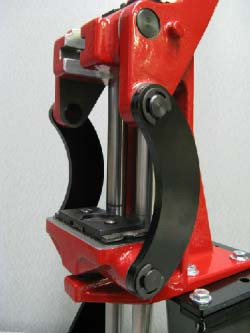
Forum member Kevin Thomas also owns a Co-Ax press, which he has hot-rodded with accessories from Inline Fabrication. Kevin tells us: “Check out the add-ons available from Inline Fabrication for the Co-Ax. I recently picked up a riser mount and a set of linkages for mine and love the results. The linkages are curved. When you replace the original straight links with these, the work area opens up substantially and the the press becomes much easier to feed.” CLICK HERE for Co-Ax Accessories.
Inline Fabrications Forster Co-Ax Accessories
Forster Co-Ax Curved Side Linkage (For Better Access)
In June 2020, Hornady introduced the 6mm ARC, a new SAAMI cartridge optimized for AR-platform rifles*. The new 6mm ARC is basically a 6.5 Grendel necked down to 6mm, with the shoulder moved back around .030″. That pushed-back shoulder does reduce case capacity (and velocity), but we assume Hornady did that to create a shorter, proprietary chamber so people could not simply neck-down Lapua 6.5 Grendel brass, as has been done for years with Robert Whitley’s outstanding 6mm AR wildcat.
What Is the 6mm ARC Cartridge? The 6mm ARC cartridge is a new SAAMI-spec cartridge based on the 6.5 Grendel case necked down for 6mm bullets, with the shoulder moved back 0.030. Yes it is designed to run in AR15-platform rifles. You’ll need a new barrel, bolt, and mags. If you already have an AR chambered in 6.5 Grendel, the ONLY thing you need to change is the barrel. Everything else — bolt, magazines, gas system – is compatible with 6mm ARC.
▶ Official SAAMI Cartridge (not wildcat)
▶ Fits standard AR15-platform rifles
▶ Fits Short/Mini action bolt rifles
▶ Efficient short, fat case design
▶ 30-degree case shoulder
What Do I Need To Shoot the 6mm ARC?
Faxon and Ballistic Advantage are already producing barrels, with more manufacturers sure to follow. All the other required components are already on the market for 6.5 Grendel rifles. Aero Precision already offers complete 6mm ARC uppers.
If you’re converting a standard 5.56×45 mm (.223 Rem) AR15 upper to shoot 6mm ARC, you’ll need a 6mm barrel, a Type II 6.5 Grendel bolt carrier group, and new magazines. Some folks have suggested standard AR mags will work, but trust us, you want the magazines that have been designed for 6.5 Grendel. Most of the hardware you need is available at Brownells.
* While 6-6.5 Grendel shooters are known to run stout pressures, the new 6mm ARC cartridge has a relatively moderate Maximum Average Pressure (MAP) rating of 52,000 psi according to the official SAAMI specifications. For a variety of reasons, is wise to keep pressures in a semi-auto rifle moderate. Don’t chase the velocities you might get in a bolt-action gun.
Kestrel wind and weather meters are often regarded as the best on the market — for good reason. Here are a series of three videos by F-Class John that show how the Kestrel 5700 with Elite Ballistics works. This article reviews the advanced Kestrel 5700 Elite Wind Meter with sophisticated ballistics capabilities. Our review features three videos by F-Class John that show how the Kestrel 5700 Elite functions with Applied Ballistics APP software and LiNK connection.
This Part I Video starts with a basic Kestrel Anemometer (blue case, 00:00-00:40) wind meter. Then reviewer F-Class John looks at the “smart” Kestrel 5700 with Elite Ballistics. John explains the many features of the Kestrel 5700 and how it holds a powerful ballistics calculator in the convenient, easy-to-tote Kestrel package. With Elite Ballistics, once you enter data about your bullets, velocity, zero, and rifle, the Kestrel can calculate come-ups and wind corrections. If you don’t yet own a Kestrel, we highly recommend you watch this series of videos that explains advanced Kestrel features in detail.
This Part II Video shows the key features of the advanced software APP used by the Kestrel 5700 unit with Elite Ballistics. The Kestrel 5700 can “talk” to a mobile device that runs the Applied Ballistics software APP that contains bullet databases and allows you to enter key information such as muzzle velocity, bullet BC, zero distance, velocity, wind, and environmental factors (altitude, temperature etc.). There are also gun-specific factors such as scope height over bore and barrel twist rate. The video also explains how “range cards” are created and how to view them with your Elite Ballistics-enabled Kestrel. John notes: “The APP is great because you don’t have to fiddle with the Kestrel’s buttons. It’s much easier to enter data and change settings with the APP.”
This Part III video shows how to determine true wind direction by aligning the SIDE of the unit into the wind. You essentially want to set the unit 90 degrees to the wind direction so the impeller runs as slowly as possible. Then, after you set your target distance (See 3:03), the unit can give you precise come-ups for your intended target (10.28 MOA for 559 yards here). The Kestrel then calculates the cross-wind correction as well (See 3:12).
DISCLAIMER: This video and description contains affiliate links, which means that if you click on one of the product links, the video author may receive a small commission. This helps support F-Class John’s YouTube channel and allows him to continue to make videos like this.
For most larger centerfire cartridges, increased barrel length augments muzzle velocity. That’s why you see F-Open rifles with 30″ and even 32″ barrels. But there is a limit — at some point, increased barrel length may not yield any additional velocity. And in the case of rimfire, too much barrel length can reduce MV. Today’s showcase explores how barrel length affects muzzle velocity, both in centerfire and rimfire rifles.
In the photo above you can see a test rifle fitted with what may currently be the longest barrel fitted to a conventional rifle. This was created by the team at MDT (Modular Driven Technologies) to test how velocity varies with barrel length.
You can see the results of testing with this one-of-a-kind rifle in the MDT video below, the first in our Saturday video showcase. This is followed with an MDT rimfire barrel length/velocity test, and additional tests for the .308 Winchester, 6.5 Creedmoor, and .223 Rem cartridge types.
World’s Longest Rifle Barrel Cut to Determine Velocity Change
This may be the most interesting velocity by barrel length test ever put on video. The MDT (Modular Driven Technologies) team started with a 69″-long barrel, chambered for .308 Winchester. The ammo was Federal Gold Medal match with 175gr Sierra HPBT Bullets (Video 3:30). This barrel had actually been fabricated from multiple sections, a challenge in itself.
Velocity was measured in one-inch increments starting at 69″ and going down to 19″. The speed at 69″ was 2778 FPS while the final speed, at 19″ barrel length, was 2567 FPS. “That is a difference of 211 FPS from the longest point to the shortest point”, observed MDT’s tester. Note that, the velocity did show fairly constant change per inch from 19″ to 45″. So going beyond 36″ inches can actually increase velocity. However, from 45″ to 61″ inches the velocity actually declined a bit. SEE VIDEO at 6:55 time-mark, and check out the chart below.
Ultra-Long .22 LR Rimfire Barrel Cut-Down Velocity Test
This video features Part 2 of MDT’s “Cutting the World’s Longest Rifle” test. This time the team shoots the diminutive .22 LR cartridge from an ultra-long barrel. The results may surprise you: “Get ready to have your assumptions shattered as the MDT team chopped a .22 LR rimfire barrel away inch by inch, recording velocities at each barrel length. In this test, the MDT team looked to determine the optimal length for a .22 LR barrel, from the standpoint of velocity. How long is too long? How short is too short? Does shorter always mean faster? Does longer always mean slower?”
In fact, MDT’s testers determined that, with standard rimfire ammunition, the velocity started to decline after 16″ length. That surprised some of the testers. So with the small .22 LR cartridge, more barrel length can actually reduce muzzle velocity from increased in-barrel friction.
6.5 Creedmoor Barrel Length Test (24″ to 16″)
For this video, testers for Western Powders took a standard test barrel chambered for 6.5 Creedmoor and cut it down one inch at a time. The velocity for five rounds at each length was then measured with a chronograph to determine velocity loss per inch of barrel reduction. Overall the recorded velocity loss from 24″ to 16″ was 197 FPS, almost exactly 25 FPS per inch of length. The velocity loss rate was fairly constant inch by inch, as you can see from the graph displayed at the 4:00-minute mark in the video.
.223 Rem (5.56×45) Velocity Tests (9 Guns, 7.5″ to 20″ Barrels)
In this video, the team from Classic Firearms tests a variety of firearms chambered for .223 Rem (5.56×45). This starts with an Springfield Saint Victor AR-type pistol with a very short 7.5″ barrel. This yielded a 2183 FPS average. Then the team tested eight more guns with increasingly long barrel lengths, adding barrel length with each gun in sequence. The test concluded with a Colt XM16E1 rig with 20″ barrel. That Colt AR averaged 3052 FPS. The guns used (and barrel lengths) are listed below.
The overall results are discussed at the 13:45 Time-Mark.
Test Lengths at Video Time — 7.5″ to 20″
2:11 — 7.5″ Springfield St.V. AR Pistol, 2183 FPS
3:23 — 10.3″ DD MK18 SBR, 2513 FPS
4:34 — 11.8″ PWS MK111 AR Pistol, 2644 FPS
5:35 — 12.5″ IWI Zion AR Pistol, 2789 FPS
.308 Winchester — 16″ Barrel vs. 24″ Barrel Velocity
With the .308 Win cartridge, many hunters prefer a shorter barrel for lighter carry weight. In this video, Gavin Gear of UltimateReloader.com compares .308 Win velocities with a 16″ barrel and a 24″ barrel, shooting the same ammo. Gavin notes: “We asked for input on our .308 build. Overwhelmingly, you all wanted a 16″ barrel, so ‘Shorty’ was born! Looking to compare velocities, I brought out my match .308 Win with a 24″ barrel to compare the results with some Hodgdon data.” CLICK HERE to read full report on UltimateReloader.com.
RifleShooter.com Barrel Cut-Down Testing
Along with these videos, our friends at RifleShooter.com have conducted a number of barrel cut-down tests, starting with fairly long barrels. Velocities were measured with each inch reduction
Most of us own a .223 Rem rifle. Now, thanks to our friends at Rifleshooter.com we can assess exactly how velocity changes with barrel length for this popular cartridge.
Rifleshooter.com performed an interesting test, cutting the barrel of a .223 Rem rifle from 26″ all the way down to 16.5″. The cuts were made in one-inch intervals with a rotary saw. At each cut length, velocity was measured with a Magnetospeed chronograph. To make the test even more interesting, four different types of .223 Rem/5.56 ammo were chron’d at each barrel length. The Rifleshooter.com team that conducts these tests has a full-service gun shop, 782 Custom Gunworks — visit 782guns.com.
Test Barrel Lost 25.34 FPS Per Inch (.223 Rem Chambering)
How much velocity do you think was lost, on average, for each 1″ reduction in barrel length? The answer may surprise you. The average speed loss of the four types of .223/5.56 ammo, with a 9.5″ shortening of barrel length, was 240.75 fps total (from start to finish). That works out to an average loss of 25.34 fps per inch.
5.56/.223 Barrel Cut-Down Speed Test 26″ to 16.5″
Start FPS at 26″
End FPS at 16.5″
Total Loss
Average Loss Per Inch
UMC .223 55gr
3182*
2968
214
22.5 FPS
Federal M193 55gr
3431
3187
244
25.7 FPS
Win m855 62gr
3280
2992
288
30.3 FPS
Blk Hills .223 68gr
2849
2632
217
22.8 FPS
*There may have been an error. The 25″ velocity was higher at 3221 fps.
Rifleshooter.com observed: “Cutting the barrel from 26″ to 16.5″ resulted in a velocity reduction of 214 ft/sec with the UMC 223 55-grain cartridge, 244 ft/sec with the Federal M-193 cartridge, 288 ft/sec with the Winchester M855 cartridge and 217 ft/sec with the Back Hills 223 68-grain match cartridge.”
How the Test Was Done
The testers described their procedure as follows: “Ballistic data was gathered using a Magnetospeed barrel-mounted ballistic chronograph. At each barrel length, the rifle was fired from a front rest with rear bags, with five rounds of each type of ammunition. Average velocity and standard deviation were logged for each round. Once data was gathered for each cartridge at a given barrel length, the rifle was cleared and the bolt was removed. The barrel was cut off using a cold saw. The test protocol was repeated for the next length. Temperature was 45.7° F.”
See More Barrel Cut-Down Tests on Rifleshooter.com
Rifleshooter.com has performed barrel cut-down tests for many other calibers/chamberings including 6mm Creedmoor, .308 Winchester, and .338 Lapua Magnum. See these test results at Rifleshooter.com.
YouTube gun video producer 22plinkster has unbridled curiosity when it comes to .22 LR performance. A while back he wanted to see how many Christmas ornaments could be penetrated by one .22 LR round. To answer that burning question, Mr. Plinkster lined up 40 plastic Xmas bulbs in a row and then fired a single round of CCI .22 LR Velocitor ammo through the bunch, using his Henry Golden Boy lever action rifle. Did the bullet penetrate a dozen ornaments? Two dozen? What do you think? Watch the video to find out the surprising answer. The CCI Velocitor ammo is rated at 1435 fps.
Christmas Ornament Penetration Test with Henry .22 LR Lever Action Rifle.
SIG Sauer has a new .22 LR rimfire handgun — the P322-COMP pistol. Designed for speed, accuracy, and flat shooting (low muzzle flip), this new rimfire pistol from SIG SAUER is ready for competition right out of the box. It comes with a red dot optic, barrel-mounted compensator, slide-mounted racker, good trigger, and high-capacity (20- and 25-rd) magazines. READ P322 Manual.
We think this would be a good choice for fun action pistol matches. One YouTube viewer noted: “I applaud SIG… basically [the P322-COMP is] the first RFPO (Rimfire Pistol Open) factory option for Steel Challenge. Every other gun on the market you have to buy the optic, thumb rest, and compensator.”
SIG P322-COMP — Components and Features Video
NOTE: This 44-second video from SIG Sauer has detailed illustrations of all components with 3D rotation of the pistol so you can see it from all angles.
SIG Sauer states: “The P322-COMP ships with a factory-installed ROMEO Zero ELITE Red Dot optic for fast target acquisition, is designed with a slide mounted racker and sport takedown lever as value-added fun features. It has a barrel-mounted compensator to reduce muzzle rise making the P322-COMP a fast, fun, and [flat-shooting pistol].
The SIG SAUER P322-COMP is a competition-ready .22 LR rimfire pistol with class-leading 25+1-round and 20+1-round capacity. It has a threaded barrel equipped with a 2-port compensator and comes with a factory-installed ROMEO Zero Elite Red Dot Optic. The polymer grip features an extended magazine catch, adjustable trigger shoe, sport takedown lever, 1913 rail, and integrated magwell. The Single Action Only hammer-fired action on the P322-COMP is completely enclosed in a two-tone competition alloy slide with a high viz fiber-optic front sight, plus front, rear, and top cocking serrations. The ambidextrous, slide-mounted racker ensures easy slide manipulation. The pistol ships with (1) 20-round magazine and (1) 25-round magazine.
P322-COMP Specs:
Caliber: .22 LR
Capacity: 20+1, 25+1
Barrel length: 4 inches
Sight Radius: 6 inches
Weight (w/magazine): 19.8 oz.
22Plinkster Review of P322-COMP Pistol
Note how fast 22Plinkster can hit multiple targets with this new brake-equipped pistol. No question this rimfire pistol would be fun to shoot on steel targets.
TheHumbleMarksman Review of P322-COMP Pistol
This video starts with close-up, slow-motion footage of the pistol. Components and magazines are illustrated at 0:55-1:30 time segment, and there’s a good explanation of how the compensator works at the 6-minute mark.
Creedmoor Sports has released a series of helpful “how-to” videos in its new InfoZone web page. In the latest InfoZone video Bill Gravatt shows how to seat bullets using L.E. Wilson Hand Dies and an Arbor Press. The basic process is simple, particularly with a micrometer-top seating die. That makes it easy to adjust and set seating depth. Before you start seating bullets, you want to adjust the height of the arbor so the stroke is appropriate to the height of your die.
Bill Gravatt Shows How to Use Hand Seating Dies — Creedmoor INFOZONE
ARBOR PRESS TECHNIQUE: When using an arbor press, smooth is good. You don’t want to slam the handle down quickly. Try to repeat the same motion each time. You can also experiment by seating the bullet part way, then rotate the cartridge (in the die) and do the final seating with a second stroke. If your arbor press has a force gauge, note both the max value of the gauge needle and how it moves as you seat the bullet. If the needle spikes too rapidly, or bounces back and forth irregularly, set that cartridge aside and/or mark it. You could have neck tension issue with that case or some other fault. You might even have a bad bullet. That’s rare, but can happen. The key to success is moving the press arm in a smooth motion every time, maintaining the same down-pressure with each cartridge.
Here Bill Gravatt Offers a Simple Tip for Adjusting Wilson Seating Dies
One of our Forum readers asked “How can I get a custom in-line seater for my new rifle?”. First, we would say that, if you are not shooting an unusual Wildcat, check first to see if L.E. Wilson makes a stainless Micrometer Seater Die for your rifle. These dies are a joy to use, and we’ve found the fit to be exceptionally good with many calibers. Typically priced from $95-$115, Wilson stainless micrometer-top seaters are available for dozens of cartridge types: .204 Ruger, 20 BR, .222 Rem, .223 Rem, 22 PPC, 22 BR, .22-250, .223 WSSM, 6 PPC, 6mmBR, 6XC, 243 Win, .243 WSSM, 25 WSSM, 6.5×47 Lapua, 6.5 Creedmoor, 6.5-284, 26 Nosler, .270 WSM, 7mm-08, .284 Win, 28 Nosler, 7mm RUM, 30 BR, 30 IHMSA, .308 Win, .300 WinMag, .338 Edge (and MORE).
If you do want a custom seater die, the process is relatively simple. Purchase a die blank from Wilson and have your gunsmith run the chambering reamer in. Forum member Gunamonth explains: “I start with a Wilson seating die blank. They’re available from Sinclair and other vendors. Just run the reamer in. For some of my rifles, where I wanted the stainless die with the micrometer adjustment, I bought a smaller die and had the smith ream it with the chamber reamer. That’s how I had my 6 Dasher and 6mm AI seaters made. With the Dasher I stared with a 6mmBR Micrometer die.”
SEATER STEM TIP: If, on your seated bullets, you are seeing a sharp line around the jacket near the ogive, you may want to smooth out the leading edge of the Wilson seater stem (see above left). Do this by putting a little lapping compound on one bullet and manually spin this around in the stem. Without much effort you’ll have a smooth bullet/stem interface.
Micrometer Top Add-on
We really like micrometer tops on a seating die. But what if Wilson doesn’t make a micrometer top seater for your chambering? Don’t despair, Brownells sells a $39.99 Sinclair Micrometer Top that can be added to Wilson standard seaters or to a custom seater die made from a Wilson die blank.
The December issue of Shooting Industry (SI) magazine features new products from many leading companies including Sig Sauer, CZ, Marlin, MDT, Springfield Armory, Savage, Garmin, Taurus and more. Part One of SI’s 2024 New Product Showcase features cool, new products from over 60 brands. This month’s product feature is the first of a three-part series, with other segments slated for January and February.
Here are some of the most noteworthy new guns and gear items featured in the December Shooting Industry Magazine Issue which can be accessed for free on the web:
CZ 600 American Rifle
The CZ 600 American is an American-style bolt-action centerfire rifle fitted with a nice Turkish walnut stock. The handsome CZ 600 American is offered in a wide range of popular chamberings including: .223 Rem, .243 Win, 6.5 Creedmoor, .308 Win, .270 Win, .30-06 Sprg, and .300 WinMag. Notably, CZ offers a sub-MOA accuracy guarantee with the CZ 600.
CZ 600 AMERICAN features:
Guaranteed sub-MOA accuracy (3-shot groups at 100m with match-grade ammunition)
All metal components treated with CZ’s patented anti-corrosion finish
Steel receiver with a Rem 700-type mounting interface
User-adjustable trigger pull weight (CZ patent)
Symmetrical stock made of Turkish walnut
Thin profile, cold hammer forged barrel
Locking, double-stack magazine
New MDT 26 oz. HNT26 Hunting Rifle Chassis
MDT now offers a super lightweight HNT26 Chassis System for Remington 700-based medium actions. The HNT26 Chassis System is specifically designed for hunting, providing great functionality along with light weight. Weighing just 26 oz., the HNT 26 combines a magnesium alloy base with carbon fiber components for durability without compromising on weight. Features include a foam-filled carbon fiber buttstock section, and a carbon fiber fore-end with an optional integral ARCA rail. The chassis works with AICS magazines for smooth and reliable feeding.
Garmin Xero C1 Pro Compact Radar Chronograph
The Garmin Xero C1 Pro is a new compact chronograph which has proven both highly accurate and easy to use with a handy smartphone App. The Xero C1 Pro can capture velocity data for arrows, crossbow bolts, shotgun slugs, paintballs and airsoft devices. It can display projectile speed and shot count, as well as average speed, standard deviation (SD) and extreme spread (ES). Very compact, the Xero C1 Pro is easy to transport and sets up easily on a small Garmin tripod.
SIG Sauer CROSS Magnum Rifle .300 Win Mag
The new bolt-action SIG SAUER CROSS Magnum is chambered in .300 Win Magnum with a 24″ user-changeable 5R barrel. This rugged rifle features a modern receiver with two-stage Match trigger and AICS magazine. The handsome aluminum Coyote anodized frame boasts a free-floating handguard (M-LOK and ARCA compatible), with PRS-style grip. The folding buttstock adjusts for length and cheek height. This CROSS Magnum rifle weight 8.9 pounds with a 45.2″ overall length.
Taurus Judge TORO Revolver
The optics-ready Taurus Judge TORO wheelguns are available in four different setups. These all have a 3″ barrel, double-action trigger, plus a fiber optic front sight. Models offered include stainless or matte black with a cylinder that accepts 2.5″ .410 shotshells, and stainless and matte black models that accept 3″ .410 shotshells. The standard Judge TORO and Magnum Judge TORO have optics plates that fit the Holosun K-series or Shield RMSc Red Dot sight footprints. “TORO” stands for “Taurus Optic Ready Option”.
Along with the 60 New Product descriptions, the December 2023 Shooting Industry issue has a number of informative articles. First, SI Editor Jade Moldae offers the SHOT Show 2024 Preview as well as a recap of the 2023 NASGW Expo.
In another article, B.A. Stear explains how to zero a rifle indoors within a relatively short distance. In 100-Yard Zero On A 25-Yard Range? Stear explains the procedure (and calculations) needed to zero a rifle at an indoor range to simulate a longer outdoor distance.
The What’s Next For The Ammo Market? feature by Bryan Hendricks assesses the potential impact ammunition retailers may face from the pending sale of Vista Outdoors’ Sporting Products segment to the Czechoslovak Group A.S. (CSG).







 One of our Forum readers asked “How can I get a custom in-line seater for my new rifle?”. First, we would say that, if you are not shooting an unusual Wildcat, check first to see if


