The 2022 NRA Annual Meetings & Exhibits will take place May 27-29, 2022 at the George R. Brown Convention Center in Houston, Texas. For all three event days (Friday, Saturday, Sunday of Memorial Day Weekend) the Exhibit Hall will showcase over 14 acres of the latest guns and gear from shooting industry companies. The Exhibits Hall will be full of product and outfitter displays. Over 540 exhibitors will provide show-goers with a look at the latest firearms, ammunition, and accessories. The NRA Annual Meetings will also include entertainment and special events over the three days. The NRA plans to have a powerhouse lineup of political speakers, country music artists, plus workshops and seminars.
Admission to the event is FREE for NRA members and their immediate family (some special events do require paid tickets). We recommend that you PRE-REGISTER to receive your admission badge(s) ahead of the show. Walk-up registration will be available on-site for members and you can join NRA on-site as well.
Get the latest information on the 151th NRA Annual Meetings & Exhibits at NRAAM.org.
NOTE: Monday, May 30th is Memorial Day, a holiday for most workers. So, if you decide to attend the NRA Annual Meetings, you can come back on Monday without missing a day of work.
Paul Phillips is a past King of 2 Miles, and one of the world’s top Extreme Long Range (ELR) Shooters. He recently showcased one of his ELR rifles that shoots the .416 Barrett cartridge with huge, 550gr Cutting Edge bullets seated in CNC-machined RCC (Robertson Cartridge Company) brass that costs $10 per case.
Even with these giant-sized cartridges, Paul Phillips is getting remarkable accuracy. He recently went out to a snow-covered rifle range to do some testing. We include some test results in this article. Paul’s rig delivered 1.056″ to 1.748″ 3-shot groups at 500 yards. That’s .202 to .335 MOA for three shots. (1 MOA = 1.047″ at 100 yards, or 5.235″ at 500 yards). That’s very impressive accuracy for such a big cartridge with serious recoil.
Confidence is Gained from Consistent Accuracy
Report by Paul Phillips
After being retired from my 30 years of service in military and law enforcement, I started my own company, Global Precision Group LLC. We specialize in Long range shooting. I am currently doing some R&D for a new ammunition company, Ultimate Ammunition, (UA) out of Las Vegas. UA specializes in Military, Law Enforcement, and Custom ammunition.
On this particular day, it was a very cool 15 degrees F. I was testing ammunition for the .416 Barrett. Since winning the King of 2 Miles in 2019, my team has been looking at ways to make everything better. The competition is fierce and everyone is getting better and better. Finding single-digit Standard Deviations (SDs) is a must. Holding SDs under 5 FPS can be what it takes to win.
After several weeks of testing, I think I found the perfect combination for the .416 Barrett in my rifle. My optimal load runs about 3000 FPS using the following components:
Cutting Edge 550 Grain Solid Bullets with Tips
RCC Brass (CNC-machined)
Vihtavuori 20N29 Powder
RWS primers
Loaded for ~3000 FPS load velocity goal
I figure if I can keep my 3-round groups under two inches consistently, I have a chance to win on any Sunday. The average group size of these groups was 1.47 inches at 500 yards. With big bore rifles it gets very costly to test. That is why I am limiting my test groups to 3 rounds. See below:
Note the single-digit Extreme Spread and SD for all of these three-shot groups, as recorded by the LabRadar (see below). The average SD for these three groups at 500 yards was about three.
NOTE: This is an animated GIF with THREE images, alternating every 4.5 seconds.
Not just the ammunition deserves credit. I also have to give credit to the quality Manson reamer, BAT action, Bartlein Barrel, Bix’N Andy trigger, Manners ELR stock, Nightforce Optic, and Accu-Tac bipod with my new P skis. All these gear/hardware items, combined with quality ammunition, allow these kind of groups.
Products featured in this article include:
Accu-Tac Bipods
Bartlein Barrel
BAT Machine Action
Bix’N Andy Trigger
CROSSTAC Shooting Mat
Cutting Edge Bullets
Edgewood Shooting Bag
Kestrel with Ballistics
LabRadar
LongShot Cameras
Manners Composite Stock
Manson Precision Reamer
Nightforce Optics
RCBS Press and Tools
RCC (CNC-machined) Brass
Vihtavuori Powder
In April 2020, the National Rifle Association (NRA) launched NRAWomen.com, a website dedicated to the fastest-growing group of firearm owners — America’s women. This website serves the increasing number of female gun owners, huntresses, and competitive shooters. Female involvement in firearms is growing significantly. Consider these numbers: Statistica estimates that 19% of women in the USA owned firearms in 2020, while 23% of women surveyed in a 2011 Gallup Poll stated they owned a gun.
Here are four videos from the NRAWomen.com website, all worth watching. For each example, click the links to read the related articles on NRAWomen.com.
1. How to Sight-In Your Hunting Rifle
This video and related article offer good basic advice for sighting-in a hunting rifle. There are a series of six points covered. Here’s Tip #1: “Find a safe place to shoot your rifle with a backstop. If possible, use a bench and a rock-solid shooting rest. Sighting-in is all about consistency, so the less human error you have, the better. For safety, be sure to also bring ear and eye protection.” READ FULL ARTICLE on NRAWomen.com.
2. Buying Your First Handgun — Factors to Consider
Buying your first firearm can be overwhelming, with all the choices available. And personal preference/fit are especially important with handguns that may be carried on your person. This video follows two first-time buyers as they select their first handgun. The video explains factors to consider: Ergonomics, Accuracy, Caliber, Concealability, Recoil, Reliability, and Price. RELATED Articles on NRAWomen.com.
3. Cartridge Case Material Varieties — Brass, Nickle-Plated Brass, Aluminum, Steel Alloy
The case of a cartridge holds bullet, powder, and primer. Brass cases are most popular, but nickle-plated brass cases are also common and reloadable (though they generally don’t last as long as plain brass). Major manufacturers produce aluminum-cased pistol ammo, such as CCI Blazer. Aluminum pistol cases can shoot great, but are not (normally) reloadable. Finally, some large manufacturers, mostly foreign, produce steel-cased ammo. All different case types have certain advantages and disadvantages, though conventional brass is definitely the best choice for hand-loaders. This video explains pros and cons of each type of cartridge case construction. RELATED Articles on NRAWomen.com.
4. Modular Safes — Smart Option for Easier Moving
This article features a great video showing how to assemble a modular safe in under 30 minutes. This article also explains the benefits of modular gunsafes — primarily easier transport and installation. “Modular safes have been around for a few years now and are becoming more popular. Here’s why: The safe comes delivered to you in panels, so you can bring them into your home one at a time and put it together anywhere you like. This makes it easy to carry up and down stairs, onto elevators or anywhere! Security — Is it as secure as one that comes pre-assembled? The answer is, absolutely.” READ FULL ARTICLE on NRAWomen.com.
We know many readers are still having trouble sourcing ammunition, particularly for popular cartridge types such as .22 LR, 9x19mm (9mm Luger), .357 Mag, .223 Rem (5.56×45) and 6.5 Creedmoor. It this article we list 15 reliable online sources for factory-loaded ammo. You may want to bookmark this page so you can quickly scan and price-check multiple vendors. In addition, you can use a service such as AmmoSeek.com.
Why Should You Shop for Ammo Online?
By shopping online for ammo, you can save money, get a wider selection, and get bulk discounts. GunDeals.com explains: “Online purchases [can] save you a lot of money [and can] also save your time… one of the most important advantages is definitively the huge selection.” With online retailers you can quickly compare prices, and you will often get a discount on a large order (300 rounds or more) that is not available in local stores. Note, with some large vendors such as Cabela’s and Sportsman’s Warehouse you can order online then pick up in a local store.
Are There Restrictions on Online Ammo Purchasing?
In most (but not all) U.S. states is it legal to order ammunition online to be shipped to your residence. However, you MUST check your State and local laws and regulations. In some states and/or cities, it is ILLEGAL to purchase ammunition online for shipment across state lines with direct delivery. For example, in California, all ammo must be purchased from a licensed ammo dealer/vendor with a state background check (so much for the Second Amendment)*. Likewise Washington DC, and Hawaii do not allow online ammunition purchases. And there are restrictions in New York City. In Alaska there are multiple shipping regulations that impact ammo deliveries from online sales so many vendors do not ship to Alaska.
*In some instances ammo can be purchased online from an out-of-state seller who will then ship to an authorized, in-state California vendor who may transfer the ammo for a fee with background checks as required by CA law.
The last 18 months has been a frustrating time for hand-loaders, and particular competitive rifle shooters who want the very best components for their match loads. Some of the most popular powders, such as Varget and H4350, are very difficult to find. And the price of primers has skyrocketed, with vendors changing as much as $150-$200 per thousand of popular types such as CCI BR2s. And even brass for popular cartridges, such as 6.5 Creedmoor and 6mmBR has been in short supply. And there are dozens of scam websites now that claim to have primers and powder for sale. Be wary of ANY site that will not take major credit cards, but insist on CashApp, Zelle, Venmo Bitcoin etc. for payment.
Thankfully, there ARE some strategies that can help competitors keep shooting despite the component shortages. First, you can use different types of bullets for practice. Creedmoor Sports offers big-name factory seconds Practice Bullets in multiple calibers. Second, you can look for alternate powder sources if you can’t find the Hodgdon or Alliant powders you prefer. You’ll find a wide selection of Vihtavuori and Accurate powders in stock at many vendors and also look for Shooters World powders. Also if you check local gunstores you may get lucky and find the H4350 or Alliant Reloder 16 you need.
To help fellow shooters overcome the problems of component shortages, our friend Dennis Santiago recently wrote a good article for Shooting Sports USA. This article talks about strategies that can help you keep up your monthly round count. One is to use more available powder and bullets for off-hand practice, where the nth degree of load accuracy is less critical. Dennis also recommends connecting with fellow shooters in your area. You may find that you may trade one hard-to-find component you’ve got for the powder or primers you need. This Editor recently traded some CCI 450 primers for H4350 powder.
We recommend you read the article by Dennis. There are many good suggestions that can help you maintain your live-fire shooting skills, and still attend matches regularly during this time of shortages.
Ever wish you could look inside your rifle, to see how the trigger and fire-control system work? Well now that is possible with the magic of 3D computer graphics. Modern software allows detailed “cutaway” side-views (see below), as well as 3D views with 360° rotation. The software can also provide X-Ray-type views into the gun’s internals — as you can see above. And computer animation can show the complete firing process from trigger pull to chambering of the next round.
Rem 700 Cutaway View from Right Side
This article provides some very cool 3-D “Cutaway View” animations of the popular Remington 700 action, probably the most successful American bolt-action ever created.
READERS — Take the time to watch the video! The Rem 700 animation is really outstanding! EVERY bolt-action shooter should watch this video all the way through.
Cutaway 3D Animation of Rem 700 Action — Watch Video
The Model 700 series of bolt-action rifles have been manufactured by Remington Arms since 1962. All are based on basically the same centerfire bolt action. They are typically sold with an internal magazine depending on caliber, some of which have a floor-plate for quick-unloading, and some of which are “blind” (no floor-plate). The rifle can also be ordered with a detachable box magazine. The Model 700 is a development of the Remington 721 and 722 series of rifles, which were introduced in 1948.
The Remington 700 is a manually-operated bolt action with forward, dual opposed lugs. It features “Cock On Opening”, meaning the upward rotation of the bolt when the rifle is opened cocks the firing pin. A cam mechanism pushes the firing pin’s cocking piece backward. The bolt face is recessed, fully enclosing the base of the cartridge. The extractor is a C-clip sitting within the bolt face. The ejector is a plunger on the bolt face actuated by a coil spring. The bolt is of 3-piece construction, brazed together (head, body. and bolt handle). The receiver is milled from round cross-section steel.
This video was made with the help of the World of Guns: Gun Disassembly interactive encyclopedia with 3D rendering. This remarkable web-based software allows users to view the inner workings of hundreds of different rifles and pistols — everything from a .22 LR Ruger to a .55-caliber Boys Anti-Tank rifle. There are also 25,000+ parts diagrams. This is a remarkable technical resource. SEE MORE HERE.
Looking for a superb illustrated coffee table book about guns? Yes there is such a thing, a great book we highly recommend — The Illustrated History of Fireams (2nd Edition). This full-color 320-page hardcover book features more than 1,700 photos compiled by NRA Museums curators Jim Supica, Doug Wicklund, and Philip Schreier. This Second Edition includes 300 photos more than the original, plus dozens of new profiles of important persons who influenced firearms development.
This follow-up to the best-selling original NRA Museums book is loaded with great images, historical profiles, and technical data on old, new, and currently-manufactured firearms that have changed history. Covering the earliest matchlocks to modern match-grade superguns and everything in between, The Illustrated History of Firearms provides a fascinating education on how guns evolved, where they originated and how they worked.
The Illustrated History of Firearms, 2nd Edition
– Authored by the experts at the NRA Firearms Museums
– Published by Gun Digest Books
– 9 ½ x 11 1/2 inches, hardcover with dust jacket
– 1,700 full-color photos
– 320 Pages
– Price: $39.99 (MSRP); $29.12 on Amazon
The Illustrated History of Firearms, 2nd Edition is available from Amazon direct for $29.12. Amazon also lists the book starting at $25.12 from a variety of other book vendors. You’ll also find the book at major bookstores such as Barnes & Noble, but it’s probably easier to purchase online.
Historic American Arms — Teddy Roosevelt’s Lever Guns
These two lever action rifles, owned by President Theodore Roosevelt, are part of the NRA Museum collection. First is a Winchester 1886 rifle known as the tennis match gun because Roosevelt used winnings from a tennis match to buy it. Below that is a suppressed Winchester model 1894 rifle. Roosevelt liked to shoot varmints around Oyster Bay (Long Island, NY) with this gun so he wouldn’t disturb his neighbors — the Tiffany and Du Pont families.
About the NRA Museums
The NRA opened the original National Firearms Museum at its Washington DC Headquarters in 1935. In 2008 the Francis Brownell Museum of the South West opened at the NRA’s Whittington Center in Raton, NM. Then, in 2013, the National Sporting Arms Museum opened at the Bass Pro Shops store in Springfield, MO. Every year, at these three museum facilities, over 350,000 persons visit to see the impressive exhibits and many of America’s most famous firearms. For more information, visit www.NRAMuseum.org.
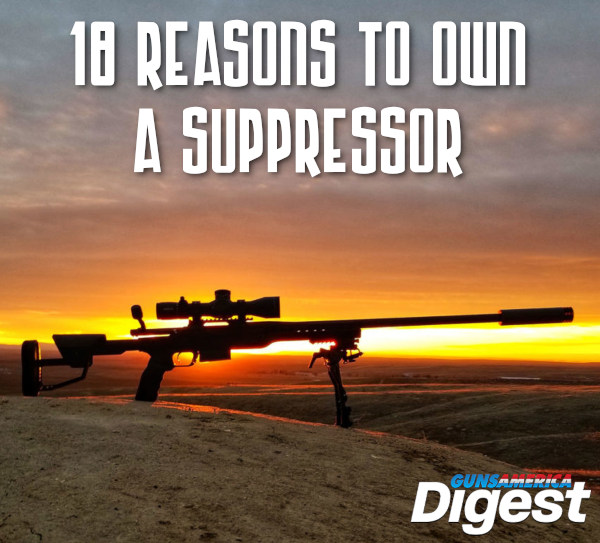
Read full story in GunsAmerica Digest for all 18 reasons to own a suppressor.
Do you own a suppressor yet? If you live in a state where silencers are allowed, there are many good reasons to get a modern suppressor. The process for acquisition has been streamlined. Vendors such as SilencerCo can now handle most of the legal paperwork required. And the choice of suppressors is greater than ever before.
Along with basic noise reduction, what are the key reasons to get a suppressor? There are actually many. True Pearce, Editor of the GunsAmerica Digest, has written an excellent article about the benefits of suppressors: Why a Silencer Might Prevent Dementia & 17 Other Reasons You Need a Suppressor. Here are FIVE of the 18 reasons outlined in the article. We recommend you read the full story to access ALL 18 reasons. That full article has worthwhile insights for anyone considering getting a suppressor.
Reason — Protect Your Hearing
Owning and using a suppressor helps prevent hearing loss. Hearing loss is a legitimate health concern that all firearms owners should be concerned about. Firearms are loud. The average firearm without a suppressor is between 140-165 dB and creates what is called an impulse noise (i.e. a noise that lasts for less than one second).
OSHA’s limit for impact/impulse noise is 140 dB…. Every time you fire a gun (including a .22 LR) without hearing protection or a suppressor, you can permanently lose hearing and it never returns. Surgery and hearing aids cannot restore the hearing you lose — it’s gone forever. Suppressors do not make your gun silent! However, they can make the impulse noise much less than 140 dB.
Reason — Reduce Muzzle Blast
A suppressor reduces or eliminates muzzle blast. Traditionally, we associate flinching with recoil, and while recoil can contribute to flinching, many shooters are finding that when using a suppressor on a caliber with no recoil they don’t suffer from the concussion, noise, and blast. As a result, they don’t close their eyes, flinch, or jerk the trigger.
Reason — Reduce Felt Recoil
A suppressor … reduces recoil or kick. Nobody that’s telling the truth enjoys getting punched in the shoulder, and that’s essentially what happens when you shoot a lightweight centerfire magnum rifle. Suppressors are very effective at slowing the recoil down or [reducing it significantly]. I personally observed a small (70-lb) 12-year-old boy shoot a 5.5-pound 6.5 PRC with a suppressor. After shooting he got up smiling and said, “That didn’t kick at all!”.
Reason — Reduce Muzzle Rise to Keep Your View on Target
Suppressors reduce muzzle rise and make it possible to stay on target through your shot [so you can watch the trace and impact]. This allows you to make your own wind calls and corrections.
Reason — Reduce Dust and Dirt Kicked Up from Muzzle Blast
Suppressors prevent snow, dust, dirt, or other debris from blowing up when you shoot prone. If you’ve shot much with muzzle brakes, you know this is a real thing.
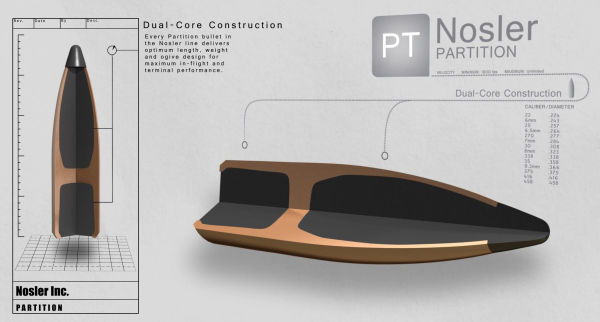
John Nosler lived 97 years, passing in 2010. During his long lifetime, John was an iconic figure in the shooting and hunting world. Considered a true pioneer in bullet and ammunition design, Nosler developed the famous Partition bullet in the 1940s. Born on April 4, 1913 in Brawley, California, John built his business from scratch. He founded his bullet company in 1948. He was considered to be one of the great innovators whose designs helped create the premium bullet category and influenced ammunition manufacturers worldwide.
Moose-Hunt Inspires Partition Bullet Design
While hunting in Canada, John experienced a bullet failure on the hide of a mud-caked bull moose. He then began developing a revolutionary new projectile, which he called the “Partition”, because of the barrier that separated the bullet into two sections. One year later, John and a friend traveled back to British Columbia with his new Partition bullets, which were designed to provide deep penetration and expansion. The men bagged two moose with two shots, and the rest is history.
NRA Golden Bullseye Pioneer Award
In recognition of his contribution to the shooting sports industry, John was the unanimous choice for the inaugural 2007 NRA Golden Bullseye Pioneer Award. The award was the highlight of a long and fruitful career. Even though he officially retired in 1988 when his son and daughter-in-law, Bob and Joan Nosler purchased the company, John still managed to come to the office on a daily basis until his health declined.
Today, John’s son Bob Nosler still presides over the company as president and CEO of Nosler, Inc., based in Bend, Oregon. Along with bullets, the company now produces cartridge brass, loaded ammunition, and hunting rifles.
To learn more about John Nosler and his bullet designs, get your hands on Going Ballistic, a “Professional Memoir” told by John Nosler to outdoor writer Gary Lewis. CLICK HERE to hear a short John Nosler audio clip or to order the book from the author.
John Nosler remained an avid hunter and shooter even late in life. Gary Lewis recalled that, at age 92, John Nosler attended the opening of a new shooting range outside Bend, Oregon. Even in his nineties, Nosler managed to drill two shots inside nine inches at 1000 yards. John Nosler leaves a legacy that will benefit hunters and shooters’ nationwide. The John A. Nosler Endowment of The NRA Foundation, sponsors the NRA’s Basic Rifle Training Program which instructs novices in safe rifle handling.
Are you seeing unpredictable changes in Point of Impact on your target? Think you may have a scope issue? Well maybe not — when was the last time you checked your BARREL?
Yes scopes do fail, and scope bases/rings do get loose. But sometimes problems with erratic POI shifts are caused by a LOOSE BARREL. This issue came up recently in our Shooter’s Forum. One member complained that his zero was shifting from day to day — by as much as two inches at 100 yards. He was convinced he had a scope problem, based on erratic POI:
“I think my scope loses 1 to 3 MOA per day. When I shot my rifle Monday it was dead on. On Tuesday it was 1″ low. Then on Wednesday it was 1 or 2″ lower. I don’t get it. — the elevation knob never touched. Scope will track and return to zero that day perfect. Yes EVERYTHING has been checked, nothing loose. What is the chance the erector tube spring has gone south? For the record this is a Vortex GE. Never had a bad scope, but this has me wondering”. — LB
On Forum member told LB to send the scope right back to the manufacturer. Two other members suggested mounting the scope on a different rifle to test. Good advice. That’s generally a smart strategy before you conclude a scope has gone bad…
Could Problem Be the Scope Base?
Two Forum members, ExPiper and Dickn52, suggested checking the scope base, recounting their past experiences with troublesome bases. This was intelligent — anyone with a POI problem should check all the optics attachments:
“Went crazy one day chasing my impacts on a 100-yard target. Shots would group fine for three then go nuts for 4-5. I cranked and un-cranked for about an hour. Then I reached up and the base wobbled on the rifle. Removed scope, tightened base screws and back in business.” — Dickn52
“Years ago I had a problem [where] shots were climbing with almost every shot. I was blaming the scope. However, when removing the scope I noticed that the 20 MOA base was cracked and getting wider with every shot. Needless to say I replaced the base and the problem was solved. — ExPiper
Eureka Moment — The problem was the BARREL, not the Scope
There were many helpful suggestions, but member PirateAmmo steered LB to the real problem — a loose BARREL: “We had a problem on a home-built AR-platform rifle once, barrel was loose a tad…”
Member Snert chimed in: “Yep — I had a PPC that suddenly went 19″ low. Picked up gun off bench by barrel and felt a wiggle. I tightened the barrel and the POI went 19 inches up”.
Problem Solved — Barrel Tightened up and POI Back to Normal
The gentleman with the POI problem took the advice of PirateAmmo and checked his barrel. BINGO! Low and behold, the barrel WAS loose.
LB posted: “Barrel loose by about 2%, checked it twice before and didn’t find it the first two times”.
After LB re-tightened his barrel, his rifle started shooting normally again. No more shooting low by 1-2 inches. Problem solved. The fix didn’t cost a penny and now LB doesn’t have to send a perfectly good optic back to the manufacturer.
Lesson learned? Check ALL the variables before you assume a scope has gone bad. Along with the barrel, also check your action screw tension, and of course the scope base and rings.


 After several weeks of testing, I think I found the perfect combination for the .416 Barrett in my rifle. My optimal load runs about 3000 FPS using the following components:


 This video was made with the help of the




 NRA Golden Bullseye Pioneer Award
 To learn more about John Nosler and his bullet designs, get your hands on Going Ballistic, a “Professional Memoir” told by John Nosler to outdoor writer Gary Lewis.


