Time flies, even during a pandemic. August is just two days away, and that means it’s time to get ready for National Shooting Sports Month (NSSM). To help grow the ranks of shooters, the National Shooting Sports Foundation (NSSF) asks you to bring a new shooter to the range in August. That’s a good mission — adding to the ranks of shooters is the best way to preserve our Second Amendment rights.
This coast-to-coast celebration spotlights the fun and enjoyment of target shooting. Newcomers can take their first shots, and experienced shooters can invite someone new to the range or help an erstwhile shooter rediscover the fun of target shooting. This month-long event involves all the shooting sports — rifle, pistol, and shotgun.
Find Shooting Sports Events Near You
The NSSF’s ShootingSportsMonth.org website offers a comprehensive, searchable database. This lets you search by state, to find ranges, events, and sales promotions near you. Visit the NSSF online database of NSSM shooting events to find matches, clinics, training sessions, special sales — and much more.
Great FREE Targets for Fun at the Range
To promote National Shooting Sports Month, the NSSF has created a dozen FREE Downloadable Targets. There are regular bullseyes, as well as Darts, Golf, and more. We really like the Billiards target and kids love the Water Balloons target. You can download all 12 targets for free, and then print them out, ideally with a color printer. Have at it!
What Shooters Can Do to Promote National Shooting Sports Month:
The NSSF says: “As shooters, you serve a critical role in the continued growth of gun ownership and shooting sports participation. We urge you to join us this August for National Shooting Sports Month.” There are a variety of ways you can help this August:
— Introduce a family member, friend, or group of friends to the shooting sports by taking them to a local range that’s hosting an event.
— Spread the word to family/friends and encourage them to get out to the range in August.
— Encourage the ranges and retailers near you to host an event this August and add them to the official events calendar at www.ShootingSportsMonth.org.
The Czech Republic could add the right to armed self-defense to its document of fundamental rights. (Photo: Self-defense class in Czech Republic, Wikimedia commons)
The U.S. Constitution’s guarantee of the right to keep and bear arms is unique on the world stage. And while courts and legislators routinely ignore or warp the words of the Second Amendment, it has stood as a bulwark against the worst kinds of anti-gun policies in places like Canada, Australia, and Europe.
This year, one of those European counties may be taking a step towards what Americans have enjoyed since 1789 [When the Bill of Rights was created].
For several years, conservatives in the Czech Republic’s parliament have been pushing to add the right to armed self-defense as one of the “fundamental human rights and freedoms”, according to David Harsanyi writing in National Review.
The proposed Amendment reads: “The right to defend one’s own life or the life of another person with a weapon is guaranteed under the conditions laid down by law.”
Conservatives passed the amendment through the lower house of parliament, but it failed in the upper house. But now they’ve earned a majority in the senate, and the Czech government unexpectedly announced it would endorse the plan to add the language.
The Czech Republic was the only European country to challenge the draconian European Firearms Directive passed by the European Union in the wake of the Charlie Hebdo terror attack in 2015. As GunsAmerica reported at the time, the Directive banned most types of semi-automatic firearms even in countries with high rates of firearm ownership and low rates of crime.
The Czech Republic lost its challenge to the directive in the European Court of Justice, but the Czech Senate first proposed a right to firearms several years ago after it had received a petition with more than 100,000 signatures. It’s unclear whether the pro-gun amendment will pass or if it will be able to override the EU’s Firearm Directive if it does. The amendment requires a 60% majority of both chambers of Parliament to join the country’s Charter of Fundamental Rights and Freedoms, but the center-right Civic Democratic Party may not be able to reach that threshold.
Czech Republic Firearms History
The Czech Republic ranks in the middle of the pack on the rankings of firearm ownership among European countries, but the country has a long history of firearm use and manufacturing. Rates of ownership have been increasing, and of course, the Czech Republic is also the home of the legendary firearms maker CZ.
The Czech Republic remains one of the safest countries in Europe and Prague remains one of the safest cities in the world. No doubt it would become even safer if every law-abiding citizen had protected right to keep and bear arms for self-defense.
Even with surging firearms sales in 2020, Remington Arms Company (Remington) found itself in financial trouble — with overwhelming obligations to creditors and investors. Accordingly, on July 27, 2020, Remington filed for Chapter 11 Bankruptcy — the second time in recent years.
Remington, based in Madison, North Carolina, filed for Chapter 11 in March 2018. With major loan reorganizations, Remington “emerged nearly two months later, having converted more than $775 million in debt into equity for its lenders.” (Source: Syracuse.com.) However, despite this debt-restructuring, the company has struggled with high interest costs and litigation related to the 2012 Sandy Hook Elementary School shooting. The perpetrator had a Bushmaster XM15-E2S rifle sold by Remington.
This time, there are more challenges — and it’s unclear how the company’s operations will fare in the months and years ahead. According to the Wall Street Journal, the debt-burdened firearms maker will seek buyers for its assets:
Remington Arms Declares Bankruptcy Despite Surging Gun Demand
Firearms maker Remington Arms Co. filed for bankruptcy protection for the second time since 2018, weighed down by more debt than it can repay even as fearful Americans buy more guns than ever.
Remington … sought chapter 11 protection and will try to sell its business at a time when civil unrest and worries about personal safety have driven firearm sales to record highs.
The chapter 11 petition in the U.S. Bankruptcy Court in Decatur, Alabama, marks Remington’s second restructuring since 2018, when it filed for chapter 11 and transferred ownership to investors including Franklin Resources Inc. and JPMorgan Chase & Co.
Remington has been searching for potential buyers and was in talks to sell itself out of bankruptcy to the Navajo Nation before negotiations collapsed in recent weeks, leaving the company without a lead bidder, or stalking horse, in place.
The manufacturer’s firearms and ammunition businesses could be sold off separately, according to a person familiar with the matter.
Remington Has a Storied History
Founded in 1816 by Eliphalet Remington in New York, Remington is the oldest continuously-operating gun manufacturer in the United States. Even with its present difficulties, Remington still sells more sporting rifles and shotguns than any other American company. Remington has developed more cartridges than any other U.S. company. And it is the only American company that sells firearms AND ammunition under its own name.
Our friend Gavin Gear of UltimateReloader.com often gets to test the latest and greatest reloading tools before they hit the market. He does a good job showing the features of new products with informative videos. Today we present three interesting products that Gavin has reviewed. First off is the impressive new RCBS Rebel reloading press. Next is the versatile three-head Case Prep Trio machine from Hornady. Third, Gavin reviews new Die Lock Rings and Breech Lock Die Bushings from Lee Precision.
RCBS Rebel Single-Stage Reloading Press
Most hand-loaders have used an RCBS Rock Chucker press at one time or another. Recently RCBS unveiled its new Rebel single-stage press. Like the Rock Chucker, the Rebel has a Cast Iron frame, but with a bigger base and taller arch (for a larger opening). The most important change is that this new Rebel press ejects primers out the bottom of the ram. This a big deal — just put a bin under the press to collect spent primers. However — take note — the Rebel has no on-press priming. You need to prime your cases separately. That’s not really a major issue, as we know the majority of our readers prime separately using hand or bench priming tools.
In this video Gavin loads ammo on the new the Rebel single-stage press and explains its notable features, including the primer ejection through the ram.
Note, RCBS is currently running a Buy Green Get Green Rebate Program. The Rebel Press qualifies for a $50.00 Rebate. And right now, MidwayUSA has the Rebel Press on sale for $186.99. So your net cost, after RCBS Rebate, is just $136.99. That’s a great deal on an excellent press.
Hornady Lock-N-Load Case Prep Trio
Hornady’s compact Case Prep Trio machine (item 050160) packs a lot of functionality in a small package. This triple-threat tool has a small footprint, yet it can perform three tasks as well as much more expensive, tower-style case prep units.
Gavin Gear does a nice job explaining the features of the Case Prep trio. Watch this video to see how it can help you perform chamfering, deburring, and pimer pocket uniforming tasks more efficiently.
With three active stations, you can chamfer, deburr and clean primer pockets without having to change tools. The Case Prep Trio ships with inside chamfer, outside chamfer, and deburr tools. You can also use the machine with other optional 8/32 threaded accessories such as primer pocket reamers and case neck brushes. We’ve used this machine and it works well. The only negative is that you will get metal shavings on your bench (unlike some of the larger case prep centers). We’ve seen some guys put a small pan under the power head — then you can just dump the shavings out of the pan.
New Lee Die Lock Rings and Spline Drive Breech Lock Bushings
New basic lock ring in left hand. Older non-splined ring in right hand.
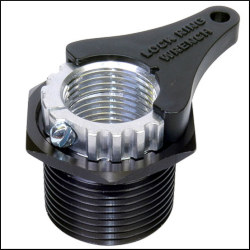
In this recent video Gavin Gear reviews three types of die accessories from LEE. These work for virtually all standard dies, not just LEE-brand reloading dies. The new LEE basic silver-finish die lock rings now feature splines for enhanced grip and compatibility with LEE’s new die lock ring wrench (photo right). They still boast a rubber 0-Ring that helps “float” the die for improved cartridge concentricity.
LEE’s new Ultimate Die Lock Rings have two major improvements — a colorful anodized finish, and a split-ring design with a tensioning screw, that allows these rings to be clamped securely to your dies. Available as a set, this package includes three ultimate die lock rings, and a plastic die lock ring wrench.
Gavin also reviews Lee’s new Spline Drive Breech Lock Bushings for use with presses fitted with LEE’s Breech Lock system. These new Breech Lock bushings allow rapid change-out of dies without modifying the setting. The colorful new bushings feature splines on top that work with the new Lee Lock ring wrench shown above. In addition, the Breech Lock Bushings have a clamp to preserve die depth setting.
Summer’s here, so many folks will head to the hinterlands on prairie dog safaris. On a good P-Dog adventure, you may shoot hundreds of rounds over a long weekend. So you’ll need plenty of ammo. With these ammo volume requirements, you probably won’t have time to load to benchrest standards, and you may not have the budget for match-grade bullets. To save time you may throw (rather than weigh) your charges, or even load on a progressive press. This all raises the question of ammo accuracy — how good is “good enough”? A Sierra Bullets expert answers that question here — explaining how to efficiently load ammo for varmint work.
Ammunition Accuracy Requirements 101 — Varmint Ammo
This story based on article by Sierra Bullets Chief Ballistician Tommy Todd
I load and shoot ammunition for a living. In my duties here at Sierra I constantly test bullet accuracy for our production needs. Because of this, I shoot a variety of different calibers and cartridges on a daily basis and a large demand of this shooting is keeping the guns and loads tuned for optimum accuracy. I have a very narrow window of tolerances to maintain in order to provide our customers (you) with the most accurate bullets on the market.
I have learned many tricks and techniques over the years to tuning a load, prepping brass, and cleaning barrels to keep a gun shooting. I often utilize the things I have learned and take them to extreme levels when competing in a shooting event. I also often ignore most of these things (other than safety) and simplify the process if the shooting I will be doing does not warrant.
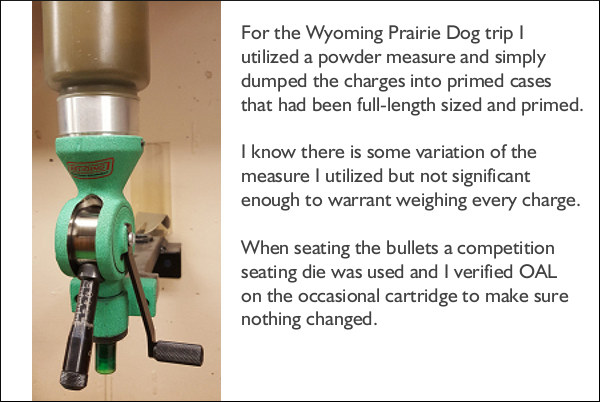
Recently I went on a prairie dog shoot in Wyoming with some good friends. The targets cooperated as did the weather with the exception of some challenging winds we experienced. We had a great time and make a lot of hits on those small rodents. When loading for the .223 Remington rifles and the TC Contender, I cut a few corners in the ammunition-loading process due to both time constraints and accuracy needed. When shooting at a prairie dog a miss is simply that, but when shooting at say the X-Ring at 1000-yard competition, a poorly-placed shot [harms your] placing in the match. Because of this, I can afford to miss an occasional shot at a varmint due to ammunition capability without worry but will not allow the same tolerances in my match ammo. For the Wyoming trip I utilized a powder measure and simply dumped the charges into primed cases that had been full-length sized and primed.
I had measured enough for length to know that while there was some variance all were under maximum length. I know there is some variation of the measure I utilized but not significant enough to warrant weighing every charge. When seating the bullets a competition seating die was used and I verified OAL on the occasional cartridge to make sure nothing changed.
This varmint ammo, with thrown charges, put TEN shots inside ONE inch at 200 yards. That’s half MOA. Good Enough? Absolutely!
The ammo produced shot under one inch at 200 yards in one of the guns I planned on taking on to Wyoming with me. [Editor: That was for TEN Shots — see above.] I knew I had loaded ammunition that was quite suitable for the task at hand which was evidenced by the number of hits I was able to make at fairly long range.
NOTE: The author, Tommy Todd, explains that, when loading ammo for F-Class matches, he uses more exacting methods. He weighs every charge and seats his bullets carefully with an arbor press. Todd adapts his methodology for his particular application. The lesson here is to load to the level of precision demanded by your discipline. READ Full Story HERE.
Talented F-Class shooter Peter Johns has been on a tear the last couple years. He won the F-TR Division at the 2020 Berger SW Nationals (SWN), after finishing second in 2019. His SWN win came on the heels of stellar performances in 2019. He won both the mid-range AND long-range Texas State championships last year. Along the way Peter set a new 600-yard NRA National F-TR Record (200-18X), and tied the 600-yard F-TR Aggregate Record with 600-47X. This Sunday GunDay story features Peter and his trophy-grabbing .308 Win F-TR rifle.
How to Campaign a Winning .308 Winchester F-TR Rifle
Report by Peter Johns
I started contemplating F-Class shooting after talking with Darrell Buell at SHOT Show a decade ago. My first F-Class match was with a Savage VLP with a 26″ Shilen 7mm SAUM barrel and a Harris bipod. After that initial match in Texas I knew I had a lot to learn. I decided that F-TR was the place to start. This story follows my development as an F-TR shooter and showcases the rifle that delivered multiple F-TR match wins in 2019 and 2020.
Watch Peter Johns Shoot his .308 Win F-TR Rig
Equipment Showcase — Key Components of Peter’s F-TR Rifle
Omar Alonzo (Alonzo Custom Rifles, (713) 283-4384, Gunbuilder284@gmail.com) does all my gunsmithing. I believe this is one of the major reasons I have been doing so well in the last couple years. He does a phenomenal job with rifle bedding. He also fixed the timing on my action. The first barrel he chambered has really helped me win matches and set records.
In this Video, Peter talks about his key rifle components and gear:
McMillan Kestros BR Stock — I switched to a Kestros BR stock when they first came out. I painted the stock myself. I am very grateful to Kelly McMillan for letting me be one of the first to try them. The Kestros BR tracks better than any stock I have tried. NOTE — the Kestros was so light that I had to add a steel bar under the forearm to get closer to the F-TR weight limit with a 30″ HV barrel. [Editor: That has the advantage of lowering the center of gravity and the bar can slide fore/aft to adjust center of balance]. I use a SEB Bigfoot rear bag with slick ears and 3/4″ spacing. When I got the Kestros I thought the rear bag spacing was too wide but it worked so well I didn’t change.
Kelbly (Stolle) Panda Action and Krieger Barrel — My rig has a Kelbly Panda F-class action with a Bix’N Andy trigger. At the Berger SWN, I used a Krieger 1:10″-twist 30″ HV 4-groove barrel. It is superbly accurate. I have been bouncing between Krieger and Bartlein for barrels for the last few years. The best barrel I have had is a 30″ Krieger 4-groove HV, however the Bartleins have been very good as well.
Duplin Bipod with Articulating Feet — I really liked the Pohlabel articulating feet that are available for the SEB JoyPod so I asked Dan Pohlabel for permission to copy his feet. I bought some aluminum and made the best copy I could. Since SWN, Duplin has coming out with a new bipod with articulating feet which are considerably better than the feet I made. I use a board and a piece of stall mat with carpet glued on it for the bipod to sit on.
Vortex Golden Eagle Scope — I use the 15-60x52mm Vortex Golden Eagle on all my F-Class rifles. I see the mirage better with the Golden Eagle than any other scope and it tracks perfectly. I also use a Vortex Razor spotting scope with long eye relief lens on the line to help watch mirage and flags. I also use the Razor spotting scope to call wind for Team Texas.
Cleaning Procedure — Less is More — No Cleaning During SWN Long Range Event
Peter has learned that he can go for long round counts without cleaning: “I have found that my .308 Win rigs, for the most part, shoot really well dirty. I can usually get 300 or more rounds before cleaning. I cleaned my barrel at the 2020 SWN after the mid-range event and fouled it before the long-range. I did not clean my barrel again until I got home from the match.”
Peter does clean thoroughly when he gets home: “After a big match I clean my rifles with Boretech Eliminator and a bronze brush followed by Iosso until the majority of carbon is removed from the barrel, as verified with a Lyman borescope. After a thorough cleaning, I find that I need to shoot a bunch of foulers. I will usually go to my practice range and shoot a 20-shot practice match and I will see the accuracy tighten up in the back half.”
600-yard practice target on left. On right is 600-yard record match target shot at 2019 TX State Championships (on ShotMarker targets). This 200-18X is a NRA National Record for F-TR division.
Peter’s Match Load and Reloading Methodology
Loading for .308 Win F-TR — Do What Matters
My loading technique has evolved almost full circle from where I started. I went from the basics to doing every step a person could conceive. Then I decided to start testing all the different steps to see what didn’t matter or made things worse. I am now back to almost no steps in my reloading process. I don’t clean brass anymore. I just wipe the case off, lube, size, prime, and load. I anneal when I feel the necks getting inconsistent when seating the bullets. I pre-load all my ammo for matches. I tried seating them at the match but I didn’t find it to matter on the score card and it takes my focus away from conditions.
Peter’s 2020 SWN-winning .308 Win load consists of Berger 200.20X bullets, Lapua Palma brass, Federal 205M primers, and Varget powder. Peter revealed: “The Berger 200-grainers are running in the mid-2600 fps range. I have tried them much faster but found the best consistency at this speed.”
Peter measures powder to the kernel and also weighs/sorts other components. He runs Berger 200.20X bullets slightly off the lands in a 0.170 freebore chamber. Notably he tests a variety of powders, ascertaining each barrel’s particular preference: “In the last few years I have tried N140, N150, H4895, and Varget. I think they are all good powders for F-TR and the 200.20X bullet. This year I was using Varget. At the 2018 SWN I placed 4th with H4895, in 2019 SWN I got 2nd with N140. I find what powder my particular barrel likes best. I also test CCI BR4 and Fed 205M to see which my rifle likes best. This year I was using Fed 205M. I have been using Lapua Palma brass and it seems to last forever.” Peter full-length sizes with a Redding bushing FL die. He seats his Berger bullets with a Wilson inline seater.
Q & A with Peter Johns, F-TR Ace
Q: What was your biggest challenge at the 2020 Berger SW Nationals?
Peter: I think the biggest challenge was staying focused on conditions. I think the hardest thing for me to do is to stop shooting when the wind conditions are out of my ability to call accurately. I focused hard on this aspect of my game this year and it has paid off. This match is super well run and staff does an excellent job which allows the shooters to maintain their focus.
Q: What gear/hardware items give you an edge over the competition?
Peter: The Kestros BR stock (below) is not used by many F-TR shooters and I think it gives me a huge advantage over the competition. This stock fits me perfectly and tracks in such a manner that I can shoot fast and accurately when conditions are right.
Q: What is your advice for newcomers in F-Class and Long Range competition?
Peter: Go to a top gunsmith building F-Class rifles and do what he says. Competition is the best way to get better. So shoot as many matches as you can. Find top shooter rivals and strive to beat them.
Q: Do you have any specific Gun Handling Tips for F-TR shooters?
Peter: I shoot better with a really light grip and cheek pressure. I can shoot well with a heavier grip and cheek pressure but when the tension of a big match is going my pressure will vary and cause poor accuracy. The most consistent I can shoot is with light gun handling. I also focus on trying to watch the bullet hit through the scope to ensure good follow through and this prevents me from jerking the trigger. There are a bunch of ways to hold a rifle that have proven to be successful. I think a shooter needs to test and find what works best for them.
Q: What do you like most about F-Class and Long Range competition?
A. I really like technical things. F-Class is right in my wheel house for technical stuff. Also, the people in the shooting world are top notch. I enjoy talking with other shooters.
Q: Do you prefer individual events or team matches?
Peter: I prefer the team matches by far because it is a social event with collaboration and there is a lot more pressure. I put a lot of effort into learning the wind for the team matches which in the long run helps me with individual matches. [Editor: Below Peter is calling wind for Team Texas at the 2018 F-Class Nationals in Raton, New Mexico.]
Peter Johns calls wind for Team Texas at 2018 F-Class Nationals in Raton.
Overcoming Serious Injury in U.S. Navy to Become a Top-Level Marksman
Peter Johns is a U.S. Navy veteran, rank Chief (E7). In 2006, during his duty aboard the U.S.S. Nimitz, Peter sustained very serious and extensive burns in a massive electrical fire. Showing great strength of character, Peter went through a tough, 4-year program of surgeries and rehab. The photo below shows Peter doing therapy during his recovery process.
Peter tells us: “As many of you know I was badly burned on board the U.S.S. Nimitz in 2006. That has limited me in my ability to compete in physical activities that I used to enjoy but F-Class has filled the gap for my competitive nature. I medically retired from the Navy as a Chief (E7) in 2010 after four years of surgeries and physical therapy. I was very surprised to find how accepting and nice people have been in the shooting community. I think the shooting community is comprised of the best people in the world.”
What happens when a round goes off unsafely in an AR? Watch this video and see. At about the 00:40 time-mark the shooter has a malfunction (click no bang), with a round. He then removes the magazine, and clears the chamber (we think). On the next round, at 00:53 you hear a “Bang” and see a big puff of smoke coming out of the upper receiver (see photo at right). This has been called a “detonation” by the video-maker, but we’re not 100% sure what happened. What do you guys think? Watch the video carefully, and state your conclusions in the comment section if you wish.
What Caused this Malfunction? Watch Video…
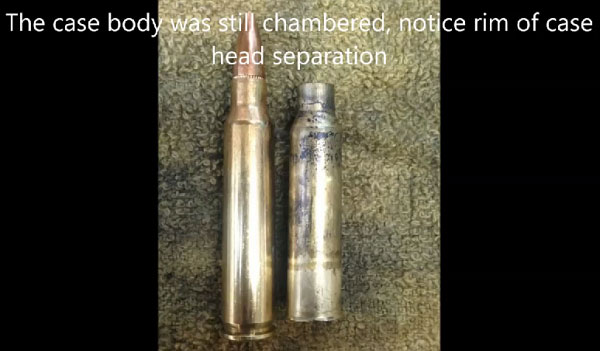
In any event, the shooter is fortunate his upper did not completely fracture, launching shrapnel into his face or other body parts. This could have turned out much worse. Here are screen-shots from the video, showing details of the gun after the accident, along with the recovered brass case, which separated near the case-head.
Have a good look at the photos below — this may be one of the most noteworthy target strings we’ve ever published. What you can see is the effect of barrel tuner position on point of impact (POI). You can clearly see that the tuner position alters the up/down POI location in a predictable fashion.
This remarkable 15-shot sequence was shot by French benchrester Pascal Fischbach using his 6 PPC fitted with a CG (Carlito Gonzales) action and a Bukys barrel tuner.
Pascal reports: “After [bullet] seating and load validation, I put the Bukys tuner on, screwing it out 10 turns. According to Carlito, the CG’s super stiff action-to-barrel fit gives a faster vibration modulus that is detrimental below 10 turns [position of the tuner].” Pascal’s procedure was to screw out the tuner 1/4 turn progressively from one shot to the next. He shot one bullet at each tuner position, with a total of 15 shots.
Left Half of Target Strip (shots with 1/4 rotation change of tuner in sequence)
Right Half of Target Strip (shots with 1/4 rotation change of tuner in sequence)
Pascal observed: “Note the point of impact displacement [from shot to shot] tracks clearly along a sinusoide (sine wave curve).” This is indeed notable and significant! This shows how the tuner’s ability to change barrel harmonics can alter the position of the muzzle as each bullet exits, resulting in a higher or lower POI. Pascal sent his results to Carlito Gonzales in Argentina for analysis.
Pascal poses this question to readers: “Guess which three positions Carlito recommends to try?”
Editor’s Note: While this target sequence clearly shows how tuner position can alter bullet point of impact, this, by itself, does not tell us which tuner position(s) are best for accuracy. That will require further multi-shot group testing, involving careful experimentation with tuner position (and powder charge weights). But for those folks who doubt that a tuner can make a difference on a short, fat barrel, just take another look at the photos. The up/down changes are undeniable, and noteworthy in the wave pattern they follow.
Shooting Set-up and Test Conditions:
Pascal did this test at an outdoor range under very good conditions: “This was shot at my home range, outdoors, with four Smiley flags. The range is a narrow cut in high woods. Wind was consistent with readable flags. I started testing the tuner from 10 turns out and on to 15. I recently… found a sweet spot very close to the rearmost position of the tuner, so the rigidity provided by this super long tenon (just short of 70mm) was not a reason to overlook the recommended Bukys tuning procedure.”
Despite the COVID-19 Pandemic, we know that many readers will be traveling by air this summer to attend major matches. If you plan to fly commercially in the weeks ahead, you need to be careful when transporting firearms through airports both in the USA and in other countries. It is important that you comply with all Homeland Security, TSA, and Airline policies when transporting guns and ammunition. Following the rules will help ensure you (and your gear) make it to your destination without hassles, delays or (God forbid), confiscations.
You’ll want to visit the TSA Firearms and Ammunition webpage, and read it start to finish. In addition, before your trip, you should check the regulations of the airline(s) with which you will fly. Some airlines have special requirements, such as weight restrictions.
TSA Guidelines for Travel with Firearms
Firearms Guidelines
• When traveling, comply with the laws concerning possession of firearms as they vary by local, state and international governments.
• If you are traveling internationally with a firearm in checked baggage, please check the U.S. Customs and Border Protection website for information and requirements prior to travel.
• Declare each firearm each time you present it for transport as checked baggage. Ask your airline about limitations or fees that may apply.
• Firearms must be unloaded and locked in a hard-sided container and transported as checked baggage only. As defined by 49 CFR 1540.5 a loaded firearm has a live round of ammunition, or any component thereof, in the chamber or cylinder or in a magazine inserted in the firearm. Only the passenger should retain the key or combination to the lock unless TSA personnel request the key to open the firearm container to ensure compliance with TSA regulations. You may use any brand or type of lock to secure your firearm case, including TSA-recognized locks.
• Firearm parts, including magazines, clips, bolts and firing pins, are prohibited in carry-on baggage, but may be transported in checked baggage.
• Replica firearms, including firearm replicas that are toys, may be transported in checked baggage only.
• Rifle scopes are permitted in carry-on and checked baggage.
Ammunition Guidelines
• Ammunition is prohibited in carry-on baggage, but may be transported in checked baggage.
• Firearm magazines and ammunition clips, whether loaded or empty, must be securely boxed or included within a hard-sided case containing an unloaded firearm. Read the requirements governing the transport of ammunition in checked baggage as defined by 49 CFR 175.10 (a)(8).
• Small arms ammunition (up to .75 caliber and shotgun shells of any gauge) must be packaged in a fiber (such as cardboard), wood, plastic, or metal box specifically designed to carry ammunition and declared to your airline.
• Ammunition may be transported in the same hard-sided, locked case as a firearm if it has been packed as described above. You cannot use firearm magazines or clips for packing ammunition unless they completely enclose the ammunition.
• Firearm magazines and ammunition clips, whether loaded or empty, must be boxed or included within a hard-sided, locked case.
• Please check with your airline for quantity limits for ammunition.
To help our readers comply with rules and regulations for air travel, we offer these guidelines, courtesy “Ron D.”, a member of our Shooters’ Forum. Before he retired, Ron D. served as a Police Officer assigned to Chicago’s O’Hare airport. Here Ron offers some very important advice for shooters traveling with firearms and expensive optics.
First, Ron explains that airport thieves can spot bags containing firearms no matter how they are packaged: “Don’t think you’re safe if your guns are placed in cases designed for golf clubs or trade show items. Baggage is X-Rayed now and cases are tagged with a special bar code if they contain firearms. It doesn’t take long for bad guys to figure out the bar coding for firearms.”
Carry-On Your Scopes and Expensive Items
Ron advises travelers to avoid placing very expensive items in checked baggage: “When traveling by air, carry on your rangefinder, spotting scope, rifle scope, medications, camera, etc. You would be surprised at the amount of people that carry-on jeans and shirts, but put expensive items in checked baggage. Better to loose three pairs of jeans than some expensive glass.”
Mark Bags to Avoid Confusion
Ron notes that carry-on bags are often lost because so many carry-on cases look the same. Ron reports: “People do accidentally remove the wrong bag repeatedly. I frequently heard the comment, ‘But it looks just like my bag.’ When de-planing, keep an eye on what comes out of the overhead that your bag is in. It’s easy to get distracted by someone that has been sitting next to you the whole flight. I tie two streamers of red surveyors’ tape on my carry-on bag.” You can also use paint or decals to make your carry-on bag more distinctive.
General Advice for Air Travelers
Ron cautions: “Keep your hands on your items before boarding. One of the most often heard comments from theft victims was, ‘I just put my computer down for a minute while I was on the phone.’ Also, get to the baggage claim area quickly. If your family/friends can meet you there, so can the opportunists. Things do get lost in the claim area. Don’t be a Victim. Forewarned is forearmed.”
Choosing a Rifle Transport Case
Ron advises: “Buy the best [rifle case] that you can afford. Don’t cry when your $3,000+ Benchrest rifle has a cracked stock or broken scope. Think about what it would be like to travel across the country (e.g. to Montana or the Cactus Classic) and arrive with a damaged rifle. Remember the Samsonite commercial. (For you younger shooters, it shows a monkey throwing the suitcase around in his cage at the zoo.) Baggage handling is NOT a fine art. There is no guarantee that your rifle case will be on top of all the other baggage. Then there is shifting of baggage in the belly of the plane. Ponder that for a while. Rifle and pistol cases must be locked. It doesn’t take a Rocket Scientist to figure out that a simple pry tool will open most case locks. There is not much that you can do to disguise a rifle case. It is what it is, and opportunists know this. Among thieves, it doesn’t take long for the word to get around about a NEW type of case.”
Plano Two-Gun Tactical Case
This Plano AW2 two-gun Case offers the functionality and durability of an SKB-type hard case for HALF the money. This is now just $116.67, while the equivalent SKB is around $300.00.
This Plano AW2 two-gun case is Amazon’s #1 Best Seller in wheeled, heavy-duty firearms cases. This is offered in three sizes: 36″, 42″, and 52″. We like the biggest 52″ version, as it is long enough inside to fit most scoped match rifles. Alternatively, if you have a really long F-Class, ELR, or Palma rig, you can detach the barreled action from the stock, and run the two sections in the shorter 42″ case. This case is strong enough for airline travel, meeting FAA requirements for checked baggage. This Plano case offers a good balance between strength and weight, all for a reasonable cost — $116.67 on Amazon.
The Sniper’s Hide Cup competition went forward this year, despite challenges presented by the COVID-19 pandemic. The event took place June 20-21, 2020 in Colville, WA. This was a backcountry match, set in beautiful green mountain scenery. Here are images from the 2020 SH Cup as posted on the Sniper’s Hide Facebook Page. Congrats to Frank Galli (aka “Lowlight”), founder of Sniper’s Hide, and all the participants in the event. Looks like a great two days of shooting.
The Everyday Sniper Episode 260: Sniper’s Hide Cup 2020
After the 2020 SH Cup event, Frank Galli hosted an informative podcast:
Topics include: Stages, Targets, Equipment, Mindset, First-Time Competitors
Frank: “I’m back from the Sniper’s Hide Cup in Colville, Washington. I’ll be breaking down some lessons learned and give you my observations from the field and competitors with whom I spoke. [We cover] the experience of attending a match and helping new shooters — the juniors, the first time competitors, and how you work with them. Thanks for listening, sharing, and commenting on the Everyday Sniper Podcast.”




 In this recent video Gavin Gear reviews three types of die accessories from LEE. These work for virtually all standard dies, not just LEE-brand reloading dies. The new LEE basic silver-finish die lock rings now feature splines for enhanced grip and compatibility with LEE’s new die lock ring wrench (photo right). They still boast a rubber 0-Ring that helps “float” the die for improved cartridge concentricity.






 Have a good look at the photos below — this may be one of the most noteworthy target strings we’ve ever published. What you can see is the effect of barrel tuner position on point of impact (POI). You can clearly see that the tuner position alters the up/down POI location in a predictable fashion.


 First, Ron explains that airport thieves can spot bags containing firearms no matter how they are packaged: “Don’t think you’re safe if your guns are placed in cases designed for golf clubs or trade show items. Baggage is X-Rayed now and cases are tagged with a special bar code if they contain firearms. It doesn’t take long for bad guys to figure out the bar coding for firearms.”


