Ruger has created a helpful set of online resources for new Firearm owners. The New Firearm Owner Resources site features a Fundamentals of Firearms Ownership Video Series, Industry Resources for local “hands-on” training, as well as information on safe storage. In addition, this online Resource Center offers a full library of product instruction manuals along with suggestions for recommended safety equipment.
There will be new video releases each week, hosted by Mark Gurney, Ruger Director of Product Management. These short (2 min. on average) videos provide key information for new gun owners. If you have friends or family members who are new gun owners, they should watch ALL these videos.
Introduction for New Firearms Owners
Safety Rules — The FOUR Fundamental Safety Rules
Range Safety Equipment — What You Need
This video reviews essential Eye and Ear Protection for shooters.
Enjoy the Shooting Sports USA Archives
With the COVID-19 restrictions we’re all spending more time indoors at home. For some folks that means long sessions in front of the boob tube. Here’s a better idea — there’s a vast resource of great gun-related content available online for FREE. Check out the Shooting Sports USA Articles Archive. SSUSA maintains a vast digital library with hundreds of articles going back to June 2009.
It’s easy to find back issues of Shooting Sports USA magazine. Here’s how: Using the gray toolbar at the top, click on the “ARCHIVES” icon in the upper right area (indicated with red arrow). When you click on “ARCHIVES”, a window will open with a selection of Shooting Sports USA magazine covers/dates in a vertical column.
Next use the vertical scroll bar to go from November 2020 (the latest issue) all the way back to June 2009. Click any issue cover to read.
How to Find and Save Articles
To search through back issues, select “MORE OPTIONS” from the toolbar. Then click the “SEARCH” button. When that opens, select either “Search archives” for ALL back issues or “Search Only this Issue”. When you’ve made your choice, enter your search term(s). For example, you can search for “Camp Perry” or “Palma” or “F-Class Championship”. You can also save any archived issue as a PDF for viewing offline. Just click “SAVE” to download the article you’re currently viewing/reading.
Read Sample Articles
Here are a couple of our favorite SSUSA feature stories from recent years. There are hundreds of other informative articles worth reading.
Top to bottom – Remington firing pin assembly with ISS, Tubb SpeedLock alloy-composite system without ISS (current versions have dual, opposite-wound springs), and Remington short action firing pin assembly without ISS.
The U.S. Army Marksmanship Unit regularly publishes technical articles on the USAMU Facebook page. One informative USAMU article covered mechanical issues and related ignition irregularities that can cause vertical fliers even with good ammunition in an otherwise excellent rifle. We highly recommend you read this article, which offers some important tech tips.
Vertical Dispersion: Mechanical/Ignition Issues?
Poor or inconsistent ignition has long been known to be one of the “usual suspects” when one encounters vertical fliers that just shouldn’t be there. By having a sense of some of the basic principles involved, and a few basic areas to check, the shooter may avoid colsiderable frustration, not to mention time, expensive loading components and barrel wear.
Is your well-built rifle of high-quality components plagued with vertical fliers across more than 1-3 handload combinations? Consider the bedding, crown and scope/sight mounts. Are they correct? If so, then you might check for ignition issues before boldly undertaking an extensive, expensive, and quite possibly fruitless quest for the “magic handload”.
SEEING IS BELIEVING: While the author had been aware for many years that poor ignition should be considered and ruled out when dealing with vertical fliers in an otherwise-excellent rifle, actually seeing the problem and its almost instantaneous cure really drove the lesson home.
He was working with a “dot” rifle – a .22 LR match rifle that really stacked bullets into little piles at 50 yards and beyond. With one lot of ELEY Tenex, it produced consistent “bughole” groups at 50, but with another, selected lot of Tenex, similar groups were regularly ruined by single, vertical fliers that did not appear in other rifles. Rather than spending days burning up expensive, select ammunition looking for “magic lots”, he contacted a well-respected rimfire gunsmith and explained the situation.
Without so much as batting an eye, the highly-experienced ‘smith tore into the rifle’s action, and quickly found the cause(s) of the problem. He discovered a demonstrably weak firing pin spring, plus a chip out of the face of the firing pin where it contacted the cartridge rim.
After replacing and tuning the offending parts, the rifle immediately began shooting tiny, bughole groups with the previously “unacceptable” lot of Tenex. Centerfire rifles can also benefit from ensuring positive, consistent ignition. A wise riflesmith is literally worth his weight in gold!
So, what are some issues we as shooters can inspect in our rifles to help determine if ignition woes could be part of our problem? At the club level, ask yourself if that “experienced” Remington, Winchester 70, or even Springfield-based match bolt gun you’re using is still running its’ original 40-80 year-old factory striker spring? If so, a new replacement is cheap insurance against current or future problems. (And BTW, it might be best to stick to the normal, factory-spec spring weight. A super-powerful spring can cause vertical, just as a weak one one can.) Along with that, a routine check for proper firing-pin protrusion is a quick preventive measure that can rule out potential issues.
Other areas to consider are the centering and consistency of the firing pin’s operation in the bolt. Admittedly, with the increasing use of precision-machined custom actions, this is becoming less an issue every day. Below is the firing pin assembly from a custom BAT action:
However, particularly with factory actions, a very quick and easy check is to remove the bolt, let the firing pin go forward, and look at the firing pin tip through the firing pin hole. Is the tip off-center in the hole, and possibly striking it as it moves forward? Is the hole out-of-round or burred from being struck repeatedly? If so, a trip to the riflesmith is likely in order.
Similarly, machining issues in the bolt/firing pin system can lead to rough and erratic firing pin movement, in which the firing pin drags against an internal surface of the bolt. In high-quality rifles these issues are relatively rare, but not unheard-of, and it takes mere minutes to rule them out. It may be worthwhile to remove the cocking piece/firing pin/spring assembly and look for any unusual gouges, dings, peening, burrs or signs of abnormal wear.
This task is especially easy with Winchester 70s, Springfields, and the similar Mauser 98s, involving little more than the push of a button and unscrewing the cocking piece assembly. This is just one of the many reasons these tried-and-true actions have earned such a loyal following in the field, among hunters who must maintain their rifles away from a shop.
Particularly with older rifles, watch for and remove excess grease (or even Cosmoline!) from both the firing pin assembly and inside the bolt. This can help improve firing pin speed and consistency. Other bolt-action designs may need a take-down tool or other measures.
As part of this inspection, AFTER ENSURING THE RIFLE IS UNLOADED, slowly cock the rifle, dry-fire, and repeat several times. Listen carefully near the action for inconsistency in the sounds it generates. Does the striker falling make the same sound each time? Do you hear or feel grinding upon operation? If so, where?
Be sure to check the operation of the cocking piece (bolt shroud), firing pin within the bolt shroud, the cocking piece cam and the rear of the bolt body where the cocking piece cam operates. As with our examination for abnormal wear marks discussed above, look for marks indicating roughness or a possible need for light polishing. Then, clean and lightly grease the bearing surfaces while you’re at it.
Remington 700 bolt shroud and cocking cam
These are relatively easy checks that shooters can undertake to perform a preliminary inspection on their own. Other mechanical issues can also cause ignition issues, chiefly centered around the action of the trigger, sear and sear spring. If these are suspected, a trip to an experienced, qualified riflesmith for diagnosis is recommended. We hope you find this information helpful! Join us again next week, and in the meantime, enjoy the shooting sports safely!
These days, online gun Auctions and Classifieds attract more attention than ever. With so many folks accessing the internet daily, many gun owners find it easier to sell their firearms online rather than in the local gun store. Online selling opens up a much larger audience. With over 53,000 members in the AccurateShooter Forum, we have a very active gun Classifieds area. And then of course, there are the big dogs — Gunbroker and GunsAmerica. You’ll find tens of thousands of guns for sale on those big sites.
Before selling your stuff online, you should survey the major online sales and auction sites, comparing their fees and features. The costs are NOT all the same. For example, though you can list an item on Gunbroker for free, if the gun sells you may end up paying a LOT of money. Confirm this with the Gunbroker FEE Calculator. Using Gunbroker’s Fee Calculator we determined that, for a $2500.00 gun, the seller will pay $93.75 in fees! Yes, that’s for a single sale.
That’s why many sellers prefer to list their rifles on Benchrest.com, or on the AccurateShooter.com FORUM Classifieds. Currently, basic Accurate Forum members get three (3) free adverts in a 12-month period, while Gold and Silver members get unlimited classifieds for 12 months. A $25 Silver membership is less than you’d pay to sell one single $550 item on Gunbroker ($25.50 fee).
SEVEN TIPS for Selling Your Gear Online
1. Include Good, Sharp Photos: A custom rifle or expensive optic will sell two to three times as quickly, at a higher price, if you include good sharp photos. We can’t over-emphasize the importance of good photos. For all products, show multiple angles, and include the original boxes if you still have them. For a rifle, include detail shots as well as a photo of the complete gun.
2. Resize Your Photos Before Posting: Half of users will probably be viewing your ads with a smartphone. So you don’t need huge photos. We recommend you size your photos down to 1000 pixels wide. This will make uploads more efficient and ensure the Forum server can handle the file sizes.
3. Be Fair and Complete in Your Description: Buyers appreciate honesty and thoroughness in product descriptions. Potential buyers want details. For a rifle, list the gunsmith, barrel-maker, round count, and provide the specifications. If the rifle has a winning competition history, say so. Always highlight the positives in your description, but you should disclose significant flaws. A buyer will be more willing to purchase if he thinks the seller is 100% honest.
4. Don’t Forget Contact Info: We’re amazed by how many adverts omit key contact info. In a forum classified ad, include a first name, e.g. “Ask for Dan.” We also suggest you list your residence city and state. Some buyers will prefer to buy from a seller in their home state. When communicating with a buyer, provide your phone number and email address. We recommend that all buyers and sellers actually talk live on the phone before concluding high-value deals.
5. Make the Price Attractive: Buyers, everywhere, are looking for good deals. If you want your item to move quickly, set the price accordingly and don’t expect top dollar. Check comparable listings and then discount by 10-15% if you want the item to move fast.
6. Include a Call to Action: Advertisements can be twice as effective if they include a “Call to Action”, i.e. a statement that directly inspires the potential buyer to respond. Sample calls to action are: “Free Shipping — today only.” Or, you can use a time limit: “Special Sale Price good ’til the end of the month”.
7. Always Follow ALL Applicable Laws: Even in states where private face-to-face gun sales are allowed, we recommend ALWAYS using an FFL for firearms transfers. This will protect YOU the seller. In addition, do your homework. Don’t sell to a buyer in a city or state (such as California) state or city where the particular firearm (such as an AR15) may be restricted
Classified Advert vs. Auctions For benchrest, F-Class, Silhouette, Tactical or High Power rifles, you may get the best results posting a For Sale ad on a Forum that caters to the right discipline. You want your ad to reach the right audience. On the other hand, a GunBroker.com auction will have tens of thousands of potential buyers. Realistically, however, if you price your rig attractively, it should sell quickly in a Forum Classified Advert. Plus with conventional Classifieds, you can sell immediately — you don’t have to wait for the auction to end. For scopes and reloading equipment (but not firearms, actions, barrels etc.), also consider eBay, which still allows many gun-related items.
CMP COMPETITION RULES FOR 2020-2021 Are Now Available
CMP Rule Changes are now available as Addenda to 2020 Rules or as complete 2020-21 PDFs (links below). There were not a lot of changes that were approved for 2021. However, most notably, eyewear rules will be more strictly enforced. NOTE: When you open the downloadable PDF files linked below, you will see the new-for-2021 changes displayed in red underlined text. The changes made in 2020 are shown in black underlined text.
Story based on Report by Gary Anderson, DCM Emeritus
CMP Competition Rules for the 2021 competition season have now been approved by the CMP Rules Committee and are posted on the CPM Website. The 2020 competition season was severely impacted by the Covid-19 pandemic and many 2020 events were cancelled, so the CMP still has a substantial inventory of printed 2020 rulebooks. In addition [there were] only a small number of changes for 2021. As a result, the CMP decided not to publish new rulebooks for 2021. 2020 Rulebooks will continue to be used and Errata (Update) sheets are being provided for each rulebook. The rulebooks posted on the CMP website have been updated with 2021 changes are labeled as “2020-2021″ rulebooks. These Rulebooks posted on the CMP website include all 2021 changes. Use the links above to get the latest rules for each discipline.
How to UPDATE Your CMP Rules:
1. If you already have a 2020 rulebook, download the Changes/Updates for that rulebook and note in your 2020 rulebook where those changes apply. (Or use the links above).
2. If you keep your rulebooks on your computer, notebook or cell phone, or want to print your own rulebook, download the Updated 2020-2021 rulebooks from the CMP Website. (Or use the links above).
2020-2021 rulebooks include a diagram showing proper use of eye protection.
When reading the 2020-2021 editions of the rulebooks, note that 2020 rule changes are displayed in black underlined text. 2021 changes are displayed in red underlined text. Those changes do, however, include the addition of a new CMP Service Revolver Match in the Pistol Rules and the addition of F-Class and AR-Tactical Mid- and Long-Range Matches in the Highpower Rifle Rules. The CMP plans to offer competitions in both of these new disciplines in the 2021 National Matches. Another significant change, which has already been announced because it applies this year, is the authorization that competitors may fire a sixth EIC match in years like 2020 when the National Trophy Individual Match is not held.
The 2020 rule requiring Highpower Rifle and Pistol competitors to wear eye and hearing protection while on the firing line has been clarified and strengthened in the 2020-2021 rules.
MANDATORY EYE PROTECTION RULE
One of the most important 2020 rule changes was a requirement that Highpower rifle and pistol competitors must wear eye and hearing protection when they are on firing lines. A big majority of experienced, knowledgeable competitors now agree that protective eyewear is a must for Highpower rifle and pistol shooting, but unfortunately this safety precaution has not been as universally accepted. Incidents involving Highpower rifle and pistol shooting where eye injuries occurred or could have occurred are more common than many realize.
Non-Compliance Results in “No Exceptions” Eye Protection Standards
The CMP Board and staff have carefully evaluated the pros and cons of this safety requirement and have concluded that mandating the wearing of eye and hearing protection is a wise policy. After this rule was introduced, a vast majority of competitors complied with its letter and spirit. Unfortunately, there were a few competitors who did not comply. Some wore shooting glasses to the line and then lowered or removed them while firing. A really strange attempt to evade this rule involved cutting a hole in the part of the shooting glasses lens where the competitor looked while aiming. A few simply refused to comply.
After evaluating experiences with this new safety requirement in 2020, the CMP is taking these additional steps to facilitate compliance in 2021:
— Rule 3.6.2 (both Highpower Rifle and Pistol) has been clarified to clearly require that “two complete lenses” be worn in front of both eyes while firing. Obtaining shooting glasses or prescription eyewear that complies with the ANSI Z87.1 safety standard is “strongly recommended”.
— Pre-match safety briefings in 2021 will include specific instructions about the requirement to wear eye and hearing protection while on the firing line.
— Match officials will give warnings to any competitor who is not in compliance. Refusal to comply with a warning is grounds for disqualification.
— Match sponsors are advised that their match officials need to monitor and enforce this rule and that results from EIC or other matches where this rule was not enforced may not be accepted.
Rifleshooter.com built this tactical rifle (top image) with a Howa 1500 action, Shilen barrel, and MDT chassis. Below is a factory Howa 1500 Multi-Cam rifle.
Many of our readers are thinking of purchasing a Howa rifle or barreled action. These feature smooth-running actions with a good two-stage HACT trigger. But some folks have heard that it may be difficult to find stocks, or to fit an after-market barrel. That’s not true. There are many stock options available, and in this article, Bill of RifleShooter.com shows that it is easy to remove the factory-installed barrel with the right tools. We think a Howa makes a fine basis for a varmint rig or field rifle. Or you can build a tactical rifle as Bill did. You can start with the factory barrel and when you want/need more accuracy, then have a gunsmith install a custom barrel from Krieger, Shilen, or other quality brand.
What You Need to Know About Howa 1500-series Rifles
Tech Feature by RifleShooter.com
Consider this article the “Howa 1500 Overview”. AccurateShooter.com’s editor mentioned there’s been a lot of interest in Howa rifles and barreled actions imported by Legacy Sports International. In addition to being able to buy a complete rifle from a dealer, Brownells sells barreled actions in a wide variety of calibers and configurations. In this post we are going to take a look at the Howa 1500 series.
Howa Rifles — General Background
Howa is a Japanese heavy machinery company. One of its product lines are firearms, which, are imported into the United States of America by two different companies, Legacy Sports International and Weatherby. Legacy sells the 1500 under the manufacturers name while Weatherby re-brands the guns as the Weatherby Vanguard. In general, the finishes on the Weatherby rifles are more refined than the LSI-imported 1500s.
General Evaluation of Howa 1500 Rifles
I’ve found Howa 1500s to be solid, entry-level rifles that are capable of sub-MOA accuracy out of the box. I’ve actually purchased two Howa rifles I’ve tested because I like them so much. The gun below, a Howa Mini-Action in 7.62×39 Russian, is one of my favorite factory guns to shoot. I’m running a Tract Optics Toric on it, these are solid little rifle scopes that offer great performance for the money.
Check out this three-shot group I drilled at 100 yards with the rifle above and 125-grain Sierras. It took a lot of work and load development to get there, but when it did, it worked well.
Howa 1500 HACT 2-Stage Trigger
Howa 1500s feature the very nice Howa HACT trigger. This is an adjustable, two-stage trigger, set for about 3 pounds (combined stages). Crisp and repeatable, this is an excellent trigger for a factory gun. There is no annoying Glock-style safety lever in the middle of the trigger blade. The 2-stage design and pull weight range works well for a hunting rifle or a rig for PRS competition. Rifleshooter.com says the Howa trigger is “one of the best factory triggers, along with Tikka. I’ve found the Howa trigger superior to a Remington 700 — the Howas doesn’t need to be replaced.”
Writing for the Western Outdoor News, WONews.com, Steve Comus has field-tested the new HACT Trigger. Steve writes: “I always liked two-stage triggers, because of the way I could take-up the slack and then actually know when the rifle was going to go off. The take-up on the [HACT] trigger was fast and easy. The crisp, positive release when pressure was put on during the second stage [reminded me] of some of the target rifles I shot through the years.”
Howa Actions — Three Options
Howa offers three action lengths: Mini, Short, and Long. You can see the bolts for the three action lengths in the image below. The Mini-Action has similar external dimensions to the Remington Model Seven, however, the Mini-Action’s bolt does not travel as far to the rear. This is a mixed bag. The upside is you have a quicker action (shorter bolt throw). The downside is you are limited to shorter rounds such as the .223 Remington, 7.62×39mm Russian, and 6.5 Grendel. But if you need a bigger cartridge, just choose the standard or long action Howa variant.
Howa 1500 vs. Remington 700 — Important Differences
Is the Howa 1500 a Remington 700 clone, or some kind of improved Remington 700? No, not really. While the top radius of the Howa 1500 does match the Model 700, and they can both use the same two-piece scope bases, there are a number of differences.
If you look at the Howa 1500 alongside the Remington 700 you’ll note the M700 is a round action, while the Howa is a flat-bottom action. In many ways the Howa’s bottom half reminds me of a push-feed Winchester. This means the chassis and stocks that support a Howa 1500 are not V-block based like you’ll find on a 700, instead they have a flat bottom. While the bolt of the Howa is similar in external appearance to the Model 700, it does offer some improvements, notably an M16-style extractor and a firing pin assembly that can be easily removed without tools.
Howa 1500 action screws are metric and are in a different location from the 700. The Howa 1500 has an integral recoil lug that accepts the front action screw, this means you have more of the front action screw engaging the action. WARNING: If you install it into a poorly-fitted stock or action you may bind it.
Can a Howa Action Be Used for a Custom Rifle Project?
Absolutely! You can either buy a barreled action from Brownells and throw it in a chassis system/stock of your choice or you can use a stripped action to build a custom rifle. If you are in the chassis market, MDT offers a wide variety of chassis in different price ranges. All have worked well for me.
How to Remove Howa Factory Barrel from Action
You may have heard internet grumblings about removing Howa barrels. Some keyboard commandos say they are extremely difficult to remove without a relief cut. Well Bill at Rifleshooter.com demonstrates that Howa barrels can be removed without trouble, provided you have the right tools. Watch this video:
Watch Howa Barrel Removal Video — Quick and Easy (Click Speaker Icon for Audio)
Q: Is it difficult to remove a barrel from a Howa 1500?
A: Not very. I’ve heard from some smiths that worked on Howas (years ago) that the factory barrels are difficult to remove. However of the half dozen or so Howa barrels that I’ve pulled, they’ve been very easy. I use a Brownells action wrench with the top piece for a Rem Model 700 and the flat bottom resting against the flat on the wrench.
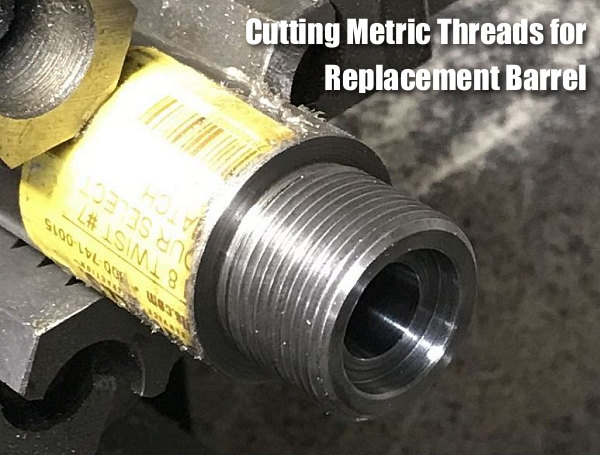
Howa Actions Require Metric Barrel Threads
It’s easy to thread a barrel for a Howa Action. You just have to cut metric threads — most lathes out there can cut them. I cut the threads below on a manual lathe using change gears. [Editor: John Whidden cuts metric tenon threads with a CNC lathe. “It’s easy,” John tells us, “No issue whatsoever.”]
Story by Lars Dalseide forNRAblog.
Back in 2012, the National Firearms Museum received a shipment from Sagamore Hill — the ancestral home of President Theodore Roosevelt. While Sagamore Hill undergoes renovation, the National Parks Service was kind enough to lend a portion of the estate’s collection to the NRA Museum. For quite some time, that collection was displayed at the NRA Museum as an exhibit named “Trappings of an Icon”.
“Basically it tells you about the life of Theodore Roosevelt,” explains Senior Curator Phil Schreier (in photo above in coat). “Hunter, Statesman, Soldier. In the first case we had two firearms from his hunting career. First an 1886 Winchester rifle known as the tennis match gun because he used winnings from a tennis match to purchase the gun.”
The second firearm on display was a suppressed Winchester model 1894 rifle. This was favorite of the President’s when clearing the grounds of the local, pesky critters. Schreier explains: “Archie Roosevelt wrote that his father liked to shoot varmints around Oyster Bay with this gun so he wouldn’t disturb the Tiffany and Du Pont families that lived near by.”
President Theodore Roosevelt was a strong supporter of marksmanship competitions. In fact President Theodore Roosevelt could be called a “founding father” of the NRA National Matches*. Teddy Roosevelt believed that, to assure peace, America needed to be prepared to fight. At the 2011 NRA National Championships, Dr. Joseph W. Westphal, Under Secretary of the U.S. Army, echoed the views of Roosevelt: “The first step in the direction of preparation to avert war, if possible, and to be fit for war, if it should come, is to teach men to shoot.”
Theodore Roosevelt also has a strong connection to the “President’s Match” fired every summer at Camp Perry. The President’s Match was patterned after an event for British Volunteers called the Queen’s Match started in 1860 by Queen Victoria and the NRA of Great Britain. The tradition of making a letter from the President of the United States the first prize began in 1904 when President Roosevelt personally wrote a letter of congratulations to the winner, Private Howard Gensch of the New Jersey National Guard.
*In February 1903, an amendment to the War Department Appropriations Bill established the National Board for the Promotion of Rifle Practice (NBPRP). This government advisory board became the predecessor to today’s Corporation for the Promotion of Rifle Practice and Firearms Safety, Inc. that now governs the Civilian Marksmanship Program (CMP). The 1903 legislation also established the National Matches, commissioned the National Trophy and provided funding to support the Matches. This historic legislation grew out of a desire to improve military marksmanship and national defense preparedness. President Theodore Roosevelt, Secretary of War Elihu Root and NRA President General Bird Spencer were among the most important supporters of this act.
Written by Sierra Bullets Ballistic Technician Duane Siercks
One of the first things new reloaders notice is that load data varies between reloading manuals. The Sierra Bullets Technicians frequently get inquiries asking us to explain why the load data appears to be inconsistent. This article explains five key factors that can influence published load data.
Example of load data variances for two 168 grain bullets:
Here are five reasons why the load data varies:
The Bullet
Basically, the similarities in the .30 caliber 168 grain Match bullets (for example) end with weight and diameter. The bullets likely have dimensional differences such as bearing surface length. Bearing surface has a large effect on pressure and velocity. There are also differences in boat tail, flat base, ogive and over-all lengths, which each help determine the cartridge over-all-length (COAL). With different COAL’s, we can expect changes in pressure and velocity also. In some calibers there are differences in bullet diameter with different bullet manufacturers.
It is also worth noting that bullet manufacturers do not all use the same copper alloy for their jackets. This produces more or less friction that results in load pressures and velocities. The solid copper bullets also vary quite a bit in comparison to a lead core and copper jacketed bullet.
The Gun
Each gun is unique, even if you are using the same make, model, and caliber. Special consideration should be used to consider that not all firearm chambers are the same either, creating more variables that need consideration. There can be drastic differences in the throat length. This controls the amount of “jump” that a bullet experiences when the cartridge is fired.
The Powder
Within normal manufacturing tolerances, you can see some variation in a given powders burn rate between different lots of the same powder. So naturally when two different Manuals are produced, it would be doubtful that the same lots would be tested.
The Cartridge Cases
New cases are almost always near minimum specs in dimension. A load fired in a new case would likely have slightly more pressure that when fired in a re-sized case. This would certainly be true if we were loading into fire-formed cases that have had minimal re-sizing done. Fired cases that are full length resized most of the time be slightly larger than the new unfired cases. This gives you differences in case capacity. The same powder charge placed within a new case and a full length resized case will produce different pressure levels and probably different velocities.
Conditions
Temperature can cause pressure increases or decreases. Hot temperatures tend to cause pressures to increase, while cold temperatures will usually do the opposite. Humidity and altitude can impact pressures and velocities likewise.
Conclusion
As you can see, an amazing number of variables effect any load combination. With the differences in the manuals, you’re just seeing firsthand examples of what took place when the data was collected with that particular set of components and firearm. Think of a reloading manual as a report. In essence, a reloading manual says, “We tried this particular component combination, and these are the results we obtained.”
Remember that you may or may not reach the same maximum load safely. There is no “one load fits all bullets.” The minimum load data offers a safe place to start. The maximum load data listed should always be regarded as a safety guideline and not necessarily a goal! Your gun should shoot accurately without breaching the maximum load data. The best advice is: always start low and work your load up!
If you have questions about variances in load data or other reloading questions, please call our ballistic technicians at 1-800-223-8799 or send us an email at sierra [at] sierrabullets.com.
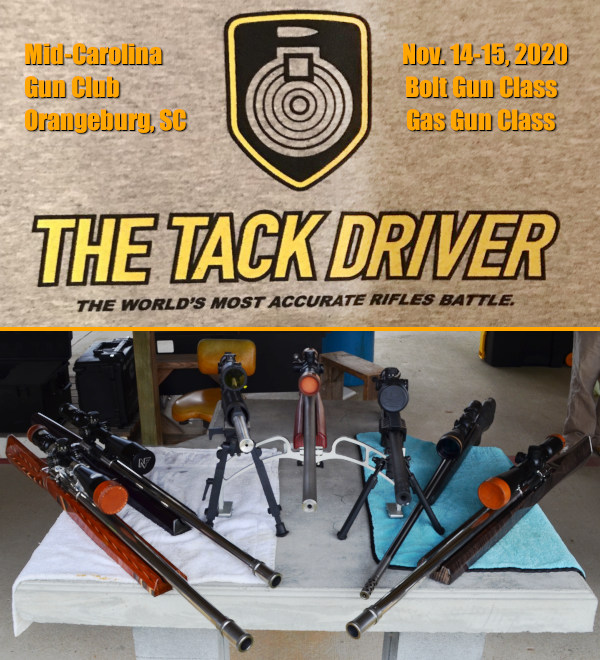
The Tack Driver Showdown is a one-of-a-kind “all comers” rifle match. This match is long overdue — we will finally get to see what rifle types are truly the MOST accurate, at least out to 300 meters. The Tack Driver Showdown match will be held November 14-15, 2020 at the Mid-Carolina Gun Club in Orangeburg, South Carolina. Co-Sponsored by the IBS, the organizers have invited virtually any type of rifle (except railguns) to compete at 300 meters for group and score honors. There are 100+ competitors pre-registered for the event this weekend. No organization membership is required.
Unlike any other rifle match in the world, on the firing line you will see 6 PPC LV/HV rifles, 30 BR score rigs, 17-lb 600-yard and 1000-yard benchrest guns, F-TR rifles, F-Open rifles, Palma rifles, PRS rifles, and maybe even an AR15 or two.
The concept behind the event is to settle the unending arguments about which guns are TRULY the most accurate. The 6PPC is king in 100/200 group competition, the 30BR rules 100/200 score, 6mmBRs and 6BR Improveds dominate in 600-yard Benchrest, the .284 Win is the leading F-Open cartridge, and various 6mms and 6.5mms win PRS matches. It will be interesting to see which chamberings and bullet weights will “rule the roost” at 300 meters. Match Director Jim Cline will post match results throughout the weekend on the AccurateShooter.com Forum.
Tack Driver Showdown targets will be placed at 300 meters (328 yards). That’s not even “mid-range” by benchrest standards, but it should be far enough that the higher BCs of the bullets shot by F-Class and 600/1000-yard benchrest rigs could come into play.
Basic Information on the Tack Driver Shoot:
There are two divisions — bolt-action rifles and semi-auto gas guns. There are no specific design limits other than a 22-lb maximum weight, and a .338 maximum caliber. IBS President Jeff Stover tells us: “We envision the full array of the world’s most accurate rifles on the line: short and long range benchrest rifles, F-Class, AR, other tactical, egg-shoot rifles, whatever…[.]” Key rules are listed below. Semi-autos will need chamber flags, otherwise bolts must be out at all times. You do not have to be a member of the IBS to shoot. The range will be open Friday, November 13th starting at 12:00 noon for practice and flag setting.
Cash Payouts for the Winners in both Group and Score
Match Director Jim Cline tells us: “1st place through 3rd place will be paid in both score, group, and Grand Aggregate finishing positions. Team Cash option also available- 4 man teams $100. The Grand Aggregate team winner takes all.”
2020 Tack Driver Showdown Rules Overview
1. No membership in any organization is required.
2. Any gun .338 caliber and under is legal (other than rail guns), with a 22-pound weight maximum.
3. There are two divisions: 1) Bolt Guns; and 2) Gas Guns.
4. All shooting will be done off benches.
5. Shooters may use bipod, bags, or rest combination but no one-piece rests.
6. You have to shoot the same gun at all targets. If you have a catastrophic failure, you have to continue with a gun of the same caliber and cartridge.
7. No electronic equipment of any type will be allowed on the bench or downrange.
8. No spotting scopes are allowed on the bench.
9. No people may coach or spot for competitors.
10. Chamber flags and brass catchers are required for gas guns.
2020 Tack Driver Showdown Match Course of Fire
1. There will be 5 group targets and 5 IBS 200-yard score targets placed at 300 METERS.
2. Targets will alternate between Score and Group each day: Day 1 Score/Group/Score/Group/Score; Day 2 Group/Score/Group/Score/Group.
3. All relays will be 7-minute matches with one 3-minute sight-in period on Saturday first target only.
4. Benches will be rotated for the second day’s course of fire.
5. Winner will be determined by place of finish at each discipline.
Covered Firing Line at Mid-Carolina Gun Club. Photo from 2019 100/200m Score Nationals.
For more information, including camping/RV details at the Mid-Carolina Gun Club venue, contact Jim Cline at 843-957-6546, or post questions on this Accurateshooter Forum Thread.
“On that day, let us solemnly remember the sacrifices of all those who fought so valiantly, on the seas, in the air, and on foreign shores, to preserve our heritage of freedom, and let us reconsecrate ourselves to the task of promoting and enduring peace so that their efforts shall not have been in vain.”
– 1954, President Dwight D. Eisenhower, Veterans Day proclamation.
102 Years Later…
On the 11th hour, of the 11th day, of the 11th month of 1918, bugle calls signaled the ‘cease fire’ ending the First World War. (The official Armistice was signed earlier that morning.) To those who endured it, WWI was the “Great War”, “the War to End All Wars.” Tragically, an even greater conflict consumed the world just two decades later.
Today, 102 years after the end of WWI, Americans mark the anniversary of the WWI Armistice as “Veterans Day”. In Canada it is known as Remembrance Day. On this solemn occasion we honor all those who have served in the military in times of war and peace.
While more WWII veterans pass away each year, there are still over 20.4 million veterans in the United States. Take time today to honor those soldiers, sailors, and airmen who have served their nation with pride. Today we remember that… “All gave some, and some gave all.” History of Veterans Day.
Former Secretary of Veterans Affairs Dr. James Peake asked Americans to recognize the nation’s 20.4 million living veterans and the generations before them who fought to protect freedom and democracy: “While our foremost thoughts are with those in distant war zones today, Veterans Day is an opportunity for Americans to pay their respects to all who answered the nation’s call to military service.”
On Veterans Day we especially need to remember the seriously wounded combat veterans. These men and women summon great courage every day to overcome the lasting injuries they suffered in battle. Some of these soldiers have lost limbs, yet volunteered to return to combat duty. That is dedication beyond measure — true patriotism.
National Veterans Day Ceremony
The Veterans Day National Ceremony is held each year on November 11th at Arlington National Cemetery. The ceremony commences precisely at 11:00 a.m. with a wreath laying at the Tomb of the Unknowns and continues inside the Memorial Amphitheater with a parade of colors by veterans’ organizations. The ceremony is intended to honor and thank all who served in the U.S. Armed Forces. Major regional ceremonies and events are also held throughout the country.



 Is your well-built rifle of high-quality components plagued with vertical fliers across more than 1-3 handload combinations? Consider the bedding, crown and scope/sight mounts. Are they correct? If so, then you might check for ignition issues before boldly undertaking an extensive, expensive, and quite possibly fruitless quest for the “magic handload”.


 These days, online gun Auctions and Classifieds attract more attention than ever. With so many folks accessing the internet daily, many gun owners find it easier to sell their firearms online rather than in the local gun store. Online selling opens up a much larger audience. With over 53,000 members in the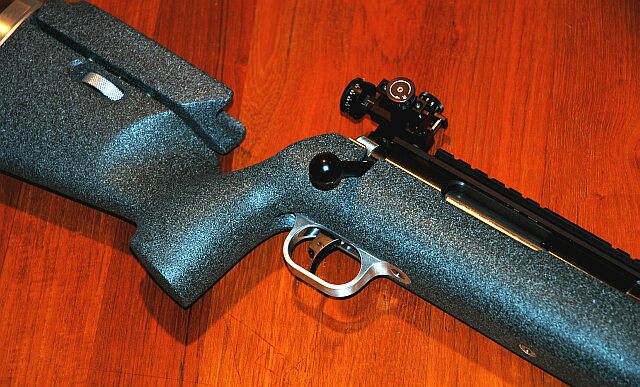
 For benchrest, F-Class, Silhouette, Tactical or High Power rifles, you may get the best results posting a For Sale ad on a Forum that caters to the right discipline. You want your ad to reach the right audience. On the other hand, a GunBroker.com auction will have tens of thousands of potential buyers. Realistically, however, if you price your rig attractively, it should sell quickly in a Forum Classified Advert. Plus with conventional Classifieds, you can sell immediately — you don’t have to wait for the auction to end. For scopes and reloading equipment (but not firearms, actions, barrels etc.), also consider eBay, which still allows many gun-related items.

 When reading the 2020-2021 editions of the rulebooks, note that 2020 rule changes are displayed in black underlined text. 2021 changes are displayed in red underlined text. Those changes do, however, include the addition of a new CMP Service Revolver Match in the Pistol Rules and the addition of F-Class and AR-Tactical Mid- and Long-Range Matches in the Highpower Rifle Rules. The CMP plans to offer competitions in both of these new disciplines in the 2021 National Matches. Another significant change, which has already been announced because it applies this year, is the authorization that competitors may fire a sixth EIC match in years like 2020 when the National Trophy Individual Match is not held.


 Howa 1500 HACT 2-Stage Trigger




 Story by Lars Dalseide for

 President Theodore Roosevelt was a strong supporter of marksmanship competitions. In fact President Theodore Roosevelt could be called a “founding father” of the NRA National Matches*. Teddy Roosevelt believed that, to assure peace, America needed to be prepared to fight. At the 2011 NRA National Championships, Dr. Joseph W. Westphal, Under Secretary of the U.S. Army, echoed the views of Roosevelt: “The first step in the direction of preparation to avert war, if possible, and to be fit for war, if it should come, is to teach men to shoot.”