On Wednesdays, The U.S. Army Marksmanship Unit regularly publishes reloading “how-to” articles on the USAMU Facebook page. One “Handloading Hump Day” article, part 5 of a 6-part series, relates to reloading on Progressive Presses. This article concerns proper procedures for Auto-Indexing Progressives, which advance the shell-plate with every pull of the handle. Auto Progressives are very efficient, but they also require special attention and focus, because so many things are happening at once. You need to train yourself to watch every station. If you run a progressive press now, or are considering getting a progressive, we recommend you read this article. Visit the USAMU Facebook page for other helpful handloading guidance.
Progressive Loading Presses — Self-Advancing Shellplate Type
Recently, we addressed manually-operated progressive presses for the beginning handloader. This type press requires one to manually advance the shellplate after each handle stroke. An advantage for beginners is that nothing happens at any station until the loader wants it to. This helps users avoid problems from clearing malfunctions without noticing that the shellplate has advanced itself. (Read Previous USAMU Article on Manual Progressives.)
The next, more luxurious type progressive press advances the shellplate automatically whenever the handle is cycled. [Editor: This is also called an “Auto-Indexing” Progressive Press.] Typically, each stroke automatically sizes and primes a case, operates the powder measure (if used) and seats a bullet. Some also have case feeders that automatically put a new case in the shellplate with every cycle. Others require the loader to insert a case each cycle. With both types, the loader usually puts a bullet on each sized/primed/charged case.
[CAVEAT: While our Handloading Shop has several progressive presses, ALL of our powder charges are thrown/weighed by hand. We do not use powder measures on our presses. Our progressives are used for brass preparation, priming, seating, etc., but not for fully-progressive loading.]
The manually-advanced press can be a boon to beginners, but as one gains experience it can be a mixed blessing, depending on one’s style. If one pays close attention to every operation and loads without distractions, the manual press is very reliable and allows full scrutiny of each round as it is loaded. However, if one easily drifts into day-dreaming, or isn’t focused on paying careful attention at all times, the manual progressive can be a bit of a liability. The opportunity for forgetting a powder charge, leading to a squib load, is ever-present. [Editor: A lock-out die can help reduce the risk of a squib load, or a double-charge. See below.]
The automatically-advancing progressives help prevent this by ensuring a powder charge will be dropped each time the handle is operated. Experienced handloaders often appreciate this feature due to the savings of time and effort. Individual preferences between the two press styles are influenced by several factors. These include one’s comfort with more- vs. less-complicated mechanisms, how often one changes calibers (case feeders often must be converted, in addition to dies and shellplates), how many rounds one loads annually, relative ease of changing primer mechanisms from small to large, etc. Automatic progressives and their caliber conversion kits tend to be significantly more expensive than manual progressives and caliber conversions from the same maker.
One USAMU handloader, who likes simple, bullet-proof machines and maximum efficiency when converting presses, owns two manually-advanced progressives. One is set up for large primers, and the other for small primers. He can change calibers in the twinkling of an eye. As he loads for many different calibers, this fits his style. Another handloader here is just the opposite. He loads for a few calibers, but in larger quantities. He much prefers his self-advancing press with case-feeder for its speed. He makes large lots of ammo in a given caliber before switching, to improve overall efficiency. His caliber conversion kits are more expensive than those for the manually-advanced progressive, but he uses fewer of them.
Whichever type one chooses, it is VERY important to buy quality gear from a manufacturer with a long, well-established track record for quality, durability and good customer support. Avoid jumping on the “latest, greatest” model until it has a proven track record. For example, this writer knows a loader who got a brand-new, expensive, self-advancing model press some years back, shortly after its introduction. As is too often the case these days, the manufacturer released it before all the “bugs” were worked out.
Better Safe Than Sorry — the RCBS Lock-Out Die
RCBS Makes a “Lock-Out Die” that senses the powder charge. This will halt the Progressive press if you have a double charge, or an undercharge. Your Editor has the Lock-Out Die on his RCBS Pro 2000. It has “saved his bacon” a half-dozen times over the years. It can be used on Dillon and Hornady progressives as well as RCBS machines.
It would not fully seat primers to the correct depth. No amount of adjustment, extra force, or fiddling would do better than to seat primers barely flush with the case head. Any inattention could result in a slightly “high” primer, protruding above the case head. It created a risk for slam-fires, particularly in semi-autos without spring-retracted firing pins, such as the M1 or M1A. In desperation, he had a machinist buddy study the problem and machine a new part to correct it. No dice. Its engineering didn’t permit full primer seating, even with extended parts. He now wishes he’d heeded his shooting buddies’ advice to stick with the “tried and true,” reliable performer they all used.
Whichever press one selects, see if the maker has a kit or list of commonly-replaced parts. Having needed springs, pins, etc. on hand in the rare event that one breaks or “goes missing” can save the day when one is busy loading for a match! Another tip for improving one’s overall loading efficiency (rounds loaded with minimal set-up/tear-down time) is to plan one’s handloading by primer size. For example, if your machine is set to use small primers, load all the calibers that you intend to that take small primers, before converting the press to load large-primer calibers.
In our next chapter, we’ll discuss peculiarities of progressive loading for rifle cartridges, with remedies for problems such as excessive cartridge-case headspace variation when sizing, tips for ensuring best powder charge consistency, and so on. Until then, be safe, and good shooting!
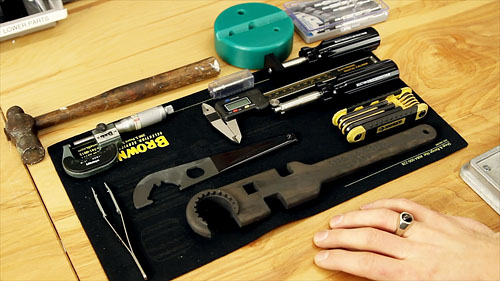
Here are the main tools you’ll need to assemble an AR-platform rifle
In these challenging times, many Americans are buying an AR-type rifle, or starting an AR project — assembling the rifle from available uppers, lowers, and parts kits.
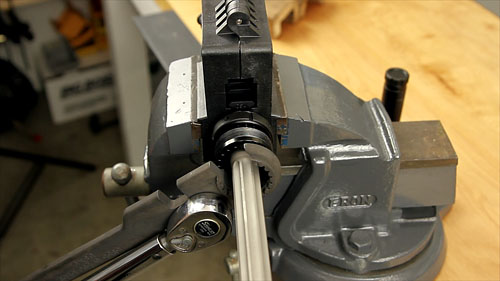
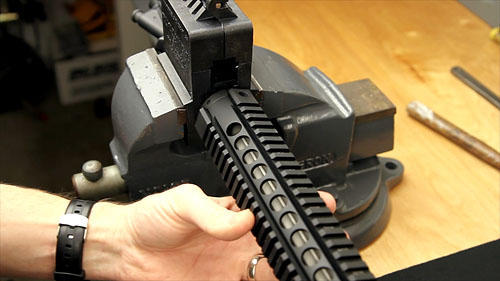
If you are planning to put together an AR-platform rifle or upgrade your AR with a new barrel, stock, or trigger group, here’s a tip. Check out the AR-15 Rifle Build DVD from our friends at UltimateReloader.com. This DVD covers all the details of a custom build, using high-resolution video sequences, and helpful supporting graphics.
In this DVD, Gavin Gear guides you through the entire process including selecting components, acquiring and using the necessary tools, assembly steps and details for each component, and even mounting a scope. Building an AR-15 can be overwhelming, but with the right guidance and help it’s not difficult and can be very rewarding. With this DVD you’ll be able to build your AR-15 with confidence.
Upper: Barrel / Gas Block / Gas Tube
Upper: Handguard Installation
UltimateReloader.com’s AR-15 Build DVD is available just $9.90 (plus $3.80 shipping/handling). This DVD can pay for itself many times over by showing you how to do your own gunsmithing (and get quality AR components at attractive prices).
OK this is no novice. But even champion pistol shooter Jessie Harrison, Captain of Team Taurus, had to start with the basics. Jessie says that safety should always be your number one priority.
Due to concerns about the Coronovirus pandemic, many Americans are purchasing firearms for self-defense. A large percentage of these purchasers are first-time gun buyers. It is vital that “newbie” gun owners learn proper safety procedures. In addition, even long-time gun owners should probably review the basic rules of gun safety. Here are six tips for shooting safely and accurately with handguns. These pointers will help you advance your skills and be more assured with your pistols and revolvers.
1. Make Sure Safety Is Number One
Whether you own one gun or one hundred, gun safety must always be your main priority. In this video, Smith & Wesson Team Captain Julie Golob covers the basics of gun safety.
2. Start with a .22 LR Handgun
We strongly recommend that new pistol shooters start off with a .22 LR rimfire handgun. The .22 LR cartridge is accurate but has very low recoil, less “bark” than a centerfire, and very little smoke and muzzle flash. New shooters won’t have to fight muzzle flip, and won’t develop a flinch from the sharp recoil and muzzle blast common to larger calibers. With the .22 LR, the trainee can focus on sight alignment, breathing, and trigger pull. When he or she has mastered those skills, move on to a .38 Special or 9mm Luger (9x19mm).
What gun to use? We recommend the 10-shot Smith & Wesson Model 617. Shooting single action, slow-fire, this is ideal for training. Shown above is the 4″-barrel Model 617version which balances well. There is also a 6″-barrel version. It has a longer sight radius, but is a little nose-heavy. Both are great choices. They are extremely accurate and they boast a very clean, precise trigger.
If you prefer a semi-auto .22 LR pistol, we recommend the Browning Buck Mark series. Buck Marks are very accurate and very reliable. This rimfire pistol is available in a variety of models starting at under $350.00. Like the S&W Model 617, a good Buck Mark will serve you for a lifetime.
3. Shoot Outdoors If You Can
We recommend that new pistol shooters begin their training at an outdoor range. There are many reasons. First, you can stay away from persons who may have a health problem, and you will be breathing fresh air. Second, the light is better outdoors. Third, sound dissipates better outdoors. The sound of gunfire echoes and bounces off walls indoors. Fourth, an outdoor range is a more comfortable environment. In addition, “stay at home” executive orders may have closed urban ranges. If you can make it to an outdoor range (which is still open in your area), you should have a good experience. Just be considerate with others and exercise “social distancing” — stay at least six feet from others.
4. Use Quality Targets with Multiple Aim Points
It’s common for new pistoleros to start shooting at cans or clay birds at a public range. That can be fun, but it’s better to start with proper targets, placed at eye level, at 7-10 yards. We like to use targets with large, brightly colored circles. Focus on putting 5 shots in a circle. We recommend targets that have multiple bullseyes or aiming points — that way you don’t have to constantly change your target. There are also special paper targets that can help you diagnose common shooting problems, such as anticipating recoil. EZ2C makes very good targets with bright, red-orange aim points. You can also use the bright orange Birchwood Casey stick-on Target Dots (right). These come in a variety of diameters. We like the 2″ dot at 10 yards.
Too many new pistol shooters try to move right to rapid fire drills. It’s better to start slow, practicing the basics, under the guidance of a good mentor. If you belong to a club, ask if there are certified instructors who will help out. This Editor learn pistol shooting from a seasoned bullseye shooter, who got me started with a .22 LR revolver and very close targets. Over the course of a few range sessions we progressed to farther targets and faster pace. But the fundamentals were never forgotten. When starting your pistol training, it’s wise to view some instructional videos. Top Shot Champion Chris Cheng hosts an excellent Handgun 101 Series produced by the NSSF. We’ve linked one of these Handgun 101 videos for Tip #6.
6. SLOW DOWN — This Is Not a Race
When you learned to ride a bicycle, you started slow — maybe even with training wheels. The same principle applies to pistol shooting. When you get started with handguns, we recommend you shoot slowly and deliberately. Start with the handgun unloaded — just work on your sight alignment and breathing. With snap caps in place, try some dry-firing drills. Then progress to live fire. But be deliberate and slow. With the target at 20 feet, see if you can get three successive shot-holes to touch. Believe it or not, many common pistols are capable of this kind of accuracy (but you won’t see many shooters at indoor ranges who pursue that kind of precision). Once you master your form and accuracy, then you can work on your speed.
Click image to view PDF with all state information.
Government officials across the nation have issued numerous orders in an effort to contain Covid-19 infections. The National Shooting Sports Foundation (NSSF) has collected the latest health-related official Executive Orders from U.S. States that can affect FFLs, firearms business owners, range operators, and gun owners. These rules are collected in a lengthy NSSF document, with state-by-state summaries plus web-links for further details. This document will be updated as new info is received from the states. Click the link below to download the State-by-State COVID-19 Information and Resources for FFLs:
The NSSF states: “On the state front, our team is working in each state and many localities to ensure our industry and the critical role it plays is not hampered by well-intended Executive Orders seeking to stem the spread of the virus. Here is a list of the orders we are actively tracking, and what they mean for our members. Please note this is a rapidly changing list, and that many of the orders are subject to interpretation. MORE INFO HERE.
Ammoland.com explains: “The list is broken down by state and gives shooters a brief rundown on each order. This includes a link to the original order itself, the order or bill’s name, and a brief summary of what it does. Shooters worried about their state, in particular, might want to download any PDF files associated with their location for safekeeping should the Government decide to delete them later.”
This report from theU.S. Concealed Carry Association (USCCA)
As anxiety has grown around the COVID-19 pandemic in recent days, news reports from across the country have detailed how more and more Americans are embracing their right to self-defense and choosing to be their families’ ultimate protectors. Ammo.com reports, for example, that revenue from sales on its website increased 309 percent from February 23 through March 15, compared to a month before. Here are some recent media reports, tracking gun-buying trends:
The New York Times
Daniel Hill had never bought a gun before. But last week he was in Larry Hyatt’s gun store in North Carolina picking out two of them: a 9mm Taurus handgun and an AR-15 semi-automatic rifle. His motivation: the coronavirus.
Pittsburgh Post-Gazette
At gun shops, cash registers rang more like Christmas Eve than St. Patrick’s Day as firearms and ammunition sales soared through the roof Tuesday. Shop owners and managers cited customers’ concerns about home defense related to the COVID-19 pandemic.
The Arizona Republic
People in the U.S. are preparing for total anarchy amidst the growing COVID-19 concerns. Fear and panic are driving the gun-buying frenzy. Whatever the reason, gun sales are up everywhere — but particularly in states like California, New York and Washington that have been hit hardest by coronavirus, according to The Los Angeles Times.
The Denver Post
Some shops are selling twice as many firearms as on Black Friday while Colorado residents grapple with the novel coronavirus pandemic, disruptions to daily life and an uncertain future.
USCCA President Says New Gun Purchasers Should Get Training
The USCCA recommends that ALL new gun buyers receive training on the proper use of firearms, including essential safety procedures. USCCA President and Founder Tim Schmidt was recently a guest on Fox News with Tucker Carlson. Schmidt declared that: “Now more than ever, people understand they need to be their families’ first line of defense.”
Schmidt noted that gun ownership and self-defense demands responsibility. He encouraged all Americans — particularly first-time gun owners — to educate and train themselves: “So many — 90% — of these people buying guns have never owned guns before. They’ve probably never even touched a gun”. Schmidt said that proper training is vital for these new gun-owners: “I personally think that firearms ownership is a natural-born right of free people. But with that right comes a tremendous responsibility, and that responsibility is to be trained. [If you] just bought a gun for self-defense, get training.”
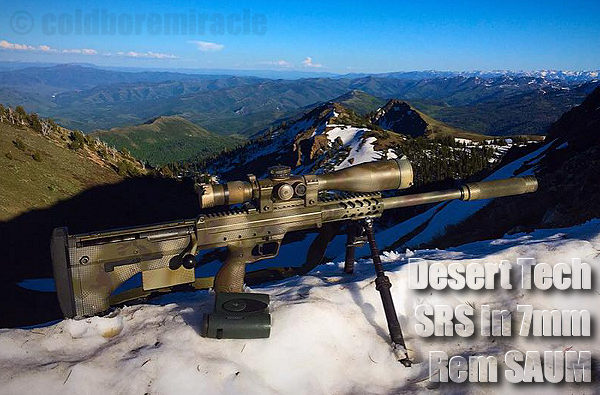
Here is the view from 9500 feet ASL. The SRS in 7mm Rem SAUM almost outran the Swarovski laser…
7mm RSAUM in a bolt-action bullpup? Yes it works. A talented shooter, who calls himself “ColdboreMiracle” in social media, has a Desert Tech SRS-A1 rifle chambered for the 7mm RSAUM, and it hammers. The 7mm Remington SAUM (Short Action Ultra Magnum) is popular with F-Open competition shooters. It can also work well for long-range hunting and tactical tasks. Learn more about the 7mm Remington SAUM in our 7mm Cartridge Guide.
ColdboreMiracle owns the SRS-A1 “covert” model, which has a shorter handguard than the standard SRS-A1 model shown below. Desert Tech now offers an SRS-A2 model which has an M-LOK handguard and some refinements to the chassis.
Here is a detailed video review of a Desert Tech SRS chambered in .308 Win. You can see a close-up of a 100-yard 5-shot group at time-mark 6:25:
Here is a review of the newer SRS-A2 Covert (shorter model), after 1000 rounds. The reviewer believe the SRS bullpup’s shorter length offers some advantages for precision shooters:
ColdboreMiracle says the bullpup design has many advantages: “The Stealth Recon Scout (SRS) rifle from Desert Tech is a bullpup-configured precision rifle with a shorter length than many carbines. The SRS has a multitude of barrel options that can be swapped in under a minute — all of them come with a 1/2-MOA accuracy guarantee and return to zero. The SRS’s bullpup design puts the rifle’s COG closer to the shoulder, making the rifle balance better off-hand. The straight-line geometry of the SRS makes recoil seem lighter, and barrel hop is reduced, allowing the shooter to stay on target better. It takes a little getting used to, when converting from a traditionally-configured bolt gun. But once you do, you won’t go back.” To learn more about this rifle (and other Desert Tech arms), visit ColdboreMiracle’s Facebook Page and YouTube Channel.
The 7mm RSAUM — Why It Was Chosen for this SRS
ColdboreMiracle explains how he selected the 7mm Rem SAUM chambering for his Desert Tech SRS Bullpup: “I just did a comparison between barrel life, velocity, brass, etc. and came to the SAUM. I can tell you this, if you go with one for your SRS, make sure you use long bullets like the 183 or 195, and seat them long. That will aid in smooth cycling.”
Mr. ColdboreMiracle tested the new generation 183gr Sierra MatchKings (item # 1983). These impressive projectiles are “tipped” at the factory. Claimed G1 BC is a lofty 0.707 (at 2300 fps and above). We have heard other reports that these bullets “hold waterline” exceptionally well at 1000 yards. That indicates the bullet-to-bullet BC is very consistent. No doubt the factory uniforming/pointing of the bullet tips helps in that regard.
As you can see, these 183-grainers shoot well in ColdboreMiracle’s SRS rifle. Here are five shots at 100 yards. That’s very impressive for a tactical-style rifle shot from a field-type bipod.
ColdboreMiracle says: “This is the only reason I need to shoot Sierra bullets. On the right (above) you can see the results of the 183gr SMK from my 7mm SAUM. Five shots at 100. A huge thanks to Mark at Short Action Customs, LLC for [chambering this barrel] for my Desert Tech SRS.”
7mm Remington SAUM — Key Considerations
In some respects, the 7mm SAUM cartridge may be better than the 7mm WSM. The 7mm SAUM holds less powder — but that’s a good thing, since the capacity is more than adequate to do the job. You can drive the 180s at 3000 fps with a SAUM using less powder than with a WSM. Additionally, the SAUM case has a slightly longer neck. This gives you greater flexibility in bullet seating. With a long neck you can set the throat so the long 180+ graing bullets are above the neck shoulder junction, yet you can still seat shorter hunting bullets close to the lands. Additionally, long case necks, some believe, cause less throat erosion than shorter necks. That’s not “hard science” but it is certainly a view shared by many experienced shooters. The long neck is one reason many varminters favor the 6mm Remington over the .243 Winchester.
7mm RSAUM Is More Efficient than 7mm WSM
7mm RSAUM shooter Steven Ikeeda tells us: “I decided that some type of 7mm was the ticket for doing well at 1000-yard matches, especially if one could drive the high-BC bullets at 2900+ fps. Looking over various 7mm cartridges that could produce those velocities (and didn’t require case-forming), I was impressed by the 7mm SAUM and the 7mm WSM. According to the load manuals, the 7mm WSM offered a bit more velocity than the 7mm SAUM. However, to achieve its small velocity advantage, the larger 7mm WSM had to burn 7-10% more powder than the 7mm SAUM. (The 7mm WSM has 81.0 grains of capacity vs. 73.6 grains for the 7mm SAUM.) The SAUM is a very efficient case. It looks like a 6.5×47 Lapua on steroids.”
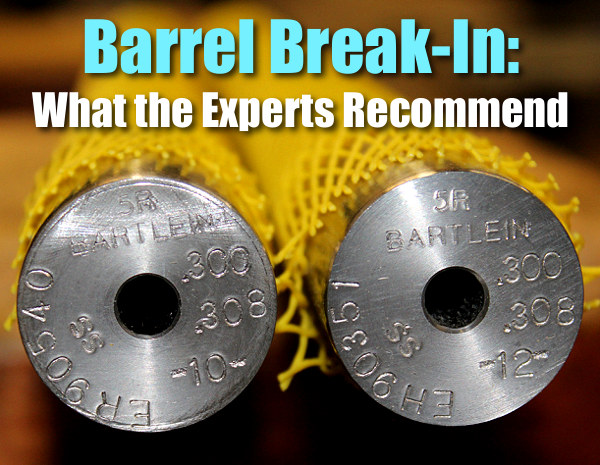
The question of barrel break-in is controversial. Some folks advocate an elaborate, lengthy cycle of shooting and brushing, repeated many times — one shot and clean, two shots and clean and so on. This, it is argued, helps barrels foul less and shoot more accurately. Others say minimal break-in, with patching and brushing after 10-15 rounds, is all you need. Still others contend that break-in procedures are a total waste of time and ammo — you should just load and shoot, and clean as you would normally.
We doubt if there will ever be real agreement among shooters concerning barrel break-in procedures. And one must remember that the appropriate break-in procedure might be quite different for a factory barrel vs. a custom hand-lapped barrel. This Editor has found that his very best custom barrels shot great right from the start, with no special break-in, other than wet patches at 5, 10, and 15 rounds. That said, I’ve seen some factory barrels that seemed to benefit from more elaborate break-in rituals.
What’s the best barrel break-in procedure? Well our friend Eric Mayer of Varminter.com decided to ask the experts. A while back Eric interviewed representatives of three leading barrel manufacturers: Krieger, Lothar-Walther, and Shilen. He recorded their responses on video. In order of appearance in the video, the three experts are:
Do I Need to Break-In a New Rifle Barrel?
Eric Mayer of Varminter.com says: “That is a simple question, [but it] does not necessarily have a simple answer. Instead of me repeating my own beliefs, and practices, on breaking-in a new rifle barrel, I decided to answer this one a bit differently. While we were at the 2016 SHOT Show, we tracked down three of the biggest, and most popular, custom barrel makers in the world, and asked them what they recommend to anyone buying their barrels, and why they recommend those procedures. We asked the question, and let the camera run!” Launch the video above to hear the answers — some of which may surprise you.
Long-Term Barrel Care — More Experts Offer Opinions
Apart from the debate about barrel break-in, there is the bigger question of how should you clean and maintain a barrel during its useful life. Some folks like aggressive brushing, other shooters have had success with less invasive methods, using bore foam and wet patches for the most part. Different strokes for different folks, as they say. In reality, there may not be one solution for every barrel. Different fouling problems demand different solutions. For example, solvents that work well for copper may not be the best for hard carbon (and vice-versa).
“Why worry about a little barrel fouling when the throat is subjected to a brutal 5,600° F volcano at 55,000 PSI? To investigate these and other questions about taking care of a match barrel, we spoke with a dozen experts and share their knowledge in this first of a series of articles.
After listening to folks who shoot, build barrels or manufacture cleaning solvents for a living, we concluded that even the experts each have their own unique recommendations on how to care for a match barrel. But they all agree on one thing — the gun will tell you what it likes best. Because the life expectancy of a match barrel is about 1,500 to 2,500 rounds, the objectives of cleaning one should include: preserve accuracy, slow the erosion, and remove fouling — all without damaging the gun. This article doesn’t claim that one cleaning method is better than the next. Rather, we set out to interject a little science into the discussion and to share some lessons learned from experts in the field.” — Chip Lohman
Savage Arms has completed a major overhaul of the Savage website. Now the SavageArms.com site is more mobile-friendly and easier to navigate. Savage has expanded information on its rifle products, and also updated the Expert Advice area. This section of the website offers informative technical articles/videos, as well as numerous helpful tips for hunters.
You’ll find 30 informative topics in the Expert Advice section of the updated Savage Arms website. Below are FIVE of our favorites. Click each item to view the full text and linked VIDEOS. Even if you don’t own a Savage, these features are useful. And all new shooters should definitely check out the Advanced Optics selection. This features a good video covering mirage and light refraction.
1. Advanced Optics — Stan Pate
Light refraction can wreak havoc on your ability to connect with a target at extreme long range. Stan Pate offers some good advice concerning mirage and refraction.
This custom war wagon hauls varmint hunters around the Longmeadow Game Resort in Colorado.
Winter is behind us — it’s officially Spring. Today, March 19, 2020, is the Vernal Equinox, the official start of Spring. For many shooters, the coming of Spring means that it’s time to head out to the varmint fields. Here are eaidht items that can help ensure successful spring varmint adventures.
Eight Great Products for Varmint Shooters
1. BarrelCool In-Action Fan
Busy Varmint shooters may expend hundreds of rounds in a day. That’s tough on barrels. One way to extend your round count is to use the ingenious BarrelCool device. This little yellow gadget fits in your action with a blower tube that goes into the chamber. A small electric fan blows cooling air through the barrel. It really works — folks who’ve purchased the Barrel Cool and run temp strips on their barrel say the BarrelCool can significantly reduce the time it takes to cool down a hot barrel.
In the past, folks have tried various methods to cool barrels: water flushed through the bore, CO2 tanks, even battery-operated fish pumps. BarrelCool is a simpler, less costly, and much handier solution. Priced at $36.99, this small device can potentially can save you money by extending barrel life. To see how Barrelcool works, visit BarrelCool.com. There you’ll find video demos of BarrelCool units in both bolt-action and AR-type rifles.
2. Uncle Bud’s Bulls Bag Sandbag
On most varmint hunts we spend most of the time shooting from a portable bench with a pedestal-type rest (we like the SEB Mini). But it’s nice having a big, heavy X-Type sandbag rig also. These four-chamber designs, such as the Uncle Bud’s Bulls Bag, allow shooting from a truck hood or any flat surface. Some rifles with narrow fore-ends really benefit from the firm “hug” provided by these “butterfly” style sandbags. We like the 15″ Uncle Bud’s Bulls Bag, currently $71.99 at Brownells. Durable and well-made, it will provide years of service. There is also a 10″ version that is easier to carry. Forum member Stoner24mkiv likes a Bulls Bag for shooting from a vehicle. He also suggests: “[take] an adjustable bipod if you are going to do any walking. Have a fanny pack or backpack for extra ammo, water, bore-snake, etc. when you go on your walkabouts. Bring a Boonie hat for blocking the sun, sun glasses, sunscreen. High leather boots.”
3. Scope with Built-In Laser Rangefinder
The Burris Eliminator III is an impressive piece of electro-optical technology. With a push of a button, a built-in laser rangefinder senses the distance to your target and the Eliminator’s microprocessor instantly calculates the required hold-over based on your load’s ballistics. The calculated aiming point is then displayed in the reticle with an illuminated red dot on the vertical cross-hair. Just put the red dot on the target and make the shot. Easy as that. If you are working a large prairie dog field and constantly moving near to far and back again, this scope is really handy. Laze, adjust aim with the dot, and squeeze the trigger. Its that simple. We’ve used this scope out to 500 yards on small steel targets and it worked flawlessly.
4. Hornady 17 HMR V-Max 500 Round Brick, $89.99
For those distant prairie dog shots, you’ll want a centerfire round such as a 22 BR/BRA or 22-250. However, for closer work, or for smaller varmints such as ground squirrels, the 17 HMR is hard to beat. There are many good factory rifles chambered for the 17 HMR, such as the Savage A17. Right now Midsouth has a Hornady 17 HMR brick of 500 for a low price of $89.99. That works out to just 18 cents per round — cheap enough that you can blast sage rats all days long and never worry about running out of ammo.
5. Stick-On Temp Strips Monitor Barrel Heat
You never want your barrel to get too hot. Accuracy suffers when barrels over-heat, and excessive heat is not good for barrel life. So how do you monitor your barrel’s temperature? You can check if the barrel is “warm to the touch” — but that method is not particularly precise. There is a better way — using temperature-sensitive strips. McMaster.com (an industrial supply house) offers stick-on temp strips with values from 86° F to 140° F. A pack of ten (10) of these strips (item 59535K13) costs $12.77 — so figure it’ll cost you about $1.28 per barrel for strips. That’s cheap insurance for your precious barrels. For best barrel life, try to stay under 120 degrees F.
6. Low-Fouling Power for High-Volume Varmint Loads
For high-shot-count varmint safaris, you want a clean-burning powder that minimizes barrel fouling. While there are many great powders for the .223 Rem, we like Hodgdon CFE 223 for our high-volume varmint loads. This powder really seems to keep barrels cleaner. Originally developed for U.S. rapid-fire military systems, CFE 223 incorporates a proprietary chemistry named “Copper Fouling Eraser”. Based on tests with extended shot strings, Hodgdon claims that, by using CFE™223, match shooters, varmint hunters, and AR shooters can maintain accuracy for longer periods, with less barrel-cleaning time.
7. Bog Pod SB-2 Sportsman’s Bipod (21″-40″)
If you’re looking for a versatile, stable and easy-to-carry field support, check out the latest BOG-POD Series SB-2 Bipod. Featuring 21″-40″ adjustable legs, the BOG-POD Bipod can be used while sitting, standing, or kneeling. This kid of support is highly recommended for shooting on hills where a conventional bipod doesn’t offer enough elevation. This unit has a 360° swivel head and the legs adjust independently out to a 60-degree angle with adjustable tension to ensure maximum accuracy. Right now you can get this SB-2 Bipod for just $19.99 on Amazon — a great deal.
8. Motorola T100 Talkabout Radios
When you’re in the varmint fields, its essential to have good communications with your fellow shooters. You can’t count on cell coverage in the hinterlands so we recommend a good pair of Walkie-Talkies. The Motorola T100s have a very impressive range (up to 16 miles in ideal conditions), yet cost just $21.99 for the pair. These 22-Channel T100 Talkabouts will run up to 18 hours on three AAA batteries. Users have been very pleased with this inexpensive handheld radios.
Any long range shooter knows that wind is our ultimate nemesis. The best ways of overcoming wind are to measure what we can and use computers to calculate deflection. The Applied Ballistics Kestrel is a great tool for this. As good as our tools may be, we don’t always have them at our fingertips, or they break, batteries go dead, and so on. In these cases, it’s nice to have a simple way of estimating wind based on known variables. There are numerous wind formulas of various complexity.
The Applied Ballistics (AB) Wind Hack is about the simplest way to get a rough wind solution. Here it is: You simply add 2 to the first digit of your G7 BC, and divide your drop by this number to get the 10 mph crosswind deflection. For example, suppose you’re shooting a .308 caliber 175-grain bullet with a G7 BC of 0.260 at 1000 yards, and your drop is 37 MOA. For a G7 BC of 0.260, your “wind number” is 2+2=4. So your 10 mph wind deflection is your drop (37 MOA) divided by your “wind number” (4) = 9.25 MOA. This is really close to the actual 9.37 MOA calculated by the ballistic software.
WIND HACK Formula
10 mph Cross Wind Deflection = Drop (in MOA) divided by (G7 BC 1st Digit + 2)
Give the AB wind hack a try to see how it works with your ballistics!
Some Caveats: Your drop number has to be from a 100-yard zero. This wind hack is most accurate for supersonic flight. Within supersonic range, accuracy is typically better than +/-6″. You can easily scale the 10 mph crosswind deflection by the actual wind speed. Wind direction has to be scaled by the cosine of the angle.







 It’s common for new pistoleros to start shooting at cans or clay birds at a public range. That can be fun, but it’s better to start with proper targets, placed at eye level, at 7-10 yards. We like to use targets with large, brightly colored circles. Focus on putting 5 shots in a circle. We recommend targets that have multiple bullseyes or aiming points — that way you don’t have to constantly change your target. There are also special paper targets that can help you diagnose common shooting problems, such as anticipating recoil. EZ2C makes very good targets with bright, red-orange aim points. You can also use the bright orange Birchwood Casey stick-on Target Dots (right). These come in a variety of diameters. We like the 2″ dot at 10 yards.





 In some respects, the 7mm SAUM cartridge may be better than the 7mm WSM. The 7mm SAUM holds less powder — but that’s a good thing, since the capacity is more than adequate to do the job. You can drive the 180s at 3000 fps with a SAUM using less powder than with a WSM. Additionally, the SAUM case has a slightly longer neck. This gives you greater flexibility in bullet seating. With a long neck you can set the throat so the long 180+ graing bullets are above the neck shoulder junction, yet you can still seat shorter hunting bullets close to the lands. Additionally, long case necks, some believe, cause less throat erosion than shorter necks. That’s not “hard science” but it is certainly a view shared by many experienced shooters. The long neck is one reason many varminters favor the 6mm Remington over the .243 Winchester.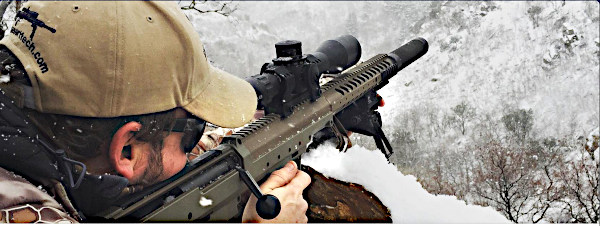
 Do I Need to Break-In a New Rifle Barrel?


