Based on the questions we get on a daily basis on our 800 (Customer Support) line, twist is one of the most misunderstood subjects in the gun field. So let’s look deeper into this mystery and get a better understanding of what twist really means.
When you see the term 1:14″ (1-14) or 1:9″ twist, just exactly what does this mean? A rifle having a 1:14″ twist means the bullet will rotate one complete revolution every fourteen inches of the barrel. Naturally a 1:9″ turns one time every nine inches that it travels down the barrel. Now, here’s something that some people have trouble with. I’ve had calls from shooters thinking that a 1:14″ twist was faster than a 1:9″ because the number was higher with the 1:14″. The easiest way to remember this is the higher the number, the slower the twist rate is.
Now, the biggest misconception is that if a shooter has a .223 with a 1:8″ twist, his rifle won’t stabilize a 55gr bullet or anything lighter. So let’s look at what is required. The longer a bullet is for its diameter, the faster the twist has to be to stabilize it. In the case of the .223 with a 1:8″ twist, this was designed to stabilize 80gr bullets in this diameter. In truth the opposite is true. A 1:8″ will spin a 55gr faster than what is required in order to stabilize that length of bullet. If you have a bullet with good concentricity in its jacket, over-spinning it will not [normally] hurt its accuracy potential. [Editor’s Note: In addition, the faster twist rate will not, normally, decrease velocity significantly. That’s been confirmed by testing done by Bryan Litz’s Applied Ballistics Labs. There may be some minor speed loss.]
Many barrel-makers mark the twist rate and bore dimensions on their barrel blanks.
Think of it like tires on your truck. If you have a new set of tires put on your truck, and they balance them proper at the tire shop, you can drive down a street in town at 35 MPH and they spin perfect. You can get out on the highway and drive 65 MPH and they still spin perfect. A bullet acts the same way.
Once I loaded some 35gr HP bullets in a 22-250 Ackley with a 1:8″ twist. After putting three shots down range, the average velocity was 4584 FPS with an RPM level of 412,560. The group measured .750″ at 100 yards. This is a clear example that it is hard to over-stabilize a good bullet.
Twist-rate illustration by Erik Dahlberg courtesy FireArmsID.com. Krieger barrel photo courtesy GS Arizona.
Hard work and tenacity do pay off. Smallbore/Air Rifle ace Katie Ezell is proof.
Story based on article by Serena Juchnowski, CMP Feature Writer
Hailing from Denver, North Carolina, Katie Ezell, 18, is a rising talent. Katie graduated Summa Cum Laude from High School in 2019 and now attends Ohio State University, where she competes on the OSU Rifle Team. At the age of 10, Katie’s parents introduced her to marksmanship, wanting their daughter to have hands-on instruction in firearm safety. Thus began a love affair that has only evolved since then.
“The first time I ever went shooting, I knew this was something that I would want to continue to do.”
One of Katie’s match rifles is a Walther LG400 Alutec Competition Air Rifle:
Since she was so young and unable to join the teenage pistol team at her club, Katie applied to the women’s team, which had no specific age restrictions, and proceeded to compete with those far older and more experienced. Katie accredits much of her competitive drive and how she handles match pressure to pursuing the competition venture at such a young age.
After pistol came skeet, in which Katie traveled to national and international competitions. Thinking about the future, Katie soon realized that a shooting scholarship would allow her to continue in the shooting sports while funding her education. Precision rifle appeared to be the best avenue for this, leading Ezell to move into rimfire sporter for four months before making the jump into precision air rifle.
Ezell cites her greatest accomplishment as “getting accepted to be on The Ohio State [University’s] rifle team after shooting for a year and a half”. While Ezell had been shooting for eight years, she had only been training and competing in precision rifle for 18 months when she was accepted onto the team, where she made her dream a reality.
After joining the Ohio State team, Katie’s first competition was the Junior Olympics, which added some extra pressure to the already prestigious event. This was not the only special part of the occasion. Katie’s father, a deployed military member, was in town, and this was the first time he could watch her compete in person, since his deployment makes attending matches difficult.
Katie Ezell at the Colorado Springs Olympic Training Center in 2018 for Winter Air Gun.
Katie notes that after she set the nervousness aside, she found herself excited and shot a personal best in smallbore. She had hoped to shoot better with her air rifle, but she knows that being part of a college team will help her to improve her skills.
Katie excels at Smallbore. Here she aims a .22 LR Walther rifle at the 2018 Nationals at Fort Benning, GA. She shot a personal best at the Junior Olympics.
With Coaching, Katie Has Achieved Personal Bests in Both Ari Rifle and Smallbore
Katie is nearing the end of her first semester at Ohio State and has surpassed her previous bests in Smallbore and Air Rifle. Her coach has changed some of Katie’s positions, and she is improving.
“Marksmanship has taught me a lot about self-control. If the shot does not look right, then I reject it and try again. I have learned that failure is okay….” Katie recognizes that failure can inspire one to do better and to learn. She advises competitors “to not be afraid to fail”. Katie started into precision shooting at a much later age than most, especially those who end up with a college shooting career. Though it took time, she learned to appreciate the experience and to not bury herself in expectations.
Walther LG400-E Expert with Electronic Trigger
The E-trigger ensures wear-free operation and exact trigger settings for many shots. The LED-indicator and the installed rechargeable battery ensure readiness to fire as well as easy and quick loading.
· Trigger pull weight can be reduced to 15 grams
· Wear-free operation and exact trigger settings over many years
· Choice between two-stage mode and direct trigger mode
· Realistic dry-firing conditions (dry-firing trigger)
· Rechargeable battery via mini-USB
· LED indicators for system readiness and battery charge level
· Automatic e-trigger turnoff when not in use
Credit The First Shot CMP Newsletter, story by Serena Juchnowski, CMP Feature Writer.
You’d like to protect your hearing, and maybe you’re a little curious about how your rifle might shoot suppressed. So you’re thinking of buying a suppressor (aka “can”, “moderator”, “silencer”). You can’t just get one off the shelf at Walmart. Acquiring a suppressor requires filling out paperwork and paying a Federal $200 Tax Stamp. Plus there is typically a pretty long wait. However, the good news is that suppressor ownership is now legal in 42 of the 50 American states — that’s 84%! For most American adults, getting a suppressor is legal, provided pass the required background checks.
States Where Suppressor Ownership is Allowed
Currently, the following 42 states allow private ownership of suppressors: AL, AK, AZ, AR, CO, CT, FL, GA, ID, IN, IA, KS, KY, LA, ME, MD, MI, MN, MS, MO, MT, NE, NV, NH, NM, NC, ND, OH, OK, OR, PA, SC, SD, TN, TX, UT, VT, VA, WA, WV, WI, WY.
Note: Even if you live in one of the states listed, you should still verify that owning a suppressor is legal in your area. Some states may have municipal- or county-based restrictions.
States Where Suppressor Ownership is Prohibited
Unfortunately, there are still eight (8) States that forbid private ownership of suppressors. The eight No-Go States are: California, Delaware, Hawaii, Illinois, Massachusetts, New Jersey, New York, Rhode Island. In these eight states, private ownership of suppressors (aka “silencers”) is forbidden. Hopefully that a few of those eight hold-out states will change their laws in the months ahead.
Looking Inside a Suppressor in Action
Popular YouTube Channel Smarter Every Day recently released a cool video featuring rifle suppressors with see-through acrylic sleeves. The team filmed shots through the suppressors using ultra-high-speed (110,000 frame per second) cameras. When played back in super-slow-motion, you can see the flame propagate through the suppressor and the bullet move through each baffle before it exists the muzzle. Watch the results in the video below — it’s mesmerizing:
See Through Suppressor in Super Slow Motion (110,000 fps) — Click Arrow to Watch:
Suppressors, On Average, Reduce Noise Levels about 30 Decibels
In an article for Ammoland, gunwriter Sam Hoober says that you can expect about 30 decibels (dB) of noise reduction from the average suppressor: “Looking at a few different products, SilencerCo attests their suppressors reduce the sound pressure of a 9mm gunshot to anywhere from 125.7 dB to 131.5 dB, depending on the model. Advanced Armament Co, another popular supplier, attests a 23 dB to 33 dB reduction or down to 127 dB. Liberty Suppressors, another manufacturer, attests a reduction of 24 dB to 38 dB, depending on model and other factors. In short, we can presume something on the order of 30 dB of attenuation as an average.”
Using that 30 dB number you can quickly discern that you’ll still need hearing protection — good hearing protection — when shooting any suppressed firearm (even a .22 LR). “Spikes of 130 dB and more can result in permanent hearing damage instantly”. Source: NRA Blog.
Story idea by Boyd Allen. We welcome reader submissions.
Will you be traveling to other states this winter? Are you concerned about the laws that might apply when you are transporting firearms across state lines? Or are you puzzled about the requirements for obtaining a carry permit in your own state? If you have any of these questions, you should definitely get expert guidance on State statutes and regulations controlling firearms. To do that, you can purchase Attorney Bryan Ciyou’s Gun Laws by State reference book. This is worth the money, and the $20 cost also includes access to an online legal database and other services.
Free State Law Summaries Online
If you don’t want to spend the twenty bucks, there is a good FREE alternative. There’s a very helpful set of State Law Summaries on the web, presented by PewPewTactical.com. Despite the silly name, the PewPewTactical website has an abundance of information that is particularly beneficial for pistol shooters and CCW holders.
One of the best features of PewPewTactical.com is the Gun Laws by State online reference guide. We looked through four of these State Law Summaries and were impressed by the depth of the coverage. But we caution — if you have specific legal questions, particularly with recently-enacted statutes, you should consult a licensed attorney for your state (or the state to which you will travel). In addition, some of the State Law Summaries have not been updated for a year or two. But they are still a good place to start. Below are links to state law articles from PewPewTactical.com. To access any State summary, simply click the State name below:
Are you looking for a muzzle brake for your rifle? Then you MUST check out the epic Muzzle Brake Test performed a few seasons back by PrecisionRifleBlog.com. This massive, data-driven field test was organized by PRB head honcho Cal Zant. Over a period of months, Cal and his team tested 20+ muzzle brakes designed for 6mm, 6.5mm, and .30-caliber precision rifles. Hundreds of hours went into this research, which provided vital new insight and empirical data for several aspects of muzzle devices. Cal put a huge amount of labor/engineering into these tests and his findings deserve to be widely read.
The Muzzle Brake Overview Article covers designs, specs, and prices of 20+ brakes. Then separate, detailed PRB articles cover sound levels, recoil reduction results, ability to stay on target, muzzle blast/ground effects and more. SEE PRB Muzzle Brake Test Results SUMMARY.
Recoil Reduction
Cal created a system to directly measure the entire recoil force signature of each muzzle brake using high-speed sensors. Although the recoil cycle happens very quickly (around 1/100th of a second), his test equipment could record up to 1,000 force data points during a single recoil cycle! He fired over 1,000 rounds of match-grade ammo through four different rifles: 6XC, 6.5 Creedmoor, .308 Win, and the monster .300 Norma Magnum. He literally spent thousands of dollars on this part of the test, to ensure he got it right.
Cartridge Types Tested: 6XC, 6.5 Creedmoor, .308 Win, and .300 Norma Magnum
Ability To Stay On Target
David Tubb helped Cal develop this part of the test, because David believes this is the most important aspect of a muzzle brake. Using a laser and high-speed camera, Cal was able to objectively quantify how well each design helped you stay on target.
Noise Level
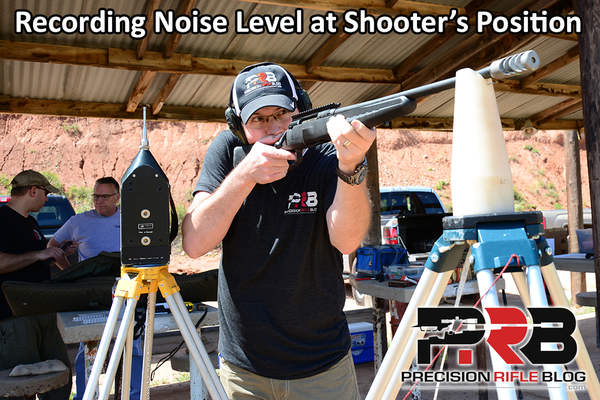
Muzzle brakes are loud, but some are louder than others … three to four times as loud. Cal enlisted the help of an expert from the suppressor industry to precisely measure how much louder each muzzle brake made a rifle. Each brake was tested in accordance with MIL-STD-1474D using calibrated military-approved equipment, and the noise level was also tested at the shooter’s position.
Recoil Reduction Summaries by Caliber
In the detailed summaries of recoil reduction test results, PRB provides hard data that might surprise a few people and even dispel a few myths. Particularly interesting is Zant’s comparison of recoil reduction with a suppressor compared to muzzle brakes. How do you think the suppressor performed compared to the brakes? You may be surprised.
American Outdoor Brands Corporation (NASDAQ: AOBC), one of the world’s leading providers of firearms and products for shooting, hunting, and outdoor enthusiasts, is splitting into two separate companies, with the Smith & Wesson gun business becoming a stand-alone enterprise again. Last week American Outdoor Brands’ Board of Directors unanimously approved a plan to spin-off its outdoor products and accessories business as a tax-free stock dividend to its stockholders. The proposed transaction, which is expected to be completed in the second half of calendar 2020, would create two independent, publicly-traded companies: Smith & Wesson Brands, Inc. (encompassing the firearm business) and American Outdoor Brands, Inc. (encompassing the outdoor products and accessories business).
According to AOBC: “The purpose of the spin-off is to enable the management team of each company to focus on its specific strategies, including (1) structuring its business to take advantage of growth opportunities in its specific markets; (2) tailoring its business operation and financial model to its specific long-term strategies; and, (3) aligning its external financial resources, such as stock, access to markets, credit, and insurance factors, with its particular type of business.”
Barry M. Monheit, Chairman of the Board, said, “There have been significant changes in the political climate as well as the economic, investing, and insurance markets since we embarked upon what we believe have been our very successful diversification efforts. We believe that separating into two independent public companies will allow each company to better align its strategic objectives with its capital allocation priorities. From the standpoint of our stockholders, at the time of the spin-off, the AOBC stockholders will own 100% of each company, thereby maintaining their pre-spin interest in both companies, and will thereafter have the ability to make distinct investment decisions tailored to their particular investment profile.”
Mark Smith Will Lead Smith & Wesson After Spin-Off
Upon successful completion of the spin-off, Mark Smith will become CEO of Smith & Wesson Brands, Inc.; Smith is currently the President of the Manufacturing Services Division of AOBC and supports all of its businesses. James Debney, current AOBC President and CEO, will lead the outdoor products and accessories company as CEO after the spin-off.
The Future of Smith & Wesson Brands, Inc. (Projections)
Headquartered in Springfield, Massachusetts, Smith & Wesson Brands, Inc. will continue its 167-year-old heritage of producing firearms. This business’s handgun, long gun, and suppressor products are marketed under the Smith & Wesson®, M&P®, Performance Center®, Thompson/Center Arms™, and Gemtech® brands. The company’s financial profile is expected to yield strong cash flows and profitability with a plan to eventually return capital to stockholders in the form of dividends and stock repurchases. Assuming a spin-off in eight to ten months, Smith & Wesson Brands, Inc. is expected to generate revenue between $450 million and $500 million and adjusted EBITDAS between $90 million and $105 million in its first 12 months as an independent company.
News Tip from EdLongrange. We welcome reader submissions.
We see comparison tests of cars, cameras, and other hardware. But how about chronographs? What could we learn by setting up three different chronographs, and running a 20-shot string over all three at the same time. One of our Forum members, Randy S. (aka AAA) did that very test with three of the best chronographs you can buy: LabRadar, MagnetoSpeed, and an Oehler model 35P. The MagnetoSpeed was attached to the barrel of an F-Class rig, with the LabRadar placed on the left side of the shooting bench. The Oehler 35P was positioned about 23 feet downrange. The photo above shows the set-up. A 20-shot string was recorded with the results in a spreadsheet.
AAA talks about this interesting experiment in a Shooters’ Forum Thread. Here is his report:
Comparison Testing Three Chronographs
We all have our favorite chronograph. Each gives a number, but how would that number compare to the same round fired with another chronograph? I wanted to know so a friend and I set up the following test with three chronographs: LabRadar, MagnetoSpeed V3, and Oehler Model 35P.
For the test we fired Berger 105gr VLDs over the three chronographs simultaneously. The test rifle was my 6mm BR Ackley (BRA) F-class rig with fire-formed brass and 200 rounds on the new barrel.
Chronogaphs Tested
LabRadar
MagnetoSpeed V3
Oehler Model 35P
Temperature: 86 deg. F
Elevation: 854 feet
Cartridge: 6mm BRA (105gr Berger VLD)
Time between shots: 45 seconds
To start off, five rounds were fired to make sure all systems were recording and to warm the barrel. Then the test was 20 shots fired across all three instruments with 45 seconds between shots. The Oehler was set 7.5 yards from the muzzle so 12 FPS was added to the recorded value.
We were using the internal trigger on the LabRadar. The manual says the Vo indicated is the actual muzzle velocity when using the internal trigger, but not if using the Doppler. The 12 FPS Oehler adjustment (back to MV) was based on the Berger Ballistics Calculator.
The LabRadar Chronograph is on sale now through 12/7/2019. Buy for $499.95, a $60.00 savings.
Results of the Triple Chronograph Shoot-Out:
LR-M is FPS variance between LabRadar and MagnetoSpeed V3. LR-O is FPS variance between LabRadar and distance-adjusted Oehler 35P. You can see all three chronos were very consistent. ES was identical with the MagnetoSpeed and Oehler 35P, while SD was identical with the LabRadar and Oehler 35P.CLICK HERE for spreadsheet.
The tester, Randy S. (aka AAA) says: “Judge for yourself, but I was impressed by all.”
This is a manufacturer’s photo showing the Magnetospeed V3 as mounted. This is NOT the test set-up.
Comments by Forum Members
Our Forum members expressed interest in this Triple Chronograph test. Some confirmed that the LabRadar and Magnetospeed give very similar FPS numbers, based on their own tests:
“Great test and thanks for sharing. I’ve tested my MagnetoSpeed and LabRadar together and results are always within 2-4 FPS of one another.” — Big D
“Very happy to see your numbers support my decision to buy a MagnetoSpeed. Had read reports comparing it to the Oehler and the numbers I get seem to be supported by my long range shooting results. Many thanks for taking the time and effort [to perform] this comparative test. Always good to get actual test results.” — Texas10
“I did a 4-shot test with my MagnetoSpeed and another shooter’s LabRadar a couple of days ago. The results were within 4 fps with the LabRadar being optimistic.” — Pat Miles
Forum Member Powderbreak studied AAA’s original spreadsheet from the chronograph trio test, then figured out the shot-by-shot FPS variance between the machines. He concluded that all the machines performed very well. Powderbreak posted:
Analyzing the Triple Chronograph Test — What Can We Conclude?
AAA did a great job of comparing the 3 chronos. What conclusions can be drawn?
1) I have not checked the manufacturer’s claims of accuracy, but the three chronos are very close to one another. There is no way for us to determine the actual true velocities, but we do not need to do so. Any of the chronos would be more than adequate for an accurate shooter.
2) The resolution of the three chronographs is actually pretty astounding. One foot per second (FPS) is a resolution of 0.033%.
3) AAA did a great job of reloading a very consistent round. With an extreme spread of 33 fps out of 3014 for 20 rounds, that is only 1.09% total spread of velocities.
4) There is a closer velocity match between the MagnetoSpeed and the LabRadar, but that does not mean the Oehler is less accurate. There is simply an offset between the Oehler and the other two. This could be due to the greater distance, the location, or the internal working of the Oehler.
5) Believe your chronograph, it is probably the most accurate reloading tool that you own.
Brian Litz of Applied Ballistics carefully explained the operation, set-up, accuracy and comparison of AB’s chronographs in his books. [Those books] are well worth the money, and give great insight into the workings of chronographs.” — Powderbreak
Thanksgiving is right around the corner. That means a large percentage of Americans will be on the road to visit relatives. We know many of our readers have concealed carry permits or will otherwise be traveling with firearms. When crossing into different states with guns in a vehicle, you need to be mindful of all state and local laws and restrictions.
Five Worst States for Traveling with Firearms
This article appears in the Cheaper Than Dirt Shooter’s Log.
The U.S. is a patchwork of confusing and cumbersome laws that change the rules of what you can carry, where you can carry, and whether you can possess the firearm, ammunition of magazine at without running afoul of the local laws. Now, if every state was like Vermont, law abiding gun owners could freely travel with their firearms with no worries. Unfortunately, many states have a history of being hostile to traveling gun owners.
The federal “Firearms Owner Protection Act” allows travel through any state as long as the firearm is unloaded, in a locked case, and not easily accessible to the passengers. However, that is not to say that certain states that are less friendly to firearms have not created their own laws that would snare unsuspecting otherwise law-abiding firearm owners. This led us to name the Top 5 States to Avoid while traveling with a firearm this holiday season.
CONNECTICUT
Connecticut does not have any gun reciprocity agreements with other states. This means nonresidents are not allowed to carry handguns in Connecticut under a permit issued by another state.
HAWAII
Every person arriving into the state who brings a firearm of any description, usable or not, shall register the firearm within three days of the arrival of the person or the firearm, whichever arrives later, with the chief of police of the county where the person will reside, where their business is, or the person’s place of sojourn. GET Hawaii Firearms INFO HERE.
MASSACHUSETTS
Massachusetts imposes harsh penalties on the mere possession and transport of firearms without a license to carry. Prospective travelers are urged to contact the Massachusetts Firearms Records Bureau at (617) 660-4780 or contact the State Police. GET Massachusetts Firearms INFO HERE.
NEW JERSEY
New Jersey has some of the most restrictive firearms laws in the country. Your firearm must be unloaded, in a locked container, and not accessible in the passenger compartment of the vehicle. The New Jersey Supreme Court ruled that anyone traveling within the state is deemed to be aware of these regulations and will be held strictly accountable for violations. If you’re traveling through New Jersey, the N.J. State Police website provides information regarding transporting firearms within state lines. GET New Jersey Firearms INFO HERE.
NEW YORK
Use extreme caution when traveling through New York state with firearms. New York’s general approach is to make the possession of handguns and so-called “assault weapons” illegal. A number of localities, including Albany, Buffalo, New York City, Rochester, Suffolk County, and Yonkers, impose their own requirements on the possession, registration, and transport of firearms. Possession of a handgun within New York City requires a New York City handgun license or a special permit from the city Police Commissioner. This license validates a state license within the city. Even New York state licenses are generally not valid within New York City unless a specific exemption applies. Possession of a shotgun or rifle within New York City requires a permit, which is available to non-residents, and a certificate of registration.
More Scary States for Gun Owners
Here are six other jurisdictions (five states and DC) where you need to be wary when traveling. California, for example, treats all handguns in vehicles as “loaded” if there is ammunition loaded into an attached magazine. It’s wise, when in California, to have handguns unloaded in a LOCKED case, with all ammunition or magazines in a separate section of the vehicle. These states (and DC) all have laws that can trap unsuspecting gun-owners. Be wary.
California
Delaware
Dist. of Columbia
Illinois
Maryland
Rhode Island
Our friends, Ed Mobley and Steve Lawrence, aka the “6.5 Guys”, have written an excellent article on getting started in practical/tactical competition. If you are new to the game, these tips can help you save money, progress faster, and have more fun. Here are article highlights, but we recommend you read the full story,5 Tips for Attending Your First Precision Rifle Match, onwww.65guys.com.
We often meet people who are new to long range precision shooting, and want to improve their knowledge and skill level. However, they aren’t sure if they are ready to sign up to compete in a match. They often ask, “What knowledge or skills are necessary to compete in a match?” Others may state, “I need to purchase this gear or that gear before I can attend a match”. For those guys who have a strong interest in precision rifle shooting, and who wish to chec out a precision rifle match, below are Five Tips to make it a positive experience.
TIP ONE: Make Plans and Commit to Go
First you need to start by finding a match to attend. This may entail a little bit of research and investigative work on your part to find what matches are scheduled in the next few months. We recommend starting with any match that may be within a reasonable driving distance. This may likely be a local “club” match, many of which are held on a regular basis. These make great venues because it will provide an opportunity to meet some of the regular attendees as well as shooters that are from your geographic area. Additionally, most of the smaller matches are a little more relaxed in terms of level of competitiveness.
Once you decide on the match you want to attend, do your homework. This means finding out if you need to pre-register or pre-pay the match fee. Commit to going by registering for the match and putting it on your schedule. Be sure to find other useful information for questions such as:
— What time should I arrive?
— Is there a mandatory safety briefing for new shooters at that venue?
— What is the travel time required to get to the match site?
— How many stages will there be?
— Is there a description of the stages available before the match?
— How many rounds should you bring?
— Are there special equipment requirements? (E.g. do you need chamber flags, is there a pistol stage?)
TIP TWO: Bring What You Have
(Don’t Spend a Fortune at the Start)
Some new shooters often assume they need a custom match rifle or all of the miscellaneous shooting gear associated with long range precision shooting to compete in match. While having a Kestrel weather meter and a high quality laser range finder and other shooting accoutrements are invaluable kit, you will find other shooters at your first match that will provide you with the information and coaching you need to get on target.
In fact, the only gear you really need to bring is a scoped rifle with a bipod and ammo capable of consistently shooting within one MOA. Also, be sure to know the ballistic drops or have a ballistic drop table prepared for your rifle/ammo to dial the correct DOPE on your scope for different target ranges. Many of the other participants at the match will be willing to let you borrow a support bag, bipod, tripod or other gear if you need one — just ask. Don’t use the excuse of not having the right gear to delay getting out to a match!
One reason not to make a big initial investment in a new rifle and assorted gear before competing, is we’ve seen a number of people come into the sport and try it for a year and then make the decision to move on to something else.
TIP THREE: Be Prepared to Learn
As a new shooter at a match, there is no better opportunity to learn. We often look to our local club matches as a group ‘training’ session to prepare for the bigger matches. You will find competitors at all levels of skill and many of your fellow shooters will enthusiastically provide helpful advice once they learn you are new to the sport. Take advantage of the opportunity to ask questions if you would like ideas for how to engage a stage, but also be sure to do more listening than talking as you receive guidance and tips from more experienced competitors.
Watch and observe other shooters and how they approach and ‘game’ a specific stage or course of fire. You’ll begin to recognize which shooting positions work best for different scenarios, and maybe even come up with some new ones that no one has thought of before.
Seeing what the better shooters do is an invaluable instructional tool. You can use your smart phone’s video camera to record other shooters (with their permission). When you’re ready to shoot, ask another shooter to record your performance. Watching yourself will point out needed areas of improvement.
After each match conduct an informal after action review and summarize for yourself the things that went well and what you should continue to do. You should also identify the specific shooting skills you should develop and make a plan to integrate the appropriate practice drills into your practice sessions. Finally, if you maintain a shooter’s data book or journal you’ll want to note things such as:
After Action Review – How you did, what went well, things you need to work on in practice. Stage Observations – Successful methods used for specific courses of fire. Note barricades, positions used, specific gear used for stages. Gear Observations – How your rifle/gear performed, what new items you should add to your “buy list”.
TIP FOUR: Be Safe and Have Fun
You’ve all heard a parent or teacher say, “It’s all fun and games until someone loses an eye.” The same can be said of the shooting sports. Safe handling of firearms is the number one rule at any match, and comes before the FUN part in terms of importance.
Before all matches start there will always be some form of a mandatory safety briefing. Make sure you know, understand, and follow any unique safety protocols for the match you attend. Some matches require all rifles have chamber flags inserted and are stowed in bags/cases while not on the firing line — other matches may not. If you run afoul of any safety rules, you risk the chance of being disqualified from a stage or worse, the entire match.
The second rule is simply have fun. This starts with having a good attitude throughout the day. Keep in mind that as a new competitor you should think of a match as a solid day of practice and training. If you blow a stage, use it as an opportunity to diagnose what you could have done differently or what you need to improve on — then smile and drive on.
Any day at the range or shooting is a good day. A match is an opportunity to hang out with like-minded people who are passionate about shooting and impacting targets far-far away. Life is great when you are doing what you enjoy!
TIP FIVE: Make Friends
There is no better way to meet lots of precision rifle shooters and make friends than at a match. The people that attend the tactical precision matches on a regular basis are those that have ‘fallen into the deep end of the pool’ and are really into the sport. As a result, they have become part of the local precision shooting community. As you strike up conversations at the match, find out if your new-found friends visit specific forum boards or social media outlets, or if there are other matches they attend.
Precision shooters tend to congregate and share information in different corners of the Internet. It will serve you well to meet some of the guys in person at matches and be able to connect a face to a screen name. As you develop your friendships and develop a level of trust, you will find opportunities become available to shoot with others in your local area, or get ‘read-in’ on a secret honey-hole of a spot to shoot long distance. Additionally, the local shooting community will often find it more convenient to sell or trade gear and equipment locally than deal with buyers/sellers that are out of state.
RCBS has come out with a new, twin-tube powder scale/dispenser that promises to deliver 1- or 2-kernel precision in the slower, more precise “Match Mode”. If it really works, this new RCBS MatchMaster unit could compete with an Auto-Trickler V3 mated to a Magnetic Force Restoration scale. However, the new MatchMaster employs a strain-gauge scale, so it will be interesting to see how the unit actually performs.
This is an impressive new machine, but it represents a signficant investment. MSRP for the MatchMaster is $1123.95 with street price around $899.00 (MidwayUSA). At around $900.00, the MatchMaster competes with an AutoTrickler system, which is definitely fast and highly precise.
Ultimate Reloader Tests the New RCBS MatchMaster
Our friend Gavin Gear of UltimateReloader.com got his hands on one of the first production MatchMasters. Gavin put the machine through its paces in a “first look” video using two powders, Bullseye and Varget. In the video, Gavin explains the machine’s design features. Then he tests the new MatchMaster in both Standard Mode (faster) and the slower, more precise “Match Mode”. Gavin also published a full-length MatchMaster Review with detailed test results.
RCBS claims that the MatchMaster can dispense charges to within ± 0.04 (four hundreths) grain in Match Mode. That’s 1-2 kernels of an extruded powder such as H4350. Gavin’s testing, using an A&D FX-120i Magnetic Force Restoration scale as a control, showed that RCBS’s claims are solid.
“You can actually fine-tune the settings for the large dispensing tube and the small tube. There are quite a few parameters… quite a bit of flexibility.” — Gavin Gear.
RCBS MatchMaster Features
— MatchMaster offers two modes, Standard (Faster) and Match (More Precise)
— MatchMaster has two powder dispensing tubes, a larger diameter for large flow and a second smaller tube for precise trickle.
— MatchMaster Settings can be controlled with RCBS Mobile App that works through BlueTooth.
— Powder is removed from the BOTTOM of the machine. This means you must lift the unit up off the bench, then plug a drain tube into the bottom of the unit. See photo.
How Accurate Is the MatchMaster?
Near the end of his video review, Gavin threw an 84.20 grain charge of Varget with the MatchMaster. He then weighed the same charge with his A&D FX-120i Magnetic Force Restoration scale. The charge weights agreed exactly at 84.20 grains. When the same pan was placed a second time, the FX-120i showed 84.16 grains. That’s still a mere 0.04 grain variance, which is RCBS’s stated precision claim for Match Mode.
Note: This shows first placement of pan on the A&D FX-120i. A second placement of pan on FX-120i stabilized at 84.16 grains.
How Fast is MatchMaster in Each Dispensing Mode?
Gavin started testing the MatchMaster in Match Mode with Bullseye, a popular flake pistol powder. With a 24.00 grain Bullseye charge, one dispensing took 26 seconds (11:40 time-mark), while another took 40 seconds (12:30 time-mark), an average of 33 seconds. In standard mode, the MatchMaster dispensed 24.0 grains of Bullseye in 18.5 seconds average (15.03 time-mark, 15:32 time mark). So Standard Mode was 44% faster with Bullseye.
Next Gavin filled the machine with Hodgdon Varget powder and dispensed a 25.0 grain charge in Standard (Fast) Mode. The first try took 12 seconds (18:30 time mark) to dispense the charge, while the second run of 25.0 grains took just 11 seconds (18:50 time mark).
“Hodgdon Varget performed VERY well with the MatchMaster powder dispenser. I would call this powder the ‘Speed King’ here — it dispensed way faster than the Alliant Bullseye with the settings I used, and I only had one overage which was corrected when I changed powder settings. Bravo!” — Gavin Gear
Then Gavin switched to Match (Precise) Mode and dispensed two more 50.00 grain charges of Varget. These two precision throws finished in 20 seconds (20:38 time mark) and 17 seconds (21:09 time mark) respectively, for an 18.5 second average. That’s very good for large 50.00 grain charges, although the first charge was actually 50.06 grains, about two kernels high. But Gavin explained that the machine permits fine-tuning of the powder type setting. He changed this to account for larger extruded kernels and got a perfect 50.00 grain throw in 35 seconds (22:01 time mark). The “customized” powder settings can be loaded into the RCBS MatchMaster App for future use (See below):
Conclusion — Initial Tests Show Good Performance
Based on Gavin’s testing, the MatchMaster delivers on its promises. With Varget extruded powder, it was quite fast, even in “Match Mode”. The dispensed charges were exact within .04 (four hundredths) of a grain, i.e. a couple of kernels, as confirmed by the A&D FX-120i Force Restoration Scale. Gavin actually liked the system of removing the powder through the bottom of the machine, using the supplied tube. It takes some practice, but it worked fine, as you can see in the video.
The RCBS MatchMaster employs a strain-gauge scale. It remains to be seen if there is a bit of drift, as you will observe with strain-gauge dispensers in the $200-$300 range, such as the original RCBS ChargeMaster. During his MatchMaster test session, Gavin said he did not observe any drift, a good sign. Overall, it looks like this is an impressive machine. But, with a $899.00 price, this is a serious investment. Anyone considering the new MatchMaster will also want to look at the AutoTrickler V3 system with AutoThrow. It costs $520.00, NOT including a lab-grade Magnetic Force Restoration balance ($600 to $1000+).