Image Courtesy NSSF. This story is based on an NSSF Article.
‘Tis the season of gift-giving (and Christmas Day is nearly here). Perhaps you’re considering giving a a first rifle to your grandson or perhaps a carry pistol to a spouse. When making a gun gift to a friend or family member, however, there are some very important legal considerations. Also the rules on firearms gift transfers vary from state to state. Bottom line here — you need to know the law BEFORE you deliver that shiny new firearm to a family member, close friend, or relative.
The first thing to remember if you’re thinking about giving someone a gun is that … it’s a gun! You already know that ownership of a firearm brings with it some serious legal and ethical obligations that other consumer products don’t. So let’s look at some questions you may have about giving a firearm as a gift.
Image Courtesy NSSF
The first question you have to ask is whether the intended recipient can legally own the firearm where he or she lives. With more than 20,000 different gun laws on the books, even the kinds of firearms that law-abiding citizens can own vary from place to place. For example, juveniles (under age 18) generally speaking are precluded by law from possessing a handgun. Check out the Bureau of Alcohol, Tobacco, Firearms and Explosives (ATF) website for an overview of local laws and, whatever you do, don’t forget that you can never under any circumstances transfer a firearm to someone you know — or have reasonable cause to believe — legally can’t own one. That’s a federal felony, so be careful.
There’s no federal law that prohibits a gift of a firearm to a relative or friend who lives in your home state. Abramski v. United States, a recent Supreme Court decision involving a “straw purchase” of a firearm did not change the law regarding firearms as gifts. The following states (California, Colorado, Connecticut, Delaware, New York, Oregon, Rhode Island, Washington State) and the District of Columbia require you to transfer a firearm through a local firearms retailer so an instant background check will be performed to make sure the recipient is not legally prohibited from owning the gun. Maryland and Pennsylvania require a background check for private party transfer of a handgun. There are exceptions, so it’s important to check the law of your state or ask your local firearms retailer.
Consider a Gift Card Instead of Direct Gift
The ATF recommends that if you want to give someone a new firearm, rather than going to a gun store and buying the gun on your own, consider instead purchasing a gift certificate/card from your favorite gun retailer. Then give that gift card as the present. That way the recipient can choose the exact gun he or she wants, and there’s no question about who is “the actual buyer of the firearm,” which is a question any purchaser must certify on the Federal Form 4473 at the time of purchase. The Gift Card option avoids any “straw purchaser” issues.
Intra-Family Transfers and Antique Arms
What if you want to give “Old Betsy,” your favorite old deer rifle, to your son or daughter as a college graduation gift? Again, in most states, there’s no law that says you can’t, but some states require even intra-family transfers to go through a licensed dealer. Remember, you can never transfer a firearm directly to another person who is a resident of a different state. In that case, you must transfer the firearm through a licensed dealer in the state where the person receiving the gift resides. Using a gift certificate from a firearms retailer near where the recipient lives might be a good solution. Pre-1898 antique firearms are generally exempt from the dealer requirement. [But check with the laws in your jurisdiction]. Be safe and check with your dealer or local law enforcement before you hand over your prized possession.
Regulations on Firearms Shipping to Third Parties
When you intend to transfer a gun, there are important rules on interstate shipping*. Generally speaking, you can only ship a handgun by common carrier (but not U.S. Mail) and a long gun by U.S. Mail or common carrier to a federally licensed dealer, but not to a non-licensed individual. With all carriers, federal law requires you to declare that your package contains an unloaded firearm. To be safe, always consult your carrier in advance about its regulations for shipping firearms. Also check your state laws on transfers.
*Different rules may apply to shipping to parties IN-STATE or shipping firearms to yourself in temporary care of others. Always consult your own state laws, but here are some FAQs copied directly from the ATF.GOV website:
The .224 Valkyrie is the “trendy” cartridge now for AR shooters looking for better long-range performance than the standard .223 Rem (5.56×45) can provide. With the right bullets and load, the .224 Valkyrie offers significantly less drop and drift at long range. The .224 Valkyrie is basically a 6.8 SPC case necked down to .22-caliber. You can use your existing AR15 lower, but you will need a dedicated .224 Valkyrie upper, or at the minimum a new barrel, modified bolt with proper bolt face, and 6.8-compliant mags.
Valkyrie fans say this efficient cartridge offers performance rivaling a 22-250 in a smaller case. The Social Regressive YouTube channel explains: “There are two key reasons why the 224 Valkyrie is unique and desirable. First, it is specifically designed to fit the limitations of the AR-15 platform. It does so even when loaded with gigantic bullets, like the 90-grain SMK that Federal announced. The .22-250 Rem is too long and too fat to work in the AR-15 platform; it needs an AR-10 bolt and magazine.”
Valkyrie Video Fest — Five Informative Videos
Here are five videos featuring the .224 Valkyrie cartridge and rifle options. We think the two applications that make most sense for this new cartridge are: 1) PRS Gas Gun matches (Open Class) — you get 6.5 Creedmoor ballistic performance with much less recoil for faster shot transitions; and 2) Long-Range (400+ yards) varminting — you get performance similar to a 22-250 in a cartridge that works with your existing AR15 lower. That will really help with those long shots on P-dogs.
In this video Gavin Gear test the .224 Valkyrie cartridge in both AR and bolt-action rifles. Using a drone to capture images of shots on target, Gavin produces some impressively small groups at 600 yards. This shows that the .224 Valkyrie has serious accuracy potential when the load is right.
In this 37-minute video on the “IraqVeteran8888″ channel, Chad tests a .224 Valkyrie rifle with various ammo, including 90gr handloads. The test addresses the pros and cons of this new cartridge, explaining the need to have realistic expectations, and a barrel with twist rate suitable for your bullet choices. This is a long video, but worth watching if you are contemplating building or buying a .224 Valkyrie.
This follow-up IraqVet888 video focuses on reloading for the .224 Valkyrie. Chad addresses a multitude of issues including: powder selection, bullet options, brass longevity and primer pocket uniforming. If you own a .224 Valkyrie and hand-load for the rifle, you should watch this video.
Here Gavin Gear tests Starline’s new .224 Valkyrie brass, seeing how well it stands up to repeated firings. Gavin checked for primer pocket stretching and found that 50% of the cases went 8 or more firings before the primer pockets grew too much. However a few cases did need to be retired after four firings. Gavin notes: “Brass longevity is one of the key considerations for loading 224 Valkyrie, so I thought I would put my Starline 224 Valkyrie cases to the test! Be sure to read the full Brass Test article for more insights.
The .224 Valkyrie has been marketed as a low-recoil round that can stay supersonic to 1300 yards and beyond (with 90gr Sierra MatchKings). Here a Sniper’s Hide duo shots an AR-platform .224 Valkyrie at distances out to 1550+ yards. To be honest, the accuracy wasn’t that impressive. However this test confirms that the .224 Valkyrie does launch the long, heavy projectiles at high enough velocities to prove superior to the standard .223 Rem. Frank Galli (aka “Lowlight”) teams up with Brian Whalen of Colorado Precision Rifle at the Blue Steel Ranch in New Mexico.
Are you looking for a new varmint rifle for next season, or perhaps you’re shopping for a “first rifle” for your son/daughter, or young relative, as a Christmas gift. Then consider the Howa Mini Action. This unique product, with a very compact action, offers excellent value for the money. The actions are smooth, the triggers are good, and the accuracy is typically better than you’ll get from most domestic rifle makers.
We’ve been fans of the Howa Mini Action rifles since they were first introduced. With actions that are nearly an inch shorter than typical “short actions”, these Mini Action rigs work great as a compact “truck gun” or carry-around varminter. Current chamberings are: .204 Ruger, .222 Rem, .223 Rem, 6.5 Grendel, and 7.62×39. There are 20″ lightweight, 20″ heavy contour, and 22″ standard contour barrel options.
6.5 Guy Ed Mobley Tests the 7.62×39 Howa Mini Action Rifle
The Howa Mini Action rifles come with the excellent HACT 2-stage trigger and a 5-round or 10-round, synthetic detachable box mag (depending on caliber). The Mini Action’s bolt is 13% shorter than on regular short actions, providing a shorter, faster bolt throw. Weight is also reduced. This makes for a nice, compact (and very shootable) package.
6.5 Guys Test Howa Mini Actions in 6.5 Grendel and 7.62×39
The 6.5 Guys tested a pair of Howa Mini Actions, one chambered in 6.5 Grendel and the other in 7.62×39 Russian: “After trying out the Howa Mini Action rifles at SHOT Show 2017, we got a couple of loaners in 6.5 Grendel and 7.62×39 courtesy of Legacy Sports. These rifles are known for their smooth cycling and lightweight actions, as well as some unique chamberings for bolt rifles (6.5 Grendel, 7.62×39). Long story short, we really enjoyed them.” In fact Steve liked his 6.5 Grendel enough that he plans to purchase the gun. Get the full scoop in this VIDEO REVIEW:
The folks at Legacy Sports also conducted extensive accuracy tests of commercial ammunition in 6.5 Grendel and 7.62×39. The most accurate 6.5 Grendel ammo, with a stunning 0.29″ group, was Alexander Arms with Lapua 123gr Scenar; second best (0.56″ group) was Hornady with 123gr A-Max bullet. The most accurate 7.62×39 ammo was Hornady 123gr SST with a 0.62″ group in the 20″ Heavy Barrel version. View Howa’s Test Reports with these links:
Proud owner Dirk L. says: “This is my first build — never thought it would be a .308!”
Here’s a handsome F-TR rifle with a beautiful red stock that suits the holiday season. This ruby red beauty was a recent addition to the long-running Pride and Joy Rifle thread in our Shooters’ Forum. The rifle belongs to Forum member Dirk L. (aka “Pinkes”) who hails from South Africa. This is a .308 Win, with 30″ Bartlein barrel, and X-Max action. The stock is a custom composite with carbon fiber for strength and lightness. And yes this rifle shoots as good as it looks. Check out the impressive 5-shot groups below…
X-Max for Xmas — Impressive Metal-work
Along with that beautiful red stock, this F-TR rig has some very cool features, including a South African-crafted X-Max Action. The action designer Piet Welgemoed explains: “The X-Max action body is 17-4PH stainless steel pre-hardened to 44° Rockwell. Bolt and handle are one-piece stainless steel, nitrated to 55° Rockwell 0.2mm deep. Bolt is also fluted. Inside is the firing pin with washers (see below). The washer cuts the lock-time almost by half and also weighs less. The bolt-knob and bolt shroud are CNC aluminum. The action has very tight tolerances.” The complete action with +20 MOA rail and trigger weighs 1.475 kg (3.25 lbs).” Owner Dirk notes that the competition trigger, set at 3.0 ounces, is also Welgemoed’s design.
Wicked Accuracy with Bartlein Barrel, Varget, and 220gr SMKs
This gun has already proven to be a great shooter. Below are two FIVE-shot groups at 100 meters. The group on the left is in the low threes, with three of five shots essentially in one hole. Dirk loads Lapua .308 Palma brass and #2231 200gr Sierra Matchkings, seated 20 thousandths off the lands. The Varget powder and CCI primers drives the 200gr SMKs at 2620 fps.
Brass: Lapua .308 Win Palma (small primer) | Primers: CCI 450 | Powder: Varget
Bullet: New 200gr SMK #2231 | Seating: 0.020″ Off | Velocity: 2620fps
Composite Stock — One of Three by Renier Mostert
And what about that beautiful red stock? The rifle’s owner told us: “This was one of three similar stocks built as a test run by Renier Mostert, a professional composite stock builder and former benchrest shooter from Pretoria, South Africa. Renier was approached by three friends, who were all looking for decent, custom-built FTR composite stocks. There were a number of stocks available to them (mostly imported), but [those] were either made of wood or aluminum. The requirements for the composite stock build was very specific. Aluminum V-Blocks for the actions were required. The stocks had to be light enough to carry some beefy barrels and optics without compromising rigidity and still be within the F-TR weight limit. The three friends supplied Renier with an imported wooden stock as their shape of choice. Although the shape was quite straight-forward, Renier made a few dimensional changes to features which were not symmetrically correct on the sample, and then built a mold from it.”
Renier uses several methods to craft composite stocks for various disciplines: F-Class, benchrest, competition rimfire, hunting, and tactical. For this build he chose to build a shell constructed of a well-planned mix of woven fiberglass cloth and bi-directionally woven carbon fiber with aerospace quality epoxy resin to reduce weight in some areas and increase stiffness in other areas. He used a wet lay-up process where the two halves gets laid up and joined together while still wet to form a complete, continuous shell. The closed mold gets cured under pressure in an oven for several hours at very specific temperatures. After curing, the shell is filled with a high-tech mix of lightweight filler and epoxy resin. The composition of the mix varies in different areas of the stock to facilitate more strength or reduced weight where applicable.
After the initial build, the aluminum hardware was installed. An adjustable cheek piece, Anschutz rail, and adjustable recoil pad mechanism were installed. The stocks were inletted by Renier, while the final fitting and bedding procedures were left for each customer’s gunsmith to complete. The stocks were light enough for the rifles to comfortably be within the F-TR weight limit. A barrel tuner was mounted on one of the rifles, and the rifle still made the F-TR Class weight limit, 8.25 kg (including bipod). The bipod shown in photos in the SEB Joy-Pod.
Paint — Candy Apple Red over Metallic Silver Base
After final gunsmithing, the stocks were returned to Renier Mostert for custom painting. The rifle featured in this article was done in Candy-Apple Red paint from DNA Paints (an Australian company). To get the desired effect, a metallic silver base coat was used, enhanced with a modest amount of medium coarse glitter, followed with multiple layers of candy until the correct shade was achieved. A high-quality automotive clear coat was used to finish off the paintwork.
This article is part of Sinclair Int’l Step-By-Step Reloading Series. Most of the products mentioned in this article are sold through Brownells.com.
by Roy Hill, Brownells/Sinclair Copywriter
Making your own precision handloads is a meticulous journey with many steps, many important matters to consider, and many sets of measurements to calculate. For those who pursue the perfect group, the highest score, the really long accurate shot, the rewards more than outweigh the effort. Choosing the right cases, deburring the flash holes, making the primer pockets uniform, trimming the cases, and lubricating them are all familiar – and critical – steps along the journey. And now that your brass preparation is complete, you are at last ready to start running the cases through your press and fill them with primers, powder, and bullets. The very first die the brass encounters is the sizing die. You insert the case, work the press’s lever to return the case to its correct pre-fired dimensions – and the journey continues.
There are three types of sizing dies to think about: neck, full-length, and small base. All three have specific benefits and potential drawbacks, and you should choose the type of die you use by thinking very carefully about what kind of shooting you plan to do with your handloads. No matter which type you select, most sizing dies will also punch out the old spent primer with some sort of decapper assembly that uses a hardened steel rod. Many types of sizing dies use an expander ball inside the die to make sure the neck of the case will accommodate a bullet after being sized. With some size dies, the expanders are easily removable and interchangeable, letting you get exactly the neck tension you want. If you are reloading for pistol cartridges, carbide sizing dies allow you to quickly resize without applying any lube to the case. But rifle cases always need lube.
Neck-Sizing Dies Neck-sizing dies resize only the neck of the case. The benefit of sizing only the neck is that the brass is “worked” very little, letting you reuse the same cases many times over. Also, cases that have already been fired in your rifle are perfectly fireformed to fit that rifle’s chamber, which can help accuracy. However, neck-sized cases will fit only the specific rifle they were originally fired in, and may still require a little extra force to chamber or extract.
Sinclair recommends that neck-sized-only cartridges should not be used any in other rifle besides the one they were originally fired from [unless they are also FL-sized], or in any action other than a bolt-action. Neck-sized-only rounds are great for the target range or the benchrest but should not be used in critical situations like military or police operations, or hunting. And if you fire them enough times, neck-sized cases will still need to be full-length sized periodically for you to keep using them.
Full-Length Sizing Dies Full-length sizing dies do exactly what their name says: resize the full length of the case, not just the neck. Full-length sizing helps create handloads that will function in any rifle, not just the one from which the cases were originally fired. The potential downside of full-length sizing is that it may shorten case life because it works the brass more than neck sizing. But it’s possible to “tune” today’s full-length sizing dies so they barely work the brass at all, as this article by Sinclair Reloading Tech Ron Dague shows.
Illustration Shows How a Full-Length Sizing Die Works
Another way to reap the benefits of full-length sizing is to use Redding’s full-length bushing dies, which size the full length of the case but use a system of interchangeable bushings that enable you give the case neck the bare minimum of resizing needed. To see how finely adjustable bushing dies are, and how they resize the case while fully supported, CLICK HERE for Video. The neck bushing helps you precisely control the neck tension to help increase the consistency and accuracy of your handloads.
Small Base Dies
A Small Base Die is just another type of full-length sizing die, but one that is typically used when reloading for semi-automatic rifles, like the AR-15, M14, or AR-style .308 rifles. (It may also work well for bolt guns that need extra sizing on the lower section of the case.) A small base die works exactly like a full-length sizing die, only it compresses the brass just a bit more, usually about .001″ more, and may even push the case shoulder back just a hair. Small base dies give that extra bit of compression to the brass to help make sure the case will properly extract from a semi-automatic firearm. The upside is that you get precision handloads that should work flawlessly in your semi-automatic. The downside is case life is really shortened, especially compared to brass used only in one bolt-action rifle, because the brass is worked more.
Shoulder Bump Gauges
A handy tool for setting up your full-length sizing dies as close as possible to your rifle’s chamber is the Sinclair bump gauge. The bump gauge lets you resize the case as little as possible, to extend case life and help your handloads fit your rifle almost like a neck-sized only die. You use deprimed cases fired in your rifle and bump gauge inserts to help you set up the die so it resizes the case only about .001″ to .004″, depending on what type of rifle you’re shooting.
Video shows how to use a shoulder bump gauge to set up your full-length dies
Article Find by EdLongrange. We welcome reader submissions
If you will be flying with firearms this holiday season, you should read this article. You need to familiarize yourself with current Federal Regulations on gun transport before you get anywhere near an airport. Thankfully, the Transportation Security Administration (TSA) has a web page that states the important requirements for airline passengers traveling with firearms and/or ammunition.
TSA Tips on Traveling with Firearms:
You’ll want to visit the TSA Firearms and Ammunition webpage, and read it start to finish. In addition, before your trip, you should check the regulations of the airline(s) with which you will fly. Some airlines have special requirements, such as weight restrictions.
Here Are the TSA’s Key Guidelines for Travel with Firearms:
1. All firearms* must be declared to the airline during the ticket counter check-in process.
The term firearm includes:
– Any weapon (including a starter gun) which will, or is designed to, or may readily be converted to expel a projectile by the action of an explosive.
– The frame or receiver of any such weapon.
– Any firearm muffler or firearm silencer.
– Any destructive device.
2. The firearm must be unloaded. As defined by 49 CFR 1540.5 – “A loaded firearm means a firearm that has a live round of ammunition, or any component thereof, in the chamber or cylinder or in a magazine inserted in the firearm.”
3. The firearm must be in a hard-sided container that is locked. A locked container is defined as one that completely secures the firearm from being accessed. Locked cases that can be pulled open with little effort cannot be brought aboard the aircraft.
4. If firearms are not properly declared or packaged, TSA will provide the checked bag to law enforcement for resolution with the airline. If the issue is resolved, law enforcement will release the bag to TSA so screening may be completed.
5. TSA must resolve all alarms in checked baggage. If a locked container containing a firearm alarms, TSA will contact the airline, who will make a reasonable attempt to contact the owner and advise the passenger to go to the screening location. If contact is not made, the container will not be placed on the aircraft.
6. If a locked container alarms during screening and is not marked as containing a declared firearm, TSA will cut the lock in order to resolve the alarm.
7. Travelers should remain in the area designated by the aircraft operator or TSA representative to take the key back after the container is cleared for transportation.
8. Travelers must securely pack any ammunition in fiber (such as cardboard), wood or metal boxes or other packaging specifically designed to carry small amounts of ammunition.
9. Firearm magazines and ammunition clips, whether loaded or empty, must be securely boxed or included within a hard-sided case containing an unloaded firearm.
10. Small arms ammunition, including ammunition not exceeding .75 caliber for a rifle or pistol and shotgun shells of any gauge, may be carried in the same hard-sided case as the firearm, as long as it follows the packing guidelines described above.
11. TSA prohibits black powder or percussion caps used with black-powder.
12. Rifle scopes are not prohibited in carry-on bags and do not need to be in the hard-sided, locked checked bag.
More Airline Travel Tips from Tom McHale
Tom McHale has written an excellent article for the Beretta Blog, Ten Things You Need to Know about Flying with Guns. We suggest you visit the Beretta Blog to read this informative story. Here are two of Tom McHale’s Travel Tips:
Weigh your gun case and ammunition
Most airlines will allow up to 11 pounds of ammunition. And, like any luggage, you will be charged more for any baggage weighing more than 50 pounds. This sounds like a lot, but when traveling to the Crimson Trace Midnight 3 Gun competition last year, my case with shotgun, rifle, pistol and ammunition tipped the scale past the 50 pound mark.
Pack ammo in the same locking case
This is another area that’s misunderstood and full of internet myth. Your ammo just needs to be stored in some type of safe container and not loose. Technically, you can keep ammunition in magazines, but I wouldn’t recommend it. It meets the letter of the law storage requirement, but too many airline and TSA agents will give you grief. Use a plastic ammo box or original cardboard packaging and you’ll be fine carrying that in the same lockable case as your gun.
*Please see, United States Code, Title 18, Part 1, Chapter 44 for information about firearm definitions.
Report by Boyd Allen, IBS Vice President
Over the weekend of October 27-28, 2018 forty-four shooters competed at the IBS 2018 Score Nationals held at the Ashe County Wildlife Club in Laurel Springs, North Carolina. The match had been rescheduled from its original, earlier date because of Hurricane Florence. Forty-three shooters shot Varmint for Score, and two of those also shot Varmint Hunter. One competitor strictly shot in Varmint Hunter class, for a total of three in that category.
Despite challenging winds and weather, there were some impressive performances. Brud Sheats won the VFS Grand Aggregate with 499-35X, with Richard Sissel second, 499-24X. Brud also topped the 200-yard VFS field, while Chris Gibby was the leading 100-yard VFS shooter.
This photo was taken on the cold and damp Saturday morning. Ashe County Wildlife Club’s 30 benches are generously proportioned and extremely well-built.
The Weather/Conditions
According to my source, Saturday morning was cool and cloudy, after a morning low of 40 degrees the day would only get up to a high of 48. As you can see from the picture of the firing line there was a little rain. The wind light and shooting conditions generally good, but on Sunday things changed. The wind became a more significant factor. According to my good friend Lee Martin, who shot the match and was kind enough to send me many good pictures, “Sunday brought 20 mph gusts that switched constantly.” Weather records show that the temperature ranged from an early morning low of 39 degrees with an eventual high of 56 and just a .01” of rain.
Photos by Clint Johnson and Lee Martin.
The Ashe County Wildlife Club
This impressive rural facility is far more than just a benchrest range. It has a Trout Pond, Skeet Field, Sporting Clays, 5-Stand Sporting, Wobble tower, Trap field, 300-yard Rifle range with 30 covered benches, and a 50-yard Pistol / Rimfire range. The 300-yard benchrest range has a newly constructed firing line and loading/multipurpose building that any club would be proud of. The firing line runs along the north east wall of the building and is covered by its extended eave.
Top Shooters, Results, and Equipment List
The above photo includes most of the “top guns” at the 2018 IBS Score Nationals. Shown, from left to right: Dean Breeden – 1st 100 Hunter, High X-Count Hunter & 2 Gun Grand Agg Hunter; Wayne France – 5th 200 & 4th Grand Agg; Dewey Hancock – 2nd 100; Chris Gibby – 1st 100 & 5th Grand Agg; John Cascarino – 4th 200 & 5th Grand Agg; Rick Hudak – 3rd 100 plus 2017 defending Grand Agg Winner; Brud Sheats – 1st 200 & 2018 Grand Agg Winner; Nick Breeden – 1st youth; David Richardson – 3rd 200; Orland Bunker – 1st 200 Hunter & 1st Grand Agg Hunter; K.L. Miller – 2nd 100 Hunter; Richard Sissel – 2nd 200 & 2nd Grand Agg. (Anything not designated as Hunter refers to VFS.)
Brud Sheats, 1st @ 200 & 2018 VFS Grand Agg Winner; Right — Richard Sissel, Grand Agg Runner-Up.
See More Match Photos from the 100/200 Score Nationals
If you want to see more photos from the Score Nationals, here are links to two web photo albums with many more images from the event:
The shooting world is lucky to have McMillan Fiberglass Stocks and MC3. Some companies talk about supporting competitive shooting. Maybe they bankroll a couple “rock stars” at pistol matches. But REAL commitment involves a LOT more. The kind of support that McMillan USA has shown to top shooters and top teams is truly exceptional. You won’t find a company that is more committed to supporting serious rifle competition than McMillan. The bossman, Kelly McMillan, loves the sport and is a capable marksman and hunter himself. McMillan has been a strong ally of AccurateShooter.com for many years. But more importantly, McMillan supports shooters and teams in many disciplines and McMillan donates prizes (and cash) in dozens of competitions.
Shown are some of the 2018 National Record holders who shoot McMillan equipment.
McMillan is a company that really supports both individual shooters and talented teams of competitors. Here is the story behind McMillan’s commitment to our sport and our Champion shooters (and rising stars).
Why We Support Competitive Shooting — McMillan’s Commitment
by Kelly McMillan
Anyone who knows the history of McMillan Fiberglass Stocks, knows that our roots are firmly planted in competitive shooting, and specifically short-range benchrest. We were in business several years before we made a stock other than a competition stock. It is where we made our reputation for high quality stocks and first rate customer service. For several years while I was running McMillan Firearms Manufacturing, I let the focus of the stock company drift a bit. I wasn’t donating to as many matches or events and was not sponsoring any shooters. When I sold the rifle company it was made clear to me almost immediately that there were competitors of mine that were taking advantage of my loss of focus, and making huge inroads into the field that used to be dominated by McMillan.
Kelly and the Talented Xit Strategy Ladies Team:
It has always been obvious to us that if we want this business to prosper for generations to come, we need to do everything we can to get young shooters and women shooters involved in the shooting sports. I personally have been sponsoring youth shooting sports, e.g. The Scholastic Clay Targets program, Boy Scouts, NRA U-25 USA team and many individual shooters. I also sponsor a Texas junior girls F-Class team as well as many individual youth and female shooters. Team Xit Strategy is an F-TR team comprised of both adult and junior female shooters. It is the only exclusively female team in the National F-Class circuit. The team includes Laura Perry 2017 (World Champion 8-person Team member), Jen Bondurant, a top level F-TR competitor, as well as Claudette Joe, one of the top juniors in F-Class currently.
Dollars and Sense — How McMillan Supports the Shooting Sports
Below is a list of the matches, teams, and shooters that McMillan has supported over the last year. Kelly notes that McMillan Fiberglass Stocks has donated $63,000 while McCubed (Mc3) has donated $6700 in gift certificates and products to various matches and conservation efforts. Kelly adds: “We have also contributed over $15,000 cash to various events. In addition, we have contributed $30,000 in cash to Team Sponsorships as well as 60 stocks of assorted types for team members.” Take note those numbers are for just ONE YEAR — yes, all that support in product and cash for just one year’s worth of sponsorship.
Match Sponsorships
All NRL matches
All Guardian matches
Arizona Elk Society
Sportsman’s Challenge
Lone Survivor Foundation
Berger SW Nationals
Boy Scouts Troops
Various PRS matches
NRA ELR Nationals
GAP Grind
Rocky Mountain Big Horn Society
AZ Mule Deer
Hillsdale College
FClass Championships
Cactus Classic
King of 2 Mile
King of 2 Mile Television Show
JC Steel Challenge Matches
France’s PRS Match
World’s Long Shot Challenge
Bushnell Elite Tactical Sniper Challenge
WTRC/Wyoming Tactical Rifle Championship and
WYSHOT
Team Sponsorships
Team Michigan
Team USA U-25 (2021 Open)
Team Xit
US Rifle Team
US Navy Marksman Team
Team Xit Strategy
Team Savage
Shooter Sponsorships
Regina Milkovich
Tim Milkovich
Andy Puzsman
Randy Galvan
Texas Youth Girls F-Class
Cody Hartsock
Derek Rodgers
Paul Phillips
Daniel J. Pohlabel
Jeff Rorer
Mark V. Lonsdale
David Mann
Rick Jensen
Stan Pate
Mike Miller
Warren Dean
Monte Milanuk
Dan Lentz
Austin Elbert
McMillan Also Sponsors Team Savage
Grow the Sport By Helping Shooters Improve Their Performance
Kelly explains McMillan’s mission in supporting the shooting sports: “In competitive shooting it is fairly simple. If people who use your product win matches, and more importantly, improve their own personal scores, it shows potential customers that they can expect the same type of improvement. It sounds more simple than it is. Getting some of the best shooters in the world to shoot your stock requires more than just giving it to them. Remember these guys (and ladies) are at the top of their game so when you offer them something they have to be shown that it will actually improve their scores and if it doesn’t, no way they are changing to your product. Finally, I am sure I have forgotten some shooters and if so I apologize to each individual.”
Kelly McMillan is also an avid hunter. Here’s Kelly with Derek Rodgers (front) and Paul Phillips (top), two of his sponsored competitors. Derek is the reigning F-TR World Champion and previous King of Two Miles.
The 6.5 Creedmoor cartridge has become extremely popular in the last few years. It is a favored cartridge among PRS and tactical competitors, and has been used successfully by deer hunters and High Power shooters. Notable major manufacturers such as Ruger and Savage are selling popular rifles chambered for this mid-sized cartridge. The availability of affordable factory rifles chambered in 6.5 Creedmoor further fuels its popularity.
To celebrate the 6.5 Creedmoor as 2018’s mid-size popularity contest winner, we’ve sourced five recent videos from YouTube. These videos cover loading for the 6.5 Creedmoor and also test accuracy in both custom and factory rifles. Enjoy this 6.5 Creedmoor Video Fest:
1. Gas Gun Shoot-Out: 6.5 Creedmoor vs. .308 Win
In this TFB TV video, testers put a 6.5 Creedmoor up against a .308 Winchester with AR-10 type rifles. The head-to-head test compares the ballistics, trajectory, recoil, and inherent accuracy of the two popular cartridge types. We can’t call this a definitive test because most 6.5 Creedmoor shooters run bolt-action rifles. The key take-aways are that the 6.5 Creedmoor has significantly less recoil, and a flatter trajectory (at least with typical factory ammo). Still, the video is a good starting point for anyone considering a gas gun in 6.5 Creedmoor.
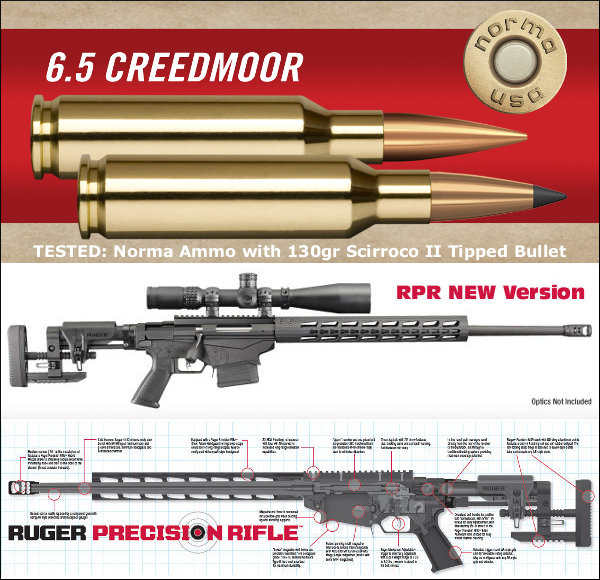
2. Ruger Precision Rifle with Norma 6.5 Creedmoor Ammo
In this video Gavin Gear tests Norma-brand factory ammo in a Ruger Precision Rifle chambered in 6.5 Creedmoor. Gavin reports: “Norma is known for its high-quality brass and ammunition. Recently, I saw that Norma had announced a new addition to their Professional Hunter lineup of ammunition: in 6.5 Creedmoor! I thought I should try some out with the Ruger Precision Rifle. As you saw in the video, this ammunition behaves more like match ammunition.”
3. 6.5 Guys Test Lapua 6.5 Creedmoor Brass in Tactical Rifles
If you have a 6.5 Creedmoor rifle, or are considering getting a gun chambered for this cartridge, we strongly recommend you watch the full 6.5 Guys Video. Ed and Steve spent a lot of time conducting this test, and the video includes helpful summaries of their findings.
4. Reloading for the 6.5 Creedmoor — Gear and Components
If you own a 6.5 Creedmoor rifle, and plan to start hand-loading for the popular cartridge, this video may help you select effective load components. The video examines a wide variety of brass, powder, and bullets options for the cartridge. In addition the reviewer looks at various reloading dies and tools suitable for 6.5 Creedmoor hand-loading.
5. The Springfield Armory M1A — Now Offered in 6.5 Creedmoor
Many folks may not realize that Springfield Armory now makes an M1A chambered in 6.5 Creedmoor. With considerably less recoil, this 6.5 CM version is easier to shoot than the classic 7.62×51 M1A: “Having a 6.5 Creedmoor caliber in the M1A lineup gives long-range shooters more choices with the precision and accuracy they require,” says Springfield Armory CEO Dennis Reese.
Readers know Jim Borden as a Hall of Fame shooter and the owner of Borden Accuracy/Borden Rifles. Jim won 10 IBS National Championships, set 10 IBS world records, and was inducted into the Benchrest Hall of Fame in 1996. But Jim is not just a great shooter. This highly-trained engineer is very much a Renaissance man. He is as skilled with cameras as he is with benchrest rifles.
Jim is a talented outdoor photographer who has compiled an impressive portfolio of wildlife and landscape photographs. For our Thanksgiving-day edition of the Daily Bulletin we are featuring some of Jim’s favorite nature images. We hope readers enjoy them as much as shooters prize Borden’s Rimrock benchrest and Rimrock hunting actions.
Growing up in rural Pennsylvania, in a hunting household and hunting community, Jim learned about shooting at a very early age. He started hunting at the age of nine with his father and grandfather. His grandfather had an avid interest in photography while they were on hunts and Jim became interested as well. Jim began using SLR cameras in the 1970s, often carrying cameras on his hunts. As the years passed, Jim became more interested in “shooting” the animals with a camera versus a gun. Jim converted from film to digital in 2006 and in 2007 Jim’s wife Joan started accompanying Jim on the photo safaris. Jim has a particular passion for elk, moose, and eagles and Jim also enjoys scenic photography. Jim and Joan both shoot Nikon professional equipment. Their photographs can be viewed at www.BordenPhotography.com. You’ll also find Jim’s images (along with photography tips) on his JandJB Wildlife Photography Blog.
All in the Family
Jim’s grandfather was a gunsmith who taught Jim the trade when Jim was very young. Jim’s father and grandfather ran a country business that included an auto repair shop, welding, a small lathe, and a forge. Jim earned a degree in Mechanical engineering at Penn State University. For 23 years he worked for Procter and Gamble (P&G) as an engineer and as an engineering manager/project manager.
Borden Rifles — A Success Story
Borden Accuracy/Borden Rifles has been a source for precision benchrest and hunting rifles for many years. Jim started doing his own gunsmithing while competing in benchrest and high power silhouette matches. Jim launched his business in 1987, working nights and weekends while still employed at P&G. The business became full-time in 1995 with Jim and his wife Joan doing the work. The business was expanded in 1999 with the construction of the new Springville, PA facility and the addition of sons Jim Jr. and John to the staff. Son-in-law John Mecca came onboard in January 2000. Now the Borden shop continues to make some of the finest rifles and actions in the world. Joan tells us that the company has seen a significant growth in ultra-high-quality precision hunting rifles in recent years.
Jim and company began making Rimrock benchrest and Rimrock hunting actions in 2001. They added Borden Alpine and Timberline actions in 2006. These actions are made in an advanced manufacturing facility which has three CNC vertical Machining centers, three CNC lathes, three manual lathes, a manual knee mill, a surface grinder, a cylindrical grinder and wire EDM machine. To learn more, visit BordenRifles.com, call 570-965-2505, or send email to info [at] bordenrifles.com.


 The first question you have to ask is whether the intended recipient can legally own the firearm where he or she lives. With more than 20,000 different gun laws on the books, even the kinds of firearms that law-abiding citizens can own vary from place to place. For example, juveniles (under age 18) generally speaking are precluded by law from possessing a handgun. Check out the Bureau of Alcohol, Tobacco, Firearms and Explosives (ATF) website for an overview of local laws and, whatever you do, don’t forget that you can never under any circumstances transfer a firearm to someone you know — or have reasonable cause to believe — legally can’t own one. That’s a federal felony, so be careful.
 Consider a Gift Card Instead of Direct Gift


 Report by Boyd Allen, IBS Vice President



 Jim is a talented outdoor photographer who has compiled an impressive portfolio of wildlife and landscape photographs. For our Thanksgiving-day edition of the Daily Bulletin we are featuring some of Jim’s favorite nature images. We hope readers enjoy them as much as shooters prize Borden’s Rimrock benchrest and Rimrock hunting actions.


 Borden Rifles — A Success Story