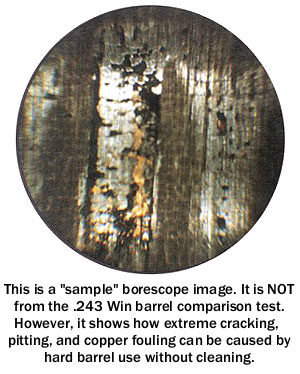
Can sustained rapid-fire shooting with no cool-down period wear out a quality barrel more quickly? The answer is “Yes” according to Forum member LCazador, who did an interesting comparison test with two .243 Winchester barrels. He started off with two, identical, match-grade HV taper stainless barrels. Both were NEW at the start of testing, and LCazador shot the same load through each: 95gr match bullets with 38 grains of Hodgdon Varget. After giving both barrels the same, gentle 20-round break-in, 300 rounds were then fired through each barrel — in very different ways. Barrel condition and wear were monitored with a borescope.
Barrel One — Slow Fire, Cool Down Periods, Cleaning Every 50 Rounds
At the end of the 300-round test, Barrel One looked brand new. There was none of the severe fire cracking found in Barrel Two. This barrel was shot no more than 10 times without a cool down and firing was done at a much slower pace. Cleaning for this barrel was done every 50 shots.
Barrel Two — Fast Firing, No Waiting, Cleaning Every 100 Rounds
The second barrel, which received hard use and minimal cleaning, was severely damaged with severe fire cracking at the leade and throat. As a result, the barrel had to be re-chambered. This barrel was shot 100 rounds at time without cleaning and was shot up to 20 times in succession without a cool down.
LESSON LEARNED — Heat Kills Barrel Life
Don’t let your barrel get too hot, and keep it clean. One afternoon can ruin a barrel!
Monitoring Barrel Wear with Borescope
Some folks worry too much about what their borescopes reveal — many barrels do not have to be “squeaky clean” to perform well. In fact some barrels run better after ten or more fouling shots. However, a borescope can be very helpful when your barrel starts losing accuracy for no apparent reason. Forum member FdShuster writes:
“A borescope is a positive way of backing up your suspicions when the rifle starts to throw an occasional (soon followed by more frequent) wild shot. Using the scope is also an excellent way to determine that the cause is barrel wear and not simply a need for a concentrated cleaning session to remove built up copper and more importantly, carbon fouling.
I’ve had a few barrels that gave every indication of being shot out. But I ‘scoped them out and found the cause to be nothing more than requiring a good cleaning. They then returned to their usual performance. There’s no guessing involved when you are able to get ‘up close and personal’ using the scope. The borescope also provides an excellent view of the all-important condition of the crown. My borescope is one of the most valuable investments I’ve ever made.”
Chris Nichols with potential world record (1.297″ 4-Target Agg) Heavy Gun Targets!
Report by Bart Sauter, Bart’s Custom Bullets
Chris Nichols is one of the best 600-yard shooters in the game. This 2019 season he compiled one of the most impressive mid-range benchrest seasons ever. Check out the stats — Chris’s nine-match, Two-Gun Group Aggregate (Agg) for the year is 1.983″! That’s under two inches average at 600 for 72 record targets fired in competition. Many 600-yard shooters aspire to shoot a single, 4-target Agg that measures 1.983″, but doing that for 72 targets is amazing!
And of the nine matches Chris shot, he took SIX Overall Two-Gun wins — a 67% win ratio. And in the process Chris also shot what is possibly the smallest 4-target Heavy Gun Agg ever recorded — 1.297 inches. Hey readers — that Agg works out to 0.206 MOA average group size — well under quarter-MOA for four, 5-shot groups at 0.34 MILES (600 yards)!
Chris with 0.665″ group at 600 yards. This is the smallest HG group fired in the IBS in 2019.
The Equipment: 6mm Dasher Light Gun and Heavy Gun
Chris likes to run 1.550 stainless steel Bat “B” actions, Jewell triggers, Brux or Bartlein barrels. He prefers wooden stocks as he feels they produce a better resonance for Long Range rifles. Chris has his own stock design crafted by Johnny Byers. Imagine a Wheeler LRB stock front half mated with an McMillan ST 1000 rear section and you have Chris’ stock! It features a Wheeler-type, 4″-wide fore-end with an ST 1000 low-comb profile in the back. Both Light Gun and Heavy Gun sport Vortex 15-60x52mm Golden Eagle scopes mounted with Harrell’s double screw tall rings. Chris does NOT use either muzzle brake or tuner.
Here is Chris at his home range with his Light Gun (17 lbs. max).
Chris Nichols’s Heavy Gun is a true heavy coming in at around 42 pounds. It was responsible for the HG Agg of 1.297″ (potential new world record). His season-long aggregate with his Heavy Gun was 1.861″ for 36 targets! This rifle has similar components as his Light Gun, except the barreled action rides in a barrel block in a McMillan HBR 50 BMG stock.
Both rifles ride a top of a Sinclair competition rest with a Protector DR Flat Top rear bag. When Chris goes to HG gun he simply switches tops (made by Daniel Greenlaw) on his front rest to accommodate the larger forend. As Chris says ,” This keeps things simple and exactly the same. ” Just the way he likes it.
Reloading for the 6mm Dasher
Chris’s load choice for both LG and HG is Hodgdon Varget pushing 105gr Berger VLDs. He uses CCI 450 primers, seated with an old Lee hand primer. When it comes to reloading, Chris likes to keep things as simple as possible. “If people saw me reloading they’d probably laugh!” Chris revealed that he doesn’t anneal or clean his cases. He just sprays them down with Hornady One Shot Case Lube, resizes, then runs a brush down the necks, and cleans the primer pockets. The only cleaning his cases get is when he wipes the lube off of them. Chris WILL trim and chamfer as needed.
Chris says seating consistency is critical — he uses a K&M Arbor press with force dial indicator. I asked if there were certain numbers he looks for when seating. Chris replied, “I’m only concerned with consistency and not a certain number, 5 pounds or 60 pounds. It doesn’t matter as long as they are the same. I take what the brass gives me.”
Tuning the 6mm Dasher for Record-Setting Accuracy
I asked Chris what was special about his Dasher and how he kept it tuned and so competitive? His reply is something all shooters should pay careful attention to: “[Success] starts with having a good reamer, bullets and barrels. But more than that, it’s KNOWING your Cartridge, KNOWING your bullets, and KNOWING your barrels! I’ve shot it so much I just know what to do. I’m comfortable with it. I know how to get it to shoot and when it’s not, I have a pretty good idea how to get it back in tune. Once you know your equipment, then you can learn how to get the most out of it.”
Chris has a range at his house and he tunes at 300 yards. He looks for consistent, 300-yard 5-shot groups of 0.600″ or less! He wants to see nice round groups! Not groups with four in and one out or vertical strings. Chris starts by finding “touch” (to the lands) then he moves the bullets .002″ off the lands and begins tuning. Chris has found that usually somewhere around .008-.012″ off the lands is where his Berger 105gr VLDs shot best. I asked Chris what’s the biggest factor contributing to his success? He said, one big thing was that he can do his own work. That’s a huge advantage.
Look for Accuracy First, Velocity Second
Early on Chris had it in his mind that for a 6mm Dasher to shoot best he needed to achieve a certain velocity range — 2990 to 3030 FPS. The problem was he wasn’t paying attention to what the target was telling him. He’d get to the speed he was looking for but the accuracy wasn’t there. Once he started slowing the speeds down and giving the barrel what it wanted, then the accuracy came! Also with the slower speeds came better consistency.
Chris Nichols’s Tuning Tips for 6mm Dasher:
• Take consistency over speed.
• Only change one thing at a time and run it to the ground.
• Every barrel is a little different, so give it what it wants.
• Pay attention to what your target is telling you.
• Don’t be afraid to REDUCE your powder load.
Chris Nichols’s Advice for New Shooters
Chris says the best thing a new shooter can do is align themselves with knowledgeable people, and if they will talk, listen! Next, be ready to buy the best equipment or be ready to buy it twice. Chris also says: “Don’t cheap-out on sighters. Sighters need to be just as good as your record rounds.”
In the Beginning — Learning the 600-yard Benchrest Game
Chris’s shooting career began in 2012. His first win came in 2014. He was shooting beside guys like Sam Hall, Larry Isenhour, Mike Hanes, Jeff Godfrey James Coffey, and Chad Jenkins, who are very tough competition indeed. He said when he won he was ecstatic and he’ll never forget it! That first trophy had him feeling like he’d just won the Nationals! Chris shot a 6BR for the first two years of his career, before switching to the 6 Dasher. I asked him why he switched? He said, “guys were starting to shoot the Dasher and winning with it!”
I asked Chris if he had a mentor and he said, “not really”. He learned by watching the guys who consistently finished Top 5 at matches and occasionally asked them a question. Not two questions, just one! Chris didn’t want to push his luck by asking too much. Then Chris would take that information and test it and apply it to his own shooting. Chris says, “he learned mainly by the ‘school of hard-knocks’. The good thing about learning that way is it sticks with you!”
Chris Nichols 2019 600-Yard Win List and Statistics
Review by F-Class John
Do you know what the inside of your barrel looks like? Borescoping is a great way to diagnose a barrel problem or evaluate your cleaning regimen. Conventional optical borescopes work great but are expensive. Low-cost digitial borescopes have been on the market for a while, but many have have lacked the resolution necessary to get the job done properly. Enter the Teslong rifle borescope. We set out to see whether this new electro-optical borescope, priced at just $49.99, could do the job of conventional optical borescopes that might cost twenty times as much. We concluded that this little device is pretty amazing…
Here is an actual video captured with the Teslong borescope owned by Forum member DMoran. This is the inside of a Howa factory .223 Rem Barrel:
Setting Up and Using the Teslong Borescope
The Teslong borescope comes in a handy, zippered case* with a mesh pouch on one side and an elastic strap on the other to help secure the cords. The unit employs two different cables. One is a flexible USB A/V cable which also thoughtfully comes with a USB/USB-C converter as well. The other piece is the mirrored borescope which is attached to a flexible but fairly rigid cable. The first thing I noticed is the generous length of the combined cable. Since the unit needs to be connected to a computer or other compatible device, the long cable allows you easily scope the entire length of your barrel while you keep your computer at a distance. I appreciated the way this works because it allowed me to continue cleaning my gun and checking the barrel without worrying about getting any cleaning supplies on my computer.
NOTE: The Teslong borescope we purchased from Amazon in September came with the storage case shown. We’d been informed that some recent shipments have omitted the case.
Plug and Play — With Impressive Resolution and Image Quality
Once the unit is plugged into the computer all I had to do was open my photo program and the Teslong activated and displayed the bore image. For Windows at least, there are no Apps to install or anything else to do other than plug it in. Once it’s plugged in you simply slide the unit into your bore and start looking. The angled mirror along with the integrated light allows for easy viewing of the lands and grooves with little to no need for focal adjustment. I ran the scope down some newer barrels as well as one of my oldest, burned-out barrels and I was shocked at the detail and resolution I saw. Rust, copper, carbon and fire-cracking really popped out. If I was assessing barrel cleaning effectiveness, I could easily see how levels of fouling are being removed. I will use my Teslong to capture photos of my next barrel in brand new condition. Then I can reference those “Day 1″ images each time I clean that barrel.
As an owner of a Hawkeye and another digital borescope, both of which are fairly expensive, I have to admit I was skeptical of a borescope that costs a mere fifty bucks. But frankly, I was amazed at the image quality. Look for yourself. These are actual Teslong photos I took while inspecting one of my barrels.
NOTE: This is a fire-forming barrel that was not cleaned for 500 consecutive rounds.
Read Reviews from Teslong Borescope Buyers
Want to know what other Teslong owners think? You can read over five pages of Teslong Rifle Borescope comments and reviews by our Forum members in AccurateShooter’s Teslong Forum Thread.
Here are actual statements by Forum Members and Amazon purchasers
“Received mine last week, incredible quality for the price.” — PhilC
“There’s a couple of threads discussing these borescopes. It actually has the 45 degree mirror so that you can see the everything much better than with a standard endoscope.” — Mark W
“Most firearm borescopes are expensive… The Teslong Rifle Borescope is currently the best affordable borescope you can buy. With the Teslong Rifle Borescope I’m able to see the fire cracking in my rifle’s bore. I definitely recommend purchasing.” — Amazon Purchaser
“The price is right and the quality is first-rate. Plugs into USB-A or Micro USB port on PC, Mac, or Android (it doesn’t work with iPhones). Takes pics or HD video, stored using either native camera software or their Teslong Camera program. It has a very close focus necessary for a borescope. Other commercial ‘endoscopes’ may be the same diameter, but they have a 2- to 5-cm focal distance, making it difficult to use in a barrel and useless for 90 degree viewing except in, say, a 105mm howitzer. Probe diameter is 0.20 in/5.0 mm diameter and is ideal for use on .223/5.56. The removable 45° mirror allows viewing chamber walls and barrel lands/grooves up close and personal.” — Jim Schmidt
“I have tried it out on my 6.5mm and .223 rifles and it performed way beyond my expectations once you know how to focus it. Also, I have a Samsung Android and neither the USB plug nor the additional adapter would fit my phone (I thought). Teslong customer service reps told me that the plug for my phone is actually a part of the standard plug that comes with the unit. Heck, all I had to do was flip the male end of the plug down! Also, there is a light intensity adjustment on the little box-looking thing that is a part of the cable. It’s really small and easily overlooked.” — Barrbqn (Amazon)
F-Class Nationals Competitors Try the Teslong — And Then Place Orders
I gave the Teslong a pretty thorough testing on my bench at home, but I was also able to test it while attending the 2019 F-Class Nationals. It hooks up easily to a laptop (either Windows or Mac). It will also work with an Android tablet or smartphone (but not yet with an iPad or iPhone). I set the Teslong up for some fellow competitors to test. Each time someone stuck it in their barrel there was a collective gasp when they saw how clear and detailed the picture was. It wasn’t long before everyone in our housing unit wanted to try it.
Interestingly, one of the fellows in our housing pulled out the exact same unit. It turned out he loved it just as much as we all did. What really told me it was a keeper is when several of the people who also own Hawkeyes or other borescopes ordered a Teslong as soon as they were done playing with it. On a side note, we also ended up using it to look inside a seating die, inside a disassembled bolt, and under a refrigerator. I’m sure there are countless other uses for the Teslong.
CONCLUSION — Impressive Product — You Won’t Be Disappointed
The bottom line is that there isn’t anything on the market that can compete with this little gem anywhere near its $50 price point. I would say that if you’ve put off buying a borescope because of price or quality concerns this is the unit to buy — you won’t be disappointed. In the video below I show how to use the Teslong in your rifle. The Teslong Borescope is available right now for $49.99 on Amazon.
Software Functionality (Apps and/or Operating System)
Windows 7/8/10 or later (Desktop or Laptop Computer)
1. Use Windows Camera, the built-in Camera software of Windows10, only for Win10.
2. Use Teslong camera software or AmCap software
Android 4.4+ (Tablet or Smartphone)
Use Teslong Camera App, CameraFi, or USB Camera App
Mac OSX 10.6+ (Desktop or Laptop Computer)
Use Photo Booth or QuickTime Player
Notice: This Teslong model does NOT support iPhone and iPad! Teslong says: “WiFi version of the rifle borescope supporting iPhone and iPad is under development, and coming soon.”
Teslong vs. Conventional Optical Borescope (Such as Hawkeye)
The Teslong is not perfect. It does have some shortcomings when compared to a conventional optical borescope such as the Hawkeye. A borescope with a long, rigid metal shaft is easy to rotate within the bore. Therefore you can quickly inspect all 360 degrees inside the barrel. By contrast, the Teslong has a flexible cable that you have to twist to rotate the lens. That works, but it’s not as easy. Additionally, in a large-diameter bore, the 5mm-wide Teslong tends to flop to the low side. Again, with a Hawkeye, it is easy to maintain a constant distance to the bore wall.
Forum member Ned Ludd explains these considerations in a Forum post: “The [Teslong] is designed to fit into a .22 Cal bore. As such, there is quite a bit of play (lateral movement) of the camera head in a .30 Cal bore as you twist the cable to swivel it around 360 degrees. This is largely caused by the angle of the cable as you spin it, which is not perfectly concentric to the bore. This is not an issue of concern in a much more expensive borescope with a purpose-built swivel mechanism.”
That said, we still think the Teslong is a great device, well worth the money ($50 vs. $850+ or so for a Hawkeye). The cable rotation isn’t that big a deal, with a little practice. Overall, for regular visual inspections of your barrels, with easy photo/video capture, the Teslong is hard to beat for the price.
*The Teslong borescope we ordered from Amazon and tested came in the black, zippered case shown in the top-most photo. We have been informed that some Teslong units have recently shipped with NO case. We do not know if cases will be provided in the future.
Here’a useful article by Sierra Bullets Media Relations Manager Carroll Pilant. This story, which originally appeared in the Sierra Blog, covers some of the more common ammo problems that afflict hand-loaders. Some of those issues are: excessive OAL, high primers, and improperly sized cases. Here Mr. Pilant explains how to avoid these common problems that lead to “headaches at the range.
I had some gentlemen at my house last fall getting rifle zeros for an upcoming elk hunt. One was using one of the .300 short mags and every 3rd or 4th round would not chamber. Examination of the case showed a bulge right at the body/shoulder junction. These were new cases he had loaded for this trip. The seating die had been screwed down until it just touched the shoulder and then backed up just slightly. Some of the cases were apparently slightly longer from the base to the datum line and the shoulder was hitting inside the seating die and putting the bulge on the shoulder. I got to thinking about all the gun malfunctions that I see each week at matches and the biggest percentage stem from improper handloading techniques.
One: Check Your Cases with a Chamber Gage
Since I shoot a lot of 3-gun matches, I see a lot of AR problems which result in the shooter banging the butt stock on the ground or nearest solid object while pulling on the charging handle at the same time. I like my rifles too well to treat them that way (I cringe every time I see someone doing that). When I ask them if they ran the ammo through a chamber gage, I usually get the answer, “No, but I need to get one” or “I didn’t have time to do it” or other excuses. The few minutes it takes to check your ammo can mean the difference between a nightmare and a smooth running firearm.
A Chamber Gauge Quickly Reveals Long or Short Cases
Size Your Cases Properly
Another problem is caused sizing the case itself. If you will lube the inside of the neck, the expander ball will come out a lot easier. If you hear a squeak as the expander ball comes out of a case neck, that expander ball is trying to pull the case neck/shoulder up (sometimes several thousandths). That is enough that if you don’t put a bulge on the shoulder when seating the bullet … it can still jam into the chamber like a big cork. If the rifle is set up correctly, the gun will not go into battery and won’t fire but the round is jammed into the chamber where it won’t extract and they are back to banging it on the ground again (with a loaded round stuck in the chamber). A chamber gage would have caught this also.
Oversizing cases also causes problems because the firing pin doesn’t have the length to reach the primer solid enough to ignite it 100% of the time. When you have one that is oversized, you usually have a bunch, since you usually do several cases at a time on that die setting. If the die isn’t readjusted, the problem will continue on the next batch of cases also. They will either not fire at all or you will have a lot of misfires. In a bolt action, a lot of time the extractor will hold the case against the face of the breech enough that it will fire. The case gets driven forward and the thinner part of the brass expands, holding to the chamber wall and the thicker part of the case doesn’t expand as much and stretches back to the bolt face. If it doesn’t separate that time, it will the next time. When it does separate, it leaves the front portion of the case in the chamber and pulls the case head off. Then when it tries to chamber the next round, you have a nasty jam. Quite often range brass is the culprit of this because you never know how many times it has been fired/sized and in what firearm.’Back to beating it on the ground again till you figure out that you have to get the forward part of the case out.
Just a quick tip — To extract the partial case, an oversized brush on a cleaning rod [inserted] and then pulled backward will often remove the case. The bristles when pushed forward and then pulled back act like barbs inside the case. If you have a bunch of oversized case that have been fired, I would dispose of them to keep from having future problems. There are a few tricks you can use to salvage them if they haven’t been fired though. Once again, a case gage would have helped.
Two: Double Check Your Primers
Another thing I see fairly often is a high primer, backwards primer, or no primer at all. The high primers are bad because you can have either a slam fire or a misfire from the firing pin seating the primer but using up its energy doing so. So, as a precaution to make sure my rifle ammo will work 100% of the time, I check it in a case gage, then put it in an ammo box with the primer up and when the box is full, I run my finger across all the primers to make sure they are all seated to the correct depth and you can visually check to make sure none are in backwards or missing.
Three: Check Your Overall Cartridge Length
Trying to load the ammo as long as possible can cause problems also. Be sure to leave yourself enough clearance between the tip of the bullet and the front of the magazine where the rounds will feed up 100%. Several times over the years, I have heard of hunters getting their rifle ready for a hunt. When they would go to the range to sight in, they loaded each round single shot without putting any ammo in the magazine. On getting to elk or deer camp, they find out the ammo is to long to fit in the magazine. At least they have a single shot, it could be worse. I have had hunters that their buddies loaded the ammo for them and then met them in hunting camp only to find out the ammo wouldn’t chamber from either the bullet seated to long or the case sized improperly, then they just have a club.
Four: Confirm All Cases Contain Powder
No powder in the case doesn’t seem to happen as much in rifle cartridges as in handgun cartridges. This is probably due to more handgun ammo being loaded on progressive presses and usually in larger quantities. There are probably more rifle cartridges that don’t have powder in them than you realize though. Since the pistol case is so much smaller internal capacity, when you try to fire it without powder, it usually dislodges the bullet just enough to stick in the barrel. On a rifle, you have more internal capacity and usually a better grip on the bullet, since it is smaller diameter and longer bearing surface. Like on a .223, often a case without powder won’t dislodge the bullet out of the case and just gets ejected from the rifle, thinking it was a bad primer or some little quirk.
For rifle cases loaded on a single stage press, I put them in a reloading block and always dump my powder in a certain order. Then I do a visual inspection and any case that the powder doesn’t look the same level as the rest, I pull it and the one I charged before and the one I charged after it. I inspect the one case to see if there is anything visual inside. Then I recharge all 3 cases. That way if a case had powder hang up and dump in the next case, you have corrected the problem.
On progressive presses, I try to use a powder that fills the case up to about the base of the bullet. That way you can usually see the powder as the shell rotates and if you might have dumped a partial or double charge, you will notice as you start to seat the bullet if not before. On a progressive, if I don’t load a cartridge in one smooth stroke (say a bullet tipped over sideways and I raised the ram slightly to reset it) Some presses actually back the charge back adding more powder if it has already dumped some so you have a full charge plus a partial charge. When I don’t complete the procedure with one stroke, I pull the case that just had powder dumped into it and check the powder charge or just dump the powder back into the measure and run the case thru later.
Lapua offers a sophisticated FREE Ballistics App for iOS and Android smartphones and mobile devices. This state-of-the-art App has many great features — much more than you’d expect for a free App. If you do much shooting past 300 yards, or use a wide variety of bullets and/or cartridge types, we recommend you download the App and give it a try. This article, written by a Lapua technician, explains how to use the App. This article is definitely worth reading — there are many important concepts and procedures discussed here that apply to all Ballistics calculators, not just the Lapua App. For more details, read the Lapua Ballistics App User Manual.
Watch Video for Explanation of Lapua Ballistics App Features
Lapua Ballistics App Basics — How to Get Started
Article by Matti Paananen
As smartphones and tablets are constantly developed, ballistic software and Apps are also improving, and with their help our ability to hit targets can improve significantly. This is a short introduction on why and how to use a ballistic calculator, namely the Lapua Ballistics App, and a few pointers that will help you use the App effectively.
Ballistics software and Apps are designed to help shooters and hunters make calculations to hit distant targets or take down game in the field by offering ballistic solutions. Lapua Ballistics is the first App utilizing the 6DOF calculation model.
Toying around with ballistics apps is always fun, but effective use of ballistic software requires general understanding of how they work. The App gets information from the user and by using mathematical formulas it provides the solution that will give the user a solid starting point to hit the target.
However, it is also important to remember that the App can’t think — it only calculates a solution based on your parameters. You will not know the error until you have already fired the shot.
1. SET UP YOUR SCOPE RETICLE AND RIFLE
Scope manufactures use different units per click, so it’s important that you use the correct unit in the App. For example, in your scope, one click can be 0.1 mil, 1/4 MOA, [or 1/8 MOA depending on the model]. You can find this information in your scope manual and also usually from the scope turrets. Setting your scope reticle is very important, partly because if you use the wrong unit in the App, the ballistic solution will not match your scope. To set up your scope reticle in Lapua Ballistics, go to Manage Rifle / Cartridge Data –> Add Rifle Cartridge Data (or choose to edit a Rifle/Cartridge combo you’ve already set up) –> Reticle –>.
Another thing to setup in Lapua Ballistics is your scope height, i.e. Line of Sight to Bore in the Manage Rifle / Cartridge Data window. This is the distance between the center of the scope and the center of the bore. The default height is 45mm but with tactical rifles, the height can be even 70mm. So check! The height is easy to measure with a ruler. Then there’s also the twist rate of your rifle to set up — look it up in the rifle manual, it can also be stamped on the rifle barrel. The rifle twist rate is needed to calculate spin drift and bullet stability. Spin drift should be taken into account with longer distances, and it can be enabled or disabled in Lapua Ballistics.
2. SET UP YOUR BULLET CHOICE
You can add your bullet of choice from the bullet library, where you find all Lapua bullets. It is also possible to add information manually. In this case, you will need bullet weight, the ballistic coefficient BC and muzzle velocity. The Ballistic coefficient can be given in G1 or G7 values. G7 is designed for low-drag bullets with a boat tail and G1 is used for more traditional flat base bullets. Lapua on the other hand uses Doppler radar-based data to calculate a more accurate ballistic trajectory for Lapua bullets by 6DOF model. Anyway, it is good to remember that the ballistic coefficient changes with velocity, so all changes in a flight path cannot be predicted.
The following thing you will need to set up is the bullet’s actual muzzle velocity. You can reverse engineer the number based on your drop or by using a chronograph. It is good to remember that more rounds you shoot, the better average velocity you will get.
Because temperature affects muzzle velocity, it would be good to shoot velocities in different temperatures and write them down. Those notes can be used with Lapua Ballistics as it is possible to set up the powder temperature variation in the App.
3. SET UP WEATHER CONDITIONS
Lapua Ballistics has settings for temperature, air pressure, and humidity. All these affect the ballistic solution and the chance to hit the target. In a nutshell, temperature affects the powder’s burn speed and in that way the bullet velocity. Air pressure and humidity also affect bullet drag.
If you are shooting approximately on sea level, you do not need to change air pressure values, but if you are shooting or hunting in mountain areas or where there is lot of elevation difference, you might want to check the air pressure. On sea level, the atmospheric pressure is 1013 hPa. The higher you go, the less air pressure you will have and thus less bullet drag. Some like to use handheld weather and wind meters that have a function to get actual air pressure and humidity, however the Get Current Weather function in Lapua Ballistics will give you the air pressure reading from your local and most close weather station, provided that your app is allowed to use your location data.
Temperature is an important variable. To understand how velocity change in different temperatures, only way is to shoot and keep notes. Some ballistic software and apps have values for muzzle velocity in different temperatures. The user needs to input muzzle velocity in different temperatures in order to software to calculate the effect. More velocities in different temperatures the user adds, the more accurate the calculation will be.
4. SET UP A BALLISTIC SOLUTION
After we have set up our own rifle / cartridge data, there are few things that need to be taken into account when shooting: the distance to the target, the wind and our shooting skills. Distance can be measured for example with a laser rangefinder and then put in. Wind can also be measured with a wind gauge but it is important to remember that the wind in the target area can be very different from that in the shooting position. Lapua Ballistics gives a ballistic solution based on stationary wind, so in the end, the shooter’s task is to estimate how much the wind factor will be.
It’s good to remember that Lapua Ballistics is a starting point and designed to assist the shooter. Software and apps have ways of helping us adjust the sight and predict the ballistic solution but they will not replace the shooter. We still have to pull the trigger and record our range data. By keeping good range notes and with the support of good ballistic software like Lapua Ballistics, we should be able hit in all environments.
Article Find by EdLongrange. We welcome reader submissions
Big News in the ammo industry! At the Lake City Army Ammunition Plant, Northrup Grumman is out, and Winchester is taking over.
Olin Corporation (NYSE: OLN) announced that its ammunition division, Olin Winchester, LLC (“Winchester”), has been selected by the U.S. Army to operate and manage the Lake City Army Ammunition Plant in Independence, Missouri. Winchester will be taking over in the fall of 2020. Winchester’s Lake City contract has an initial term of seven years and may be extended for up to three more years, which would put Winchester in charge of the plant for a full decade.
Prior to its acquisition by Northrup Grumman in 2018, Orbital-ATK ran the plant since 2000, initially as Alliant Techsystems (ATK). Before that, Winchester previously operated the Lake City facility from 1985-2000, so Winchester knows this facility. Following a one-year transition period, Winchester will assume full operational control of the Lake City plant on October 1, 2020.
The Lake City plant, which began production in 1941, is the primary provider of small-caliber U.S. military ammunition for training and combat use. The plant produces as many as 2 billion rounds per year. The plant, encompassing nearly 4,000 acres, also serves as a national and regional test center for ammunition performance and weapons firing.
Orbital-ATK Was Losing Millions at Lake City in Recent Years
The Lake City contract was a huge financial problem for Orbital ATK, now a division of Northrup Grumman. Orbital ATK was losing money on its plant contract, due to the high cost of materials. KCRU.org reported:
“Orbital ATK, the defense contractor that ran the Lake City facility from 2000 until it was bought [in 2018] by Northrop Grumman, stunned investors on August 10, 2016, when it announced it wouldn’t be able to file its quarterly earnings report on time. Orbital ATK stock plummeted more than 20%. Institutional investors… filed a class-action lawsuit alleging the company fraudulently hid the fact it was losing hundreds of millions of dollars on its massive, multi-year Army contract. [Orbital ATK] eventually said it expected to lose $373 million on the contract.”
About Orbital-ATK and Alliant Techsystems: Before it split into two companies, Orbital-ATK and Vista Outdoor, Alliant Techsystems (ATK) was the parent company of numerous major gun industry brands, including: Alliant Powder, CCI, Champion, Federal, RCBS, Speer, and Weaver. These brands are still operated by Vista Outdoor.
It’s summer time. That means many of our readers are on the road (attending major shooting matches or enjoying summer vacations). How do you do your reloading chores while living like a gypsy for a few weeks? Here’s a solution from Forum member Dave Gray (U.S. Army Retired).
Dave is a self-declared “full-time RVer” who spends most of his time on the road. Behind his Ram 3500 pickup, Dave tows a huge 41-foot Heartland Cyclone toy hauler featuring a 12X8 foot garage in the rear. In the rear garage area, which holds a Smart Car, Dave has set up a removable reloading bench complete with RCBS Rockchucker single stage press and Dillon progressive press.
Reloading Bench Mounts to RV Wall with Brackets
Dave explains: “I used a 2″X6″X5′ board for the bench. It’s perfect for my needs, and is easy to disassemble. I made it this small so that I can park my Smart Car in the garage during travel to my destinations. The bench, attached to the wall frames, is very solid. The presses’ centers are 3″ and 6.5″ from the brackets. [There are] four bolts on the wall into aluminum wall frame and 3 bolts in the bench. If I ever have to replace the current board, I’ll do so with oak or birch or hickory. When I’m not reloading, I remove the presses and store them in a protected space. I can easily attach other equipment to the bench by using C-Clamps.” Dave’s “rolling reloading room” looks very well thought-out. We commend Dave for his inventiveness.
Today is National Hunting and Fishing Day. To help the avid hunters among our readers, here are Twenty Tips that can help ensure a safe and successful hunt. These tips have been compiled from our AccurateShooter Hunting Forum, with help from Hunting Editor Colton Reid (who has already been out deer hunting this month). Some items are preparatory — such as working with maps, sighting in the rifle, and improving physical fitness. We also talk about equipment — having the right gear, from proper boots to a GPS for multi-day hunts.
Of course there are entire volumes written on hunting, but these 20 Tips can benefit all hunters. Follow these suggestions and you should have a safer hunting experience with greater likelihood of success. If you liked these pointers, you’ll find two dozen more helpful hints on the NSSF Website.
Preparations Before The Hunt
1. Map Your Hunt and Notify Others — Before your hunt, make a plan and notify friends and family members about WHERE you are going and your intended return date and time. Print out a Google Satellite map and locate landmarks and trailheads. Mark where you plan to park your vehicle and give a copy of this map to friend and/or family members. A hunter may injure himself by falling off a rock, or tumbling in a creek-bed. After that kind of injury the hunter may be confused or unable to walk. If you get stranded in the wilderness, you want trusted persons to know where you are. So, before you leave on a trip, provide a map to a friend or family member. Show them where you will leave your vehicle, and where you expect to be every day of your hunting adventure.
2. Licenses and Permits — Make sure you have a valid hunting licenses and all the necessary tags. Begin this process with ample time before your intended hunt(s). The NSSF adds: “If you are crossing state or national borders, find out about any special considerations you must take care of. Border crossings can mean knowing about firearm transport laws or Chronic Wasting Disease-related regulations.”
3. Work on Your Fitness — On a multi-day hunt you may be trekking many miles. You need to be in good shape. If you are out of shape you may be putting yourself in a precarious situation, particularly if you underestimate the terrain difficulty. As the NSSF says: “Not being able to handle the conditions lessens your chances of success, can turn a great experience into an agonizing one and can endanger your health.”
4. Do Your Homework — Study the area you will be hunting. Talk to other hunters. Look at satellite photos. Get a real sense of the walking and terrain challenges. For a multi-day hunt, MAKE a PLAN. The NSSF states: “Eliminate surprises. Learn as much about where you will be staying, the area you will be hunting, what the weather might be like and what you need to bring[.]”
5. Rifle and Ammo — Make sure your rifle is sighted-in and your ammo is tested. Sight-in your rifle with the ammo you plan to use on your hunt. CLICK HERE for 4-Shot Sight-in Method. After sighting-in from the bench, confirm your zero by shooting from typical hunting positions (kneeling and with forearm supported on a rock or post).
6. Shooting Positions — Practice the shooting positions you will use in the field. Practice sitting, kneeling, and prone positions. You should also practice with shooting sticks, using your day pack as a rest, and with a bipod. Try to have a rock-steady rest before taking your shot.
7. Back-Up Irons — If possible, select a rifle with back-up iron sights. While modern scopes are very durable, they can and do fail (glass can crack). If you’ve invested a lot of time and money in your hunt, back-up iron sights can keep you in the game even if your riflescope fails.
8. Communications and GPS — Bring a GPS if you are in a true wilderness area far from civilization. It’s a good idea to bring a cell phone, but you may not have any coverage if you’re quite a distance from populated areas. A smart-phone also doubles as a digital camera to record your trophies.
9. Select Good Gear — Make sure you have GOOD BOOTS that are comfortable — you’ll spend a lot of time on your feet. You may want a pack with harness for your rifle so you have both hands free. On a multi-day trip, make sure you can carry enough water, and that you will stay warm enough at night. Good practices for backpacking apply to multi-day hunts.
10. Make a Checklist — Create a complete checklist of the gear and supplies you need. That includes arms, ammunition, rangefinder, binoculars, proper clothing (including spare clothes), hunting accessories, sleeping gear (on multi-day hunts), toiletries, medications. Don’t forget a good first aid kit — lots of bad things can happen during any wilderness trip. You can cut a hand, break an ankle or worse.
During The Hunt
11. Have a Plan — know where you plan to go and when. Try to be where you want in the early morning and early evening hours when deer are likely most active.
12. Take Your Time — If you spot a deer and get too excited and don’t take your time you may spook him. Go slow and glass. If possible, wait for the animals to bed down and relax. Then work out the best way to approach your prey. Remember, “You get so few opportunities, don’t screw it up!”
13. Glass More, Walk Less — Let your eyes do the walking — get good binoculars and use them. With their heightened senses of smell and hearing, deer/elk are able to spot you way better than you can spot them. If you are walking around a lot, chances are you are getting spotted by your prey.
14. Riflescopes Are Not Binoculars — Never use a riflescope as a substitute for binoculars. The temptation to do so is real, but when one does this, one is by definition pointing the muzzle of the gun at unknown targets. We like binoculars with built-in rangefinders. When glassing at long range, try supporting your binoculars on your pack.
15. Be Sure of Your Target before Shooting — Every year during whitetail season, farmers everywhere are forced to spray-paint their cattle or risk having them “harvested” by hunters who don’t bother confirming the species in their sights. Hunters with “buck fever” can make mistakes. When in doubt, don’t shoot.
16. Know When to Unload — When finished hunting, unload your firearm before returning to camp. You should also unload your gun before attempting to climb a steep bank or travel across slippery ground.
17. Hearing Protection — While pursuing and stalking your prey you’ll want full sensory use of your ears. But when you’re finally ready to take the shot, slip in hearing protection. A shot from a large-caliber hunting rifle can exceed 170 decibels. Unprotected exposure to noise from a SINGLE 170+ dB shot can cause permanent hearing damage. (Source: ASHA.org). If you make a follow-up shot, you double that noise hazard. Therefore a hunter with a non-suppressed rifle should have hearing protection available.
You can keep a pair of quick-insert plugs on a cord around your neck. Or, get the Howard Leight Quiet Band QB2HYG. This is a plastic ring with earbuds, you can keep around your neck.
“Once a hunter is successful, the REAL work begins.” — Colton Reid
18. Harvesting the Animal — When dressing your animal, be careful with the meat. You’ll want very sharp knives. Some hunters prefer knives with replaceable, razor-sharp blades. Don’t rush the task. Make sure you don’t get moisture or dirt on meat. The three spoilers of meat are heat, moisture, and dirt.
19. Pace Yourself When Packing Out — If you DO succeed, and bring down a big buck, will you be able to dress the animal and carry out the meat? Always be prepared to hike out with extra weight. If you are successful, make sure not to waste the meat you worked so hard for. Choose a pack that can help you carry a heavy load. Remember, this is not an insignificant challenge — you may be carrying 60 to 100 extra pounds in addition to your other gear. Again, take your time. Rest as needed. Don’t hurt yourself.
20. Remember to Enjoy the Experience — Our Hunting Editor, Colton Reid, offers this sage advice to all hunters, but particularly to novices: “Have fun, and appreciate your hunt, whether you bag a buck or not. It is a privilege to experience the wilderness and to get away from the city. Enjoy it while you’re out there. And keep your spirits up. You may get tired, but remember that ‘comes with the territory’. At the end of the day, yes you may be exhausted. And you may want to quit and go home. But stay positive, stay focused. Be patient, the experience is worth it.”
CLICK HERE for Hunter Training/Mentoring Programs State-by-State.
Prepare For Your Hunt — Get Fit and Practice Positions
As part of the NRA’s Tips & Tactics video series, Kristy Titus explains how to prepare for a hunt. Titus, co-host of the Team Elk TV show has hunted around the globe. She grew up in the outdoors, running pack mules in Oregon with her father. In this video, Kristy discusses fitness training and demonstrates field positions that can be employed during a hunt.
Kristy explains: “Hunting can lead you into some steep, rough country. It’s really important that you train both your body and your mind to handle the elements and the rigors of hunting So, if you plan on going on a mountain hunt, get out and train your body. Train with your firearm. Get off the bench and have some fun with this. Do some positional shooting or, if you want to add a stress dynamic… have someone put you under a time parameter.”
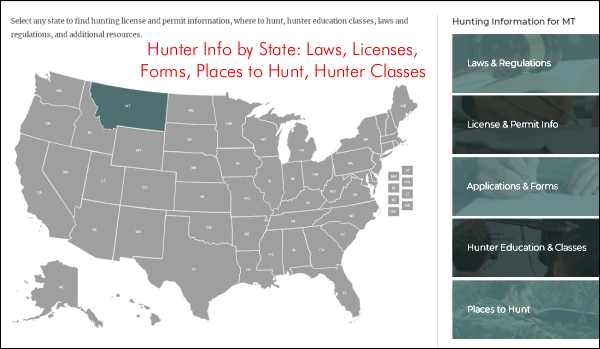
Visit WhereToHunt.org
There’s a great online resource for hunters that will help you find game locations in your state and ensure you have all the proper permits and game tags. WheretoHunt.org features an interactive map of the country. For all 50 states, the NSSF has compiled information about hunting license and permits, where to hunt, hunter education classes, laws and regulations and more. For each state you’ll also find a link for required applications and license forms.
Today, September 28, 2019, is National Hunting & Fishing Day. The annual celebration takes place on the the 4th Saturday of September every year. National, regional, state and local organizations will run thousands of “open house” hunting- and fishing-related events around the country. Events will include Fishing Derbys, Hunting Expos, Wing-shooting tournaments, and much more.
Hunting Safety Checklist
A good hunt begins with preparation. And during the hunt, safety is a key priority. To help hunters, the National Shooting Sports Foundation (NSSF) has created a Safety Checklist for hunters. This Hunting Safety Checklist, produced as part of the NSSF’s “Hunt S.A.F.E.” campaign, helps hunters follow good, safe practices in the field and at home.
Honored American Veterans Afield (HAVA) is a volunteer organization that provides hunting and shooting experiences for American military veterans and injured active military personnel. HAVA has sponsored events in Texas, Georgia, South Dakota, Montana, North Carolina, California, Washington, Florida, and other states. HAVA was conceived and organized in 2007 by shooting sports industry executives to help the healing and re-integration of disabled veterans and injured active military back into normal American life through participation in outdoor events.
One of the most recent HAVA events was the 7th Annual HAVA/Rockcastle Family Day at the Park City, KY shooting complex on Saturday, September 14, 2019. Over 300 disabled veterans, family members, and volunteers assembled to share a day of shooting, winning prizes, eating good food, and enjoying fellowship with other military veterans who have bravely protected the American dream.
Every year, HAVA conducts a series of hunting and shooting events for groups of disabled veterans and injured active military. Many of these events include instruction by world-class shooting experts, such as Jerry Miculek. The next major HAVA event will be the 12th Annual National Family Day, to be held in San Antonio, Texas on October 19, 2019. EVENT INFO HERE. Admission is FREE, and all disabled veteran participants will receive a backpack full of gifts.
HAVA organizes hunting adventures throughout the United States
HAVA states: “These veterans have given their full measure of commitment to the preservation of their country’s values, and deserve America’s contribution to their healing process to whatever degree necessary to accomplish physical, mental and cultural rehabilitation.”
HAVA, through its Sustaining Sponsors, contributors, and volunteers, provides services to veterans in recognition of their sacrifice and service to a grateful nation. If you would like to support HAVA’s programs, you can make a tax-deductible donation through www.HonoredVeterans.org.
About HAVA — Honored American Veterans Afield
HAVA is a 501(c)3 organization formed by companies in the shooting and outdoor industry with the purpose of raising awareness and assisting disabled veterans with their healing process through guided hunts, shooting events, and other outdoor sports activities. Sustaining sponsor companies are: Smith & Wesson, National Shooting Sports Foundation (NSSF), SIG SAUER, Academi, Arnold Defense, Crimson Trace, E3 Training, FMG Publications, GLOCK, Hornady, Leapers/UTG, Leupold & Stevens, Mossberg, National Association of Sporting Goods Wholesalers (NASGW), Operation Hat Trick, Ruger, Savage, Surefire, Taurus, Vista Outdoor/Federal, XS Sights, and Yamaha Outdoors among numerous contributing companies. To learn more about HAVA, go to: www.HonoredVeterans.org.


 Monitoring Barrel Wear with Borescope


 Oversizing cases also causes problems because the firing pin doesn’t have the length to reach the primer solid enough to ignite it 100% of the time. When you have one that is oversized, you usually have a bunch, since you usually do several cases at a time on that die setting. If the die isn’t readjusted, the problem will continue on the next batch of cases also. They will either not fire at all or you will have a lot of misfires. In a bolt action, a lot of time the extractor will hold the case against the face of the breech enough that it will fire. The case gets driven forward and the thinner part of the brass expands, holding to the chamber wall and the thicker part of the case doesn’t expand as much and stretches back to the bolt face. If it doesn’t separate that time, it will the next time. When it does separate, it leaves the front portion of the case in the chamber and pulls the case head off. Then when it tries to chamber the next round, you have a nasty jam. Quite often range brass is the culprit of this because you never know how many times it has been fired/sized and in what firearm.’Back to beating it on the ground again till you figure out that you have to get the forward part of the case out.


 Big News in the ammo industry! At the Lake City Army Ammunition Plant, Northrup Grumman is out, and Winchester is taking over.


 Reloading Bench Mounts to RV Wall with Brackets