Timney Triggers has stepped up to help preserve the history of American firearms. Recently Timney pledged $500,000 to the Cody Firearms Museum renovation project. The Buffalo Bill Center of the West recently announced its plan to fully renovate the Cody Firearms Museum, opening Summer 2019. Total project cost is estimated at $12,000,000 to house the 7000+ firearms in the Museum’s collection. The National Endowment for the Humanities and Institute of Museum & Library Services have provided large grants. Notably, however, the Timney Triggers’ donation is the first substantial contribution from a major gun industry company.
The CFM is planning a two-floor renovation that will cater to both firearms enthusiasts and the general public. Currently, there are approximately 3,000 firearms on display. After renovation, the museum will boast over 4,500 firearms on display, multiple shooting simulators, and hands-on inter-active displays. According to CodyEnterprise.com: “The plan is to produce a special exhibit of the collection’s top 75 guns and sprinkle other firearms exhibits throughout the rest of the 325,000-square-foot museum. That includes placing guns in the Buffalo Bill Museum, the Draper Museum of Natural History, the Whitney Western Art Museum and the Plains Indian Museum.”
John Vehr, Owner of Timney Triggers, stated: “Our industry must support and appreciate the benefits derived from having the finest gun museum in the world educate hundreds of thousands of people who visit AND are new to guns, on the historical importance and the positive aspects of our industry.”
Curator of the Cody Firearms Museum Ashley Hlebinsky commended Timney Triggers: “When we set out to plan the new museum, we wanted to make sure that not only our historic roots were fostered in the new museum, but that we would acquire representation from newer companies or companies whose stories haven’t been told previously in museums, solidifying their place in history.”
This stunning Westley Richards & Co. shotgun was made for the 1981 nuptials of Lady Diana Spencer and HRH Prince Charles. It is rare, has a unique history of ownership, and is also elaborately decorated.
Jim Supica, Director of the NRA Firearms Museum, has written a trio of articles about gun collecting. If you are thinking of starting your own collection of firearms, you should read Supica’s informative articles. The first talks about the basics of gun collecting, the second explains the five key factors that govern gun values, and the third article explains where to find rare and valuable arms. Today we want to highlight the five factors that contribute most to a gun’s value, according to Supica:
Make and Model, Condition, Rarity, History, Art — These are the five factors that … appeal to collectors and help determine the value of collectible guns.
Make and model tends to be the starting point for evaluating collectible guns for most collectors and will be a basic threshold requirement for those with specialized collections.
Factors here include the quality of a particular manufacturer’s products, the historical usage of the guns in question, and the brand’s aura of romance. As an example of that last (and most intangible) factor, consider that Colt Single Action Army revolvers were for several decades the most prevalent focus for collectors interested in full-size revolvers from the post-Civil War to turn of the 20th Century-era, and there is no question that Colts were widely used during that time. In recent years, there has been a refreshing trend in gun collecting to look at a broader range of guns than the traditional blue chip Colts, Winchesters, and Lugers.
Colt Single Action Army Revolvers remain among the most prized (and collectible) firearm.
2. Condition (and Originality)
Obviously, condition plays a major role in the value of a collectible firearm. The classic advice to new collectors in this regard has always been to hold out for guns in the best condition and pay the extra premium they demand. This condition-emphasis seems to have developed in the 1970s and 1980s. In the early post-WWII years of gun collecting there was more interest in rare variations and history, and fewer collectors to whom a few percentage point difference in remaining original finish was of much concern.
Although the highest-condition guns continue to bring record prices, it seems that the pendulum is beginning to swing back the other way, a trend met with my hearty approval. The appeal of “mint” guns has been largely lost on me, and seems to be more appropriate to coin or stamp collecting than a field in which the possible historic usage of the artifact holds so much interest and significance. There is a definite segment of the collector market that is not overly concerned with perfect condition, so long as the gun is original and has not been messed with in a more recent (and, in my opinion, usually misguided) attempt to enhance its desirability.
3. Rarity
In terms of rarity, the well-worn saying that “just because a gun is rare doesn’t mean it’s valuable” remains true to a certain extent. There may only be five known examples of a particular gun, but if only three people care about it, the market is saturated. However, there does seem to be more interest in cornering the rare variations within established collecting fields. There is a bit of a resurgence of the collecting philosophy of completing a punchlist of models and variations within a specialization, and this lead to vigorous competition for the rarest examples in these fields. In emerging collecting fields, when new research is published revealing the rarity of certain variations there can develop a brisk interest in those guns.
4. History
Individual guns with a known history of ownership by a specific individual or usage in a specific historical event have always captured the fascination of collectors, as well as historians and the general public. This seems to reflect a basic human interest and shows no sign of abatement. A positive trend here seems to be an increase in general understanding of the type of documentation which must accompany a historically attributed firearm to give it the credibility to justify a premium price, and the importance of creating and preserving such documentation.
This Beretta has extra value because it was owned by pilot Chuck Yeager. Photo NRA Museum.
5. Art (Decorative Embellishment)
Fine engraved guns are collected more for their artistic value than for their worth as firearms. Here the market for classic works by the great engravers of the 19th and early 20th Centuries remains strong, as well as for factory-engraved pieces from more recent years. Interest in recent non-factory engraving seems to have diminished, as has… the trend of adding modern engraving to older firearms.
Here is a matching set of three three beautifully engraved pistols by the late Indiana engraving wizard Ben Shostle — a Luger, a Mauser, and a Colt. Photo courtesy Amoskeag Auction Company.
Factory-custom engraving should not be confused with mass-produced, factory-made commemorative firearms, which flooded the market in the 1960s and 1970s. A couple of major manufacturers worked this genre to death, and prices on commemoratives have been stagnant for many years now, although the market for these shows some signs of renewal.
CAUTIONARY WORDS about RESTORATION
With prices for high-condition original finish guns running away from the budgets of many collectors, period-of-use refinished guns and older factory-refinished guns are finding more enthusiastic buyers than they did a few years ago.
The availability of excellent-quality restoration services is another factor that I anticipate may impact collector preferences in the future. The top restoration artists are reworking guns to “as new” condition with such skill that it has become increasingly difficult for even knowledgeable collectors to distinguish mint original finish guns from the best restorations.
When such restoration is disclosed to a prospective buyer (as it ethically should be), the prices the gun will bring are significantly below a similar gun with original finish, and may be less than the original cost of the pre-restoration gun plus the cost of the rework. This creates a mighty incentive for deception by a motivated seller, either by active misrepresentation (a.k.a. “fraud”) or passively by simple failure to mention the modification.
Many of our readers are thinking of trying out PRS-type competition. Tactical matches are becoming more popular every season. Along with F-Class, tactical/practical disciplines are the fastest-growing forms of competitive rifle shooting. Rich Emmons, one of the founders of the Precision Rifle Series (PRS), has written an insightful article about getting started in the tactical game. This will help PRS novices pick the right equipment and understand the game. Here are highlights from Emmon’s “PRS — Intro to Competition” article, originally published on the PRS website. You may also want to read the current PRS FAQ Page.
Precision Rifle Series — Intro to Competition
by Rich Emmons, PRS President
Tactical Shooting with a precision rifle is not like other disciplines, there is no set course of fire or format. That is what makes it so fun!
First, you have to ask yourself what do you want to accomplish. When I was introduced to long range shooting, immediately a light turned on for me, once I saw how easy it was to hit 300–600 yard targets. What I quickly learned from my first competition and the many that followed was there is so much to learn and shooting in competition put everything you thought you knew to the test. So back to the question: “What do YOU want to accomplish?”. The reality is you may not know yet, you just think it is cool to have a bad ass rifle and scope that can make almost any shot. Now if you’ve got that rifle and scope, it’s time to take it to the next level.
Watch PRS 2016 Championship
Getting Started — What to Expect
If you’re reading this, you have probably already have been bitten by the long range shooting bug. It can seem quite intimidating to just jump in with a new bunch of shooters you don’t know and shooting lingo you don’t quite understand yet. But here is the key — show up and shoot! I guarantee you if you show up to a match as a new shooter, other experienced shooters will guide you along and give you help on anything you need.
AUDIO: Click Button to hear Rich Emmons Talk about the Precision Rifle Series.
Now, a couple things you should just expect. You’re not as good as you think you are. Don’t expect to come into your first match and beat all the veterans. That just doesn’t happen unless you have had some really good coaching or other shooting competition experience to get you ready for this type of competition. If possible, find a local rifle club that has monthly long range matches, or any type of match will help prepare you for a larger PRS event. Getting involved with a rifle club and starting out shooting monthly matches is definitely the way to jump into competition shooting.
The Gear You Need
The first question that many ask is: “What kind of rifle/caliber/scope do I need?” The easiest answer to this is, the best you can afford. It’s no secret the gear is expensive. It took me several years of buying sub-par gear and eventually trading up to figure this out. Now, a guy can get a real sense of pride of doing it on the cheap, or with a factory rifle. I’ve seen many old Savage 10FPs take down custom rigs that cost 10 times as much. And if that’s all you can afford, then eventually you will learn the limitations of yourself or your gear. As for choice of cartridge/caliber, the respected Precision Rifle Blog has analyzed three years worth of match results (2014, 2015, 2016) from the best tactical shooters in the nation. CLICK HERE to read an article that reveals what the “top guns” use. (CLICK HERE for PRB cartridge survey covering 2012-2014.)
Making Good Ammo
Producing quality reloads is something you have to master. It’s not hard at all, you just have to pay attention to detail, and eventually you are going to do something stupid like mis-priming your brass, or skip a row of brass when dumping your powder. Everybody has their own horror story of some reloading failure that cost them a stage or even a match. So load to perfection, work with your rifle to find what load it likes the best, then start your practice.
Practice Makes Perfect
You want to become ONE with your rifle, learning everything you can about its functionality. Getting comfortable with the operation of your rifle is key. Learn the feel of your trigger, dry-firing until you wear the paint off your bolt handle. Learn how the rifle works best — pay attention to little things like the sound and feel of the bolt feeding a round from the mag (or when it doesn’t). Learn how to remove a jammed round quickly, learn how to reload a magazine quickly. Learn to scan across a field and find targets in a quick manner, seeing the targets with your eye and coming into the scope on target. These are some of the basic practices that separate the new shooters from the seasoned ones.
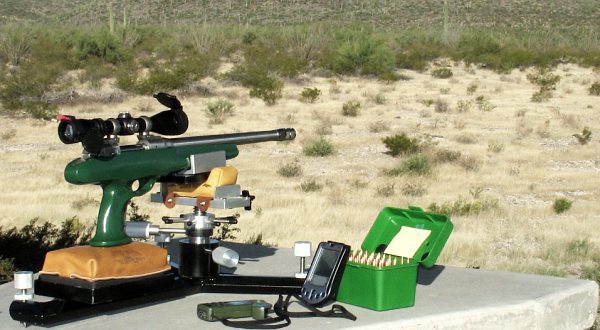
Here’s something you’ve probably never seen before — a single-shot, bolt-action pistol chambered for the 6mm BR Norma cartridge. Featured as one of our Guns of the Week a while back, this Green Machine is a Savage Striker upgraded by Chuck G. from Arizona, a self-described “Savage Maniac”.
Chuck transformed this Savage Striker single-shot from a ho-hum .308 into a reliable half-MOA precision 6BR that can run with accurized rifles all the way out to impressively long ranges. Here we provide highlights from our original article. Click the link below to read our full Savage Striker article, which is three times longer than this story, and has more photos, plus videos and a detailed load development section.
The Striker Project — Pursuit of Precision, by Chuck G.
I didn’t even know Savage Strikers existed until I saw one for sale on Gunbroker.com. I snagged it with a $400 bid. My idea was to build an accurate, long-range pistol on a pauper’s budget. As purchased, the Striker had a .308 barrel with an unknown round count, the standard center-grip, black synthetic stock, an odd two-piece custom brake, and an old Burris 4X pistol scope in a Conetrol 2-piece ring set. The trigger was very heavy, 6-8 lbs I’d estimate, with a lot of take-up and over-travel.
Initial Disappointments — Too Much Recoil, Poor Accuracy
My initial attempts to get the Striker to shoot well at even 100 yards were disappointing. I was never able to get better than a 3″, 5-shot group at 100. Not what I was looking for. Being used to benchrest triggers, the pull on this one was hard for me to manage. The gun would roll around on any type of front rest I had, and from a cement bench on a bipod it would jump about 18 inches up and sideways with every round. Not being used to this type of gun, I found the recoil and muzzle blast to be unsettling. It was hard not to flinch. I started off using my 1K .308 rifle load, 175 SMKs over 44 grains of Varget. That probably would have knocked the hell out of a deer, but it wasn’t much fun to shoot from the bench.
New Caliber, New Barrel — Way Better Accuracy!
I decided to rebuild the Striker in a caliber that would be more fun to shoot. 6mmBR was an obvious choice for all the usual reasons–good brass, wide choice of match bullets, easy to load, low recoil, very accurate, and relatively cheap to shoot. As part of a SavageShooters.com group buy, I ordered a 15″, SS match grade, 3-groove, heavy varmint contour, 10-twist barrel from Pac-Nor. To set the freebore, I provided Pac-Nor with a dummy case with an 88gr LD Berger bullet seated to use as a guide. Total delivered price was $340 chambered and threaded for a muzzle brake from JP Rifles.
When I bought it, the Striker, with factory .308 barrel, shot 3″ groups at 100. Now, with a Pac-Nor 6BR Match barrel, 3″ fore-arm plate, upgraded trigger, 24X scope, and match bullets, the gun consistently groups 1/2″ or better at 100 yards. What a transformation!”
Striker Project — Mission Accomplished
With further load development and bench practice, the gun is showing even more accuracy potential. Using a 24X target scope, the Striker has delivered 5-shot groups in the 3s and 4s during recent range visits. All in all, I’m very satisfied with the project. I ended up with an accurate, fun-to-shoot gun for under $1,000 including scope, paint, and bedding materials.
Stock Modifications
While waiting for the barrel I started working on the stock. As virtually no aftermarket stocks were readily available for the center-grip Striker, I decided to rebuild the standard black synthetic stock. The grip fit my hand poorly so I worked it over with a Dremel tool and sandpaper, built up the grip with Bondo, filled in some holes and bedded the action using Devcon Plastic Steel. This was my very first attempt at these tasks so progress was slow. Once I had re-shaped the stock, I sprayed five coats of “John Deere” green topped by several coats of auto clear. It came out surprisingly well considering I had never painted a stock before. I had originally planned to build up the fore-end to 3″ wide using Bondo but later decided to just use a Sinclair Benchrest Adapter that I had on hand.
Chuck notes: “I’m really pleased with the C & J one-piece Rest. It’s solid, heavy, and well-designed. There is no real need for a windage top; small adjustments are easily made by slightly shifting the pistol butt. Elevation adjustments are positive and once the pistol is set up on this rest NOTHING moves.”
Airport photo by Politikaner under Creative Commons License.
Thanksgiving is almost here. We know many readers will soon be traveling to spend the holiday with family members. If you will be flying with firearms this November, you should read this article. You need to familiarize yourself with current Federal Regulations on gun transport before you get anywhere near an airport. Thankfully, the Transportation Security Administration (TSA) has a web page that states the important requirements for airline passengers traveling with firearms* and/or ammunition.
You’ll want to visit the TSA Firearms and Ammunition webpage, and read it carefully. In addition, before your trip, check the regulations of the airline(s) with which you will fly. Some airlines have special requirements, such as weight restrictions.
Here are the TSA’s key guidelines for travel with firearms:
More Airline Travel Tips from Tom McHale
Tom McHale has written an excellent article for the Beretta Blog, Ten Things You Need to Know about Flying with Guns. We suggest you visit the Beretta Blog to read this informative story. Here are two of Tom McHale’s Travel Tips:
Weigh your gun case and ammunition
Most airlines will allow up to 11 pounds of ammunition. And, like any luggage, you will be charged more for any baggage weighing more than 50 pounds. This sounds like a lot, but when traveling to the Crimson Trace Midnight 3 Gun competition last year, my case with shotgun, rifle, pistol and ammunition tipped the scale past the 50 pound mark.
Pack ammo in the same locking case
This is another area that’s misunderstood and full of internet myth. Your ammo just needs to be stored in some type of safe container and not loose. Technically, you can keep ammunition in magazines, but I wouldn’t recommend it. It meets the letter of the law storage requirement, but too many airline and TSA agents will give you grief. Use a plastic ammo box or original cardboard packaging and you’ll be fine carrying that in the same lockable case as your gun.
*SEE United States Code, Title 18, Part 1, Chapter 44. A “firearm” is defined as: any weapon (including a starter gun) which will, or is designed to, or may readily be converted to expel a projectile by the action of an explosive; the frame or receiver of any such weapon; any firearm muffler or firearm silencer; and any destructive device. As defined by 49 CFR 1540.5 a loaded firearm has a live round of ammunition, or any component thereof, in the chamber or cylinder or in a magazine inserted in the firearm.
Do you enjoy shooting pistols for sport, or perhaps you carry a handgun for self-defense? If you’re like most of us, you might benefit from a “refresher course” on the fundamentals of handgun shooting. The NRA has created a useful Infographic that covers important basics of handgun marksmanship — key things such as Sight Alignment and Trigger Control. Here are the first two (2) lessons. Click the link below to see all SIX (6) training topics: Sight Alignment, Sight Focus, Trigger Control, Breath Control, Hold Control, and Follow-Through.
Video Shows Sight Alignment, Grip, Stance, Trigger Control and More
In this USAMU video, SGT Shane Coley talks about the basics of sight alignment and trigger control. But then SGT Coley talks about other important control factors such as grip, arm position, and body stance. For rapid-fire shooting, you need to have a good arm and body positioning to control recoil and get back on target quickly. This video is a valuable complement to the NRA Infographic because it demonstrates all the important pistol fundamentals during live fire, at the range.
Finding Peace On The Other Side Of War NRA Blog Storyby Catherine Parks, Divide Camp Volunteer
For combat veterans there is a great divide between life pre-war and life post-war. Soldiers prepare, train and are equipped to go to a war zone, but, upon returning home, physically and psychologically injured veterans struggle to assimilate back into a normal life. Divide Camp, located in northeastern Oregon, honors the service of post 9-11 combat veterans through small-group outdoor adventures. The non-profit camp offers hunting, fishing, and other recreational activities. Learn More HERE.
Divide Camp provides lodging, home-cooked meals and transportation at no charge to the veterans served. The camp features 40 acres of remote forestland, six cabins, a shop and an outdoor picnic shelter. In 2014, The NRA Foundation funded its first grant to Divide Camp — $15,000 for an Action Trackchair — to allow amputee veterans to traverse the mountain terrain.
Another grant in 2015 funded pistol range construction, safety gear and targets. Initial range work for a competition 3-D archery course shootable from a Trackchair began with funding from an NRA Foundation grant in 2016.
How Divide Camp Helps Rebuild Lives
Army veteran Jose Martinez stepped on an improvised explosive device in Afghanistan. Following numerous surgeries and months of therapy, Jose was fitted with prosthetics, which allowed him to walk. Still, extreme depression set in and two suicide attempts followed. On his first day at Divide Camp, Jose used the new all-terrain wheelchair to hunt. “I missed the first couple of times, but my friends didn’t give up on me and Divide Camp didn’t give up on me, and I got one the next morning,” Jose said. “Elk hunting was one of the best experiences I’ve ever had. How many amputees in California can say they shot an elk?” Jose stayed in a new cabin built to accommodate veterans with disabilities.
Just being in nature is an amazing healer
Julie Wheeler, Divide Camp executive director, has served as a critical incident stress worker to help others prevent post-traumatic stress disorder. She is familiar with what happens when people are exposed to high stress and trauma. “I know it takes a long time to overcome,” Julie said. “I think they need help beyond what’s provided by the Department of Veterans Affairs, which is drugs and therapy. Just being in nature is an amazing healer.”
Ellis Wins Three-Gun and Four-Gun Titles at 2017 Western CMP Games Story based on Report by Ashley Brugnone, CMP Writer
In a masterful showing of marksmanship, William Ellis of Langley, England won both the Three-Gun and Four-Gun Aggregate rifle competitions during the CMP Western Games in Phoenix last month. 2017 was a great year for Ellis, who first traveled to the Western Games in 2009. William’s 2017 performances earned him the second Distinguished Rifleman Badge by a non-U.S. citizen this past year.
Earning twin Aggregate Titles was a great accomplishment for Ellis, who had nearly won three years ago. In 2014, Ellis was the runner-up (second-place) in both 3-Gun and 4-Gun. But this was Ellis’s year — he was unstoppable. He shot superbly in the Arizona desert, taking the top spot in the Springfield Rifle Match along with second place in the Vintage Military Match. Those strong showings helped earn Ellis the 3-Gun and 4-Gun overall victories. To accompany his centerfire victories, Ellis shot great in the Rimfire Match, winning the Tactical Class. This was truly a masterful five days of shooting by Ellis.
Ellis Will Be Featured on Shooting USA
The media took notice of Ellis, who may have traveled farther than any other competitor at this year’s Western Games. Ellis will be featured in a Carbine Match video segment by Shooting USA TV, which filmed portions of the 2017 CMP Western Games for an upcoming episode.
Other Winners at CMP Western Games — Ben Avery Shooting Facility, October 13-17, 2017
Garand Match: Randall Dwornik, 287-3X
Vintage Military: William Fairless, 290-7X
Modern Military: Jeffrey Schneider, 293-6X
Vintage Sniper Team Match:
Manual Class: Michael Miller, Mike Barranco – 393-11X
Vintage Sniper Semi-Auto Class: SSG Steven Ophoff, Jeffrey Schneider – 364-8X
Training and Instruction at Western Games
Along with competitive events, Western Games also featured a Small Arms Firing School class, a Garand-Springfield-Military new competitor clinic, and a High Power Level II Range Officer class.
Hot Day-Time Temps and Wicked Night Winds at Ben Avery
2017 Western Games competitors experienced hot weather in Phoenix. Temperatures reached well into the 90s each day. The afternoon of the Sniper team match day saw temps topping out at 102° F. But the real weather problem was a gale-force wind that howled one night. The CMP’s 30 electronic targets were set up on the berm in front of the High Power rifle range pits wall. After the Small Arms Firing School was concluded, 40+ MPH overnight wind gusts toppled the entire target line. Thanks to the CMP staff and several competitors, the majority of the targets were reset, and all matches were fired upon them for the scheduled day and the remainder of the matches.
About the CMP Western Games at Ben Avery
The CMP Western Games include Garand, Springfield, Vintage Military, Modern Military, Rimfire Sporter, Carbine, and Vintage Sniper matches. The October Western Games event is the last of the CMP Travel Games events held each year. The other Travel Games, hosted in Oklahoma, North Carolina, and New England, feature both vintage and modern rifle and pistol events — recreational competition for both adults and juniors and all experience levels. The Western Games is the only Travel event for rifles only.
Enjoy the Shooting Sports USA Archives
Winter is right around the corner. Soon we’ll all be spending more time indoors. For some folks, that means long sessions in front of the boob tube. We have a better idea — there’s a vast resource of good gun-related content available online for free. Check out the Shooting Sports USA Articles Archive. SSUSA maintains a vast digital library with hundreds of articles going back to June 2009.
It’s easy to find back issues of Shooting Sports USA magazine. Here’s how: Using the gray Toolbar at the top, click on the “Archives” icon in the upper right area (blue arrow) and you’ll be presented with a selection of magazine covers/dates in a vertical column. Simply use the vertical scroll bar to go from 2017 all the way back to 2009. Click any issue cover to read.
How to Find and Save Articles
To search through back issues, select “More Options” from the gray Toolbar. Then click the “Search” button. When that opens, select either “Search archives” for ALL back issues or select “Search Only this Issue”. When you’ve made your choice, enter your search term(s). For example, you could search for “F-Class” or “Camp Perry”. You can also save any archived issue for viewing offline as a PDF file. Just click “Save” to download the article you’re reading.
Read Sample Articles
Here are a couple of our favorite SSUSA feature stories from recent years. There are hundreds of other informative articles worth reading.
Ask 10 shooters about barrel cleaning and you’ll get 10 different opinions. This reflects that fact that different fouling problems demand different solutions. For example, solvents that work well for copper may not be the best for hard carbon (and vice-versa). To come up with the right solution, first you must understand the nature of the fouling in your barrel.
John Krieger Interview with AccurateShooter at SHOT Show:
The debate about the proper care of a match barrel is a hot one, spiked with folklore and old wives’ tales, Lohman said. He and his staff set out to set the record straight: “We tried to interject some science into the discussion of cleaning a match barrel,” he explained. In his article, Lohman writes:
Why worry about a little barrel fouling when the throat is subjected to a brutal 5,600° F volcano at 55,000 PSI? To investigate these and other questions about taking care of a match barrel, we spoke with a dozen experts and share their knowledge in this first of a series of articles.
After listening to folks who shoot, build barrels or manufacture cleaning solvents for a living, we concluded that even the experts each have their own unique recommendations on how to care for a match barrel. But they all agree on one thing — the gun will tell you what it likes best. Because the life expectancy of a match barrel is about 1,500 to 2,500 rounds, the objectives of cleaning one should include: preserve accuracy, slow the erosion, and remove fouling — all without damaging the gun. This article doesn’t claim that one cleaning method is better than the next. Rather, we set out to interject a little science into the discussion and to share some lessons learned from experts in the field.
For more Shooting Sports USA articles, visit www.ssusa.org.