We were pleased to see our friend John Whidden featured in the October 2017 issue of Shooting Sports USA. John captured the 2017 NRA Long Range Championship this summer, his second LR title in a row, and fifth overall. This year was a bit different, as the competition was held in Indiana at Camp Atterbury. All John’s previous Long Range HP titles were earned at Camp Perry.
Whidden’s Perfect Palma Match
Whidden secured the 2017 LR Title by shooting “clean” (not dropping a point) in the tough Palma competition. In the NRA Palma match, rifles must be .223 Rem or .308 Winchester, with metallic sights (no scopes). The match is conducted at three yardages, 15 shots at each distance of 800/900/1000 yards, with unlimited sighters at 800 and two sighters at 900 and 1000.
SSUSA’s Editor John Parker writes: “On another note, this month’s cover feature highlights the very first NRA High Power Rifle Championships conducted at the match’s new home—Indiana’s Camp Atterbury. Located about 50 miles south of Indianapolis, this active Indiana National Guard base boasts over 60 ranges, making it the ideal new venue to continue the legacy of NRA High Power. Hundreds of competitors made the trek to continue the historic tradition of rifle competition at the National Matches.”
Another friend, Anette Wachter, is featured in this issue as well. That’s the 30CalGal herself in the upper right after winning the Andrus Trophy Match.
Sling Rifle Evolved: The Ultra-Accurate Hybrid Palma Rifle
Since John captured his fifth Long Range crown with a superb performance in the Palma match, we thought we’d give readers a look at John’s very special Palma rifle. This unique .308 Win prone rifle features a Barnard “P” action in a converted aluminum Anschutz “Precise” smallbore (rimfire) stock. The combo of Barnard action and Anschutz ergonomics is hard to beat, says John, who told us: “this is easily the best Palma rifle I’ve ever had.” John told us this gun handles like no other: “After recoil, with this Anschutz stock, the sights fall right back on target — better than any other prone rifle I’ve shot”.
As a bonus, the Barnard “drop-in” required no modification of the Anschutz Precise stock. This means John can actually swap in his rimfire barreled action and shoot smallbore with the same stock.
Whidden Palma Rifle
Action: Barnard “P” (three lugs, 60° bolt lift)
Barrel: Bartlein 32″, Light Palma contour, cryo-treated by 300 Below.
Stock: Anschutz Precise aluminum smallbore stock, set up for centerfire barreled action.
Trigger: Barnard Two-Stage adjustable
Whidden’s Wonder-Gun: German Stock, New Zealand Action, American Barrel
John built this Palma rifle in early 2016. With it, John won back-to-back long-range Championships in 2016 (Camp Perry) and 2017 (Camp Atterbury). The major components are: Barnard ‘P’ action, Anschutz Precise smallbore stock, and Bartlein barrel. The caliber is .308 Win, as dictated by the Palma rules. Palma matches are fired from 800, 900, and 1000 yards utilizing iron sights only. No optical sights are allowed.
Are you a safe hunter? Go through this checklist to find out. The National Shooting Sports Foundation (NSSF) has created a helpful Safety Checklist for hunters. This Hunting Safety Checklist was produced as part of the NSSF’s “Hunt S.A.F.E.” campaign which encourages hunters (and all firearm owners) to secure their firearms when not in use, and to focus on safe firearm handling and storage. The Hunting Safey Checklist helps hunters follow good, safe practices in the field and at home.
“Hunting is a time-honored tradition for many Americans, and the hunting season brings a wave of excitement and activity for all enthusiasts,” said NSSF President and CEO Steve Sanetti. “It’s also a good time of year to remind firearm owners about … safe and responsible gun handling and storage.”
Do you really know (and understand) the gun laws in your home state? Do you know when the use of deadly force is allowed? Do you know if the “Castle Doctrine” applies in your state or whether your state has a “Stand Your Ground” law in effect? If you ever carry a firearm for self-protection, you should know the answer to these and other important questions. Thankfully there are some excellent, up-to-date resources that explain the gun laws in five key states: Colorado, Florida, Oklahoma, Pennsylvania, and Texas. These gun law treatises, published by U.S. Law Shield, provide the text of important gun laws, along with expert commentary from experienced attorneys. The books provide clear explanations of gun laws in easy-to-understand language.
Gun Law Seminar Programs in Eleven States
In addition to its Gun Law books (offered for five states), U.S. Law Shield conducts legal seminars in 16 states across the country: AR, CO, FL, GA, KS, MD, MO, NC, NJ, OH, OK, PA, SC, TN, TX, and VA. At these Gun Law Seminars, you can ask questions and get state-specific answers from Law Shield Independent Program Attorneys in each jurisdiction. CLICK HERE to find a seminar in your state.
2017 IBS 1000-Yard Benchrest Nationals Report By Boyd Allen
On September 1-4, the IBS held its 2017 1000-yard Benchrest Nationals at the Whitehorse Shooting Center in Peeltree, West Virginia. There was a great turn-out this year, with 118 entries in Light Gun Class (17-lb limit, 5 shots per target) class and 107 shooters in Heavy Gun Class (Unlimited weight, 10 shots per target). The conditions this year were challenging to say the least, with rain storms, spiraling winds, and fog. In fact, rain and fog on Saturday (with cancelled relays) caused the Nationals to be extended by one day through Monday, September 4th. What’s more, of the 107 shooters listed in the Two-Gun Overall results who actually shot both guns, there were dozens of DQs. (Yes, the wind was a bit tricky at this year’s Nationals.)
Sam Hall, past IBS Shooter of the Year, provided this image and most of the photos in this report.
Congratulations to the “top guns” at the Nationals: Edward Kenzakoski (Two-Gun Overall Champion), Mike Gaizauskas (Light Gun Overall, plus LG Score Agg), and Mike Brennan (Heavy Gun Overall, plus HG Score Agg). Group Agg winners were Richard Schatz for LG, and Charlie Lentz for Heavy. Two ladies also deserve mention. Sally Bauer shot the smallest group of the match, a 1.923″ 5-shot group in LG — that’s 0.184 MOA! Ruth Edwards drilled a 2.104″, also mighty impressive. Nice shootin’ ladies…
White Horse Wind and Weather Factors — and Topography
The firing line for the 1000-yard range has a covered structure with 14 well-spaced masonry benches with block bases and cast concrete tops. Facing southwest, the firing line is above the land between it and the target butts, which are at the head of a canyon. There is a low area with trees on the left with an elevated flat area on the right.
This topography create unpredictable wind patterns that can change rapidly with no warning. Those changes can wreak havoc with competitors’ groups and scores. The wind direction at the targets can be opposite that at the firing line, with the result that a let-off down range not only carries the penalty of making a hold-off incorrect, but because the wind at the firing line can continue, adding the additional penalty of a reversal. This was the common cause of disqualifications, which were numerous at this year’s Nationals.
Light Gun and Heavy Gun Equipment Lists (Partial Sample):
Barrel-Block Heavy Gun with a handsome wood stock. Wide fore-ends enhance stability.
Delay Caused by Fog and Rain
On Saturday, rain and fog delays, caused the match to be extended through Monday. The rules dictate that if a full match cannot be finished because of weather, then all of the day’s results are discarded. This meant that even those shooters who completed their relays on Saturday had to shoot them over — hence another day was added to the event. Because of the prospect of worsening conditions on Saturday afternoon, even though there was daylight left, the decision was made to extend the match through Monday.
Profile of 2017 IBS 1000-Yard National Champion Edward Kenzakoski
Commenting on his performance at the Nationals, Ed said modestly:
“I didn’t shoot really good. I just shot better than them other guys.”
Winning Hardware (with a 110-lb Heavy Gun)
Notably, Ed does all of his own gunsmithing, and he built his Championship-winning rifles. Both guns featured 1:11″-twist, 30″ Krieger barrels. (LG: 1.250″ shank and .950 muzzle; HG: 2″ contour untapered). Ed’s Light Gun has a BAT action, no barrel block, Jewell trigger, and McMillan Tooley MBR stock. His Heavy Gun boasts a 10″-long BAT action in a two-piece aluminum stock with barrel block. That HG beast weighs 110 pounds! Both of Ed’s rifles (light and heavy) wore Nightforce 12-42x56mm BR scopes.
Winning Numbers
To win the Two Gun Overall, Ed posted 137 LG Score, 262 HG Score, and 399 Two-Gun Score Agg. His Group numbers were: LG Group 5.659, HG Group 7.483, Two-Gun Agg: 6.571.
Winning Loads and Reloading Methods
Both rifles are chambered in 300 WSM. Ed shoots 210gr Berger VLDs (sorted every way possible), with Norma brass, Hodgdon H4350 powder, and CCI BR2 primers. For the two guns he used very different seating depths — barely touching for the HG, 0.100″ jump for the LG. He said that it takes him a full four days to load the ammunition for both rifles for a match. Yes, he weighs primers, and he even passes his bullets through a .309 bushing.
No Dark Horse at White Horse — Kenzakoski is a Proven Winner
One shouldn’t be surprised at Edward Kenzakoski’s success. Ed really cleaned up at Williamsport this year, winning one 6-match Aggregate and two 10-match score and group Aggregates. He also established a new Williamsport club Light Gun record of 3.2″.
Last year’s winner Tom Mousel sitting at the bench on Sunday. Tom finished third overall this year.
Record-Setting Asymmetry
In 2016 Michael Gaizauskas set the current 1000-yard IBS Heavy Gun (10 shot) group and score records. He set those records with the rifle on the left (below), then chambered in 6.5×47 Lapua. In this match, Mike won LG Group and LG Overall with the rifle on the right as chambered in his own 7mm short magnum wildcat. Mike designed and built both these distinctive assymetric stocks.
Prizes and Gift Certificates Galore at White Horse
The prize table at the IBS 1000-yard Nationals was impressive, with many scopes and stocks as prizes, plus a treasure trove of gift certificates:
White Horse Shooting Center Facilities, Organization, and Location
The 1000-yard range used at the IBS 2017 Nationals is part of a large shooting facility run by Whitehorse Firearms Outdoor Education Center in cooperation with the West Virginia Division of Natural Resources. White Horse is located off of Route 20 near the small community of Peeltree, WV. The nearest town of any size, ten miles to the south, is Buckhannon, WV, which has about 5600 residents.
White Horse Geography and Climate
The White Horse range is set in wooded hill country, with lots of creeks and some smaller rivers all kept green and running by an annual rainfall of about 48 inches and about the same for snowfall. To my eyes it is beautiful county, pleasingly rural and lush, in marked contrast to where I live where every plant must be served by some sort of irrigation.
Want to improve your understanding of Ballistics, Bullet Design, Bullet Pointing, and other shooting-related tech topics? Well here’s a treasure trove of gun expertise. Applied Ballistics offers dozens of FREE tech articles on its website. Curious about Coriolis? — You’ll find answers. Want to understand the difference between G1 and G7 BC? — There’s an article about that.
“Doc” Beech, technical support specialist at Applied Ballistics says these articles can help shooters working with ballistics programs: “One of the biggest issues I have seen is the misunderstanding… about a bullet’s ballistic coefficient (BC) and what it really means. Several papers on ballistic coefficient are available for shooters to review on the website.”
Credit Shooting Sports USA Editor John Parker for finding this great resource. John writes: “Our friends at Applied Ballistics have a real gold mine of articles on the science of accurate shooting on their website. This is a fantastic source for precision shooting information[.] Topics presented are wide-ranging — from ballistic coefficients to bullet analysis.”
Here are six (6) of our favorite Applied Ballistics articles, available for FREE to read online. There are dozens more, all available on the Applied Ballistics Education Webpage. After clicking link, select Plus (+) Symbol for “White Papers”, then navigate to particular articles with Left/Right arrows.
The science behind annealing during the manufacture of new cases is well-established. What happens after that, when we repeatedly reload and anneal those same cases, has always been somewhat of a “dark art”. To help separate scientific fact from fiction, the creators of the Annealing Made Perfect (AMP) Annealer machine have conducted detailed studies of cartridge brass. The AMP Team’s studies offer some remarkable insights, while disproving a number of myths about annealing. Will annealing tighten your groups? The evidence of these studies shows it could.
The test results are fascinating. The team compared brands of brass, sectioning brass to examine both alloy composition and thickness from case mouth to case-head (bottom). They also examined how carbon build-up affects next tension. And they determined how brass changes over multiple loading cycles. They even did a series of bullet-pull tests to analyze factors affecting neck tension. Here are some of the key subjects in the reports:
Brand by Brand Analysis — How the cartridge brass alloy varies among different manufacturers. Bullet Release and Neck Tension — Tensile Bullet-Pull tests show factors affecting neck tension. Neck Tension and Carbon — How carbon build-up inside the neck affects “neck tension”. SS Tumbling and Hardness – How tumbling with stainless media affects brass hardness. Case Cleaning (Ultrasound and Tumbling) — How case cleaning affects annealing. Multiple Loadings — How brass performs when annealed every reload over 10+ cycles.
You really should read the reports — there are some fascinating revelations. The AMP team made longitudinal sections of various cases to show different case wall thicknesses and head geometry. These examples also show how the hardness of the case varies from the case mouth to the case-head. Both virgin and used, annealed cases were examined.
Bullet-Pull Tests — Using advanced tensile test equipment, AMP experimented with different combinations of dies, reloading sequences, and neck hardness to ascertain the best practice.
Carbon Inside Your Case-Necks May Be a GOOD Thing
AMP’s testers found carbon in necks can be beneficial: “Even with identical interference fit and neck hardness, as the carbon layer increased (microscopically), the force to draw the bullet decreased. It would appear the carbon acted as a lubricant. Interestingly, the [pull force] standard deviation also improved, i.e. the case to case variation in the force required to draw the bullets decreased.”*
Read the Full Test Reports
The AMP team’s objectives were to clarify some misconceptions on just what annealing does and does not do, and also to establish the best practices for consistent results. They have consulted with three independent certified metallurgy laboratories to produce some definitive information. So far, the Stage 1 and Stage 2 reports have been released. The studies include a report on the general physical properties of cartridge brass, including grain structures, hardness scales, time/temperature annealing information, and what can cause de-zincification.
The FULL REPORTS, including comprehensive appendices, are found here:
Examining Different Brands of Brass — What the Tests Revealed
Is Lapua brass harder than Norma? Is Lake City better than Remington? You’ll find answers to these and other questions in AMP’s annealing studies. One of the key findings in Stage 2 of Amp’s research is that brass from different manufacturers does vary in the distribution of material in the walls of the case.
Stage Two Conclusions:
— Different brands of the same cartridge cases can require different annealing power settings due to differing case wall thickness in the neck and shoulder region. The greater the mass of brass to be annealed, the greater the power requirement. Lot to lot variation within the same brand can occur for the same reason.
— The bushing die used in this set of tensile bullet pull tests gave significantly more consistent results than the standard neck die with expander ball.
— Cases should be annealed every reload in order to get the best repeatability.
Case Variations: Brand to Brand, and Lot to Lot
Here is a sample from AMP’s test report:
Analyzing Different Brands of Brass
In our Stage One report, we demonstrated that there is insufficient variation in alloy composition between brands to account for the variations we experience when annealing different brands of the same cartridge case. We therefore sought to confirm that it is the mass of brass to be annealed which accounts for the difference. Below are sectioned samples of four different brands of .223 Remington cases.
Both the Lapua and Norma neck walls are 314* microns (0.01236”) at the mouth. The Lapua neck wall thickens to 348 microns at the junction of the neck and shoulder, and the Norma neck thickens to 325 microns. Through the shoulder, however, the walls of both cases thicken to 370 – 380 microns. Once past the shoulder, they both taper back to 314 microns, before starting to thicken again, moving towards the case head.
The Lapua case requires AMP Program 47 to anneal correctly. It is the heaviest of the four cases tested through the shoulder region. The Norma case, which is only slightly lighter through the same region, needs Program 43.
The Remington case is very similar to the Lapua and Norma cases in the neck region, but it actually thins fractionally through the shoulder and front section of the body. The AMP program setting for Remington 223R is P32.
The Lake City case is the thinnest throughout of all four samples. It only requires Program 28.
The above samples clearly demonstrate that the mass of brass to be annealed is critical to the power requirement for correct annealing.
To see how the AMP Induction Annealing Machine works, watch this video:
* However, in Stage Two of AMP testing, the testers experimented with clean, carbon-free necks with dry lube. There was some indication of greater tensile pull consistency with dry-lube, but AMP plans to do more testing.
While attending the CA Long Range Championship a few seasons back, we had the opportunity to test the performance of a high-magnification (63X) spotting scope in near-ideal conditions (maybe the best I’ve ever witnessed). On the event’s last day we arrived at 5:45 am, literally as the sun was cresting the horizon. I quickly deployed our Pentax PF-100ED spotting scope, fitted with a Pentax SMC-XW 10mm fixed-power eyepiece. When used with the 100mm Pentax scope, this 10mm eyepiece yields 63X magnification. Befitting its $359.00 price, this eyepiece is extremely clear and sharp.
At the crack of dawn, viewing conditions were ideal. No mist, no mirage, no wind. The first thing this Editor noticed was that I could see metal nail heads on the target boards. That was astonishing. As soon as the first practice targets went up, to my surprise, I could see 6.5mm, 7mm, and 30-caliber bullet holes in the white at 1000 yards. No lie…
That’s right, I could see bullet holes at 1000. I know many of you folks may not believe that, but there was no mistaking when I saw a 7mm bullet cut the white line separating the Nine Ring and Eight Ring on the target in view. (I was watching that target as the shot was fired and saw the shot-hole form). And when I looked at the 30-cal targets, the bullet holes in the white were quite visible. In these perfect conditions I could also make out 3/8″ bolt heads on the target frames.
The Human Factor
When viewing the bullet holes, I was using my left naked eye (no safety glasses or magnification). I also had a contact lens in my right eye (needed for distance vision). To my surprise, while I could see the bullet holes without much difficulty with my left eye, things were fuzzier and slightly more blurry with the right eye, even when I re-focused the scope.
Then I invited 3 or 4 shooters to look through the scope. One younger guy, with good eyes, said immediately: “Yeah, I can see the holes — right there at 4 o’clock and seven o’clock. Wow.” Some older guys, who were wearing glasses, could not see the holes at all, no matter what we did to the scope’s main focus and diopter adjustment.
The lesson here — if you have to wear glasses or corrective contact lenses, just that extra bit of optical interference may make a difference in what you can see through the scope. Basically anything that goes between the scope eyepiece and your eyeball can degrade the image somewhat. So… you may be better off removing your glasses if you can still obtain good focus sharpness using the diopter adjustment and focus ring. I did the left vs. right eye test a half dozen times, and I could definitely see small features at 1000 yards with my naked eye that I could not see with my right eye fitted with a contact lens. (I did have to re-focus the scope for each eye, since one had a corrective lens while the other did not.)
Mirage Degrades Image Sharpness and Resolution
The “magic light” prevailed for only an hour or so, and then we started to get some mirage. As soon as the mirage appeared I was no longer able to see raw bullet holes, though I could still easily see black pasters on the black bulls. When the mirage started, the sharpness of the visible image degraded a huge amount. Where I could see bullet holes at dawn, by mid-morning I could barely read the numbers on the scoring rings. Lesson: If you want to test the ulimate resolution of your optics, you need perfect conditions.
Chromatic Aberration Revealed
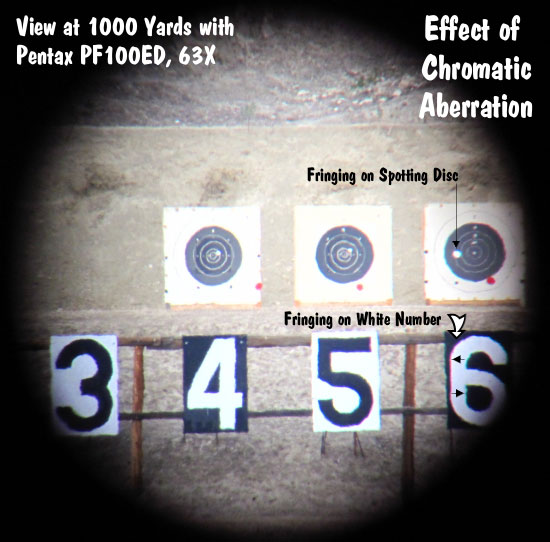
As the light got brighter and the mirage increased I started to see blue and red fringing at the edges of the spotting disk and the large numerals. This was quite noticeable. On one side of the bright, white spotting disc you could see a dark red edge, while on the other side there was a blue edge (harder to see but still present).
The photo below was taken through the Pentax spotter lens using a point and shoot camera held up to the eyepiece. The sharpness of the Pentax was actually much better than this photo shows, but the through-the-lens image does clearly reveal the red and blue fringing. This fringing is caused by chromatic aberration — the failure of a lens to focus all colors to the same point. Chromatic aberration, most visible at high magnification, causes different wavelengths of light to have differing focal lengths (see diagram). Chromatic aberration manifests itself as “fringes” of color along boundaries that separate dark and bright parts of the image, because each color in the optical spectrum cannot be focused at a single common point on the optical axis. Keep in mind that the Pentax does have “ED” or low-dispersion glass, so the effect would be even more dramatic with a cheaper spotting scope.
If you wonder why top-of-the-line spotting scopes (such as the $3900 Leica APO-Televid 82) cost so much, the answer is that they will deliver even LESS chromatic aberration at long range and high magnification. With their exotic apochromatic (APO), ultra-low-dispersion glass, a few ultra-high-end spotting scopes can deliver an image without the color edging you see in the photo above.
The Pentax PF-100ED is a heck of a spotting scope. Any scope that can resolve bullet holes at 1000 yards is impressive. But if you want the ultimate in optical performance, with minimal chromatic aberration, you may need to step up to something like the 88mm Kowa Prominar TSN-883 with Flourite Crystal lenses ($2450.00 body only), or the 82mm Leica APO ($3899.00 with 25-50X eyepiece).
EDITOR’s NOTE: The purpose of this report is to show what is possible… in IDEAL conditions. With this Pentax 100mm, as well as a Swarovski 80mm, we have often been able to resolve 6mm bullet holes at 600 yards. But again, that performance requires really good viewing conditions. By 10:00 am at my range, even with the 100mm Pentax at 75 power, seeing 6mm bullet holes is “iffy” at best. So don’t go out and mortgage the house to buy a $4000 optic with the hope that you’ll be able to spot your shots at 1000 yards. If conditions are anything less than perfect, you’ll be lucky to see bullet holes at 500 yards. The real solution for very long-range spotting is to set up a remote target cam that broadcasts a video picture to a screen at your shooting station.
National Hunting and Fishing Day (NHF Day) takes place on Saturday, September 23, 2017. The annual celebration serves as a reminder that conservation succeeds because of leadership and funding from hunters, shooters and anglers. National, regional, state and local organizations will run thousands of “open house” hunting- and fishing-related events around the country. Events will include Fishing Derbys, Hunting Expos, Wing-shooting tournaments, and much more. Over four million Americans will participate.
Take the Pledge to take someone hunting or fishing on or before September 23, and you can enter a sweepstakes with valuable prizes. ENTER Contest HERE.
Find Events in Your State
For info on NHF Day, visit www.nhfday.org. To find NHF Day events in your state, click links below:
Hunters Aid Conservation Efforts
The contributions of hunters, in the form of excise taxes paid on firearms, ammunition, and archery equipment, benefit every state. These taxes have generated approximately $5.6 billion for wildlife conservation since 1939.
Check out that bolt assembly. It features a fluted stainless bolt body, laser-engraved Titanium shroud, and Titanium dragon-scale bolt knob with polished stainless handle.
You haven’t seen a Ruger Precision Rifle (RPR) like this before. Forum member TerryH has customized his Second-Gen 6.5 Creedmoor RPR with a wicked purple finish, snazzy stainless/titanium bolt, and slick HDPE (polymer) bag-riders front and rear. The mods on this Hot Rod Ruger don’t stop there. Terry added a Seekins hand rail, Timney trigger, ergonomic grip, and more…
For his Hot Rod Ruger, Terry has the right skill set, learned on the job: “I work in a body shop and have pretty much custom-painted all my stuff for many years. For this 6.5 CM RPR, colors of choice are House of Kolor PBC-65 Passion Purple and black covered with Cerakote MC-161 matte clear.” Terry even painted his Bald Eagle rest purple to match his Hot Rod RPR.
Terry reports: “I’m shooting an RPR in 6.5 CM. It has a Patriot Valley Arms 26″ barrel. Josh at PVA is making a thread protector for me so I can remove the Mad Scientist brake. The butt stock has a V-Tab adjustable butt plate and Wiebad check rest pad. Glass is a currently a Vortex Gen I PST 6-24x50mm but I have a Golden Eagle on layaway”. To learn more about this rifle or ask TerryH questions about the build, visit this Shooters’ FORUM THREAD.
Ruger Precision Rifle Modifications: Chassis and Hanguards Painted Passion Purple
Patriot Valley Arms 26″ Barrel with Brake
Timney Trigger with Ambi Safety
Custom HDPE (Polymer) Bag-Riders front and Rear
V-Tab adjustable butt plate and Wiebad cheek-pad
Seekins Rail
Good Accuracy with Factory Ammunition
Terry reports: “The RPR is shooting .3 MOA @ 100 with factory Fed American Eagle 140s.” Terry plans to start handloading for the rifle with the goal of shooting F-Class matches next year: “I’ve successfully shot steel out to 1140 yards on the range but [I don’t know] if that will actually translate well in a match. I’m committed to practicing as much as I can and starting to shoot some matches in 2018.”
Front and Rear Bag-Riders with Protektor Rear Bag and Upgraded Bald Eagle Rest
Terry has engineered a slick set-up for F-Open competition and load testing. Up front is a Bald Eagle rest upgraded with windage knob mod, stainless F-Class feet, and longer adjusters. Terry also “changed the hardware to all stainless and added a couple of levels”. In the rear, Terry runs a Protektor Doctor rear bag with 1″ ear spacing.
The really impressive additions are custom HDPE bag-riders Terry crafted himself: “I realized that the butt stock wasn’t going to cut it on the rear bag and even though I got the 2 1/4″ front bag and the Seekins rail is 2″ wide and flat that it wasn’t as stable or smooth as I’d like.” So Terry made his own front and rear bag-riders from HDPE, a material similar to Delrin. Currently the front unit is 2.25″ wide, but Terry will be changing that to a 3″-wide front sled: “I decided that I’d get a 3″-wide front bag and mill a new front bag-rider. I’m going to recess the center to fit around the hand guard and I’ll mill a recess on the bottom of that one.”
Shown below is the Hot Rod Ruger before Terry added the HPDE Bag-Riders front and rear. Terry says the rifle now handles much better with the bag riders, and he plans to upsize the front sled to 3″ width.
Bling’s the Thing. Below is the Hot Rod Ruger’s bolt assembly. It features a custom flat-fluted bolt shaft, laser-engraved Titanium shroud and Titanium dragon-scale knob with polished stainless handle. Terry confesses: “I simply can’t resist anything shiny!”
by James Mock
After owning three different rifles with BAT actions, I have become a loyal fan of BAT Machine quality and customer service. Back in 2009, I traded my BAT/Scoville for the BAT/Leonard that I currently shoot. This rifle has a long history and Terry Leonard told me that “Old 87″ (as I have named it) was one of the earlier BATs that he stocked. He wrapped the stock in fiberglass and used 2-part epoxy back then. I must say that this rifle has held up remarkably well since it dates back to the 1990s. The action is a RB/LP/RE octagon Model B with .308 bolt-face.
With this gun, I have shot several barrels of different calibers (.22 PPC, .22 PPC-short .095, 6mm PPC, 6XC, 6mm Dasher, .30BR, and will soon have a 6 BR-AI). It has been an exceptionally accurate rifle in several disciplines. In the hands of previous owners, it earned several Hall-of-Fame (HOF) points, and a “middle-of-the-pack” shooter (me) even received a HOF point with this rifle.
For most of its life, Old 87 served as a short range benchrest rifle, but I have used it for the last few years as a 600-yard rifle with the 6mm Dasher barrel. I was lucky enough to earn the Shooter of the Year award at the Prince Memorial Range in Louisiana for 2016.
After shooting my two Dasher barrels for last eight years, I have noticed a drop-off in accuracy at 600 yards. A decision had to be made — get a new barrel or sell the rifle and retire from competition. I will be 74 years old in six months and my competition days are limited due mainly to a chronic neck problem. After mulling over the decision to retire or not, I decided to give Old 87 one more year. Here is the story of how we upgraded the old war-horse.
Old 87 REBORN — Upgrading with New Components
I prefer cut-rifled barrels with four lands and grooves and have had success with .236 bore diameters and 1:8″ twist in long range rifles. I searched for barrels meeting those parameters and found a suitable BRUX at Bugholes.com (Southern Precision Rifles).
The 6BR-AI Option — Easy Fire Forming
I thought about having Billy Stevens chamber it for the Dasher, but decided to try something new. There seems to be a lot of interest in the 6BR-AI and I said, “Why not?” Well, I bought a shortened Dasher die from Harrell’s and will use my Wilson Dasher seating die. Bart Sauter was kind enough to let me use his reamer for chambering.
Fitting a New Roller-Type Cocking Piece on Older BAT Action
Since I was into the project this deep, I called Mike Ezell and ordered one of his Tungsten powder-dampened tuners. Since Old 87 had thousands of rounds since the firing pin spring has been replaced, I decided that it was probably needed. Well, I got to thinking (very dangerous) and asked Daryle Thom if it would be feasible to put a roller-type cocking piece and a new firing pin spring on such an old action.
The folks at BAT are very accommodating and they said that it would be no problem with such a conversion. While my bolt was in Idaho, the barrel with Ezell tuner arrived and I could not shoot it. However, my friend Jeff Turner loaned me his BAT bolt to see if it would work. Although the rifles differ in age by 15 or more years, the borrowed bolt worked perfectly in my rifle. This is a testimony to the great machine work performed at BAT Machine.
New Bolt Roller Tail-Piece Makes a Big Difference in Cocking Effort
With the borrowed bolt I managed to fire-form 50 rounds and get them ready for our 600-yard match on September 16. The folks at BAT quickly fixed my bolt by replacing the mainspring and ejector spring, polishing the ejector, and replacing the tail-piece with their roller type. Pictured below is this tail piece that makes a remarkable difference in the force needed to cock the action. It is amazing what this little wheel can do… even when placed in a 20+ year old action.
Working with the Ezell Barrel Tuner — Small Increments Work Best
Also, I would like to congratulate Mike Ezell on his new tuner which contains powdered Tungsten. It is easy to set up and Mike will help a buyer get maximum effectiveness from the unit. Just give him a call. Below is a picture of the tuner. I was lucky enough to have some time to “play” with it before the match.
Talking about the tuner, Mike writes: “Our new barrel tuners…
PDT stands for particle dampening technology. The science is there, we just applied it to a barrel tuner. The advantages are a wider tune window and more efficient control of barrel harmonics…in a tuner design that actually looks good.”
Mike advised me to set the tuner by turning it all the way into the shoulder and then come out to zero or the second time zero comes up if there is not at least half of a turn between the shoulder and the first zero. It is best to start with a proven load and adjust the tuner from that load. As unlikely as it seems, a rifle can go from a good tune to a very poor tune with only 5 marks (.005”) and vice versa.
Mike cautions those who use his tuner to NOT make adjustments which are too large. As a matter of fact, he recommends adjustments of .001 inch at a time. Ezell’s tuners are screwed onto the barrel with .900” by 32 threads per inch and has 32 marks on the circumference of the tuner. Therefore, each mark moves the tuner in or out by .001 inch. There are three set screws with Teflon tips which provide friction for the tuner on the threads. Do not tighten the screws so tight as they damage the fine threads.
If you want the smoothest bolt possible for your BAT, call or e-mail Daryle or Bruce Thom at BAT Machine and discuss your needs with them. I am sure glad that I did. If you want a state-of-the-Art tuner for your barrel, give Mike Ezell a call or visit his Ezell Custom Rifles Facebook Page.
— Good shooting, James Mock


 While attending the CA Long Range Championship a few seasons back, we had the opportunity to test the performance of a high-magnification (63X) spotting scope in near-ideal conditions (maybe the best I’ve ever witnessed). On the event’s last day we arrived at 5:45 am, literally as the sun was cresting the horizon. I quickly deployed our Pentax PF-100ED spotting scope, fitted with a Pentax SMC-XW 10mm fixed-power eyepiece. When used with the 100mm Pentax scope, this 10mm eyepiece yields 63X magnification. Befitting its $359.00 price, this eyepiece is extremely clear and sharp.
 Then I invited 3 or 4 shooters to look through the scope. One younger guy, with good eyes, said immediately: “Yeah, I can see the holes — right there at 4 o’clock and seven o’clock. Wow.” Some older guys, who were wearing glasses, could not see the holes at all, no matter what we did to the scope’s main focus and diopter adjustment.
 Chromatic Aberration Revealed