|
|
March 22nd, 2017
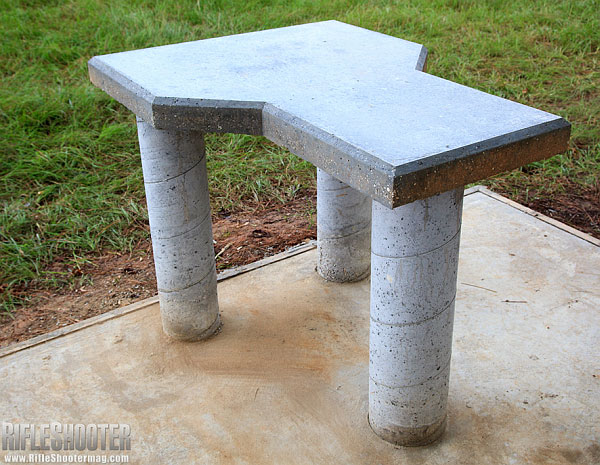
Who hasn’t dreamed of having a professional-quality, permanent shooting bench on their own property? Well here’s an article that can help you make that dream come true. This “how-to” feature from the archives of RifleShooter Magazine shows how to build a quality concrete shooting bench step-by-step.

All aspects of the construction process are illustrated and explained. The author, Keith Wood explains: “Construction happened in three phases — first creating the slab foundation, then the support pillars (legs), and finally the table.”
Click image below to load article with slide show.

Each step in the process is illustrated with a large photo and descriptive paragraph. Starting with framing the foundation (Step 1), the article illustrates and explains the 15 Steps that produce the finished, all-concrete bench (see top photo).
March 9th, 2017

Mirage as a Wind Indicator
Read FULL ARTICLE in Midsouth Shooters Blog
 by Glen Zediker by Glen Zediker
Most good shooters use mirage as their leading indicator to spot changes in the wind. With well-designed stand, the scope can be set it up where you can see the wind with the left eye and see the sight with the right without anything more than a visual focus shift. That gets the shooter back on the trigger with the least chance of missing another change. In the photo above you can see 11-time National High Power Champion David Tubb using a spotting scope set up for his left eye.
There are resources that give clues or evidence of wind direction and strength: wind flags, observation of grass and trees, and mirage.
Almost always I use mirage as my leading indicator. Mirage (heat waves) is always present but you’ll need a scope to read it. For 600 yards I focus my scope about halfway to the target. Mirage flows just like water and the currents can be read with respect to wind speed as well, but it’s not clearly accurate beyond maybe a 15 mph speed. The thing is that mirage shows changes, increases or decreases, and also direction shifts, really well.
A couple more things about mirage flow: when mirage “boils,” that is appears to rise straight up, either there’s no wind or the scope is dead in-line with wind direction. And that’s a quick and accurate means to determine wind direction, by the way, move the scope until you see the boil and note the scope body angle. It’s also how to know when a “fishtail” wind is about to change, a boil precedes a shift.

You don’t need to spend big bucks for an effective spotting scope to view mirage. You can get the Kowa TSN-601 Angled Body for just $249.00 from B&H Photo. An eyepiece will run another $275.00 or so. Though relatively inexpensive, the TSN-601 is used by many top marksmen.
I use a long-eye-relief 20X to 25X wide-angle eyepiece. That setup shows the flow best. And pay attention to where the wind is coming from! See what’s headed your way, because what’s passed no longer matters. That’s true for any indicator. Right to left wind? Read off the right side of the range.
Once I get on target then all I am doing is watching for changes. It’s really uncommon to make a big adjustment between shots. The fewer condition changes you are enduring, the easier it is to keep everything on center. That’s why I shoot fast, and why I start at the low point in a wind cycle.
 Making Corrections with Limited Sighters Making Corrections with Limited Sighters
Here’s a Tip for NRA High Power matches where only two sighters are allowed: “Make a full correction off the first sighting shot location! Even if there are minor changes afoot, that’s how to know how well you assessed condition influence pre-shot. Don’t second-guess. After the second sighter you should be on target and then simply watching for changes. Pay attention, correlate visible cues to the results of prior shots, and if in doubt, click into the wind.”
Information in this article was adapted from material in several books published by Glen Zediker and Zediker Publishing. Glen is an NRA High Master who earned that classification in NRA High Power Rifle using an AR15 Service Rifle. For more information and articles visit ZedikerPublishing.com.
March 9th, 2017

 Sandy Froman is a past president of the National Rifle Association (NRA), only the second woman to ever hold that position. Froman grew up in a “gun-free” home in San Francisco, California but now lives in Arizona. Sandy, an attorney with a J.D. from Harvard Law School, is a staunch advocate of the Second Amendment and has promoted pro-Second Amendment legislation. Sandy Froman is a past president of the National Rifle Association (NRA), only the second woman to ever hold that position. Froman grew up in a “gun-free” home in San Francisco, California but now lives in Arizona. Sandy, an attorney with a J.D. from Harvard Law School, is a staunch advocate of the Second Amendment and has promoted pro-Second Amendment legislation.
A member of the NRA Board of Directors since 1992, Froman served as second vice president for five years followed by two years as first vice president. In April 2005 she was elected NRA President. She completed her second term in April 2007 and currently serves as a member of the NRA Board of Directors. Froman was elected to The NRA Foundation’s Board of Trustees in 1992 and became The NRA Foundation’s first woman president. She helped establish the Foundation’s permanent endowment, which now exceeds $53 million.
Here are highlights of the Sandy Froman interview which first appeared in the NRA Foundation’s Traditions Journal, Quarter 4: 2016. These highlights appear courtesy the NRA Blog.
Women are the fastest growing segment in the shooting sports — Why is that?
Froman: Today, women have more responsibility for their day to day lives and the lives of their children than ever before. There are more women who work outside the home. There are more single women and many are single by choice. Women today have a heightened awareness of ordinary crime, of potential domestic violence, and of possible terrorism. Women are becoming more concerned about understanding their choices for personal safety and for defense of their families. This is why more women are buying guns. This is why more women are taking training. This is why more women are getting their concealed carry permits. It’s a change in the culture of our country that is reflected in women’s attitudes and their choices about firearms. I’m a big proponent of women-only firearms classes, but not because I don’t think women can compete with men-they actually compete very well. In an all-female class, women tend to ask different kinds of questions than they would in a co-ed class. Many women come to these classes because they have been a victim of a crime; they have been raped, they have been attacked, beaten, molested. They understand their physical vulnerability, and they want to do something about it. Once they master the basics of mental preparedness, gun handling and marksmanship, they quickly become more confident and go on to competing and hunting and teaching other women. I love seeing women teaching other women informally and supporting other women in the shooting sports.
What words of advice do you have for the future generation of shooters?
Froman: Exercise your Second Amendment rights. My dear friend and former NRA board member, the late David Caplan, warned that rights not exercised cease to exist. If you don’t go to the range and shoot, pretty soon there won’t be shooting ranges. There won’t be places to shoot. If there aren’t places to shoot, there won’t be guns. Guns will be collectibles — things under glass that future historians will talk about: “People actually used to shoot these things”. So I tell folks: Support ranges. Support your gun clubs and gun stores. Support The NRA Foundation. You know why the NRA is so successful? ““Each of us, one by one, together” — Wayne LaPierre says this all the time. You have to go out and do something if you want to be part of the solution.
When did you become a huntress?
Froman: When I was an officer of NRA, I met Larry and Brenda Potterfield of Midway USA. One afternoon on a break from a meeting, I went shoe shopping with Brenda. [Laughs] We were hunting for shoes! And this ties in with the Potterfields since they hosted the first Friends of NRA event in Columbia, Missouri, in 1992. Brenda and I got to know each other and she showed me photos of her family trips to Africa and the animals they hunted. I was intrigued by these pictures of this beautiful, intelligent, well-dressed woman in her hunting clothes with the exotic wild animals she had hunted. I was fascinated by this contrast-here was a cultured, sophisticated woman who loved hunting! Later Brenda invited me to her farm to go pheasant hunting. I had never shot an animal and so at first I wasn’t sure how I would feel about shooting a pheasant. Well, I shot my first pheasant, and I was immediately hooked on hunting. I was invited back to the Potterfield’s farm go wild turkey hunting with Brenda’s husband Larry. Soon after I went to one of the very first Women On Target hunts in Texas. It was a wild pig hunt, so I shot my first mammal. Hunting provides the excitement and satisfaction of being able to hunt animals and eat what you’ve harvested — and I’ve eaten everything I’ve hunted except for this one very nasty, old European mouflon sheep. After I downed the sheep, and asked my guide where I should take the meat for processing, he said, “Lady, you don’t want to eat this.” So hunting my own food has been truly an educational experience for a girl who grew up in the San Francisco Bay Area.
What role do you see the NRA playing in the next 10 years?
Froman: Broadening our base to include and grow the changing demographic of Americans — younger women and minorities. Critics say that NRA membership is only middle-aged white guys. If you look at our members and supporters you will see that is not true. While we still have our traditional membership base, the face of the NRA has changed dramatically over the past 10 years. A lot of new members are women and minorities, and the new members tend to be younger and less rural than in the past. Families are raising their kids to know that firearm ownership in America is part of our culture and we need to keep driving that.
Do you have a favorite quote?
Froman: One is by Judge Alex Kozinski of the US Court of Appeals for the Ninth Circuit, regarding the Second Amendment:
“The Second Amendment is a doomsday provision, one designed for those exceptionally rare circumstances where all other rights have failed – where the government refuses to stand for reelection and silences those who protest; where courts have lost the courage to oppose, or can find no one to enforce their decrees. However improbable these contingencies may seem today, facing them unprepared is a mistake a free people get to make only once.”
February 25th, 2017

We’ve been giving a lot of coverage to tactical rigs and gas guns lately, so we though it was time to showcase a purebred, state-of-the-art 1000-Yard Benchrest rig. This article features the impressive .284 Shehane Light Gun used by Henry Pasquet to capture the 2013 IBS 1000-yard Nationals.
With a 5″-wide “hammerhead” front and a special 3″-wide bag-rider plate in the rear, this 17-lb rig is ultra-stable in the bags, and tracks like a dream. In this story, Henry explains his set-up plus his processes for loading super-accurate ammo. Every long-range shooter can benefit from some of tips revealed here. And F-Class guys — if you’re shooting a .284 Win-based case in F-Open you should definitely read Henry’s precision reloading advice.
EDITOR: Guys, there is a ton of solid gold information in this article — take your time and read it carefully.
 Yes old dogs can learn new tricks. Just five years ago Forum member Henry Pasquet (aka “HenryP”) got started in 1000-yard benchrest shooting. He was 66 at the time. Henry worked hard, learned fast, and pursued accuracy with a vengence. That all paid off when Henry won the 2013 IBS 1000-yard Nationals this summer, finishing as the Two-Gun Overall National Champion. Henry was kind enough to talk about his rifle, his reloading methods, and his strategy for success. In fact, Henry was eager to share “everything he knows, so that other guys can fast-track their learning process”. Henry told us: “I want to share every lesson I’ve learned, so that other guys can improve their game and enjoy the sport more.” Henry also wants to encourage other senior shooters: “If you pay attention to details (when reloading), and get a good rifle with a good barrel, age is not a handicap. With a good set-up, older guys can compete with anyone out there. This is one sport where you can be a champion in later life.” Yes old dogs can learn new tricks. Just five years ago Forum member Henry Pasquet (aka “HenryP”) got started in 1000-yard benchrest shooting. He was 66 at the time. Henry worked hard, learned fast, and pursued accuracy with a vengence. That all paid off when Henry won the 2013 IBS 1000-yard Nationals this summer, finishing as the Two-Gun Overall National Champion. Henry was kind enough to talk about his rifle, his reloading methods, and his strategy for success. In fact, Henry was eager to share “everything he knows, so that other guys can fast-track their learning process”. Henry told us: “I want to share every lesson I’ve learned, so that other guys can improve their game and enjoy the sport more.” Henry also wants to encourage other senior shooters: “If you pay attention to details (when reloading), and get a good rifle with a good barrel, age is not a handicap. With a good set-up, older guys can compete with anyone out there. This is one sport where you can be a champion in later life.”
Click on Rifle Photos to View Full-screen Versions

Q&A with Henry Pasquet, IBS 1000-Yard National Champion
Q: First, do you have any advice for older shooters getting started in their golden years?
Henry: You’re never too old. In this sport, you can excel even in your 60s, 70s and beyond. At this stage in life, we now have the time and money to get good equipment and rifles. Plus, our years of work experience help us to think, analyze, and thereby make progress. In this game, we older guys can definitely compete on a par with younger shooters.
HARDWARE
Q: Tell us about your Nationals-winning rifle and bench gear. Is there anything unique about your hardware that gave you an edge?
Henry: At the Nationals, I used my 17-lb Light Gun for both Light and Heavy Class. This rifle has a 1.55″, round BAT LP/RE action, fitted with a Bartlein barrel chambered for the .284 Shehane (an improved version of the .284 Winchester). The barrel was near-new; this was the first time I had used it this year. A great barrel and great batch of Berger 180gr VLDs all made a difference. Jay Cutright chambers my barrels. Jay’s metal-work is so precise that I can screw any barrel he’s chambered to any BAT action I own. The laminated stock was modified by Tommy Shurley from a standard 3″-wide fore-end to a 5″-wide True-Trac with an adjustable 3″-wide rear plate. It’s not pretty but it tracks like a Heavy Gun stock. Tommy made my other stocks as well.

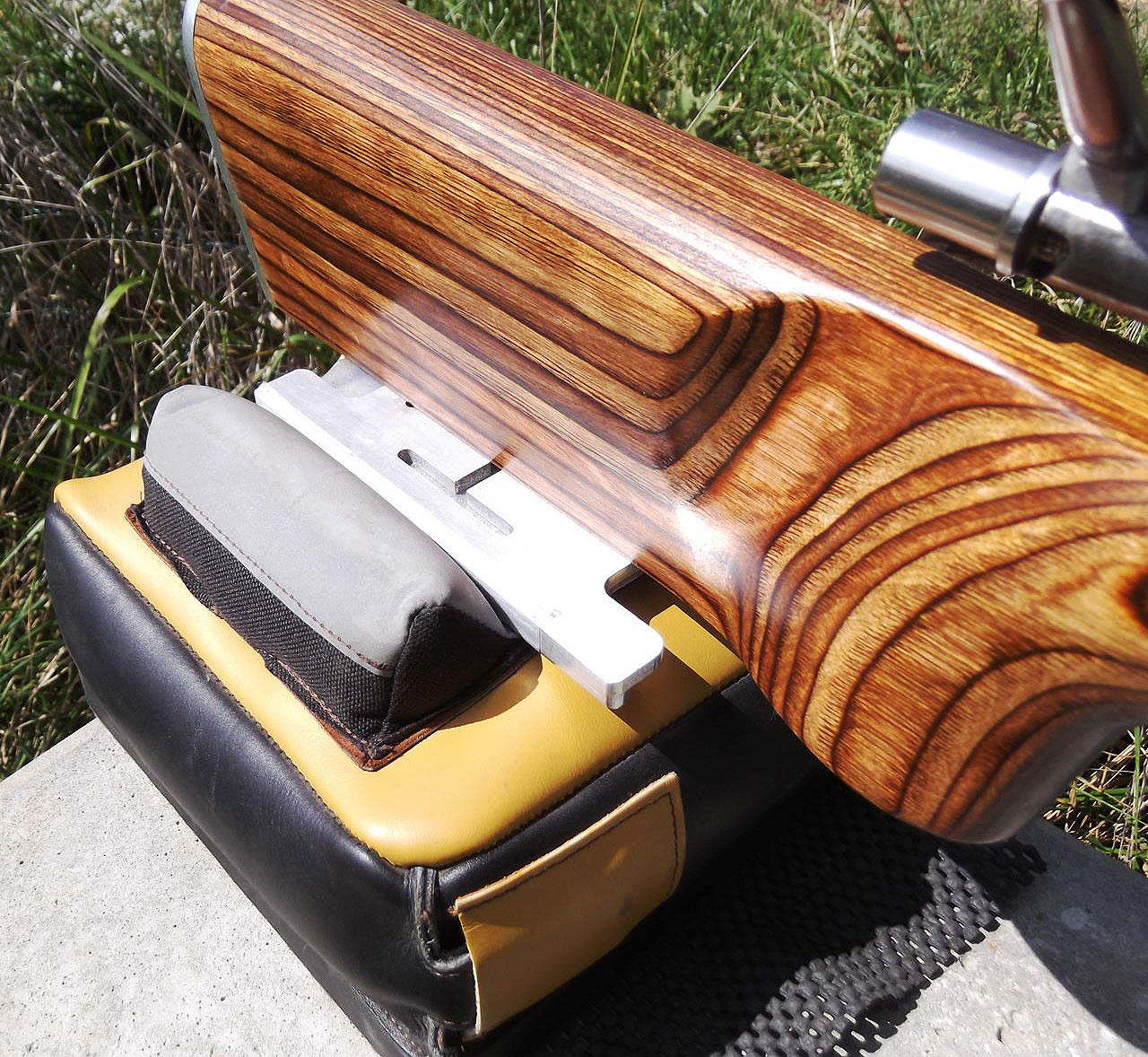
 On top is a Nightforce 12-42x52mm Benchrest scope with CH-3 reticle. I used a Fulghum (Randolph Machine) front rest with an Edgewood bag made with the low-friction 3M material. In the rear I use a special-order Protekor rear “Doctor” bag with ears spaced 3 inches apart. The rear bag also has the new 3M material on contact surfaces (photo at right). On top is a Nightforce 12-42x52mm Benchrest scope with CH-3 reticle. I used a Fulghum (Randolph Machine) front rest with an Edgewood bag made with the low-friction 3M material. In the rear I use a special-order Protekor rear “Doctor” bag with ears spaced 3 inches apart. The rear bag also has the new 3M material on contact surfaces (photo at right).
Q: During the Nationals, at the last minute you switched guns. Why did you go from a 6mm Dasher to a 7mm Shehane?
Henry: I had planned to use my Light and Heavy Dashers, but after placing the Dasher on the ready line, decided to switch to the .284 Shehane. It was still early in the morning and I felt that the heavier bullets would be easier to see against the berm. The Dasher had actually been giving tighter groups under perfect conditions, but seeing the impact is important.
Q: Tell us about the combined tuner/muzzle brake on some of your barrels. How does this improve rifle performance and how do you set the “tune”? Do you tune the barrel to the load?
Henry: I use a tuner or tuner/brake on every barrel. I started with Time Precision tuners. Art Cocchia advised getting a load with a good known accuracy node with minimum extreme spread, which controls vertical. Do not go for the hottest loads, which just reduces brass life. Then use the tuner and tune the barrel to the load. The .284 Light Gun needed a muzzle brake and tuner. I had a local gunsmith cut a thread on the muzzle brake for a tuner I got from Sid Goodling. (Eric Bostrom developed an almost identical unit at the same time. I use Eric’s tuner/brakes on all my new barrels.) Just before Nationals, I tried going up and down one marker. Down one mark cut the group in half! Think how much range time (and barrel life) that saved me. Using a tuner is easier than messing around changing loads and tweaking seating depths. Tuners definitely can work. Last year I shot a 3.348″ 10-shot group at 1000 with my .284 Win Heavy Gun fitted with a Time Precision Tuner.

Q: What are the advantages of your stock’s 5″-wide fore-end and 3″-wide rear plate? Is there a big difference in tracking and/or stability? Does the extra width make the rifle easier to shoot?
Henry: I had true Heavy Guns with 5-inch fronts and 3-inch rears. They tracked well. I felt the same result could be had with a Light Gun. I talked two stock makers into making them. I initially had the standard rear stock until Tommy Shurley and Mike Hearn came out with an adjustable rear plate. The stocks track perfectly. You can see your scope’s crosshairs stay on the target the whole time and push the rifle back for the next shot. There is no torquing (gun wobbling) when cycling the bolt. Us old guys need all the help we can get. I am getting rid of my 45-pound Heavy Guns and replacing them with Light Guns with heavy barrels.

Q: Some people say the .284 Shehane is not as accurate as the straight .284 Winchester. You’ve proved them wrong. Why do you like the .284 Shehane? More speed, less pressure?
Henry: The reason I rechambered my 7mm barrels to .284 Shehane was not velocity, pressure, or brass life. It was all about bolt lift. My straight .284 almost required me to stand up to eject brass. I damaged an extractor and had to send the bolt back to BAT. With the .284 Shehane, my bolt cycles like there is no case to eject.
Reloading Methods
Q: People want to know about your load and your loading methods. What can you reveal?
Henry: For my .284 Shehane at the Nationals, I loaded 52.5 grains of Hodgdon H4350 and Federal BR-2 primers behind Berger 180gr VLDs. I usually anneal the brass each winter. I have used the same brass for years. I use Redding bushing dies, apply Imperial sizing wax, resize, wipe off wax, clean and uniform the primers pockets using the RCBS Trim Mate Case prep center, then apply Imperial dry neck lube with a bore mop.
 To dispense powder, I use a RCBS ChargeMaster set 0.1 grain below my desired load and then weigh them on a Sartorius GD-503 magnetic force restoration scale to get identical charges. I use a K&M Arbor Press with seating force gauge when seating the bullets with a Wilson inline die. My “target” seating force on the K&M dial is 20-23 units for Dashers and 35-40 units for the .284 Shehane. I put any variables aside for sighters. I do not weigh brass, bullets, or primers. My bullets were so consistent that I did not sort by bearing surface. I did trim the Berger VLDs to the shortest bullet length with a Hoover Trimmer, and then pointed the meplats just enough to close them with a Whidden pointer. I sort my bullets to 0.005″ overall length, rejecting about five percent. To dispense powder, I use a RCBS ChargeMaster set 0.1 grain below my desired load and then weigh them on a Sartorius GD-503 magnetic force restoration scale to get identical charges. I use a K&M Arbor Press with seating force gauge when seating the bullets with a Wilson inline die. My “target” seating force on the K&M dial is 20-23 units for Dashers and 35-40 units for the .284 Shehane. I put any variables aside for sighters. I do not weigh brass, bullets, or primers. My bullets were so consistent that I did not sort by bearing surface. I did trim the Berger VLDs to the shortest bullet length with a Hoover Trimmer, and then pointed the meplats just enough to close them with a Whidden pointer. I sort my bullets to 0.005″ overall length, rejecting about five percent.
Q: What kind of precision are you looking for in your reloads? Do you trickle to the kernel? Does this really help reduce extreme spread?
Henry: I try to keep my charge weights consistent to one kernel of powder. I use the Omega powder trickler with a Sartorius GD-503 lab-grade balance to achieve that. For accurate dispensing, put very little powder into the Omega so you can drop one kernel at a time. Single digit ES (Extreme Spread) is the goal. This does make a difference at 1000 yards. If you get the same push on the same bullet with the same neck tension, good things are going to happen.
Q: You believe consistent neck tension (i.e. grip on the bullet) is really important. What methods are you using to ensure consistent bullet release?
Henry: I apply Imperial dry neck lube to the inside of my case-necks with a bore mop. The K&M arbor with seating force gauge shows the need to do this. If you put a bullet into a clean case, it will be jerky when seating the bullet. You may see 40 units (on the K&M dial) dropping to 20, then slowly increasing pressure. I explained to a friend that not lubing the neck is like overhauling an engine without lubing the cylinders. Smooth entry gives the bullets a smooth release.
Barrel Cleaning
 Q: You go 60-80 rounds between cleaning and the results speak for themselves. What is your barrel cleaning procedure? Do you think some guys clean too often or too aggressively? Q: You go 60-80 rounds between cleaning and the results speak for themselves. What is your barrel cleaning procedure? Do you think some guys clean too often or too aggressively?
Henry: I cringe when I see people wearing out their barrels with bronze brushes between relays. I clean my barrels at the end of each day when I get home. I shot my best-ever 1K Heavy Gun group (3.348″) at day’s end after 60 to 80 rounds. After trying other solvents, I have gone back to Wipe-out’s Carb-Out and Patch-Out products. I use about four patches of Carb-Out, let it sit a few minutes, then use one stroke of a nylon brush followed by Patch-Out until the barrel is clean. I use a bore mop to clean inside the chamber, then some Break Free LP on the bolt followed by bolt grease on the lugs and cocking part. I use a bore guide when anything goes down the barrel.
Shooting Skills and the Learning Process
Q: Henry, you can shoot long-distance on your own property in Missouri. How important is practice, and what do you do during a typical practice session?
Henry: I can shoot 1000 yards on my farm. I have a concrete bench using a slab from a yard furniture place on concrete blocks. Two 4 x 8 sheets of plywood hold four IBS targets. I never practice. I only test, keeping a notebook with all the info. I do most of my testing at 300 to 500 yards, shooting off my deck so I can see my shots immediately.

Q: How much of your success do you credit to really accurate rifles, versus superior shooting skills?
Henry: I do not consider myself another Carlos Hathcock or some master marksman. I am an average 1000-yard shooter, but I do work hard getting the most out of my rifles. Four other people have shot their first 1000-yard matches with my rifles, including my wife, and all of them won relays! I loaned my Dasher to another shooter two years ago and he got second at the 600-yard Nationals. Others will tell you that the rifle must be “on” to win. If your barrel or bullets are average, don’t expect to perform above average in competition.
Q: What you do enjoy most about long-range benchrest shooting? What are the attractions of this sport?
Henry: The sport offers good people and a real challenge. 1000-yard shooting keeps us all humble, but we still keep trying to see how good we can do. I am thankful for Robert Ross providing the only match location that I can shoot regularly.
Q: Henry, you have been a Forum member for many years. Have you learned important techniques from other Forum members and other shooters?
Henry: I have followed the AccurateShooter Forum since 2008. At my age I am not good at computers. I copied and analyzed many articles, especially on the .284 and the Dashers. Without AccurateShooter.com, I would probably still be shooting double-digit (10″+) groups at 1000 yards, and I sure wouldn’t have my name on a National Championship trophy.
Q: You are in your 70s now and have only been shooting competitively for a few years. How did you get so good so fast? How did you manage to beat shooters who are decades younger?
Henry: I had 20/10 vision when I was young, but am down to only 20/20. I have been interested in long range shooting for a long time including ground hog hunting. I went to some VHA jamborees also. In 2008, I went to the Williamsport Benchrest School with a friend from Pennsylvania, John Haas. We would compare notes frequently. I bought a BAT three lug from Tom Mousel in Montana. We also compared notes and made each other better. At IBS matches I studied other shooters’ equipment and techniques. I tried some, accepting some and rejecting some.
Here’s my advice:
Always be ready to learn something new. If it makes sense, try it. I would also encourage other older shooters not to quit. Stick to it. You can make enormous progress in a few seasons.
February 22nd, 2017

Diagram from SouthTexasShooting.org.
 There was an excellent article about Mirage created for the South Texas Marksmanship Training Center (STMTC) website a while back. This article explains what causes mirage and how mirage can move the perceived aiming point on your target. Most importantly, the article explains, in considerable detail, how you can “read” mirage to discern wind speeds and wind directions. There was an excellent article about Mirage created for the South Texas Marksmanship Training Center (STMTC) website a while back. This article explains what causes mirage and how mirage can move the perceived aiming point on your target. Most importantly, the article explains, in considerable detail, how you can “read” mirage to discern wind speeds and wind directions.
Mirage Is Your Friend
While hot days with lots of mirage can be frustrating, mirage can reveal how the wind is flowing (and changing). If you learn how to recognize and read mirage patterns, you can use that information to shoot higher scores. That’s why many leading long-range shooters tell us: “Mirage is your friend.” As the STMTC article explains: “A mirage condition is not a handicap, since it offers a very accurate method of perceiving small wind changes[.]”
CLICK HERE to Read Complete Mirage Article
Mirage Illustrated with Diagrams
With simple but effective graphic illustrations, this is one of the best explanations of mirage (and mirage reading) we have found on the internet. This is a “must-read” for any serious competitive shooter. Here is a brief sample from the article, along with an illustration. NOTE: the full article is six times longer and has 8 diagrams.
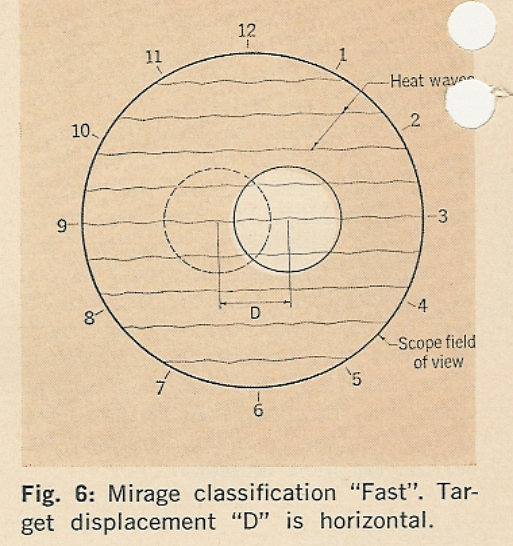
The term “mirage” as used by the shooter does not refer to a true mirage, but to heat waves and the refraction of light as it is bent passing through air layers of different density. Light which passes obliquely from one wind medium to another it undergoes an abrupt change in direction, whenever its velocity in the second medium is different from the velocity in the first wind medium; the shooter will see a “mirage”.
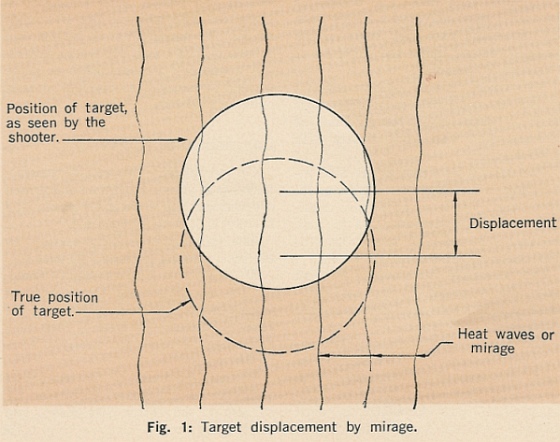
The density of air, and therefore its refraction, varies with its temperature. A condition of cool air overlaying warm air next to the ground is the cause of heat waves or “mirage”. The warm air, having a lower index of refraction, is mixed with the cooler air above by convection, irregularly bending the light transmitting the target image to the shooter’s eye. Figure 1 shows (greatly exaggerated) the vertical displacement of the target image by heat waves.
Heat waves are easily seen with the unaided eye on a hot, bright day and can be seen with spotting scope on all but the coldest days. To observe heat waves, the scope should be focused on a point about midway to the target. This will cause the target to appear slightly out of focus, but since the high power rifle shooter generally does not try to spot bullet holes, the lack in target clarity is more than compensated by clarity of the heat waves.
Story tip from Boyd Allen. We welcome reader submissions.
January 31st, 2017
The following article by Tom Alves describes a very practical approach to physical training for those of us who are not as young and spry as we once were. Tom shows us how to give our bodies at least some of the maintenance we give our rifles. While we all realize that our rifles will outlive us, let’s see if we can’t narrow the margin a bit with some personal maintenance that just might help the shooting too!
This article originally appeared in the Rifleman’s Journal, and appears with permission of GS Arizona.
A Suggested Training Approach for Older Shooters
By Tom Alves
Most articles and discussions regarding competitive shooting center around equipment. Now and then one will come across an article about training such as the recent one from the AMTU posted on www.6mmbr.com/. If you break the articles down they often discuss “core strength” and durability. The purpose of this paper is to elaborate on those points with a bit different perspective. Many of the articles you will read in books about position shooting and the one mentioned before are directed more toward the younger generation of shooters in their 20’s. If you look down the line at a typical high power match these days you are likely to see quite a few folks who are in their middle 30’s and up. Many people in that age range have had broken bones and wear and tear on their joints so a training program needs to take that into account. For instance, while jogging for an extended period for heart and lung conditioning – often called cardio exercises – may be the recommended approach for younger folks, it may be totally inappropriate for older people. The procedure to repair meniscus tears in knees is one of the most frequently performed operations in this country. Another approach one often sees in training to improve core strength is the use of weight machines which isolate certain muscle groups in their operation. I would like to suggest an alternative approach that not only does not require special equipment but uses the body’s muscles in a coordinated fashion in the same way they are used in our natural movements. So, let’s set down some criteria:
1. The approach has to be low impact to conserve joints.
2. One goal is to improve the strength of the core muscles which are the muscles of our trunk that keep us erect and from where all movements initiate.
3. Along with core strength we need flexibility and full range of motion.
4. We want to improve our lung and heart function so we can have a good flow of oxygen going to our organs and muscles to reduce the rate at which we become fatigued during a competitive event.
Before I continue I believe it is appropriate for the reader to understand that I am a fellow shooter and this is a program I have designed for myself based on considerable reading and experience over a number of years. I am not a medical doctor, a formally trained exercise professional or any other type of specialist in the field. Consequently, this information is offered with the advice that you consult your medical advisor or similar authority before you embark on this or any similar regimen.
I will start with core strength and flexibility. Pilates exercises are resistance exercises that can incorporate the use of resistance bands, light weights and the weight of your body parts in order to strengthen the muscles in the abdomen, back, hips, chest and shoulders. The exercises can be performed alone but I recommend attending classes put on by a certified instructor who will ensure that you perform a balanced routine meaning you work on the front and back and both sides of your trunk. As to flexibility, yoga complements Pilates exercises and they are often taught together. In practical terms yoga strengthens through resistance using the weight of the body and increases flexibility by stretching the various muscle groups in a coordinated fashion. Some yoga exercises also work on balance which is helpful in position shooting and life in general. Again, I suggest attending formal yoga classes since an instructor can help you address such things as a joint misalignment. As an example, my right leg healed improperly after the femur was broken and my right foot splays out putting undue load on my left knee. There are a number of books available on Pilates and yoga and some of them get pretty involved; I leave that to the reader to explore. I will list some reference material at the end of the article that I have found useful.
Finally, heart and lung improvement. In order to exercise the heart and lungs while not abusing the joints, particularly the knees and hips, one has to resort to something other than jogging. Walking, bicycling, elliptical machines and swimming may be alternative methods you’d like to consider. Based on my reading, in order to get the most benefit it is important to exercise so that the pulse rate becomes elevated for periods of time rather than kept at a constant rate. The process I use, called PACE, is promoted by Al Sears, MD, http://www.alsearsmd.com/. It is interval training for the non-athlete. In simple terms one exercises, using whatever equipment one desires, to achieve a heart rate in which you are slightly above your ability to bring enough oxygen into your body to sustain the activity for an extended period. This is similar to wind sprints for a sprinter or a football player. After each episode you must rest until you have achieved recovery, meaning you can catch your breath easily. A series of three sets is recommended which covers a total time of about 20 minutes.
As a result of this training program I have experienced increased strength in my legs and trunk, less joint stiffness, lower blood pressure, and lower resting pulse rate. I will be 64 in June of this year. The Pilates/yoga classes are usually attended 2 to 3 times a week and the interval training performed twice a week.
Before I close I would like to touch briefly on two other related subjects: hydration and visual training. When one is exerting oneself, the body produces perspiration to keep the body’s temperature at an acceptable level. As one perspires the blood gets thicker and the ocular fluid in one’s eyes thickens as well. The heart has to work harder to supply oxygen and nutrients to the body so visual and cognitive functions degrade and fatigue sets in rapidly. Essential chemicals called electrolytes are also carried out of the body with the perspiration. As a result, it is necessary to replace moisture and electrolytes to maintain basic health and a competitive level of performance. If one goes on the Internet there is a multitude of articles on hydration. Due to the kindness of my lead Pilates/yoga instructor, Ms. Annette Garrison, I have a pretty comprehensive article on various aspects of hydration that I have included, http://www.ideafit.com/fitness-library/hyponatremia-other-side-hydration-story , for your information.
Last I want to mention visual performance training. The New Position Rifle Shooting, A Comprehensive Guide To Better Target Shooting by Bill Pullum and Frank Hanenkrat mentions sports vision training amongst other aspects of vision in competitive shooting. If one goes on the Internet you will find training programs directed at golfers, baseball and football players. There is one site that has a demo which, if one looks at it for long, it is obviously very similar to a shooting gallery video game. The training involves rapid recognition and hand-eye coordination. Another source of visual training exercises, along with a wealth of other information, is the book Prone And Long Range Rifle Shooting by Nancy Tompkins.
Hopefully, I have provided some information which will be helpful in improving shooting performance and extending the time you can participate at a competitive level. It is important that you proceed at your own pace. I have pushed myself too hard in the interval training and now have to back off a bit. In closing I would like to thank Annette Garrison and GS Arizona for their help, considerable patience and encouragement.
Additional Reference Material
1. Framework by Nicholas A. DiNubile, MD
This is required reading for anybody who has suffered an injury like a torn meniscus or has muscular skeletal issues. This is the book that led me to Pilates/yoga
2 P. A. C. E., The Twelve Minute Fitness Revolution by Al Sears, MD
The approach I use to interval training. I am sure there are other sources.
3. Physical Conditioning For Highpower Shooting by SGT Walter E. Craig, USAMTU
4. Rifle, Steps To Success by Launi Meili
January 27th, 2017

Today, AR-platform rifles are hugely popular. Dozens of manufacturers sell AR-type rifles, in a wide variety of configurations and calibers. But before there were M16s and AR-15s, ArmaLite produced a 7.62×51 caliber rifle, the AR-10. Yes before there were millions of 5.56 black rifles, there was a .30-caliber big brother with reddish-brown furniture. Invented by Eugene (‘Gene’) Stoner for the Armalite company in the late 1950s, this is the father of all of today’s AR-platform rifles. Way ahead of its time, this remarkable, select-fire battle rifle weighed just 7.25 pounds as first developed.
If you’re curious about the AR-10, in this video, Jerry Miculek puts an original 1957-vintage AR-10 through its paces on the range. This extremely rare, early-production rifle was provided by Mr. Reed Knight and the Institute of Military Technology. (The gun in the video was actually produced in the Netherlands under license, see video at 4:40.) This AR-10 is the direct ancestor of the AR-15, M16, and many of the modern sporting rifles that we use today.
The AR-10 was slim and light, weighing in at around 7 pounds. Some folks might argue that the original “old-school” AR10 is actually better that some of today’s heavy, gadget-laden ARs. The AR-10’s charging “lever” was under the carry handle — that made it easier to manipulate with the gun raised in a firing position.

You’ll notice there is no “forward assist”. Inventor Gene Stoner did not believe a separate “bolt-pusher” was necessary. The forward assist was added to solve problems encountered in Viet Nam. Some critics say the forward assist “only takes a small problem and makes it a big problem.” For today’s competition ARs (that are never dragged through the mud) the forward assist probably is superfluous. It is rarely if ever needed.

Note also that the handguards are fairly slim and tapered. Today, six decades after the first AR-10 prototypes, we are now seeing these kind of slim handguards (made from aluminum or lightweight composites) used on “full race” ARs campaigned in 3-gun competition.
History of the AR-10
The AR-10 is a 7.62 mm battle rifle developed by Eugene Stoner in the late 1950s at ArmaLite, then a division of the Fairchild Aircraft Corporation. When first introduced in 1956, the AR-10 used an innovative straight-line barrel/stock design with phenolic composite and forged alloy parts resulting in a small arm significantly easier to control in automatic fire and over one pound lighter than other infantry rifles of the day. Over its production life, the original AR-10 was built in relatively small numbers, with fewer than 9,900 rifles assembled.
In 1957, the basic AR-10 design was substantially modified by ArmaLite to accommodate the .223 Remington cartridge, and given the designation AR-15. ArmaLite licensed the AR-10 and AR-15 designs to Colt Firearms. The AR-15 eventually became the M16 rifle.
AR-10 photos from Arms Izarra, a Spanish company specializing in de-militarized, collectible firearms. Interestingly, this particular AR-10 was produced in the Netherlands under license.
January 20th, 2017

Digital editions of the four issues of SHOT Daily, the magazine printed each day of the SHOT Show, are available free in convenient Web eZine formats. Three web issues are available right now, and the fourth issue will be released later today (Friday, 1/20/17). You’ll find many product features plus articles that can benefit shooting club directors and range managers. Definitely check out the Day One Issue’s extensive coverage of new-for-2017 firearms. SHOT Daily is produced for NSSF by Bonnier Corp., publishers of Outdoor Life, Field & Stream, and many other magazines.
SHOT Daily 2017 Digital Editions (Click to View)
January 13th, 2017
 Randy Robinett, founder of BIB Bullets, is a highly respected custom bullet-maker. In recent years, Randy’s 30-caliber projectiles have won countless benchrest-for-score matches, and captured many National titles. If you want to “run with the big dogs” in score competition, campaigning a 30BR with BIB bullets is a very smart way to go. In this article, Randy talks about the process of creating highly uniform cores for benchrest bullets. Randy Robinett, founder of BIB Bullets, is a highly respected custom bullet-maker. In recent years, Randy’s 30-caliber projectiles have won countless benchrest-for-score matches, and captured many National titles. If you want to “run with the big dogs” in score competition, campaigning a 30BR with BIB bullets is a very smart way to go. In this article, Randy talks about the process of creating highly uniform cores for benchrest bullets.
This article originally started as an exchange of posts in Stan Ware’s Bench-Talk Forum. Stan, a gifted gunsmith, converted the Forum posts into an article, which first appeared on Stan’s Bench-Talk.com Website.
How to Make Benchrest-Quality Bullet Cores
by Randy Robinett, BIB Bullets
OK, Stan “made me do it”! A while back, Stan Ware asked if I’d submit a ditty on bullet-making. Here is the “picture is worth a few words” version. Below is a photo of a spool of lead wire. This is the first step in making benchrest-quality bullets. This spool of .250″ diameter lead wire will be cut into approximately 130 pieces, each about thirty inches long.

The Core Cutter
Here’s a really neat machine built by my Uncle and BIG MIKE. This is the core cutter. We made it using scrap steel and borrowed the crank shaft out of a 1966 Yamaha motorcycle to get the desired reciprocating-motion slide. When properly “juiced”, this machine can cut more than 3000 cores per hour.
As you doubtless deduced, the “sticks” are inserted, then fed via gravity — straightness is a virtue here! The crank, for now, is powered by the human hand. The bucket contents are the result of loading the cutter and turning the crank wheel. This photo shows cores for 112 grain, .30-caliber bullets. There are about 2500 cores to the bucket.
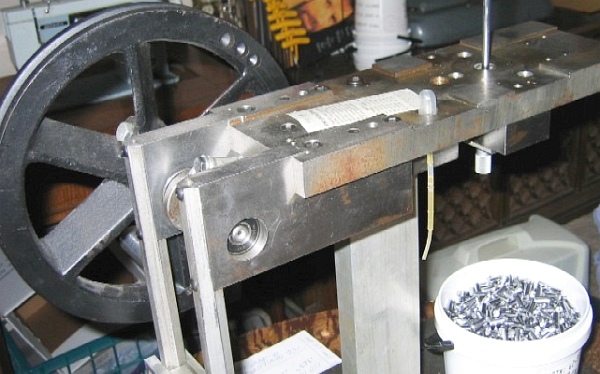
Here’s a close-up of the business end of the core cutter. Using recorded micrometer settings, this clever design allows us to get very repeatable length when changing through the length/weight cycle.

The photo below provides a closer look at the just-cut cores. Note the relatively clean shanks and square, unflared ends. This bucket contains roughly 2500 cores. By contrast, a tour of the Hornady plant will reveal cores being cut and squirted via a single operation, and deposited into 50-100 gallon livestock watering tanks!
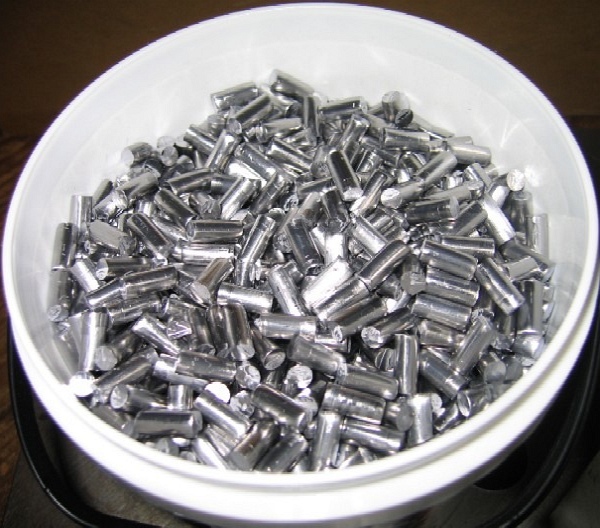
Upon my first tour of a commercial plant, I lost all feelings of guilt about the cost of custom, hand-made bullets. When one totals the amount of labor, “feel” and “culling” that goes into them, custom hand-made bullets represent one of the best bargains on the planet!
At Hornady, each press produces 50-55,000 finished bullets per 10-hour shift. By contrast, a maker of hand-crafted bullets, at best, may make 3% of that number during a 10-hour span! Yep, hand-made benchrest-quality bullets are a labor of love and should be purchased with these criteria in mind: 1) QUALITY; 2) availability; 3) price. There is no reason for a maker of hand-made benchrest-quality bullets to negotiate on price. His time is worth what one receives from the bargain!
Core-Making Q & A
Randy’s original Bench-Talk Forum posts inspired some questions by Forum members. Here are Randy’s answers to spedific questions about core-making.
Question by Stan Ware: Randy, a post or two back you said the cores were cut into 30″ lengths first and straightened. Why do you cut to 30″ lengths? What is the reason for this?
Answer by Randy: Stan, the wire is cut into 30″ lengths (sticks) and then straightened, following which it is fed into the core cutter and cut into the individual individual “cores”. If you look at the core cutter photo above, you’ll see a stick of lead wire sticking up -it’s toward the right hand end of the contraption. The cut cores are also “ejected” by gravity — the white “tickler” brushes the cores as the slide moves forward and dislodges the core from the cutter bushing.
Q by GregP: Randy, How do you straighten the 30″ sticks? Roll them between metal plates?
Answer by Randy: Greg, BIG MIKE may kill me for letting out the secret. WE “roll” the wire between an aluminum plate, which is equipped with handles, and the “plate” which you can see in the pic of cutting the wire. The straightening is really a drag. Eventually, we will have the new cutter hooked up to a “feeder/straightener” and the wire will be cut into core slugs right off the roll! Well, that’s the Dream….
Question by Jim Saubier: How much of a nub do you use at the end of the 30″ section? I imagine that every section you will lose a little from the feed end. Your cutter looks real slick, we are using the manual deal and it isn’t quick by any means.
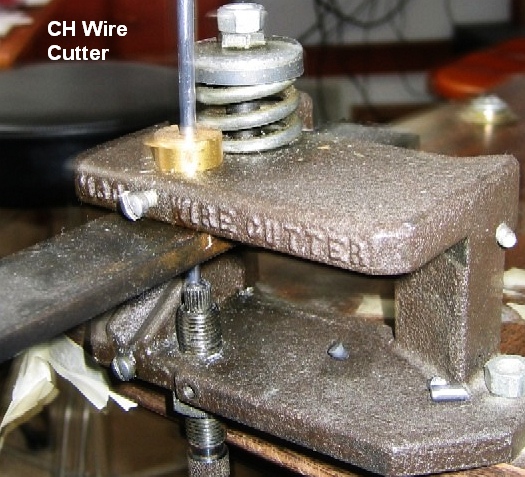
Answer by Randy: Jim, Since I cut all of the sticks using diagonal-cutting pliers, the ends are, indeed, waste. However, only about 1/8th inch on the beginning end — the final core may be too short. I have attached a pic of my old reliable CH cutter. I still use this cutter for .22-cal and 6mm cores and, occasionally, an odd lot of thirties. The CH cuts very square ends which are free of bulges and/or flaring.
December 22nd, 2016

Image Courtesy NSSF
By Bill Brassard for NSSF
‘Tis the season of gift-giving (and Christmas Day is almost here). As hunters, shooters, collectors or just plain plinkers, it’s a natural instinct to want to share our enjoyment of firearms with others. What better way to do that than to make a gift of a firearm to a family member, close friend or relative?
The first thing to remember if you’re thinking about giving someone a gun is that … it’s a gun! You already know that ownership of a firearm brings with it some serious legal and ethical obligations that other consumer products don’t. So let’s look at some questions you may have about giving a firearm as a gift.
 The first question you have to ask is whether the intended recipient can legally own the firearm where he or she lives. With more than 20,000 different gun laws on the books, even the kinds of firearms that law-abiding citizens can own vary from place to place. For example, juveniles (under age 18) generally speaking are precluded by law from possessing a handgun. Check out the Bureau of Alcohol, Tobacco, Firearms and Explosives (ATF) website for an overview of local laws and, whatever you do, don’t forget that you can never under any circumstances transfer a firearm to someone you know — or have reasonable cause to believe — legally can’t own one. That’s a federal felony, so be careful. The first question you have to ask is whether the intended recipient can legally own the firearm where he or she lives. With more than 20,000 different gun laws on the books, even the kinds of firearms that law-abiding citizens can own vary from place to place. For example, juveniles (under age 18) generally speaking are precluded by law from possessing a handgun. Check out the Bureau of Alcohol, Tobacco, Firearms and Explosives (ATF) website for an overview of local laws and, whatever you do, don’t forget that you can never under any circumstances transfer a firearm to someone you know — or have reasonable cause to believe — legally can’t own one. That’s a federal felony, so be careful.
Though there’s no federal law that prohibits a gift of a firearm to a relative or friend that lives in your home state, some states (such as California) require you to transfer the gun through a local firearms dealer so an instant background check will be performed to make sure the recipient is not legally prohibited from owning the gun.
The ATF recommends that if you want to give someone a new firearm, rather than going to a gun store, buying it on your own and giving it to, say your father, consider instead purchasing a gift certificate from that retailer and giving it to Dad as his present. That way he’ll get the exact gun he wants, and there’s no question about who is “the actual buyer of the firearm,” which is a question any purchaser must certify on the Federal Form 4473 at the time of purchase.
You can only ship a handgun by common carrier (but not U.S. Mail) and a long gun by U.S. Mail or common carrier to a federally licensed dealer, but not to a non-licensed individual. With all carriers, federal law requires you to declare that your package contains an unloaded firearm. To be safe, always consult your carrier in advance about its regulations for shipping firearms.
What if you want to give “Old Betsy,” your favorite old deer rifle, to your son or daughter as a college graduation gift? Again, in most states, there’s no law that says you can’t, but some states require even inter-family transfers to go through a licensed dealer. Remember, you can never transfer a firearm directly to another person who is a resident of a different state. In that case, you must transfer the firearm through a licensed dealer in the state where the person receiving the gift resides. Using a gift certificate from a firearms retailer near where the recipient lives might be a good solution. Pre-1898 antique firearms are generally exempt from the dealer requirement. [But check with the laws in your jurisdiction]. Be safe and check with your dealer or local law enforcement before you hand over your prized possession.
About the National Shooting Sports Foundation
The National Shooting Sports Foundation is the trade association for the firearms industry. Its mission is to promote, protect and preserve hunting and the shooting sports. Formed in 1961, NSSF has a membership of more than 6,000 manufacturers, distributors, firearms retailers, shooting ranges, sportsmen’s organizations and publishers. For more information, log on to www.nssf.org.
|