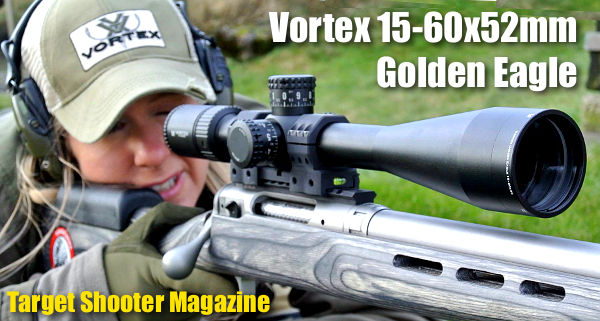
Our British friend Vince Bottomley has had a chance to test the new Vortex 15-60x52mm Golden Eagle scope, priced at $1499.00 in the USA. How does this affordable, high-magnification target scope compete with other comp scopes that cost hundreds (or even thousands) more? Very well indeed according to Vince. He says the Golden Eagle can definitely run with other “big name” high-magnification zoom optics designed for F-Class, Benchrest, and Long Range competition. Vince has written a detailed 15-60x52mm Golden Eagle review for Target Shooter Magazine. Shooters looking for a high-magnification zoom optic should definitely read Vince’s review.
Vince notes that the Vortex Golden Eagle offers impressive performance for the price: “The stunning March 10-60 is the current choice of the serious F-TR shooter – this hand-built scope weighing just 25 oz. from the Deon Optical Corporation of Japan is as near to perfection as any long-range competition shooter could wish. There are several other scopes which have also stood up to scrutiny against the March — the 7-42 Leupold and the Nightforce 15-55 Competition for example. So, why are we getting so excited about the Vortex? One reason – the price!
Sensibly, Vortex manages to offer a product which ticks all the boxes but comes in at around two-thirds of [Leupold 7-42, Nightforce 15-55]. Fantastic value for a top-quality Japanese/American scope, especially considering the dollar/pound exchange rate following Brexit.”
Useful Reticle Design and Innovative Windage Knob
Vince liked the scope’s ECR-1 Reticle which provides true MOA-value hold-off/hold-over stadia (hash marks) at 40X. The Golden Eagle also offers an optional new type of windage knob that provides an increasing value count on both sides of the windage Zero. Vince says this was a smart feature: “The ‘both ways’ windage knob was great. At the end of the shoot, it was easy to know which way to turn it back to zero.”
Should You Buy One?
Here’s how reviewer Vince Bottomley answered that question:
“Well, a high-magnification zoom scope seems to be an F-Class essential, judging from the number of 10-60 March and 15-55 Nightforce scopes in evidence at any GB F-Class League match. If these three scopes were all in the same price-bracket, then the decision in choosing the Vortex 15-60 Golden Eagle would be more difficult but, when the Vortex is only two-thirds the cost of the other two. However, weight-wise, there’s a small penalty – at a tad under 29 oz., the Eagle is 3 oz. heavier than the March but, if you choose your rings carefully, you could pull some of that back.
Finally, Vortex offers probably the best ‘no quibble’ guarantee on the planet and, if you had any wavering doubts about buying a Golden Eagle, that should clinch it.”
UK readers interested in purchasing the Golden Eagle should Contact Osprey Rifles on OspreyRifles.com or e-mail Stuart on stuart@ospreyrifles.com
Top shooters like 11-time National Champion David Tubb have mastered marksmanship by being continually aware of their physical state while shooting. This article by Glen Zediker talks about respiration and how to modulate your breathing to maximize on-target accuracy and consistency. This article originally appeared in the MidSouth Shot Report Blog.
by Glen Zediker
Elsewhere I’ve talked about what I call the “true fundamentals” of shooting. Put the sight on the target and pull the trigger without moving the sight. And we’ve talked about some of the mechanics, like natural point of aim, sight picture, and the trigger itself, that combine to assist this goal.
Holding still sometimes takes more thought, and effort, than we might realize. Shooting well is a truly multi-faceted task that shooters like 11-time National Champion David Tubb have attended to through miniscule details, like being aware of the physical state continually while performing.
Another crucial and largely unknown element is controlling breathing. Right. That thing we do to stay awake and alive. Breathing can be a calculated technique among competitive shooters, and that is because the state of the body in the framework of making a shot is a defining element in the effectiveness of the shooting platform. That platform, by they way, is you!
I’ll break it down, and then offer a few suggestions on how to incorporate a better understanding of the dynamics of maintaining human oxygen supply.
When we are breathing when doing nothing in particular but living, we’re not taking the deepest breaths we can when we inhale, and we’re not expelling all the air we had when we exhale. We’re also not breathing in and out, in and out, in and out in constant successions. We breathe in to a comfortable level. Hold that a bit. We breathe out to a comfortable level. And then we hold that state for a bit. Then we very naturally breathe in again. These cycles are on a balanced rhythm, and a relatively shallow cycle. It’s a lot different than when we’re doing something strenuous, like running.
So, to fire a gun from our most stable state, make the trigger break in what shooting coaches call “the natural respiratory pause”. That’s the state between exhaling and inhaling. From a “human machine” standpoint, that’s when the body is most calm and stable.
Breathing Cycles for Best Shooting
Learn to use the natural pattern of your breathing to experience the most effective (steadiest) hold. When we breathe normally we don’t inhale as much air as we can hold and then blow it all out, and we also don’t breathe continually in and out, in and out. Rather, we simply inhale and exhale to levels that are comfortable to us. Take aim and fire the shot when you have reached what some call the “natural respiratory pause,” or the natural resting point prior to inhalation where we are “using” the oxygen we have retained.
It’s a narrow window. That window of opportunity varies widely depending on a lot of factors, but some experience dry-firing will show you where you stand.
It’s December already. That means winter has definitely arrived — no doubt about it. If you plan to put away all or some of your firearms for the winter, here are TEN Tips for winterizing your firearms.
1. Bore Cleaning and Coating — Clean your barrels and neutralize any solvents you may have used. Then run a couple patches with a corrosion-fighter down the bore. We recommend Eezox or CorrosionX. Eezox leaves a glossy dry film shield with excellent rust resistance. CorrosionX is more like a conventional oil, but with special anti-rust additives. Other products may work well too. Just be wary of the “all in one” products that have a strong solvent, and don’t use any fluid that contains ammonia — this can actually promote corrosion. Here’s a test of various anti-corrosion products: Rust Block Comparison Test.
2. Crown Inspection — After cleaning the barrel, inspect the crown with a magnifying glass. If you see any unusual wear, abrasion, or “shark’s teeth” at the very outer edge of the rifling, make a note — it may be wise to recrown the barrel next spring. Before you place your rifle in the safe, we recommend putting a piece of electrical tape or blue masking tape loosely over the muzzle to protect the crown. This is just to protect the delicate crown during handling — you are NOT trying to seal off the bore.
3. Optics Storage — If your gunsafe is crowded, you may wish to remove the optics and rings from your rifles before winter storage. You can use a white crayon to mark the ring position (on the rail) for next season. We recommend that you store your optics inside a warm part of your house, where temperatures and humidity are relatively stable.
4. Trigger Group — Inspect your trigger assembly. Trigger housings accumulate dirt, grit, and oily gunk over the course of a season. If you have some basic mechanical skills, you may wish to remove the trigger from the hanger and clean it per the manufacturer’s recommendations. Don’t flood it with any kind of thick oil.
5. Bolt and Action – Clean the gunk off your bolt and raceway in your receiver. Put a thin coat of anti-corrosion product on the bolt, and re-grease the lugs and camming surfaces as recommended by the manufacturer. Don’t forget the fasteners and pins on the action and scope rail — these may not be stainless even if you have a stainless steel receiver.
6. Use Thin Gloves — When oiling firearms during the winterization process, we recommend you wear thin latex or nitrile gloves. This will prevent you from leaving skin oils and acids that can actually promote corrosion. This will also protect YOU from any chemicals in the corrosion-blockers you put on your guns.
7. Applying Surface Protectants — For blued firearms, put Eesox or other rust-fighter on a cloth and wipe the barrel and exposed metal. Eezox works best with a couple light coats. Don’t forget iron sights, bottom metal, trigger guards, bolt handles, and sling swivels — they can rust too if not protected. Use Q-Tips or small swabs to reach small, internal parts.
8. Use Gun Sacks — We put rifles and pistols in Bore-Store Gun sleeves. These thick, synthetic-fleece sacks cushion your guns, preventing nicks and scratches. The breathable fabric wicks away moisture, and the fibers are coated with corrosion inhibitors to help fight rust. Bore-Stores are offered in a wide range of sizes, so you can find something to fit everything from a Snub-nosed revolver to a 32″-barrelled 50 BMG. Rifle-size Bore Stores can be purchased for $10.00 – $22.00 from Brownells.com or Amazon.com. While we prefer Bore-Stores for regularly-used guns, if you have heirloom firearms that will be kept in storage for very long periods without seeing any use, you may want to grease them up and place them in the thin, but rugged three-layer storage bags sold by Brownells. Here’s one VITAL bit of advice for using these bags. Be absolutely sure, before you seal up the bags, that your guns are DRY and that all metal surfaces have been coated with an effective rust-blocker, such as BoeShield T9 or Eezox.
9. Take Your Guns OUT of Foam-lined Cases — These common foam-lined cases are Rust Magnets. This may be the most important Tip in this article. Just about the worst thing you can do in the winter (short of leaving your rifle outside in the rain) is to store firearms in tight, foam-padded cases. The foam in these cases actually collects and retains moisture from the air, acting as the perfect breeding ground for rust. Remember, those plastic-shelled cases with foam interiors are for transport, not for long-term storage.
10. Make Your Gun Safe Ready for Winter — If you don’t have a Goldenrod (or equivalent), buy one. Sold as a “dehumidifier”, the Goldenrod is a simple electrical element that can maintain temperature in your gun vault. This helps prevent moisture in the air from condensing on your guns. A small incandescent light-bulb can help as well (just make sure it cannot touch any flammable fabrics or objects). In addition, you may want to purchase Dessicant packs to put inside the safe to absorb moisture. If you have an electronic keypad for your safe, we recommend replacing the batteries at least once a year.
The Legal Brief is a feature of TheGuncollective.com that focuses on firearms rules and regulations. In this Legal Brief video, Attorney Adam Kraut explains key State and Federal regulations governing firearms, and explains how to ensure compliance with all applicable laws.
This five-minute video explains barrel length rules for rifles and shotguns, and also explains the best (and most fool-proof) methods to measure your barrel. In addition, the video explains how to measure firearm overall length. A rifle or shotgun which is less than 26 inches overall can also be classified as a “Short-barreled” rifle/shotgun subject to the NFA. NOTE: Under federal law “If the rifle or shotgun has a collapsible stock, the overall length is measured with the stock EXTENDED”.
Highlights of LEGAL BRIEF Discussion of Barrel Length and Firearm Overall Length
The ATF procedure to measure the length of a barrel is to measure from the closed bolt or breech face to the furthest end of the barrel or permanently attached muzzle device. ATF considers a muzzle device that has been permanently attached to be part of the barrel and therefore counts towards the length.
How to Measure Barrel Length: Drop [a] dowel or rod into the barrel until it touches the bolt or breech face, which has to be closed. Mark the outside of the rod at the end of the muzzle crown (if you don’t have a permanently attached muzzle device) or at the end of the muzzle device if it is permanently attached. Remove the rod and measure from the mark to the end of the rod. That is your barrel length[.]
Remember, if the barrel length is less than 16 inches, it is possible that the firearm could be a short barrel rifle (if you are building a rifle or it is already on a rifle) and if the barrel length is less than 18 inches, it is possible the firearm could be a short barrel shotgun (again if you are building a shotgun or it is already a shotgun). Both of these firearms would be subject to the purview of the National Firearms Act and would require the firearm to be registered accordingly.
How to Measure Overall Length:The overall length of your rifle or shotgun may also classify it as a Short Barrel Rifle or Short Barrel Shotgun. The overall length of a firearm is the distance between the muzzle of the barrel and the rearmost portion of the weapon measured on a line parallel to the axis of the bore. … If the rifle has a permanently attached muzzle device, that is part of the overall length. … If the rifle or shotgun has a collapsible stock, the overall length is measured with the stock extended.
You can do your own experimental calculations using JBM Online Ballistics (free to use). Here is an extreme example, with two printouts (generated with Point Blank software), one showing bullet trajectory at sea level (0′ altitude) and one at 20,000 feet. For demonstration sake, we assigned a low 0.2 BC to the bullet, with a velocity of 3000 fps.
One of our readers asked “What effect does altitude have on the flight of a bullet?” The simplistic answer is that, at higher altitudes, the air is thinner (lower density), so there is less drag on the bullet. This means that the amount of bullet drop is less at any given flight distance from the muzzle. Since the force of gravity is essentially constant on the earth’s surface (for practical purposes), the bullet’s downward acceleration doesn’t change, but a bullet launched at a higher altitude is able to fly slightly farther (in the thinner air) for every increment of downward movement. Effectively, the bullet behaves as if it has a higher ballistic coefficient.
Forum member Milanuk explains that the key factor is not altitude, but rather air pressure. Milanuk writes:
“In basic terms, as your altitude increases, the density of the air the bullet must travel through decreases, thereby reducing the drag on the bullet. Generally, the higher the altitude, the less the bullet will drop. For example, I shoot at a couple ranges here in the Pacific Northwest. Both are at 1000′ ASL or less. I’ll need about 29-30 MOA to get from 100 yard to 1000 yards with a Berger 155gr VLD @ 2960fps. By contrast, in Raton, NM, located at 6600′ ASL, I’ll only need about 24-25 MOA to do the same. That’s a significant difference.
Note that it is the barometric pressure that really matters, not simply the nominal altitude. The barometric pressure will indicate the reduced pressure from a higher altitude, but it will also show you the pressure changes as a front moves in, etc. which can play havoc w/ your calculated come-ups. Most altimeters are simply barometers that read in feet instead of inches of mercury.”
As Milanuk states, it is NOT altitude per se, but the LOCAL barometric pressure (sometimes called “station pressure”) that is key. The two atmospheric conditions that most effect bullet flight are air temperature, and barometric pressure. Normally, humidity has a negligible effect.
It’s important to remember that the barometric pressure reported on the radio (or internet) may be stated as a sea level equivalency. So in Denver (at 6,000 feet amsl), if the local pressure is 24″, the radio will report the barometric pressure to be 30″. If you do high altitude shooting at long range, bring along a Kestrel, or remember to mentally correct the radio station’s pressure, by 1″ per 1,000 feet.”
Recommended Books about Hunting
There’s no shortage of good hunting-related reading material. Here are some of the best books written about hunting. You can find all these titles on Amazon.com. Many are offered in eBook format as well as printed versions. Click on the link(s) below to preview a sample from each book.
“On that day, let us solemnly remember the sacrifices of all those who fought so valiantly, on the seas, in the air, and on foreign shores, to preserve our heritage of freedom, and let us reconsecrate ourselves to the task of promoting and enduring peace so that their efforts shall not have been in vain.”
– 1954, President Dwight D. Eisenhower, Veterans Day proclamation.
On the 11th hour, of the 11th day, of the 11th month of 1918, bugle calls signaled the ‘cease fire’ ending the First World War. (The official Armistice was signed earlier that morning.) To those who endured it, WWI was the “Great War”, “the War to End All Wars.” Tragically, an even greater conflict consumed the world just two decades later.
Today, 98 years after the end of WWI, Americans mark the anniversary of the WWI Armistice as “Veterans Day”. In Canada it is known as Remembrance Day. On this solemn occasion we honor all those who have served in the military in times of war and peace.
While more WWII veterans pass away each year, there are still over 21.8 million veterans in the United States. Take time today to honor those soldiers, sailors, and airmen who have served their nation with pride. Today we remember that… “All gave some, and some gave all.”
Former Secretary of Veterans Affairs Dr. James Peake asked Americans to recognize the nation’s 21.8 million living veterans and the generations before them who fought to protect freedom and democracy: “While our foremost thoughts are with those in distant war zones today, Veterans Day is an opportunity for Americans to pay their respects to all who answered the nation’s call to military service.”
On Veterans Day we especially need to remember the seriously wounded combat veterans. These men and women summon great courage every day to overcome the lasting injuries they suffered in battle. Some of these soldiers have lost limbs, yet volunteered to return to combat duty. That is dedication beyond measure.
National Veterans Day Ceremony
The Veterans Day National Ceremony is held each year on November 11th at Arlington National Cemetery. The ceremony commences precisely at 11:00 a.m. with a wreath laying at the Tomb of the Unknowns and continues inside the Memorial Amphitheater with a parade of colors by veterans’ organizations. The ceremony is intended to honor and thank all who served in the U.S. Armed Forces. Major regional ceremonies and events are also held throughout the country.
The Coriolis Effect comes into play with extreme long-range shots like this (2100 yards at Raton, NM). The rotation of the earth actually moves the target a small distance (in space) during the long duration of the bullet’s flight.
When you’re out at the range, the Earth seems very stable. But it is actually a big sphere zooming through space while spinning around its axis, one complete turn every 24 hours. The rotation of the earth can create problems for extreme long-range shooters. During extended bullet flight times, the rotation of the planet causes an apparent deflection of the bullet path over very long distances. This is the ballistics manifestation of the Coriolis Effect.
Bryan Litz of Applied Ballistics has produced a short video that explains the Coriolis Effect. Bryan notes that Coriolis is “a very subtle effect. People like to make more of it than it is because it seems mysterious.” In most common shooting situations inside 1K, Coriolis is not important. At 1000 yards, the Effect represents less than one click (for most cartridge types). Even well past 1000 yards, in windy conditions, the Coriolis Effect may well be “lost in the noise”. But in very calm conditions, when shooting at extreme ranges, Bryan says you can benefit from adjusting your ballistics solution for Coriolis.
Bryan explains: “The Coriolis Effect… has to do with the spin of the earth. You are basically shooting from one point to another on a rotating sphere, in an inertial reference frame. The consequence of that is that, if the flight time of the bullet gets significantly long, the bullet can have an apparent drift from its intended target. The amount [of apparent drift] is very small — it depends on your latitude and azimuth of fire on the planet.”
Coriolis is a very subtle effect. With typical bullet BCs and velocities, you must get to at least 1000 yards before Coriolis amounts to even one click. Accordingly, Bryan advises: “Coriolis Effect is NOT something to think about on moving targets, it is NOT something to think about in high, uncertain wind environments because there are variables that are dominating your uncertainty picture, and the Coriolis will distract you more than the correction is worth.”
“Where you could think about Coriolis, and have it be a major impact on your hit percentage, is if you are shooting at extended range, at relatively small targets, in low-wind conditions. Where you know your muzzle velocity and BC very well, [and there are] pristine conditions, that’s where you’re going to see Coriolis creep in. You’ll receive more refinement and accuracy in your ballistics solutions if you account for Coriolis on those types of shots. But in most practical long-range shooting situations, Coriolis is NOT important. What IS important is to understand is when you should think about it and when you shouldn’t, i.e. when applying it will matter and when it won’t.”
The Coriolis Effect — General Physics
The Coriolis Effect is the apparent deflection of moving objects when the motion is described relative to a rotating reference frame. The Coriolis force acts in a direction perpendicular to the rotation axis and to the velocity of the body in the rotating frame and is proportional to the object’s speed in the rotating frame.
A commonly encountered rotating reference frame is the Earth. The Coriolis effect is caused by the rotation of the Earth and the inertia of the mass experiencing the effect. Because the Earth completes only one rotation per day, the Coriolis force is quite small, and its effects generally become noticeable only for motions occurring over large distances and long periods of time. This force causes moving objects on the surface of the Earth to be deflected to the right (with respect to the direction of travel) in the Northern Hemisphere and to the left in the Southern Hemisphere. The horizontal deflection effect is greater near the poles and smallest at the equator, since the rate of change in the diameter of the circles of latitude when travelling north or south, increases the closer the object is to the poles. (Source: Wikipedia)
Jeffrey Block has created a great FREE software program, OnTarget, that measures shot groups quickly and precisely. All you need is a photo or scan of your target. The program allows you to set your target distance, and provides caliber-specific tools to precisely mark the center of each shot. Once you’ve marked each bullet hole, Jeff’s OnTarget program automatically calculates group center, maximum group spread (CTC), average distance to center, group width and height, and group offset from point of aim. The program will even measure multiple groups on the same target.
Video Tutorial Shows How OnTarget Software Works
Jeff created an excellent Animated Tutorial demonstrating OnTarget’s functions. It shows how to import a target image or scan, how to set target distance and scale, how to set bullet size, how to circle each bullet hole, and how to save the marked and measured target. VIEW OnTarget TUTORIAL.
After just a few minutes spent learning the program’s tool buttons, we were able to plot shot groups on a variety of targets with ease. Once you select the target distance and bullet diameter, figuring group size is a simple matter of centering a circle tool over each bullet hole. Then the program “connects the dots” and provides all the info you could want automatically.
The program worked with bullet holes as small as 17 caliber and as large as 50 caliber. It is very precise, but remember that if your target photo was taken at an angle, distorted perspective can cause slight errors in measurement. Therefore, for the ultimate precision, you want to start with a flat scan of the target.
OnTarget Compared to Measuring Manually
We found OnTarget to be especially useful for groups with widely dispersed bullet holes, or very small bullet holes, such as 17 caliber holes. We’ve found that it’s difficult to measure 17-cal group sizes with a standard caliper, because the tool itself obscures the tiny holes. With OnTarget, the program can zoom up your target view, making it much easier to plot the center of each shot. And with a widely dispersed group of shots, the program automatically finds the two most distant shots. You can’t mistakenly pick the wrong pair of shots to measure.
MEASURING REAL TARGETS — Actual Examples
Here are examples we created with OnTarget. The first photo shows a 17 Mach 2 target. These tiny 17-cal holes are notoriously hard to measure. With OnTarget, it’s a snap. You just load the target image into the program, zoom in with the controls, and then click on the center of the holes. The program automatically calculates group size, displaying measurements in both inches and minutes of angle (MOA)
Original Target (with ruler for scale)
Target Captured and Displayed in Program
Detail of Group, Enlarged by Program
10-shot Groups? — No Problem
Here’s another target, showing 6mm bullet holes at 600 yards. The first image shows the target image loaded into the program with the ten holes circled in red.
Target Displayed in Program
For this target we have used the Aiming Point option. The Aim Point was set at the center of the “X” and the program calculates average distance from the Aim Point. Very cool.
Detail of 10-Shot Group, Enlarged by Program
No Scanner Needed
The OnTarget program grabs target scans directly from a flatbed scanner using Microsoft’s Windows Image Acquisition system. But don’t worry if you don’t have a scanner. You can just take a digital photo of your target and OnTarget will import it quickly and easily. To set target scale, a simple tool allows you to mark a known length on the target (such as the diameter of the “X” Ring), and the program will then size the target accordingly. Is OnTarget precise and accurate? Here’s what Forum Member Steve W. says: “I used the extreme spread measurement of a group on one of my 600-yard match targets… as it was officially scored at the match. By clicking the +—+ icon, then clicked the cursor in the centers of the two extreme spread holes, I then entered that value in the reference window. After that it was simple because the bullet placement cursor’s circle was the same size as the black outline of the actual bullet holes on the picture of the target. OnTarget’s measurement came up within .006″ of the official 2.772 inch measurement of the group. That’s pretty darned close; well inside the human judgment of aligning the tips of a micrometer on the bullet holes.”
Bottom Line — Great Program — Download It Today
Jeffrey Block has done a great service for shooters by creating the FREE OnTarget program. It is easy to learn, it functions great, and it can save you time and effort measuring targets. It also lets you easily archive and compare multiple targets produced during load development or rifle testing. You can record ammo type, date, location, weather etc. in note fields accessed by “Group Info” and “Target Info” tabs.
Keep in mind that OnTarget was NOT created to replace existing methods for scoring competition targets. But for all other target measuring purposes it does a great job. Visit Jeff’s website, OnTargetShooting.com, view the tutorial, and check out OnTarget for yourselves.
To learn more about OnTarget, see more measuring samples, and read advanced Power-User Tips, visit our full OnTarget Product Review.
What is Parallax?
Parallax is the apparent movement of the scope’s reticle (cross-hairs) in relation to the target as the shooter moves his eye across the exit pupil of the riflescope. This is caused by the target and the reticle being located in different focal planes.
Why is it Important?
The greater the distance to the target and magnification of the optic, the greater the parallax error becomes. Especially at longer distances, significant sighting error can result if parallax is not removed.
How to Remove Parallax
This Nightforce Tech Tip video quickly shows how to remove parallax on your riflescope.
While keeping the rifle still and looking through the riflescope, a slight nod of the head up and down will quickly determine if parallax is present. To remove parallax, start with the adjustment mechanism on infinity and rotate until the reticle remains stationary in relation to the target regardless of head movement. If parallax has been eliminated, the reticle will remain stationary in relation to the target regardless of eye placement behind the optic.
This Parallax Discussion first appeared in the Nightforce Newsletter. To get other helpful Tech Tips delivered to your mailbox, CLICK HERE to open the Nightforce Newsletter sign-up page.




 1. Bore Cleaning and Coating — Clean your barrels and neutralize any solvents you may have used. Then run a couple patches with a corrosion-fighter down the bore. We recommend
  3. Optics Storage — If your gunsafe is crowded, you may wish to remove the optics and rings from your rifles before winter storage. You can use a white crayon to mark the ring position (on the rail) for next season. We recommend that you store your optics inside a warm part of your house, where temperatures and humidity are relatively stable.
 6. Use Thin Gloves — When oiling firearms during the winterization process, we recommend you wear thin latex or nitrile gloves. This will prevent you from leaving skin oils and acids that can actually promote corrosion. This will also protect YOU from any chemicals in the corrosion-blockers you put on your guns.
 9. Take Your Guns OUT of Foam-lined Cases — These common foam-lined cases are Rust Magnets. This may be the most important Tip in this article. Just about the worst thing you can do in the winter (short of leaving your rifle outside in the rain) is to store firearms in tight, foam-padded cases. The foam in these cases actually collects and retains moisture from the air, acting as the perfect breeding ground for rust. Remember, those plastic-shelled cases with foam interiors are for transport, not for long-term storage.
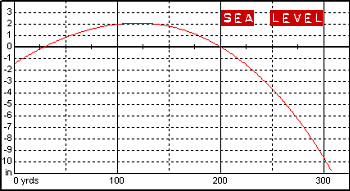

 One of our readers asked “What effect does altitude have on the flight of a bullet?” The simplistic answer is that, at higher altitudes, the air is thinner (lower density), so there is less drag on the bullet. This means that the amount of bullet drop is less at any given flight distance from the muzzle. Since the force of gravity is essentially constant on the earth’s surface (for practical purposes), the bullet’s downward acceleration doesn’t change, but a bullet launched at a higher altitude is able to fly slightly farther (in the thinner air) for every increment of downward movement. Effectively, the bullet behaves as if it has a higher ballistic coefficient.




 When you’re out at the range, the Earth seems very stable. But it is actually a big sphere zooming through space while spinning around its axis, one complete turn every 24 hours. The rotation of the earth can create problems for extreme long-range shooters. During extended bullet flight times, the rotation of the planet causes an apparent deflection of the bullet path over very long distances. This is the ballistics manifestation of the

 After just a few minutes spent learning the program’s tool buttons, we were able to plot shot groups on a variety of targets with ease. Once you select the target distance and bullet diameter, figuring group size is a simple matter of centering a circle tool over each bullet hole. Then the program “connects the dots” and provides all the info you could want automatically.


