Ask 10 shooters about barrel cleaning and you’ll get 10 different opinions. This reflects that fact that different fouling problems demand different solutions. For example, solvents that work well for copper may not be the best for hard carbon (and vice-versa). To come up with the right solution, first you must understand the nature of the fouling in your barrel.
The debate about the proper care of a match barrel is a hot one, spiked with folklore and old wives’ tales, Lohman said. He and his staff set out to set the record straight: “We tried to interject some science into the discussion of cleaning a match barrel,” he explained. In his article, Lohman writes:
Why worry about a little barrel fouling when the throat is subjected to a brutal 5,600° F volcano at 55,000 PSI? To investigate these and other questions about taking care of a match barrel, we spoke with a dozen experts and share their knowledge in this first of a series of articles.
After listening to folks who shoot, build barrels or manufacture cleaning solvents for a living, we concluded that even the experts each have their own unique recommendations on how to care for a match barrel. But they all agree on one thing — the gun will tell you what it likes best. Because the life expectancy of a match barrel is about 1,500 to 2,500 rounds, the objectives of cleaning one should include: preserve accuracy, slow the erosion, and remove fouling — all without damaging the gun. This article doesn’t claim that one cleaning method is better than the next. Rather, we set out to interject a little science into the discussion and to share some lessons learned from experts in the field.
For more Shooting Sports USA articles, visit www.ssusa.org.
John Krieger Interview with AccurateShooter at SHOT Show:
For years, Timney triggers have been popular drop-in upgrades for hunting rifles, rimfire rifles, and AR platform rifles. To meet the demand for its many trigger products, Timney Triggers has expanded its operation, adding state-of-the-art CNC machines and other high-end, automated equipment. A far cry from the dank gun factories of the 1950s and 1960s, Timney’s Arizona production center now resembles the squeaky-clean, ultra-modern facilities where electronics are assembled.
Today’s Timney factory is all about computerized automation. Timney Triggers’ owner John Vehr states that it would take 60 or more trained machinists and metal-workers to produce as many triggers as can Timney’s modern machines. Timney does employ two dozen workers, but they are assigned tasks that the computerized machines can’t do as well or better.
If you want to see how Timney triggers are made this days, check out Tom McHale’s recent account of his visit to the Timney Factory in Scottsdale, Arizona. McHale explains how the triggers are designed and fabricated, and 20 high-rez photos illustrate the production process and machinery.
Report by Clint Johnson, ACWLC
The 2015 IBS 200/300 Yard National Championships were held September 12-13 at the Ashe County Wildlife Club (ACWLC) outside Jefferson, North Carolina. Fifty shooters from 13 states attended. Nightforce was the major event sponsor, donating a $2,400 rifle scope. While rain threatened to mar the 200-yard match on Saturday, none fell. By Sunday, the day of the 300-yard shoot, the first cold front of the fall had passed, leaving mostly sunny conditions.
Conditions Keep Scores Low At 200/300 Yard Nationals
The rain that fell on Friday night started drying Saturday morning when the sun rose. That slow evaporation created mirage that plagued shooters looking northeast down the two-year-old, 300-yard range with a 50-foot high backstop. The wind that came in with the cold front also hampered shooters on both days.
Mean Conditions at Ashe County
“Shooters told me the conditions were as bad as they have ever shot”, said Steve Eller, the IBS chair for the Wildlife Club. “We all had a hard time seeing the rings through the mirage blur. No one shot clean, and no records were set.”
Shooters came from as far away as Maine, Indiana and Florida to Ashe County, “the coolest corner of North Carolina”. The ACWLC range is located in the mountainous northwest point of the state with Virginia to the north and Tennessee to the west. Some of those shooters have made every one of the four IBS-sanctioned matches held at the club this year and last year. The Club hosted the 100 and 200 Yard National Championship in 2014, the first full year since the opening of the club house in 2013 with its 30 benches protected by an overhang.
“I love coming here. It is my favorite place to shoot,” said Hillary Martinez of Damascus, Maryland. Hillary, shown below, was one of the four women shooters this year.
Danny Hensley of Jonesville, Virgina, won the Grand Aggregate Varmint for Score (VFS) with a score of 493 (10X), followed by David Richardson with 492 (11X) and Randy Jarvais with 491 (12X). Danny talks about his victory in the audio clip linked below. To listen, click on the black arrow in the white circle.
AUDIO FILE: Danny Hensley Talks about the Conditions at the 200/300 Nationals.
Here are all the Class Winners at the IBS 200/300 Yard Nationals:
Wayne France of Burke, Va. won the 200-Yard VFS with a score of 250 (11X), followed by rookie Ken Habedank with score of 250 (8X), and David Richardson with a score of 250 (8X).Morris Williams of Eden, Maryland, won the 300-Yard VFS with a score of 244 (3X), followed by Danny Hensley with a score of 243 (4X), and David Richardson with a score of 242 (3X).
There were just five (5) shooters in the Hunter Class. Dean Breeden topped the small field to win the Hunter Grand Aggregate with a score of 483 (10X), followed by Randy Jarvais with a sore of 480 (7X), and K.L. Miller with a score of 478 (12X). Randy Jarvais won the 200-Yard Hunter with a score of 248 (6X), followed by K.L. Miller with a score of 246( 8X), and Dean Breeden with a score of 246 (7X). Orland Bunker of Damariscotta, Maine, won the 300-Yard Hunter with a score of 238 (2X), followed by Dean Breeden with a score of 237 (3X), and K.L. Miller with a score of 232 (4X).
Dean Breeden (Frederick, Maryland) had a beautifully-figured wood composite rifle.
Barbecue North Carolina Style
Some shooters remarked that they drove to Ashe County not only to shoot, but to eat as well. A 300-pound hog was slow-cooked all Friday night by Club members. Corn was also roasted on the grill. The cost of this distinctive North Carolina pork barbecue was included in the registration fee.
Ashe County Wildlife Club maintains a website, www.acwlc.org and a public Facebook page. The Club hosts rifle, pistol, and shotgun sports (skeet, trap, sporting clays) events at its range facility located about 15 miles east of West Jefferson at 3220 Big Peek Creek Road, Laurel Springs, NC (turn north off NC Highway 88). Visit www.acwlc.org to learn more about the club or obtain Membership applications.
Derek Rodgers is a member of the Team Sinclair F-TR squad. This talented group of shooters hasn’t lost a team match in years. What’s the secret of Team Sinclair’s success? Well there is not one single factor. These guys have very accurate rifles, work hard on load development, and practice in all conditions. In this interview, Derek Rodgers talks about long range competition, reviewing the hardware (and skill set) it takes to win. He offers some great tips on developing loads. You’ll find a longer version of this interview on the Sinclair Int’l website. CLICK HERE to Read Full Interview.
Derek Rodgers BIOGRAPHY
Derek Rodgers (Albuquerque, NM), is the only shooter to have won BOTH the F-Open and F-TR National Championships. Derek shot his first NRA sanctioned-match in 2007, and just three years later Derek won the 2010 F-Open Nationals. He also won the 2013 F-TR Nationals, making him the only person to win both divisions. He has won other major F-TR matches, including the 2013 Sinclair East Coast Nationals and the 2015 Berger SW Nationals. Derek holds the current 1000-yard, 20-shot, National F-TR Record (200-12X). Derek enjoys spending his time outdoors with his wife and two daughters, ages 12 and 7. He is blessed by his faith and supported by his family. Derek’s goal is to pass on what he has learned to the next generation.
Q: What is your favorite reloading product?
I really like my BenchSource Case Annealer. There is something about watching fire that I find relaxing. I can watch those shells go around the wheel for hours.
Q: What’s your preferred front rest or bipod?
I’m currently using a Duplin bipod. At 17.2 ounces it allows me a solid platform to shoot from and the extra wiggle room to make weight with a heavy barrel and Nightforce NXS scope. Also, I can’t do without my board under the bipod. We shoot off sand at my local range and in most cases the feet will tend to dig holes if not supported. The board is necessary gear for me.
Q: What rear bag do you use?
I have an Edgewood bag that I’ve used for years. Recently, I got a SEB Bigfoot and like how it supports the gun and stays put under recoil.
Q: Explain your load development process. What’s your methodology?
I have two log books that have many combinations that work with 308s. I have tried to keep detailed notes in these books. Now I am reaping the rewards, as I can go back to a particular twist and barrel length and find something very close. I usually start with 3-shot groups and check the chamber behavior. If something looks promising I will go back to the range and load up 6-shot groups. If those shoot well, I take it to a match to verify it in a 20-shot string. If it passes that test it is either good to go or I table it and try another. I tend to pick mild loads that the cartridge shoots well — consistently.
Q: What piece of shooting gear helps your load development?
I use a MagnetoSpeed Chronograph to record velocities. Then I can slow down or speed up my loads to reach an accuracy node. It is amazing that most barrels will shoot very accurately when fired at certain known velocity nodes.
Q: What do you carry in your range bag on Match days?
Multi-piece Brownells tool set, RX Glasses, Sunglasses, Range Rod, Towel, Empty Chamber Indicators, Jacket, Sunscreen, Foam Ear Protection, Ear Muffs, Data Book, Plot Sheets, Pen, Clip Board, iPod with ballistic data, and chewing gum.
Q: How did you get started shooting?
I was raised in New Mexico where outdoor activities are abundant. Once my father introduced me to a Crossman pellet gun, all I wanted to do was shoot and refine my skills. Shooting evolved into hunting and then into perfecting my skills in off-season matches. Shooting local F-Class matches made me better as a marksman. Now I feel like I am competitive with anyone. However, I will never forget that my roots started with hunting and still cherish the opportunity to hunt…
Q: What do you find most challenging? How do you learn from mistakes?
What I find most challenging about precision shooting sports is how great shooters are able to reflect on what was learned — both positively and negatively. It is important to slow down and perform this step. Stopping to reflect and learn from mistakes I’ve made on the firing line is challenging. Not many people enjoy accurately critiquing themselves. Also the wind usually blows here in New Mexico and choosing the right time to shoot and to stop is important. It’s often tempting to try to finish out a string of fire. But sometimes challenging yourself to quit and wait out some wind will pay off[.]
Q: What advice do you have for selecting a gunsmith?
The best recommendation I can give is for a person to get to know a gunsmith. If you can find a local gunsmith that is available — even better! If you run into a snag along the way, it is so nice to be able to work it out without sending things back and forth. Be honest, realistic with your expectations and tell the gunsmith what you want. If he only wants to do things his way, or takes extra or excessive time in meeting the goals, you may want to consider someone else.
Q: Who would you recommend for stock work on your rifle?
Alex Sitman from Master Class Stocks and Doan Trevor can build or fix most anything.
Q: What do you do to mentally prepare before a shooting competition?
I relax and try to remember I do this for fun. I anticipate what game plan I want to go to the line with. I also try to take small snapshots of the conditions. I do not like getting overloaded with staring down a spotting scope for long periods of time. I try not to get overwhelmed with the match and just shoot my game. My approach is “One shot at a time — good or bad”. I will usually tell my scorer what I’m going to do so he or she is ready as well.
Q: What advice would you give to novice competitors?
Partner up with an experienced shooter that is ranked nationally. Mentoring under a veteran shooter would be the best way to help save time learning instead of experimenting. Chances are an experienced shooter has already tried what you are considering. As a new shooter, do not get sucked into reading all of the opinionated blogs on the internet. Stick to good information. AccurateShooter.com | 6mmBR.com is a great resource with a wealth of information from knowledgeable writers. That site has articles that are based from facts and/or industry news and information.
Q: What is something you would NOT recommend before a shoot?
I do not recommend coming unprepared. If you are late, scrambling around, or do not have your gear in order, you will not perform at your best.
Q: How many rounds do you shoot in a year and how often do you practice?
I shoot 3000+ rounds a year. I try to shoot 1 x a week if I can get away in the evening or on the weekend. If I am close to finding a load I may try to get out more until I exhaust that load as an option. So there may be occasions that I will try to shoot three times a week. Fortunately, the winters are mild in New Mexico and it allows me to shoot year round. I actually shoot more when it is colder. The summer sun here can create mirage that makes it nearly impossible to learn anything.
Each Wednesday, the U.S. Army Marksmanship Unit publishes a reloading “how-to” article on the USAMU Facebook page. This week’s “Handloading Hump Day” post covers an important safety issue — why you should never assume that a stated “book” load for a particular bullet will be safe with an equal-weight bullet of different shape/design. The shape and bearing surface of the bullet will affect the pressure generated inside the barrel. Visit the USAMU Facebook page next Wednesday for the next installment.
Beginning Handloading, Part 13:
Extrapolating Beyond Your Data, or … “I Don’t Know, What I Don’t Know!”
Last week, we addressed several key facets of Service Rifle reloading. Today, we continue our Handloading Safety theme, focusing on not inadvertently exceeding the boundaries of known, safe data. Bullet manufacturers’ loading manuals often display three, four, or more similar-weight bullets grouped together with one set of load recipes. The manufacturer has tested these bullets and developed safe data for that group. However, seeing data in this format can tempt loaders — especially new ones — to think that ALL bullets of a given weight and caliber can interchangeably use the same load data. Actually, not so much.
The researchers ensure their data is safe with the bullet yielding the highest pressure. Thus, all others in that group should produce equal or less pressure, and they are safe using this data.
However, bullet designs include many variables such as different bearing surface lengths, hardness, and even slight variations in diameter. These can occasionally range up to 0.001” by design. Thus, choosing untested bullets of the same weight and caliber, and using them with data not developed for them can yield excess pressures.
This is only one of the countless reasons not to begin at or very near the highest pressure loads during load development. Always begin at the starting load and look for pressure signs as one increases powder charges.
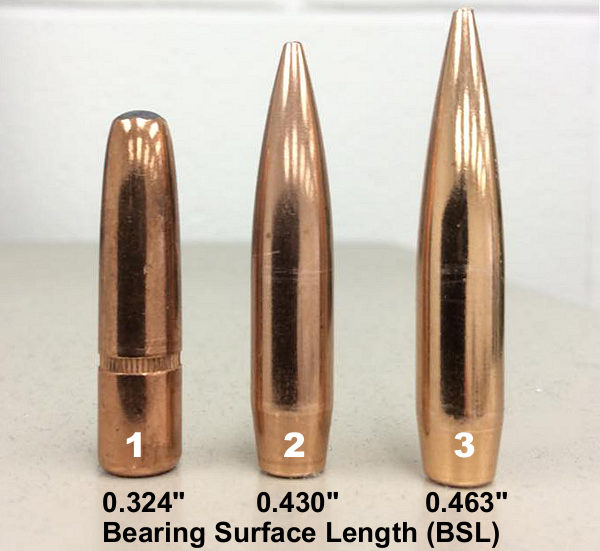
Bullet bearing surface length (BSL) is often overlooked when considering maximum safe powder charges and pressures. In photo 1 (below), note the differences in the bullets’ appearance. All three are 7mm, and their maximum weight difference is just five grains. Yet, the traditional round nose, flat base design on the left appears to have much more BSL than the sleeker match bullets. All things being equal, based on appearance, the RN/FB bullet seems likely to reach maximum pressure with significantly less powder than the other two designs.
Photo 1: Three Near-Equal-Weight 7mm Bullets with Different Shapes
Due to time constraints, the writer used an approximate, direct measurement approach to assess the bullets’ different BSLs. While fairly repeatable, the results were far from ballistics engineer-grade. Still, they are adequate for this example.
Bullet 1 (L-R), the RN/FB, has a very slight taper and only reaches its full diameter (0.284”) very near the cannelure. This taper is often seen on similar bullets — it helps reduce pressures with good accuracy. The calculated BSL of Bullet 1 was ~0.324”. The BSL of Bullet 2, in the center, was ~0.430”, and Bullet 3’s was ~ 0.463”. Obviously, bullets can be visually deceiving as to BSL!
Some might be tempted to use a bullet ogive comparator (or two) to measure bullets’ true BSL for comparison’s sake. Unfortunately, comparators don’t typically measure maximum bullet diameter and this approach can be deceiving.
Photo 2: The Perils of Measuring Bearing Surface Length with Comparators
In Photo 2, two 7mm comparators have been installed on a dial caliper in an attempt to measure BSL. Using this approach, the BSLs differed sharply from the original [measurements]. The comparator-measured Bullet 1 BSL was 0.694” vs. 0.324” (original), Bullet 2 was 0.601” (comparator) vs. 0.430” (original), and Bullet 3 (shown in Photo 2) was 0.602” (comparator) vs. 0.463” (original). [Editor’s comment — Note the very large difference for Bullet 1, masking the fact that the true full diameter on this bullet starts very far back.]
Please join us again next week as we examine other lesser-discussed variables that affect pressure and velocity during handload development. In the meantime, stay safe, and favor center!
Dan Pohlabel is a member of the all-conquering Team Sinclair F-TR squad. This talented group of shooters hasn’t lost a team match in years. What’s the secret of Team Sinclair’s success? Well there is not one single factor. These guys have very accurate rifles, they work hard on load development, and they practice in all conditions. In this interview, Dan Pohlabel talks about F-TR competition, reviewing the hardware (and skill set) it takes to win. He offers some great tips on developing loads. You’ll find a longer version of this interview on the Sinclair Int’l website. CLICK HERE to Read Full Interview.
Q: What do you find most challenging in F-TR Shooting?
It has to be keeping up with the competition, our sport has grown so quickly with new talented shooters. Staying at the top requires having a laser of a rifle, perfect loads, near perfect wind reading, and, of course, breaking good shots.
Q: How can novice shooters improve their game?
Seek out the local F-TR shooters and go to matches with them, listen and learn. Attend team matches and offer to score for one of the teams. As a scorer, you will sit close enough to hear the coach make wind calls and see the results on the target. Through the spotting scope you will see changes in mirage and it’s the quickest way to learn the basics of wind reading. Choosing and buying equipment is relatively easy, learning to read the wind is a journey.
Q: What’s in your range bag for match days?
Rear bag, towel, shooting glasses, canned air, ear protection, data book, pen, rifle rain cover, hat, rifle tools, timer, ammo, and bug spray.
Q: What specialized gear can you not live without?
1. A good set of elbow pads. It’s hard to keep concentrating on shooting when your elbows are rubbed raw from days of competing on them.
2. Good bug spray. We shoot from the ground but our shooting mats aren’t that big. It’s hard to concentrate with bugs crawling or chewing on you.
Q: Load Development — How do you work up a load?
First, I call Derek Rodgers and get his load data, he is the best load development shooter I know! Otherwise, here is the procedure I recommend. Measure throat length with bullet of your choice, to determine how much room is left in the case. The above measurement determines what powders you can use. We use only Hodgdon Extreme powders. Shoot a ladder test, five rounds each in 0.2 grain increments, to find the accuracy node for that bullet/powder combination. Take the best two loads and do a jump test with five rounds each, test at .005″, .025″, .060″ jump. One of these groups will be significantly better than the rest, now you can tweak that measurement +/- .002” or .005” to get the best accuracy.
Test at least three different primers to determine which offers a little better ignition for your load, a 5-shot test will usually tell you which is the best. Go back and test the two best combinations in a 10-shot test at least twice, pick a cool overcast day and also a hot sunny day and compare results. Take your final “best load” back and do a “simulated match”, 20 shots, waiting at least 20 seconds between shots. If you like those results it’s probably a reliable and accurate load.
Q: What rear bag do you use?
I use a two-bag system, large bag on bottom with a smaller bag on top. I had the bags made of marine canvas, zippered and filled with plastic beads. I can adjust the amount of fill to make them a perfect height for my shooting position. Teammate Jeff Rorer uses a similar system and mine is nearly a copy of his rear bags.
Q: How often do you practice and how many rounds do you shoot per year?
In good weather I practice a couple times a week at the local range, a couple more dry-firing practices/week at home. I typically shoot between 2,000-2,500 rounds per year.
Q: How do you prepare mentally before a match?
[I do] lots of visualization — run the video in my head of what I expect to see and of my performance. I think about the correct strategy for the conditions, staying disciplined to the strategy.
Q: What do you avoid before a shoot?
No late nights or excessive alcohol. Very little caffeine in the morning. Leave your cell turned off. Avoid emotional people.
Q: What’s your procedure on a Match day?
I arrive early, get squadding card, move gear, watch wind speed/direction, check over rifle and gear, sit and relax, visualize and focus on the most important goal of the day. Most days we shoot three relays of 20 shots. It’s important to eat and hydrate continually all day. My focus and concentration are better when I snack all day with fruit and energy bars, and lots of water. While taking my turn in the pits, I try to relax and only focus on what is ahead of me and [not] what’s already happened.
Q: What is your favorite reloading product?
My favorite reloading product is the Sinclair Premium Neck Turning Tool with Handle, I also use the expander mandrels provided by Sinclair for sizing the brass in preparation for the turning process. Correct and repeatable neck tension begins with turning necks to a uniform thickness. Sinclair also has mandrels to size the necks after neck turning that accurately size the necks for a specific neck tension.
Q: What is your preferred scope?
The scope I find the most useful is the Nightforce Competition Scope. This scope is very light-weight, has 15-55X magnification, world-class quality glass, 10 MOA per revolution on the turrets, 1/8 moa adjustments. It’s perfect for F-Class competition.
Q: What advice do you have for someone wanting to get into the sport?
Find a local club with some F-TR shooters and ask for their help. Most shooters will be happy to take you with them to a match, listen and learn while you’re there. You may find out it’s not what you thought, or you may be hooked. If you decide to jump in, start with an inexpensive rifle. This sport is expensive and you don’t need a $5000 rifle to learn good wind-reading skills. Start with a used Savage F-TR rifle and learn the basics, shoot for a year at least before making a larger investment. The money you saved buying a used Savage rifle will help pay for your divorce lawyer, LOL.
Q: What training drills do you use?
Dry-firing the rifle at home is a good way to practice when you can’t get to the range and shoot. It allows me to practice set-up, rifle handling, and position. When I can practice at a local range, I also dry-fire between shots to increase the amount of repetitions and increase the time spent in position.
Q: Who has been your biggest influence in shooting?
Eric Bair, 2006 F-Open National Champion helped me get started and gave me great advice. Most of the shooters on Team USA and Team Sinclair help each other, nobody knows all the answers but we share what we have learned. Danny Biggs, 2008 and 2009 F-TR National Champion also helped me when I was struggling to learn some of the ranges. I learned a lot from Danny.
We’ve all seen them — you know those guys who don’t follow range rules, or who handle firearms in a careless manner. Sometimes bad range etiquette is simply annoying. Other times poor gun-handling practices can be downright dangerous. The NRA Blog has published a useful article about range safety and “range etiquette”. While these tips were formulated with indoor ranges in mind, most of the points apply equally well to outdoor ranges. You may want to print out this article to provide to novice shooters at your local range or club.
8 Tips for Gun Range Etiquette
Story by Kyle Jillson for NRABlog
Here are eight tips on range etiquette to keep yourself and others safe while enjoying your day out [at the range]. Special thanks to NRA Headquarters Range General Manager Michael Johns who assisted with this article.
1. Follow the Three Fundamental Rules for Safe Gun Handling
ALWAYS keep the gun pointed in a safe direction.
ALWAYS keep your finger off the trigger until ready to shoot.
ALWAYS keep the gun unloaded until ready to use.
2. Bring Safety Gear (Eye and Ear Protection)
Eye and Ear protection are MANDATORY for proper safety and health, no matter if “required” by range rules or not. It is the shooter’s responsibility to ensure proper protection is secured and used prior to entering/using any range. Hearing loss can be instantaneous and permanent in some cases. Eyesight can be ruined in an instant with a catastrophic firearm failure.
3. Carry a Gun Bag or Case
Common courtesy and general good behavior dictates that you bring all firearms to a range unloaded and cased and/or covered. No range staff appreciates a stranger walking into a range with a “naked” firearm whose loaded/unloaded condition is not known. You can buy a long gun sock or pistol case for less than $10.
4. Know Your Range’s Rules
Review and understand any and all “range specific” rules/requirements/expectations set forth by your range. What’s the range’s maximum rate of fire? Are you allowed to collect your brass? Are you required to take a test before you can shoot? Don’t be afraid to ask the staff questions or tell them it’s your first time. They’re there to help.
5. Follow ALL Range Officer instructions
ROs are the first and final authority on any range and their decisions are generally final. Arguing/debating with a Range Officer is both in poor taste and may just get you thrown out depending on circumstances.
6. Don’t Bother Others or Touch Their Guns
Respect other shooters’ privacy unless a safety issue arises. Do NOT engage other shooters to correct a perceived safety violation unless absolutely necessary – inform the RO instead. Shooters have the right and responsibility to call for a cease fire should a SERIOUS safety event occur. Handling/touching another shooter’s firearm without their permission is a major breech of protocol. Offering unsolicited “training” or other instructional suggestions to other shooters is also impolite.
7. Know What To Do During a Cease Fire
IMMEDIATELY set down your firearm, pointed downrange, and STEP AWAY from the shooting booth (or bench). The Range Officer(s) on duty will give instructions from that point and/or secure all firearms prior to going downrange if needed. ROs do not want shooters trying to “secure/unload” their firearms in a cease fire situation, possibly in a stressful event; they want the shooters separated from their guns instantly so that they can then control the situation as they see fit.
8. Clean Up After Yourself
Remember to take down your old targets, police your shooting booth, throw away your trash, and return any equipment/chairs, etc. Other people use the range too; no one wants to walk up to a dirty lane.
The NRA’s Shooting Sports USA has a “new and improved” website. The new mobile-friendly format makes it easy to access current articles as well as locate interesting archived stories.
One great recent Shooting Sports USA article, Shooting is 90% Mental, was penned by Chip Lohman (SSUSA’s former Editor). With the help of two very smart Ph.D types, Judy Tant and Mike Keyes, Lohman examines the mental processes involved in the shooting sports. Chip’s co-authors have impressive credentials. Dr. Judy Tant is a Clinical Psychologist and National Bullseye Pistol Champion. Dr. Michael J. Keyes, is a licensed Psychiatrist and former physician for the U.S. Shooting Team.
If you shoot competitively, this is definitely a “must-read” article. The authors examine how the brain functions under stress, how “visualization” can be used to improved performance, how “brain speed” can be enhanced through proper training, and how the brain stores learned routines into “muscle memory.” And that’s just for starters — the article gives many concrete examples of techniques top shooters have employed to improve their “mental game” and shoot higher scores.
Brain Speed and Trigger Control: Research: Scientists believe that the newer frontal lobe may not be able to keep up with “deep” brain signals that transmit at nearly 300 mph. This is explained when athletes talk about “letting go,” rather than over-thinking the shot. This conscious signal can take up to 0.3 seconds from recognizing the desired sight picture to moving the trigger finger—too long to capture the opportunity for a perfect shot. However, if the signal is initiated spontaneously in the cerebellum where such procedures are thought to be stored through repetition, the reaction speed is much quicker. Signals are processed by the “deep brain” almost twice as fast as the problem-solving frontal lobes.
More guns… more guns than ever. That’s what U.S. gun-makers have been cranking out. According to the latest BATFE Fireams Commerce Report, American gun manufacturers produced over ten million guns in 2013, the last full reporting period. That’s an all-time record.
The 2013 total of 10.885 million guns produced in 2013 represents a 27% increase over the 8.579 million guns made in 2012. What’s even more surprising, the 2013 total is nearly double the quantity product just three years before in 2010 — 5.459 million firearms. Any way you look at it, that’s a huge increase in firearms production in a very short time.
As a category, pistols (primarily semi-auto, and not counting revolvers) have seen the largest increase in production, rising from 662,973 in 1986 to 4,441,726 in 2013. Notably the number of wheelguns produced has actually declined from 761,414 in 1986 to 725,282 in 2013.
In recent years there has been a significant growth in the number of shotguns sold, due to increased consumer interest in scatterguns for sport and defense. The number of shotguns sold topped did break the million mark in 2013, rising from 949,010 in 2012 to 1.203 million in 2013, and increase of 27%.
There has also been a significant growth in NFA items sold over the last dozen years, lead by a huge increase in the number of suppressors. In fact, as we reported last week, from 2014 to 2015, the number of NFA-registered suppressors rose from 571,150 to 792,282. That’s a 39% increase in just one year! There are now nearly 800,000 suppressors now registered in the USA.
The BATFE Report, officially the Firearms Commerce in the United States Annual Statisical Update 2015, also included data on firearms imports and export. Notably, more than 3.6 million firearms were imported into the USA in 2014. Of those 2.1 million, or 58%, were handguns (pistols and revolvers).
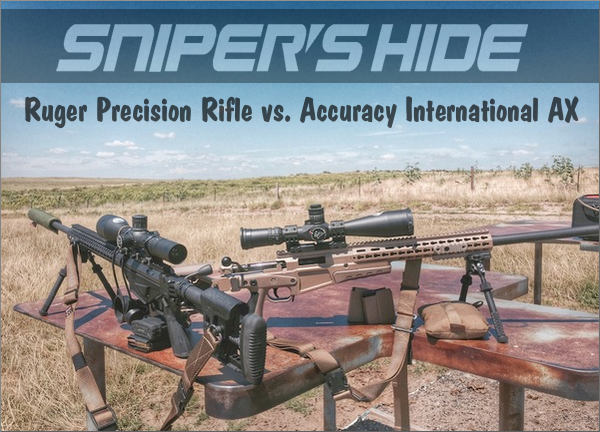
Sniper’s Hide has just released an interesting comparison test, running the $1150* Ruger Precision Rifle vs. a $7000 Accuracy International AX in a 450-yard “mad minute” drill. The goal was to see how many shots could be put on a 12″ steel target in one minute. Both rifles were chambered for the 6.5 Creedmoor and were fed with Hornady 140gr Amax ammo. The much cheaper Ruger did surprisingly well, though the AI AX did come out on top. Frank Galli, Head Honcho of Sniper’s Hide, got 19 rounds on target in one minute with the AI AX compared to 14 rounds with the Ruger.
Watch the “mad minute” face-off in this video:
Galli notes: “The target is 450 yards away, and, as noted in the video, we have winds gusting anywhere from 10 to 18 mph out on the Front Range of Colorado today. So my job is to not only hit the target as fast as possible, but to also manage the conditions.”
In Summary
Frank Galli says the Ruger offers a lot of bang for the buck:
“For those looking to get into competitive tactical shooting, like a PRS Event, there is absolutely no excuse. This rifle will allow you to be competitive, the only thing that would hold a person back is themselves. The more this rifle is shot, the more impressive it is. Would I trade my Accuracy International for one? Well, odd question, but no. However for those on a budget I would recommend the Ruger in a heartbeat.”
*MSRP for the Ruger Precision Rifle is $1399.00. Some dealers are posting prices as low as $1100.00, but $1150.00 seems typical.


 Derek Rodgers is a member of the Team Sinclair F-TR squad. This talented group of shooters hasn’t lost a team match in years. What’s the secret of Team Sinclair’s success? Well there is not one single factor. These guys have very accurate rifles, work hard on load development, and practice in all conditions. In this interview, Derek Rodgers talks about long range competition, reviewing the hardware (and skill set) it takes to win. He offers some great tips on developing loads. You’ll find a longer version of this interview on the



 Research: Scientists believe that the newer frontal lobe may not be able to keep up with “deep” brain signals that transmit at nearly 300 mph. This is explained when athletes talk about “letting go,” rather than over-thinking the shot. This conscious signal can take up to 0.3 seconds from recognizing the desired sight picture to moving the trigger finger—too long to capture the opportunity for a perfect shot. However, if the signal is initiated spontaneously in the cerebellum where such procedures are thought to be stored through repetition, the reaction speed is much quicker. Signals are processed by the “deep brain” almost twice as fast as the problem-solving frontal lobes.