|
|
January 14th, 2015
 The NRA Gunsmithing Guide contains 336 pages of solid, comprehensive gunsmithing info drawn from articles originally published in the American Rifleman magazine. The NRA Gunsmithing Guide contains 336 pages of solid, comprehensive gunsmithing info drawn from articles originally published in the American Rifleman magazine.
The $24.95 book includes 116 articles by expert smiths who build, repair, accurize, and customize all types of firearms (with a strong emphasis on rifles). The three main subject areas are: improving rifle accuracy, customizing fine rifles, and restoring old rifles. Roughly one-third of the articles cover these three topics.
As you would expect from content that first ran in American Rifleman magazine, the articles in the NRA Gunsmithing Guide are richly illustrated with photographs, charts, drawings, diagrams, and data tables. Not Available in bookstores, the NRA Gunsmithing Guide is sold online through Palladium Press, the NRA’s Book Publishing Affiliate.
Click Here for NRA Gunsmithing Guide ORDER Page
January 12th, 2015
Sierra Bullets Ballistic Technician Gary Prisendorf has written a nice essay about how reloading can become a life-time hobby, a rewarding pastime that can bring together a father and son…
by Gary Prisendorf
For as long as I can remember I have been around reloading. I have tons of childhood memories of my father reloading and shooting. I remember how he would let me help him load his ammunition, by letting me clean primer pockets or wipe the sizing lube off of his cases. I really thought I was doing something. Well, I guess I was, I was spending quality time with my father doing something that would become a great hobby and eventually land me a great job working for Sierra Bullets.

I remember watching my father sizing cases on his Herters press, dropping his powder charges with a Belding & Mull powder measure and weighing powder charges with his Texan scales. Heck, I can even remember when he would buy powder at a local pawn shop, and they would weigh it out and put it in a paper sack. He would save his empty powder cans, wrap them with masking tape and write what the powder was on them with a black magic marker.

When I was in Junior High, I got my first shotgun, a 20 gauge Mossberg 500 and within a couple of weeks my father came home with a 20 gauge Lee Load-All and a pound of Blue Dot. He gave me a crash course on how to use it, and got me up and running with a couple of safe loads. I put a lot of shells through that old 20 gauge.
From that day forward I was hooked. If I got a new gun, I was loading ammunition for it. I don’t buy factory ammunition unless I just want to shoot it up so I can get some once fired brass. I reload everything that I shoot, except for rimfire stuff, and if I could figure out how to do that safely, I would probably load that too.
Through the years I have learned to appreciate things — such as once-fired military .30-06 cases that can be converted to obscure cartridge types. And I know the value of a five-gallon bucket of lead wheel weights that will be melted down and cast into bullets.
I remember finding 19 once-fired Norma 7.7×58 Arisaka cases laying on the ground at a public shooting range, and it was like Christmas came early. I must have looked for that 20th case for about thirty minutes, but I never did find it.
I can’t thank my father enough for getting me started in reloading, he gave me a great hobby, many wonderful memories and taught me the skills that gave me a career doing something that I love.
If you are a reloader, teach someone. You may just give them a hobby for the rest of their life and who knows, you could help them find an enjoyable career, doing something that they love. — Gary Prisendorf

January 3rd, 2015
Many of us would like to outfit one (or more) of our rifles with a suppressor, but the cost and red tape involved can be daunting. Some states prohibit private individuals from owning suppressors. However, most U.S. states DO allow suppressor ownership. That’s the good news. On the other hand, suppressors are not inexpensive and the process of obtaining governmental approval is time-consuming. Then there is the cost of the tax stamp itself — $200.00 for each silencer you own.
Nonetheless, suppressors are fun, and they serve an important function. Along with protecting your hearing, suppressors can tame recoil and dramatically reduce muzzle flash. Noise reduction of up to 35 decibels is possible with a .223 Rem. When shooting any firearm, you should still wear hearing protection of course, but suppressors can help reduce the risk of permanent hearing damage.
Benefits of a Suppressor — Why Suppressors Make Sense:
Is It Legal For You To Own A Silencer?
The vast majority of the 50 states permit citizens to own silencers. Currently, the following states allow private ownership of suppressors: AL, AR, AK, AZ, CO, CT, FL, GA, ID, IN, KS, KY, LA, ME, MD, MI, MO, MS, MT, ND, NE, NV, NH, NM, NC, OH, OK, OR, PA, SC, SD, TN, TX, UT, VA, WA, WI, WV, and WY. Even if you live in one of these states, you should verify that owning a suppressor is legal in your city/county.
If you live in a state where suppressor ownership is legal, and you can legally own a firearm, then you can buy a suppressor. However, you need to obtain ATF permission and pay a tax.
If you are interested in getting a suppressor, thankfully there is a source that can help you select the right product, and fill out all the paperwork required. The Silencer Shop specializes in sound moderators for pistols, rimfire rifles, centerfire rifles, and yes, even shotguns. The Silencer Shop maintains a large selection of suppressors for sale, and the shop can guide you through the NFA permitting process from start to finish.
How to Buy a Silencer, Part One:
Based on hundreds of successful applications for its customers, the Silencer Shop has streamlined the National Firearms Act (NFA) Registration process for suppressor ownership. Having submitted more silencer NFA Forms than any other dealer, these guys know the ropes: “We’re at the leading edge of making the NFA process as fast and easy as possible. From our famous ‘Black Packets’ to the latest electronic submissions and Silencer Shop Direct, we have a history of innovation in this area”. The Silencer Shop also works with knowledgeable attorneys who can help you set up an NFA trust to own suppressors and other NFA items. CLICK HERE to Learn How to Register a Suppressor to a Trust.

December 30th, 2014
We can predict, with some certainty, how long a light bulb will last (in use), or a shingle roof, or even a nuclear reactor. But how about barrels? Is there a way to reliably estimate barrel life based on known characteristics? This article explains one effort to quantify barrel life…
 How long will a barrel last before the accuracy “goes south”? There are so many variables involved (powder type, bore diameter, bullet coatings etc.) that it’s hard to predict. You might say “Well, my buddy has a .243 and he got 1500 rounds before the throat was shot out” — those kind of comparisons can be useful, but they’re not very scientific, and they won’t help much if you’ve got a gun in a new chambering (such as the 6.5×47) for which long-term test results are lacking. How long will a barrel last before the accuracy “goes south”? There are so many variables involved (powder type, bore diameter, bullet coatings etc.) that it’s hard to predict. You might say “Well, my buddy has a .243 and he got 1500 rounds before the throat was shot out” — those kind of comparisons can be useful, but they’re not very scientific, and they won’t help much if you’ve got a gun in a new chambering (such as the 6.5×47) for which long-term test results are lacking.
Is there a more reliable way to predict barrel life — one that will work for a broad range of calibers? Well, Forum member MikeCr has developed an Excel spreadsheet that accounts for a number of variables, and gives a pretty good estimate of useful barrel life, whether you’re shooting a .223 Rem or a 338 Lapua Magnum. Mike’s program predicts barrel life using five variables: 1) Bullet Diameter; 2) Powder Charge weight; 3) Powder Heat Potential (KJ/kg); 4) Pressure (in psi); and 5) Bullet Coating (yes/no). Mike provides a table with Heat Potential ratings for most popular powder types. The user needs to know the pressure of his load. This can be estimated with QuickLOAD.
You can download the lastest version of Mike’s spreadsheet below. You’ll need Excel or an Excel viewer to open the file.
Click to Download Spreadsheet: Barrel Life Spreadsheet (Latest Version)
Shown below is Mike’s Spreadsheet, with variables for a 6BR shooting 105gr “naked” bullets with 30.3 grains of Hodgdon Varget powder. The formula predicts 2401 rounds of barrel life. That corresponds pretty well to what we’d expect for a 6BR — about 2500 rounds.
 
Mike observes: “There has been a lot of discussion lately related to cartridge design and resulting barrel life. This is a really important factor to consider amongst a myriad of choices. Barrel life is controversial, and subjective. There are no clear-cut standards for comparison. But a few years ago, I put together a spreadsheet based on Bart Bobbit’s rule of thumb. It worked pretty good, only occasionally failing some tests when validated against posted barrel lives.
According to Ken Howell, I had to account for pressure. And Henry Child’s powder temperature testing provided another piece needed. So, I’ve tweaked it here and there to pass more tests. From 223 Rem to 300 UltraMagnum. Another element added, but turned off, is shot interval. I would need way more tests to lock in on this. But everyone knows, the faster you shoot, the worse the barrel life.
Anyway, another factor hard to define is ‘accurate’ barrel life. This cannot be quantified without standards. Barrels are replaced when expectations are no longer met. I feel that a [barrel] passes peak potential in a finite period due to throat erosion. But that don’t mean it’s toast, if it still shoots well enough. It’s just as likely that many of us never see that peak potential anyway. It’s a slippery thing. Point-blank BR competitors will toss a barrel when it leaves the 1s. I could get another 4000 rounds from it, and be content with its performance, I’m sure.”
NOTE: Mike says: “This spreadsheet may show a lower barrel life than you prefer. But it pretty well spotlights cartridges to stay away from if you plan much time at the range or in dog town.”
Editor’s Comment: Mike’s spreadsheet is a helpful tool, but it is NOT a definitive “take-it-to-the-bank” indicator of barrel life. Mike cautions that predicting barrel life involves so many different factors (including how hot the barrel is run), that the task is a bit like predicting tread life on car tires. Still, the spreadsheet is very helpful. It can certainly warn us that some chamberings (such as the 6-284) are likely to be barrel burners. That can help you make a smart decision when choosing a chambering for your next rifle.
December 25th, 2014
One of the most popular features of our Shooters’ Forum is the Official ‘Pride & Joy’ Rifle thread. There you’ll find dozens of interesting rifles, with photos and descriptions supplied by proud owners. Today we’re spotlighting one of the more interesting ‘Pride & Joy’ rifles unveiled this year, a Mosin Nagant “senior citizen”. This 72-year-old Russian bolt gun is not like any Mosin Nagant you’ve ever seen before. It has been brought into the 21st Century with a handsome target stock and some first-class upgrades, including Lothar Walther barrel and Timney trigger. Here’s a look at a very nice Russian rifle, belonging to Forum member Ben C. (aka “Grimstod”):
CLICK TO See Full-Screen Photo:


Video Shows Rifle Shooting Sub-Half-MOA from Bipod (in the Snow):
Name of rifle: Smyert Mk3 (Modified Mosin Nagant)
Make: Izhmekh/Izhevsk (“Izzy”) High Wall
Model: 91/30 | Year: 1942

Components and Specifications:
Barrel: Lothar Walther 26″
Contour: 1.18″ straight
Chambering: 7.62x54R, .310 bore
Stock: Bluegrass Tactical (Gen 1 & 2)
Trigger: Timney with Bluegrass trigger shoe
Magazine: Finnish No-Jam magazine |
Scope mount: Rock Solid (looks like an action sleeve)
Scope: SWFA 20x42mm MRAD
Gunsmith: Sheppard
Bolt handle: Rock Solid with Surgeon tactical handle
Bipod: Versa Pod
Total Weight: 18.6 lbs |


Grimstod’s Mosin Nagant Custom Shoots Under 0.5 MOA From Bipod
Even in harsh winter conditions, the rifle shot well. (I guess we should expect that for a Russian gun). The photo below shows a group shot from bipod. (The video shows Grimstod’s snow-bound range session). Grimstod calculated the group at 0.394 MOA measuring from outside edge to edge. Using our On-Target software, which measures center to center of most distant shots, we came up with 0.428 MOA. Still that’s impressive for an ancient action being shot in the dead of winter with snow falling. To learn more about this rifle (and view photos of the build process), visit the SurplusRifleForum.com.

November 12th, 2014
Looking to shoot an AR-platform rifle out past 500 yards? Then you should read two recent articles by AR guru Glen Zediker. Author of The New Competitive AR-15 and The Competitive AR15 Builders Guide, Zediker is an expert when it comes to AR-platform rifles — he knows as much as any guy around. Glen believes ARs have excellent long-range capability, provided they are built to high standards, with good barrels. Glen says: “a properly configured AR-15 is easily capable of good performance at 500+ yards. Good performance means it can hit a 1-foot-square target all the time. Competitive shooters can cut that standard in nearly half (the X-Ring on an MR1 600-yard NRA High Power Rifle target is 6 inches, and high X-counts are commonplace among more skilled shooters).”
Published in the Cheaper than Dirt Shooter’s Log, Zediker’s pair of articles cover the history and upgrading of the AR-15. Part One reviews the AR’s development as an accurate firearm, tracing its evolution from a Vietnam-era combat weapon to what is now a favored target rifle of High Power competitors. READ PART ONE.

Part Two discusses the specifics that make an AR accurate at 500 yards and beyond. Zediker talks about barrel configuration (profile and twist rate), bullet selection, floating handguards, and proper mounting of optics or iron sights. READ PART TWO.

Here are some highlights from Long-Range AR-15 Part TWO:
Barrel Twist Rate
To stabilize anything longer than a 68- or 69-grain bullet, the barrel twist rate must be — at minimum– 1-in-8. Twist rates reflect how far the bullet travels along the lands or rifling to make one complete revolution. So, 1-in-8 (or 1-8, 1:8) means “one turn in eight inches.” I think it’s better to go a little faster in twist. There is nothing wrong with a 1:7 twist. The 90-grain bullets require a 1:6.5, and that is getting on the quick side. If you want to shoot Sierra 77s or equivalent, and certainly anything longer, 1:8 is necessary. By the way, it is bullet length, not weight, which constitutes the necessary twist rate to launch a stable bullet.
Optics Mounting
Correct optical sight positioning can be a challenge. With a flattop upper, I need a good inch additional forward extension at the muzzle side of the upper for the sight mount bases to avoid holding my head “back” to get the optimal view through the scope. A longer rail piece is necessary for my builds as a result.
Buttstock Length and Adjustment
An adjustable buttstock is valuable, and even more valuable if it’s well-designed. Mostly, a standard stock is too short, and the cheek area sits too low. Adding length helps a lot by itself. There are assemblies that replace the standard buttplate to allow for length and, usually, height and rotation adjustments for the buttpad. An elevation-adjustable cheekpiece is a big help to attain a solid position.

November 6th, 2014
 In response to questions from a fellow F-Class shooter, German Salazar offered some expert advice in an article entitled: Basics: A Few Wind Reading Tips. Here are highlights from that essay. You can read the entire article on German’s Rifleman’s Journal Website. German cautions that: “I certainly am not attempting to make this short item into a comprehensive lesson in wind reading, but there may be a nugget or two in here for the newer shooter. There is, however, no substitute for range time and coaching.” In response to questions from a fellow F-Class shooter, German Salazar offered some expert advice in an article entitled: Basics: A Few Wind Reading Tips. Here are highlights from that essay. You can read the entire article on German’s Rifleman’s Journal Website. German cautions that: “I certainly am not attempting to make this short item into a comprehensive lesson in wind reading, but there may be a nugget or two in here for the newer shooter. There is, however, no substitute for range time and coaching.”
Preliminary Matters — Holding Off vs. Knob-Turning
Let’s begin by eliminating one topic altogether — I realize that the predominant method of wind correction in F-Class is holding-off with the crosshairs of your scope rather than adjusting the windage knob. I am a firm believer in aiming at the center and turning the knob as needed, but we’ll leave that for another time and focus on seeing what the wind is doing.
The Wave — Wind Cycles and Shot Timing
I find that most shooters begin to shoot immediately when the time commences rather than waiting for an appropriate moment in the cycle, this often leads to lost points early on. If you’ve been scoring prior to shooting, hopefully you’ve observing the flags and your shooter’s shot placement. It’s a very useful way of gaining some insight into the day’s wind patterns before shooting.
 My technique is based on the understanding of wind as a cyclical wave motion. That statement alone should give you plenty to think about[.] Imagine for a moment, a surfer. He waits for a gentle swell, gets moving on it and rides it through it’s growth and ultimately its crescendo and hopefully avoids being swallowed in its crash. Wind typically behaves in the same fashion as that wave and a smart shooter behaves as does the surfer — get on early in the wave, ride through the major change and get off at the right moment. Knowing when to stop shooting is every bit as important as shooting quickly through the predictable portion of the wave; getting back on to the next wave is a matter of delicate judgment and timing. My technique is based on the understanding of wind as a cyclical wave motion. That statement alone should give you plenty to think about[.] Imagine for a moment, a surfer. He waits for a gentle swell, gets moving on it and rides it through it’s growth and ultimately its crescendo and hopefully avoids being swallowed in its crash. Wind typically behaves in the same fashion as that wave and a smart shooter behaves as does the surfer — get on early in the wave, ride through the major change and get off at the right moment. Knowing when to stop shooting is every bit as important as shooting quickly through the predictable portion of the wave; getting back on to the next wave is a matter of delicate judgment and timing.
When you are on that rising (or falling) wave, the idea is to shoot very quickly to minimize the amount of change between shots and to make a small adjustment on each shot. Too many shooters waste time trying to analyze the exact amount of the change, by which time it has changed even more! Get on with it, click or hold over a set amount and fire the next shot quickly. This is the foundation of how I shoot and it is very effective as long as you know when to start, when to stop and you have a good man working the target – a slow marker is the death of this method.
Watch Shots from Other Shooters
We all watch the wind flags, of course, and the trees if your range is so blessed (ours are fairly barren), and many other small wind indicators. Watching the shots of your fellow shooter can also be a very useful tool and should be observed whenever possible. When a good shooter next to you comes up with a poor shot, it should signal you to stop and reassess conditions as they may not be what they appear.
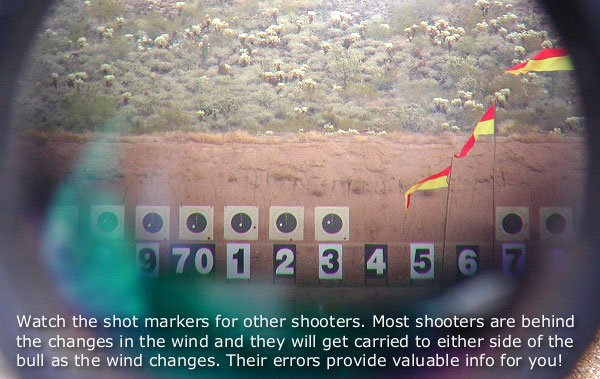
While scoring for another shooter, take a moment to scan the line of targets. You’ll be surprised at how most of the shot markers move in unison to one side and then the other. The sad truth is that most shooters are behind the changes in the wind and they will get carried to either side of the bull as the wind changes. You’ll see this in the targets as they come up, and once learned, you’ll find that the line of targets is as useful as another row of flags.

October 30th, 2014
RifleShooter online magazine has published a list of the Ten Best Bolt-Action Rifles of All Time. Ten classic rifle designs (including the Remington 700 and Winchester Model 70) are illustrated with a paragraph or two explaining their notable features.

These Top 10 lists are always controversial. While most readers might approve of half the entries, there are always some items on the Top 10 list that some readers would challenge. Here is RifleShooter’s Top 10 list. What do you think? Are there some other bolt-actions that are more deserving?
|
1. Springfield M1903
2. Mauser 98
3. Winchester Model 70
4. Remington Model 700
5. Weatherby V |
6. Sako L61/AV
7. Savage Model 110
8. Ruger M77
9. Tikka T3
10. Mannlicher-Schonauer |

October 27th, 2014
Today, October 27th, is the birthday of President Theodore (“Teddy”) Roosevelt. An avid explorer, hunter, and firearms enthusiast, Teddy Roosevelt (TR) was a larger-than-life figure who lead this nation as it emerged as a world power.


Theodore Roosevelt — A Great Leader
If you want to learn more about TR, we strongly recommend Theodore Roosevelt on Leadership, a book by noted author and political analyst James Strock. This work captures the vision, commitment, and personal courage that marked Theodore Roosevelt’s career. Theodore Roosevelt was a leader of uncommon strength who, through the sheer force of his extraordinary will, turned America into a modern world power. Thrown headfirst into the presidency by the assassination of his predecessor, he led with courage, character, and vision in the face of overwhelming challenges, whether busting corporate trusts or building the Panama Canal. Roosevelt has been a hero to millions of Americans for over a century.
October 25th, 2014
Webyshops.com, a leading online vendor of optics, range gear, and hunting accessories has prepared a helpful guide for new hunters. This “how to” article Before You Start Hunting provides basic information on preparing for a hunt, finding a hunter education class, choosing appropriate gear, and selecting a safe, approved area for hunting.

Hunting Affiliation Groups
There are many good organizations dedicated to promoting hunting and preserving our hunting habitats. These groups all offer valuable information for hunters:
Recommended Books about Hunting
There’s no shortage of hunting hunting-related reading material. Here are some of the best books written about hunting.

Hemingway on Hunting by Ernest Hemingway
A Sand County Almanac by Aldo Leopold
Beyond Fair Chase: The Ethic and Tradition of Hunting by Jim Posewitz
Meditations on Hunting by Jose Ortega y Gasset
Eating Aliens: One Man’s Adventures Hunting Invasive Animal Species by Jackson Landers
It’s Only Slow Food Until You Try to Eat It by Bill Heavey
The Beginner’s Guide to Hunting Deer for Food by Jackson Landers
Whitetail Nation: My Season in Pursuit of the Monster Buck by Peter Bodo
|