|
|
October 21st, 2013
Here’s a feel-good story about a talented young shooter.
Article based on report by Lars Dalseide, for NRA Blog.

Finding the X-Ring while taking part in NRA’s National Rifle and Pistol Championships can be challenging enough. Finding the X-Ring from three positions during the smallbore rifle phase of the championships can be even more trying. But Amy Fister, winner of this year’s NRA 3-Position Rifle High Woman title, found it with no trouble at all. A surprising result given her wry self-description.
“I’m a nerd,” she said with a laugh. “I’m very dedicated to my studies.”
Based out of Kutztown, Pennsylvania, Fister walked away from the 3-Position Awards Ceremony with three titles: High Woman with Metallic Sights, High Civilian with Metallic Sights, and High Woman Overall. Fister finished with a score of 2374 – 140X (good for 7th overall). “Last year I was close but not close enough,” said Fister. “I guess this year it was my time.” Seeing her on stage, winning award after award, it’s hard to believe that it almost didn’t happen — she nearly fell victim to the summer heat at Camp Perry.
Fighting Dehydration at Camp Perry
About halfway through the National Championship match, Fister was setting up targets when she realized something was wrong: “I was delusional, seeing things,” Fister explained. “After setting up my target, it wasn’t there. I started chasing down the target guy for another one. It was an interesting and a little bit scary of an experience.”
She was dehydrated. Heartbeat rapid, extremely lethargic, unsteady on her feet — she recognized the signs and started back for the line. Pulling a bottle of Gatorade out of her bag, she gulped until it emptied. Feeling a touch steadier, she made for the water coolers behind the line. A few cups later and she was ready to proceed. “Luckily it happened during prone,” she said with a laugh. “Standing would have been a different story.”
How a Nerd Became a World-Class Rifle Shooter
Starting as far back as she can remember, Fister was out shooting with her dad. First as the official gear porter, then as a huntress. “Deer and goose, that’s what we went for,” she said. “I go out deer hunting whenever I can, but it cuts into my shooting time. You’ve got to find a happy medium.”
 Though it was dad who first put a rifle in her hand, it was her sister Valerie who started her down the competitive trail. Like most stories of sibling rivalry, big sister joined the rifle team so little sister (Amy) wanted to also. A little practice, a little patience, and it all came together — so well in fact that Amy has earned a shooting scholarship to the University of Memphis. But her ambitions don’t stop there. They reach as far as Rio de Janeiro, site of the 2016 Olympics. Though it was dad who first put a rifle in her hand, it was her sister Valerie who started her down the competitive trail. Like most stories of sibling rivalry, big sister joined the rifle team so little sister (Amy) wanted to also. A little practice, a little patience, and it all came together — so well in fact that Amy has earned a shooting scholarship to the University of Memphis. But her ambitions don’t stop there. They reach as far as Rio de Janeiro, site of the 2016 Olympics.
“I missed a spot on the U.S. Team by two points. Now the goal is to be part of the Olympic Rifle Team in 2016. Problem is that I don’t want my scores to drop and I don’t want my grades to drop.
“My goal is to become a pediatrician and an Olympian. Guess I’ll just find a way.”
To learn more about the NRA’s Competitive Shooting Programs, visit compete.nra.org.
October 10th, 2013
 Need reading material on the cheap? How about sixty-nine (69) YEARS of Gun Digest articles for just $59.99. That’s not a misprint. Gun Digest is now offering a 3-disc DVD set containing sixty-nine years of Gun Digest archives — over 3000 articles in all. This massive Gun Digest digital collection includes all 69 Annual Editions of Gun Digest, complete with gun values, firearm reviews, collecting tips, and buying guides. You get 69 years of gun history in one spot. As one buyer notes: “You could never find these old issues anywhere else and you get the 2012 and 2013 digest in the set as an additional incentive.” Need reading material on the cheap? How about sixty-nine (69) YEARS of Gun Digest articles for just $59.99. That’s not a misprint. Gun Digest is now offering a 3-disc DVD set containing sixty-nine years of Gun Digest archives — over 3000 articles in all. This massive Gun Digest digital collection includes all 69 Annual Editions of Gun Digest, complete with gun values, firearm reviews, collecting tips, and buying guides. You get 69 years of gun history in one spot. As one buyer notes: “You could never find these old issues anywhere else and you get the 2012 and 2013 digest in the set as an additional incentive.”
The Gun Digest 3-DVD set includes each Annual Edition of Gun Digest by Year (1944-2013) in PDF Format. This collection includes Test Fire gun reviews, articles on shooting, hunting, gun collecting, gunsmithing, optics and more. Here’s a sample: Elmer Keith’s classic article on the .44 Magnum
 |
Three Discs VS. Sixteen Feet of Shelf Space
This DVD collection is a treasure trove, as another purchaser of the 3-DVD set explains: “You can occasionally find older editions of this iconic tome, used of course, but nowhere will you get all 69 issues from the start of publication through the 2013 edition in digital form. They are all here… for your reference and enjoyment.” By contrast, 69 years worth of “the print version would require 16 feet or so of shelving.”
|
October 6th, 2013
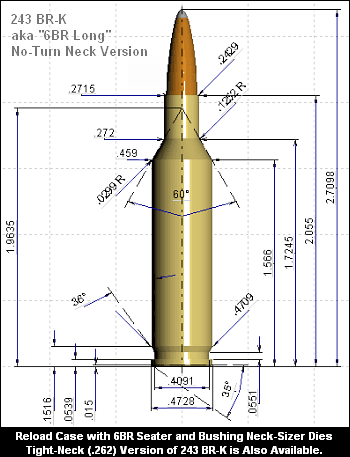
Gunsmith Mike Sosenko and long-time AccurateShooter Forum member John Adams have been using a modified .243 Winchester case with great success in Varmint Silhouette matches at the Pala Range in Southern California. Officially called the “.243 BR-K” (and informally dubbed the “6BR Long”), the wildcat is basically a .243 Winchester with less body taper and a 30-degree shoulder. The design essentially grafts a 6mmBR Norma “top end” to the .243 Winchester case. After fire-forming, Mike and John can reload this case using normal, unmodified 6BR neck-sizing and seater dies.
Compared to a .243 Winchester, the .243 BR-K’s body length is about .006″ longer, and the shoulder is about .0055″ wider. The main difference is the shoulder angle (30° vs. 20°), and the location of the neck-shoulder junction (“NSJ”). Based on reamer prints, the base to NSJ dimension is 1.718″ on the 6BR Long, compared to 1.804″ for the .243 Winchester. Neck length is a bit shorter because “the neck shrinks a little when the shoulder blows out” according to Sosenko. We’ve provided a mock-up diagram of the .243 BR-K, but you should check with Dave Kiff of Pacific Tool & Gauge for exact dimensions. Dave created the reamers for both the 6mm and 22-caliber versions of this wildcat. Ask for the “22 BR-K” or “.243 BR-K” reamer designs.
 |
 |
Wicked Velocity with Stable Brass
The main advantage of the .243 BR-K is serious velocity in a case that is very stable. Mike’s favorite load is the 95gr Berger VLD pushed by Reloader 22. With a stout load of RL22 and Federal 210m Primers, Sosenko is getting 3450 fps with the 95-grainer, with no bullet blow-ups. This is with a 1:8.5″ twist Broughton 5R barrel finished at 28.5″. The cases are holding up very well. Mike has a half-dozen loads on his brass and he hasn’t had to full-length size yet. Mike runs a .262″ tight neck, but there is also a no-turn version of the case (see illustration). Accuracy is excellent. Mike says the round delivers repeatable 1/4 MOA groups at 100 yards in testing. He has also experimented with N160, but, thus far, Reloader 22 has delivered smaller groups with better ES and SD.
VIEW 243 BR-K REAMER PRINT (No-Turn Neck)
John Adams shoots a no-turn (.274″) neck .243 BR-K with 105gr Berger VLDs. He’s getting about 3230 fps using Reloader 22. John says he can push the 105s faster, but 3220-3240 fps “seems to be the sweet spot.” John notes that “after about five reloadings on a case, it gets a little tight”. John then full-length sizes with a custom Hornady FL bushing die. “The Hornady custom shop dies work great” according to John. Adams also shoots a version of this wildcat necked down to 22-caliber. It has demonstrated outstanding velocity and good accuracy in initial testing with a 9-twist barrel. Using the 80gr Amax bullets, John is getting 3570+ fps speeds. John feels that his 22 BR-K needs some more development work. “The .243 BR-K is proven. We know what works. With the 22 I want to try different seating depths, experiment with a few different bullets, and fine-tune the velocity.”
Whitley’s 6mm Super X
Robert Whitley shoots a variant of the .243 Winchester he calls the 6mm Super X. This features a 30° shoulder, and slightly less body taper. He gains a little case capacity over the standard .243 Win, and he says the cartridge is extremely accurate with both 105-108 grain pills and the heavier 115s: “Here’s a picture of a .243 Win (left), a 6mm Super X (center), and a 6XC (right). All I can say is the 6mm Super X has been good to me and I have shot many a clean in 600-yard High Power matches with it with either DTAC 115s or Berger 115s.”

While Mike Sosenko and John Adams use their BR-Ks to push 95s and 105s at high velocities, Robert takes a different approach with his Super X. He shoots the high-BC 115s and keeps velocities under 3000 fps. A long-range High Power shooter, Robert demands consistency during long shot strings. That means backing off from max attainable speeds, at least with the 115s. Robert writes:
“You can get 3050 fps with H4831SC and the 115s with no problem, I did it in testing multiple times, but to me that also does not mean anything because I shoot loads where they are the most consistent and accurate over a 22+ shot string. I have never found that any of the 6mm cartridges I have used with 115s will stay consistent, tight and accurate the whole way at 3050 fps for 22+ shots straight. I have tried 115s in the .243 Win, the 6CM, the 6mm Super X, the 6XC, the 6-6.5 x 47 Lapua and none of them ever stayed consistent and tight for 22 shots straight with the 115s at that speed. Most of the time with all the 6mm cartridges, if you get the 115s much over 2975 fps, they won’t hold tight for 22+ shots straight. Now if you’re a bench rest shooter and you only need to do a few sighters then 5 or 10 shots for record, you can run 3050 fps or more and the groups will likely hold tight during your string, but not when you need to go 22+ shots straight with no break. I have shot many different 6mm cartridges and done a lot of testing with many different powders, moly and non-moly bullets. I don’t find the ‘consistent accuracy’ (for 22+ shots straight) at those higher velocities.”
October 5th, 2013
 This story is not (directly) about guns and ammo, or reloading gear, or any of the little details of our sport. It, instead, is about life… and, sadly, about death. As you may know by now, Tom Clancy died this week at age 66. Clancy created a new fiction genre that entertained millions — the “military techno-thriller”. Tom was a damn fine writer, and like you and me, he was also a true “gun guy”. He will be missed. This story is not (directly) about guns and ammo, or reloading gear, or any of the little details of our sport. It, instead, is about life… and, sadly, about death. As you may know by now, Tom Clancy died this week at age 66. Clancy created a new fiction genre that entertained millions — the “military techno-thriller”. Tom was a damn fine writer, and like you and me, he was also a true “gun guy”. He will be missed.
Tom Clancy’s unexpected passing was a “wake-up call” for your Editor. I turn 58 this month. That number is not much less than 66, the number of years Clancy got to spend on our blue planet. This got me to thinking, “What if I only had ten more years to live — how would I want to live my life? What really counts the most? What things would I do differently? What dreams would I pursue?”
From the demographics of this website, I know we have thousands of readers in their 50s, 60s, and 70s. Hopefully we will all live long, happy, and fruitful lives. But it’s not a bad idea to consider that we are all mortal, and the clock is ticking. Consider this — in the United States, the average male life expectancy is 76 years*. Using that number as a benchmark, I personally may have another 18 years to enjoy life and to do the things I love — shooting, traveling, sailing, camping, listening to music, being with friends and family. Breaking that down into months, I have 216 more months to do fun and rewarding stuff. Just 216 months — that’s a real number my brain can comprehend all too well. If I live an average lifespan, that means I also only have 939 more weekends to do all that I want to do. With less than 1000 weekends remaining, I don’t want to waste a single one. Here’s a chart that shows how many more weekends you may have, based on your current age:

Living a Life with More Good Times, and Fewer Regrets
Recently, a group of men, very near the end of their lives, were surveyed. They were asked if they would do things differently if they could live their lives over again. The vast majority of these men gave surprisingly similar responses, which fit into five “Life Lessons”. These “Top 5 Regrets of the Dying” were reported in a story by Bronnie Ware, writing for the AARP online magazine. Ware writes: “When questioned about any regrets they had or anything they would do differently, common themes surfaced.” Here are the five regrets most often mentioned by older men:
1. I wish I’d had the courage to live a life true to myself, not the life others expected of me.
“This was the most common regret of all. When people realize that their life is almost over and look back clearly on it, it is easy to see how many dreams have gone unfulfilled. ”
Lesson: Don’t wait to follow your dreams. Be true to yourself.
2. I wish I didn’t work so hard.
“This came from every male patient [surveyed]. All of the men… deeply regretted spending so much of their lives on the treadmill of a work existence.”
Lesson: Don’t let your work crowd out other important aspects of life.
3. I wish I’d had the courage to express my feelings.
“Many people suppressed their feelings in order to keep peace with others. As a result, they settled for a mediocre existence and never became who they were truly capable of becoming.”
Lesson: Express yourself truthfully. Don’t suppress your feelings for decades.
4. I wish I had stayed in touch with my friends.
“There were many deep regrets about not giving friendships the time and effort they deserved. Many [were] so caught up in their own lives that they had let golden friendships slip by over the years.”
Lesson: Take an interest your friends’ lives; keep bonds of friendship strong.
5. I wish that I had let myself be happier.
“This is a surprisingly common [regret]. Many did not realize until the end that happiness is a choice.”
Lesson: Affirmatively pursue the things that bring you happiness. Don’t just stick to old habits.
Turn Off the Computer, and Do Something Memorable with Your Friends Today
How does this all apply to our shooting hobby? Well, if (like me) you are middle-aged (or older), go have some fun this weekend! Load up your rifle and get to the range. Don’t put off doing the things that make you happy. Call those old buddies you may not have seen in a long time. Renew friendships. Get out into nature. And start figuring out how you can live your dreams. As the saying goes, “Time waits for no man”.
*One of our readers pointed out that the numbers actually work out better than this, because once a man survives to later life, men of his surviving age cohort enjoy a projected lifespan longer than the average projected lifespan from birth. For example, using actuarial tables, a man born exactly 60 years ago (still alive today), has a calculated life expectancy of 23.4 years… meaning he would live to age 83.4 years, on average. CLICK HERE to see actuarial-predicted longevity based on your birthdate.

August 27th, 2013
 Months ago, we reported on the new, .17 Winchester Super Magnum (Win Super Mag or WSM) rimfire cartridge. Able to drive a 20gr bullet over 3000 fps, this new .17 Win Super Mag raises the bar for rimfire cartridges. The .17 WSM shoots faster, flies flatter, and bucks the wind better than a .17 HMR. Months ago, we reported on the new, .17 Winchester Super Magnum (Win Super Mag or WSM) rimfire cartridge. Able to drive a 20gr bullet over 3000 fps, this new .17 Win Super Mag raises the bar for rimfire cartridges. The .17 WSM shoots faster, flies flatter, and bucks the wind better than a .17 HMR.
Sounds good right? Well the only problem is that .17 Win Super Mag cartridges (and a rifle that could shoot them) have been virtually impossible to obtain. In January, Savage unveiled its new B-Mag rifle chambered for the .17 Win Super Mag, but there were delays getting the gun into production.
GunsAmerica Tests .17 Win Super Mag
At last, after many months, the B-mag rifle is ready, and .17 Win Super Mag rimfire ammo is starting to hit dealer’s shelves. GunsAmerica managed to score some .17 WSM rimfire ammo, borrow a B-Mag rifle, and test the new cartridge at the range. GunsAmerica has published its findings in a detailed review on the GunsAmerica Blog.
CLICK HERE for .17 Win Super Mag Rimfire Field Test Report
GunsAmerica Says New 17-Cal Rimfire Cartridge Is Promising:
“Savage sent us this test rifle over two months ago, but we had no ammo, so like everyone else, we waited. Finally, as you can see from these tests, the ammo has started to trickle out. Several of our dealers have reported that they have gotten 40 box orders in (and quickly out) the door, and this ammo you see here was purchased retail at Bass Pro in Hollywood, Florida. We were only able to get the 2600 fps 25 grain load, but it is still a rip-roaring monster for a rimfire, and the accuracy is acceptable, (though not fabulous for a Savage).
The Savage “B-Mag” rifle is currently the only gun for the cartridge, and it carries an MSRP of $349.00. As a first effort on a new and revolutionary rimfire, the B-Mag performed well, and the cartridge looks to have great potential.
The .17WSM is not just a hotter .17HMR. It is a different, and much larger case entirely. Winchester based it on a .27 caliber blank made for industrial nail guns used for cement nails…. They beefed up the case by doubling the wall thickness and added extra meat to the top.”
Photos from GunsAmerica Blog, All Rights Reserved.
August 22nd, 2013
 Building your own portable shooting bench is a great do-it-yourself project. You can build a sturdy bench for well under $100 in materials. Compare that to some deluxe factory-built benches which may cost $500.00 or more. Building your own portable shooting bench is a great do-it-yourself project. You can build a sturdy bench for well under $100 in materials. Compare that to some deluxe factory-built benches which may cost $500.00 or more.
FREE Bench Plans on the Web
You’ll find a wide assortment of home-built shooting bench designs (both portable and fixed) on the internet. Renovation Headquarters has links to FREE Plans and building instructions for fourteen (14) different shooting benches. There are all-wood shooting bench designs as well as benches that combine a wood top with a metal sub-frame or legs.
CLICK HERE for Shooting Bench FREE Plans Webpage
Among Renovation HQ’s fourteen featured shooting benches, here are five designs we liked:
Reader Jim Jewell has used the eHow bench design shown above. He recommends it highly. Jim reports: “A colleague and I built two of the eHow permanent wood, sturdy benches for our Pt. Phillips Rod and Gun Club in PA, which had outdated benches. I want to tell you that these benches are very stable and a real bargain. The benches cost precisely $100.00 each using the bill of materials and pressure treated wood. The bill of materials, with careful cutting, using a Chop saw, resulted in almost no scrap wood if carefully measured and cut. The plans are terrific and the benches are great platforms for bench-rest shooting. I made only one modification — I left a 6″ wing on both sides of the table to mount a spotting scope. Further we added a base of dry QuickCrete or similar fast setting concrete mix material. Add it dry, make sure the table is level and fill in the 6″ hole. The hole and QuickCrete add maximum stability. The QuickCrete sucks moisture from the ground, hardens in situ, and adds stability to the bench.
I can’t recommend this design highly enough. It is dirt cheap for clubs on a budget, goes together quickly, the table is very stable and there is no waste if you make precise measurements and cuts. A bag of QuickCrete is enough for two tables adding about $2.00 to the cost of each table. We plan on building new tables for the whole club for under $1000. After about a year, with a completely water-free wood in the bench I recommend a coat of Thompson’s Water Seal and these benches should last a long time.”
Heavy Wood Bench That Converts to Three Sections for Transport
In addition to the fourteen benches mentioned above, here is an interesting break-down bench design. Call it a “semi-portable” bench. The legs and frame are made from stout 4×4 post segments so the bench is fairly heavy. However, this bench can break down into three (3) sections for easier transport to and from the range. Dado-cut channels assure proper top alignment. This might be a good choice if you plan a multi-day excursion to a location without fixed benches. This three-leg bench design can be made from easy-to-locate materials. Note: The dimensions of this bench are are larger than typical fixed benches to accommodate 50 BMGs and other big rifles. CLICK HERE for more details.

Do you like the bench in the illustration at the beginning of this story (top right)? This is a prototype design by Chris Byrne of the Anarchangel Blog. For more details, CLICK HERE.
August 9th, 2013
While the mainstream media (and many politicians) call for new bans on firearms, ammunition, and magazines, not to mention further restrictions of Second Amendment rights, too little attention is being paid to the actual facts in the debate over gun control. Sponsors of new restrictions on firearms claim that gun crime is increasing. A majority of Americans also seem to believe that firearms-related crimes are on the rise. But is this really the case? You may be surprised….
 In fact, if you look at the hard facts, firearms homicides and other gun-related crimes have been decreasing for decades. That’s right — gun crimes are down significantly over the past twenty years. Since 1993, in the USA, the number of homicides committed with guns has dropped 39% even while gun ownership rates have increased. The number of “all other” crimes with firearms has dropped 69% in the same period. And the number of fatal gun accidents has declined 58% in the past two decades — that’s a big change. In fact, if you look at the hard facts, firearms homicides and other gun-related crimes have been decreasing for decades. That’s right — gun crimes are down significantly over the past twenty years. Since 1993, in the USA, the number of homicides committed with guns has dropped 39% even while gun ownership rates have increased. The number of “all other” crimes with firearms has dropped 69% in the same period. And the number of fatal gun accidents has declined 58% in the past two decades — that’s a big change.
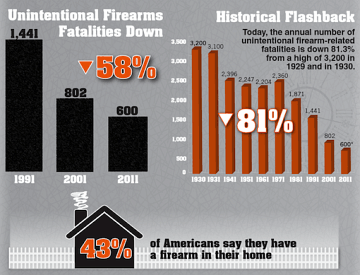
The numbers don’t lie — over the past twenty years, there has been a significant reduction in actual gun-related crime while gun ownership levels have increased. But despite all this evidence that gun-related crimes have declined precipitously in the past two decades, 56% of Americans have the mistaken notion that gun crime is on the rise. Could that be because mainstream media outlets conveniently ignore the facts?

Actual, verified gun crime trends (based on Federal crime statistics) have been presented in an interesting “infographic” chart prepared by the NSSF. Click on the illustration at right to see the full-size version with data charts.
August 7th, 2013
 Daily Bulletin readers often tell us: “I saw a story in the Bulletin a while back, but I can’t find it now. How do I locate it?” In addition, some folks say: “There’s a Bulletin article that I want to share on my Facebook page. How do I do that?” Daily Bulletin readers often tell us: “I saw a story in the Bulletin a while back, but I can’t find it now. How do I locate it?” In addition, some folks say: “There’s a Bulletin article that I want to share on my Facebook page. How do I do that?”
How to Use Search Features
Take heart, readers. There are quick and easy ways to locate (and share) Daily Bulletin Posts. First, on the right side of the Bulletin you can select stories by topic (e.g. Reloading) or by date. You can also use our SEARCH TOOL. Go to the top right-hand corner of the page, type your search term then click the RED SEARCH BUTTON. This will instantly search over 5,000 Daily Bulletin stories. Matching articles will appear in chronological order, with the newest articles at the top. For best results, try to be pretty specific in your search, and avoid common terms such as “bullet”, “rifle”, “barrel” etc. that may appear in hundreds of articles.
How to Share Daily Bulletin Articles on Facebook, Twitter, and Other Sites
Let’s say you’ve found an interesting article or gear review in the Daily Bulletin that you would like to share on your Facebook page or other social media sites. Or maybe you’d like to email the article URL (web address) to a shooting buddy so he could read the story too. It’s easy to share a story. Simply click on the small RED-ORANGE BOX at the end of the article marked “Share”. This will open up a small window with multiple choices. With your mouse, select “Facebook” to share on your Facebook page. Or, click the “email” or “gmail” icons to email the article’s web URL to your friends.

If you merely want to save the article URL (i.e. its web location), right click on the “Permalink” button at the bottom left of the article frame (look for the dark blue-gray border). When you right click, you’ll see a pull-down menu. Select “Copy Link Address”. Then you can paste this link anywhere you like, using the paste command (CTRL-P on a Windows computer).
July 26th, 2013
 A $10 million-dollar CDC report ordered by President Obama determined that victims of crime who were armed with a firearm suffered fewer injuries than crime victims who were un-armed. A $10 million-dollar CDC report ordered by President Obama determined that victims of crime who were armed with a firearm suffered fewer injuries than crime victims who were un-armed.
Well, at least the CDC came up with the right answer, but we’re flabbergasted at the cost of this study. Dustin Ellermann, past Top Shot Champion, comments: “$10,000,000 to discover the obvious… [at least] maybe now the anti-gunners will stop yelling ‘If you have a gun it will most likely be used against you!'”
According to Texas Fish & Game Blog, the CDC Report, entitled Priorities For Research to Reduce the Threat of Firearm-Related Violence, reveals that “studies that directly assessed the effect of actual defensive uses of guns (i.e., incidents in which a gun was ‘used’ by the crime victim in the sense of attacking or threatening an offender) have found consistently lower injury rates among gun-using crime victims compared with victims who used other self-protective strategies.”
Here are some comments on a related NewsMax.com story about the CDC report:
I am glad that an official Obama research project shows the same thing that Professor Gary Kleck found in his research about 20 years ago. Professor Kleck found that an honest citizen that had a gun saved himself from death more than 1 million times a year and often did not have to fire a shot. Usually when the crook saw that the citizen was armed that was the end of it.
Why does our government have to spend millions of dollars to do a study to find out what everyone else on earth in the history of man has already known?
July 22nd, 2013
 There was an excellent article about Mirage on the South Texas Marksmanship Training Center (STMTC) website. This article explains what causes mirage and how mirage can move the perceived aiming point on your target. Most importantly, the article explains, in considerable detail, how you can “read” mirage to discern wind speeds and wind directions. With simple but effective graphic illustrations, this is one of the best explanations of mirage (and mirage reading) we have found on the internet. This is a “must-read” for any serious competitive shooter. Here is a brief sample from the article, along with an illustration. NOTE: the full article is six times longer and has 8 diagrams. There was an excellent article about Mirage on the South Texas Marksmanship Training Center (STMTC) website. This article explains what causes mirage and how mirage can move the perceived aiming point on your target. Most importantly, the article explains, in considerable detail, how you can “read” mirage to discern wind speeds and wind directions. With simple but effective graphic illustrations, this is one of the best explanations of mirage (and mirage reading) we have found on the internet. This is a “must-read” for any serious competitive shooter. Here is a brief sample from the article, along with an illustration. NOTE: the full article is six times longer and has 8 diagrams.
The term “mirage” as used by the shooter does not refer to a true mirage, but to heat waves and the refraction of light as it is bent passing through air layers of different density. Light which passes obliquely from one wind medium to another it undergoes an abrupt change in direction, whenever its velocity in the second medium is different from the velocity in the first wind medium; the shooter will see a “mirage”.
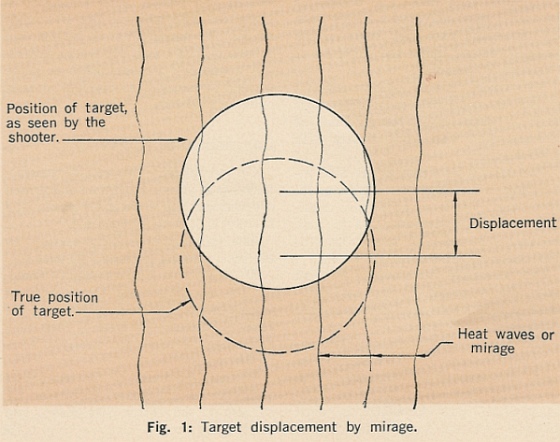
The density of air, and therefore its refraction, varies with its temperature. A condition of cool air overlaying warm air next to the ground is the cause of heat waves or “mirage”. The warm air, having a lower index of refraction, is mixed with the cooler air above by convection, irregularly bending the light transmitting the target image to the shooter’s eye. Figure 1 shows (greatly exaggerated) the vertical displacement of the target image by heat waves.
Heat waves are easily seen with the unaided eye on a hot, bright day and can be seen with spotting scope on all but the coldest days. To observe heat waves, the scope should be focused on a point about midway to the target. This will cause the target to appear slightly out of focus, but since the high power rifle shooter generally does not try to spot bullet holes, the lack in target clarity is more than compensated by clarity of the heat waves.
CLICK HERE to Read Complete Mirage Article
Mirage Is Your Friend
While hot days with lots of mirage can be frustrating, mirage can reveal how the wind is flowing (and changing). If you learn how to recognize and read mirage patterns, you can use that information to shoot higher scores. That’s why many leading long-range shooters tell us: “Mirage is your friend.” As the STMTC article explains: “A mirage condition is not a handicap, since it offers a very accurate method of perceiving small wind changes[.]”
Story tip from Boyd Allen. We welcome reader submissions.
|