In our Shooters’ Forum, one member posed the question: “What makes an AR accurate? What parts on an AR can really affect accuracy — such as free-floating handguards, barrels, bolts, bolt carriers?” He wanted an honest, well-informed answer, not just sales pitches. Robert Whitley posted a very comprehensive answer to this question, based on his experience building and testing dozens of AR-platform rifles. Robert runs AR-X Enterprises, which produces match-grade uppers for High Power competitors, tactical shooters, and varminters.
Building an Accurate AR — What is Most Important
by Robert Whitley
There are a lot of things that can be done to an AR to enhance consistent accuracy, and I use the words “consistent accuracy” because consistency is a part of it (i.e. plenty of guns will give a couple great 5-shot groups, but won’t do a very good 10- or 20-shot groups, and some guns will shoot great one day and not so good on others).
Here are things we think are important to accuracy.
1. Great Barrel: You’ll want a premium match-grade barrel, well-machined with a good crown and a match-type chambering, true to the bore and well cut. The extension threads must also be cut true to the bore, with everything true and in proper alignment.
2. Rigid Upper: A rigid, heavy-walled upper receiver aids accuracy. The typical AR upper receiver was made for a lightweight carry rifle and they stripped all the metal they could off it to make it light to carry (which is advantageous for the military). The net result are upper receivers that are so thin you can flex them with your bare hands. These flexible uppers are “strong enough” for general use, but they are not ideal for accuracy. Accuracy improves with a more rigid upper receiver.
3. True Receiver Face: We’ve found that truing the receiver face is valuable. Some may argue this point but it is always best to keep everything related to the barrel and the bore in complete alignment with the bore (i.e. barrel extension, bolt, upper receiver, carrier, etc.).
4. Barrel Extension: You should Loctite or glue the barrel extension into the upper receiver. This holds it in place all the way front to back in the upper receiver. Otherwise if there is any play (and there typically is) it just hangs on the face of the upper receiver completely dependent on the face of the upper receiver as the sole source of support for the barrel as opposed to being made more an integral part of the upper receiver by being glued-in.
5. Gas Block: You want a gas block that does not impose pointed stress on the barrel. Clamp-on types that grab all the way around the barrel are excellent. The blocks that are pinned on with tapered pins that wedge against the barrel or the slip on type of block with set screws that push up from underneath (or directly on the barrel) can deform the bore inside of the barrel and can wreck the accuracy of an otherwise great barrel.
6. Free-Float Handguard: A rigid, free-float handguard (and I emphasize the word rigid) really makes a difference. There are many types of free-float handguards and a free-float handguard is, in and of itself, a huge improvement over a non-free-float set up, but best is a rigid set-up. Some of the ones on the market are small diameter, thin and/or flexible and if you are shooting off any type of rest, bipod, front bag, etc., a rigid fore-end is best since ARs want to jump, bounce and twist when you let a shot go, as the carrier starts to begin its cycle before the bullet exits the bore.
7. Barrel Contour: You want some meat on the barrel. Between the upper receiver and the gas block don’t go real thin with a barrel (we like 1″ diameter if it’s workable weight-wise). When you touch off a round and the bullet passes the gas port, the gas system immediately starts pressuring up with a gas impulse that provides vibrations and stress on the barrel, especially between the gas block back to the receiver. A heavier barrel here dampens that. Staying a little heavier with barrel contour through the gas block area and out to the muzzle is good for the same reasons. ARs have a lot going on when you touch off a round and the gas system pressures up and the carrier starts moving (all before the bullet exits the bore) so the more things are made heavier and rigid to counteract that the better — within reason (I’m not advocating a 12-lb barrel).
8. Gas Tube Routing Clearance: You want a gas tube that runs freely through the barrel nut, through the front of the upper receiver, and through the gas key in the carrier. Ensure the gas tube is not impinged by any of them, so that it does not load the carrier in a stressed orientation. You don’t want the gas tube bound up so that when the gas tube pressures up it immediately wants to transmit more force and impulse to the barrel than would normally occur. We sometimes spend a lot of time moving the gas block with gas tube on and off new build uppers and tweaking gas tubes to get proper clearance and alignment. Most gas tubes do need a little “tweaking” to get them right — factory tubes may work OK but they typically do not function optimally without hand-fitting.
9. Gas Port Tuning: You want to avoid over-porting the gas port. Being over-gassed makes the gas system pressure up earlier and more aggressively. This causes more impulse, and increases forces and vibration affecting the top end and the barrel. Tune the gas port to give the amount of pressure needed to function properly and adequately but no more.
10. Front/Back Bolt Play: If accuracy is the game, don’t leave a lot of front/back bolt play (keep it .003″ but no more than .005″). We’ve seen factory rifles run .012″ to .015″ play, which is OK if you need to leave room for dirt and grime in a military application. However, that amount of play is not ideal for a high-accuracy AR build. A lot of front/back bolt play allows rounds to be hammered into the chamber and actually re-formed in a non-consistent way, as they are loaded into the chamber.
11. Component Quality: Use good parts from a reputable source and be wary of “gun show specials”. All parts are NOT the same. Some are good, some are not so good, and some aftermarket parts are simply bad. Don’t be afraid to use mil-spec-type carriers; by and large they are excellent for an accuracy build. Also, remember that just because a carrier says “National Match” or something else on it does not necessarily mean it’s any better. Be wary of chrome-plated parts as the chrome plating can change the parts dimensionally and can also make it hard to do hand-fitting for fit and function.
12. Upper to Lower Fit: A good upper/lower fit is helpful. For quick and dirty fit enhancement, an Accu-Wedge in the rear helps a lot. The ultimate solution is to bed the upper to a specific lower so that the upper and lower, when together, are more like one integral unit. For the upper receivers we produce, we try to get the specs as close as we can, but still fit the various lowers in the market place.
13. Muzzle Attachments: Don’t screw up the muzzle (literally). Leave as much metal on the barrel at the muzzle as you can. People like to thread the muzzle for a flash hider, suppressor, muzzle brake, or some other attachment, but if you really want accuracy, leave as much metal as you can there. And, if you have something that screws on, set it up so that it can be put on and have it stay there without putting a lot of torque and stress on it right where the bullet exits the bore. If you are going to thread the end of the barrel, make it concentric with the bore and make sure what you screw on there is as well. For all muzzle attachments, also ensure that the holes through which the bullet passes through are dead true to the bore. Many aftermarket screw-on things are not so good that way. Anything that vents gas should vent symmetrically (i.e. if it vents left, it should vent equally right, and likewise, if it vents up, it should vent down equally). Uneven venting of gas can wreck accuracy.
14. Quality Ammunition: Ammo is a whole story by itself, but loads that are too hot typically shoot poorly in an AR-15. If you want accuracy out of an AR-15, avoid overly hot loads. Shown below are test groups shot with four (4) different uppers, all with moderate loads. These four uppers all pretty much had the same features and things done to them as explained in this article, and they all shot great.
In an article for the CMP Online Magazine, SSG Tobie Tomlinson of the USAMU Service Rifle Team explains the various sight alignments employed by iron sights shooters. Tobie writes: “There are a myriad of sight picture options that shooters have used to great effect over the years. The sight picture that allows you to consistently shoot the smallest group, with a minimal shift in zeros, is the correct one. Remember, for any shooter to be successful, consistent sight picture must be complemented by front sight focus and sight alignment.”
Center Hold
The front sight is placed directly in the center of the target. A center hold is great in different light conditions. On a bright day the target appears small. On a dark day the target appears large. In [any] light conditions the center of the target is always in the center. A shooter who has problems with elevation shots in various light conditions may benefit from a center hold.
6 O’Clock Hold
With the 6 O’Clock hold the front sight is placed at the bottom of the aiming black. For many shooters, this hold allows precision placement of the front sight. The ability to accurately call your shots will come with time and experience. Light changes, which alter the appearance of the target, may affect shooters who utilize the 6 O’Clock hold.
Sub 6 Hold
The sub 6 is just like the 6 O’Clock hold, only there is a small line of white between the front sight and the aiming black. Many shooters have a problem determining the exact 6 O’Clock position with their front sight, but by using a sub 6 or line of white they may be able to better estimate their hold.
Frame Hold
With the frame hold, just like with the other holds, the front sight is in the center of the rear sight. The front sight can then be placed at the 6 or 12 O’Clock position on the frame when there is no visible aiming point. This hold is typically reserved for foul weather and poor light conditions. By placing the front sight at the top or bottom of the frame, a shooter may hold better when there is little target to see. It can be difficult to hold a tight group this way, but it may add more hits in bad conditions. This technique is normally applied when shooting longer ranges such 600 or 1000 yards.
The June, 2013 Edition of Target Shooter Magazine is now available online, in PDF format. This month’s issue contains gear reviews, match reports, and a feature on handloading for the .204 Ruger cartridge. As ever, Target Shooter boasts plenty of great, large-format photos. Optics get considerable play this month with a comparison test of spotting scopes by Richard Utting, and an in-depth review of the Vortex Razor HD 5-20x50mm riflescope by Chris Parkin. There’s plenty of great reading material this month — and it’s all free to read online. (Be patient while downloading the PDF file).
Laurie Holland has authored two major articles in the June issue of Target Shooter Magazine. First, Laurie reviews the latest “Mk. 2″ version of Seb Lambang’s joy-stick bipod. Laurie found that Seb’s new “Joy-Pod” was beautifully built and performs “as advertised”. Laurie writes: “The coarse leg adjustment using the ratchet lock is excellent, allowing quick and easy set-up. The overall stability was better than on the Mk.1 — provided I loaded the butt slightly to push the bi-pod forwards and take up the small amount of slack that shows in the mechanism/joystick-head. I thought the Mk.1 prototype was a winner/game-changer. The Mk.2 is a further and noticeable improvement on that.”
Laurie has also compiled a very authoritative feature story on reloading for the .204 Ruger cartridge. Laurie discusses the available brass, powder, and projectile options for this popular cartridge. Laurie also includes Ballistics tables so you can compare performance with various loads. If you own a .204 Ruger rifle, or plan to get one, Laurie’s .204 Ruger story is definitely a “Must-Read”. This is Part One of a two-part series by Holland.
Many of our readers travel far and wide during summer months, both on family vacations and to participate in shooting matches. When transporting firearms across state lines, it is vital to understand the laws and regulations that apply in each jurisdiction. Moreover, all of us need to stay informed about gun laws in our home states, since new laws are passed every year.
Indiana attorney Brian Ciyou has created an outstanding resource, Gun Laws by State (2013 Ed.) (GLBS), that explains firearms laws in all 50 states. Ciyou’s gun law treatise, available in both book and online (web) formats, covers state laws as well as key federal laws that apply in federal buildings, airports, National Parks, and school zones. There is a handy Reciprocity Map showing which states recognize concealed weapon permits issued in other jurisdictions. GLBS covers Reciprocal Carry for all 50 states, Constitutional Law, Federal Statutory Law, Use of Force, Criminal Provisions, Civil and Criminal Liability, Preemption, Federal Property Rules, and Interstate Transportation.
Amazingly, you can access all this important legal information for FREE on the GLBS website. Click on an interactive map to quickly review gun laws in any state. Navigation links provide quick access to particular topics, such as rules for Airline Travel, Amtrak, National Parks, and Federal properties. The web version of Gun Laws by State is updated regularly, and Ciyou even provides a GLBS Gun Laws Blog with current “news and views” on gun regulations nationwide. This Editor regularly references the Gun Laws by State website. I suggest readers bookmark the site, and consider buying the book if you frequently travel with firearms outside your home state. The printed book version costs $19.95, while a digital eBook is $9.95. Click here to purchase GLBS books and eBooks.
Many readers will be driving across multiple states this summer to attend competitions. Other shooters will be heading out of state for a game hunt or prairie dog safari. For $13.95 you can purchase a state-by-state Traveler’s Guide to firearms laws. This book can help ensure you comply with all state laws during your trip. Highways Magazine states: “If you carry a weapon in your rig, you need this book.” This 68-page guide covers all firearms types and all 50 states. It even has info for Canada and Mexico. The latest edition of the Traveler’s Guide, updated with 50 changes for 2013, is now shipping.
The Traveler’s Guide to the Firearm Laws of the Fifty States has sold more than 950,000 copies since it was first released in 1996. The book’s author, Attorney J. Scott Kappas, has written numerous magazine articles and has appeared on television, explaining the unexpected pitfalls that shooters may encounter when traveling with firearms. Along with being an attorney, Mr. Kappas serves as a director on the Board of the Kentucky Firearms Foundation, and Kappas is a Class III firearms dealer.
The Traveler’s Guide is especially useful for shooters traveling in RVs and motorhomes. The American Rifleman Magazine declared: “This book is a must-have for truck drivers, motor home enthusiasts, campers and other travelers…easy to read and understand, well-organized and concise….” One reader from Texas adds: “I used to think that my RV was the same as my home when it came to gun carry….the Traveler’s Guide set me straight. Now I know my motorhome is subject to the same laws as any vehicle when it comes to guns.”
These days, online gun auctions are busier than ever. Many folks are purchasing arms for the first time, and sellers are enjoying good prices for their wares based on increased demand. Some people even think that guns may be a safer investment than real estate or bonds at this time. That’s questionable, but this Editor finds it ironic that most of his guns have held their value while the price of gold has dropped over 25% in the past couple of years. For those with extensive collections (and gun safes bursting at the seams), this may be an opportune time to “thin out” your holding and sell off little-used (or less favored) rifles and pistols.
To assist our readers with the gun buying and selling process, we’ve prepared a guide to Selling Your Stuff Online. This quick guide surveys the major online sales and auction sites, comparing their fees and features. The costs are NOT all the same. Did you know that Gunbroker.com charges sellers 5% of the first $25.00, plus 2.5% of the value from $25.00 – $1000.00, plus 1.5% of the remaining value ($1000+). For a $3000.00 gun that’s over $50.00 in sales commissions! That’s why many sellers prefer to list their rifles on Benchrest.com for just $3.00, or right here on AccurateShooter.com for FREE!
1. Include Good, Sharp Photos: A custom rifle or expensive optic will sell two to three times as quickly, at a higher price, if you include good sharp photos. We can’t over-emphasize the importance of good photos. For all products, show multiple angles, and include the original boxes if you still have them. For a rifle, include detail shots as well as a photo of the complete gun.
2. Resize Your Photos Before Posting: Remember that many readers have monitors that only display 800-1000 pixels in screen width. We recommend you size your photos down to 600×480 pixels, or 800×600 at the most.
3. Be Fair and Complete in Your Description: Buyers appreciate honesty and thoroughness in product descriptions. Potential buyers want details. For a rifle, list the gunsmith, barrel-maker, round count, and provide the specifications. If the rifle has a winning competition history, say so. Always highlight the positives in your description, but you should disclose significant flaws. A buyer will be more willing to purchase if he thinks the seller is 100% honest.
4. Don’t Forget Contact Info: We’re amazed by how many adverts omit key contact info. In a forum classified ad, include your phone number, and email address in your listing. Include a first name, e.g. “Ask for Dan.” We also suggest you list your residence city and state. Some buyers will prefer to buy from a seller in their home state.
5. Make the Price Attractive: Buyers, everywhere, are looking for good deals. If you want your item to move quickly, set the price accordingly and don’t expect top dollar. Check comparable listings and then discount by 10-15% if you want the item to move fast.
6. Include a Call to Action: Advertisements can be twice as effective if they include a “Call to Action”, i.e. a statement that directly inspires the potential buyer to respond. Sample calls to action are: “Free Shipping — today only.” Or, you can use a time limit: “Special Sale Price good ’til the end of the month. Act soon”.
Classified Advert vs. Auctions For benchrest, F-Class, Silhouette, Tactical or High Power rifles, you may get the best results posting a For Sale ad on a Forum that caters to the right discipline. You want your ad to reach the right audience. On the other hand, a GunBroker.com auction will have tens of thousands of potential buyers. Realistically, however, if you price your rig attractively, it should sell quickly in a Forum Classified Advert. Plus with conventional Classifieds, you can sell immediately — you don’t have to wait for the auction to end. For scopes and reloading equipment (but not firearms, actions, barrels etc.), also consider eBay, which still allows many gun-related items.
ATK announced that it will pay $315 million to acquire Caliber Company, the parent company of Savage Sports Corporation which runs Savage Arms, and Stevens. Savage will be integrated into ATK’s Sporting Group business which includes Federal Premium, Alliant Powder, CCI, RCBS, Speer, Champion Targets, and other outdoor sports brands.
The acquisition of Savage by ATK will expand ATK’s portfolio offering by adding a respected producer of long guns to its family of leading brands in the shooting and outdoor sports industries. ATK anticipates closing the transaction in the first quarter of its Fiscal Year 2014, which ends June 30, 2013.
ATK (NYSE: ATK) announced it has entered into an agreement to acquire Caliber Company, the parent company of Savage Sports Corporation (Savage). Savage is one of the world’s largest manufacturers of hunting rifles and shotguns, delivering innovative products for more than 100 years. The acquisition would expand ATK’s portfolio offering by adding long guns to its leading brands in commercial and security ammunition, shooting sports and security-related accessories. The transaction is subject to regulatory approvals and customary closing conditions. ATK anticipates closing the transaction in the first quarter of its Fiscal Year 2014 (FY14), which ends June 30, 2013.
Under the terms of the transaction, ATK will pay $315 million in cash, subject to a customary working capital adjustment. This represents a trailing twelve months ended March 31, 2013 EBITDA multiple of approximately 5.5 times (unaudited). ATK believes the acquisition will be accretive to FY14 earnings per share. ATK will finance the acquisition with cash on hand and funds available under its existing credit facility.
“The acquisition will complement ATK’s growing portfolio of leading consumer brands,” said Mark DeYoung, ATK President and CEO. “This opportunity will allow us to build upon our offerings with Savage’s prominent, respected brands known for accuracy, quality, innovation, value and craftsmanship. Savage’s sales distribution channels, new product development, and sophistication in manufacturing will significantly increase our presence with a highly relevant product offering to distributors, retailers and consumers.”
Operating under the brand names of Savage Arms, Stevens, and Savage Range Systems, the company designs, manufactures and markets centerfire and rimfire rifles, shotguns and shooting range systems used for hunting as well as competitive and recreational target shooting. The company was organized in 1894 by Arthur Savage and has expanded into market-leading positions. Savage is located in Westfield, Mass. and Lakefield, Ontario, and employs approximately 600 skilled employees.
“Savage offers customers a unique value proposition that is unmatched by any other firearms manufacturer and will be a tremendous complement to ATK’s existing ammunition and shooting accessories portfolio,” said Al Kasper, Savage President and Chief Operating Officer.
ATK will integrate Savage within its Sporting Group business. ATK’s Sporting Group is the established leader in sporting and law enforcement ammunition and shooting accessories. ATK’s ammunition brands include Federal Premium, CCI, Fusion, Speer, Estate Cartridge and Blazer. ATK’s accessories brands include BLACKHAWK!, Alliant Power, RCBS, Champion targets and shooting equipment, Gunslick Pro and Outers gun-care products, and Weaver optics and mounting systems.
Caliber Company has been a portfolio company of Norwest Equity Partners (NEP), a leading middle market equity investment firm, since January 2012. NEP is headquartered in Minneapolis, Minn.
ATK is an aerospace, defense, and commercial products company with approximately 15,000 employees and operations in 21 states, Puerto Rico, and internationally. ATK is headquartered in Arlington, Va. News and information can be found on the Internet at www.atk.com, on Facebook at www.facebook.com/atk, or on Twitter @ATK.
Editor: With Jerry Tierney steering a straight .284 Win to victory at the recent NBRSA 1000-Yard Nationals, we thought readers would appreciate a “second look” at this story. Our friend Bruce Duncan talks about the .284 Win and explains why it has proven so successful in long-range competition.
Building a Straight .284 Winchester
Sometime back–at least two years ago–Jerry Tierney confided in me that he was givng up on the 6.5s, and moving to the 7mms. “If you could only shoot one 7mm, Jerry,” I asked, “which would it be?” … “Straight 284 Win,” he answered.
So when I was thinking to rebarrel my 6.5×47 Lapua, in the fall of 2010, the .284 Win came immediately to mind. I am not about to argue the primacy of any chambering. I look at the dominance of the 6mm Dasher, at Missoula, say, or the recent NBRSA 600- and 1000-Yard Nationals and wonder.
And I’m reasonably convinced that none of us ever makes an entirely rational decision — one based purely on fact, and void of prejudice and emotion. But I knew a bunch of the U.S. F-Class guys were moving to 7mm, and decided to build one myself. This would be a NBRSA Heavy Gun, using my existing Barnard PC twin-port action, and my existing Shehane MBR Tracker stock. Going to the 7mm made sense to me — an accurate heavy bullet with a high BC, such as the Berger 7mm 180gr Hybrid, has a good chance of getting where one wants it to go. That’s particularly important when you’re shooting in tough wind conditions.
I ordered a 1:9″-twist barrel from Bartlein with 5R rifling and 1.250″ straight contour. (By the way, MT Guns has racks of Bartlein barrels if you need one right away.) I spoke at length with Ray Bowman of Precision Rifle & Tool (PR&T), who has immense experience with the .284 Win, and his fingerprints on a lot of winning rifles. Ray was supportive.
“The .284 Shehane isn’t enough bang for the buck”, Ray suggested. I sense he was telling me that I could achieve what I wanted with a standard .284 Win, without the cost of custom-run dies or the hassle of case-forming. I had David Kiff of Pacific Tool & Gauge cut me a reamer with a .313″ neck. I hadn’t decided on a bullet — I shoot Bergers exclusively — but watched the results from Phoenix in 2011, and noticed Bryan Litz did well with his .284 Win, shooting the Berger 180 Hybrid, as did Danny Biggs, shooting a 7mm RSAUM. I did some preliminary 100-yard load testing, and settled on a few loads I wanted to try (at longer range) with the Berger 180.
Shooting in good conditions on an Ojai, California morning, I tried three, five-shot groups with three different loads at 600 yards. One load in particular gave me two groups out of three at 1.8xx”. That’s pretty darn good at 600. The only surprise was that the bullets were seated to have the ogive just kiss the lands, rather than the slight jump that most were using.
It turned out that my load development wasn’t a fluke. The gun shot well, taking Third Place, 6-Target Aggregate Heavy Gun Group at the 2011 NBRSA 1000-Yard Nationals in Sacramento. Together with my 6×47 Lapua Light Gun, I took Third Place Overall. (The LG also featured a Barnard Action, Bartlein barrel, and Shehane stock.)
Great Accuracy Is Possible
So I was not surprised when Ed Docalavich, one of MT Guns clients, wrote to say how happy he was with the .284 Winchester we built for him. He attached one of the proverbial “Wallet Targets” from load testing. You can see it at right. There are five (5) shots at 100 yards, in a ragged hole you could practically cover with the Excedrin tablet in the photo. Not bad for a stout-recoiling rifle. Ed’s gun features a Barnard P action, Bartlein 5R 1:9″-twist, 1.250″-straight barrel, chambered for a no-turn neck.
Like I said, I’m not about to argue the primacy of any particular chambering, and my hat is off to the 6mms that do so well at 1000 yards. But I like the idea of a heavier bullet; the Berger 180gr Hybrid seems like magic. And as you might imagine, I don’t think it’s any coincidence at all that Ryan Pierce recently set a new 1000-Yard F-Open Record shooting the straight .284 Winchester. (READ Pierce Record Story).
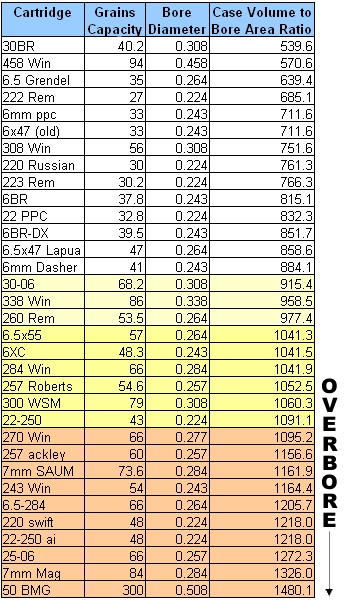
Forum Member John L. has been intrigued by the question of “overbore” cartridges. People generally agree that overbore designs can be “barrel burners”, but is there a way to predict barrel life based on how radically a case is “overbore”? John notes that there is no generally accepted definition of “overbore”. Based on analyses of a wide variety of cartridges, John hoped to create a comparative index to determine whether a cartridge is more or less “overbore”. This, in turn, might help us predict barrel life and maybe even predict the cartridge’s accuracy potential.
John tells us: “I have read countless discussions about overbore cartridges for years. There seemed to be some widely accepted, general rules of thumb as to what makes a case ‘overbore’. In the simplest terms, a very big case pushing a relatively small diameter bullet is acknowledged as the classic overbore design. But it’s not just large powder capacity that creates an overbore situation — it is the relationship between powder capacity and barrel bore diameter. Looking at those two factors, we can express the ‘Overbore Index’ as a mathematical formula — the case capacity in grains of water divided by the area (in square inches) of the bore cross-section. This gives us an Index which lets us compare various cartridge designs.”
OVERBORE INDEX Chart
So what do these numbers mean? John says: “My own conclusion from much reading and analysis is that cartridges with case volume to bore area ratio less than 900 are most likely easy on barrels and those greater than 1000 are hard on barrels.” John acknowledges, however, that these numbers are just for comparison purposes. One can’t simply use the Index number, by itself, to predict barrel life. For example, one cannot conclude that a 600 Index number cartridge will necessarily give twice the barrel life of a 1200 Index cartridge. However, John says, a lower index number “seems to be a good predictor of barrel life”.
John’s system, while not perfect, does give us a benchmark to compare various cartridge designs. If, for example, you’re trying to decide between a 6.5-284 and a 260 Remington, it makes sense to compare the “Overbore Index” number for both cartridges. Then, of course, you have to consider other factors such as powder type, pressure, velocity, bullet weight, and barrel hardness.
Overbore Cases and Accuracy
Barrel life may not be the only thing predicted by the ratio of powder capacity to bore cross-section area. John thinks that if we look at our most accurate cartridges, such as the 6 PPC, and 30 BR, there’s some indication that lower Index numbers are associated with greater inherent accuracy. This is only a theory. John notes: “While I do not have the facilities to validate the hypothesis that the case capacity to bore area ratio is a good predictor of accuracy — along with other well-known factors — it seems to be one important factor.”
Using digital publishing software, the NRA is now offering iPad-optimized versions of American Rifleman and American Hunter magazines. These two magazines are now available for iPad-using NRA members who download the NRA Magazines App in the Apple App Store.
Bonus Content for iPad Users
The new digital magazines will feature all the stories, photos, and graphics found in the print magazines, PLUS bonus content. NRA Members with iPads can access videos, extra photos, sidebars, computer graphics and other interactive features. NRA Publications’ Joe Graham states: “The new iPad editions are designed to be convenient, easy to use and, most importantly, fun to read. The digital magazines have the same look and feel as the print magazines [but with] additional interactive content you can only get on an iPad.”
How to Get the iPad Editions of American Rifleman and American Hunter
As Official Journals of the NRA, American Rifleman and American Hunter are available exclusively to NRA members. You must be a current NRA member to access these digital eZines. To join the NRA visit Membership.nrahq.org or call 1-877-NRA-2000. For a limited time, all NRA members who currently receive their magazines in print will be able to download the iPad editions.
To get the new iPad editions of American Rifleman and American Hunter, NRA members can download the free NRA Magazines App from the Apple App Store. Once downloaded, launch the app and enter your NRA membership number and last name. Upon verification, the magazine you currently receive as part of your NRA membership will be displayed. Tap “download” to have the digital magazine delivered directly to your iPad and start enjoying all of the exciting new interactive features.


 5. Gas Block: You want a gas block that does not impose pointed stress on the barrel. Clamp-on types that grab all the way around the barrel are excellent. The blocks that are pinned on with tapered pins that wedge against the barrel or the slip on type of block with set screws that push up from underneath (or directly on the barrel) can deform the bore inside of the barrel and can wreck the accuracy of an otherwise great barrel.


 Center Hold
 6 O’Clock Hold
 Sub 6 Hold
 Frame Hold
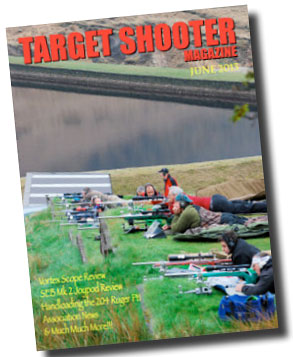 The June, 2013 Edition of


 Many readers will be driving across multiple states this summer to attend competitions. Other shooters will be heading out of state for a game hunt or prairie dog safari. For $13.95 you can purchase a state-by-state
  The Traveler’s Guide to the Firearm Laws of the Fifty States has sold more than 950,000 copies since it was first released in 1996. The book’s author, Attorney J. Scott Kappas, has written numerous magazine articles and has appeared on television, explaining the unexpected pitfalls that shooters may encounter when traveling with firearms. Along with being an attorney, Mr. Kappas serves as a director on the Board of the Kentucky Firearms Foundation, and Kappas is a Class III firearms dealer.
 These days, online gun auctions are busier than ever. Many folks are purchasing arms for the first time, and sellers are enjoying good prices for their wares based on increased demand. Some people even think that guns may be a safer investment than real estate or bonds at this time. That’s questionable, but this Editor finds it ironic that most of his guns have held their value while the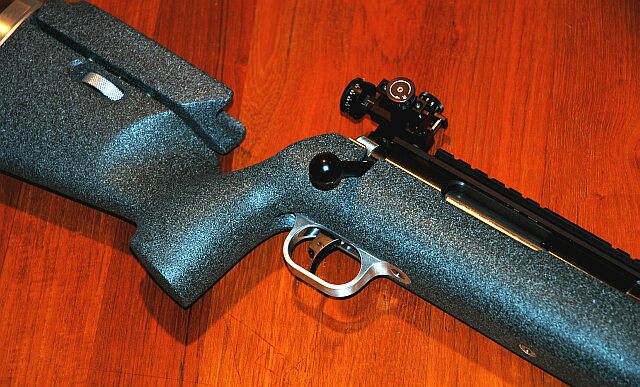
 For benchrest, F-Class, Silhouette, Tactical or High Power rifles, you may get the best results posting a For Sale ad on a Forum that caters to the right discipline. You want your ad to reach the right audience. On the other hand, a GunBroker.com auction will have tens of thousands of potential buyers. Realistically, however, if you price your rig attractively, it should sell quickly in a Forum Classified Advert. Plus with conventional Classifieds, you can sell immediately — you don’t have to wait for the auction to end. For scopes and reloading equipment (but not firearms, actions, barrels etc.), also consider eBay, which still allows many gun-related items.
 ATK announced that it will pay $315 million to acquire Caliber Company, the parent company of Savage Sports Corporation which runs Savage Arms, and Stevens. Savage will be integrated into ATK’s Sporting Group business which includes Federal Premium, Alliant Powder, CCI, RCBS, Speer, Champion Targets, and other outdoor sports brands.
 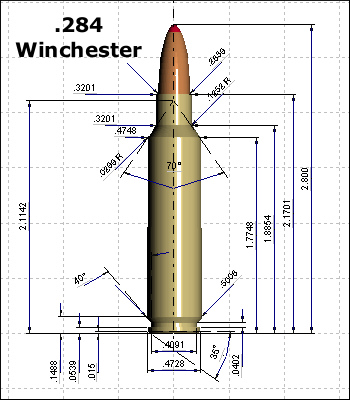 Building a Straight .284 Winchester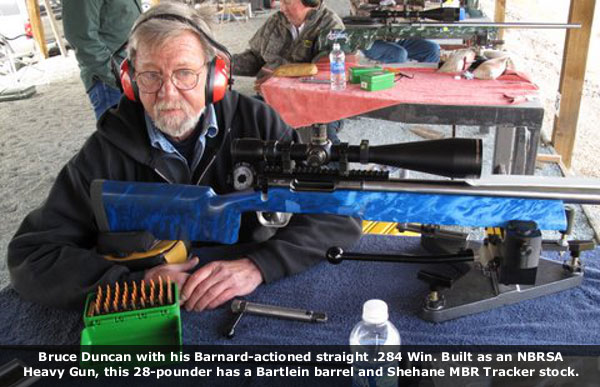
 It turned out that my load development wasn’t a fluke. The gun shot well, taking Third Place, 6-Target Aggregate Heavy Gun Group at the 2011 NBRSA 1000-Yard Nationals in Sacramento. Together with my 6×47 Lapua Light Gun, I took Third Place Overall. (The LG also featured a Barnard Action, Bartlein barrel, and Shehane stock.)

 Using digital publishing software, the NRA is now offering iPad-optimized versions of American Rifleman and American Hunter magazines. These two magazines are now available for iPad-using NRA members who download the


