|
|
April 21st, 2009

The Ninth Circuit Court of Appeals ruled yesterday that the Second Amendment of the U.S. Constitution restricts the powers of state and local government as much as it does those of the federal government. A three-judge panel issued this ruling in Nordyke v. King (Alameda County). This is the first case where a Circuit Court has declared that the actions of states or municipalities are subject to the Second Amendment protections recognized by the U.S. Supreme Court in D.C. v Heller last year. (Other cases challenging state action on Second Amendment grounds are pending before the Seventh Circuit.)
In finding that the Second Amendment applies to actions of States, counties, and local municipalities, the 9th Circuit applied the due process clause of the 14th Amendment. The Circuit Court concluded “that the right to keep and bear arms” as a personal right has been recognized by the Supreme Court in Heller, and that this applies to the states through the Fourteenth Amendment’s due process clause.
 In Nordyke v. King, the plaintiffs challenged an Alameda County ordinance that effectively prevented plaintiffs from holding a gun show at the Alameda Fairgrounds. Though the 9th Circuit acknowledged the existence of rights under the Second Amendment, the three-judge panel concluded that D.C. v. Heller was limited in scope, and only recognized a right of “armed self-defense in the home”. Accordingly, the Ninth Circuit ruled against plaintfiffs, and upheld the Alameda County ordinance, which banned possession of guns “on county property.” Disturbingly, the Ninth Circuit ruling attempts to carve out a “public property” exception to the Second Amendment. The Nordyke v. King opinion states that a gun ban on county property: “fits within the exception from the Second Amendment for ‘sensitive places’ that Heller recognized.”
We’re not certain that the U.S. Supreme Court would agree with the Ninth Circuit’s holding that a fairground was a ‘sensitive place’ where the Second Amendment, effectively, has no sway. If a state or county can ban guns at a fairground, then why not public parks, parking lots, bus stops and so on? This could lead to cities and counties declaring extensive “gun-free zones” within their boundaries. Ironically, public places such as parking lots may be exactly where citizens are most at risk of violent crime. And ask yourself this… what other Constitutional rights are geographically limited? Would a court dare to restrict the First Amendment so as to eliminate the right of free speech on public property?
CLICK HERE to Read Full 9th Circuit Decision (.pdf download).
April 13th, 2009
The 2009 NBRSA 600-Yard Nationals (Sloughhouse 600) will be held April 24, 25, and 26, at the Sacramento Valley Shooting Center. This 3-day match is hosted by the Folsom Shooting Club, at the Sacramento Valley Shooting Center in Sloughhouse, CA, a few minutes East of Sacramento. This event grows more popular every year as more and more top shooters are drawn to the relatively new 600-yard benchrest discipline.

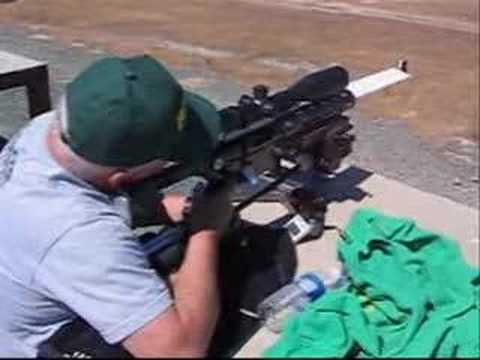
Last year, Jerry Tierney (shown in VIDEO below) dominated the field, shooting a 6mmBR Improved in an Elesio R5 Tubegun. CLICK HERE to read an in-depth report on last year’s 600-yard Nationals, with lots of photos.
Match information plus range maps are available at www.sacvalley.org in the “Upcoming Events” section, or click the links below:
NBRSA 600 Nationals Match INFO
Download NBRSA 600 Nationals REGISTRATION FORM (.pdf file)
Match fees are currently $75.00 per class (light gun and heavy gun). If you have further questions, or need forms mailed to you, contact match Director Ed Eckhoff: (530) 661-6018; e-mail: eckran@yahoo.com.
RECOMMENDED: Read Feature Story on 2008 NBRSA Nationals
April 5th, 2009
Sinclair International recently launched its enhanced and upgraded website. The revamped site is faster to navigate, and you’ll find it much easier to find new products and bargain specials. Congrats to Bill Gravatt and the folks at Sinclair Int’l for a job well done.

One great feature newly integrated into Sinclair’s website is The Reloading Press, a regularly-updated Blog with product info and authoritative technical articles on reloading and precision shooting. Here are some of the valuable “how-to” articles you’ll find on Sinclair’s Blog:
Determining Bullet Seating Depth
Setting Up a Full-Length Sizing Die
Shooting Non-Benchrest Rifles from the Bench
Basics of Reloading for the AR15
Methods and Benefits of Sorting Cases by Weight

The Reloading Press is a valuable addition to the online resources available to precision shooters. We commend Sinclair for investing the time and effort to provide this material at no cost to Sinclair’s customers. Click one of the links above and check it out yourself.
April 3rd, 2009
 There is a fascinating article in Investors.com about Arthur W. Savage, founder of Savage Arms Company. A brilliant inventor, Arthur Savage had a remarkable personal history, full of adventure. (Did you know that, in addition to being a great gun designer, Savage invented a torpedo, built race cars, and is credited as being the inventor of radial tires?)
Born in Kingston, Jamaica, Arthur Savage was educated in Britain and the United States. In his 30s he explored the Australian outback with his wife and eight children, eventually coming to own the then-largest cattle ranch in Australia. But he soon sold the ranch and bought a coffee plantation in Jamaica. In 1892, still in his 30s, Savage moved to Utica, New York, hiring on with a Railroad and part-time with a gun parts maker. Savage turned his attention to gun design with the goal of producing a lever-action rifle that could shoot the sharp-nosed .303-caliber spitzer rounds favored by the military. To overcome the problem of pointed bullet tips detonating primers in a tubular magazine, Savage invented a new rotary magazine. Arthur’s new rifle also featured a spring-activated firing pin rather than a hammer. The design, perfected in 1893, became the classic Savage Model 99, credited as the first mass-produced hammerless rifle. In 1894 Arthur Savage founded Savage Arms Co. in Utica in 1894 to produce his new rifle. Savage’s Model 99 rifle stayed in production for 105 years, being produced with relatively minor changes through 1999.


Photos courtesy Hallowell & Co., Livingston, MT, purveyor of fine sporting arms.
Origin of Savage’s Indian Head Logo
You may wonder about the Indian head logo Savage arms still uses as its trademark. Here’s how it came into use. In 1919, Chief Lame Bear (illustration below) approached Arthur to purchase lever-action rifles for the Indian reservation and the two men struck a deal. The tribe would get discounted rifles and Savage would get their support and endorsement. It was at this time in the company’s history, that Arthur Savage added the Indian head logo–a direct gift from the Chief–to the company name.

April 2nd, 2009
 Lead by top UK shooter Vince Bottomley, a team of UK gun experts has launched Target Shooter, a new online “e-zine” dedicated to precision shooting. This is a great new offering — you should log on to TargetShooter.co.uk right now to check it out. Vince explains: “Our online magazine will cover target shooting in all its forms, including rimfire and centerfire benchrest, F-Class, classic military rifle, and tactical. We’ll deliver feature articles plus match reports and gear reviews.”
Target Shooter employs a publishing format called “Scribd” that delivers a print-magazine style format over the web. This is actually kind of cool, as you can zoom pages smaller and larger and download the entire “magazine” for off-line reading. A new edition of Target Shooter will be released every month.
Target Shooter Offers Great Content
The debut April 2009 edition, 109 pages long, is truly impressive. It contains many interesting articles including a 2009 IWA (Euro Shotshow) report from Vince Bottomley, a comparison test of budget scopes by Carl Boswell, a detailed F-TR Tubegun review by Laurie Holland and Vince B., and a fascinating discussion of Field-Target shooting by Tim Finley (covering all positions). And that’s not all — the magazine offers a two-month event calendar, plus match reports (check out Gwyn Roberts’ Gallery Shooting Tri-Nations tournament report).
Target Shooter also features many gear reviews and product evaluations. In the April edition, Carl Boswell provides a comprehensive review of the BullzeyePro optical boosters. If you are considering purchasing this product you should definitely read this review — it even includes through-the-lens photos, so you can see the magnification boost with your own eyes.
Overall, the new Target Shooter online magazine is a mighty impressive accomplishment. It is rich with content, the photography is excellent, and the level of technical expertise is high. We were very impressed by the diversity of disciplines covered — this magazine covers much more than conventional benchrest. Any gun enthusiast interested in precision shooting should log on to TargetShooter.co.uk. Not only is it one of the best sources of shooting information available, but it is currently 100% free. You can’t beat that.

March 31st, 2009
 John Parker of the NRA’s Competitive Shooting Division has authored a new brochure on the topic of High Power Rifle competition. It is available from the NRA online store for just $0.50, item CT17000. The booklet covers all the key components needed for High Power shooting. It also includes a special “Getting Started” section.
In the new booklet, Parker covers the following topics: Course of Fire, Rifle, Sling, Spotting Scope, Shooting Coat, Shooting Glove, Eye and Ear Protection, Sight Blackener, Scorebook, and Ammunition. Parker also explains the NRA Classification System and provides basic summaries of popular High Power disciplines: Long Range, Mid Range Prone, F-Class, and High Power Sporting Rifle.
You can order this booklet online at the NRA Program Materials Center, or call 800-336-7402 to place your order over the phone. Visit NRA’s High Power Rifle Competition webpage for more information.
This report comes courtesy of the NRA Blog.
March 8th, 2009
As shooters seek less expensive ways to shoot, rimfire competition of all types is becoming more popular. Silhouette shooting is fun because you get to knock down small steel targets, just like in a shooting gallery at a County Fair. But don’t let anyone suggest Silhouette is easy. All shots are taken from the standing position. If you haven’t tried that recently, you’ll find that your crosshairs will be dancing all around the target.

At an official match, you’ll shoot at least 40 shots, ten each at four sets of 1/5th size standard High Power Rifle Silhouette targets. The smallest targets, the chickens, are set at 40 yards, Pigs are at 60 yards, Turkeys are at 77 yards, and Rams are at 100 yards. (Alternatively, metric distances are used.) Though the rams are the largest targets, hitting them is far from easy, given the ballistics of 22 rimfire ammo. At 100 yards, a little bit of wind will blow you off the target.

Two classes of rifles are used in Rimfire Silhouette: Standard and Hunter Class. Standard rifles can weigh up to 10 pounds, 2 oz. (with sights) and have no restriction on trigger pull weight. The fore-end shall not exceed 2 1/4″ wide, and 2 1/4″ deep measured from the centerline of the bore. Bull barrels are common, and the gun of choice is the Anschutz 54.18 MS (Metallic Silhouette) or 1808 (thumbhole version of the 54.18). A 54.18, if you can find one, will set you back $1200.00 – $1700 depending on condition. The 54:18 is in limited production and even good used models are hard to find.

Hunter Class rifles must have a more conventional “sporter-style” stock, typically with a narrow fore-end. A high comb is used to provide a good cheek weld. Hunter Class Rifles are limited to 8.5 pounds (with scope), and the trigger pull weight shall not be less than 2 pounds. No bull barrels are allowed — you must use a conventional tapered hunting barrel. Among production rifles, the Anschutz 1712 is the rifle to beat. These guns are very accurate out of the box, and come with an outstanding two-stage trigger that breaks cleanly right at two pounds. Kimber and CZ also make factory silhouette rifles for the Hunter Class. Though not on a par with the Anschutz 1712, the Kimber and CZ are viable options for novices or shooters on a tight budget.
Many top silhouette shooters like Mark Pharr will shoot the lighter Hunter rifle in both classes. Pharr and others have found that accurized Hunter Class guns can be competitive even against the heavier guns. While a stock Anschutz 1712 Hunter is impressive, many competitors will hot-rod their gun, putting a 1710 or 1712 action in a Mark Pharr-designed stock. They will then add a match barrel from Lilja, Shilen or other top barrel maker. Shown below is an Anschutz 1712 action in Pharr stock.


If you want to learn more about rimfire silhouette, visit SteelChickens.com. To order a Mark Pharr stock (built by Robertson Composites), contact Chickens Shooting Supply.
CLICK HERE for Summary of Rimfire Silhouette Rifle Rules.
February 27th, 2009
 For years the NRA has published Shooting Sports USA, an informative print magazine for competitive shooters. While sample articles and a match calendar could be found on the web, the complete magazine contents were available only via a conventional print magazine subscription.
Now that’s changed. You can read ALL the contents of Shooting Sports USA now for FREE, in a monthly “Digital Edition”. Using “digital paper” technology from Olive Software, the entire magazine loads as a file in your internet browser. You can size the pages larger or smaller. You can even turn the pages as with a conventional magazine. To get your FREE subscription to Shooting Sports USA in digital form, just go to the Shooting Sports USA website, and enter your email address and zip code. That’s it — no fees, no credit card info required.

CLICK HERE to read a sample Digital Edition of Shooting Sports USA
(Note: This will load a flash player that may not be compatible with all browsers.)
Get New Rules, Match Results, Gear Reviews, and More…
The current issue of Shooting Sports USA includes the 2009 NRA Competitive Rule Changes. You can access those rule changes by viewing the March, 2009 sample digital edition (may take some time to load). Other features in the March edition include Shooters News, a Score Sheet (recent match results), Brief Product Reviews, and a Calendar of Coming Events.

February 24th, 2009
 On LongRangeHunting.com, you’ll find a good article about wind reading by Shawn Carlock. Shawn Carlock is a veteran law enforcement marksman and the current USPSA national precision rifle champion. Shawn offers good advice on how to estimate wind speeds and directions using a multitude of available indicators — not just your wind gauge: “Use anything at your disposal to accurately estimate the wind’s velocity. I keep and use a Kestrel for reading conditions….The Kestrel is very accurate but will only tell you what the conditions are where you are standing. I practice by looking at grass, brush, trees, dust, wind flags, mirage, rain, fog and anything else that will give me info on velocity and then estimate the speed.”

Shawn also explains how terrain features can cause vertical wind effects. A hunter positioned on a hilltop must account for bullet rise if there is a headwind blowing up the slope. Many shooters consider wind in only one plane — the horizontal. In fact wind has vertical components, both up and down. If you have ever piloted a small aircraft you know how important vertical wind vectors can be. Match shooters will also experience vertical rise when there is a strong tailwind blowing across an up-sloping berm ahead of the target emplacements. Overall, Shawn concludes: “The more time you spend studying the wind and its effect over varying terrain the more successful you will be as a long-range shooter and hunter.”
February 19th, 2009
Mark Trope, Webmaster of the Gun Owner Network website, has written a very thorough review of the SEB Coaxial front rest. Mark’s SEB Rest Review covers all the bases, showing how the rest works with a variety of rifle types, including both wide-forearm match rifles and narrow-forearm sporter rifles. Mark provides dozens of clear photos of the rest, showing many of the fine points of SEB’s impressive design. The review shows how to set-up and level the rest, and how to tune the “feel” of the joystick to suit your preferences. Some rest users prefer the joystick to move quite freely, while others prefer to dial in some resistance so there is no chance of movement when you remove your hand from the joystick.

 After covering the features and performance of the SEB Rest, Trope turns his attention to the SEB “BigFoot” rear bag. He explains why it’s a super-stable choice in rear bags, one of the best products available. You’ll note we acquired a SEB BigFoot rear bag for our latest AccurateShooter.com Project Rifle (see story above). After providing tips on how to fill the bag with heavy sand, Trope shows how to adapt a RubberMaid “ActionPacker” plastic storage bin to carry both the SEB Front Rest and the BigFoot Bag.
If you are considering the purchase of a joystick-style front rest, or joystick-style rest top, you should definitely read Trope’s Rest Review. It will definitely help you identify the features you need, so you can make an informed decision, whatever brand you ultimately choose. To learn more about the SEB coaxial rest, or to place an order, contact Sebastian Lambang’s American dealer, Ernie Bishop:
Ernie Bishop
306 West Flying Circle Drive
Gillette, WY 82716
(307) 257-7431
ernieemily [at] yahoo.com
|


