|
|
February 17th, 2009
A new study by Target Sports Marketing, based on surveys of Camp Perry competitors, provides some interesting facts. First, and this is no surprise, more than 80 percent of competitive shooters reload their own ammunition. The majority of these shooters (60 percent) compete year-round while a larger percentage (70 percent) practice year-round.

Shooters in 50s and 60s Outnumber Younger Participants
Interestingly, there is a significant “generation gap” among shooters. According to the survey, shooters in their 50s compose the largest segment of competitive rifle shooters. And, the combined number of rifle shooters in their 50s and 60s exceeds all other age categories combined. Keep in mind, Camp Perry focuses on traditional NRA High Power, Palma, and long-range events. Were you to survey other disciplines (such as 3-Gun Matches), you’d likely find a different age distribution. Nonetheless, the numbers do demonstrate the need to increase the number of younger rifle competitors. Unless there is a major effort to attract new, younger shooters, it appears that competitive rifle shooting could decline in popularity dramatically in a decade or so, as the Age 50s cohort gets older.

The findings are based on the feedback of nearly 400 rifle and pistol competitors at the 2008 U.S. National Matches at Camp Perry, Ohio, hosted by the Civilian Marksmanship Program (CMP). The study focuses on individual competitor demographics, shooting sports engagement and brand preferences for firearms, ammunition, components and accessories. An animated, narrated summary of the report is available at css.targetsportsmarketing.com. Definitely click the link — many interesting facts are revealed. This particular presentation focused on 186 CMP competitors, two-thirds of whom were rifle shooters.
Graphs and data created by Target Sports Marketing for the CMP.
February 16th, 2009
We recently tested two large spotting scopes and two high-magnification riflescopes to see if they could resolve 6mm bullet holes at 600 yards. In ideal, early-morning conditions, we could see 6mm bullet holes in the white with all four optics (Pentax PF100ED, Swarovski 80mm ATS, March 10-60, Nightforce 12-42 BR). However, as the day wore on, and mirage increased, it became increasingly difficult to see the bullet holes, even with the big spotters.
It became obvious to our crew of testers, that if you want to see 6mm bullet holes at 600 yards and beyond, in all conditions and against any background color, some kind of remote camera system may be easier on the eyes than even the finest high-power glass you can buy.
CLICK HERE to READ Complete Target Cam Article With Hardware Tips
 Advantages of Target Cam System
By placing a remote camera relatively close to the target, you bypass many issues that compromise optical resolution. You can see the target clearly even in misty conditions or when the mirage is extreme. You can view your target easily on a large screen… that means no more straining with tiny (1mm) exit pupils with ultra-critical eye relief (move your head slightly and you lose the “view” completely). Over an extended period, you’ll experience much less eye fatique using the target cam.
Components of a Target Cam System
You can put together a good long-range target cam system for under $1200.00. This will include camera, tripod, remote wireless transmitter, receiver and monitor/display screen. You can shop for your own components through catalogs. Or you can contact Forrest Foster, an AccurateShooter.com Forum member and long-range shooter from South Dakota. Over the last couple of years, Forrest has experimented with a variety of Target Cam components. He’s field-tested different cameras and transmitter/receiver packages and come up with an affordable system that works reliably at 1000 yards and beyond.

Foster offers his target-cam set up in two configurations. For $825.00 he supplies a quality Sony video cam, wireless transmitter and receiver, cables and powerful, rechargeable 12 volt batteries. All you need to do is add a monitor or small TV set. If you already have a video camera, Forrest offers the same package, without the Sony camera, for $525.00. For more information, call Foster at (605) 342-8320, or email FFoster [at] dsginc.biz.
Target Cam System in Use
Forum member Donovan has used Foster’s target cam system extensively, and currently has it deployed using an older camcorder rather than the Sony device. Shown below is Donovan’s screen displaying a target placed 1000-yards away. Note you can see the bullet holes clearly.

Donovan is highly pleased with the set-up and says it works great all the way out to 1000 yards. Donovan writes: “For those interested, I am one of Forrest’s system testers. With a cheap Sanyo 21″ TV, I get a great picture of the target at 1000 yards. With a Samsung 151MP flat screen, I get a better target view yet. The video camera that Forrest sells with the system features a variable focal 5-50x lens. In testing, I have placed it as close as 5 feet and as far as 75 feet (25 yards) away from the target with no difference in quality of view on the screen. Just simply adjust the zoom to the amount of target you want displayed.
When set up at 300, 600, and 1000 yards, I did not see any difference in picture quality, as received back at the bench. 1000 yards is the farthest distance at which I’ve used the Target Cam system, but I’m sure it would transmit and receive further.”
February 14th, 2009
The editors of the NRA’s American Hunter magazine recently tested 10 brands of shooting glasses, determining how well the eyewear could shield users from shotgun birdshot. Eyewear samples were tested at 25, 15, 10, 8, and 5 yards, using #8 shot. One ANSI Z87.1-certified polycarbonate sample was then repeat-tested with #6 shot, #4 shot, #2 steel and buckshot. Read Full Test Report.
 The tests provided some very important conclusions:
1. The glasses marked Z87.1+ (“plus” is a high-impact rating) performed the best. Overall, Z87.1-rated polycarbonate lenses provided excellent protection from birdshot at 10-15 yards and beyond. Some Z87.1+ eyewear even blocked birdshot at 8 yards.
2. You can’t necessarily rely on price as an indicator of quality. The $12 Bollé VX and the $5.95 Pyramex Rendezvous both worked better than some much more expensive brands. The $5.95 Pyramex, in fact, was one of only three products that stood up to the #8 birdshot at 8 yards. The Pyramex does carry a Z87.1+ rating.
3. Avoid no-name, un-rated plastic eyewear. American Hunter Editor Jeff Johnston writes: “It’s a mistake to assume that any plastic-lens sunglasses off the rack at the local 7-11 are made of polycarbonate and therefore are effective as shooting glasses—cheap plastics are not polycarbonates; in fact, wearing them could be worse than wearing nothing, as they can introduce sharp shards of plastic to your eyes in addition to the projectile(s) that caused them to break.”
To learn more about safety standards for shooting glasses, read our comprehensive Guide to Eye Protection for Shooters.
February 12th, 2009
Site contributor Chris Long (aka “TechShooter”) has crafted a report about his July, 2007 Prairie Dog Expedition in Wyoming. Ralph and Lenora Dampman of Trophy Ridge Outfitters served as guides for the trip. Trophy Ridge runs ‘Dog hunts near the town of Carlile in the NW range of the Black Hills, near Devil’s Tower National Monument. Primarily big game outfitters, Ralph and Lenora have access to thousands of acres of private ranch land. They run guided prairie dog hunts during their off-season. Chris reports “The terrain is beautiful, a welcome change from the South Dakota prairie, with lots of hills and Ponderosa pine trees. [These] ranch lands are home to some prodigious dog towns.”
Chris continues: “The goal of this trip (besides having a great time) was to get in some long range (1000+ yard) opportunities, and possibly even a shot over 1500 yards, in order to qualify for the VHA 1500 yard certification. I had worked up some really good loads for the 6.5-284 TubeGun and the .260 AI using the new 130 grain Berger VLDs, and wanted to see how they performed at these extreme ranges. I also wanted to see how the trusty 6 Dasher performed as a long range varmint cartridge.”
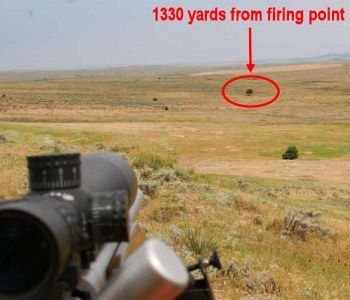
Chris Long was joined by two friends who came all the way from Virginia. Chris reports, “Our plan was to get in four days of intense, long-range shooting. We were not disappointed! The shooting was from 100 to over 1000 yards, and the dogs were everywhere. There were plenty of targets close in, so there was a lot a variety. It is especially challenging to move in and out in range by these extreme amounts. It gave me a lot of practice estimating range and wind conditions, then seeing if I could get the come-ups and windage right on the scope for the first shot at the new range. By the end of the trip, I was getting it pretty close, with some 1-shot hits out to about 600 yards.”

Chris’s primary long-range rifle was his 6.5-284 Tube-gun (photo above) running 130gr Berger VLDs at 3165 fps. Chris reports the 130s can be shot at 3165 fps with no excessive pressures, and “scary, one hole, 5-shot 100-yard group accuracy.” With a B.C. of about 0.6, the 130s shoot flatter and exhibit less wind drift than the 140gr class bullets at 2950 FPS.
Chris’s second gun was a more conventional bolt-action in a Franklin LowRider stock, set up with both 6mm Dasher and .260 AI barrels. Chris notes: “The Dasher has proven itself in spades as an extremely accurate cartridge for F-Class Open competition, and I was anxious to see how it performed as a varmint cartridge. The performance was excellent, with many hits out past 1000 yards. This rifle is set up as a switch-barrel rig, and is the platform for the 260 AI. I made a portable barrel vise that mounts in the trailer hitch receiver on the Suburban. That, with a rear entry action wrench, makes barrel changes a 5 minute affair. I would shoot until the barrel got a bit hot, then switch and proceed with the other caliber.”
CLICK HERE to read the complete story. It contains more load data, details of hits made out to 1330 yards, and many great photos of the Wyoming scenery. For .260 AI and 6 Dasher tech tips, visit TechShooter’s Shooting Pages.

Photos and quotes copyright © 2007 Chris Long, All Rights Reserved, used by permission.
January 24th, 2009

The First Shot, the CMP’s online magazine, features a well-written article on Prone Shooting Technique by SPC Matthew Sigrist of the U.S. Army Marksmanship Unit (USAMU). The article covers all the major points of gun hold and body position: hand position, elbow position, stock weld, buttstock placement, and sling position/tension.

SPC Matt Sigrist of the USAMU breaks down the prone position into “fundamentals” and explains how you put each element together to create a stable body position: “The fundamentals are the building blocks of a position. Much like the framework of a house, a correct application of the fundamentals ensures a solid and stable structure. Since each person’s position will depend on their particular body build and shape, there is no ‘perfect position’ that applies to everyone. Experience, practice and knowledge of the correct fundamentals will dictate the best position for you.”
SPC Sigrist also demonstrates the two basic variations of the leg position when shooting prone: open/spread legged, and bent-legged.
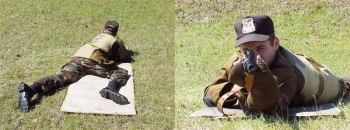

For any service rifle, highpower, cross-course, or prone shooter, this helpful article can improve your performance in the prone position.
January 22nd, 2009
 The National Shooting Sports Foundation’s SHOT Show wrapped up Sunday in Orlando with strong attendance and a cautiously optimistic outlook for the coming business year. Though many trade shows have seen a decline in attendance, SHOT Show attendance increased 3% when compared to its last visit to Orlando in 2007, and was down just 6% when compared to last year’s record-breaking show in Las Vegas. According to preliminary figures, this year’s show attracted 25,384 attendees, 22,098 exhibiting personnel and a record 1,425 members of the media for a total attendance of 48,907.
Many manufacturers’ representatives confirmed that the show was very good from a business standpoint. Despite the troubled economy, orders were being taken and demand seemed strong for a wide variety of products. High-tech rifles and handguns, in particular, have seen a jump in sales heading into 2009.
Steve Hornady, president of Hornady Manufacturing Co.:
“Response to our new products has been good. Some of this, of course, is in anticipation of a problem down the road. This year will be determined primarily by what happens in Washington, and is for the most part out of our control. We hope that common sense will prevail, and the fact that further regulation of our industry is not the solution.”
Scott Grange of Browning:
“It’s been a good show. With all of the interest in high-tech arms, it good to see that the interest in our over/under shotguns was also up. The SHOT Show specials we laid out for retailers were very well received. The success here has helped position us for the expected upturn in the economy.”
Al Russo of Remington Arms Co.:
“Our meeting rooms were booked, and the quality of the buyers at the show was very good. We saw good volume in our law enforcement booths, and we’re very pleased with the media turnout.” |

SHOT Daily Available Online
All four issues of SHOT Daily, the magazine printed each day of the SHOT Show, are available online in PDF format at www.shotshow.org. SHOT Daily is printed for NSSF by Bonnier Corp., publishers of Outdoor Life, Field & Stream and SHOT Business magazines.
January 15 | January 16 | January 17 | January 18
Story and photo © 2009 by NSSF, used with permission
January 22nd, 2009
 In our SHOT Show reports, we’ve provided in-depth coverage of notable new optics from March (DEON), Leica, Nightforce, Schmidt & Bender, and Zeiss. To learn more about new riflescopes, spotting scopes, rangefinders, and binoculars from other manufacturers, you can download the January 16th (Friday) edition of the SHOT Daily.
Just posted online, this NSSF e-zine dedicates five pages to new products from all the well-known optics manufacturers, including Bushnell, Burris, Leupold, Nikon, Pentax, and Swarovski. Plus, on page 64 of the Jan. 16th SHOT Daily, there is an in-depth feature on Nikon’s new hunting scopes, including the Predator Hunter with BDC reticle, and the low-magnification (1.1-4×24) 30mm African Series scopes, designed for dangerous game. The Predator Hunter bullet-drop-compensating (BDC) reticle has a center circle that subtends a coyote’s vital area at 100 yards, for quick sighting and target acquisition. Nikon’s new scopes, “are an example of an increase in specificity of hunting and shooting products,” according to SHOT Daily.
CLICK HERE to Download 1/16 SHOT Daily with OPTICS REPORT (.pdf file).

January 17th, 2009
 The latest SHOT Daily is now available for FREE online. The latest edition, dated Jan. 17th, covers SHOT Show events, and includes gear and hardware reviews. This issue spotlights knives, camouflage clothing, and hunting accessories. The issue also has a feature story about the Brownell’s Gun Industry Career Fair. Click the link below to download the Jan. 17th SHOT Daily as an Adobe Acrobat (.pdf) file.
CLICK HERE to Download Jan. 17th SHOT Daily
January 15th, 2009
Each day during SHOT Show, the NSSF publishes a magazine-style E-Zine, the SHOT DAILY. The SHOT DAILY is a “must-read” if you want to keep up with the latest SHOT news and product unveilings. You’ll find lots of product photos plus short gear reviews. All this is FREE in a downloadable .PDF (Adobe Acrobat) file.
CLICK HERE to Download SHOT DAILY 2009, Part One
In today’s edition of the SHOT DAILY is a 20-page Guide to the New Rifles of 2009. It is organized alphabetically, covering manufacturers from Anschütz to Winchester. According to the 2009 Rifle Guide, “New lever-actions and bolt-actions dominate the scene this year, but tactical rifles remain strong sellers. In the bolt-action arena, every major maker is offering new models in both light and heavy versions, as well as updates and caliber introductions to existing models”
One of the featured rifles is the handsome new Anschütz Model 1770 Hunter in .223 Remington. A mag-fed, centerfire repeater, the model 1770 features a new six-locking-lug action — the company’s first completely new action in three decades. This new design boasts a short 60-degree bolt lift for fast cycling. The receiver has a dovetailed rail on top, but is also drilled and tapped for scope mounts.

This issue of the SHOT DAILY also includes lengthy sections dedicated to new shotguns and new handguns, plus discussion of gun buying trends and new developments in gun range management.
December 31st, 2008

The NRA offers a new website dedicated to the interests of hunters, particularly big game hunters. The NRAHuntersRights.org website offers current news items, gear reviews, and stories about hunts in the USA and abroad. There is also a Trophy Gallery and a state-by-state directory of Places to Hunt. The site also allows readers to share their views via a Hunters’ Blog and Forum.
Site Features More Than Politics
NRAHuntersRights.org might be better titled “Hunters’ News”. The site is more a general interest resource for hunters than a platform for gun rights advocacy. While it does have links to gun rights stories, most of the content covers the basics… where to hunt, how to hunt, and what equipment to hunt with. You’ll also find interesting historical stories. Currently, HuntersRights.org features a video about Teddy Roosevelt’s .405-caliber, lever-action 1895 Winchester, the rifle Teddy called “Big Medicine.”
Click Here to Watch Video about 1895 Winchester

In the video, National Firearms Museum curator Phil Schreier explains that the 1895 Winchester accompanied the former commander in chief on a 1910 safari in Africa, as well as Roosevelt’s famed 1915 expedition to Brazil to find the source of the Amazon River. Roosevelt used his .405 to hunt moose, bear and elk stateside, too.

|


