|
|
December 30th, 2008
 2008 was a remarkable year in terms of global events. From the on-going conflict in the Middle East to the spectacle of the Beijing Olympics, this was a year to remember. The Boston.com website has collected some of the year’s most remarkable images from around the world. You’ll find many of the photos to be amazing, although be fore-warned, some are shockingly graphic — showing the aftermath of terrorism. There are three sets of images. All three sets are worth viewing. We wish we could give you a preview but all these images are copyrighted, so you’ll just have to click on the links. We predict your reaction will be “Wow… amazing.”
Year in Pictures – Set 1 | Year in Pictures – Set 2 | Year in Pictures – Set 3
December 29th, 2008
Free Recent Sample Issues to Review
Wolfe Publishing offers FREE downloadable partial samples of recent issues of Rifle Magazine. Click the links below to view the Jan/Feb 2009, and Nov/Dec 2008 issues. (Note: these are fairly large, 4-5 megabyte .pdf files that will take some time to download.) The Nov/Dec ’08 issue has a nice article on a Kimber model 8400 “tactical” rifle in .308 Winchester. This gun, fitted with a McMillan stock, delivered true half-MOA accuracy with Federal Gold Match ammo.

CLICK HERE for Jan/Feb 2009 (partial issue) | CLICK HERE for Nov/Dec 2008 (partial issue)
December 27th, 2008
 The technical staff of MidwayUSA has created a series of useful “how-to” articles for the NRA’s Guns and Hunting website. These stories cover many basic operations that can be done in a home workshop without expensive tools. The articles available online include:
 Fitting a Recoil Pad
Scope Mounting Made Easy
Glass-Bedding a Rifle Stock (Part 1) | (Part 2)
Applying a Baked-On Gun Finish
How to Shorten and Crown a .22 LR Barrel
How to Install Sling Swivel Studs
Working with Polishing Stones
December 14th, 2008
 The Varmint Hunters’ Assocation (VHA) publishes an excellent print publication, the Varmint Hunter magazine. In addition, the VHA offers a wealth of online resources. On the VHA Website, VarmintHunter.org, you’ll find lots of useful features, including Event Calendar, online store, shooting and safety tips, and select reprints from Varmint Hunter magazine. Right now you can read a free feature article by Thomas Tabor on the 20 VarTarg cartridge in a Cooper model 21 Montana Varminter. If you’re a fan of small, efficient cartridges for varminting, this article is a “must-read”. Here are links to the 20 VarTarg story, and three other excellent articles from Varmint Hunter Magazine:

• 20 VarTarg in Cooper Montana Varminter
• Precision Ballistic Charts–A Critical Aid To Long-Range Shooting
• Trials And Tribulations Of Making The Long Shot
• Stand And Deliver: 10 Tricks… To Be A Better Coyote Hunter
Files are Adobe Acrobat (.pdf) format. Copyrighted photos courtesy Varmint Hunters Association, All Rights Reserved.
December 11th, 2008
If you’re looking for a holiday gift for a serious shooter, or just to add to your library of “classic” shooting resources, here are two books that “lead the field” for their respective shooting disciplines.
 For Short-Range Benchresters
Extreme Rifle Accuracy by Mike Ratigan should be on the shelf of every serious short-range benchrest shooter. (Shooters in other disciplines will find many parts of the book helpful as well.) Butch Lambert has said Mike’s book is “far and away the best BR book written. Very comprehensive, it touches on every aspect of our game.”
A Super Shoot winner and US World Benchrest Team Director, Mike Ratigan is a leading figure in the Benchrest game. It’s rare to find an active competitor with Mike’s credentials who has shared his vast knowledge of the sport. Mike’s new 368-page book is dedicated to getting the most from modern rifle accuracy equipment with an emphasis on shooting 100-200-300 yard group benchrest tournaments.
For the new benchrest shooter, this book presents topics seldom covered elsewhere. The most popular hardware plus new equipment offerings are covered, including external mount scopes, actions, triggers, stocks, wind flags, and more. Also covered are match formats and etiquette, rifle handling techniques, note taking, tuning, bullet selection, goals, match strategies, and the mental aspect of competition. Mike provides many tips that will help active competitors update their own competitive program. The chapter on Superman bullets alone will answer some age-old questions. Ratigan also provides an excellent overview of the World Benchrest Championships and the US Benchrest Hall of Fame. To order, call Mike at (580) 256-2963, or use this ORDER FORM.
Review by Scott Smallwood.
For Long-Range Shooters
Prone and Long-Range Shooting, is a must-read for serious Palma, F-Class, and Highpower shooters. We predict your scores will go up if you read (and re-read) the sections on match strategies and Reading Wind & Mirage. The sections covering Mental and Physical training and will benefit all precision shooters, regardless of discipline. Other topics include Shooting Fundamentals, International Competition, and Loading for Long Range.
 |
 |
Nancy Tompkins has been shooting competitively for over 33 years. She has won the National Long Range Championships four times, and is the only woman ever to win the National Highpower Championships. She has also won the prestigious Wimbledon Cup, and is a 5-time Leech Cup winner. Nancy has been on six Palma Teams (as both a shooter and a coach). Nancy’s mentor is 6-time National Highpower Champion, Wimbleton Cup Winner, and 2005 World F-class Champion Middleton (‘Mid’) Tompkins, and she was able to draw on his considerable expertise in creating her new book. This book is available from RifleShootingbyNancy.com, for $34.95 plus shipping. You can also order through Sinclair International. However, Nancy has signed copies of the book available to those who order directly from her website.
November 26th, 2008
Serious shooters spend lots of time in the reloading room. If you want to produce great ammo, start with a good, solid bench with a very rigid working surface and plenty of storage space. Here we present three sets of FREE workbench plans. Any one of these bench designs can be a good winter do-it-yourself project for those with basic word-working skills.
Easy-to-Build Basic Bench
Simpson, maker of Strong-Tie fasteners, offers FREE Workbench Plans for a sturdy, 48″-wide bench with a pegboard backing and both upper and lower shelves. A complete list of fasteners and cut lengths is provided. For use as a loading bench with mounted presses, double-up the bench-top for extra ridigity. Without much difficulty, the plans can be adapted to build a wider bench if you prefer. The same downloadable document also contains plans for an 80″-high 6-shelf unit, a 72″-high heavy-duty shelving unit (with 4 shelves), and a 48″-wide heavy-duty table.

FREE Strongtie Bench Plans (.pdf file).
Corner Bench with Swinging Doors
The next design is rather unique — a corner bench with swing-out cabinets. This reloading bench is based on plans by M. L. McPherson as published in the October 1993 American Rifleman. The compact footprint that makes good use of corner space that is usually poorly utilized. This set of plans is provided by from Ray-Vin.com, which sells scope stands, shooting carts, sight accessories, and AR15 parts.
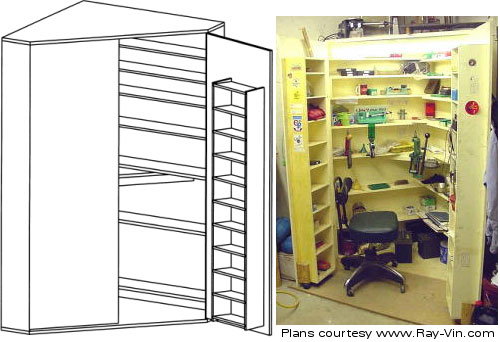
FREE Corner Bench Plans (330kb .pdf file)
Classic NRMA Bench with Cabinets
The last bench design is a large, versatile bench with a full set of enclosed overhead cabinets. A National Reloding Manufacturers Association (NRMA) design, this bench requires many hours to build, but it will house all your reloading gear and provide a very stable platform for your presses.This bench was designed to be as versatile as possible to meet the needs of most reloaders. However, the bench design can easily be customized. For instance, it can be made larger or smaller to meet space requirements or quantities of equipment and components. As it is currently designed, the work area is about waist-high for a 6’2″ person. This can be adjusted to fit your height simply by making the legs longer or shorter.

FREE NRMA Reloading Bench Plans (2.42 megabyte .pdf file).
November 19th, 2008
Muzzle brakes are controversial. Some people swear by them, while others swear at them. Still, there’s no question that a good brake can reduce felt recoil up to 45%. And likewise, the best brakes, when installed properly, seem to have no negative effect on accuracy.

Roy Bertalotto has done considerable experimentation with muzzle brakes, testing dozens of brake designs on his own rifles over the past few years. Roy’s article, Adventures with Muzzle Brakes, discusses various aspects of muzzle brake design and performance. Roy doesn’t claim that his testing is definitive, but his article is definitely worth a read. Here are some of Roy’s interesting findings:
Exit Hole Diameter
“Best accuracy and effectiveness of the brake was obtained with a hole .020″ over bullet diameter. If the exit hole is too small, such as +.005″ over bullet diameter, accuracy suffers. If the depth of the exit hole is too shallow, the metal around the hole will erode very quickly.”
Hole Placement
“The most effective braking was with a brake 1″ in diameter with a 3/4″ exit hole on each side, just in front of the muzzle. The bullet passes through a cone of 35 degrees before it exits the brake. (Like the tank example), Incredible reduction of recoil. But loud and ugly. Very easy to make since you don’t need a spin fixture or a dividing head.”
Bottom Gas Venting Helps Accuracy
“In my tests, not having holes all around the brake effects accuracy a bit. I believe it does something to the bullet by the air pushed ahead of the bullet creating unequal turbulence in the bullet path. I’ve tried a few brakes where I drilled only holes on the top, test fired, and then completed holes on the bottom and in every case, accuracy improved.” Below you see some spiral-ported brakes crafted by Clay Spencer.

Brakes Work Best with High-Pressure Cartridges
“The higher the pressure of the particular round, the more effective the brake. I have over 20 rifles with brakes. The 220 Swift is the king of reduction. Followed very closely by the 25-06, 6mm Remington, any Weatherby small bore. With a proper brake and a hot handload under a 40 gr bullet, the Swift will move 1/2″ to the rear and 0 muzzle rise! Big boomers with low pressure like 45-70s and shot guns benefit the least.” [Editor’s Note: Roy is judging effectiveness by the percentage of recoil reduction rather than absolute levels of recoil. Obviously if you start with a heavier-recoiling round, the absolute amount of recoil energy reduction is greater. Roy is really talking about efficiency–brakes are most efficient when used with high-pressure cartridges.]
Installation is Key to Accuracy
Roy’s findings are fascinating and suggest that further study of muzzle brakes is warranted. But we can all agree that precision installation of the brake is essential for accuracy. A poorly-installed, mis-aligned brake will degrade accuracy, that is well-known.
Harrell’s Precision has made tens of thousands of muzzle brakes, in many styles and port arrangements. The Harrell brothers offer some good advice for gunsmiths installing brakes: “Muzzle brakes aren’t magic, they reduce recoil by redirecting exiting gas. What’s important is that they are straight and the threads are perpendicular with the base. The only way to get the base and threads perpendicular is to thread, not tap, them on a lathe.”
November 9th, 2008
 In our recent article on Bullet Coating we covered the basic principles of applying dry lubricants to “naked” bullets. This article covered the three main coating options: Molybdenum Disulfide (Moly), Tungsten Disulfide (WS2 or “Danzac”), and Hexagonal Boron Nitride (HBN or “White Graphite”). All three compounds can be impact-plated on to bullets with relative ease, using inexpensive equipment. Moly is still the most popular choice, but many more shooters are considering HBN because it is ultra-slippery, it is less messy, and it offers some advantages over Moly or WS2.
After we published our Bullet Coating feature, many readers asked for more info on HBN. Some current moly users had questions about switching over to Boron Nitride. Recently Forum member Larry Medler published an excellent web article discussing the process of applying 70nm HBN using plastic jars and a Thumler’s rotary tumbler. If you are working with HBN currently, or plan to experiment with Boron Nitride, you should read Medler’s HBN-Coating Article.
After coating some bullets for his 6XC, Medler seems “sold” on the merits of HBN. Larry writes: “The coating process is much better than Moly — no black mess. My coating process times are the same as for Moly. Three hours of tumbling in the corn cob and three hours of tumbling in the steel balls with 3.0 grains of hBN Powder. The bullets look something like sugar-coated donuts when I dump the jar of steel balls with the freshly coated bullets into my sieve to separate. The coated bullets wipe clean to the touch with a little towel rub down and remain very slippery. So far I am very pleased with my coated bullets’ smoothness and appearance.”

Field Tests Are Very Promising
Interestingly, Larry’s HBN-coated bullets are shooting flatter, with tighter vertical, than his moly-coated bullets. Since he has also pointed the tips of this batch of bullets, it’s not clear whether the reduced drop is due to the pointing or the HBN coating, but the results are certainly encouraging: “I have shot the HBN-coated bullets a couple of times now at 600 yards and everything seems to be okay or a lot like Moly. Funny thing is the HBN-coated bullets are shooting higher by 7/8 MOA. I have to check the speed and see if it has changed enough for that POI change. Good news is I had a string of 15 shots with less than 1.5 inches of vertical which is the best I have ever seen with my rifles. Is that due to the hBN or bullet pointing?”
Boron Nitride 500gr Packs Available for $20.00
Larry acquired more HBN than he needs, so he is offering smaller quantities for other reloaders to try. Larry tells us: “If anyone would like to try using the 70 nm Hex Boron Nitride powder, I have made a few small bags with 500 grains of the HBN powder. That’s enough to coat 10,000 -16,000 bullets based on my results so far.” $20.00 includes shipping. Send email to anyrange [at] comcast.net to order or to check availability.
Photos courtesy Larry Medler, All Rights Reserved
November 5th, 2008
In recent weeks we’ve seen many Forum posts from folks who are just getting started with precision hand-loading. They tell us that it’s a bit overwhelming in the beginning. Just learning all the technical terms (e.g. ogive, meplat, ballistic coefficient, load density etc.) is difficult, and the task of selecting the right tools and gear can be daunting.
 The first thing a new reloader should do is find a seasoned veteran to act as a “reloading mentor”. One can learn the basics much more quickly under the guidance of an experienced hand-loader who “knows the ropes”. We also recommend that newbies acquire a good basic reloading handbook — not just a list of load recipes, but a book that explains the processes. One of the best handbooks available is The ABC’s of Reloading (8th Edition, 2008) by Bill Chevalier. Recently updated, this reference contains 288 pages with 300 black-and-white photos. The new 8th Edition is available from Amazon.com for $16.49. Here’s a review from a recent purchaser of “The ABC’s”:
“When I first got the itch to load my own ammunition, I was overwhelmed by the amount of information and terminology involved in this fascinating field/hobby. It was very difficult to take all the individual pieces of information that I had and form it into an understandable process. I was snowed in under a blizzard of data that I was piecing together through chat rooms and web sites. Phrases like ‘roll crimp’ and ‘headspace’ came at me in a blizzard. I could look up each phrase, understand each one as a piece, but still the whole picture was fuzzy. In essence, that is what this book will do for you — turn it all into a coherent, linear whole. The writing is very solid and clear, the illustrations are well-done and helpful, and the information is very complete. After reading this book, the entire process made sense to me, and more importantly, I was fully warned about the dos and don’ts of the reloading world. The coverage is very complete. Primers, powders, bullets, and … all necessary tools and accessories are discussed and explained. This is just a great book. It won’t make you an expert … but it will put you on the right road if you wish to become one.” — Mykal Banta
November 2nd, 2008
 Among the most popular features on AccurateShooter.com are our signature Cartridge Guides. These combine all the key “data points” you need to load and campaign a particular chambering (such as .308 Win), or a set of similar caliber cartridges (such as the “Twenties”). Each Cartridge Guide features a cartridge diagram, load recipes, plus expert reloading tips and analyses of bullets, brass and other recommended components. How well-received are these guides? Well, our .308 Win Guide has been viewed over 360,000 times. Google “.308 Win” and you’ll find our .308 Guide right near the top.
We have just released a very comprehensive new Cartridge Guide for the 7mm “Accuracy Calibers”, namely 7mm-08, .284 Winchester, 7mm WSM, and 7mm Rem SAUM. The 7mm Guide contains a bullet ballistics analysis by NRA Palma Champ (and rocket scientist) Bryan Litz, plus contributions from F-Class National Champ Charles Ballard, and UK long-range record-holder Vince Bottomley. Our article compares the performance of the two short mags — WSM vs SAUM — and the results may surprise you. We also spotlight the impressive .284 Shehane, a “moderately” improved version of the .284 Winchester. With its additional 3.35 grains of powder capacity, the .284 Shehane can drive 180gr Bergers at 2950 fps. Jim Hardy has been shooting this cartridge with great success. And lately he has been testing his .284 Shehane with Alliant Reloder 17. The velocity results with Reloder 17 are quite remarkable — and it looks like the ES/SD does tighten up significantly at the top end.
Intrigued? CLICK HERE to read our new 7mm Cartridge Guide

|


