|
|
June 24th, 2009
Lapua has used sophisticated Doppler radar to calculate the actual air drag of its bullets throughout the course of bullet flight. Drag coefficients derived from these continuous field measurements make it possible to calculate bullets’ trajectories with great precision. By using Doppler-radar derived drag coefficients, trajectories can be predicted much more accurately than when using the simplified one-number BCs provided by most other bullet-makers.
To enable shooters to calculate trajectories (with the Doppler bullet data) more effectively, Lapua now offers a FREE special edition of QuickTarget Unlimited (QTU) software tailored for Lapua bullets. QTU is a very sophisticated program that allows you to choose among 12 different drag models. QTU also allows you to compensate for rifle firing angle, rifle cant, wind speed, atmospheric pressure, temperature, and humidity.

Using this free software, you can calculate the trajectories of Lapua bullets to a great degree of certainty. With the QTU Program, as starting values, you need only bullet type and muzzle velocity (add windspeeds if known). The software will calculate bullet drop, velocity and energy as a function of distance and flight time. Complete QTU instructions are in the QTU Manual.
CLICK HERE to download QTU Software Manual. (Read the manual. QTU is complex with many variables and uses metric values by default. The manual explains how to set everything for yards and MOA, and how to input data for wind, temperature, rifle angle and other variables.)
How to Get the Software
To get the FREE QuickTarget Lapua Edition software, first go to the Lapua Ballistics Start Page. On that page, click the “Register” link. Fill in ALL the required info (user name, password, email etc.), and hit the “Create Account” button. Validation: Lapua will send a message to the email account you listed. Open that email and click the internal link to verify that you have an active, valid email account.
OK, now go back to the Ballistics Start Page. Fill in your user name and password, and click the “Login” button. A new page should open with the heading: “About QuickTarget Unlimited (QTU) Lapua Edition”. OK, now move your mouse pointer left and click on the words “Download Lapua Edition”. Now a new page will open.
Almost done. Scroll down and you’ll see a blue “Download Now” button at the bottom. Click that, then click “Agree” on the software license screen that comes next. After you click “Agree” a new page appears showing: “QuickTarget Unlimited Lapua Edition”.

Click the link for “qtulapua.zip” and a 6.1 megabyte .zip archive file will be downloaded to your computer. Open that .zip file and click the “SETUP.EXE” file to install the software.
June 12th, 2009
While conventional print gun magazines are having trouble maintaining readership, it seems like a new Firearms Blog (short for Web Log) launches every week. Our own AccurateShooter.com Daily Bulletin is one of the most popular rifle-oriented Blogs on the Internet, receiving over 14,000 page views every day.
Blogs represent the “new wave” of gun journalism. At the NRA Annual Meeting in Phoenix, on-site bloggers outnumbered “normal” print journalists for the first time. With the ability to provide late-breaking news, streaming video, and user comments, it’s no wonder Blogs are increasing in popularity compared to print journalism. For gun enthusiasts and supporters of the Second Amendment, you’ll find a wide variety of firearm blogs covering everything from antique arms to the latest high-tech military weapon systems.
50 Best Gun Blogs
The folks at Criminal Justice Degrees Guide recently released a list of the 50 Best Blogs for Gun Enthusiasts. Our Daily Bulletin made the Top 50 list, as did many of the Blogs we visit regulary. You may want to check out these firearms-related sites (listed in Alphabetical Order):
Gun Nut — Affiliated with Field & Stream magazine, this Blog is updated daily, and has nice photos and videos. It emphasizes shootgun sports and game hunting.
NFA Gun Trust Lawyer Blog — Edited by an Attorney, this blog covers legal issues facing gun owners.
Nigel Allen’s Airgun Blog — Well-written blog for air-gunners with nice photos. UK-based Allen founded the Bristish Airgun Shooters’ Association.
NRA Blog — This diverse blog features NRA activities, match reports, and gun rights news. NRA Blog staffers often travel to report first-hand from major events.
The Firearm Blog — Blogmaster Steve scours the net for interesting news and product intros. Updated daily, this blog has lots of photos and videos. Handguns and military-style rifles are featured heavily.

June 6th, 2009
Vince Bottomley and his team of writers and photographers have released the June issue of Target Shooter online magazine. This third monthly edition is the most impressive so far. You’ll find a full 118 pages of articles, match reports, gear reviews, and shooting info. There are many interesting feature articles in this June issue, including a great story by Laurie Holland on Savage precision rifles.

There is also Vince Bottomley’s regular column featuring updates on Benchrest events and gear. Vince provided a “spy shot” of the new rear bag from Sebastian Lambang (maker of SEB coaxial rests). In this design the “ears” are integrated into the main bag body. As Vince notes: “Seb has always been an [innovative] thinker.” The rear bag design is “radical” compared to most current designs, but it has an elegant simplicity that we like.

Target Shooter is designed like a conventional magazine, with large, half-page and full-page ads. Believe it or not, we actually like perusing through the ads, because they illustrate many cool products not commonly seen in North America, such as RPA Precision rifles. It’s fascinating to see the high-end products marketed in the UK but not sold on the other side of the Atlantic.

We think the Target Shooter staff is doing a great job with their new magazine and we strongly recommend you log on to www.Targetshooter.co.uk and check it out. You can either browse Target Shooter online in a flip-page format, or download each monthly edition as a .zip archive for later reading.
June 4th, 2009
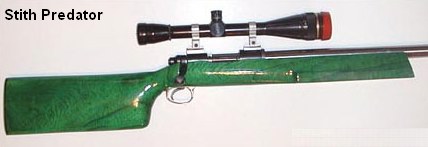
We often hear the question: “Where can I get a quality bench stock, with a wide, flat fore-end, for a rimfire action?” First, McMillan can inlet their popular Edge and Hunter benchrest stocks for rimfire actions such as the Hall, Rem 40X, and Turbo. Second, if you’re looking for a nice wood stock, contact Don Stith in Troutville, Virginia. Don’s St. Louis Plains Rifle Co. offers match-proven wide fore-end designs, inletted for most of the popular rimfire target actions: Anschutz 54, Hall, Remington 37, Remington 40X, Remington 540 or 580, Sako Finnfire, Suhl, Turbo, Ultralight, and Winchester 52. Stith also sells a rimfire sporter stock with a narrower fore-end. This is designed to meet the regulations of IR50/50 Sporter Class
Stith offers a variety of fancy woods, as well as colored laminates. Stock weight depends on your choice of wood. Butternut, Catalpa, and Sassafrass will weigh 1.5 to 1.75 pounds. Walnut and Curly Maple are 1.75 to 2.25 pounds and the laminates are approximately 2.5 pounds.

Stith “Class BR” rimfire stocks start at $220 for laminates, and $200 for solid wood, but fancy or highly figured woods can cost quite a bit more. Call Don for a quote. The popular “Predator” design (known for its great tracking) starts at $250.00. Don’s rimfire benchrest stocks are fully shaped, sanded to 120 grit, and inletted but no finish is done and they are shipped without buttplates.
June 1st, 2009
Many Forum members are putting together their first custom or semi-custom precision rifle this season. These folks often ask us, “What kind of accuracy can I expect from my first 6mmBR?” Of course there are no guarantees, but a 6BR with a good custom barrel, good chambering job, and a nice bag-riding stock should be able to shoot well under half-MOA (1/2″ at 100 yards), maybe even approach quarter-MOA. Forum member Eric (aka Exercion) provided this interesting report on his new 6BR:
Love at First Group by Eric
Well, I took my new stick to the range for the first time today. It features a Savage single shot target action in RBLP configuration, 28″ Broughton 5C barrel, Sharp Shooter Supply Dogtracker stock with adjustable buttplate, and Nightforce scope.
 Now, I have never owned a 6mmBR before, but from reading here and seeing them in action I decided to build one. Its main purpose in life is mid-range F-Class shooting, mainly at 600 yards, and if the winds are favorable, at 1,000. (I already have a 6.5 for “normal” conditions.) I am most grateful for all the info here, and especially the load data. I picked Reloder 15 under the 107gr SMKs for my first loads, starting at 29.0 grains, and proceeding in half grain increments to 30.0 grains. Jumped the bullets 0.015″. Ran the Lapua brass through the neck-sizer bushing die, and was concerned at the force needed to pull the expander button through the virgin brass necks but figured this was a once per case deal to round them out for initial loading. When I measured the runout on the loaded rounds, I was appalled as they had more wobble than anything I personally loaded before, but I kept reminding myself that this was the fireform/chronograph/scope and gun trial stage.
Three Shots in 0.335″ Edge to Edge
So off to the range this morning. No wind here at the house, so life was good … until I got to the range and the wind started to blow. So I set up everything, leveled the gun in the bags, leveled the scope to the gun, made sure the bore was in the center of the chronograph and bore-sighted. First couple of rounds were off to the right, so I moved the scope over 5 MOA and fired another shot, hit paper with it, so I shot 2 more and stopped because I couldn’t tell what was happening. A walk down to the hundred yard berm revealed a nice hole that measures 0.335″ at its absolute widest edge to edge! That’s the smallest 3-shot group I’ve ever fired with anything. I am so in love!

SDs Improve with Heavier Charge and Run-out Disappears
I kept going ’til I worked my way through my first 100 rounds.Given the conditions, I was more interested in the chrony numbers than group, (though 20-shot strings yielded nice quarter-sized holes) and found that as my charges got heavier the SD was coming down (the 30 grain load gave me an SD of 9). I can’t wait to see what will happen with some load tinkering, as well as bullet trials (have Bergers, Hornady A-Maxs, and Lapua Scenars waiting for the next trip). Also, as I had hoped, fire-forming “cured” the run-out problem. I ran the fired but un-sized cases over my concentricity tool and saw less than 0.001 runout on the necks now.
May 24th, 2009
We all know that certain popular powders are very hard to find right now, and the situation for rifle primers is even worse. With increased demand from various sources, available supplies of Varget and other powders have dried up, creating incentives for some folks to resell powder and primers at windfall prices.

Recently, one 8-lb jug of Hodgdon Varget sold for $680.00 on Gunbroker.com. You read that right — SIX hundred eighty dollars. Add $35 for shipping and hazmat fees and you’re talking $715.00 for a jug of Varget, or $89.38 per pound, nearly four times the going price before the “panic buying” started.
Eighty-nine bucks for a pound of powder is crazy. We caution our readers not to get caught up in such nonsense. First, if you can’t find a particular powder, such as Varget, there are good alternatives available at reasonable prices. Norma 203B is an outstanding powder, very similar to Reloder 15, that works well in place of Varget. Grafs.com has plenty of 1-lb cans of Norma 203B in stock, Item Number: NP203B1, priced at $24.99 per pound. (That price includes shipping but not Haz Mat fees.)
We also expect the supply situation to stabilize in the next few months. Hodgdon recently received 22,000 pounds of Varget powder. Those supplies (along with other Hodgdon powders) should make their way to vendors soon, and that should relieve some of the shortages which encourage price-gouging.
As for the primer situation, things should remain tight for a while. All the primer makers are running at full capacity, but it could be some months before we see normal primer inventories at most large retailers.
May 20th, 2009
“Shooters Ready? Commence Fire!”. This morning the nation’s top “point-blank” Benchrest shooters heard those commands as Kelbly’s Super Shoot kicked off. The Firearm Industry Super Shoot (FISS), the largest short-range benchrest match in North America, runs for four days, May 20-23, 2009 at the Kelbly range in North Lawrence, Ohio. This is a LV/HV match only. Here’s the shooting schedule: May 20 10.5-lb 100 yards; May 21 13.5-lb 100 yards; May 22 13.5-lb 200 yards; May 23 10.5-lb 200 yards. For more information, call (330) 683-4674 or click this Map to Range.

Hall of Famers Share Super Shoot Strategies
A while back we surveyed a number of top benchrest shooters, asking them for their advice on “How to Succeed at the Super Shoot.” CLICK HERE to read what Jim Borden, Wayne Campbell, Mickey Coleman, Allie Euber, Speedy Gonzalez, and Bart Sauter have to say.
READ Interviews with Top Benchrest Shooters
Famed bullet-maker Sauter (photo below) offered this advice for newcomers to the Super Shoot: “Go ahead and sign up for the cash option! A lot of new shooters don’t do it. A new shooter will often shoot several small groups, because they’ve worked hard on tuning their rifle. And one really small group could pay for their whole trip. I know a few shooters personally who did not sign up and lost some money.”

To do well at Super Shoot, Bart added: “It helps to get shots downrange quickly. I can usually send five in 15 seconds, and sometimes 12 seconds. That helps beat the conditions.” Good brass is very important: “Most of the better shooters will have a new set of brass for the match. The guys that shoot the same 100 pieces all year don’t normally win. I’ll use practice brass for tuning. The brass I take to a major match will have just 2-3 firings on it. You can’t win with brass that is less than optimal”.
May 9th, 2009
 Marine M/Sgt. Jim Owens (USMC, retired) is well-known to many readers as a shooting instructor and the creator of JarHeadTop.com, a popular web resource for High Power and Service Rifle shooters. JarHeadTop.com features articles, tips, products and instructional material for both the beginner and the veteran shooter.
Jim Owens has pioneered interactive instructional web seminars (Webinars) for competitive shooters. The way it works is you log onto the web, then call a special phone number. While you watch a PowerPoint presentation over the internet, Jim is “live” on the phone. During the Webinar, up to 15 students can ask questions and listen to Jim’s answers via a conference call connection. If it sounds complicated, don’t worry… the system, which employs GotoMeeting.com web technology, works great.

 Reading The Wind Webinar with Jim Owens
On Tuesday, May 12th, at 8:00 pm Central Time, Jim Owens hosts a Webinar class on Reading the Wind & Using Kentucky Windage. You can view two PowerPoint presentations on your computer while listening and talking to Jim on your speaker phone. Topics will include: Determining speed, direction and changes in the wind; Reading the Mirage; Reading the range flags; How to make the Wind work for you; and much more.
The Wind Reading Webinar class costs $15.00. There is limited “seating” (15 people per class). You can pay with PayPal or send a check. To sign up, e-mail Jim@JarHeadTop.com. Place “Wind Class May 12th” in the subject line. Give your name, e-mail and phone number. For more info or questions, call Jim at (334) 347-0020.
Monthly FREE Webinars by Jim Owens
If you would like to try one of Owens’ Web Seminars at no cost, Jim offers a FREE class on his Advanced Theory once a month. The next Free Webinar is scheduled for May 26, 2009 at 8:00 pm Central Time. Act soon, as this Webinar is limited to 15 “students”. To register, e-mail Jim@JarHeadTop.com with “Free Class May 26th” in the subject line.
CLICK HERE for info on FREE Jim Owens Advanced Theory Webinar.
April 29th, 2009
 Shooting Sports USA is the NRA’s dedicated journal for competition shooters of all disciplines. Shooting Sports USA offers feature stories, news briefs, and a comprehensive schedule of events, organized by discipline. You can now read the latest May 2009 issue in digital format on the web–at no cost. In fact, online subscriptions are free. You can sign up to receive a reminder in your inbox every time a new issue is available.
This month’s cover story, “Winning Vision: A Guide for the Eye Care Professional,” is a must-read. It’s written by Dr. Norman H. Wong, O.D., a professional eye doctor and competitive shooter.
 The article is written to help shooters and eye doctors find the best solutions for vision problems. We know many shooters, particularly as they hit “middle age” and beyond, experience a variety of vision issues. However, it’s common for shooters to ignore their eye problems, at the same time spending buckets of money on expensive optics. Pay attention to what Dr. Wong writes and you can benefit. Remember that the last element in the sighting system is the human eye — and no scope, no matter how sophisticated, can overcome serious failings in a shooters’ vision that remain uncorrected.
CLICK HERE for an archive of 24 more vision-related articles by Dr. Wong. Forum Member Jim Hardy comments: “[The] 24 articles by Dr. Norman Wong address many of the ocular issues confronting the competitive shooter. I downloaded all 55 pages and consider it mandatory reading for anyone associated with the shooting sports, whether you shoot iron sights or scope — handgun or rifle. The information is absolutely invaluable.
If you are not seeing your best, you cannot shoot your best. If you don’t know the questions to ask your eye professional, you are not likely to get the answers your need — starting with the selection of your eye care professional. The Rx that works for reading, work, and driving may not be close to what you need on the range. These articles will give you the basic education you need to address the vision issues in your shooting game.”

This item is provided courtesy the NRA Blog.
April 25th, 2009
 Ever wondered what twist rate is required to stabilize a particular bullet? Or would you like to see how changes in spin rates (rpm) affect bullet stability? Well thanks to our friends from Canada, you’ll find helpful formulas online that answer many questions about external ballistics.
The Ballistics Page for the Canadian National Firearms Association (NFA) website offers a variety of useful programs and data charts created by Peter Cronhelm. These include:
Caliber Twist Rate Chart
Greenhill Formula Twist Calculator
Bullet Stability Calculator (requires MS Excel)
Ballistic Coefficients Chart (MS Word), (Or DOWNLOAD HERE.)
Ranging Ballistics Computer (Scroll to bottom of page.)
This exterior ballistics computer works in conjunction with range data as well as computing a conventional drop and windage chart. Using an FFP (Final Firing Point) and multiple TRP’s (Target Reference Points) the system will simultaneously calculate Drop and Windage data for up to 30 TRP’s 360 degrees around the FFP. Windage is corrected for the TRP direction compared to the primary wind direction. The spreadsheet consists of six individual pages. Each page performs a distinct function and contains all the information required to complete a shot at a target or targets. The entire system can be used in any laptop or handheld computer capable of running MS Excel or Excel CE.
CLICK HERE to download Ranging Ballistics Computer (requires MS Excel)
Rimfire Ammo Comparison Table
Canada’s NFA even provides a detailed table with bullet weights and velocities for over 100 varieties of 22LR Rimfire ammunition from Aguila, CCI, Eley, Federal, Fiocchi, Lapua, PMC, Remington, RWS, and Winchester. This Rimfire Ammo Table is a “must-have” resource for any smallbore shooter. Shown below is the section for Lapua:

|


