|
|
December 21st, 2007
… Shall stay the shooter from the delivery of his appointed rounds. Of .308 Winchester that is. Forum member Mike (“TheSilverFox”) from Alberta, Canada, recently went out for some ranging practice with his Clay Spencer-built .308. Despite freezing temps and gusty winds, Mike successfully made hits on targets beyond 800 yards. Exact target distance was unknown and Mike had to range them, using the Mil-marked reticle of his 5-25x56mm Schmidt & Bender scope.

Mike posted a nice report with some great winter-time photos in our Forum. We’ve put that together as a winter shooting “Photo Essay” that you might enjoy. One look at those conditions, and you can feel the chill in your bones.
CLICK HERE for WINTER SHOOTING STORY.

We have to give credit to Mike for braving the elements. Shooting from the snow-laden bed of a pick-up truck in the dead of winter takes real dedication.

Note to readers: People have been asking for more frequent feature stories on the site. This shows what can be done if readers submit GOOD PHOTOs and a nice storyline. Submit stories to mailbox [at] 6mmBR.com. Keep sample images under 300kb (but save your hi-rez originals!).
December 20th, 2007
Muzzle brakes are controversial. Some people swear by them, while others swear at them. Still, there’s no question that a good brake can reduce felt recoil up to 45%. And likewise, the best brakes, when installed properly, seem to have no negative effect on accuracy.

Roy Bertalotto has done considerable experimentation with muzzle brakes, testing dozens of brake designs on his own rifles over the past few years. Roy’s article, Adventures with Muzzle Brakes, discusses various aspects of muzzle brake design and performance. Roy doesn’t claim that his testing is definitive, but his article is definitely worth a read. Here are some of Roy’s interesting findings:
Exit Hole Diameter
“Best accuracy and effectiveness of the brake was obtained with a hole .020″ over bullet diameter. If the exit hole is too small, such as +.005″ over bullet diameter, accuracy suffers. If the depth of the exit hole is too shallow, the metal around the hole will erode very quickly.”
Hole Placement
“The most effective braking was with a brake 1″ in diameter with a 3/4″ exit hole on each side, just in front of the muzzle. The bullet passes through a cone of 35 degrees before it exits the brake. (Like the tank example), Incredible reduction of recoil. But loud and ugly. Very easy to make since you don’t need a spin fixture or a dividing head.”
Bottom Gas Venting Helps Accuracy
“In my tests, not having holes all around the brake effects accuracy a bit. I believe it does something to the bullet by the air pushed ahead of the bullet creating unequal turbulence in the bullet path. I’ve tried a few brakes where I drilled only holes on the top, test fired, and then completed holes on the bottom and in every case, accuracy improved.” Below you see some spiral-ported brakes crafted by Clay Spencer.

Brakes Work Best with High-Pressure Cartridges
“The higher the pressure of the particular round, the more effective the brake. I have over 20 rifles with brakes. The 220 Swift is the king of reduction. Followed very closely by the 25-06, 6mm Remington, any Weatherby small bore. With a proper brake and a hot handload under a 40 gr bullet, the Swift will move 1/2″ to the rear and 0 muzzle rise! Big boomers with low pressure like 45-70s and shot guns benefit the least.” [Editor’s Note: Roy is judging effectiveness by the percentage of recoil reduction rather than absolute levels of recoil. Obviously if you start with a heavier-recoiling round, the absolute amount of recoil energy reduction is greater. Roy is really talking about efficiency–brakes are most efficient when used with high-pressure cartridges.]
Installation is Key to Accuracy
Roy’s findings are fascinating and suggest that further study of muzzle brakes is warranted. But we can all agree that precision installation of the brake is essential for accuracy. A poorly-installed, mis-aligned brake will degrade accuracy, that is well-known.
Harrell’s Precision has made tens of thousands of muzzle brakes, in many styles and port arrangements. The Harrell brothers offer some good advice for gunsmiths installing brakes: “Muzzle brakes aren’t magic, they reduce recoil by redirecting exiting gas. What’s important is that they are straight and the threads are perpendicular with the base. The only way to get the base and threads perpendicular is to thread, not tap, them on a lathe.”
December 18th, 2007
If you’re not familiar with the short-range benchrest game, and want to learn more about this most precise of all shooting disciplines, Peter Cronhelm has prepared an excellent summary of Benchrest Basics. Cronhelm covers everything from the origins of the PPC (Palmisano Pindel Cartridge) case, to the special terminology heard at short-range benchrest matches:
Bughole: Very small group.
Mothball: The 10-ring on the standard Benchrest Target.
Tomato Stake: A worn out or otherwise inaccurate rifle barrel.
Screamer: A group measuring less than 0.100” at 100 yards or less than 0.250” at 200 yards.
Weather Report: A Group “scattered” as a result of poor wind doping.
Wailing Wall: Place where targets that have been scored can be viewed by competitors.
If you want to learn about “point-blank” BR, give Peter’s well-written article a read. It’s fact-filled from start to finish and provides a quick but thorough explanation of the rules, gear, and shooting styles used in the short-range benchrest game.

Super Shoot (Kelbly’s Range) photo by Turk Takano, used by permission
December 1st, 2007
Are you headed to the southern hemisphere for a winter hunt? Or perhaps you’re planning a cross-country airline trip with your precious match rifles? Remington has a helpful article on Airline Travel with tips on how to safeguard your guns while complying with airline flight regulations. The well-researched article contains specific recommendations for firearms, ammunition, bows and arrows, hunting knives, chemical repellents, and even fishing tackle.
CLICK HERE to READ ARTICLE

The article links to the Transportation Security Administration (TSA) web site, an excellent general travel info source. The TSA maintains a regularly-updated list of Permitted and Prohibited Items. You should definitely consult this list before heading to the airport. Of course, you should also check with your particular air carrier — each airline has its own specific baggage handling regulations. You’ll find links to the major domestic airlines in the article.
Photo: “Tuffpak” gun case from Hunters Headquarters.
November 3rd, 2007
Hunters are a very important force in land and wildlife conservation. A National Geographic feature article, Hunters: For the Love of the Land, demonstrates how hunters help preserve wildlife and open lands: “[T]he nation’s 12.5 million hunters have become essential partners in wildlife management. They have paid more than 700 million dollars for duck stamps, which have added 5.2 million acres to the National Wildlife Refuge System since 1934, when the first stamps were issued. They pay millions of dollars for licenses, tags, and permits each year, which helps finance state game agencies. They contribute more than 250 million dollars annually in excise taxes on guns, ammunition, and other equipment, which largely pays for new public game lands. Hunters in the private sector also play a growing role in conserving wildlife.”
This 8-page article, written by hunter Robert M. Poole, is well worth a read. Poole raises many intriguing points. Poole suggests that hunting is an important part of our heritage: “[H]umans are still programmed for the chase, since our species has been doing that far longer than we have been farming, writing poetry, or marketing stuff by telephone at dinnertime.” But Poole also observes that “In recent decades, the number of hunters has been dropping. According to U.S. Census Bureau data, there were 14.1 million hunters in 1991, 13 million in 2001, and 12.5 million in 2006, which means that they now make up a mere 5 percent of the adult population. Younger hunters are entering the field but not in sufficient number to replace the old ones[.]” Poole’s article suggests that it is time we re-double our efforts to involve more young people in hunting and the shooting sports.

October 26th, 2007
Site contributor Chris Long (aka “TechShooter”) has crafted a report about his July, 2007 Prairie Dog Expedition in Wyoming. Ralph and Lenora Dampman of Trophy Ridge Outfitters served as guides for the trip. Trophy Ridge runs ‘Dog hunts near the town of Carlile in the NW range of the Black Hills, near Devil’s Tower National Monument. Primarily big game outfitters, Ralph and Lenora have access to thousands of acres of private ranch land. They run guided prairie dog hunts during their off-season. Chris reports “The terrain is beautiful, a welcome change from the South Dakota prairie, with lots of hills and Ponderosa pine trees. [These] ranch lands are home to some prodigious dog towns.”
Chris continues: “The goal of this trip (besides having a great time) was to get in some long range (1000+ yard) opportunities, and possibly even a shot over 1500 yards, in order to qualify for the VHA 1500 yard certification. I had worked up some really good loads for the 6.5-284 TubeGun and the .260 AI using the new 130 grain Berger VLDs, and wanted to see how they performed at these extreme ranges. I also wanted to see how the trusty 6 Dasher performed as a long range varmint cartridge.”
Chris Long was joined by two friends who came all the way from Virginia. Chris reports, “Our plan was to get in four days of intense, long-range shooting. We were not disappointed! The shooting was from 100 to over 1000 yards, and the dogs were everywhere. There were plenty of targets close in, so there was a lot a variety. It is especially challenging to move in and out in range by these extreme amounts. It gave me a lot of practice estimating range and wind conditions, then seeing if I could get the come-ups and windage right on the scope for the first shot at the new range. By the end of the trip, I was getting it pretty close, with some 1-shot hits out to about 600 yards.”

Chris’s primary long-range rifle was his 6.5-284 Tube-gun (photo above) running 130gr Berger VLDs at 3165 fps. Chris reports the 130s can be shot at 3165 fps with no excessive pressures, and “scary, one hole, 5-shot 100-yard group accuracy.” With a B.C. of about 0.6, the 130s shoot flatter and exhibit less wind drift than the 140gr class bullets at 2950 FPS.
Chris’s second gun was a more conventional bolt-action in a Franklin LowRider stock, set up with both 6mm Dasher and .260 AI barrels. Chris notes: “The Dasher has proven itself in spades as an extremely accurate cartridge for F-Class Open competition, and I was anxious to see how it performed as a varmint cartridge. The performance was excellent, with many hits out past 1000 yards. This rifle is set up as a switch-barrel rig, and is the platform for the 260 AI. I made a portable barrel vise that mounts in the trailer hitch receiver on the Suburban. That, with a rear entry action wrench, makes barrel changes a 5 minute affair. I would shoot until the barrel got a bit hot, then switch and proceed with the other caliber.”
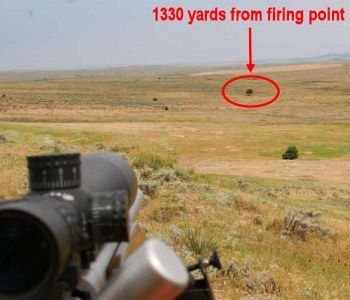
CLICK HERE to read the complete story. It contains more load data, details of hits made out to 1330 yards, and many great photos of the Wyoming scenery. For .260 AI and 6 Dasher tech tips, visit TechShooter’s Shooting Pages.

Photos and quotes copyright © 2007 Chris Long, All Rights Reserved, used by permission.
October 8th, 2007

The CMP webzine, The First Shot, currently features an excellent article for any rifleman (hunter or competitor) who employs the standing position. Authored by USAMU Team member Sgt. Brandon Green, the story covers rifle hold, body positioning, and trigger control. Sgt. Green writes: “We’ve all been there—on the two hundred yard line and in our three-minute prep period. As you stand there looking through your sights, you just can’t seem to make them stay in the center of your target or even close for that matter. You know that your three minutes are running out quickly, so what are you going to do? This is the time when a lot of shooters start to come unraveled….We all know how to stand up, but it’s the standing still part that gives us trouble most of the time.”

Sgt. Green continues: “We will start our position rebuild at the feet. You normally want your feet about shoulder width apart and perpendicular to the target. Some shooters like to keep their weight evenly distributed between the heels and balls of their feet, but this may not be the best position for you. I normally try to find a place on the firing line where my toes are just slightly higher than my heels, maybe a 1/4 to 1/2 inch higher. With my toes slightly higher, I feel a little more of the pressure on the balls of my feet. This usually helps me eliminate some of the back and forth movement in my position by inducing a little tension in my calf muscles.

At this point I will check for excess tension in other parts of my legs. I notice that excess tension in my upper legs can also cause me to sway back and forth more than usual. By rotating each foot in or out, I can usually find a position that will eliminate this excess tension and help my legs feel more relaxed. I then check the tension in my knees. I don’t shoot with my knees locked, but they aren’t exactly bent either. I find where they are comfortable and stick with it. Now that my legs are at a good starting point, I move up to my hips and waist. I normally shoot with my hips perpendicular to the target and twist at the waist slightly. This is more of an international style rifle position than a traditional highpower position, but it is very comfortable and relaxed for me. With my waist only slightly twisted, I can rest my forward arm almost directly on my hip bone instead of bringing it around and resting it on my ribs.” [Continued…].
READ COMPLETE ARTICLE.
Photos and text ©2007 CMP and USAMU, used by permission.
October 5th, 2007
Here’s a story for the serious varmint hunters out there. The August 2007 issue of Precision Shooting magazine features a story by Bob Bell about Dana Calhoun from Pennsylvania. Dana recently recorded his 5000th Groundhog kill, after more than 40 seasons of shooting. CLICK HERE to read the complete story about Dana and his legendary prowess in the varmint fields.

Dana has averaged about 125 chucks taken per season (June through September). The most chucks Dana ever got in one day was 28, 16 of them within a little more than an hour. Bob Bell writes: “Practically all of Dana’s 5000 kills were made in Cumberland County, PA. That in itself is unusual, for this county isn’t especially known for an abundance of chucks. But in a continuing effort begun decades ago, Dana has made a real effort to become acquainted with landowners. He explains his interest and goals to them, assures them of his safe gun handling and proves it by his actions, even lets them try a few shots with his rifle if they care to; after all, such impressive equipment attracts attention, even of non-shooters. This has paid off, opening thousands of acres of farmland to Dana, not only to chuck hunting, but even for whitetails in deer season. Dana’s approach should be tried by more hunters.”
Dana has used many rifles and calibers over the years, but currently has three favorite groundhog guns. All are customs built on blueprinted Remington 40X actions. Bell notes: “One is a 6mm Rem with a 6.5-20X Leupold, another is a .220 Swift topped by a Bausch & Lomb 6-24X, and the third is a .22 Cheetah [with] a 24X Leupold. All three have fiberglass stocks, 2-oz. Jewell triggers, and heavy 27-inch stainless steel barrels, the newest a Krieger, the others from Hart and Shilen. These guns were built by [BR gunsmith] Clarence Hammonds of Red Lion, PA.”
Quoted text and photo © 2007, Precision Shooting Magazine, used by permission.
October 4th, 2007
 If you’ve read our feature story on Ultrasonic Cleaning by Jason Baney, you’ve seen the remarkable results that can be achieved with this method. Ultrasonic cleaning has many advantages over traditional tumbling methods of case cleaning. There is no dust or media residue to remove from the brass, and when done right, the cases come out clean and shiney, inside and out, even the primer pockets.
In its Benchtalk Archives, Brownell’s has an excellent article discussing Ultrasonic Case Cleaning. Brownell’s staff compares results, with measured dwell times from 5 to 75 minutes, using both Mpro-7 and HCS 200 cleaning solutions. Tests are performed with once-fired and 5x-fired Tactical 20 cases, as well as once-fired Rem 260 Cases. The article also compares the results from ultrasonic cleaning vs. tumbling in walnut media.
How Does Ultrasonic Cleaning Work?
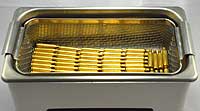 The Brownell’s article explains: “Ultrasonic cleaning uses high-frequency sound waves (generally between 20-80 kHz) to remove a variety of contaminants from objects immersed in a liquid. The result of these high-frequency sound waves is a process called cavitation. These high frequency bursts of ultrasonic energy produce a three-dimensional wave of alternating positive and negative pressure areas as the sound wave passes through the solution. During negative pressure, microscopic cavitation bubbles form and will continue to grown until they reach resonant size. As the positive sound wave passes, the pressure rises rapidly and implodes these tiny bubbles. Before these miniscule bubbles implode they store a tremendous amount of energy. These bubbles can be as hot as 10,000 degrees and have as much as 50,000 lbs per square inch of pressure. This sounds alarming, but you have to remember that these bubbles are microscopic in nature and pose no harm to anything, unless you are a carbon /powder residue deposit on a cartridge case!
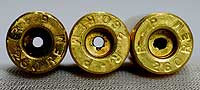 When this cavitation bubble implodes near your brass case, it transforms the bubble into a jet about 1/10th of its size. This jet of energy can travel as fast as 400 km/hour. At 43 kHz, as is the frequency for our L & R HCS 200 ultrasonic cleaner, this is happening 43,000 times per second. This micro-burst of extreme energy is responsible for removing contaminants from the surface of your cartridge brass. Ultrasonic cleaning can reach into crevices and inaccessible areas and remove surface debris that can’t be cleaned by any other process.”
Photos and quotes © 2007, Brownells®, Inc. All Rights Reserved, Used with Permission.
September 23rd, 2007
 A quality borescope is a pricey tool, but once you have the opportunity to use one, it is hard to imagine how you ever did without it. Rifle Shooter magazine has an excellent article about using a Gradient Lens Corp. HawkEye BoreScope. In this feature, What the Eye Can See, writer Terry Wieland explains how to inspect for defects in new barrels, how to recognize different kinds of fouling (in both barrels and brass), and how to spot throat erosion in its early stages. The current generation of HawkEyes can be attached to a still or video camera to record digital images of your bore. The most interesting part of the article is on the second page. There, author Wieland provides photos of various types of internal flaws that can appear in barrels. This will help you spot pitting, excessive land wear, rust damage, and damage from corrosive primers.

Wieland also explains that BoreScopes aren’t just for barrels: “The borescope has other uses as well. It can be used to examine the interior of a cartridge case to look for the beginnings of a case separation or to examine the interior of a loading die that is giving you trouble. When you consider the number of tubular objects that play such an important role in rifle shooting, it is a wonder we were ever able to function without such a method of studying bores.”
|


