Some folks say you haven’t really mastered marksmanship unless you can hit a target when standing tall ‘on your own hind legs’. Of all the shooting positions, standing can be the most challenging because you have no horizontally-solid resting point for your forward arm/elbow. Here 10-time National High Power Champion Carl Bernosky explains how to make the standing shot.
Carl Bernosky is one of the greatest marksmen in history. A multi-time National High Power Champion, Carl has won ten (10) National High Power Championships in his storied shooting career, most recently in 2012. In this article, Carl provides step-by-step strategies to help High Power shooters improve their standing scores. When Carl talks about standing techniques, shooters should listen. Among his peers, Carl is regard as one of the very best standing shooters in the history of High Power shooting. Carl rarely puts pen to paper, but he was kind enough to share his techniques with AccurateShooter.com’s readers.
If you are position shooter, or aspire to be one some day, read this article word for word, and then read it again. We guarantee you’ll learn some techniques (and strategies) that can improve your shooting and boost your scores. This stuff is gold folks, read and learn…
How to Shoot Standing by Carl Bernosky
Shooting consistently good standing stages is a matter of getting rounds down range, with thoughtfully-executed goals. But first, your hold will determine the success you will have.
1. Your hold has to be 10 Ring to shoot 10s. This means that there should be a reasonable amount of time (enough to get a shot off) that your sights are within your best hold. No attention should be paid to the sights when they are not in the middle — that’s wasted energy. My best hold is within 5 seconds after I first look though my sights. I’m ready to shoot the shot at that time. If the gun doesn’t stop, I don’t shoot. I start over.
2. The shot has to be executed with the gun sitting still within your hold. If the gun is moving, it’s most likely moving out, and you’ve missed the best part of your hold.
3. Recognizing that the gun is sitting still and within your hold will initiate you firing the shot. Lots of dry fire or live fire training will help you acquire awareness of the gun sitting still. It’s not subconscious to me, but it’s close.
4. Don’t disturb the gun when you shoot the shot. That being said, I don’t believe in using ball or dummy rounds with the object of being surprised when the shot goes off. I consciously shoot every shot. Sometimes there is a mistake and I over-hold. But the more I train the less of these I get. If I get a dud round my gun will dip.* I don’t believe you can learn to ignore recoil. You must be consistent in your reaction to it.
5. Know your hold and shoot within it. The best part of my hold is about 4 inches. When I get things rolling, I recognize a still gun within my hold and execute the shot. I train to do this every shot. Close 10s are acceptable. Mid-ring 10s are not. If my hold was 8 inches I would train the same way. Shoot the shot when it is still within the hold, and accept the occasional 9. But don’t accept the shots out of the hold.
6. Practice makes perfect. The number of rounds you put down range matter. I shudder to think the amount of rounds I’ve fired standing in my life, and it still takes a month of shooting standing before Perry to be in my comfort zone. That month before Perry I shoot about 2000 rounds standing, 22 shots at a time. It peaks me at just about the right time.
This summarizes what I believe it takes to shoot good standing stages. I hope it provides some insight, understanding, and a roadmap to your own success shooting standing.
* This is very noticeable to me when shooting pistol. I can shoot bullet holes at 25 yards, but if I’ve miscounted the rounds I’ve fired out of my magazine, my pistol will dip noticeably. So do the pistols of the best pistol shooters I’ve watched and shot with. One might call this a “jerk”, I call it “controlled aggressive execution”, executed consistently.
All shooters, even rimfire enthusiasts, should always wear ear protection when at the range. A typical rifle gunshot is very loud — in the region of 140 to 170 decibels (the pain threshold is 130-140 db). Without ear protection, you can permanently damage your hearing during a single shooting session. We all know older shooters who are partially deaf, or who suffer from Tinnitus, because they didn’t use earplugs or muffs when they were younger.
How Humans Hear Sounds — Amazing Video Reveals All
The human sense of hearing involves multiple delicate internal membranes, bones, organs, and nerves. Shooters understand the importance of protecting their hearing, but they may not understand the bio-mechanics of human hearing. We hear sounds through Auditory Transduction. Sound waves vibrate the ear drum (tympanic membrane), but that is only the beginning. These vibrations are passed along via tiny rocker-arm-like bones to be “processed” in a spiral chamber, the cochlea.
This remarkable VIDEO explains how humans hear sounds. We strongly recommend you take the time to watch and learn. The hearing you save may be your own!
Click Speaker Icon to turn on the video’s soundtrack.
Vibrations moving through the cochlea are separated into frequencies and then sent as neural messages to the brain. It is an astonishingly complex process, one that truly seems miraculous when you examine the bio-engineering involved. In the Video above, the process of human Auditory Transduction is explained and illustrated with 3D animation. You really should watch this amazing video. By the end you will have a new-found appreciation for your ability to hear.
⏺ Dual-function electronic muffs — great for range communications
Electronic earmuffs protect your hearing while allowing you to hear range commands. With these Walkie-Talkie muffs you also get 2-way communication capabilities. The Walker Razor Slim Low Profile Electronic Earmuffs (NRR 23dB) with Walkie Talkie allows you to communicate with other FRS radios. These are now just $59.99 (40% Off) with FREE Shipping. If you don’t need the two-way functionality, you can get Walker’s NRR 23 Razor Slim Electronic Muffs for $37.00 (#ad) — 54% off the list price.
Every shooter should own a pair of Electronic muffs, even if you prefer shooting with earplugs and/or standard muffs. Electronic muffs are great when you are spotting for other shooters or are working near the firing line. They let you hear ordinary conversations while still providing vital hearing protection. You can also wear ear-plugs under muffs for extra sound attenuation.
Plugs PLUS Ear-Muffs — The Benefits of “Doubling-Up” Your Hearing Protection
According to OHS Online: “The combined attenuation of an ear plug and an ear muff is not simply the algebraic sum of the performance of each individual protector. This is due to an acoustic and vibratory interaction between the ear muff and the ear plug that causes them to behave together as a system rather than as independent hearing protectors.
Generally speaking, when you combine two hearing protectors, ear muffs over ear plugs, you can expect an increase [in noise reduction] of between 3 and 10 dB over the higher-performing hearing protector. OSHA [now advises] 5 dB as the [typical] benefit offered by combining hearing protectors.” Source: OHSonline.com
SSG Amanda Elsenboss, now with the Pennsylvania National Guard, was the 2021 NRA National High Power Champion and 2019 NRA Long Range National Championship in 2019.
In the archives of On The Mark magazine, DCM Emeritus Gary Anderson, an Olympic Gold medal-winning shooter in his younger years, offers sage advice for competitive shooters.
In his article Ten Lessons I Wished I Had Learned as a Young Shooter, Anderson provides ten important guidelines for everyone involved in competitive shooting. Here are the Ten Lessons, but you should read the full article. Anderson provides detailed explanations of each topic with examples from his shooting career.
LESSON 1 – NATURAL ABILITY WILL NOT MAKE YOU A SHOOTING CHAMPION.
(You also need hard work, training effort and perseverance.)
LESSON 2 – ANGER IS THE ENEMY OF GOOD SHOOTING.
(The key to recovering from a bad shot is to stay cool, no matter what happens.)
LESSON 3 – BAD SHOTS CAN TEACH YOU MORE THAN GOOD SHOTS.
(Today, error analysis is one of the most powerful tools for improving scores.)
LESSON 4 – NEVER GO WITHOUT A SHOT PLAN.
(A shot plan is a detailed breakdown of each of the steps involved in firing a shot.)
LESSON 5 – PRACTICE IN BAD CONDITIONS AS WELL AS GOOD CONDITIONS.
(Most competitions are fired in windy conditions or where there are plenty of distractions.)
LESSON 6 – CHAMPIONS ARE POSITIVE, OPTIMISTIC PEOPLE.
(Negative shooters expect bad results; positive shooters expect to train hard to change bad results.)
LESSON 7 – IT’S NOT ABOUT WHETHER YOU WIN OR LOSE.
(It’s about how hard you try to win.)
LESSON 8 – YOUR DOG WON’T BITE YOU AFTER SHOOTING A BAD SCORE.
(Hopefully your coach, parents and friends won’t bite you either.)
LESSON 9 – YOUR PRESS CLIPPINGS CAN HURT YOU OR HELP YOU.
(Winning can go to our heads. We start thinking we are so good we don’t have to work hard any more.)
LESSON 10 — YOU NEVER SHOT YOUR BEST SCORE.
(Great champions are always looking for ways to improve.)
USAMU shooters on the firing line at the Wa-Ke’-De outdoor range in Bristol, IN. Photo courtesy USAMU.
About Gary Anderson Gary Anderson served as the Director of the Civilian Marksmanship Program (CMP) from 1999-2009, and is now DCM Emeritus. As a Nebraska farmboy, Gary grew up hunting and shooting. Dreams of winning an Olympic Gold Medal in shooting led Gary to the U.S. Army. In 1959, he joined the elite U.S. Army Marksmanship Unit. Just two years later, he won his first national championship.
At the 1962 World Shooting Championships in Egypt, Anderson stunned the shooting world by winning four individual titles and setting three new world records. At the 1964 Tokyo Olympics, Gary won the 300m free-rifle Gold Medal, setting a new world record in the process. At the 1966 World Shooting Championships in Germany, Anderson won three additional world titles. At the 1968 Olympics, Gary won a second gold medal in the 300m free-rifle event.
After his “retirement” from international competition, Gary competed in the National High Power Championships, winning the President’s National Trophy in 1973, 1975 and 1976. Over his competitive career, Anderson won two Olympic Gold Medals, seven World Championships, and sixteen National Championships. He is unquestionably one of the greatest American marksmen ever.
This USAMU article explores three different “Philosophies” of precision reloading. Some handloaders seek to produce ammo that yields the very tightest groups (without factoring in the wind). Other shooters load their ammo to deliver the highest safe velocity. That’s because a projectile launched at higher velocity will drift less in the wind. The theory is that even if fast ammo doesn’t produce the tightest groups in zero wind conditions, it will yield higher scores in a the real world (where the wind blows). Lastly, some handloaders favor ammo that is ultra-consistent across a wide temperature range. This last philosophy dictates selection of a powder that is temp-insensitive, even if it may not produce the very best raw accuracy (or speed).
What’s Your Handloading Philosophy?
Objectives of Reloading — Accuracy, Velocity, Temp Stability What do you, the reader, primarily value in your handloads?
Viewpoint ONE: Accuracy Trumps Everything
Some shooters prize consistent, excellent medium/long range accuracy enough that they’re willing to give up some extra velocity (and reduced wind deflection) to obtain that. Their underlying philosophy could be stated: “Superior accuracy is present for every shot, but the wind isn’t”. One’s ability to hold well, aim well and read the wind are all factors in making this type decision. The photo below shows stellar raw accuracy. This is an 0.67″, 10-shot group at 300-yards fired from a text fixture. The group measures just 0.67″. (This shows the USAMU’s 600-yard load with 75gr bullets).
Viewpoint TWO: Load to Highest Safe Velocity for Less Wind Drift
Some shooters value obtaining the highest safe velocity, even if one’s pure, consistent mechanical accuracy at medium/long range isn’t quite as brilliant. The theory here seems to be that a really good hold extracts as much mechanical accuracy from the rifle/ammo as possible, and faster bullets equal occasional “bonus” points snatched from the jaws of wind.
[For example] one of the USAMU’s many Service Rifle National Champions revealed his philosophy. It can be stated thus: a super-accurate, but [relatively] “slow” load “required him to have a Ph.D. in wind reading for every shot, while a faster, but less accurate load netted him more points.”
Note — this was not mere speculation; his score book data backed up his claims, due to less wind effects. Remember, however, this fellow has a consistent, National Championship-level hold, and other Champions on the same team would have opted differently.
Viewpoint THREE: Temperature Stability Is Key
Still another approach is to place heavy emphasis on fine accuracy with absolute stability in changing temperatures. When this writer was actively earning his Distinguished Rifleman badge, that was his goal. The reason? Sighting shots are not allowed in EIC (“Leg”) matches. The first shot out of the barrel was for score. It had to be 100% consistent, with very reliable, predictable elevation and wind deflection regardless of the ambient temperature — even if it wasn’t the lowest wind deflection possible.
Naturally, selecting a powder that is insensitive to temperature changes is a key element here. Elevation zeros and wind effects HAD to be consistent every time. Hunters and military snipers might be among those who fall into this camp, as well as those in pursuit of their Distinguished Rifleman badges.
Contrast that with a traditional High Power shooter who gets two sighter shots before each event (offhand, sitting rapid, prone rapid, prone slow fire.) If there is a zero change on any given day, he/she can correct during sighters. This writer well remembers talking with another very high-level Service Rifle competitor who was happy to have high temperatures boost the velocities of his ammunition above their usual level… As far as this SR competitor was concerned, 60-80 fps more velocity -– even if only due to high ambient temperatures -– meant less wind deflection, and he was mighty happy to have it.
Particularly in the summer, with hot daily conditions, you need to be concerned about temperature stability. Loads worked up in winter may not work in the summer time.
This article has been confined to NRA High Power Rifle competition, which has relatively generous 10-ring dimensions in relation to the accuracy of well-built competition rifles. Hopefully, it will provide food for thought. For some, this might be an opportunity to ensure that one’s load development approach helps them attain their desired results.
For the fourth year in a row, the MidwayUSA Foundation has provided cash grants to help ranges across the country expand and support youth shooting sports activities. This year, $2.3 million has been awarded to 99 recipients — a substantial increase in recipients and dollars paid compared to last year. A key factor in choosing winning applicants is a range’s plan to increase and enhance youth shooting sports opportunities.
MidwayUSA Foundation Executive Director, G. Scott Reynolds, spoke about the Range Development Grant Program: “America’s youth not only need funding to cover their shooting sports expenses, but they need qualified coaches to teach them to shoot safely, and they need a safe place to shoot. MidwayUSA Foundation is proud to offer grant programs to cover all three needs.”
Since this grant program’s inception in 2021, the Foundation has awarded $4.45 million for range improvements to recipient programs throughout the USA. MidwayUSA Foundation Range Development grant recipients are listed at: Midwayusafoundation.org/range-development-grants.
Applications for special purpose grants, like Range Development and Coach Training, will be accepted annually and applicants must hold an endowment with MidwayUSA Foundation to apply. Youth shooting teams and organizations should work closely with their range operators to complete the grant application.
The MidwayUSA Foundation is a 501(c)(3) public charity working to sustain and grow youth shooting sports by providing long-term funding to youth shooting teams. Every donation made is tax-deductible. The Foundation supports all shooting disciplines. Visit Midwayusafoundation.org or call 1-877-375-4570.
Are you a do-it-yourself kind of guy with a creative eye? Then you’ll love the FREE Target Generator from the folks at ShooterShed.com. This FREE, interactive webpage allows you to design a variety of fun targets, including grids, benchrest-type Score/Group Shooting targets, sight-in targets, and even playing card targets. Choose the paper size and orientation (vertical or horizontal), then select the number of target elements on the page. For example, you could have four (4) bulls or a dozen playing cards. Then click the Style TAB to choose your target style. Use the OPTIONS TAB to overlay a grid on the target, choose squares or diamonds, or include load information blocks. For bullseye targets, you can control the number, color, and spacing (diameter) of the rings. LINK to TARGET GENERATOR.
QWIK TIP: For Super-Quick Target Creation, click the “Target Style” tab, then select a design from the list on the left. Then go to OPTIONS.
Click the TARGET STYLE TAB to select one of many target styles, including NBRSA Benchrest targets and 20+ types of NRA bullseye targets, scaled to distance:
Benchrest
Bullseye
Shapes
NRA High Power
NRA Pistol
NRA Rimfire
Images
Playing Cards
Load Test Blocks
Creating new targets is fast and easy. No computer graphics skills required! We created this green diamonds grid target in just five minutes using the ShooterShed Target Generator:
And here is a handy target with short-range range Benchrest competition-style box/circle aiming points, along with fields for entry of gun/load data:
The program provides a preview of each target you generate. There are controls to choose border and fill colors. If you like a particular design, save the file, and then print as many targets as you want. Check it out, this program is fun and handy to use. Here are four (4) targets your Editor created just for this article. With a bit of practice, you can be generating your own custom targets in minutes.
About the Creator of the Target Generator
The Target Generator program was created by Rod Brown of Sheridan, Wyoming. Rod tells us: “I build custom rifles… I’ve got a 100-yard range out my back door. I shoot short- and long-range benchrest competitively around the country. I’m a full-time software development consultant and an FFL holder. When I’m not developing custom software for my clients, I’m usually fiddling in the shop, building a custom benchrest rifle, traveling to a match, chambering a barrel, or reloading some ammunition.”
Story tip from Boyd Allen. We welcome reader submissions.
The CMP National Matches at Camp Perry, Ohio commence July 8, 2024 with 3P Air Rifle events. The Camp Perry matches are historic, having been held since 1907 at this location on the shores of Lake Erie. The 2024 First Shot Ceremony takes place Monday, July 15 on the grounds of Camp Perry. Air Force Academy shooting coach and former Olympian Launi Meili is the 2024 First Shot Speaker. Launi will address the crowd and make the traditional First Shot to officially open the National Matches.
For this week’s Saturday at the Movies, we offer seven videos from Camp Perry. These cover both rimfire and centerfire shooting, team matches (including the famous “Rattle Battle”), along with pistol shooting. If you’re heading to Camp Perry this summer, today’s video showcase provides an informative preview. And watch the video above for a great short preview of the event.
CMP National Matches at Camp Perry — Ranges, Events, Training
This 3-minute video above shows the Camp Perry ranges and shooting facilities and explains the programs scheduled, including training courses. The video also covers nearby accommodations and explains how to register for the National Matches on the CMP website.
NTIT Team Match — “Rattle Battle” at Camp Perry
The CMP’s National Trophy Infantry Team Match (NTIT) has been a staple at the National Matches since 1922. Also known as the “Rattle Battle,” the event is one of the most unique in the competitive rifling world — scoring is based on how many hits six-person teams can score on a bank of targets during a series of 50-second firing periods at four yardages.
Watch CMP ‘Rattle Battle’ Video — 50 Seconds of Rapid Fire…
Teams fire upon eight silhouette targets from 600, 500, 300 and 200 yards during successive 50-second periods. After each rapid-fire string, team members move forward (to the next-closest distance) carrying all equipment from firing line to firing line. The video shows the California Grizzlies, one of the top junior squads. The lead photo shows the U.S. Army Reserve (USAR) Team in action during the NTIT match. See more in USAR “Rattle Battle” Video.
Camp Perry M1 Garand Competition — Vintage Military Rifle
The John C. Garand match is a Camp Perry classic. Note the signature Garand clip in the air.
The CMP hosts the popular M1 Garand Match as well as the Springfield M1A Match. This writer’s father carried a Garand in WWII — reason enough for me to want one. But I also loved the look, feel, and heft of this classic American battle rifle. And the unique “Ping” of the ejected en-bloc clip is music to the ears of Garand fans. Some folks own an M1 Garand for the history, while others enjoy competing with this old war-horse. The CMP’s John C. Garand Match is one of the most popular events at Camp Perry every year. There are other vintage military rifle matches.
Rimfire Sporter Event Draws Hundreds of Competitors
If there is a single CMP event at Camp Perry every summer that draws the most competitors and offers the lowest cost of entry, that would be the annual Rimfire Sporter Match. This year’s match will be held on Saturday, July 13th at the Viale Range. There will also be a CMP Sporter Live-fire Training Clinic on Friday the 12th. One of the most popular annual Camp Perry events, the Rimfire Sporter Rifle match features .22 LR competition in open sights (O-Class), telescopic (T-Class) and tactical/unlimited (TU) classes, fired at 25 and 50 yards. A CMP Rimfire Clinic will be held prior to the match.
Each year, the Rimfire Sporter Match attracts hundreds of shooters to the shore of Lake Erie at Camp Perry. The CMP National Rimfire Sporter Rifle Match offers shooters a recreation-oriented competition where they use affordable, smallbore sporter rifles with either scopes or iron sights. All you need are a .22 LR rifle, sling, and ammo.
Service Rifle Matches — AR-Platform Rifles, Now with Optics
Service Rifle shooting is fun yet challenging. You need to develop skills with multiple positions and be able to make rapid wind calls. However, the modern AR-based service rifle is affordable and has relatively low recoil. Highly-customizable, modern service rifles can be fitted with adjustable stocks and optional magnified optics. Older military rifles, such as the M1A and M1 Garand, offer different challenges with heavier-recoiling cartridges, greater weights, and classic iron sights. Hi-Lux asked competitors at Camp Perry during CMP’s 2021 summer games what they enjoyed most about competition with service rifles and Military rifles such as the M1 Garand. The shooters’ responses had four key themes: Self-Improvement, Comradery, History (enjoying shooting rifles with heritage), and Challenge.
Camp Perry Bullseye Pistol Competition
Camp Perry hosts the most prestigious annual trophy matches in our nation’s history. And in a venue renowned for service rifle matches, the sport of precision pistol is no less important, no less challenging, and no less respected. The National Trophy Pistol Matches are all about traditional handgunning — the stance, the intense concentration, and of course, the one-handed grip. It’s all unmistakable as the game of Bullseye Pistol. Every year there are 20+ match trophies for the top Bullseye Pistol shooters, both military and civilian. And the very best will claim National Match Trophies and receive the President’s 100 Tab.
CMP Camp Perry National Matches Registration Links
The 2024 CMP National Matches at Camp Perry officially commence Thursday July 11, 2024. The summer schedule concludes Saturday, August 10 with the Palma Match and awards. Here is the full CMP schedule (click to zoom):
NOTE: This CMP Calendar is hosted online in spreadsheet format. This allows you to increase display size, and also to search for specific words. CLICK HERE to view full spreadsheet calendar.
History of Camp Perry
“In the year 1907 the machinery of the National Matches, now grown to immense proportions, was moved to the mammoth new range at Camp Perry.”
—James Drain, Arms and the Man, August 1911
Federal legislation originally launched the National Matches. The 1903 legislation also established the National Matches, commissioned the National Trophy and provided funding to support the Matches. The National Matches have been held at Camp Perry since 1907. The range is located along the shores of Lake Erie in northern Ohio near Port Clinton. The site was first acquired in 1906, in response to the need for a larger facility for military training and the NRA’s shooting programs. The original land for Camp Perry was purchased in 1906, and the reservation was named after Commodore Oliver Hazard Perry, the American naval commander who won the Battle of Put-in-Bay during the War of 1812.
On August 19, 1907, Cpl. L. B. Jarrett fired the first shot at the new Camp Perry Training Site. And that year, 1907, Camp Perry held its first National Pistol and Rifle Championship events. This location has hosted the annual National Matches ever since. Typically over 4,000 competitors attend the National Matches each year, making it the most popular shooting competition in the western hemisphere.
The 2024 NRA National Matches at Camp Atterbury commence Monday, July 22, and conclude Monday, August 19, 2024. You can register now for pistol, smallbore rifle, and centerfire (High Power) rifle matches via the NRA Competitive Shooting website. Click the link below to REGISTER for the 2024 NRA National Matches at Camp Atterbury.
15 Ruger Guns as Prize Awards: Ruger, the Title Sponsor of the NRA National Matches, has donated 15 firearms to the competitors’ prize tables at the 2024 NRA National Matches.
This year’s calendar returns to the traditional National Matches schedule, starting with the Precision Pistol National Championships, followed by the Smallbore Rifle National Championships and ending with the High Power Rifle Nationals, specifically the Long-Range and Palma Championships. The 2024 NRA High Power National Championships will be fired on electronic targets.
Precision Pistol (July 22 – 25)
July 22 –Opening Ceremony, Practice, Preliminary Match (no awards), Harry Reeves Match
July 23 – .22 Championship, .22 EIC
July 24 – Centerfire Championship, Service Pistol EIC
July 25 – .45 Championship, Distinguished Revolver, Awards Ceremony
Smallbore Rifle Prone and F-Class (July 28 – August 1)
July 28 – Squadded practice, Metallic Sights Day One
July 29 – Metallic Sights Day Two
July 30 – Randle, Dewar, Team Matches
July 31 – Any Sights Day One
August 1 – Any Sights Day Two, Awards Ceremony
Smallbore Rifle Three-Position (August 2 – 4)
August 2 – Metallic Sights
August 3 – Drew Cup Team Match, Team Matches
August 4 – Any Sights, Awards Ceremony
High Power Rifle Across the Course (August 5 – 10)
August 5 – Seeding Match
August 6 – Member’s Trophy, Scott Trophy, Coast Artillery Trophy Matches
August 7 – Navy Cup, Army Cup, Coast Guard Trophy Matches
August 8 – Appreciation Cup, Marine Corps Cup, Air Force Cup Matches
August 9 – Crescent Cup, Cavalry Cup, Crowell Trophy Matches, Awards Ceremony
August 10 – EIC Leg Match
High Power Rifle Mid-Range (August 11 – 14)
August 11 – 300-, 500-, 600-yards, 600-yard Teams
August 12 – 3×600 yards, 600-yard Teams
August 13 – 300-, 500-, 600-yards, 600-yard Teams
August 14 – 3×600 yards, Awards Ceremony
High Power Rifle Long-Range (August 16 – 19)
August 16 – Wimbledon Cup, Rem Trophy, Porter Trophy, Andrus Trophy, Herrick Trophy Team Matches
August 17 – Leech Cup, Mustin Trophy, Farr Trophy, Aitken Trophy, Roumanian Team Trophy Matches
August 18 – Palma Individual Match, Awards Ceremony
August 19 – Palma Team Matches, Awards Ceremony
2024 NRA National Matches at Camp Atterbury Calendar
Camp Atterbury is a National Guard training facility located in Edinburgh, Indiana, which is about 37 miles south of Indianapolis.
The NRA National High Power Championships will be fired on advanced Silver Mountain electronic targets. Another other nice feature of Camp Atterbury is the large, modern covered range. This is used for smallbore and pistol competitions.
Will you be traveling out of state this spring? Or do you have questions about your own state’s firearms laws? Then you’ll want to have quick access to summaries of gun laws in America’s 50 states. Here’s a very valuable online resource you may want to bookmark.
The NRA-ILA (Institute for Legislative Action) has a great feature on the NRA-ILA’s homepage. There is a pull-down menu that includes all 50 states plus the District of Columbia, New York City, and Guam. This quickly provides a host of legal information for each region you select. From the NRA home page, NRA-ILA.org, you can instantly access a host of information for all 50 states. NOTE: Some of this information is not completely current, so you may want to check with more detailed, up-to-date reference, such as the Legal Heat $10 50 State Guide to Firearms Laws and Regulations (2023 Edition). Most of the information in the book is also available in the FREE Legal Heat Firearms Law APP for Android (Google) smartphones and Android mobile devices. Here are screenshots from the Legal Heat Android App.
Shown below is part of the NRA-ILA’s coverage for Texas. There is a summary of the most important Texas gun laws. Below that is a map showing the states that recognize Texas carry permits.
Today, June 20, 2024 is Summer Solstice, the longest day of the year. And right now the Northeast USA is undergoing a major heatwave. That means “peak heat” summer conditions have arrived already. It’s vitally important to keep your ammo at “normal” temps during the hot summer months. Even if you use “temp-insensitive” powders, studies suggest that pressures can still rise dramatically when the entire cartridge gets hot, possibly because of primer heating.
It’s smart to keep your loaded ammo in an insulated storage unit, possibly with a Blue Ice Cool Pak if you expect it to get quite hot. Don’t leave your ammo in the car or truck — temps can exceed 140° in a vehicle parked in the sun.
The way ambient temperatures, barrel heating, and powder warming can affect cartridge pressures (and hence velocities) was covered in a study Pressure Factors: How Temperature, Powder, and Primer Affect Pressure by Denton Bramwell. In that article, the author used a pressure trace instrument to analyze how temperature affects ammo performance. Bramwell’s tests yielded some fascinating results.
For example, barrel temperature was a key factor: “Both barrel temperature and powder temperature are important variables, and they are not the same variable. If you fail to take barrel temperature into account while doing pressure testing, your test results will be very significantly affected. The effect of barrel temperature is around 204 PSI per F° for the Varget load. If you’re not controlling barrel temperature, you about as well might not bother controlling powder temperature, either. In the cases investigated, barrel temperature is a much stronger variable than powder temperature.”
This Editor had the personal experience of 6mmBR hand-loaded ammo that was allowed to sit in the hot sun for 45 minutes while steel targets were reset. The brass became quite warm to the touch, meaning the casings were well over 120° on the outside. When I then shot this ammo, the bullets impacted well high at 600 yards (compared to earlier in the day). Using a Magnetospeed, I then chron-tested the sun-heated ammo. The hot ammo’s velocity FPS had increased very significantly — all because I had left the ammo out in the hot sun uncovered for 3/4 of an hour.
LESSON: Keep your ammo cool! Keep loaded ammo in the shade, preferably under cover or in an insulated container. You can use a SEALED cool pack inside the container, but we do NOT recommend H20 ice packs. And don’t have the container do double duty for food and beverages.
Powder Heat Sensitivity Comparison Test
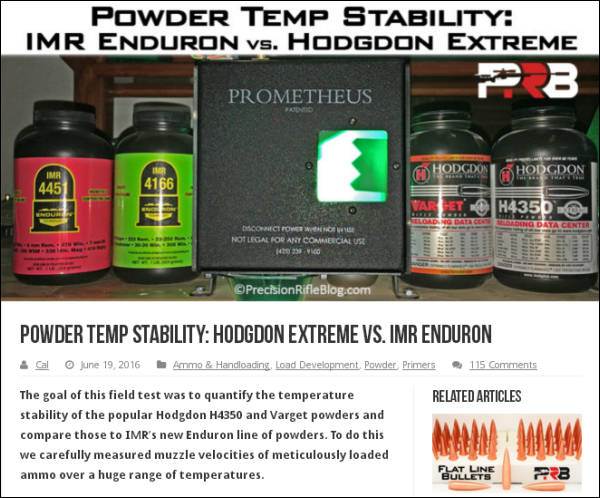
Our friend Cal Zant of the Precision Rifle Blog has published a fascinating comparison test of four powders: Hodgdon H4350, Hodgdon Varget, IMR 4451, and IMR 4166. The first two are Hodgdon Extreme powders, while the latter two are part of IMR’s Enduron line of propellants.
The testers measured the velocity of the powders over a wide temperature range, from 25° F to 140° F. Hodgdon H4350 proved to be the most temp stable of the four powders tested. [NOTE: New Alliant Reloder TS 15.5 has also proved very temp stable in AccurateShooter’s range tests.]


 How to Shoot Standing
 5. Know your hold and shoot within it. The best part of my hold is about 4 inches. When I get things rolling, I recognize a still gun within my hold and execute the shot. I train to do this every shot. Close 10s are acceptable. Mid-ring 10s are not. If my hold was 8 inches I would train the same way. Shoot the shot when it is still within the hold, and accept the occasional 9. But don’t accept the shots out of the hold.
 All shooters, even rimfire enthusiasts, should always wear ear protection when at the range. A typical rifle gunshot is very loud — in the region of 140 to 170 decibels (the pain threshold is 130-140 db). Without ear protection, you can permanently damage your hearing during a single shooting session. We all know older shooters who are partially deaf, or who suffer from


 In the archives of
 Gary Anderson served as the Director of the Civilian Marksmanship Program (CMP) from 1999-2009, and is now DCM Emeritus. As a Nebraska farmboy, Gary grew up hunting and shooting. Dreams of winning an Olympic Gold Medal in shooting led Gary to the U.S. Army. In 1959, he joined the elite U.S. Army Marksmanship Unit. Just two years later, he won his first national championship.




 The way ambient temperatures, barrel heating, and powder warming can affect cartridge pressures (and hence velocities) was covered in a study Pressure Factors: How Temperature, Powder, and Primer Affect Pressure by Denton Bramwell. In that article, the author used a pressure trace instrument to analyze how temperature affects ammo performance. Bramwell’s tests yielded some fascinating results.