On Father’s Day, time spent together is more important than any gift that comes in a box…
Today is Father’s Day, a special Sunday when we acknowledge our patriarchs and show our gratitude for all their hard work and sacrifice on our behalf, and the love they have shown us over the years. If you’re lucky, you’re reading this after having spent a day at the shooting range (or the local fishing hole, or golf course) with your Dad. The important thing is to be together with “Pops” and do something you both enjoy together. If you haven’t finalized your Father’s Day planning, here are some suggestions:
1. Hand-wash and wax your father’s truck or car.
2. Clean your dad’s rifles, or help him put together some handloads.
3. Take your dad out to a live music concert, go to a ball game, or maybe head down to the local fishin’ hole.
4. Go for a hike together or just a drive in the country.
5. Head down to Sears or the local hardware store and let you Dad pick out some new tools.
6. Sit down with your dad, bring a note pad, and ask him to tell you some stories about his youth, or his military experience. This Editor learned some amazing things about his own father this way.*
Whatever you choose to do with your father, use your time wisely. Turn off your computer, and go be with your father today. Do something with him that makes him smile. The time spent together is more important than any gift that comes in a box. And, if he lives far from you, give him a call and let him know how important he is to your life. Remind him of the old adage: “Good fathers make good sons”.
When my father, a disabled WW2 Army vet, passed away I received the flag that was draped on his coffin. On most days I fly one of those nylon flags that you can pick up at hardware or department stores. But on holidays, like today, and his birthday, Dad’s flag is out there snapping in the breeze on top of the pole. I find myself talking to him as it gets put up in the morning and comes down at sunset. Hope when the time comes one of my boys will fly my flag. — Bill Slattery Jr.
My father used to play with my brother and me in the yard. Mother would come out and say, “You’re tearing up the grass”! “We’re not raising grass,” Dad would reply, “We’re raising boys”. — Harmon Killebrew.
* My father was a Lieutenant in the U.S. Army in WWII. He was part of three different amphibious landings — North Africa, Sicily, and Operation Dragoon in the South of France. During one conversation about the French invasion, he showed me the invasion armband he wore in 1944. He had kept that band, with its faded American flag, for over 50 years. It is now a cherished memento of his life and service to his country.
Editor’s Note: The CMP National Matches at Camp Perry are less than a month away. This article covers key points for rifle competitors at major matches. To do well, you want to be an “informed competitor” with a positive attitude and full knowledge of the course of fire and match rules.
Don’t Be “That Guy” (The Bad Apple on the Firing Line)
By SFC Norman Anderson, USAMU Service Rifle Team Member
You know the guy, he’s still talking at the coffee jug when his preparation period begins, then his magazines aren’t loaded when the command “STAND” is given, and finally, he doesn’t know the rules when he argues with the block officer as his target comes up marked “9 and No”. Although this guy might be the highlight of the “after match” activities, he is the proverbial bad apple on the firing line. With this example fresh in your mind, let’s go over how not to be “that guy”.
While the sport of High Power shooting is a hobby for most, all are passionate about performance throughout the day. In order to achieve your maximum performance each and every day, it is essential that you conduct yourself as a professional competitor. As a competitor, you have a personal responsibility to know the course of fire as well as the rules and procedures that apply to it and to be prepared to follow them. Knowing this will not only make you a better competitor, but it will enable you to resolve situations with other targets besides your own. So what does all this mean? I’ll explain…
Know the Course of Fire
Know the course of fire. It sounds easy enough, as we all shoot plenty of matches, but it’s more than that. If you think about it, how many people in the pits, for example, do not really know what is happening on the firing line? This leads to targets being pulled early during a rapid fire string or missing a shot during a slow fire string. In cases like this, the result is the same, delays in the match and upset competitors. To avoid being “that guy,” it is imperative that you stay tuned to the events as the day progresses. When you are at the range shooting a match, be at the range shooting the match.
At any firearms competition — be sure you know (and understand) the course of fire.
Know the Rules
Now, let’s discuss rules. As you have probably heard more than once, the rulebook is your best friend. Here is why. I can virtually guarantee that most competitors know some of the rules based only on the old “this is how we do it at home” adage. The funny part of that is, the same green NRA rulebook and orange CMP rulebooks are used to govern High Power matches all over the country.*
It is vital that all shooters be familiar with the rules as they are written, not with “how they are applied at home”. This creates consistency and continuity in how matches are conducted, from local club matches to state tournaments to National Championships. Knowledge is power when it comes to scoring targets under contention, what to do in the case of a malfunction, or even how to file a protest correctly. These rules are in place for a reason and it benefits everyone to both know and operate by these rules.
Maintain Composure and Humility — Exhibit Good Sportsmanship
One aspect of competing that cannot be forgotten is bearing. As I mentioned earlier, you must be prepared for both good and bad to happen. All too often we all see “that guy” (or that “that guy’s” gear) flying off of the firing line in disgust. Remember that we all must maintain our composure and humility in all conditions, not matter what happens. After all, it’s just a game. To put it into perspective, if it were easy, attendance would be a lot higher. Sportsmanship must be displayed in an effort to keep from ruining the day for all those around you. It doesn’t cost anything to smile, and smiling never killed anyone. So turn that frown upside down and keep on marching, better days will come.
Like a Boy Scout — Always Be Prepared
Lastly, I would like to cover preparedness. Being prepared goes beyond simply having your magazines loaded and a zero on your rifle. It means approaching the firing line, knowing what you are about to do, being ready for what is going to happen (good or bad), and being ready for the results. If you approach the firing line to merely shoot 10 shots standing in your next LEG match, you are not going to be pleased with the result. You must be prepared mentally and physically, not only for the next stage, but also the next shot. By being prepared physically (equipment ready), you give yourself peace of mind which is an essential part of being prepared mentally, and by being prepared mentally, you are less likely to become distracted and are more likely to maintain focus for each and every shot.
Conclusion — Informed Competitors Make for Better Matches
The culmination of these efforts results in a shooter that knows how to be ready for success on the range, but also and perhaps more importantly, a shooter who knows what it means to be a competitor. When you have a range full of competitors who know and follow the rules and proper match procedures, the match runs smoothly, everyone shoots well, and a good time is had by all. In the end, isn’t that what it’s all about?
* After this article was originally written, the CMP separated its rules into multiple Rulebooks, which can all be downloaded from the CMP.org/rulebooks page:
The CMP Highpower Competition Rules 2024 (27th Ed.) for CMP-sponsored and sanctioned matches for Highpower Rifle events in National Trophy Matches, Excellence-In-Competition (EIC) Matches, CMP Cup Matches and other CMP-sanctioned competitions.
The CMP Pistol Competition Rules 2024 (27th Ed.) for CMP-sponsored and sanctioned Pistol Matches in the National Matches, National Trophy Matches, Excellence-In-Competition (EIC) Matches, and other CMP-sanctioned competitions.
Lapua now offers a FREE Ballistics App. This was the first mobile ballistics App utilizing the 6DOF calculation model, making it one of most accurate ballistics Apps on the market. With this free mobile App you can calculate trajectories, range, bullet drop, turret adjustments and more.
Lapua’s sophisticated FREE Ballistics App has many great features — much more than you’d expect for a free App. If you do much shooting past 300 yards, or use a wide variety of bullets and/or cartridge types, definitely download the App and give it a try. For more details, read the Lapua Ballistics App User Manual. This handy PDF file explains how to set up the App and utilize all its powerful features.
Utilizes 6DOF, the most accurate calculation method
Always available with latest Lapua cartridge / bullet information
Quick and easy to change inputs like distance, wind speed and angle
Several result outputs available, with numerical, reticle, table and graph views
Create and clone your own firearm / reticle combinations
Choose between metric and imperial values
Set Point Blank-range to different sight-in distances and impact windows
Set Aiming point to moving target
Add custom bullets (calculations based on BC G1 or G7 and Siacci method)
Features include Sight-in-POI, Coriolis, Max Range and Cant Angle calculation
Compare up to 3 Lapua cartridge/bullet performances to each other
Custom trajectory tables
After downloading the FREE Lapua Ballistics App for Android device or Apple iPhone/iPad, you’ll want to access the Lapua Ballistics App Guide which shows how to use all the features and options. In addition, Lapua offers a handy FAQ Page with User Tips and Answers to frequently Asked Questions. After downloading the FREE App, you should definitely go to the FAQ page. It has helpful illustrations showing how to set up the App for your firearms and cartridge types.
Watch Video for Explanation of Lapua Ballistics App Features
Shooting ranges have gone upscale with the development of the “Guntry Club”. This new kind of recreational/social facility combines a shooting range with Country Club style amenities. Imagine a high-tech indoor range with “Pro Shop”, restaurant, and maybe outdoor shooting facilities as well. In the past five years, more and more of these deluxe “Guntry Clubs” have opened nationwide.
An episode of GunVenture TV featured some of the country’s finest gun clubs. Tom Gresham and RECOIL Magazine’s Iain Harrison checked out of the original “Guntry Clubs” — the Scottsdale Gun Club. Then, Tom visited a high-end facility in Centennial, Colorado. The upscale Centennial Gun Club features a retail store, range, training center, and lounge.
Here’s a CBS News report on upscale “Guntry Clubs”, luxurious facilities that target younger, more affluent patrons. Chip Reid reports on a high-end gun club in Manassas, Virginia: “This is not your Grandfather’s shooting range. Elite Shooting Sports is 65,000 Square feet of bright lights, polished wood, flat-screen TVs, and state of the art equipment”. Unfortunately for private shooters, this range closed to the general public in April 2023. Prince William County has agreed to purchase the Elite Shooting Sports facility as its new law enforcement training center, county officials announced Tuesday night.
Want to improve your understanding of Ballistics, Bullet Design, Bullet Pointing, and other shooting-related tech topics? Well here’s a treasure trove of gun expertise. Applied Ballistics offers dozens of FREE tech articles on its website. Curious about Coriolis? — You’ll find answers. Want to understand the difference between G1 and G7 BC? — There’s an article about that.
“Doc” Beech, technical support specialist at Applied Ballistics says these articles can help shooters working with ballistics programs: “One of the biggest issues I have seen is the misunderstanding… about a bullet’s ballistic coefficient (BC) and what it really means. Several papers on ballistic coefficient are available for shooters to review on the website.”
Credit Shooting Sports USA Editor John Parker for finding this great resource. John writes: “Our friends at Applied Ballistics have a real gold mine of articles on the science of accurate shooting on their website. This is a fantastic source for precision shooting information[.] Topics presented are wide-ranging — from ballistic coefficients to bullet analysis.”
Here are six (6) of our favorite Applied Ballistics articles, available for FREE to read online. There are dozens more, all available on the Applied Ballistics Education Webpage. After Clicking link, select Plus (+) Symbol for “White Papers”, then find the article(s) you want in the list. For each selection, then click “Download” in the right column. This will send a PDF version to your device.
Editor: This story by Tommy C. (aka “dc.fireman”) comes from our Shooters’ Forum. It’s fascinating to see how a relatively inexpensive Savage M12 BVSS varmint rig was transformed into a sophisticated 300M match rifle with a modern chassis, Shilen barrel, and top-of-line sights. With some ingenuity, and careful parts selection, Tommy created a rifle that can compete with match rifles costing many thousands of dollars more. American ingenuity at work!
Savage Reborn — Old BVSS Transformed into 300M Match Rifle
by Tommy C. (aka “dc.fireman”)
So, I began the project of building a 300M International competition gun, about a year ago, intending to compete at the 300M Nationals this year in Minnesota at the Minneapolis Rifle Club. Realistically, I didn’t want to pay the price-tag demanded of the Bleikers, Grunig & Elmigers, Hammerlis, or Tanners that (infrequently) pop-up for sale from time to time. So I decided to build my own 300M Match rifle with an American action, barrel, chassis, and trigger.
Here is Tommy’s completed 300M Match rifle with Savage action in PDC Custom chassis.
I had decided on the .260 Remington (aka 6.5-08) as the caliber choice. This beat out 6.5×47 Lapua simply due to the cost/availability of brass. The .260 Rem cartridge is based on the .308 Win parent. I made my first batch of brass by necking down some Federal .308, and it worked great. [Editor: We do recommend Lapua .260 Remington brass for match purposes for those who don’t have a supply of good .308 Win brass.]
I had an older Savage M12 stagger-feed action, originally from an old .22-250 BVSS. I contacted James at Northland Shooter Supply, and he walked me through the game plan and equipment I needed: Shilen Select Match 26″ barrel, NSS Stainless recoil lug and nut, a set of Forster headspace gauges, and the NSS action wrench.
Catalog photo of current Savage M12 BVSS in .22-250 Rem.
A few months later, I replaced the original Accu-trigger with a Rifle Basix SAV-II trigger, and immediately wondered why I waited so long to do that. The Rifle Basix is perfect for my application. Mind you the he safety DOES NOT work now, but, I don’t need it for my application.
Another member on the AccurateShooter Forum sold me a BVSS stock that has been re-worked by Alex Sitman of Masterclass Stocks, and it served as a placeholder, until I could find a maker who could nearly replicate my Feinwerkbau 2700 Alu stock in my smallbore match gun.
After scouring the AccurateShooter Forum, and multiple internet searches, I found PDC Custom in Michigan. I spoke with Craig Kierstadt a few times, before finally deciding to pull the proverbial trigger on his chassis. He had a few of the older chassis stocks with spacing for the Savage stagger-feed action. He machined an Anschutz rail into the fore-end for my hand stop and sling. Then he powder-coated the chassis black, and sent it to me sans grip and butt plate.
Photo of action/chassis. Tommy says: “It locks up really tightly, and you can tell Craig spent some time on the CNC work need to make this all fit.”
There are a few minor issues with the PDC chassis, but overall, I would rate this a 9.5 out of a possible 10. The price, and the features built into it, plus the ease of which everything fit together, far outweigh any minor issues. And two of the issues I quickly corrected with Teflon tape. I will need to make a walnut cheek piece — a curved one isn’t conducive to aperture iron sight shooting.
Savage Action .260 Rem 300M Match Rifle Components:
Action, Barrel, Stock, Grip
Savage M12 stagger-feed action, 4.27″ spacing
Shilen Select Match Barrel, 26″
Rifle Basix SAV-II Trigger
PDC Custom Chassis — tool-less adjustments
Bobsled SLED for single loading (required)
MEC Contact III Butt plate (German)
MEC handstop/sling swivel (German)
Walnut Target grip for AR-15 (eBay sourced)
Sight Components and Hardware
MEC Spy Long rear sight (German)
Centra front sight tunnel (German)
Centra adjustable aperture (German)
Medesha sight extension tube + collar
Champion’s Choice front sight base
Champion’s Choice mirage band
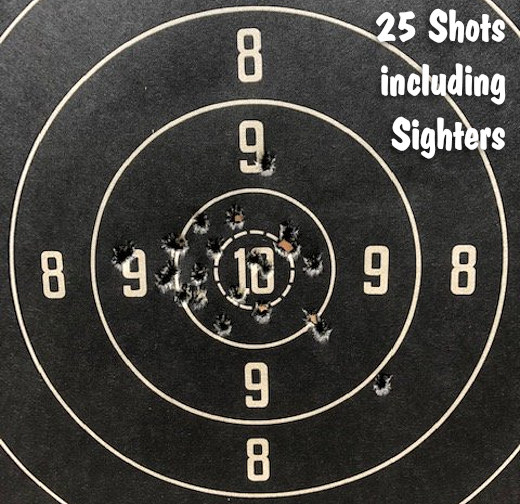
For his practice load, Tommy shot 123gr Hornady ELD-M bullets with H4831 powder and CCI BR2 primers. This load performed well — Tommy posted: “My 25-shot initial prone test today shows promise. There are five sighter shots, and 20 record shots. One of the 9s at 9 o’clock is my first sighter, the other one I own. The 8 out at 4 O’clock was a round that was difficult to chamber. My initial scoring puts me somewhere in the vicinity of 193-7X.”
The target used is the NRA C2, “300M International Rifle Target, reduced for 200 yards”. The 10 Ring is 2.40″ in diameter, while the Inner 10 (X-Ring) is 1.24″.
Match Load — Varget and Nosler Bullets
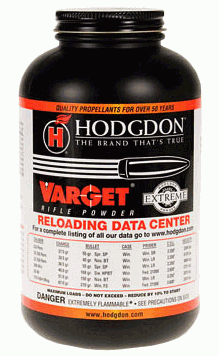
For his match load, Tommy switched to Varget and Nosler bullets: “My match load uses 37.9 grains Hodgdon Varget with a Nosler 123gr bullet. This was a recommendation by a gentleman with a lot of experience in 300M shooting.”
Tommy adds: “The amount of knowledge gained via the AccurateShooter Forum has made this all a reality, instead of just a passing thought.”
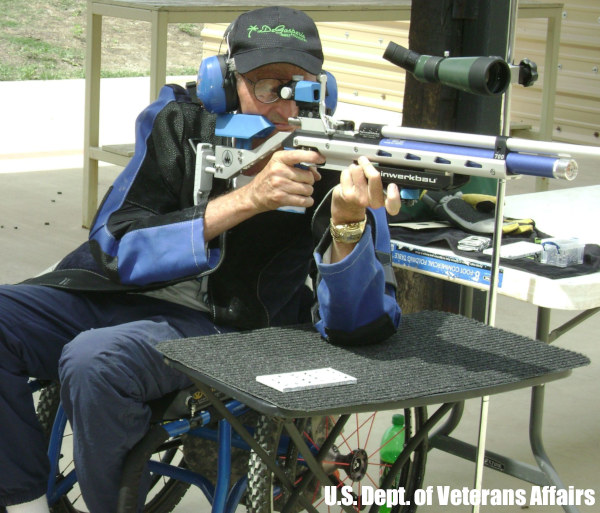
One of the great thing about shooting is that marksmanship is one of the few sports where physically-challenged persons can compete at the highest level — with some provisions for wheelchair access and mobility. For example, in the world of F-Class competition, Matt Schwartzkopf is one of the best in the nation. Matt, a rangemaster at Ben Avery in Arizona, is a double amputee (below the knee). He hasn’t let that challenge stop him. He has been a Top-10 finisher at major F-Class matches, and was chosen to shoot with F-TR Team USA.
F-TR Team USA member Matt Schwartzkopf is a double amputee below the knee, having had his lower legs removed due to a birth defect. That hasn’t held him back. Matt is an inspiration to us all. He told us: “This condition has not held me back from anything.” Jokingly, he added, “I may not have ‘a leg to stand on’, but that doesn’t mean I can’t still shoot 10s and Xs at 1000.” Matt is living proof that competitive shooting is a sport for all individuals — young and old, able-bodied and physically challenged.
Matt isn’t just a talented shooter — he runs range operations at Ben Avery in Arizona. During a major match, Matt can be seen supervising the firing line, organizing pit crews, and posting match results.
New USA Nationwide Adventure Database for Adaptive Shooters
Here’s a great new opportunity for shooters and sportsmen with physical limitations. The NRA has created a nationwide database of hunting and fishing adventures for individuals with disabilities. There are programs throughout the country with 45+ organizations such as Buckmasters, Freedom Hunters, Hope Outdoors, Hunting with Heroes, and Safari Club International.
“Venturing into the outdoors has long been acknowledged as healing for the body and soul”, said NRA National Adaptive Shooting Programs Manager Dr. Joe Logar, PT, DPT. “These benefits can be even more profound for someone experiencing an illness, injury, or disability.”
NRA’s Hunter Services and Adaptive Shooting Programs have maintained a list of organizations offering people with disabilities outdoor opportunities. Now available in a searchable database, any adaptive shooter can easily choose from adventures such as guided whitetail hunts, chartered fishing trips, and accessible hiking trails anywhere across the country. To find a program, visit the NRA Adaptive Shooting Program’s Hunting/Fishing Trip Database.
NRA Resources for Adaptive Shooting Events
The NRA Adaptive Shooting Program also provides information for organizations planning an event to include person with disabilities. Events may be organized by veterans’ groups, rehabilitation facilities, and gun clubs. For more information visit AdaptiveShooting.NRA.org.
Adaptive Shooting Programs in the United Kingdom
Across the pond, the National Rifle Association of the United Kingdom (NRAUK) also has adaptive shooting programs. The NRA.ORG.UK website has a wealth of information for shooters with physical challenges.
The NRAUK states: “There are many different types of target shooting available for people to try in Great Britain. Some of them are readily accessible to disabled people, others less so. Also, shooting clubs and facilities do not all cater for every discipline; some only offer one, whilst larger complexes can cater for many of them. The only place in the country where almost all disciplines can be tried is Bisley Camp in Surrey. Access to the outdoor ranges is being improved all the time, although most are already accessible.
If the disciplines that you particularly fancy are not suitable for your type of disability at the moment, or are not currently available in your area, do not give up hope! The key skills for target shooting are very similar for all disciplines, so you could start with a different but similar option, learn those key skills, and take up your first choice when it is available to you.”
Making Ranges Suitable for Disabled Shooters
The Summer 2019 issue of NRA Club Connections magazine has a feature on Adaptive Shooting. This article explains how range owners can make their lines of fire more accessible with the addition of a simple mat.
Back in 2014, a decade ago, Forum member Robert Chombart posted this message from his home in Normandy, France: “On the occasion of the 70th anniversary of D-Day, I … salute the memory of the thousands of American soldiers who sacrificed their youth to liberate France, with … particular [respect] for those who rest in Normandy ground.” Today, 80 years after that historic invasion day, it is important we never forget the sacrifice of those who gave their lives on the beaches of Normandy.
Today we should remember those who crossed the Channel to begin the liberation of Europe. Thousands of soldiers, sailors, and aviators gave their lives on June 6, 1944. Their sacrifice on “The Longest Day”, allowed people throughout Europe to enjoy freedom. We should remember those brave warriors, and never forget that freedom is not free — it requires continuing vigilance and sacrifice.
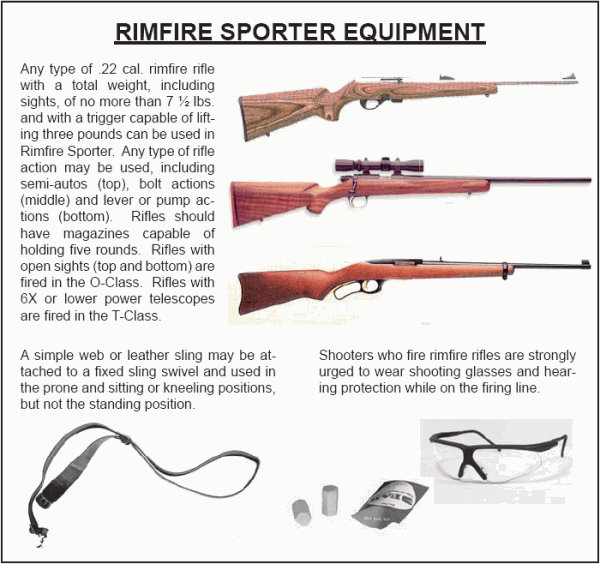
The CMP Rimfire Sporter discipline is for smallbore rifles that weigh 7 1/2 pounds or less with sights. Firing is done at 25 and 50 yards in prone, sitting, and standing positions, in slow and rapid-fire modes. The CMP has a special smart-phone App that helps speed up scoring. Rimfire Sporter matches are held throughout the country in connection with the CMP’s Travel Games.
And each summer, the major National Rimfire Sporter Match attracts hundreds of shooters to the shore of Lake Erie at Camp Perry. This year’s Rimfire Sporter Match at Camp Perry will be held on Saturday, July 13, 2024 — just five weeks away. The CMP National Rimfire Sporter Rifle Match offers shooters a recreation-oriented competition where they use affordable, smallbore sporter rifles with either scopes or iron sights. All you need are a .22 LR rifle, sling, and ammo.
Rifles may be manually operated or semi-automatic, in three classes: the standard “O Class” for open-sighted rifles, “T-Class” for telescope-sighted rifles, and the “Tactical Rimfire” Class. Firing is done at 50 and 25 yards on a target with a 1.78″ ten-ring. The target is simple enough for a beginner to hit, yet challenging enough that only one competitor in the history of the match has ever fired a perfect 600 score.
Rimfire Sporter Course of Fire
At the Rimfire Sporter Match, competitors complete slow fire prone, rapid fire prone, slow fire sitting or kneeling, rapid fire sitting or kneeling, slow fire standing, and rapid fire standing shot sequences.
What is Required for the Camp Perry Rimfire Sporter Match
Competitors need to bring their own .22 cal. Rimfire rifle(s) and ammunition. Special target shooting equipment, shooting jackets, or shooting gloves are not permitted, but you can bring a spotting scope and ground cloth or shooting mat. The firing points have grass (sometimes a bit wet with rain). Competitors are strongly urged to wear hearing and eye protection. Assistance for disabled competitors is provided.
A free Shooters’ Clinic is usually held in connection with the Rimfire Sport match at Camp Perry. The Clinic covers Rimfire Sporter rules, safety instructions, course of fire, and competition procedures. Shooters who have not previously attended a CMP Rimfire Sporter Match are strongly encouraged to attend.
How is a modern, metal-chassis rifle built? This very cool video from Masterpiece Arms answers that question. The nicely-edited video shows the creation of a Masterpiece Arms tactical rifle from start to finish. All aspects of the manufacturing process are illustrated: 3D CAD modeling, CNC milling of the chassis, barrel threading/contouring, chamber-reaming, barrel lapping, laser engraving, and stock coating. If you love to see machines at work, you will enjoy this video…


 Today is Father’s Day, a special Sunday when we acknowledge our patriarchs and show our gratitude for all their hard work and sacrifice on our behalf, and the love they have shown us over the years. If you’re lucky, you’re reading this after having spent a day at the shooting range (or the local fishing hole, or golf course) with your Dad. The important thing is to be together with “Pops” and do something you both enjoy together. If you haven’t finalized your Father’s Day planning, here are some suggestions:


 Know the Rules


 Match Load — Varget and Nosler Bullets

 F-TR Team USA member Matt Schwartzkopf is a double amputee below the knee, having had his lower legs removed due to a birth defect. That hasn’t held him back. Matt is an inspiration to us all. He told us: “This condition has not held me back from anything.” Jokingly, he added, “I may not have ‘a leg to stand on’, but that doesn’t mean I can’t still shoot 10s and Xs at 1000.” Matt is living proof that competitive shooting is a sport for all individuals — young and old, able-bodied and physically challenged.