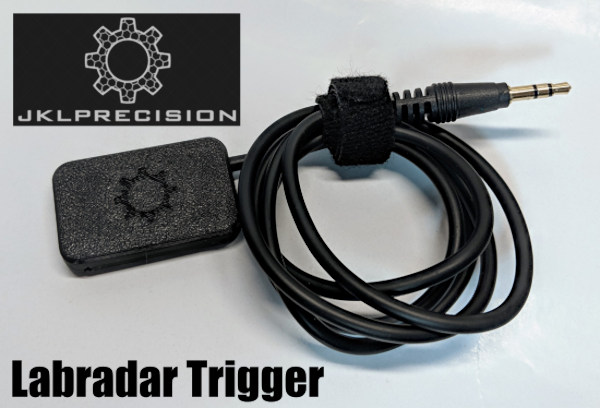
SUMMARY: This article reviews a device that “triggers” the LabRadar chronograph to register bullet speed. Rather than activate by sound or Doppler reading, this $35 JKL Inertial Trigger works from the rifle’s instantaneous recoil pulse when a shot is fired. After some frustration with his LabRadar when shooting at a range with reflective surfaces, our tester is now reporting that 100% of his actual shots are being captured correctly by his LabRadar chrono equipped with the JKL Inertial Trigger. He won’t use his LabRadar without it now. Other users have become instant fans of this inertial LabRadar trigger as well. It is very affordable and it works great. VIEW LARGE PHOTO.
JKL Inertial Trigger for LabRadar Chronograph
Product Review by F Class John
The LabRadar chronograph has been one of the most revolutionary tools in the shooting world because of how it collects velocity data, how it reports (and stores) that data, and, ultimately, the ease with which it can be positioned and operated. However, it’s not a perfect system. A majority of the complaints come from users whose LabRadars sometimes fail to record all the shots fired in a string. For the average plinker, this may not be an issue. But for serious shooters trying to do ladder tests or load development requiring all shots to be reported, it can be frustrating when a shot is missed.
Traditionally, LabRadar has recommended trying different settings that compensate for the gap between the unit and muzzle as well as well as having different options for how the unit recognizes a shot fired. While these options work to some degree, they aren’t a guaranteed fix especially when shooting at ranges with concrete baffles or with roofs, walls, and dividers that can alter sound waves. While nobody can precisely explain why shots are lost under certain circumstances, the fact remains it DOES happen. In addition, the default system can sometimes pick up stray shots from nearby rifles.
Not willing to give up on this sophisticated chronograph, many shooters have looked for a foolproof way to prevent such failures from happening. In fact, for this shooter, the frustration was so high that I actually sold my first LabRadar and went back to another chronograph before ultimately buying another LabRadar almost a year later. But I made that repeat purchase only after vowing to finding a way to make the LabRadar work — EVERY time, for EVERY shot.
See How JKL Inertial Trigger Works in this Video
JKL Inertial Trigger — Outstanding Product That Works Great
Enter the JKL Gen 2 Trigger for the LabRadar. This is an easy-to-use, inertial-driven trigger that activates simply from the recoil of your gun. The unit consists of a small rectangular pad attached to a long audio cable. All you do is plug in the audio cable, attach the pad to your gun with the provided hook and loop (Velcro) material. Then (important), you must change the LabRadar trigger settings from “Doppler” to “Trigger”. The unit works great and is easy to set up. In my experience, the unit will activate no matter where you place it on a stock. However the recoil of every gun is slightly different, so you will need to make sure you find a location that doesn’t interfere with your shooting setup.
An unexpected benefit of using the JKL trigger is that it gives you a larger area in which to place your Labradar unit, making it more convenient to setup on benches or range stations. I found this a welcome relief since the LabRadar originally seemed somewhat fussy about where I placed it. Now I can place the LabRadar in more convenient locations — as long as it’s still near my gun and pointed at the target correctly, I get consistent bullet speed data.
Are There Issues with “False Positives”?
If there is any downside to using the JKL Inertial Trigger, it’s that a very hard bump or aggressive working of the action can trigger a false reading. However these are easy to identify in your data, because the speed value is way lower than true fired shot values. Simply remove that low entry or otherwise ignore it in your calculations. To be fair, this “bump activation” really doesn’t happen very often once you get used to using the inertial trigger.
SUMMARY — Outstanding Accessory for LabRadar Users
Bottom line — if you own a LabRadar, then definitely get a JKL Inertial Trigger. Priced at just $35.00 this device is not expensive, yet it’s one of the most effective accessories you can buy for the LabRadar. I’ve recommended these inertial triggers to dozens of shooters. Every one of those guys who did buy a JKL trigger says they can’t imagine using a LabRadar without one. If you love what the LabRadar can do, but have been frustrated with shots not getting recorded 100% of the time, then definitely get yourself a JKL Inertial Trigger. It turns a good system into an amazing system. JKL Industries states that its inertial trigger “will work on anything from a .22 LR to a suppressed system or with standard rifle and brake.”
Each year, on the last Monday in May, Americans honor the sacrifices of military men and women who paid the ultimate price in their service to our nation. More than 1.35 million American men and women have died in military service during wartime, including more than 666,400+ combat deaths. On May 29, 2023, we again pay tribute to these men and women and remember their service to their country.
This is what Memorial Day symbolizes — a time Americans take a clear look at both our past and our future. One day each year, when we acknowledge the debt we owe to those men and women who — because they so cherished peace — chose to live as warriors.
Could anything be more contradictory than the lives of our soldiers? They love America, so they spend long years in foreign lands far from her shores. They revere freedom, so they sacrifice their own that we may be free. They defend our right to live as individuals, yet yield their individuality in that cause. Perhaps most paradoxically of all, they value life, and so bravely ready themselves to die in the service of our country. — Deborah Y. Parker
Moment of Remembrance
Memorial Day Observances will range from parades to memorial ceremonies and organized moments of silence. The Memorial Day National Moment of Remembrance honors America’s fallen warrriors. Established by Congress in 2000, the “Moment” asks Americans, wherever they are at 3:00 p.m. local time on Memorial Day, to pause for one minute, in an act of national unity and respect for the fallen.
What Is Memorial Day?
Memorial Day is a federal holiday in the United States for remembering the men and women who died while serving in the country’s armed forces. The holiday, which is celebrated every year on the last Monday of May, was formerly known as Decoration Day and originated after the American Civil War to commemorate the Union and Confederate soldiers who died in the war. By the 20th century, Memorial Day had been extended to honor all Americans who have died while in the military service.
On Memorial Day, the United States flag is traditionally raised to the top of the staff, then solemnly lowered to half-staff position until noon, when it is raised again to full-staff for the rest of the day. The half-staff position is to remember the more than one million men and women who have given their lives for this country.
Flags placed in Arlington National Cemetery by members of the 3rd Infantry Regiment, the “Old Guard”.
Many people visit cemeteries and memorials, particularly to honor those who have died in military service. Many volunteers place an American flag on each grave in national cemeteries.
Annie Oakley Profile by T. Logan Metesh
Annie Oakley learned to shoot at a young age. It started as a skill developed to help feed her family when she was still known as Phoebe Ann Mosey (or possibly “Moses”). Annie began shooting and hunting by age eight, to support her siblings and her widowed mother. She honed her skills, adopted the stage name Annie Oakley, and earned the nickname of “Little Miss Sure Shot” for her expert marksmanship.
Annie Oakley’s trick-shooting and marksmanship skills were so good that she toured the world as part of Buffalo Bill’s Wild West Show for more than a decade and a half. It was rumored that she was one of the highest paid performers in the show. Annie was known for making some truly astounding shots: hitting dimes in midair, aiming backwards through a mirror, and more. She traveled overseas with Buffalo Bill and performed for royalty in England, France, Italy, and Germany. Annie even shot the ashes from a cigarette held by Kaiser Wilhem II!
Biographers say Annie met her husband, Frank Butler, at a shooting competition when she was just 15. Young Annie beat Butler in a one-on-on shooting match, and they later married.*
Here is rare 1894 footage of Annie Oakley shooting, filmed in the Edison Black Maria studio.
“Annie Oakley was arguably America’s first female superstar, touring the U.S. and the world in the late 1800s and early 20th century and demonstrating her legendary Wild West sharp-shooting skills.”
— Tom Slater, Historian for Heritage Auctions.
Annie Oakley’s Favorite Firearms
Annie Oakley’s sharpshooting feats were impressive in their own right, but the equipment she used to accomplish these things made them even more impressive. Annie favored basic, commonly available firearms. She didn’t need modified guns to make her shots.
She enjoyed shooting her Parker Bros double-barrel shotgun, but it wasn’t fancy in appearance. It had just standard grade wood and, aside from the standard scrollwork on the locks, it was just a normal gun.
She also owned a Smith & Wesson Model No. 2 revolver. The gun was nickel-plated and had mother-of-pearl grips, but those were options that anyone could have had on their own revolver. Another one of her pistols, a Stevens single-shot tip-up, was gold-plated and had mother-of-pearl grips, but it had not been modified or accurized in any way to improve its performance. Annie simply didn’t need the help.
Annie’s firearms may not have been modified for trick shooting, but she did own a number of one-off specials. For example, she owned one of the 800 Remington Beals rifles made between 1866 and 1866, but hers is the only known example to bear factory engraving.
Of course, many arms makers saw Annie’s fame as a way to promote their guns, so a large number of engraved and/or gold-plated guns were gifted to her. Some of these include a Winchester Model 1892 carbine and a Stevens Model 44 rifle.
Annie Oakley Continued to Perform at Age 60+ during the 1920s
A consummate performer, Annie continued to wow crowds even as her craft took its toll on her body. A lifetime of exposure to gunpowder residue and smoke led her to experience repeated eye infections. Despite the advent of smokeless powder, she had spent years using blackpowder beforehand. Even if it had all been smokeless, the quality we know today was not the quality they had back then. Plus, the sheer amount of powder she encountered certainly added up.
Her public appearances required lots of travel, which wasn’t without its own dangers. She underwent spinal surgery from a train accident in 1901 while travelling with the Wild West Show. Years later, she had to wear a steel brace on her leg due to a car accident in 1922, but she got back to performing and continued to set records in 1924 at the age of 64. By this time, though, her health had begun to decline. Annie Oakley passed away in 1926 at the age of 66. Her husband, Frank Butler, was so fraught with grief that he stopped eating and died of starvation just 18 days later.
Annie Oakley Championed Women’s Rights
While most of the world remembers Annie for her accomplishments with a firearm, she used her fame in a different way during her lifetime. She was an advocate for women’s rights and shooter education. She is quoted as having said, “I would like to see every woman know how to handle guns as naturally as they know how to handle babies.” It’s believed that she taught some 15,000 women how to shoot during her lifetime. Today, educational shooting experiences geared towards women often use her name to their advantage. After all, what shooter wouldn’t want to be as well regarded as Annie Oakley?
About Author T. Logan Metesh
T. Logan Metesh is a firearms historian and consultant who runs High Caliber History LLC. Logan has more than a decade of experience working for the Smithsonian Institution, the National Park Service, and the NRA Museums. Logan has been a frequent guest on the “Curator’s Corner” program for NRATV and has served as an historic firearms facilitator for American Rifleman TV and other shows.
*On Thanksgiving Day 1875, the Baughman & Butler shooting act was performing in Cincinnati, Ohio. Traveling show marksman and former dog trainer Frank E. Butler, an Irish immigrant, placed a $100 bet per side (equivalent to $2,300 in 2019) with Cincinnati hotel owner Jack Frost that Butler could beat any local fancy shooter. The hotelier arranged a shooting match between Butler and the 15-year-old Annie, saying, “The last opponent Butler expected was a five-foot-tall, 15-year-old girl named Annie.” After missing on his 25th shot, Butler lost the match and the bet. He soon began courting Annie and they married. They did not have children.
The National Shooting Sports Foundation (NSSF) is challenging California’s firearm industry liability law, AB 1594, passed in 2022 and signed into law by Gov. Gavin Newsom. The law, which goes into effect on July 23, 2023, encourages civil suits against the firearm industry for the illegal actions of criminals with guns. This law is an affront to the U.S. Constitution and is an attempt to circumvent the will of the U.S. Congress when it passed the Protection of Lawful Commerce in Arms Act (PLCAA).
The litigation, NSSF v. Bonta, was filed in the U.S. District Court for the Southern District of California. The NSSF now seeks a preliminary injunction to halt enforcement of the unconstitutional law as challenges to AB 1594 progress through the courts.
“California’s General Assembly and Governor Newsom made a spectacle of defying the U.S. Supreme Court’s Bruen decision when this bill was passed and enacted,” said Lawrence G. Keane, NSSF Senior Vice President and General Counsel. “This law is openly hostile to the firearm industry and also defiant to Congress, the U.S. Supreme Court and the Constitution. Governor Newsom [seeks] to exert California’s radical gun control agenda across the United States. NSSF will defend our Constitutionally-protected industry against the broadsides of this extremist agenda.”
NSSF’s challenge explains that AB 1594, misleadingly titled the “Firearm Industry Responsibility Act,” is a law that was drafted prior to the Bruen decision and signed just weeks after the Supreme Court published the landmark ruling. Rather than re-examining the legislation to ensure it complied with Supreme Court precedent, Gov. Newsom forged ahead, challenging the ruling when he signed it.
The law bans the manufacture, sale and marketing of firearms the state deems “abnormally dangerous” regardless if they are commonly-owned. It also encourages civil lawsuits by a person who has suffered harm in California, the Attorney General, or city or county attorneys against a firearm industry member for the harm caused by the criminal misuse of a firearm by a remote third party. This is expressly prohibited by PLCAA. The law unconstitutionally invades the sovereignty of sister states by directly regulating lawful commerce occurring entirely and wholly outside the state of California in violation of the Commerce Clause and our system of federalism.
The NSSF argues that AB 1594 not only infringes on Second Amendment rights but chills First Amendment rights by restricting advertising of Constitutionally-protected products that are lawfully made and sold — even when that advertising takes place outside of California’s borders.
California’s AB 1594 is clearly unconstitutional on several fronts.
Emil Praslick III is widely recognized as one of the greatest wind wizards on the planet — a master at identifying wind value and direction, and predicting wind cycles. As coach of the USAMU and top civilian teams, Emil has helped win many high-level championships. In the three videos we feature today, Emil, who works with Capstone Precision Group (Berger, Lapua, SK, Vihtavuori) and Team Applied Ballistics, explains how to determine wind direction and velocity using a variety of indicators. Praslick, now retired from the U.S. Army, was an 18-time National and 2-time World Champion coach with the USAMU.
Video ONE: Wind Theory Basics — Understanding “Wind Values”
In this video from UltimateReloader.com, Emil explains the basics of modern wind theory. To properly understand the effect of the wind you need to know both the velocity of the wind and its angle. The combination of those variables translates to the wind value. Emil also explains that the wind value may not be constant — it can cycle both in speed and velocity. Emil also explains some of the environmental conditions such as mirage that can reveal wind conditions.
Video TWO: Determining the Direction of the Wind
Key Point in Video — Find the Boil
Emil explains how to determine wind direction using optic. The method is to use spotting scope, riflescope, or binoculars to look for the “Boil” — the condition in mirage when the light waves rising straight up. The wind will generate that straight-up, vertical boil in your optics when it is blowing directly at you, or directly from your rear. To identify this, traverse your scope or optics until you see the boil running straight up. When you see that vertical boil, the direction your optic is pointing is aligned with the wind flow (either blowing towards you or from directly behind you).
Video THREE: The No Wind Zero Setting
In this second video, Emil defines the “No-Wind Zero”, and explains why competitive shooters must understand the no-wind zero and have their sights or optics set for a no-wind zero starting point before heading to a match. In order to hit your target, after determining wind speed and direction, says Emil, “you have to have your scope setting dialed to ‘no wind zero’ first.”
Coach of Champions — Emil Praslick III
SFC Emil Praslick III, (U.S. Army, retired) works with Berger Bullets and Applied Ballistics. Emil served as the Head Coach of the U.S. National Long Range Rifle Team and Head Coach of the USAMU for several years. Teams coached by Emil have won 33 Inter-Service Rifle Championships. On top of that, teams he coached set 18 National records and 2 World Records. Overall, in the role of coach, Praslick can be credited with the most team wins of any coach in U.S. Military history.
Are you a do-it-yourself kind of guy with a creative eye? Then you’ll love the FREE Target Generator from the folks at ShooterShed.com. This FREE, interactive webpage allows you to design a variety of fun targets, including grids, benchrest-type Score/Group Shooting targets, sight-in targets, and even playing card targets. Choose the paper size and orientation (vertical or horizontal), then select the number of target elements on the page. For example, you could have four (4) bulls or a dozen playing cards. Then click the Style TAB to choose your target style. Use the OPTIONS TAB to overlay a grid on the target, choose squares or diamonds, or include load information blocks. For bullseye targets, you can control the number, color, and spacing (diameter) of the rings. LINK to TARGET GENERATOR.
QWIK TIP: For Super-Quick Target Creation, click the “Target Style” tab, then select a design from the list on the left. Then go to OPTIONS.
Click the TARGET STYLE TAB to select one of many target styles, including NBRSA Benchrest targets and 20+ types of NRA bullseye targets, scaled to distance:
Benchrest
Bullseye
Shapes
NRA High Power
NRA Pistol
NRA Rimfire
Images
Playing Cards
Load Test Blocks
Creating new targets is fast and easy. No computer graphics skills required! We created this green diamonds grid target in just five minutes using the ShooterShed Target Generator:
And here is a handy target with short-range range Benchrest competition-style box/circle aiming points, along with fields for entry of gun/load data:
The program provides a preview of each target you generate. There are controls to choose border and fill colors. If you like a particular design, save the file, and then print as many targets as you want. Check it out, this program is fun and handy to use. Here are four (4) targets your Editor created just for this article. With a bit of practice, you can be generating your own custom targets in minutes.
About the Creator of the Target Generator
The Target Generator program was created by Rod Brown of Sheridan, Wyoming. Rod tells us: “I build custom rifles and coach shooters. I’ve got a 100-yard range out my back door. I shoot short- and long-range benchrest competitively around the country. I’m a full-time software development consultant and an FFL holder. When I’m not developing custom software for my clients, I’m usually fiddling in the shop, building a custom benchrest rifle, traveling to a match, chambering a barrel, or reloading some ammunition.
Story tip from Boyd Allen. We welcome reader submissions.
A good, quick-access safe can keep your handgun secure, but also readily accessible. There many factors to consider when buying a small, rapid-access pistol safe: reliability, locking mechanism type, case metal strength/thickness, need for battery, ease of installation, internal capacity, built-in lighting, attack resistance, and overall quality. If you are considering getting a small handgun safe, we recommend you watch the videos below. Each shares some valuable observations, and the videos cover a wide selection of pistol safes with many different features.
Quick-Access Handgun Safes Reviewed by Lucky Gunner
Not all small handgun safes are created equal. In this 11-minute video, Lucky Gunner reviewer Chris talks about what to look for in a small pistol safe, setting out the pros and cons of the seven safes with which he has done “hands on” testing.
Fort Knox Original Pistol Box
Fort Knox handgun safes feature 10-gauge Uni-body construction and reliable Simplex mechanical locking mechanism. Low-tech but reliable. The vertical lid PB01 Pistol Box is $299.00 at Amazon.
V-Line Hide-Away Two-gun Pistol Safe
The V-Line safe with Simplex mechanical lock and slide-out drawer holds two handguns. Sold with mounting bracket, this is designed for under-tabletop or under-shelf installation. It is $260.84 on Amazon.
ShotLock Handgun 200M Solo-Vault
Shotlock’s 200M Solo-Vault, reliable mechanical lock, and mounting plate costs $198.75 on Amazon. This can be set up horizontally or (preferred) in a vertical orientation on the side of a desk or wall.
Vaultek VT20i Biometric Pistol Safe
This is a modern two-handgun safe with electronic lock and Biometric (fingerprint scan) instant-access system. Crafted of 16-gauge steel, the VT20i has a rechargeable Lithium-Ion battery. $289.99 on Amazon.
Hornady RAPiD Safe 2600KP
The Hornady RAPiD 2600KP safe offers very fast RFID access for a modest $139.99 on Amazon. This small safe meets TSA requirements for handgun storage in checked luggage. Good choice for travel.
Stack-On PDS-1500-B Drawer Safe
This is a basic safe with biometric electronic locking mechanism. Just 4.5″ high, it can store in a drawer easily. Good value at $119.99 on Amazon. If you don’t need biometric access, consider the Amazon Basics Drawer Safe for $46.84, which has a programmable electronic keypad plus key access.
Ten Handgun Safes Reviewed by Survival Gear
This video is titled “TOP 10 Best Gun Safe”, but it should be more accurately titled “10 Pistol Safes”. None of these safes will hold a long-gun, and most will hold just two handguns. The largest safe reviewed, the Vaultek MX high-capacity, will hold six pistols on the lower level, and a couple more on the upper, internal shelf. This is a well-made, professionally-produced video that shows “hands-on” operation of 10 safes.
SentrySafe QAP1E Handgun Safe with digital keypad. Top-opening gas-strut supported lid. Circular key override. Single pistol safe $79.99 on Amazon. Larger model with 2-gun capacity and interior light $220.77 on Amazon.
Konig Safe “Smart” Motion Sensor Gun Safe. Modern exterior design. Safe has audible motion alarm that sounds if moved. This unit has keypad, RFID, and fingerprint funtionality. $239.99 from Konig SAfe.
Titan Pistol Vault Safe with mechanical, push-button lock, 14-gauge steel with mounting brackets for vehicle or home installation. $348.52 on Amazon.
Vaultek VS10i Biometric Smart Pistol Safe with Auto-Open Lid and Rechargeable Battery and backlit keypad, $269.99 on Amazon.
Verifi Smart Safe S5000. Worth a look if you want a Biometric pistol safe. This has the largest and only FBI-certified fingerprint sensor. There is back-up key access, but no keypad. $299.99 on Amazon.
BILLCONCH Biometric Gun Safe. This offers four access modes: keypad, biometric, phone App, and keyed entry. User reviews have been good. If you want a biometric safe on a budget, this is a logical choice for just $139.99 on Amazon.
Vaultek MX WiFi High Capacity Smart Handgun Safe. Auto-open Door and rechargeable battery. This 15″x 11.5″x 11.6″ safe can hold up to 8 handguns on two levels. Available as Biometric ($629.99 on Amazon with WiFi connectivity — receive instant alerts for safe activity on your phone.
Handgun Safes for Bedside at Home — Pew Pew Tactical Reviews
A rapid-access bedside safe is a great way to keep your pistol secure, but also readily available, close at hand. Not all rapid-access pistol safes are created equal, however. In this video, John of Pew Pew Tactical explains what to look for in a small pistol safe, and points out the pros and cons of the four safes tested:
Fort Knox FTK-PB Simplex Pistol Box
Strong case, reliable no-battery locking system. This was a very good safe, but has been superseded by the Fort Knox PB1 handgun safe ($299.00 on Amazon).
Vaultek Electronic Pistol Safes
Multiple styles, thin profile, 5-button electronic ($159.99 on Amazon), or Biometric VT10i + 5-button ($269.99 on Amazon), both with rechargeable batteries.
GunVault SpeedVault Handgun Safe
Designed for vertical mount under desk on vehicle, one gun only, requires batteries, $222.00 on Amazon.
Quick Summaries of 2023 Model Pistol Safes (Rapid Access Focus)
Here are a couple more handgun safe reviews. These are mostly collections of manufacturers’ promotional materials, but these two videos do showcase some of the most recent models. In addition, the first video covers rapid-access, biometric-activated safes.
Smart Advice for Handgun Safes from AccurateShooter
With any small pistol safe, there are some important points to remember.
1. Keep the safe out of plain view — Don’t place it on top of a bedside table. Burglars often go straight to the bedroom looking for valuables. We recommend attaching your pistol safe to a secure surface using bolts. Or use a steel cable.
2. With electronic handgun safes, you should change/charge the batteries regularly. It is pointless to have a self-defense pistol in a safe you can’t open because the battery is dead. Electronic safes should always have back-up key-locks!
3. Don’t put important valuables such as car keys, credit cards, and jewelry in compact pistol safes. Even when screwed down, these small safes are known targets for thieves.
4. Remember the KISS principle. Some of the latest pistol safes are WiFi enabled so they can talk to a smart-phone APP. This may provide entertainment for tech types, but simpler may be better. You want a safe that will open/close without WiFi and without a battery.
Want to improve your understanding of Ballistics, Bullet Design, Bullet Pointing, and other shooting-related tech topics? Well here’s a treasure trove of gun expertise. Applied Ballistics offers dozens of FREE tech articles on its website. Curious about Coriolis? — You’ll find answers. Want to understand the difference between G1 and G7 BC? — There’s an article about that.
“Doc” Beech, technical support specialist at Applied Ballistics says these articles can help shooters working with ballistics programs: “One of the biggest issues I have seen is the misunderstanding… about a bullet’s ballistic coefficient (BC) and what it really means. Several papers on ballistic coefficient are available for shooters to review on the website.”
Credit Shooting Sports USA Editor John Parker for finding this great resource. John writes: “Our friends at Applied Ballistics have a real gold mine of articles on the science of accurate shooting on their website. This is a fantastic source for precision shooting information[.] Topics presented are wide-ranging — from ballistic coefficients to bullet analysis.”
Here are six (6) of our favorite Applied Ballistics articles, available for FREE to read online. There are dozens more, all available on the Applied Ballistics Education Webpage. After Clicking link, select Plus (+) Symbol for “White Papers”, then find the article(s) you want in the list. For each selection, then click “Download” in the right column. This will send a PDF version to your device.
Summer is approaching. That means many of our readers will be on the road traveling to matches or holiday destinations. LawShield, America’s largest provider of Legal Defense for Self Defense® coverage, offers a National Travel Guide for Gun Owners and state-specific Travel Guides for Gun Owners. These guides feature practical information for people traveling through nearly every state in the USA.
State-Specific Travel Guides — Access for FREE
State-specific Travel Guides and a National Travel Guide for Gun Owners can be accessed for FREE on the the U.S. LawShield website. For planning future travel, bookmark Resources.uslawshield.com/travel-guide,
According to Kirk Evans, President of U.S. LawShield, “Because there are so many details for people to understand before they leave home, we developed state-specific guides to help folks stay on the right side of the law. Take the time to learn the laws before hitting the road because they are not the same everywhere. Don’t wait until after the fact to plan for your guns when preparing for your trip.”
Travel Guide for Gun Owners Topics:
Permits/licenses recognized by specific states
State laws you should know, including vehicle carry, duty to notify law enforcement, and open and concealed carry laws
Where you can legally carry your gun
Federal laws you should know
Carrying in National Parks
Transfer of firearms
Traveling from state to state and the Safe Passage provision
Flying with a firearm, including TSA requirement warnings and how to pack ammunition
Driving with a firearm
Two Knowledgeable Attorneys Explain State Law Issues When Traveling
In this video U.S. LawShield Independent Program Attorneys Richard Hayes and Emily Taylor provide essential information for traveling with firearms. Discussion includes essential information needed to stay safe and responsible while traveling with firearms.
Know the Laws of Every State You Travel Through
“There is no standardization of gun laws within the 50 individual states, so even if a state recognizes your handgun license or permit, they may have additional restrictions on certain types of firearms, magazines, or ammunition,” said Evans. “In some states, it’s illegal for a non-resident to possess a firearm in the passenger compartment of their vehicle. And, because you are subject to a state’s laws when you are in that state, if you break their laws, you could be committing a crime — whether you think you intentionally broke the law or not,” he added.
“Remember, not knowing the law is not a valid defense,” stated Evans. “Use our Travel Guide for Gun Owners for whatever state you’re traveling through, and learn which states honor your carry license or permit before you go.”
The 22BR cartridge is viewed by many as primarily a varmint round. However, with modern, high-BC bullets, it offers excellent long-range performance. With high-BC 80-95gr .22 caliber bullets, the 22BR can excel in a variety of shooting disciplines. Here we feature the Tubb 2000 rifle of Clint Greenwood. Clint did his load testing with the 90gr JLK (Jimmy Knox) VLDs, but now the new Sierras promise to rival the performance of the JLKs with readily-available factory bullets. That’s good news for long-range shooters since we’re told Jimmy is retiring from the bullet-making business.
A ‘New Twist’ on the Tubb 2000
A few seasons back, Texan Clint Greenwood let us know about a 22BR project he had in the works. We were intrigued by the potential of 90gr bullets in this cartridge. Clint reports: “I got involved with the 22BR after working with its parent case, the 6mm BR Norma. I became interested in the 6BR about three years ago. I had read everything I could find concerning the 6BR, particularly several of Larry Bartholome’s Precision Shooting articles. I was convinced that I just had to have a 6BR, so I took a Rem 700 short action that I had and sent it off to Greg Tannel for some work. While waiting for the rifle to return, I succumbed to the fever and purchased a Tubb 2000, also in 6BR. Both of these rifles were outstanding. It was harder to find a load that didn’t work in the 6BR than to find one that did.
I devote most of my shooting time to High Power XC, but shoot the occasional prone match. My home club was constructing a 1000-yard range and would shortly begin shooting monthly 1000 prone matches. I had originally planned to shoot one of my 6BRs in the prone matches, but a friend that I shoot with, also a 6BR fan, had recently built a bolt-gun in 22BR, and was really pleased with it. We talked at length about his rifle. He had Dave Kiff grind a reamer that would allow him to neck down Lapua 6BR brass to 22 BR and not have to neck turn. His rifle was barreled with a 7.7-twist Kreiger, and he was having great success shooting the 80 Sierra MK across the course.
Better BC for Service Rifle Competition I am primarily a Service Rifle shooter, shooting an AR. Being aware of the self-imposed limitations of shooting the AR Service Rifle, particularly at long range, I had always endeavored to gain every advantage for myself. When the .224 90gr Jimmy Knox (JLK) VLDs came out… I jumped on the bandwagon with a passion. I was easily able to obtain 2750 FPS with the 90 out of the tiny .223 case using VV N540, moly and CCI 450 primers. This familiarity with the quirks of the 90 JLK led me to build my wife a prone rifle in .223.
I had John Holliger chamber a 30″ PacNor in 1:6.5″-twist for the rifle. John Holliger is absolutely the guru for 6.5-twist barrels, having pioneered them. I have had a half-dozen 6.5-twist PacNors that John has done, and every one has been a hummer. Using the 30″ barrel, I was able to push the 90gr JLK to 2900 FPS with no problems. The 90gr JLK’s BC has been listed from .560 to .590, and pushing it at 2900 fps, it was obvious that, as far as a .22 was concerned, the 90gr JLK was the best wind-bucking bullet [available at the time]. [Editor’s NOTE: There are now other high-BC .22 caliber bullets from Berger, Lapua, and Sierra].
Several factors converged at once to finally turn on the dim 10-watt bulb in my head. I had a large supply of Lapua 6BR brass, several thousand 90gr JLKs, a friend with a 22BR reamer for loan, and a gunsmith that really knew his way around 6.5 twist PacNor barrels who also made T2K barrels. I was doomed! Holliger chambered a 30″ 6.5-twist PacNor for my T2K, using my friend’s reamer. I was busy getting tooling ready. When the barrel arrived, I removed the 6BR barrel off of my T2K, and screwed the 22BR barrel on.”
22BR Cartridge Basics
The 22BR is a simple wildcat formed by necking-down 6mm BR brass. Case forming is easy — just run a 6BR case through a 22BR sizing die. With custom bullets, the 22BR has done well in NBRSA short-range Benchrest. Accuracy is on a par with 6mm BR out to about 250 yards, but from there, the 6mm VLDs, with their high BCs, buck the wind better. The 22BR with 90gr bullets offers very impressive ballistics, with less recoil than you might experience shooting a 6BR or 6mm Creedmoor with 105-110gr projectiles.
Forming the 22BR Case
Forming 22BR brass is not complicated. Starting with 6mm BR cases from Peterson or Lapua, you simply run the case through a 22BR full-length sizing die. Be sure to outside-chamfer the case mouths first and lube the case necks and body.
To reduce run-out, half-way through the stroke back out the case and rotate it a half-turn. Then finish by running the case all the way up into the FL die. You can also use a bushing neck-sizing die, but it goes more smoothly if you use an intermediate bushing, then do a second pass with your final bushing. (Or, if you have a Redding 22BR die, using it first will reduce the neck enough to finish with a single bushing.) Using a full-length sizing die is the better method, as the bushings tend to push brass down to the neck-shoulder junction (NSJ). With either method we suggest you run a mandrel down the necks after necking down, and neck-turn the last .050″ or so of the neck and slightly up into the shoulder. This will remove any bulge at the NSJ, and help prevent doughnut formation. And remember to load a few dummy cases before you spec the neck diameter for your reamer to ensure your cases will chamber without further neck-turning.
Load Development for the 22 BR
After necking down the brass from 6mmBR, Clint used a K&M neck turner to remove the doughnuts formed when necking down. He ran the turned brass back through the sizer die, with no expander, and then inside-neck-reamed with a .221 reamer. Then, as a last step he used a mandrel to expand the necks, using two different mandrels to obtain some cases with .004 and some with .002 neck tension.
Clint reported: “I talked with Wes Grass, who had been playing with the 22BR and the 90 JLK. He opined that Varget, while a stellar powder in the 6BR, was simply too fast for the 22BR pushing the 90-grainer. Wes suggested trying VV N550, of which I had a supply. I loaded incremental loads of 0.5 graina of Varget and N550, in the two different sets of neck-tensioned cases. Being familiar with the 6BR, and having spoken with Wes about his loads, I began the Varget loads at 30.0 going up to 32.0. The N550 started at 30.0 also, and went up to 31.5.” Here is a table with the loads Clint worked up using the 90gr JLK:
VARGET Charge
Velocity
Extreme Spread
Std. Dev.
30.5
3022
14.3
6.2
31.0
3091
28
11.5
32.0 Ejector marks — too hot
3185
2.5
2.2
Vihtavuori N550 Charge
Velocity
Extreme Spread
Std. Dev.
30.0
2861
60.9
27
30.5
2930
46
16.5
31.0
2960
33
12.7
31.3 — Match Load
3050
22
9
31.5
3062
10.5
4.9
Clint noted: “All of the above loads used Lapua 6BR brass, neck turned and reamed, .004 tension, CCI BR4 primers. (I did settle on .003 neck tension). These loads were OK in my rifle. Reduce at least 10% before using them! [EDITOR’S NOTE: If you start about 10% under these loads, that should be a good beginning point for using the 90gr Sierra Match-King in a 22BR.]
Final Thoughts on Bullets, Powder and the 22BR
Clint Greenwood found that his 90gr JLK .22 Caliber worked best in his barrel seated well into the lands. You may get different results with different brands of VLD bullets or hybrid bullets. We recommend trying different seating positions and evaluating what works best.
Clinet explained his load development using 500 series VV powder. He observed that he had to get the pressures up pretty high. With higher pressures, “the groups will suddenly shrink dramatically. When you reach the operating pressure for the 500 series of powder, groups shrink dramatically, as if a light switch has been thrown.”
Working up the loads for the 22BR didn’t yield any surprises with the components that I had chosen. At 30.5 grs, the VV N550 loads began to really group into knotholes. 31.5 grains of N550 yielded some pretty impressive groups, as well as chrono numbers that were encouraging. I decided to back off 0.2 grains, as shooting in South Texas, I might be shooting these loads anywhere from 45 degrees to 110 degrees. The VV 500 series is fairly temperature insensitive, not as good as Varget, but decent, but on a few occasions in the past I have had a few “pressure excursions” that were unsettling in .223, and didn’t want to go there with my T2K. Dropping the loads 0.2 grains didn’t appear to change the accuracy and gave me a little insurance. At 200 yards, the warmer N550 loads were consistently under 1/2 MOA. I expect a bit better results when I use the fireformed brass, instead of the new Lapua that was sporting .010″ runout.
I am really pleased with the accuracy of my T2K in 22BR. I have to give most of the credit to John Holliger. If he hadn’t gone out on a limb and experimented with the PacNor 6.5 twist .22 barrel, none of this would have been possible. Good Luck, and remember to work up to these loads! — Clint Greenwood
David Tubb Explains T2K Stock Adjustments
I advocate setting stock length a little longer than most people might. I am a firm believer that it is best to “reach” slightly for the pistol grip as this ensures a strong, secure hold on the rifle. I pull the rifle firmly into my shoulder pocket when shooting offhand, and also prefer to have what I would characterize as very firm contact between rifle butt and shoulder in the sitting and prone positions as well. When using a sling in prone or sitting, stock length (and sling tension) should be great enough so that, at the least, you have to push the buttpad forward with your hand in order to place the stock into the shoulder pocket. My buttstock is shortest offhand and longest prone. If my standing setting is “0”, I’m usually out about 1-1/2 inches for sitting and about another inch for prone. I have found that many people tend to shoot with a stock that’s too long in sitting and too short everywhere else.
I have found the cast off/on adjustment feature on the buttstock greatly helps in attaining the natural shooting positions I desire. For prone, I offset the clamping block so the buttplate moves outward [the index mark on the clamp is to the right of center on the scale on the receiver extension tube]. I swing it a little bit inward for offhand and slightly more inward for sitting. The amounts of cast on/off (in clock-face terms) are approximately 6:30 for standing, 4:30 for prone, and 8:00 o’clock for sitting.
Stock Length Adjustment Procedure
The buttstock is adjustable in length 4-plus inches. This adjustment is accomplished by moving the buttplate tube in or out after loosening the four screws on the clamping block. Ensure that the buttstock tube is fully contained in the block. The extent of rearward (lengthening) movement is determined by the front of the buttstock tube fitting flush with the front of the block.
Cast and Cant Adjustment Procedure
The buttstock is adjustable for cast or offset by loosening the four screws on the clamping block and swiveling the block on the receiver extension tube. The buttplate itself is adjustable for cant up to 360 degrees and after loosening the screw directly in the center of the rubber recoil pad is adjustable for height at approximately 1-1/2 inches. The cheekpiece is adjustable vertically approximately one inch. The vertical cheekpiece adjustment is accomplished via the top knurled ring. The lower knurled ring will then secure the setting.
For more information on the Tubb 2000 Rifle and SSS Accessories, contact:
Superior Shooting Systems
Maker of Tubb 2000 Accessories,
and DTAC Bullets and Brass DavidTubb.com




 Better BC for Service Rifle Competition
 The 22BR is a simple wildcat formed by necking-down 6mm BR brass. Case forming is easy — just run a 6BR case through a 22BR sizing die. With custom bullets, the 22BR has done well in NBRSA short-range Benchrest. Accuracy is on a par with 6mm BR out to about 250 yards, but from there, the 6mm VLDs, with their high BCs, buck the wind better. The 22BR with 90gr bullets offers very impressive ballistics, with less recoil than you might experience shooting a 6BR or 6mm Creedmoor with 105-110gr projectiles.


