Are you curious about bullet stabilization? Do you understand why bullets can tumble or become unstable if the velocity gets too low or if the twist rate is inadequate. Here is an excellent video from Gunwerks that explains Bullet Stabilization.
This animated video starts by showing the design/shape differences between an older-style rifle bullet and a newer VLD-style bullet with higher BCs (Ballistic Coefficients). Generally speaking, the longer a bullet gets relative to diameter, the more RPM is required for stability. And to achieve that higher RPM you need more barrel twist and/or more RPM. The video illustrates where the Center of Gravity and the Center of Pressure are located. These are farther apart (in relative terms) for a VLD or Hybrid-style, long-nose bullet.
When the bullet is in flight there is an angle of attack. This is exaggerated in the animation for illustration purposes, but it is important to understand the the attack angle affect stability. The rotation rate (Revolutions Per Minute) is a function of bullet velocity as it leaves the muzzle and the twist rate of the barrel. Since long VLD-style bullets need more stability, the barrel twist rate needs to be higher than with shorter, fatter bullets. This is pretty much try for all calibers.
The importance of adequate barrel twist rates for bullet stabilization is further discussed in this next video featuring Bryan Litz of Applied Ballistics:
Bullet Stability and Twist Rates
In this video, Bryan Litz talks about bullet in-flight stability and how to calculate barrel twist-rate requirements for long-range bullets. Bryan explains that bullet stability (for conventional projectiles) is basically provided by the spinning of the bullet. But this spin rate is a function of BOTH the nominal twist rate of the barrel AND the velocity of the projectile. Thus, when shooting the same bullet, a very high-speed cartridge may work with a slower barrel twist rate than is required for a lower-speed (less powerful) cartridge. For match bullets, shot at ranges to 1000 yards and beyond, Bryan recommends a twist rate that offers good stability.
At the request of our readers, we provide select “Deals of the Week”. Every Sunday afternoon or Monday morning we offer our Best Bargain selections. Here are some of the best deals on firearms, hardware, reloading components, optics, and shooting accessories. Be aware that sale prices are subject to change, and once clearance inventory is sold, it’s gone for good. You snooze you lose.
Today is Tax Day 2022
Today, April 18, 2022, is the deadline for individuals to file Federal and (most) state tax returns. April 15 is the typical deadline, but the the 2022 IRS deadline was moved to April 18, due to the Emancipation Day Holiday observed in DC. If you are anticipating getting a tax refund, here are some great deals to make the most out of that IRS refund check.
⏺ Very good value for a quality press with all needed tools
This Hornady reloading kit is quite a bargain at $359.99. The Hornady Lock-N-Load Classic Kit includes all this hardware: L-N-L Classic Single-Stage Press, L-N-L Powder Measure, Digital Scale, Powder Trickler, Powder Funnel, 3 Die Bushings, Hand Priming Tool, Chamfer & Deburr Tool, Reloading Handbook, Positive Priming System with primer catcher, Universal Reloading Block, and Aerosol One Shot® Case Lube. Considering you can easily pay $240+ for a good single-stage press by itself, this very complete Classic Kit is a great value. The regular price is $445.99.
⏺ Complete, well-equipped tactical 12ga pump shotgun for under $180!
A pump 12ga with iron sights is a great choice for a home defense weapon. And here is one of the best shotgun deals we’ve found. No that $179.99 price is not a mis-print. This GFORCE Arms GF3T features 19.5″ barrel with 3″ chamber. There is a nice fiber optic front sight and large ghost ring rear sight. Overall weight is 7 pounds. The stock is impact-resistant synthetic stock with pistol grip. There is a rail on top of the action for mounting optics, plus a short rail on the underside of the fore-end to mount lights and/or lasers. The same shotgun sells for $379.99 elsewhere and it has earned great reviews on Guns.com from verified buyers (who paid $323.99): “Great home defense shotgun for the price!”
3. EuroOptic — Nikon Spring Sale on Spotting Scopes and Binocs
⏺ Save hundreds on high-quality spotting scopes and binoculars
Nikon is a legendary brand in optics. Nikon’s premium spotting scopes rival elite European brands costing 50-70% more. Right now you can save big on Nikon spotters and binoculars with the Nikon Spring Sale running April 11, 2022 through May 8th, 2022. Check out the Monarch 20-60x82mm ED, a great spotter with outstanding glass and sharpness. Save $200 with EuroOptic’s $1399.95 sale price. You’ll have to pay a LOT more to get a better 80mm-class spotting scope.
Shooting steel is fun — you get instant gratification from hearing the “clang” and seeing the gong swing. Shooting steel is also good practice for PRS/NRL events and ground-hog matches. Right now, you can get some great deals on quality AR500 steel targets. These Dragon Target Gongs start at just $16.99 for a 4″-diameter, 3/8″-thick gong. Larger 6″, 8″, 10″, and 12″ gongs are offered in 3/8″ and 1/2″ thicknesses, and a 3-pack of 8″ gongs is available. A 6″-diameter gong is $25.99 (3/8″ thick) or $32.99 (1/2″ thick). The largest 12″-diameter gong in the heavy 1/2″ thickness is $76.99. NOTE: All these Dragon gongs have a center hole allowing more hanging options.
⏺ Save $100 on good rangefinder for hunting with effective stabilization
This Monarch 3000 Stabilized laser rangefinder, now $319.97 on sale ($100 off), is a great value in a big-name laser rangefinder. This unit can range faster than typical LRFs because the Monarch 3000 instantly stabilizes the image you see in the 6X monocular. This makes one-handed ranging much easier — vibrations in the viewfinder caused by wind or hand movements are dramatically reduced. Nikon says vibrations of the image in the viewfinder caused by hand movement (sinusoidal waves) are reduced to one-fifth or less. This Monarch 3000 also has Incline Correction, providing the true horizontal distance to the target. The Monarch 3000 Stabilized LRF is also fully waterproof and fogproof, important for hunters.
6. Midsouth — Rimfire Ammo Sale, as low as $4.59 50/rd
⏺ Highly-rated units with impressive range and 50 channel
Walkie-Talkies are “must-have” items for long-range hunting and ELR shooting. They are also great for communicating with a buddy who is down-range setting or recovering targets. The 50-CH Midland GXT1000VP4 Two-Way Radio set is Amazon’s #1 Best Seller among FRS/GMRS Handheld Radios. Priced at $69.99, this Midland two-unit kit includes earbuds plus both 12V and 120V chargers. This Midland set features 50 Channels with impressive range plus “whisper mode”, so they’re good for hunting. These units include Vibrate Alert and VOX for hands-free operation. These units even offer NOAA Weather Scan capability.
8. MidwayUSA — Caldwell NRR 23 dB Youth Earmuffs, $12.74
⏺ Very good price on earmuffs sized to fit youngsters and teens
It’s vital to protect the hearing of young persons whenever they go to a shooting range or are exposed to loud noises. But the full-sized earmuffs designed for adults may not fit younger heads and ears so well, reducing muff effectiveness. These NRR 23-rated Caldwell Youth Earmuffs are designed to properly fit younger persons. Right now these NRR 23 muffs are just $12.74 in a choice of three bright colors: Hot Coral Orange (shown), Neo Blue, and Neon Green.
9. Amazon — 12″ x 12″ Splatter Grid Targets, 10 for $10.99
This 12″x12″ Splatterburst Target combines splatter shot marking with a grid background, with five aiming points. The bright neon shot circles make it easy to see your shots. And the handy grid lets you quickly estimate your group size. Get a 10-pack for $10.99, or a 25-pack for $19.99 (better deal). This particular target has earned rave reviews — 87% of verified buyers gave this a FIVE-Star rating.
⏺ Very positive user reviews, good selection of diameters
While bore cleaning should be done with a good cleaning rod and fitted bore guide, there are times when Bore-Snakes can be handy, such as when cleaning pistols, ARs, and 10/22s. Now on Amazon you can get two (2) Gogoku Bore-Snakes for just $9.99. You can get a twin-pack for .223 (5.56) rifles, a combo for .223 and .308 caliber rifles, or a pair with big and small diameters for .223 rifle plus 12ga shotguns. There are also single Huntsen Bore-Snakes for $5.99 in a wide variety of calibers and shotgun bore sizes.
Here’s something all shooters need — a smartphone App that calculates bullet-hole group sizes from your own photos. The Ballistic-X App is simple to use. Take a photo of your target, set some values (such as bullet diameter and distance to target), then use the touchscreen to place circles around each hole. The App will calculate group size (in MOA or Mils), distance to point of aim, and provide all the info in an overlay. Then click “save” to record your group for posterity!
This App works well, is relatively easy to set-up, and costs just $7.99. It is available for both Android devices and iOS (Apple) devices. There are other ways to measure group sizes from target images, such as the excellent On-Target program, which we have used for years. However On-Target requires a software installation on a Windows platform desktop or laptop. Ballistic-X is a simple, easy-to-install App with versions for both Android and iOS (Apple) Mobile devices.
The Ballistic-X App has a relatively easy-to-use interface. Of course you can choose either MOA or Milrad group values, and Inch or Metric dimensions. There are various labeling options that provide useful info for Load Development. There is even an ATZ (Adjustment To Zero) feature for adjusting your turrets.
How to Use Ballistic-X App
1. Select Photo Source — Choose Camera to take new photo or get image from Photo Library.
2. Set Reference Values — Select Bullet Diameter and enter Distance to Target.
3. Establish Scale on Image — Mark two points on target photo to set scale. For example, if the target has a 1″-square grid lines, mark two points on grid for 1″ distance.
4. Mark Point Of Aim — Put the central X on the aim point.
5. Designate Shot Locations — Place the green circles around each shot.
6. Finalize Data Display — Position Overlay, select size/color options, and export file.
Android Options — Range Buddy FREE App
Along with Ballistic-X, there is another Mobile App, Range Buddy, that also measures shot groups. Range Buddy is currently offered for Android devices only. It is FREE, but has adverts. Range Buddy isn’t bad, but users complained about the program crashing, and there are compatibility issues with newer phones. We recommend you pay $7.99 and stick with Ballistic-X.
NRA Media offers a series of informative videos about the Science of Shooting, covering a wide range of topics, from eye dominance to long-range ballistics. These videos feature high production values, with super-slow motion segments, as well as helpful computer graphics to illustrate the principles covered.
The videos are narrated by Jessie Harrison, a top action pistol shooter (and the first women ever to achieve USPSA Grand Master status). Jessie is assisted by talented shooters such as Top Shot Season 4 Champion Chris Cheng. There are 40 videos in the Firearm Science Video Series. Here are seven good NRA science videos, with links to others below.
BULLET TRAJECTORY — Factors at Play and Zeroing Strategies
Host Jessie Harrison (formerly Jessie Duff) and Veteran Air Force Sniper and Long Range Expert George Reinas help us understand the factors behind bullet trajectory. NOTE: There are some exaggerations in the graphics in the videos, and inconsistent terminology use, but it’s still a helpful basic primer on the subject of trajectories. This popular video has over 1 million YouTube views.
Olympic Gold Medalist Jamie Gray demonstrates the four positions used by competition shooters: Prone, Standing, Sitting, and Kneeling. Helpful overlay graphics show how the human skeleton aligns in each of these positions. This video should help hunters as well as competitive position shooters. If you shoot silhouette, definitely watch this video!
INTERNAL Ballistics — Cartridge Ignition and Bullet in Barrel
What happens inside the barrel of your gun when you pull the trigger? In this edition of Firearm Science, Jessie Harrison goes over internal ballistics, which studies the combustion of propellant, the pressure developed, and the motion of the bullet along the bore of the barrel. There are some good 3D animations showing how the powder charge ignites and the bullet moves through the barrel.
CHOKE TUBES and Shot Patterns — Shotgun Science
With over 2 million YouTube views, this shotgun-centric video is the most popular of all the NRA Firearms Science series videos. Here Olympic trap shooter Corey Cogdell explains how choke tubes affect a shotgun’s shot pattern in this edition of Firearm Science. We recommend that all Shotgun hunters watch this video — it explains the effect of choke tubes very well.
ZEROING RIFLES for Long Range — Tech Tips
The process of zeroing rifles for long range is covered in this Firearm Science video featuring George Reinas, a veteran Air Force sniper. George demonstrates how to adjust his scope to compensate for bullet drop at long range. Our friend Dennis Santiago was involved in the making of this video, which was filmed at the Burbank Rifle & Revolver Club in Southern California.
CHRONOGRAPHS — Calculating the Speed of a Bullet
This video shows a conventional chronograph with front and rear light sensors. The bullet first trips the front sensor and then the rear sensor as it flies over the unit. The difference in sensor time is used to calculate bullet speed. This is not the only kind of chrono in common use today. The popular MagnetoSpeed chrono works by tracking the bullet as it passes over two magnetic sensors mounted on a bayonet-style fixture on the barrel.
The high-tech LabRadar chronograph employs Doppler Radar to measure the speed of a bullet without the need to send the round directly over sensors. No need to set up tripods down-range. Just set the unit near your rifle’s muzzle, on the side. There is also an inertial trigger accessory for LabRadars. Interestingly, this video also explains how, in the days before electric lamps, digital processors, and radar, scientists used a mechanical “Ballistic Pendulum” to calculate bullet velocity using Newtonian physics. The Ballistic Pendulum (shown at right) was first used in the mid 1700s.
EYE DOMINANCE — How to Determine Which Eye is Dominant
Host Jessie Duff and longtime shooter Krystie Messenger demonstrate how eye dominance affects aim and teach you how to determine your dominant eye in this edition of Firearm Science. There are very simple tests you can do to determine your eye dominance. This Editor is right-handed but left-eye dominant. All competitive shooters should check for eye dominance. If you are cross-dominant, you can alter your head position or put a paper patch on one frame of your shooting glasses.
Powder and primers are still very pricey but (thankfully) we are starting to see the price of factory-loaded ammunition slide down a bit. Here is a great deal for rimfire shooters. You can now get CCI .22 LR Standard Velocity 40gr Target Ammo for just $4.99 per box, with flat-rate shipping. This is good, reliable ammo for plinking, practice, and rimfire pistol work. And it will probably be good enough for NRL22 competition if the targets are not too far out.
Save $1.40 per Round or More by Training/Competing with Rimfire
The ammo price differential is why many PRS/NRL competitors are now doing more rimfire matches than centerfire matches. At $4.99 per 50-round box, this CCI ammo runs just $0.10 (ten cents) per round. Compare that to handloaded 6mm Creedmoor ammo. These days, you might pay close to $1.00 per round just for bullet, powder, and primer. And then you must figure in brass costs and barrel depreciation. A good 6mm barrel may lose its competitive edge after 1500 rounds. That means each centerfire shot could cost you $0.40 (forty cents) or more just in barrel depreciation, assuming the cost of your new chambered/fitted barrel is $600. So you see why rimfire makes sense from a budget standpoint.
Big news for Georgia — Norma Precision Ammunition, a subsidiary of Swiss ammunition manufacturer RUAG Ammotec, will establish its new U.S. headquarters, manufacturing site, and warehousing and distribution operations in Chatham County, Georgia, close to Savannah, which boasts an excellent seaport.
You’ve certainly seen Norma rimfire and centerfire ammunition — quality ammo favored by hunters and competitors. Norma ammo has been produced in Europe and the USA by Swiss-based parent company RUAG Ammotec, and its American subsidiary, RUAG Ammotec, USA.
While much of Norma’s product line still comes from Europe, RUAG Ammotec has actually been manufacturing in the United States for 10+ years as RUAG Ammotec, USA, based in Tampa, Florida. Now the USA manufacturing operations will shift to Georgia. This will be a significant operation. Last year, in 2021, RUAG Ammotec produced over 30 million cartridges in the USA, and it plans to ramp up USA production significantly at its new Georgia ammo plant.
Christoph Eisenhardt, President/CEO of RUAG Ammotec declared: “Norma Precision Ammunition has been manufacturing in the United States for over 10 years as RUAG Ammotec, USA. With this relocation, expansion, and focus on the Norma Ammunition brand, we will continue to grow while better serving our customers and industry partners[.]” Paul Lemke, President of Norma Precision Ammunition added: “The Savannah area offers a significant opportunity to expand our small arms ammunition manufacturing and distribution … while providing unmatched access to the world-class Port of Savannah.”
Georgia Governor Brian Kemp Hails New Norma Precision Ammunition Operations
Governor Kemp stated: “With their facilities in close proximity to the Port of Savannah … and our highly-skilled pool of talent, I’m confident that RUAG Ammotec will be very pleased with their decision to invest in the Peach State. I’m grateful to Norma Precision Ammunition for [its] job-stimulating investments, and I look forward to seeing the opportunities this creates for hardworking Georgians[.]”
Norma TAC-22 rimfire ammunition is very good. Here’s an example of accuracy with a lot from 2017. Photo from Champion Shooters Supply. Groups shot with Anschutz 1913 match rifle at 50 yards.
Norma Precision Ammunition is Hiring — Employment Opportunities
Norma Precision Ammunition will be located at 141 Prosperity Drive in Garden City, GA, on the eastern side of Savannah. The company has positions available in manufacturing, distribution, management, and sales. Individuals interested in career opportunities can visit www.NormaShooting.com for additional information.
Georgia Is Now Among Top 10 States in Firearms and Ammunition Manufacturing
Georgia continues to attract global businesses like RUAG Ammotec. In 2019 Taurus opened a large gun factory in Bainbridge, Georgia. And other gun/ammo makers have found a friendly home in Georgia. According to NSSF data, Georgia has become one of the country’s top 10 states for firearms and shooting sports products manufacturing.
About RUAG Ammotec — Swiss Company That Operates in 12 Nations
With operations in 12 different countries, Swiss-based RUAG Ammotec develops and produces ammunition for sports shooters, special operations forces, and peace officers worldwide, serving key markets in the military, law enforcement, hunting, and sporting goods sectors. In 2021, Norma Precision Ammunition imported over 400 containers of ammunition from RUAG Ammotec factories in Europe, while also producing over 30 million ammunition cartridges in the USA.
At the request of our readers, we provide select “Deals of the Week”. Every Sunday afternoon or Monday morning we offer our Best Bargain selections. Here are some of the best deals on firearms, hardware, reloading components, optics, and shooting accessories. Be aware that sale prices are subject to change, and once clearance inventory is sold, it’s gone for good. You snooze you lose.
1. Midsouth — LEE Challenger Single-Stage Press, $72.99
⏺ Good basic or back-up press at really low price — great bargain
New to reloading and nee a simple but effective single-stage press? Or perhaps you wan to add a secondary press for repetitive chores such as primer decapping. Then the LEE Challenger Breech Lock Press. This LEE Press has a large opening for easy Case access while loading. The smart primer ejections system drops removed primers through a tube straight down into your trash big — that’s smart. The Challenger Breech Lock Press comes is fully compatible with LEE’s Breech Lock Quick Change die system. That allows you to swap dies in seconds.
⏺ Very good price on a major mfg. ultrasonic cleaning machine
Using ultrasonic technology to clean your brass is a fast and effective way to get both the case outside/inside plus the primer pockets clean. The Hornady Lock-N-Load Sonic Case Cleaner is on sale now at Graf & Sons for just $109.99, a 26% savings. This machine features a one quart stainless steel tank that removes carbon residue from the inside and outside of cartridge cases with high-frequency ultrasonic energy and a cleaning solution. The L-N-L Sonic Cleaner™ effectively cleans the inner surfaces of cartridge cases as well as the primer pockets.
3. Titan Reloading — LEE Load-Master Progressive Press, $214.99
⏺ Solid 5-station progressive — add powder measure + other features later
Are you looking to upgrade from a single stage to an affordable progressive press? The LEE Load-Master offers great performance for the price — just $214.99 on sale (less that you’d pay for some single-stage presses). Start with the basic auto-indexing unit with five stations. Then, as your budget permits, you can add a LEE Powder measure, Bullet Feeder, Case Feeder, Primer Feeder, and other Lee accessories. This is a solid starter set-up that you can upgrade over time. For pistol reloaders in particular the LEE Load-Master offers good performance for the price.
4. Taurus G3c 9mm Pistol, $209.99 after Mfg. Rebate
⏺ Good 9mm carry pistol for under $210 with Rebate that ends 4/15/22
Looking for a slim, compact carry pistol but have a tight budget? Here’s one of the best deals we’ve seen in many months. The compact 9mm Taurus G3c is on sale now for just $234.99 at LockedandLoaded.com. Plus this Taurus 63c pistol qualifies for a $25 Taurus factory rebate through 4/15/2022. That lowers your net cost to a crazy-low $209.99! This pistol features a tough Tenifer-finish slide plus Teflon coatings on all operational controls. Buyer reviews have been positive: “The pistol is easy to operate, clear, and the re-strike capability is nice. Great gun and not just for the money.”
5. Amazon — Quality Clamp for ARCA Rail Attachments, $23.99
⏺ Use to clamp rifle ARCA rails to bipods, tripods, and bagriders
Need an inexpensive way to fit accessories to a rifle’s forearm ARCA Rail? We found this 70mm Quick Release ARCA Swiss Clamp for only $23.99 — much cheaper than high-end ARCA Swiss clamps. This can be used to fit a benchrest bag-rider, or PRS accessory bag. Or, you can clamp Atlas-type bipods. And yes, you can mount your rifle to a tripod with this clamping unit (which secures to the top of the tripod). One of our Editors uses this model and finds it’s a solid mount with two handy built-in levels. NOTE: This is not a true “quick release” clamp. It takes nearly a full rotation on the knob to loosen the clamp, so this may not be ideal for rapid accessory-swapping in tactical competitions.
6. KYGUNCO — Savage .22 LR Mark II FV-SR Rifle, $259.99
⏺ Inexpensive rifle has shown good accuracy for NRL22
Looking for a fun .22 LR rifle that offers good accuracy for a very affordable price? Grab the Savage Mark II FV-SR. A good starter for NRL22 work, this rifle boasts a multi-Cam synthetic stock plus 5-round detachable box magazine. This Mark II FV-SR includes a one-piece scope rail, plus user-adjustable AccuTrigger for crisp trigger pulls. The heavy, button-rifled, 16.5″ barrel is fluted, and is threaded at the muzzle.
⏺ Amazing value for a good 80mm objective spotting scope
Need a spotting scope but have a very tight budget? Consider the Athlon Talos Spotting scopes. These are now on sale at EuroOptic for just $139.99, 53% off the regular $299.99 price. These Athlon Talos spotters feature a large, 80mm objective lens with multi-coating treatment for excellent light transmission. Buyers report that the general clarity and sharpness are surprisingly good for the money. The Athlon Talos features a rotating ring, so you can easily adjust the viewing angle when mounted on a tripod.
⏺ Very good set of Torque control fastener tools now on sale
For many years Wheeler’s FAT Wrench has been a popular tool for working on firearms. Now Wheeler Engineering has introduced the excellent Wheeler FAT Stix set. This includes 12 Screwdriver Bits, 5 Torque Limiters, and fitted Storage Case. Use this FAST Stix set for for firearm assembly, maintenance, and installing accessories. Along with the bits and torque limiters, Wheeler includes a comfortable T-handle all wrapped up in a convenient case. With the FAT Stix kit you can ensure your actions and scope rings are attached properly.
9. Amazon — Caldwell Steady Rest, $24.64
⏺ Works as front/rear rifle support or detach to use as separate pistol rest
The Caldwell Steady Rest is a sturdy yet inexpensive modular rest design. At $24.64 on Amazon you can’t go wrong with this Caldwell Steady Rest, even if you use it just for pistols, or sighting in hunting rifles. Use the front section by itself as a pistol rest, or connect both units for rifle use. We’ve used this for pistols and it worked very well — the design provides a nice handrest below the pistol grip. Lightweight yet stable, the Caldwell Steady Rest is easy to store, easy to transport, and ultra-affordable.
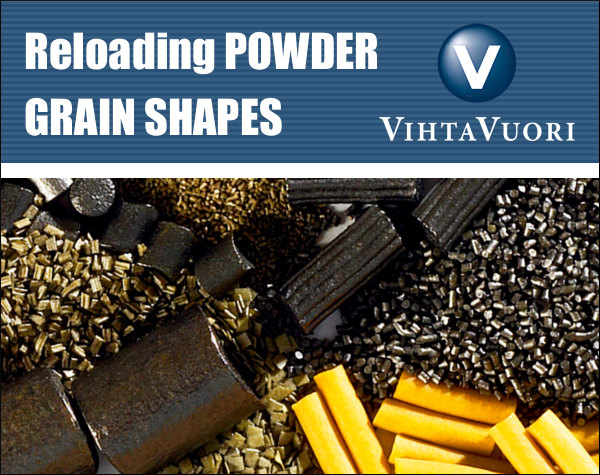
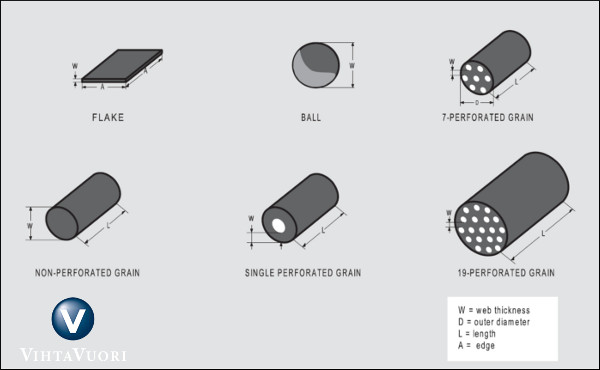
The shape of powder grains has a profound effect on the performance of the powder charge, as it concerns both pressure and velocity. There are multiple powder shapes including flake, ball, and extruded or “stick” (both solid and perforated).
All Vihtavuori reloading powders are of the cylindrical, single-perforated extruded stick type. The differences in burning rate between the powders depend on the size of the grain, the wall thickness of the cylinder, the surface coating and the composition. Cylindrical extruded powders can also have multi-perforated grains. The most common types are the 7- and 19-perforated varieties. A multi-perforated powder grain is naturally of a much larger size than one with a single perforation, and is typically used for large caliber ammunition.
Other types of powder grain shapes include sphere or ball, and flake. The ball grains are typically used in automatic firearms but also in rifles and handguns. The ball grain is less costly to produce, as it is not pressed into shape like cylindrical grains. Flake shaped grains are typically used in shotgun loadings.
Web thickness in gunpowder terminology means the minimum distance that the combustion zones can travel within the powder grain without encountering each other. In spherical powders, this distance is the diameter of the “ball”; in flake powder it is the thickness of the flake; and in multi-perforated extruded powders it is the minimum distance (i.e. wall thickness) between the perforations.
The burning rate of powder composed of grains without any perforations or surface treatment is related to the surface area of the grain available for burning at any given pressure level. The change in the surface area that is burning during combustion is described by a so-called form function. If the surface area increases, the form function does likewise and its behavior is termed progressive. If the form function decreases, its behavior is said to be degressive. If the flame area remains constant throughout the combustion process, we describe it as “neutral” behavior.
The cylindrical, perforated powders are progressive; the burning rate increases as the surface area increases, and the pressure builds up slower, increasing until it reaches its peak and then collapses. Flake and ball grains are degressive; the total powder surface area and pressure are at their peak at ignition, decreasing as the combustion progresses.
So how does the shape affect pressure and muzzle velocity? In general, it can be said that powder that burns progressively achieves a desired muzzle velocity at lower maximum pressure than a powder that burns neutrally, not to mention a degressive powder. As grain size increases, the maximum pressure moves towards the muzzle, also increasing muzzle blast. Muzzle velocity and pressure can be adjusted by means of the amount of powder or loading density, i.e. the relationship between the powder mass and the volume available to it. As the loading density increases, maximum pressure grows.
With the high cost and reduced availability of factory ammo, more shooters are loading their own ammo. When good 9mm pistol ammo was $10/box, it might be hard to justify handloading. Now that 50 rounds of factory 9mm can run $25 or more it certainly makes sense to reload. The same is true with rifle ammo if you shoot large quantities, or if you simply can’t find your preferred ammo for sale these days.
To increase productivity when reloading large quantities of ammunition, many shooters are thinking of getting a progressive press. Because multiple operations take place with a single pull of a lever, a progressive press can produce way more ammo in a given period of time than any single stage press. With a progressive, on the ram up-stroke, the multiple stations can simultaneously remove spent primer, full-length size case, drop powder, seat bullet, and crimp (if desired). Most progressives are also set up to prime cases with the ram in the lower position — though some guys prefer to prime manually.
Progressive presses aren’t just for high-output pistol ammo or bulk rifle ammunition. Good progressives can be adapted to do certain reloading tasks for top-on-the line match ammo. You might use a progressive for decapping, priming, and sizing, then throw powder and/or seat bullets separately. Some Champion shooters do use progressives to load their match ammo! For example 5-Time National Long Range Champion John Whidden and 2020 Berger SWN F-Open Champion Jay Christopherson both use progessive presses for some (but not all) operations.
To help you get started with progressive presses, here are six videos from UltimateReloader.com that cover seven popular machines, from the elite Mark 7 Evolution to the affordable Lee Loadmaster. With many of these machines you can add separate vertical bullet feeder systems that further increase loading efficiency. Machines Covered: Lyman Mark 7, Dillon XL-650, Dillon XL-750, Dillon RL-550c, RCBS Pro Chucker 7, Hornady Lock-N-Load AP, and Lee Load Master.
Mark 7 Evolution Press — Distributed by Lyman
Dillon XL-650 vs. Dillon XL-750
RCBS Pro Chucker 7 with Bullet Feeder
Dillon 550C with 6mm Creedmoor and 9x19mm
Hornady Lock-N-Load AP Progressive
Lee Load-Master Features and Loading 9mm
SAFETY BONUS — Why You Need a Lock-Out Die
The RCBS Lock-Out Die can also be used with some Dillon and Hornady progressive presses.
If you load pistol or rifle ammo with a progressive press, we strongly recommend you get a Lock-Out Die from RCBS. This unique reloading die will prevent your progressive press from advancing if the dispensed powder charge is more or less than about 0.3 grains too high or too low. The Lock-Out Die really works.
The Lock-Out Die works by using a central die detection rod that sets its vertical position based on the height of the powder column in the case. Through an ingenious design, if the powder column height is too low or too high, the rod locks in place as you start to pull the press handle. This halts the press before the ram can lift and the cartridge plate can advance. Unlike a beeping alarm system (which can be ignored or defeated), the Lock-Out Die physically stops the movement of the press ram and prevents a bullet being seated in the “problem” case.
It takes a bit of tweaking to get the Lock-Out Die detection rod setting just right, but once it is correctly positioned, the Lock-Out Die works smoothly in the background. The Lock-Out Die won’t interfere with the loading process unless it detects a high or low charge — and then it positively stops the progressive loading cycle.
While crafted for use in RCBS progressive presses, the RCBS Lock-Out Die can also be used on a Dillon XL Progressive or Hornady Lock-N-Load progressive — though it does take up one station which could otherwise be used for a final crimp die (after the seating die). This Editor has used the RCBS Lock-out die very successfully on an RCBS 2000 progressive press for many years.
Shiny brass — it may not shoot more accurately, but it does make you feel better about your hand-loaded ammo. While it’s not necessary to get brass “bright and shiny” after every firing, it is a good idea to clean powder residue, grime, and grit off your brass before you run cases into sizing dies. There are many ways to clean cartridge cases. A quick wipe with solvent on a patch may suffice for recently-shot cases. Older brass with baked-on carbon may require lengthy tumbling. Ultrasonic cleaning is another popular option that gets your brass clean inside and out.
Sinclair International has a series of helpful videos on brass cleaning. These short “how-to” videos, hosted by Bill Gravatt, Sinclair’s past President and current Creedmoor Sports President, cover the various processes you can use — tumbling, ultrasonic cleaning, chemical cleaning, and cleaning by hand.
Video ONE — Cleaning Brass in Vibratory or Rotary Tumbler
TIP: Brass that has recently been shot will clean more easily than brass that has been sitting many days or weeks. If your tumbling media is fresh the job should be done in an hour or less. It’s your choice whether to tumble with primers removed or with primers still in the cases. If you choose to tumble with primers out, we suggest you deprime with a depriming die, rather that put dirty brass into your sizing die. Some people like to add a teaspoon of liquid polish to the media. This does work, cutting tumble time, and making your brass more shiny. However, if you add liquid polish, do that BEFORE you add the brass and let the tumbler run for a 15 minutes to get the polish completely mixed into the media. Otherwise you can else up with gooey gunk inside your cases — a very bad thing.
Video TWO — Ultrasonic Case Cleaning
TIP: There are many different types of solutions you can use. Soapy water suffices for some folks, particularly if you add a little Lemi-Shine. The Hornady One-Shot Sonic Clean and Lyman Turbo Sonic solutions both work well, and can be used multiple times, provided you strain the solution to remove dirt and grit after cleaning sessions. Many ultrasonic cleaning machines have timers. Experiment with dwell time to see how long you need to immerse your brass. A very small amount of Ballistol in the solution will help lubricate your necks on the inside. This can make bullet seating go more smoothly, with more consistent neck tension.
Video THREE — Chemical Cleaners (Soaking without Ultrasound)
TIP: After using chemical cleaners, such as the Iosso solution, you need to water-rinse your brass thoroughly. A kitchen strainer helps with this (see video at 0:20). Also, don’t forget your brass in the chemical solution — follow the manufacturers recommendations and don’t exceed the recommended dwell time. Chemical cleaners work surprisingly well to remove grease and grime, and the solution can be re-used multiple times. However, if you want your cases to look bright and shiny (like new brass), you will probably have to tumble. [Editor: A very effective new chemical cleaner is the Brass Monkey product from the makers of Wipe-Out and Carb-Out. Add a teaspoon to a gallon of water then soak your brass for 20-30 minutes. It really works — the cases clean up dramatically].
Video FOUR — Manual Cleaning (By Hand)
TIP: Keep some oversize patches in your range kit. At the end of your shooting sessions, wipe off your fired brass with a patch dampened with a mild, non-corrosive solvent (once again Ballistol works well). Before the carbon sets up on your brass it is very easy to remove. For tougher jobs, you can use 0000 Steel Wool (as Bill recommends in the video). You may find that timely hand-cleaning lets you avoid tumbling altogether — or you may choose to tumble (or ultra-sound) your brass only after a half-dozen or so firings.


 This video shows a conventional chronograph with front and rear light sensors. The bullet first trips the front sensor and then the rear sensor as it flies over the unit. The difference in sensor time is used to calculate bullet speed. This is not the only kind of chrono in common use today. The popular


 While much of Norma’s product line still comes from Europe, RUAG Ammotec has actually been manufacturing in the United States for 10+ years as RUAG Ammotec, USA, based in Tampa, Florida. Now the USA manufacturing operations will shift to Georgia. This will be a significant operation. Last year, in 2021, RUAG Ammotec produced over 30 million cartridges in the USA, and it plans to ramp up USA production significantly at its new Georgia ammo plant.





 Shiny brass — it may not shoot more accurately, but it does make you feel better about your hand-loaded ammo. While it’s not necessary to get brass “bright and shiny” after every firing, it is a good idea to clean powder residue, grime, and grit off your brass before you run cases into sizing dies. There are many ways to clean cartridge cases. A quick wipe with solvent on a patch may suffice for recently-shot cases. Older brass with baked-on carbon may require lengthy tumbling. Ultrasonic cleaning is another popular option that gets your brass clean inside and out.


