Congratulations to Lapua’s Rimfire Performance Center Manager, Luke Johnson, on winning the Lapua Silhouette Super Shoot. Johnson won the Standard Rifle class with a score of 176 out of a possible 200 and a shot a perfect 40 out of 40 in the Hunter Rifle to win the class with an aggregate score of 185.
With Johnson’s perfect score in Hunter Rifle, he joins the elite 4-member club of registered masters who have shot a perfect score in both Standard and Hunter Rifle silhouette disciplines. Johnson obtained his perfect score in Standard Rifle at the 2017 National Silhouette Championship.
The Lapua Super Shoot took place May 29-30, 2021 at the “Silhouette Capital” of the USA, Ridgway Rifle Club in Ridgway, PA. It consisted of 3 x 120 round relays, all fired from the standing position. For each relay, shooters engage ten chickens at 40 meters, ten pigs at 60 meters, ten turkeys at 77 meters and ten rams at 100 meters.
“This was my 3rd perfect 40/40 of my silhouette career, all have been shot with tested Lapua Center-X,” stated Johnson, “There have only been 10 different competitors to ever fire a perfect score in registered competition. This was a special 40/40 with it being my first in Hunter Rifle class.”
Choosing the Perfect Ammo for His Rifle
Johnson’s Lapua Center-X .22 LR ammunition is matched to his firearms at Lapua’s Rimfire Performance Center indoor facility. Unique lots of ammunition are tested at 50 and 100 meters simultaneously, identifying the best performing ammunition for purchase. This service is available to all shooters who wish to gain a competitive advantage. Readers take note — you can do this type of ammo testing for your own rimfire rifles. CLICK HERE to schedule ammo testing at either of Lapua’s Rimfire Performance Centers located in Mesa, AZ or Marengo, OH.
About Luke Johnson — Past National Silhouette Champion and All-American
Johnson, a native of Marysville, PA, brings a long background of competitive shooting and hunting to Capstone. Johnson is a graduate of the University of Alaska-Fairbanks. While pursuing his Bachelor of Science degree, Luke was a 4-year letterman for the University’s D1 Rifle Team. In addition to his 3P/Prone shooting pedigree, Luke is a High Master rifle silhouette competitor. Highlights of his competitive background include: NRA Smallbore Rifle Silhouette Champion, NCAA & CRCA All-American, USA Junior National Champion (50 meter rifle).
About Lapua Bullets, Brass, and Ammunition
Lapua produces the highest-quality, small-caliber cartridges and components for civilian and professional use. Lapua is a part of the Capstone Precision Group, exclusive U.S. distributor for Berger, Lapua, Vihtavuori and SK-Rimfire products. For more information, visit Lapua.com.
At the request of our readers, we provide select “Deals of the Week”. Every Sunday afternoon or Monday morning we offer our Best Bargain selections. Here are some of the best deals on firearms, hardware, reloading components, optics, and shooting accessories. Be aware that sale prices are subject to change, and once clearance inventory is sold, it’s gone for good. You snooze you lose.
1. Palmetto State Armory — Savage A22 .22 LR, $249.99
⏺ Great Price on versatile self-Loader for plinking or NRL22
Looking for an affordable, versatile .22 LR rifle for NRL22 rimfire matches, varminting, and fun shooting? The Savage A22, now just $249.99 on sale, is a great value. The A22 features a strong steel receiver, chromed bolt, 10-round rotary magazine, and adjustable Savage AccuTrigger. The A22’s rotary magazine offers fast cycling, while the delayed blowback action is safe and reliable. For gun games where speed counts, we like semi-autos — follow-up shots are way faster than a bolt-action.
2. Midsouth — Frontier .223 Rem 55gr HP Ammo, $12.99/20
⏺ Yes, finally — .223 Rem ammo IN STOCK at a reasonable price!
Looking for good .223 Rem ammunition without breaking the bank? Midsouth has Frontier .223 Remington 55 Grain Hollow Point ammo in stock at just $12.99 per box of 20 rounds. Quality .223 Rem ammo at $0.65 per round is about the best deal you’ll find these days. So grab some now before it’s all gone. Verified buyers say this ammo is dependable.
3.Graf & Sons — Magnetospeed Sporter Chronograph, $170.99
⏺ Great Deal on efficient, reliable, easy-to-use Chronograph
Priced at just $170.99, the Magnetospeed Sporter Chronograph model costs less than half as much as Magnetospeed’s V3 models. This chronograph attaches directly to your barrel so you don’t have to go downrange to set up sky-screens or tripods. For most people the Sporter Model contains all the features they need. Using Magnetospeed’s XFR adapter (sold separately), data can be transferred easily to your mobile device. Check out this Magnetospeed Sporter Review to learn more.
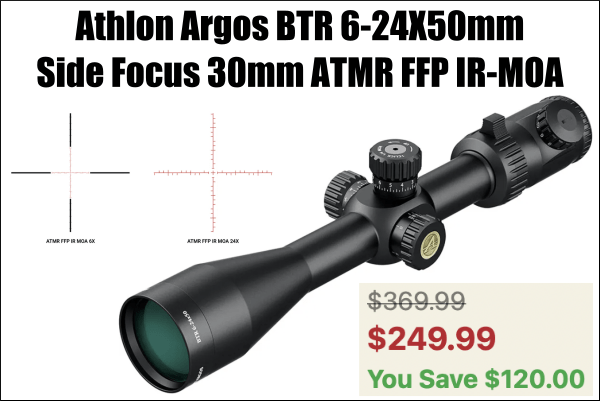
⏺ No FFP scope can rival this 6-24X Athlon anywhere near this price
Looking to get into PRS or need an affordable FFP scope? Check out this Athlon Argos BTR 6-24X50mm riflescope. Now deeply discounted, this versatile optic features a wide 6-24X magnification range — just about perfect for PRS (or varmint hunting). Controls are precise and glass is surprisingly good. The Argos BTR’s advanced ATMR reticle features a 2 MOA center cross and 2 MOA hashmarks to compensate for bullet drop and wind drift. This scope has a First Focal Plane (FFP) reticle, meaning the reticle hashmarks stay constant relative to the viewed target as you zoom in or out.
5. Creedmoor Sports — Radians Safety Product Sale
⏺ All Radians products now discounted 10-15%
Protecting your vision and hearing is vital. Every shooter needs good eye and ear protection. If you’re looking to upgrade your current safety gear, check out the Radians Safety Equipment Sale over at Creedmoor Sports. You can find everything from earmuffs to custom fit earplugs to ANSI Z87.1-certified safety glasses, all on sale. Head over to Creedmoor Sports this week for 10-15% savings on quality eye and ear protection.
6. Amazon — Lyman Brass Smith Xpress, $119.99
⏺ Efficient, well-designed power trimmer that indexes off shoulder
Trimming brass is critical to precision reloading. However, with most case trimmers it’s a pain to adjust trim length, plus the hand-cranking becomes tiresome. A better, more efficient case trimming solution is offered by the Lyman Brass Smith Case Trim Xpress. We like this case trimmer for good reason. The smart design allows for .001″ trim length adjustments with the click of a dial. The tool ships with 10 bushings that cover the most popular neck sizes on the market. To see a video of the Case Trim Xpress in action, check out our Lyman Case Trim Xpress Review.
7. EuroOptic — SIG Sauer Kilo1000 Laser Range Finder, $129.99
⏺ Insanely low price on good Laser Rangefinder for hunters
Get a quality Laser Rangefinder at an insanely low price. Right now the SIG Sauer Kilo1000 Laser Range Finder is just $129.99 on sale at EuroOptic. This unit is probably all a hunter needs for most ranging chores. SIG says it is good to 1200 yards on reflective targets, 800 yards on trees and 600 yard on animals such as deer. The handy Kilo1000 LRG is compact and easy to carry. Note: EuroOptic also has BDX model SIG Sauer LRFs on sale. These BDX units communicate via bluetooth with your Ballistics App. The SIG Kilo 1000 with BDX is $199.99. If you want more performance, EuroOptic also has longer-range-rated SIG Laser Rangefinders for a bit more money. For example the 2200-yard-rated Sig2200 BDX is $319.99 on sale, a $180.00 savings.
8. Amazon — Brifit Digital Mini Scale, $16.99
⏺ Good, very compact scale for component sorting, many positive reviews
Handloaders can benefit from having a speedy, compact digital scale for basic tasks. Use this as a supplement to your ChargeMaster or premium, full-size scale. The very affordable Brifit Digital Mini Scale is great for sorting duties — weighing bullets, brass, primers and other items. This handy Brifit pocket scale measures up to 200 grams, with stated precision of 0.01 grams. With the push of a button, you can switch between grams, ounces, or grains instantly. This $16.99 Brifit scale ships with a 50 gram calibration weight. The unit boasts a nice LCD Backlit Display and “Auto Off” feature that saves battery life.
9. Amazon — Meralian Range Bag and Pistol Tote, $26.99
⏺ Great Value for Range Bag that holds multiple pistols, muffs, and mags
Here’s a well-designed, functional range bag at a good price — just $26.99. The Meralian tactical pistol range bag is great for hauling handguns. With a 13″ x 7″ x 9″ main compartment, there’s plenty of room for your pistols, ammo, and safety gear such as muffs and eye protection. Under an outer zip panel are six dedicated pouches for magazines. This range bag is currently available in four colors. You may want to select a bright color so your bag stands out at the range.
10. Amazon — Feyachi AR Brass Shell Catcher, $11.99
⏺ Many great features — holds its shape, easy to empty
Shooting AR-platform rifles can be fun but they can eject spent cases a considerable distance. Nobody likes to chase down the fired brass tossed out by these semi-auto rifles.
An easy fix for brass-chasing chores is the Feyachi Brass Shell Catcher. This attaches to the side of your AR and capture all your ejected cases. This new version features a strong 45-deg upper wire frame so the entire unit sticks out further and holds its shape better. There is also an updated Velcro attachment plus reinforced mesh that retains large amounts of brass. With these design enhancements, this is a smart choice AR brass-catcher. This unit also boasts a zipper at the bottom for quick and easy brass removal.
The 600-yard target has an X-Ring 6 inches (1 MOA) across, while the 10-Ring spans 12 inches (2 MOA).
The following article is about reloading for NRA/CMP Highpower Rifle competition and is geared toward competitors shooting the AR15 Service Rifle. In Highpower Rifle competition, shooters fire in four stages: Standing slow-fire at 200 yards, Sitting rapid-fire at 200 yards, Prone rapid-fire at 300 yards, and Prone slow-fire at 600 yards. Competitors use a sling for support in all positions but standing. A typical AR15 Service Rifle sports a 20″ free-floated barrel and a 4.5-pound trigger. Service Rifle scopes are limited to maximum power of 4.5X.
Thoughts on Loading for Service Rifles, Particularly for 600 Yards
by Danny Arnold, Team CMP Article originally published in CMP Shooting News
Before we get started, I want to stress that all of the information that follows is geared toward the .223/5.56 Service Rifle. That doesn’t mean that there’s nothing here for anyone else, but the .223/5.56 Service Rifle platform is where I’ve spent the majority of my time, so here we go.
There is only one “Perfect” 600–yard load for my rifle, True or False? This example is more anecdotal than scientific, but it provides some food for thought….
Team CMP spent the early part of March competing in the Orange Blossom Regional. As soon as we got on the range, Sara Rozanski (Team CMP member) started having problems with her 600-yard ammunition. Nearly 1/3 of her cases were exiting the chamber minus the primers. I offered to swap my ammunition for hers, suspecting that my Wylde chamber would be more forgiving than her CLE chamber — a solution that seemed to solve the problem. At least neither of us was blowing primers!
Sara’s ammunition was a factory load using a well-known 80+ grain bullet with an unknown primer and powder, using brass from a respected manufacturer. My load was a different brand of 80-grain bullet, with my choice of powder and primer, all in brass made by someone else. Given the color of the primers, the only thing that our ammunition could possibly have had in common was the brand of powder… maybe. So, how did we shoot?
Sara and I shot the two-person team together and the entire 2,400 Aggregate, although on different relays. Sara’s combined 600-yard score was 780-28X (97.5%). Mine was a 783-24X (97.87%). Our scores were never more than two points apart on any of the four days. Keep in mind that we were using each other’s ammunition the entire time.
So, we had different barrels, chambers and ammunition, but similar results. That goes back to the idea that a good load will perform similarly if fired in a good barrel.
Are We Too Focused on Ballistic Coefficients (BCs)?
The revailing wisdom has always trended toward loading the highest-BC bullet we could find and pushing it as fast as possible. Back in the early ’90s when I got started with the AR15, the 80-grain Sierra was state of the art. Actually, I picked up all of my Leg points with it, although today it looks a bit dated — kinda like me.
So, the question I’ll pose is this: Would you rather shoot a high-BC bullet that groups 3/4-MOA (minute of angle) or a lower-BC bullet that groups into one-half-MOA traveling 50 feet-per-second faster? The reason that I posed this question is a situation I found myself in a decade ago. Our coach decided that he wanted us to pair-fire some 600-yard for practice. Unfortunately, I hadn’t gotten the memo and all that I had available was my normal short-line ammunition, loaded with a 77-grain bullet. The shooter I was paired with was using a higher-BC bullet than I was, but in the end, we both shot 198s.
Admittedly, using 77-grainers meant that coach had to work a little harder to keep us together on target, but it was a teaching moment for me. I knew that my upper shot 77s better than the available bullets in the 80-grain range, so I cranked out a windage table for the 77-grain bullet at 600 yards and shot those for the rest of the season. After all, the wind blows ALL bullets around. It’s just a matter of knowing what YOUR bullet is doing.
With the shortages that we’re experiencing right now, a lighter bullet may be all that you have available for the 2021 season. That doesn’t mean that you’re disadvantaged though.
Danny Arnold teaching Highpower Clinic at 2021 CMP Eastern Games
Loading High-BC Bullets
In the past decade, several bullets have appeared that weigh 80-grains or more. One thing that many of them have in common is a very sharp nose profile, whether metal or polymer. The question is: Are you using the right seating stem?
The jacket material in the bullet’s nose is very thin. If you section a bullet, you’ll find that there is a surprising amount of air space in the nose. If you’re using older seating dies, your seating stem may be contacting the bullet nose too close to the tip, where the jacket is the both thinnest and is unsupported by the lead core. This can manifest itself either as a deformation at the very tip of the bullet or as a circular dent around the bullet nose that you can see and feel with your thumbnail. I think we can all agree that denting a bullet is usually considered a bad thing.
One company goes so far as to recommend their proprietary seating stem for use with their high-BC bullets. Other companies leave it up to you to find a seating stem that will allow the bullet nose to go deeper into the seating stem, moving the contact point further down the bullet where the jacket is thicker and supported by the core material.
Seating Depth and Bullet Preferences
Some bullets don’t mind some “jump” into the lands, but some really do. Unfortunately, manufacturers don’t tell you much about that. Your chamber configuration (Wylde, CLE, or some hybrid of the two) and the bullet that you choose will determine your optimal seating depth. Long and short of it, a quality measuring tool to determine seating depth is a necessity these days. Keep in mind that if you’re doing this with a brand new barrel, the throat is likely going to change slightly in the first 200 rounds and may need to be re-measured. Actually, since all of your short range ammunition has to be loaded to magazine length, you’re probably better off developing your short range loads before starting on long range load development. That gives the throat a chance to wear in a bit on a new barrel.
Brass Prep — Why It Is Important
When match-grade AR15s first arrived on the scene, it was amazing how little it took to get them to shoot well. Other than making sure that I had brass from the same lot and running it through a set of match-grade dies, I did nothing. Of course, we were also using a post front sight. Was the occasional bad shot me, the rifle, the load or just an archaic sighting system?
Transitioning to optics has caused me to reconsider how and what I do in my reloading process: That, and having some extra time on my hands to experiment.
A little (or a lot) of time spent with a neck turning tool, a primer-pocket uniformer and a flash-hole reamer will quickly show you how consistent brass is by manufacturer and even by individual lot. That exercise also makes the prices charged for high-quality brass seem ridiculously cheap. That doesn’t mean that I advocate neck-turning or other uniforming practices, nor do I advocate spending scandalous amounts of money on long-range brass. However, our sport is about consistency. The consistency of your brass is a matter of choice, whether you choose to simply segregate cases by weight (cheap option), neck turn (labor intensive) or open your wallet a little wider for premium brass.
Weighing Charges vs. Throwing with Powder Measure
To measure or weigh? For a long time, I used a powder measure to throw all of my 600-yard loads. The powder I was using metered well, and the results downrange didn’t justify the extra time spent with a scale. That was in the day of iron sights though. Nowadays, I’m throwing my charges and trickling up to the desired weight as measured on a scale that weighs to a 100th of a grain.
To quantify the difference between individually weighing each charge versus throwing charges with a powder measure, I weighed six kernels of powder that I trickled into the pan and then dumped them into the hopper. Going through that process 10 times, I came up with an average weight of .08 grains for six kernels. Next, I threw 50 charges for weighing using my powder measure. If I felt the measure hanging up as it cut kernels, I put the charge back into the hopper without weighing it.
That’s six kernels of powder sitting in the pan — average weight .08 grains.
Those 50 smoothly-thrown charges varied .26 grains from lowest to highest, with the majority varying no more than .16 grains from highest to lowest. If the desired weight was exactly in the middle, at worst you’d be .13 grains (9-10 kernels) low or high, with the majority being off no more than .08 grains (6 kernels) above or below the desired charge weight. Is that enough to send a shot outside the 2-MOA 10-Ring? Probably not.
Has more consistent brass and weighing charges to one-hundredth (0.01) of a grain added up to higher scores? Honestly, this question is hard to answer. Looking at the results on paper at 200 yards, using a powder that meters well combined with a consistent touch on the loading lever doesn’t appear measurably different than meticulously weighing each and every powder charge. Looking back over my 600-yard plots however, I can see a trend toward a group that is closer to X-Ring height.
Since the bullseye is widest at the center, shooting groups that are the height of the X-ring gives you more room for error when the wind is blowing. That can translate into higher 600-yard scores.
How You Load Your Ammunition vs. How You Load Your Rifle
The loading/chambering cycle of the AR-15 is, in a word, violent. You have a relatively heavy bolt and carrier assembly under power of a stout buffer spring slamming forward to chamber each round of ammunition. By design, those rounds were supposed to be held securely by the magazine feed lips until the bolt stripped them off the follower. Obviously, due to their overall length, 600-yard loads can’t be chambered that way. Although the barrel extension is funnel-shaped, it’s also got a lot of “teeth” ringing the inside of it (see below).
Whether you’re using a standard magazine or a single-round loading device (SLED), dropping a round in the loading port and releasing the bolt is an act of faith in that you’re trusting the bullet to arrive in the chamber undamaged.
Ask yourself, how many times have you seen someone drop a round on the follower, press the bolt release and watch as the bolt jammed on a cockeyed round? If that happens once every 100 tries, how many times did the bolt close on a scratched, dented, or misaligned bullet? Could that be the cause of the occasional errant shot?
My technique is to drop each round on top of the SLED and then push it slightly forward with my finger, partially chambering it before releasing the bolt. Admittedly, some people may be unable to do this due to body configuration or left-handedness, but why go to all the trouble of loading “perfect” ammunition and then damage it on the way into the chamber?
Now that we’ve covered bullets, brass, and assorted errata we can move on to discussing loads for 600 Yards…
The NRA Highpower 600-yard target has a 6-inch (1 MOA) X-Ring, and a 12-inch (2 MOA) 10-Ring.
Load Development for 600 Yards
Finding a load for 600 yards is a lot like finding a load for short range. Once I decide on a bullet, powder, primer, velocity range and a measured guesstimate of seating depth, I load 10 rounds of each test load, increasing in 0.2 (2/10) grain increments. I test them from the prone position at 200 yards. Ideally, I want to see two loads that are 0.2 (2/10) of a grain apart that shoot almost identical groups. The load that I choose will fall in between the two best shooting loads that I tested. If the first load is XX.2 grains and the second is XX.4 grains, my chosen load will be XX.3 grains.
Why develop loads in 0.2-grain (tenths) increments if I have a scale that measures in 0.01-grain (hundredths) increments? Or, why not test in 0.1-grain increments?
For me, working in 0.2-grain increments gets me to the results quicker. Also, there is a difference between accuracy and consistency in this scenario. Developing loads in 0.2-grain increments gets me to an accurate load. Producing that load using a scale that accurately measures to .01-grain insures a consistent load, assuming that I do my part.
Once I’ve settled on a load, it’s time to play with seating depth, if I choose to. If I’m lucky and the groups are acceptable as-is, I won’t do anything. If I think there’s room for improvement, I’ll experiment a little. Depending on the bullet, changing the seating depth by a couple of thousandths one way or the other may change the group size. During this phase of testing, it’s a good idea to chamber a round and see if the entire round will then extract. If you leave a bullet stuck in the throat, your rounds are too long. Finding that out at a match can ruin an otherwise good day.
Danny Arnold shooting his AR15 Service Rifle, standing position at 2021 CMP Eastern Games.
Another thing to keep in mind is that your barrel is not static. Every round fired has an effect on the throat, vaporizing and scouring away metal until the distance the bullet travels before meeting the rifling measurably increases. If you have chosen a bullet that shoots best when close to the lands, you’ll need to periodically re-measure and possibly change your bullet seating depth to maintain that optimal relationship.
The Elephant in the Room — User Skill Level
There’s really not a delicate way to put this, so I won’t try. There’s little point in spending time and effort developing a load that shoots into half-MOA off the bench if you’re only capable of shooting 2 MOA using a sling right now.
That doesn’t mean that there’s no hope. On the contrary, it just means that your time and effort is better spent practicing with some good short-range ammunition on reduced targets at a 100 or 200-yard range. At that distance, wind is not a factor and your technique can be improved more quickly so you’re in a position to benefit from that ½ MOA ammunition.
About Team CMP
CMP has created a Highpower Team with top competitors. Team CMP competes at several events throughout the year and most importantly, helps to teach Highpower Clinics at CMP Competition Events. Learn from Team CMP at Camp Perry during the Advanced Highpower Clinic, scheduled this year for July 30 through August 1, 2021. Visit the Highpower Clinic Web Page for more information.
The Civilian Marksmanship Program is a federally-chartered 501(c)(3) non-profit corporation. It is dedicated to firearm safety and marksmanship training and to the promotion of marksmanship competition for citizens of the United States. For more information about the CMP and its programs, visit www.TheCMP.org.
Pieter “Piet” Malan is a South African precision rifle shooter and hunter who has created an impressive YouTube Channel with over 300 videos. While Pieter’s Impact Shooting Channel focuses primarily on tactical PRS/NRL type disciplines, his channel also includes dozens of videos of interest to hunters and anyone who handloads rifle cartridges. We particularly like Pieter’s tech review videos which explain important reloading methods and showcase new products.
Here are four Peiter Malan tech videos. Topics include annealing, hydro-forming, case priming, and how to record video with spotting scopes. As a bonus for you hunters out there, we added Pieter’s latest hunting video, Kudu Hunting Paradise Part 2. After watching that, you’ll probably want to book an African Safari.
Hydro-forming Dasher Brass Using Hammer Method
Fire-forming 6mm Dasher brass can be fairly costly if you factor in barrel life along with the cost of components. If you figure a new 6mm custom barrel, chambered and fitted by a top smith, could cost $650.00 and may only be good for 1300 rounds (in competition), barrel cost per shot is $0.50 (fifty cents). Add the price of a bullet, powder, and primer, and you are approaching $1.00 per round. Given those numbers, it makes sense to hydro-form your 6mm Dasher brass. In the USA, DJ’s Brass will hydro-form and then anneal your cases for $0.60 per case. That’s not much more than the barrel cost per shot alone for fire-forming.
In this video, Pieter Malan explains the hydro-forming process for Dasher brass and shows how he does the job using the mallet method with hydro-forming dies. He shows that it takes some technique (and multiple hammer blows) to get a good result, with a case that will fit in the chamber.
Annealing Cartridge Brass with AMP Annealer
With premium cartridge brass for popular match cartridges now approaching $1.20 (or more) per case, you want that new brass to last. But after multiple firings, even the best cartridge brass will start degrading. That’s where annealing comes in. Proper, precision annealing can restore case-neck consistency, reducing ES/SD and improving accuracy. Some top shooters anneal after every firing to keep their brass in top condition. Others will anneal after every 4-6 firings.
Today with the advanced AMP microprocessor-controlled annealing machine, brass cartridge annealing is easier yet more precise than ever. The AMP Annealer provides advanced electrical induction annealing with ultra-precise temperature control set perfectly for your cartridge type and brand of brass. In this video, Pieter shows how to use the AMP Annealer to anneal 6mm Dasher cases and other cartridge types.
Primal Rights CPS — World’s Most Expensive Priming Tool
Seating primers can be a “dark art”. Many top shooters prefer to seat “by feel” using a hand tool. Others prefer lever-equipped, bench-mounted tools that offer higher work-flow rates and less strain on the hands.
There are many bench-mounted priming options — Forster has a tool, as does RCBS, and Lee. At the top of the heap is the $600 Primal Rights Competition Primer Seater (CPS). This may be the most precise bench priming tool ever created. It is certainly the most expensive at $600.00. But the CPS delivers something special — superb, repeatable depth control, along with the ability to prime up to 1000 cases per hour. For some reloaders, that precision + productivity will justify the high price. In this video Pieter reviews his Primal Rights Competition Primer Seater.
How to Record Video Through Your Spotting Scope
There are many things viewed through a spotting scope that you might want to record for posterity — a successful hunting shot on a game animal, or steel targets being hit in a PRS match. In addition, after a match, it can be useful to study the wind conditions and mirage that occurred during a match. This can help improve your wind reading skills as you watch what unfolded.
In this video, Pieter shows how to mount a smartphone to the eyepiece of a spotting scope with a plastic adapter. This allows you to record, for posterity, what the scope is “seeing”. In addition, this allows the viewer to see the scope’s magnified image conveniently without having to strain into the eyepiece and focus on a very small exit pupil.
Figure 1. When the bullet is seated farther out of the case, there is more volume available for powder. This enables the cartridge to generate higher muzzle velocity with the same pressure.
Effects Of Cartridge Over All Length (COAL) And Cartridge Base To Ogive (CBTO) – Part 1 by Bryan Litz forBerger Bullets.
Many shooters are not aware of the dramatic effects that bullet seating depth can have on the pressure and velocity generated by a rifle cartridge. Cartridge Overall Length (COAL) is also a variable that can be used to fine-tune accuracy. It’s also an important consideration for rifles that need to feed rounds through a magazine. In this article, we’ll explore the various effects of COAL, and what choices a shooter can make to maximize the effectiveness of their hand loads.
Sporting Arms and Ammunition Manufacturers’ Institute (SAAMI)
Most loading manuals (including the Berger Manual), present loading data according to SAAMI (Sporting Arms and Ammunition Manufacturers’ Institute) standards. SAAMI provides max pressure, COAL and many other specifications for commercial cartridges so that rifle makers, ammo makers, and hand loaders can standardize their products so they all work together. As we’ll see later in this article, these SAAMI standards are in many cases outdated and can dramatically restrict the performance potential of a cartridge.
Bullet seating depth is an important variable in the accuracy equation. In many cases, the SAAMI-specified COAL is shorter than what a hand loader wants to load their rounds to for accuracy purposes. In the case where a hand loader seats the bullets longer than SAAMI specified COAL, there are some internal ballistic effects that take place which are important to understand.
Effects of Seating Depth / COAL on Pressure and Velocity
The primary effect of loading a cartridge long is that it leaves more internal volume inside the cartridge. This extra internal volume has a well known effect; for a given powder charge, there will be less pressure and less velocity produced because of the extra empty space. Another way to look at this is you have to use more powder to achieve the same pressure and velocity when the bullet is seated out long. In fact, the extra powder you can add to a cartridge with the bullet seated long will allow you to achieve greater velocity at the same pressure than a cartridge with a bullet seated short.
When you think about it, it makes good sense. After all, when you seat the bullet out longer and leave more internal case volume for powder, you’re effectively making the cartridge into a bigger cartridge by increasing the size of the combustion chamber. Figure 1 illustrates the extra volume that’s available for powder when the bullet is seated out long.
Before concluding that it’s a good idea to start seating your bullets longer than SAAMI spec length, there are a few things to consider.
Geometry of a Chamber Throat
The chamber in a rifle will have a certain throat length which will dictate how long a bullet can be loaded. The throat is the forward portion of the chamber that has no rifling. The portion of the bullet’s bearing surface that projects out of the case occupies the throat (see Figure 2).
The length of the throat determines how much of the bullet can stick out of the case. When a cartridge is chambered and the bullet encounters the beginning of the rifling, known as the lands, it’s met with hard resistance. This COAL marks the maximum length that a bullet can be seated. When a bullet is seated out to contact the lands, its initial forward motion during ignition is immediately resisted by an engraving force.
Seating a bullet against the lands causes pressures to be elevated noticeably higher than if the bullet were seated just a few thousandths of an inch off the lands.
A very common practice in precision reloading is to establish the COAL for a bullet that’s seated to touch the lands. This is a reference length that the hand loader works from when searching for the optimal seating depth for precision. Many times, the best seating depth is with the bullet touching or very near the lands. However, in some rifles, the best seating depth might be 0.100″ or more off the lands. This is simply a variable the hand loader uses to tune the precision of a rifle.
Lapua now offers a FREE Ballistics App. This was the first mobile ballistics App utilizing the 6DOF calculation model, making it one of most accurate ballistics Apps on the market. With this free mobile App you can calculate trajectories, range, bullet drop, turret adjustments and more.
Lapua’s sophisticated FREE Ballistics App has many great features — much more than you’d expect for a free App. If you do much shooting past 300 yards, or use a wide variety of bullets and/or cartridge types, definitely download the App and give it a try. For more details, read the Lapua Ballistics App User Manual. This handy PDF file explains how to set up the App and utilize all its powerful features.
Here’s something you don’t see every day — a reloading press that has loaded over 1,000,000 rounds of ammo. At the NRA Convention in Dallas in 2018, Redding showcased an old Redding T-7 Turret Press delivered to Sierra Bullets decades ago. 0ne of the very first T-7s made by Redding, this “old warrior” was used by Sierra Bullets to load over 1,000,000 rounds of ammunition in Sierra’s ballistics lab.
Redding T-7 Still Within Spec
After all that loading, Redding tested the press and, remarkably, found that it still remained “within spec”. Redding notes: “This press was subjected to real world reloading wear and stress yet remains within ‘new’ spec after this historic test”. When showcased in Dallas, this Redding turret press was fitted with indicators to show “just how good American steel and craftsmanship remains after what, in a normal situation, would represent numerous lifetimes of use.”
About Redding Reloading
Redding Reloading Equipment has crafted quality, American-made products for the precision handloading market since 1946. Along with single-stage and turret presses, Redding makes great dies. And Redding’s line of tools/accessories includes concentricity gauges, scales, trimmers, powder measures, powder tricklers, cleaning tools, deburring tools, bushings, and many other quality items.
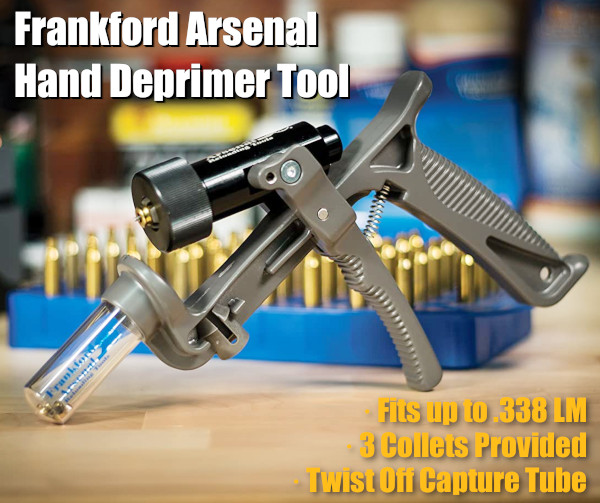
Many shooters prefer to deprime their brass before resizing. That way they can tumble cases or keep primer debris off their main press. To deprime cases before sizing or cleaning you can use a Depriming Die (aka “decapping die”). This pushes out the spent primer without changing the neck or body of a case. Such decapping dies work fine, but they do require the use of a press. Here is a handy alternative — a cool tool that allows you to deprime brass anywhere — no press needed.
Handheld Primer Removal Tool From Frankford Arsenal
This cleverly-designed Hand Deprimer Tool allows you to deprime cartridge cases without a press. This hand-tool from Frankford Arsenal will deprime brass and capture primers conveniently. You can deprime your cases while watching TV or relaxing in your favorite chair.
This device lets you remove spent primers anywhere — no press needed and all the mess (cups/anvils/residue) stays in the capture chamber. This tool comes works with nearly all common case types up to .338 Lapua Magnum. With good leverage, this tool does the job quicklyi and efficiently. Forum members have praised this handy tool, but recommend wearing a thick glove if doing more than 100 cases in a sesssion.
This handy depriming tool is very versatile. With a universal, cylinder-style cartridge-holder, the tool can deprime a wide variety of cartridge types from .20 caliber up to .338 caliber. Three different plastic collets are provided to handle for different diameter cases. Spent primers are captured in a removable spent primer catch tube. Simply twist off the clear catch tube to dump the spent primers. With die-cast metal construction, this tool should last through many thousands of depriming cycles. MSRP is $54.99. Right now it is $44.99 on Amazon with 82% 5-star ratings.
User Modifications — Grip Padding and High-Volume Capture
Many users recommended putting some kind of padding on the grip and front lever to reduce pressure on the fingers. This can be done with a wrap or a rubber covering. In addition, users have adapted the unit with an attached hose and large primer capture jug. If you depriming hundreds of cases at a time, this hose conversion may make sense.
Review from actual owner: “I have owned one of these for about eight years and deprimed over 10,000 cases with this tool. I have never had to replace a single part on it. You will have to adjust the return spring every so often, but that is a very easy task. If you are depriming a LOT of brass, the handle can tear up your hand a bit. Solution: Wear a Mechanics Glove. Easy Peasy! You will NOT regret this purchase.”
How to Adapt Tool for Small Flash Hole Brass
The Frankford Arsenal Deprimer Tool was designed for LARGE flash-hole brass. To deprime brass with small (1.5mm/0.59″) small flash-holes, as found on Lapua .220 Russian and 6mmBR cases, you will need to reduce the pin diameter. A smaller pin is “in development” according to the manufacturer. Frankford Arsenal currently recommends purchasing a replacement pin and “sanding it down” to the smaller diameter. NOTE: This is NOT difficult — simply spin the stock pin in some sandpaper.
Gear Review by Mark LaFevers With its innovative “moving die/static cartridge” design, the RCBS Summit Press definitely demonstrates “out of the box” thinking. Unlike other presses, the case does not move. Rather, the reloading die comes down to the case. We are happy to report that this unique “upside-down” reloading press works great.
We have tested the RCBS Summit Press in the workshop and in the field. We’ve now loaded hundreds of rounds with the press. It is smooth, solid, and easy to use. The spent primer ejection/capture system works great (our testers preferred the Summit’s simple, foolproof primer capture to the Rockchucker’s capture system). Most importantly, the Summit produces very straight ammo that gave excellent results on the target in actual matches.
We compared ammo loaded with the Summit with ammo loaded on an RCBS Rockchucker press. The Summit gave up nothing to the bigger press. Cartridge base-to-ogive measurements of Summit-loaded ammo were just as tight as with ammo loaded on the Rockchucker. Run-out, measured with a concentricity gauge, was the same or better (about .002 or less on bullet nose). Most importantly, the Summit loads accurate ammo. In fact, at one match, scores shot with Summit-loaded .284 Win ammo were actually better than scores shot (in the same gun) with ammo loaded on a Rockchucker:
Despite its small footprint, the Summit is very stable — it doesn’t tip, wobble, or rock. The two front mounting bolts hold it firmly in place — the Summit doesn’t need a rear anchor. This, combined with the fact that the Summit has no overhang, makes this press ideal for a mobile application. For field use (at the range), our tester Mark LaFevers mounted the Summit press on a small platform secured to his trailer hitch (on top of a steel post). This set-up worked great, as you can see in the video below:
Watch Reloading (Sizing/Decapping, Expanding, Bullet Seating) with Summit Press
Photo shows Redding Micrometer Seating Die and .284 Win Cartridge
Mark tells us: “I think the Summit press worked out sweet mounted on the hitch pedestal. The receiver hitch pedestal I made will switch tools between a heavy barrel vise I made and the Summit press. Instead of securing the pedestal with a standard 5/8″ hitch pin, I drilled and tapped for 1/2″-13 bolt to draw the insert up tight against the receiver, eliminating wobble. For charging rounds, I bought 150 plastic test tubes with caps and racks so I can avoid weighing powder charges in the field, unless I want to make changes on the fly.”
The RCBS Summit Press features a rugged cast-iron frame with all-steel linkages. The press is very strong with minimal flex and slop. This allows you to “bump” your case shoulders and seat bullets with great precision and repeatability. The handle can be switched from right to left side (good for southpaws), and the open-front design provides good access, facilitating quick die changes*. The 4.5-inch opening allows you to work with tall cases. Beneath the shell-holder is a spent primer catcher (not shown in photos). The Summit press has a beefy 2-inch diameter ram, with compound linkages for plenty of leverage. A Zerk fitting is included for easy lubrication. The press will accept larger bushings for oversize 1-inch dies.
Summit Press Retails for $238.99
The RCBS Summit Press (RCBS item #09290) lists for $269.95. However, Midsouth currently has the Summit Press on SALE for $238.99. Yes it is IN STOCK and available. An optional short handle from RCBS costs $17.99 at MidwayUSA. ($19.95 MSRP).
This useful video explains the special features of the Summit press — ambidextrous handle, primer catcher, Zerk lube fitting — and shows the press operation.
*To permit his dies to be swapped from Rockchucker to Summit (and back again), with no locking ring adjustments, Mark LaFevers fabricated a new shell-holder base which positions the shell-holder .088″ higher relative to the Summit’s die port. This keeps Summit-mounted dies in the same position relative to the shell-holder as dies mounted in a Rockchucker. So, Mark can swap dies from his Rockchucker to his Summit and maintain exact COAL (when seating) and correct shoulder bump (when sizing). While Mark’s custom shell-holder base lets him swap dies quickly from one press to another, this is NOT a necessary modification. Most folks will simply re-set the locking rings.
Tech Report by B. Walker, owner of The Urban Rifleman LLC
I have been moly coating since I started shooting rifles nearly 26 years ago. I have always moly-coated my bullets. I figured if it was good enough for Walt Berger, it was good enough for me (Walt still moly coats his bullets to this day, if recent match pictures are any indication). I had always used the typical dry method (without the wax) and I had the same jar of moly (molybdenum disulfide) for many years.
I had tried all kinds of methods over the years. But then AccurateShooter Forum member “Bowfisher” sent me a message about moly-coating bullets using water. After his suggestion, I did several batches using the moly-in-the-water method. I was stunned with the great results. This Wet Moly method is the cleanest, easiest, and best coating method I have ever tried. I strongly believe Wet Moly should be the recommended method.
Traditional Dry Moly Coating Process is Dusty and Messy
Before I started the Wet Moly process, I always coated my bullets in small containers in my big Dillon tumbler. I would put the bullets in old EMPTY 1-lb powder containers and add the moly. I would place the powder containers in my big Dillon tumbler and tumble for at least three hours. I would then throw rice in with the bullets to soak up any excess moly dust and shine the bullets. Then I would shake out the rice using a lid with holes drilled in it. My coated stuff came out beautiful if I do say so myself even dry. However, there was always dust and moly mess (there was always some on my fingers when I would handle the bullets after). I only liked to doing coating in big batches to get it over with because it was a chore (by all means don’t get moly on the bottom of your shoes and track the carpet)!
Wet Moly Method — Tumbling in Bottles with Moly and Water
The new wet method entails adding water to the bullets during the tumble in the bottle, and it is way easier and cleaner. The final product is totally dust free and will not come off on your fingers as there is no dust or residue. I think they shoot better too, and the moly works as it is supposed to. I won’t get into the debates over the merits of moly. Some folks believe it works for them. This article is intended for those guys — it is not intended to convert handloaders who are happy with shooting uncoated bullets.
Editor: None other than John Whidden, Multi-Time National Long Range Champion, moly-coats his bullets. Whidden also uses a Wet Moly application method. He agrees that applying moly in a water solution delivers the best results, and doesn’t leave dusty residues.
Here is the basic outline of the Wet Moly application method. In addition to this outline, I created an instructional video that shows my entire process. [Editor: Definitely WATCH the video. It is important to see the post-tumbling rinsing and buffing processses.]
1. Use old 1-lb powder containers. Work over a sink. Add the bullets in reasonable batches to the containers (lets say 2-3 inches of bullets). I try to use use only enough water to cover the bullets and I use a little more moly than I used to with a dry application. I suggest using half a teaspoon of moly per two inches depth of bullets.
2. Tumble for four hours (at least). I tape the container lids shut before placing them in the tumbler. Then, simply place the powder container in your vibratory tumbler.
3. After the elapsed time, take the bottle to the sink and, dump contents into a plastic strainer. I use an old spaghetti strainer that I save just for moly. IMPORTANT: BE SURE you have a strainer that won’t let the bullets fall out! Stream water (from faucet) gently over the bullets to thoroughly clean excess residues off the bullets. Shake strainer to get all the water out. See video time 6:00-10:00.
4. Sift out the bullets onto a paper towel inside an old baking pan and shake to buff. Repeat until the bullets are completely dry and buffed to a high shine. The bullets are clean, dust-free and the moly is gorgeous! Leave for several days before storing or put them in your oven at about 130 degrees for 30 minutes to remove the last bit of any moisture. (WARNING: DO NOT use excessive oven heat or cook too long — set a timer!).
If you follow these instructions, the result should be the best moly coating you have ever seen!
Before and AFTER Wet Moly. Note how uniform the moly coating is on the bullets. The Wet Moly process also leaves a perfect glossy finish after rinsing and drying. And the bullets are totally dust-free! These are Sierra #1380 .224 69gr HPBT MatchKings.
Be sure to visit our online store at TheUrbanriflemanstore.com. We have a full compliment of front and rear bag riders for various rifles that we designed and produce in-house. We also stock Revolution laminated benchrest stocks, and we sell stainless steel Remington prefit barrels (which are getting rave reviews from customers). Also available are Wilson dies, Timney and Triggertech triggers, Berger and Sierra bullets, Magpul and Accuracy International chassis, and lots more.




 Shooting AR-platform rifles can be fun but they can eject spent cases a considerable distance. Nobody likes to chase down the fired brass tossed out by these semi-auto rifles.


 Effects Of Cartridge Over All Length (COAL) And Cartridge Base To Ogive (CBTO) – Part 1


 Redding T-7 Still Within Spec


 With its innovative “moving die/static cartridge” design, the RCBS Summit Press definitely demonstrates “out of the box” thinking. Unlike other presses, the case does not move. Rather, the reloading die comes down to the case. We are happy to report that this unique “upside-down” reloading press works great.


 Be sure to visit our online store at


