At the request of our readers, we provide select “Deals of the Week”. Every Sunday afternoon or Monday morning we offer our Best Bargain selections. Here are some of the best deals on firearms, hardware, reloading components, optics, and shooting accessories. Be aware that sale prices are subject to change, and once clearance inventory is sold, it’s gone for good. You snooze you lose.
⏺ Very good 9mm defensive pistol complete with holster and mag loader
Finding a 9mm handgun that’s well-made and cost-effective can be tough these days. If you’re in the market, check out the CANIK TP9SF 9MM kit. Owners have praised this pistol, saying it is accurate, reliable, and offers good balance/ergonomics. This $449.99 kit includes the pistol in hard case, PLUS carry holster, cleaning kit, and magazine loader. You’d spend $200 more for a Glock by itself with no holster.
⏺ Recent powder outages show need to have a reliable home generator
If recent events have taught us anything, it’s that you need to be prepared for power outages. For an affordable, basic system, consider the FIRMAN 4550/3650 Watt Recoil Start Gas Generator. This provides 4550 startup watts and 3650 running watts. That should be more than enough to run the necessities until power is restored. This unit also features a patriotic Stars and Stripes color scheme.
3. MidwayUSA — Pelican Vault V800 Case, $134.65 Black
⏺ Very good deal on excellent, large wheeled hard case
This is one of the best large, hardshell rifle cases on the market. The Pelican Vault V800 offers 53″ x 16″ internal capacity — big enough for long match rifles. The V800 compares well to other large, wheeled hard cases costing up to $320.00 but right now, the black V800 is just $134.65 at MidwayUSA, a truly great price NOTE: You must add to MidwayUSA Shopping Cart to see this super-low clearance price. For the tan version V800, the best deal we found was $164.75 on Amazon, still a bargain. This case will hold two large match rifles securely. It features five layers of customizable foam, along with six push-button latches.
4. MidwayUSA — Pro Series Gen 2 Comp Shooting Mat, $69.99
⏺ Large, comfortable, padded shooting mat — save 30%
Shooting well requires good body position and reasonable comfort. You can’t shoot well prone if you don’t have a good mat. One of our favorite mats is the MidwayUSA Pro Series Gen 2 Competition Shooting Mat. This mat boasts welcome extra padding for your knees and elbows and it is oversized to make sure you’re protected from rocks, gravel and ground debris. This mat rolls up nicely for convenient carry.
5. Natchez — Spring Optics Sale Simmons Tasco up to 52% off
⏺ Some excellent deals on hunting optics and binoculars
If you’re in the market for a new scope for recent rifle build or if you need a spotting scope to help at the range, check out the Spring Optics Sale at Natchez. You’ll find a wide selection of Tasco and Simmons scopes, sights, binoculars and spotters all at amazingly low prices up to 52% off.
6. Midsouth — LEE Deluxe APP Press, $84.99
⏺ Unique new Lee App vertical feed press good for repetitive processes
Ever found yourself wanting a dedicated press for repetitive processes such as decapping (spent primer removal) or primer pocket swaging, but you don’t want to buy a costly, conventional cast-iron press. Then consider the innovative Deluxe APP (Automatic Processing Press) Reloading Press. With the ability to mount your dies either on the top or bottom, this press offers unique versatility. The LEE Deluxe APP also offers a vertical feed function for cases or bullets.
⏺ Strong priming tool saves hand fatigue and mounts to bench
There are some great hand-held priming tools on the market but some people have aching hands and need a bench-mounted priming tool. If you want to upgrade to a bench unit, check out the RCBS Auto Priming Tool which features both large and small primer tubes.
As you can see in the video, this unit employs a unique single lever design that allows for good feel and plus positive seating. The vertical tubes feed one primer at a time via a tilting tube-holder.
8. Amazon — Kestrel 1000 Windmeter, $74.00
⏺ Basic Kestrel unit under $74.00 — reliable and accurate
Reading wind is critical for successful shooting and the Kestrel 1000 windmeter is probably the best way to do it for under $100. At only $74.00, this Kestrel 1000 features a 3-button control system and large LCD display. The unit measures current, average, and peak wind speed values quickly and accurately in mph, km/h, feet/min, m/s, or knots.
9. Amazon — Giottos Large Rocket Blaster Air Duster, $16.99
⏺ Clean scope lenses without risking damage, kit has air blower + scope brush
We recently witnessed the shattering of the front lens of an expensive scope when that warm lens was sprayed with cold, compressed air from an aerosol cleaning can. Instant lens fracture. A great alternative to compressed air is the Giottos Large Rocket Blaster Air Duster. Coming from the camera industry, this manually-operated air duster creates a strong blast of ambient-temp air with a single squeeze. This air unit is safe for all optics. The best part is there’s nothing to run out — just squeeze and go. There is also an $18.99 kit with a RED version of the Air Duster. That may be easier to spot in your range bag or tool box.
Brian Williams is one of the top CMP match shooters in the nation. At the recent 2021 CMP Eastern Games, Brian won both the 3-Gun and 4-Gun Aggregates. He also won the 4-Gun at the CMP National Matches in Camp Perry three years in a row — the inaugural 2017 4-Gun Agg, plus 2018 and 2019. Due to COVID, there were no CMP Camp Perry National Matches in 2020. Brian noted: “We will never know what may have happened in 2020, but I will be there in Ohio in 2021 to defend the 4-Gun title.”
Given his remarkable, consecutive “three-peat” in the CMP 4-Gun Aggregate at Camp Perry, it cannot be questioned that Brian is the leading CMP 4-Gunner in the nation. In this article, Brian provides perspectives on the “Wood Gun” game, with suggestions on how to improve your performance with the M1 Garand, M1903 Springfield, M1917 Enfield, M1 Carbine, and other 20th Century military rifles. While Brian also shoots his AR15 for the 4-Gun, today’s article focuses on his favorite firearms — his classic “Wood Rifles”.
VIDEO Showcase — Brian Williams Shoots M1903A3 Prone in May 2021
The Classic Wood Guns of CMP 4-Gun Competition
Perspectives on M1 Garand, M1903A3, M1917, and M1 Carbine
Q: What should one look for when acquiring older rifles for CMP 4-Gun Games — M1 Garand, M1903/1903A3, M1917, M1 Carbine? What are realistic budgets for these firearms? What kind of accuracy can one expect? What upgrades are important?
Brian: All of these military surplus rifles are out there, but they are getting harder to get your hands on. And, just like everything else, the prices continue to rise. Not that long ago you could get your hands on a M1 Garand for four or five hundred dollars. In today’s market they are usually about double that price. But understand that these rifles are all unique and all have a story to tell. No two are alike, or have the same story. Just like the guns themselves, there are fewer and fewer dedicated gunsmiths for these vintage rifles. But I promise if you look for a good smith, they are out there and they are some of the most interesting people you will ever meet.
M1 Garand — Of the four (4) centerfire guns I shoot in the CMP games, my favorite has to be the M1 Garand. There were over 6 million of them produced in a very short time period, and every single one has its own unique story, and that is just cool. M1 Garands are capable of good accuracy. I believe that a well-maintained M1 with at least a replacement barrel is capable of shooting between 1 and 1.5 MOA.
M1903A3 Springfield — I find that the sights on a M1903A3 are a little easier to see than the sights of the M1903, but both are very accurate rifles. Like most military rifles in the current climate the prices have risen dramatically, but there are some gems out there that can be had for far less than $1000. The nice thing about the Springfield rifle is that almost all of the accuracy than you would want can come from just replacing a worn out 80-year-old barrel. In terms of accuracy, I think a good M1903A3 can shoot 1 MOA most of the time.
M1917 Enfield — This rifle is the newest of my collection and it shoots very well, with just a new Criterion barrel — again about 1 MOA with iron sights. These rifles are very close in price to the M1903 Springfield. But if you do your homework and keep your eyes open, there are always great deals to be found. I actually prefer shooting the M1917 to my M1903A3, due primarily to the M1917’s cock-on-close bolt which allows smoother cycling.
M1 Carbine — By 1945 there had been more M1 Carbines built than Garands. Today the Carbine can be harder to find, and due to the scarcity the price has shot up and most military M1 Carbines are going for more than $1000 at this point. The great thing about the M1 Carbine is that as long as you have a good ammo supply this rifle can shoot. Honest. I have had countless numbers of people that tell me that there is not an M1 carbine that will shoot. I can tell you from experience that they will, but you are going to have to put in some time with one to learn how to get it to shoot where you want it.
The M1 Carbine shoots the .30 Carbine round, with 110gr bullet going about 1990 FPS. In comparison, the .30-06 Springfield round used in the M1 Garand is almost three times more powerful than the .30 Carbine.
Reloading for .30-06 Springfield Rifles
Tech Report by Brian Williams
Reloading for a military surplus gun as different than loading for a modern precision rifle in my opinion. There are a few tasks that care over from one to the other, but the main goal is slightly different. The Target that is being shot in the CMP games matches has a rather generous 10 ring, and with a little larger target you focus needs to change from a round with ultra accuracy to a round that is safe and functions well in your particular rifle.
Bullet Selection — With the .30-06 for my Garands and Springfields I stick mostly with 168gr bullets plus some 155-grainers. These bullet weights have just worked for me in the past.
Cartridge Brass (Milsurp vs. Commercial) — I use both military and commercial brass, having success with each. I do prefer commercial brass as it is easier to prep for the first reload. Military brass usually has a primer crimp of some kind that needs to be removed, and I have found that trimming these cases can sometimes leave you scratching your head as the OAL on military cases varies considerably.
Power Charge and Dispensing — I have always had good success with Hodgdon H4895 powder. My load has always been right around 47.0 grains, with both the 168gr and 155gr bullets. I also use the Auto-Trickler to drop all of my powder charges. This is a fantastic piece of equipment that not only gives super-consistent powder charges quickly, but it also makes one less thing that you have to worry about while on the firing line. With the Auto-Trickler, there is never a question about the powder charge in your ammo. As for primers, I have been shooting CCI 200 Large Rifle primers for many years and have never had an issue.
Case Care and Trimming — With most of the .30-06 brass that I use, I will only reload them 5 times maximum. I don’t push the brass too much, because the Garand’s semi-auto cycling can be tough on the cases. I also trim my cases for OAL each reload cycle. I use a Giraud power trimmer, so trimming is relatively quick and easy.
The chambers in some of the older rifles are not perfectly-machined like a modern high-end rifle. This can cause the brass to grow a little inconsistently, so I find trimming every load cycle helps to make sure that everything stays in a nice safe spec.
Case Annealing — A few years ago I started to anneal my .223 Rem service rifle brass. Now I have added that process for all my match ammunition. I anneal after every firing. It is a rather easy step as I can have my auto-feeding Annealeez machine running while doing something else, so annealing does not add a great deal of time or effort to the reloading process.
The .30-06 case was the father of the .308 Winchester, which was adopted as the 7.62×51 NATO cartridge. Brian has another Garand chambered in .308 Win which he shoots in Service Rifle Class in the President’s Match and NTI Match at Camp Perry.
Perspective on CMP 4-Gun (and 3-Gun) Aggregate Competition
Since the CMP’s introduction of the 4-Gun Aggregate in 2017, combining three classic wood rifles with the modern AR15-platform guns, Brian has lead the field, winning the 4-Gun at every National Match cycle held so far by the CMP at Camp Perry. Brian has also dominated in the 3-Gun Aggregate which includes the three older wood rifles.
Q. What’s the most fun/satisfying thing about shooting CMP 4-Gun Aggs?
Brian: The 4-Gun Agg takes place over several days, and is usually decided by a very thin margin of victory. Making sure that you are prepared for all four rifles and keeping focus through several days of competition is very difficult. There is a great sense of accomplishment when you are able to perform well for the entire aggregate.
Q. Do you like shooting the wood rifles more or the AR in Modern Military?
Brian: No question that the wood rifles are my favorite. A steel rifle, with a beautiful wood stock (see above), firing the .30-06 Springfield, is “where it is all at” in my opinion.
Q. What is the best approach to shooting these older Wood Guns?
Brian: One of the things that I struggled with shooting the “wood guns” is that it is so easy to tell yourself that its the rifle and not your bad habits or poor position. “The rifle is far older than I am it must just not be a shooter”. In order to be successful with these rifles you have to be honest with yourself. Only then will you improve.
Q. If you could change any CMP 4-Gun course of fire, or revise aspects of the CMP 4-Gun discipline, what would you modify/alter?
Brian: There is always conversation around changing the course of fire, target dimensions, or putting certain rifles into different classes. I like the fact that I have to adapt myself to fit the current discipline. I would surely not want to make it any easier. I feel like that would decrease some of the satisfaction that I get from competing well.
Q: What are your key gear items and shooting accessories?
Brian: A good shooting coat has been very important for me. I currently use a Creedmoor Hardback Cordura Leather Coat. I also think that a good rifle sling is very important. For the last couple of years I have been using a Eric Hollis National Match leather sling and love it. I own a ShotMarker e-Target system and I think it’s one of the best training tools that I own. It just makes it so easy to shoot, capture information, and then be able to recall that information later and use it to improve.
The Mental Game — How to Become a Better Marksman
Q. What is your pre-match routine (mental/physical match prep)?
Brian: I try not to do anything different on match day that I would do any other day. I am a coffee drinker and drink just as much on match day as I do on any work day. This game is very mental, and I find that treating match day just like any other day helps me to control stress and anxiety.
Q. If you could do it all over from the beginning, how would you change your training/practicing processes?
Brian: I have learned that practice makes me better, but just sending rounds down range is not that beneficial to me. Some of the biggest improvements I have made have come from practice sessions where I did not fire very many rounds. Working through the shot process, being honest with myself, and evaluating what needs to happen to get the desired outcome.
Q. Most guys will never achieve what you’ve done in Marksmanship, i.e. win multiple multi-gun titles. What are the other positive things people can get from the sport, beyond trophies and glory?
Brian: This is an easy one — this sport is full of the most genuine, thoughtful, and helpful people out there. I have friendships with people that I only see a couple times per year… yet when we see each other it’s like we had just gotten together last week. This does not just apply to fellow competitors, but also to the folks who run matches, to those who supply gear, even to spouses of competitors who’ve fed me more times than I can remember.
Brian “Carbine” Williams, King of Wood Guns
— Commentary by Dennis Santiago
When it comes to CMP Games competition, Brian Williams presently dominates the multi-gun field. I first met Brian at the so-called Michigan Embassy at Camp Perry, a makeshift compound of tables, pop ups and lawn chairs where competitors gather at the end of the shooting day to exchange stories. It’s a “who’s who” gathering of High Power personalities exchanging tall tales. In this prestigious crowd, Brian Williams is “King of Wood Guns”, his mastery of the GSMM (Garand, Springfield, Modern Military) Four-Gun Aggregate renown to all. Yet he is as humble a champion you can ever hope to spend time with.
I discovered that Brian and I share a mutual love of the U.S. .30 Caliber M1 Carbine, a rifle many other shooters don’t give a second thought. But we believe in the potential of the little gun. We know that when driven right, the joy of collecting gold achievement pins with it. I’ve enjoyed trading notes with Brian about how to make it shoot better to turn in scores in the high 360s to mid-370s out of a possible 400. In this regard, I assure you Brian is again the guy who will shoot the 400 possible on any given day. He truly deserves the moniker “Carbine” Williams.
Marksmanship Journey — from Novice to CMP 4-Gun Champion
I started shooting High Power rifle in 2007 with an iron sights AR15 A2. Most of the local shooting clubs are reduced course, so for the first couple of years I only shot reduced course of fire at 100 and 200 yards. In 2010 I shot my first match at the full distance of 200, 300, 600 yards, and was introduced to the Distinguished rifleman program. At that point I decided set a goal to “go distinguished”. In 2011, I made the trip to Camp Perry and was able to shoot in the M16 EIC match and thereby earn my first four introductory leg points. The day of the match went very well for me. Not only did I earn the points, but I won the match, and set a new National Record with the win. Over the rest of that season and the beginning of 2012 I was able to collect enough points to make my goal of going Distinguished.
Over the following years I continued to shoot a service rifle, first with iron sights and then with a scope when the rules changed. I enjoyed every bit of shooting the AR15. In 2014 I started to get into the CMP Games guns, with the M1 Garand and M1 Carbine. I enjoyed these two rifles so much that I decided that I should get a M1903 Springfield and I should also get a rifle to shoot in the vintage military rifle matches. For that I ordered a K-31 Swiss rifle.
In 2017 the CMP introduced a 4-Gun Aggregate award at the National Matches. This Aggregate would include the Garand, Springfield, Vintage rifle, and the new Modern Military rifle (non-scoped service rifle). For the first year of the 4-Gun Agg, I spent a good deal of time preparing for these matches in the months leading up to Nationals. Well that time was well spent as I did win the 4-Gun Aggregate. At this point in my shooting career I had gone Distinguished, made the President’s 100, and had achieved a classification of High Master, but the 4-gun Agg was the thing I was most proud of. I enjoy shooting these older rifles because they had such an impact on the world in which we live today. The M1 Garand played a key role in WW II, and the M1903 Springfield has been carrying out its job for over 100 years.
Mix that in with the fact that all of the competitors in the CMP Games matches are some of the finest people that I have ever surrounded myself with. Great guns and great people, who could ask for more?
In 2018 I campaigned a .308 Win-chambered Garand across the course in the President’s Match and the National Trophy Match at Camp Perry. Again I spend a good deal of time shooting the Garand for the months leading up to Nationals, and was able to be the high shooter with the Garand in both matches for 2018 and 2019. But I never took my eye off the 4-Gun, and was able to win it in 2018, and 2019, as well as the inaugural year of 2017.
Rimfire Sporter — Brian’s Fifth Gun
Along with his centerfire rifles, Brian Williams likes to shoot in CMP Rimfire Sporter matches. In fact, he won the Rimfire Sporter Match “O” Class (Iron Sights) at the 2021 CMP Eastern Games. Shown below is his Czech-made .22 LR CZ 452 Ultra Lux bolt-action rifle.
Q: How do you like Rimfire Sporter? Do you have to adjust your technique for rimfire vs. centerfire?
Brian: Most of the fundamentals will transfer from centerfire guns to the rim fire guns, the biggest difference is in the course of fire for the match. The Rimfire course of fire includes a slow-fire seated stage, and a rapid-fire standing stage, both of these stages are unique to the Rimfire Sporter game. I enjoy this discipline, but due to the scheduling of the Rimfire Sporter match at Nationals I have not yet shot this event at Camp Perry. I did do well in this event at both the Eastern CMP Games and New England CMP Games.
Q: What is the most popular gun book in the history of the planet?
A: That distinction goes to the Shooter’s Bible, which has sold over 7 MILLION copies since it was first published over 80 years ago.
Released in October 2020, the 112th Edition of this respected resource is bigger and better than ever. This latest Shooter’s Bible boasts 608 pages with 275 color photos and more than 1000 black-and-white photos. The new 112th Edition features many new firearms as well as new optics.
Published annually for more than eighty years, the Shooter’s Bible is one of the most comprehensive firearms reference guides in print. The publishers claim that “nearly every firearms manufacturer in the world” is included. The 112th Edition also contains new and/or enhanced sections on ammunition, optics, and accessories, along with updated handgun and rifle ballistic tables. There are also extensive charts of currently available hunting and match bullets for hand-loaders.
While many shooters are now using the internet to get reloading data and equipment specifications, the Shooter’s Bible remains a valuable resource with a great legacy. As one recent Shooter’s Bible purchaser explains: “While it’s true that much of the information contained in the Shooter’s Bible can be found on the Internet, there are many of us who would first rather relax in our easy chair and page through the book at our leisure. If you find an item that catches your fancy, you can then follow up by going to their Web site.”
Another buyer observed: “This latest edition is proof that, even with all the attacks on our 2nd Amendment right over the years, the industry has persevered and grown. I hope the day never comes when there will no longer be a reason to publish the Shooter’s Bible.”
Sample Page from Shooter’s Bible, 112th Edition
Here is a sample product description page from the Shooter’s Bible. Hundreds of firearms are listed with specifications and photos. Products from nearly all commercial gun makers on the planet are included.
More Great Gun Books From Shooter’s Bible Publishers
Here are three other books from the publishers of the Shooter’s Bible that you may want to add to your library: Guide to Cartridges; Gun Trader’s Guide; and Guide to Firearms Assembly, Disassembly & Cleaning. These are all available in softback print and Kindle (digital) editions:
The U.S. Army Marksmanship Unit (USAMU) regularly releases a reloading “how-to” article on the USAMU Facebook page. Here’s a helpful USAMU guide on removing military primer pocket crimps. If you ever use surplus military brass, you really should this article. It contains vital information “learned the hard way”. The writer has tried many different options for removing/swaging out crimps. He weighs the pros and cons of various methods and provides some advice that will save you time and headaches. This article was the second in a 3-part series. Visit the USAMU Facebook page regularly for other informative articles on reloading methods.
A common question, and important issue with US GI surplus 5.56 brass is “what to do with the primer crimp?” Our Handloading Shop does not prime/re-prime GI 5.56 brass, as we receive it in virgin state (primed) and don’t reload it. However, our staff has extensive private experience handloading GI brass in our own competitive shooting careers, and have several tips to offer.
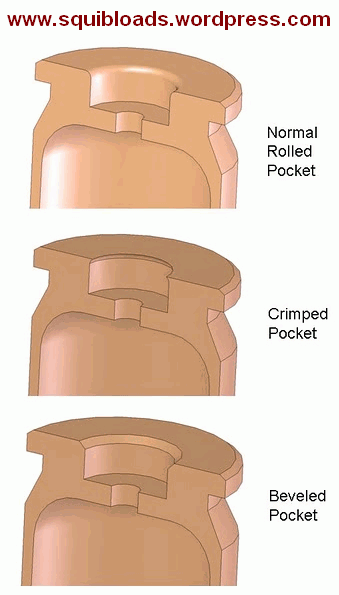
Once the brass is full-length sized and decapped, the staked-in ring of displaced metal from the primer crimp remains, and hinders re-priming. Some swaging tools exist to swage out this ring, allowing free access to the primer pocket. Some are stand-alone products, and some are reloading-press mounted. Early in this writer’s High Power career, he used the common press-mounted kit several times, with less than stellar results.
Setting Up Swaging Tools
Surplus brass tends to come from mixed lots, and primer crimp varies from very mild to strong. Also, primer pocket dimensions vary. So, setting up this “one size fits most” tool involves trying to find a happy medium for a selection of different types of brass in your particular lot. Some are over-swaged, some under-swaged, and some are “Just Right.” Overall, it was a time-consuming and sub-optimal process, in this writer’s experience.
Cutting Out the Crimp Ring with a Chamfer Tool
[After trying swaging tools] this writer evolved to using the ubiquitous Wilson/RCBS/Other brands chamfer and deburring tool to cut out only the displaced crimp ring at the top of the primer pocket. One caution: DON’T OVER-DO IT! Just a little practice will let the handloader develop a “feel” for the right degree of chamfer that permits easy re-priming without removing so much metal that primer edges start to flow under pressure. For this writer, it was three half-turns of the tool in the primer pocket, with medium pressure.
Here, as with all bulk reloading operations, mechanization is our friend. A popular reloading supply house has developed an inexpensive adaptor that houses the chamfer/deburr tool (retained by an allen screw) and allows mounting in a hand drill or drill press. This speeds the operation significantly, as does use of one of the popular Case Preparation Stations that feature multiple powered operations. (Say good-bye to carpal tunnel syndrome and arthritis!)
One advantage of chamfering the primer pockets lightly to remove remnants of primer crimp, vs. swaging, is that primer pockets are not loosened in this process. US GI (usually LC) NATO 5.56 brass has a great reputation for longevity due to the superior hardness of the case head vs. some softer brands of commercial brass. This means the brass will stand up well to multiple full-pressure loads without loosening primer pockets, and the chamfering method helps support this benefit.
Powered Case Prep Centers — What to Look For
A word of advice (often learned the hard way) — think carefully before jumping on the “latest/greatest” case prep center. One with a proven, long-time track record of durability and excellent customer support has a lot going for it, vs. the flashy “new kid on the block.” Analyze the functions each case prep center can support simultaneously — i.e., can it chamfer, deburr and clean primer pockets all at the same time, without having to re-configure?
Do the tool-heads that come with it look truly functional and durable? If not, can they be easily replaced with proven or more-needed versions, such as a VLD chamfer tool, or a solid/textured primer pocket cleaner rather than a less-durable wire-brush type?
Tips for Priming with Progressive Presses
When re-priming, a couple of factors are worth noting. When re-priming using either single-stage presses, hand tools, or bench-mounted tools (such as the RCBS bench-mounted priming tool), precise alignment of the primer pocket entrance with the primer is easily achieved, and priming goes very smoothly. When using certain progressive presses, due to the tolerances involved in shell-heads, etc., one may occasionally encounter a primer that isn’t quite perfectly aligned with the primer pocket.
If resistance is felt when attempting to re-prime, DO NOT attempt to force the primer in — doing so can be dangerous! Rather, just exert SLIGHT upward pressure to keep the primer in contact with the case-head, and with the support hand, move the case back/forth a trifle. The primer will drop into alignment with the primer pocket, and then prime as usual. After priming, check each seated primer by feel. Ensure it is below flush with the case head (cleaning primer pockets helps here), and that there are no snags, burrs or deformed primers.
More Info on Primer Pocket Swaging
For more information about removing military crimps in primer pockets, we recommend you read Get the Crimp Out on the Squibloads Gun Thoughts Blog. This is a detailed, well-illustrated article that shows how to use various primer pocket reamers/cutters. It also has a very extensive discussion of swaging using CH4D, RCBS, and Dillon tools. The Squibloads author had much better luck with swaging tools than did the USAMU’s writer — so if you are considering swaging, definitely read the Squibloads article.
The illustration of primer pocket types is from the Squibloads Blog Article, Get the Crimp Out.
At the request of our readers, we provide select “Deals of the Week”. Every Sunday afternoon or Monday morning we offer our Best Bargain selections. Here are some of the best deals on firearms, hardware, reloading components, optics, and shooting accessories. Be aware that sale prices are subject to change, and once clearance inventory is sold, it’s gone for good. You snooze you lose.
1. Creedmoor Sports — Lapua Brass in Stock
⏺ Superb cartridge brass — very uniform, long-lasting
Creedmoor Sports has received a large shipment of long-lasting, high-quality Lapua cartridge brass. Many of the most popular types are available including .220 Russian (for PPC), 22-250, .223 Rem, 6mmBR, 6mm Creedmoor, 6.5×47 Lapua, .260 Rem, 6.5-284, and .308 Winchester and more. Sorry, Creedmoor is sold out of the new .284 Win brass and the 6.5 PRC and 300 PRC. Creedmoor’s Lapua brass is selling fast, so stock up now while you can.
2. Bullet Central — BAT Bumblebee Aluminum and Steel Action
⏺ Ultimate lightweight action for precision hunters
Do you lust for a light-weight, ultra-accurate hunting rifle? Then consider the new BAT Bumblebee Action. Weighing just 23.8 oz (11.4 oz lighter than a BAT VR/TR), the Bumblebee features an aluminum body with Chrome-Moly steel internals. The weight is comparable to Titanium actions. BAT claims the Bumblebee is 31%-42% stiffer than light-weight steel actions and over 130% stiffer than round Titanium actions. The Bumblebee’s modular bolt allows low-cost bolt face changes for different cartridge types. The firing pin, bolt, and shroud are Melonited for smooth bolt movement and low maintenance. On top is a +20 MOA integral 20 MOA Picatinny rail. The Bumblebee is compatible with Rem 700-type bottom metal and magazines. This action is offered with a .308 Win Sized boltface or Magnum boltface for $1699.00.
3. Leupold — Get FREE Tripod with Spotting Scope
⏺ Order high-quality 80mm Leupold Spotter, get Pro Guide Tripod for FREE
Purchase any Leupold SX-5 Santiam HD Spotting Scope and receive a free Pro Guide Tripod Kit, a $399 value. This offer is valid for purchases made from May 3 through June 27, 2021. This 27-55x80mm spotting scope boasts outstanding sharp, HD glass with DiamondCoat2 lens coatings. Boasting great low-light performance, this spotter is also 100% waterproof and fogproof. The SX-5 Santiam HD is offered with either angled body or straight body for around $1799.00, including protective soft-case.
4. Brownells — KRG Bravo Chassis Rem 700, $329.99 with Code
⏺ Versatile internal frame stock for PRS or hunting — tan, black, or green
The Kinetic Research Group (KRG) Rem 700 Bravo Chassis is a good dual-purpose choice for PRS and hunting. This chassis features an internal aluminum frame with polymer exterior in Flat Dark Earth, Sako Green, or Black. The stock fits Rem 700 and Rem clone actions, accepts AICS-pattern mags, and is M-LOK compatible. The 2.9-lb KRG Bravo chassis features adjustable cheek riser and length-of-pull, built-in thumb shelf, plus quick-detach sling-swivel and bipod mounts. The KRG Bravo stock costs $349.99 at Brownells. You can also get $20 Off with Brownells code VSJ, lowering the net cost to $329.99.
5. Natchez — CCI 9mm FMJ Blazer Brass Handgun Ammunition
⏺ Quality 9mm pistol ammo — grab a 1000-ct case while you can
Good name-brand handgun ammunition is hard to find these days. But Natchez Shooters Supplies has scored a large quantity of CCI Blaser 115gr 9mm ammo. We’ve used CCI Blazer 9mm ammo and it proved accurate and reliable. NOTE: This ammo features conventional, reloadable brass cartridge cases (some other CCI ammo is non-reloadable). This ammo is shipped in a single large carton with 1000 rounds inside. Price is $549.00 for 1000, or $0.55 per round — a decent price these days.
6. Midsouth — Bulldog 54″ Long Range Rifle Case, $69.99
⏺ Good deal on excellent case for long rifles up to 52.5″
Highly rated by purchasers, the Bulldog Long Range Rifle Case fits rifles up to 52.5″ long. This premium 54″ soft case is on Sale Now for $69.99 at Midsouth, 18% off the regular $84.99 price. The Bulldog LR works great for long-barreled match rifles. This versatile case boasts a tough 600-dernier water-resistant outer shell, plus quilted inner lining with Velcro tie downs. There are two zippered center pockets plus an external zippered pocket at front. The main compartment zippers are lockable. Choose tan version as shown, or the 54″ Bulldog in black.
7. EuroOptic — Vortex Razor HD LH 1.5-8x32mm and 2-10x40mm
⏺ Very lightweight — 5X zoom range good for hunters
Here are two good optics for hunters. We like the Vortex Razor HD LH at $429.99, a bargain. With a 5.3X zoom ratio, you get a very wide field of view at 1.5X (Field of View is 72.2-13.2 ft @ 100 yards). Then, when you spot your prey, you can instantly zoom up to 8 power. This scope is compact (11″) and lightweight — just 13.2 ounces. If you want more magnification, choose the Razor HD LH 2-10x40mm for $449.99. (NOTE: This 2-10X scope is $599.00 on Amazon.) The 2-10X model has a bigger objective, and Field of View ranges from 56.2-10.8 ft @ 100 yards. Both of these fixed-parallax scopes have excellent HD glass with high light transmission.
8. Sportsman’s Warehouse — Henry AR-7 Rifle, $269.99
The Henry AR-7 Survival rifle is a unique rifle. Weighing just 3.5 pounds, this little semi-auto rimfire can perform pest-control duties for a farmer or rancher, or serve as a utility rifle carried in a truck or ATV. The cleverly-designed AR-7 is affordably priced, just $269.99 at Sportsman’s Warehouse. The Henry AR-7 breaks down for easy carry in a backpack or a vehicle. The barrel, receiver, and magazines all fit INSIDE the buttstock. That’s handy. And this little 3.5-pound rifle offers surprisingly good accuracy.
9. Amazon — Tipton Best Gun Vise, $84.99
⏺ Versatile, stable, works with all rifles, including ARs
When cleaning long guns, you need a secure, stable platform. We recommend the Tipton Best Gun Vise, now $84.99 on Amazon. This vise was designed to accommodate the widest possible array of firearms for cleaning, maintenance, or gunsmithing. This vise is easily configurable to handle bolt-action rifles, break-open shotguns, AR-15s, and handguns. You can also purchase the Best Gun Vise for $89.99 at Midsouth. NOTE: Midsouth also sells the Tipton basic gun vise for just $39.99. That is lighter and still works well.
9. Amazon — 12″ x 12″ Splatter Grid Targets, 10 for $10.99
⏺ Popular Grid Target — easy to estimate group size
This 12″x12″ Splatterburst Target combines splatter shot marking with a grid background, with five aiming points. The bright neon shot circles make it easy to see your shots. And the handy grid lets you quickly estimate your group size. Get a 10-pack for $10.99, or a 25-pack for $18.99 (better deal). This particular target has earned rave reviews — 87% of verified buyers gave this a FIVE-Star rating. One example: “Excellent quality and durability. The adhesive is really strong and the splatter contrast is [great].”
Here’s something all shooters need — a smartphone App that calculates bullet-hole group sizes from your own photos. The Ballistic-X App is simple to use. Take a photo of your target, set some values (such as bullet diameter and distance to target), then use the touchscreen to place circles around each hole. The App will calculate group size (in MOA or Mils), distance to point of aim, and provide all the info in an overlay. Then click “save” to record your group for posterity!
This App works well, is relatively easy to set-up, and costs just $7.99. It is available for both Android devices and iOS (Apple) devices. There are other ways to measure group sizes from target images, such as the excellent On-Target program, which we have used for years. However On-Target requires a software installation on a Windows platform desktop or laptop. Ballistic-X is a simple, easy-to-install App with versions for both Android and iOS (Apple) Mobile devices.
The Ballistic-X App has a relatively easy-to-use interface. Of course you can choose either MOA or Milrad group values, and Inch or Metric dimensions. There are various labeling options that provide useful info for Load Development. There is even an ATZ (Adjustment To Zero) feature for adjusting your turrets.
How to Use Ballistic-X App
1. Select Photo Source — Choose Camera to take new photo or get image from Photo Library.
2. Set Reference Values — Select Bullet Diameter and enter Distance to Target.
3. Establish Scale on Image — Mark two points on target photo to set scale. For example, if the target has a 1″-square grid lines, mark two points on grid for 1″ distance.
4. Mark Point Of Aim — Put the central X on the aim point.
5. Designate Shot Locations — Place the green circles around each shot.
6. Finalize Data Display — Position Overlay, select size/color options, and export file.
Android Options — Range Buddy FREE App
Along with Ballistic-X, there is another Mobile App, Range Buddy, that also measures shot groups. Range Buddy is currently offered for Android devices only. It is FREE, but has adverts. Range Buddy isn’t bad, but users complained about the program crashing, and there are compatibility issues with newer phones. We recommend you pay $7.99 and stick with Ballistic-X.
The 6mm Dasher wildcat cartridge is very popular among competitive benchrest shooters, varminters, and even PRS competitors. So this Sunday we thought we’d showcase a matched Duo of Dasher rifles belonging to a Forum member Chuck L. (aka “Ridgeway”). The 6mm Dasher began as a wildcat improved version of the 6mmBR Norma cartridge. The Dasher has been very successful in competition, and now factory Peterson 6mm Dasher brass is sold by Grafs.com. And Alpha Munitions also offers high-quality 6mm Dasher cartridge brass.
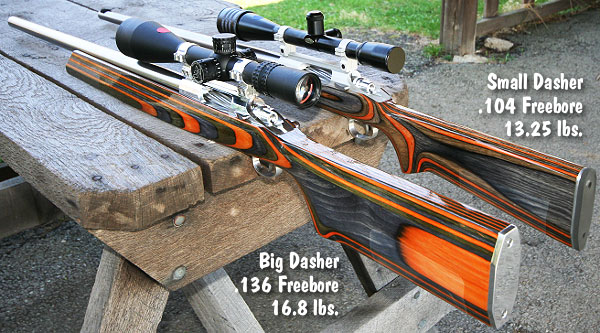
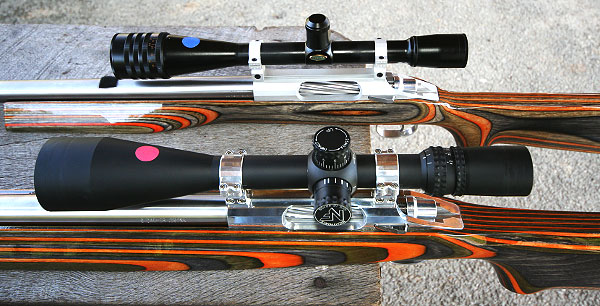
Chuck has a prize pair of 6mm Dashers for competitive benchrest and varmint matches in Pennsylvania. Both guns feature Kelbly Panda RBLP actions, Bartlein 8-twist barrels, and Shehane Laminated Tracker Stocks. However, the two rifles are not exact twins, as you can see. One, which we’ll call the Big Dasher, is built on a Shehane ST1000 Tracker stock. The other gun, the Small Dasher, sports Shehane’s “Baby Tracker” stock — a design used with great success by Richard Schatz. The Big Dasher, optimized for 1000-yard competition, has a slightly longer freebore — 0.136″ vs. 0.104″ for the Small Dasher.
Specifications for the Dasher Duo:
Small Dasher (13.5-pounder): Chambered for 6mm Dasher with approximately .104 freebore and a .264 NK. (No way of knowing exactly since its freebore was set in a separate operation by Kelbly.) Components are: Shehane Baby Tracker laminated stock, Kelbly Panda RPLB action, Bartlein 1:8″ LV barrel at 26 ¾”, Kelbly Rings, Weaver T36, Jewell trigger. The barrel was chambered by Kelblys and the stock was bedded, glued and balanced by a shooting buddy (Forum Member johara1). Chuck clear-coated the stock with auto urethane. Total weight is 13 lbs., 4 ounces.
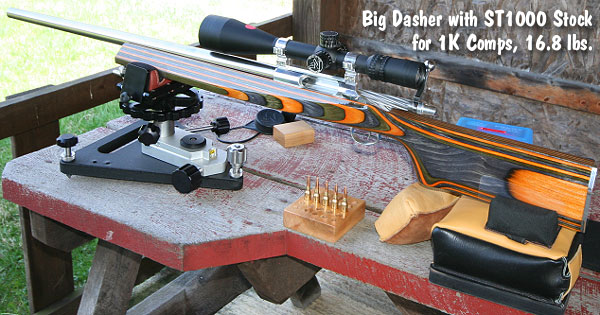
Big Dasher (1K Light Gun, 17-pounder): Chambered for 6mm Dasher with a .136 freebore and .264 neck (PTG Reamer). Components are: Shehane ST-1000 laminated stock, Kelbly Panda RPLB action, Bartlein 1:8″ HV 5R barrel at 28″, Shehane +20-MOA rings, Nightforce NXS 12-42x56mm, Jewell trigger. The barrel work, pillar installation, and bedding was done by Dave Bruno. The stock was clear-coated by Chuck with auto urethane. Chuck also made the rear butt plate and balanced the rifle. Total weight: 16 lbs., 13 ounces.
Chuck tells us: “I don’t get out shooting competition as much as I want due to time and family, but when I do compete, I shoot a Groundhog match at Southfork Rifle Club in Beaverdale, PA. Info on Southfork Club events can be found at Southforkrifleclub.com. The Southfork match is basically a 100-, 300- and 500-yard match with one sighter the entire match and 5 shots at each yardage for score. The Small Dasher, with the shorter ‘Baby Tracker’ stock, was set up for the Southfork Rifle Club’s ‘Light Unlimited’ class which has a 13.5-lb max weight.” (Editor: ‘unlimited’ is a misnomer for a weight-limited category.)
Chuck adds: “The Big Dasher with the heavy ST-1000 stock is set up for 1000-yard benchrest matches in Light Gun class. I shoot 1K matches with it at Reade Range in southwest Pennsylvania. One ironic thing is, it shoots the same load I’m shooting out of the lighter gun rather well. The only difference between the two chambers is the freebore is roughly thirty thousandths longer on the 1K gun (Large Dasher). I will also shoot this at Southfork in the ‘Heavy Unlimited’ class.”
Both Dashers Group in the Ones at 100 Yards
Chuck favors 107gr Sierra MK bullets in both Dashers. Other components are: Reloder 15 powder, Lapua cases, and CCI 450 primers. His main load for the Small Dasher is 33.0 grains of Reloder 15. This load shoots in the ones at 100 yards. For the Big Dasher Chuck reported: “I’m still working on a load, although the same 33.0 grain load shoots in the ones in the heavier gun as well. I’m still looking for more velocity and my ‘max’ node.”
Dasher Brass — Three Options
1. Buy Peterson 6mm Dasher Brass
In years past, you had to create your own Dasher brass, by fire-forming (with or without projectiles), or by hydro-forming. However, Peterson Cartridge now offers factory-made 6mm Dasher brass.
If you do not want to waste time with fire-forming or hydro-forming, you can look for Peterson 6mm Dasher brass. This is excellent quality brass that has earned high praise from purchasers. The price — $62.99 for 50 cases at Graf’s (i.e. $1.26 per case) — is less than what you’d pay for Lapua 6mmBR brass, which is $149.99 for 100 cases or $1.50 per case. The advantage is that you save time, barrel life, and you won’t lose any cases to split necks. Peterson brass can be ordered from Grafs.com.
2. Fire-Form Dasher Brass with Bullets Hard in Lands
Chuck fireforms his Dasher brass for both rifles. Because he has a tighter-neck chamber, he neck-turns the brass first: “To fireform, I turn my cases down to fit the chamber and stop where the false shoulder makes snug contact with the chamber. Fire-forming rounds are loaded up with a 29-grain charge of H4895 or Varget and a 108gr Berger bullet seated hard into the lands about 0.020″ past initial contact with the rifling. It takes about three firings to make a nice clean Dasher case with a sharp shoulder.”
Chuck anneals his Dasher brass regularly to help maintain consistency: “I anneal about every 3-4 firings. I have many cases that have about 10+ firings on them and they are still shooting well. The primer pockets are a little looser, but still hold a primer.”
3. Have Darrell Jones Hydro-Form Your 6BR Brass to 6mm Dasher
DJ’s Brass can hydro-form a wide variety of cases for a modest fee
Fire-forming all your own 6mm Dasher brass takes time, costs money (in bullets and powder), and consumes precious barrel life. Well there IS a better solution — you can have your new brass hydro-formed by DJ’s Brass to your exact specifications for a $60.00 per hundred, which includes annealing.
DJ’s Brass Service now offers custom case hydro-forming to your exact specs. Darrell Jones offers this service for a variety of popular cartridges: 6 PPC, 30 PPC, 30 BR, 6 BRA (BR Ackley), 6mm Grinch, 6 BRDX, 6 BRX, .260 Ackley, .284 Shehane and of course the very popular 6mm Dasher. After hydro-forming your brass, Darrell can also neck-up or neck-down the cases to meet your needs. He can also turn the necks to your specs for an additional $0.60 per case.
Above is a sectioned barrel showing an 80gr Sierra that was fired in a .223 bolt action with a cleaning rod in the bore. Both the bullet and the rod are still in the bore.
A Negligent Shooter Gets Lucky
“Here we have a story so filled with negligent acts that I can only marvel that the shooter survived the experience. The photo and narrative were provided by the gunsmith who took in the repair job, my comments are in italics. It’s worth reading, we can’t get enough safety warnings in our hobby.” — GS Arizona, Rifleman’s Journal
Description of Incident (with Commentary)
The shooter had a stuck case in his .223 chamber. The stuck case was actually a loaded round that didn’t fire. It wouldn’t extract because it was a .222 case that got mixed in with his .223 brass. [He had loaded the wrong brass.] I saw the loaded round with an 80gr bullet in it and a light primer strike. Negligent Act #1: Wrong brass was mixed in with the brass being reloaded.
The shooter removed the stuck case with a 3-piece aluminum rod. Negligent Act #2: Hammering out a loaded round with a cleaning rod. People have been killed doing this as the round can fire and drive the cleaning rod right into you. I remember one such incident about 5 years ago, the shooter was pounding out a stuck round, the cleaning rod went right through him, he didn’t survive.
The shooter didn’t notice only two segments of the cleaning rod came out when he removed it. Negligent Act #3: If you put anything at all down the barrel of a rifle you’d better make darn sure you got it all out before doing anything else!
He then chambered another round and fired it. Negligent act #4: If you’ve had a barrel obstruction of any kind, and if you’ve put something in the barrel, look through the barrel before proceeding! Within the past two years I know of an incident in which a benchrest shooter was killed in exactly this manner. The pressure built up and the rifle bolt came out of the receiver and into his chest.
The shooter is ‘OK’, but did not escape unscathed. He said there was a huge explosion and after regaining his senses found he was bleeding heavily from his forehead. The blood was thick enough that it ran in his eyes and he couldn’t see. In his words “I thought I was going to die”.
He has what looks like a pretty deep cut about an inch long on the side of his head, right in line with his right eye starting where the eye socket turns out to the side of the skull. And no telling what he’s got in the way of brass particles embedded in his forehead.
He was shooting on private property, and was alone when this happened. Negligent Act #5: Don’t shoot alone! Accidents happen, this is just one more example. If we could predict accidents, we wouldn’t have them. Always shoot with at least one other person.
He managed to get the bleeding stopped, or at least under control, packed his car and drove himself home without seeking immediate medical attention. Negligent Act #6: This one could have cost him his life after being lucky enough to survive the incident. There’s no way to know what’s happened just after an incident like this. He should have been at a hospital getting checked for shrapnel in the head.
The rod and slug could not be driven out. Since the barrel had a high round count there was no point in trying to salvage it. Note that the aluminum rod is expanded to a tight fit in the bore for the first couple inches. The base of the bullet is a little over 2″ from the mouth of the chamber.
What we’ve seen here is negligence and an absolute indifference to the established rules of safe reloading and gun handling, from start to finish, capped off with the shooter’s foolish avoidance of medical treatment. This shooter is lucky to be alive, but he’s surely used up all his luck. Don’t assume you’ll be so fortunate.
This article originally appeared in the Rifleman’s Journal website, which is no longer available.
The Firearms Guide is a comprehensive guns and ammo reference guide, available online or on a flash drive. Published since 2009, this Guide offers gun prices, gun schematics, blueprints, and manuals. Guns are cross-referenced with the ammunition database. Guns and ammo are presented with prices, tech specifications, features, ballistic information and high-resolution color pictures. The Firearms Guide also includes a wide selection of printable targets.
The 12th Edition of the Firearms Guide has just been released. If you’d like to have instant access to 15,000+ gun schematics and descriptions of 80,000 types of guns and ammo from 1,500 manufacturers, then check this out. The basic annual subscription is on sale right now for just $49.94. A six-month subscription is $29.94. Or for just $8.80 per month you can get a recurring monthly membership which can be cancelled at any time.
You can also get a Flash Drive add-on that lets you access the database even without a web connection. The 1-year Online Edition PLUS Firearms Guide 12th Ed. Flash Drive for Windows is $99.90. CLICK HERE. This lets you directly access the data from laptops and tablets with a USB port — no WiFi needed.
Database Includes Printable Targets: This resource even includes printable targets. You’ll find practice targets, sight-in targets, silhouette targets, special shapes and, yes, even Zombie targets.
The 12th Edition Firearms Guide is a fully interactive, subscription-based online database of firearms and ammo. The database also includes global gun values. The amount of imagery is amazing — there are tens of thousands of photos and over 18,500 schematics, which help you identify key components/parts.
Guns and ammo are presented with prices, specifications, features, ballistics, and up to 12 high-rez color pictures. NOTE: The Ammo information includes bullet BCs and velocities. GUN VALUES are provided for dealers and gun collectors. You can access 18,500+ printable and zoom-able GUN SCHEMATICS (diagrams or exploded views) with parts lists and blueprints for professional gunsmiths. The Firearms Guide permits detailed searches of antique and modern guns and side by side comparisons. Guns are cross-referenced with the ammunition database.
Firearms Guide Sample Schematic
The online database’s comprehensive search capability lets you search by gun caliber, manufacturer, and key features (e.g. “.223 Rem, Colt, folding stock”). There are 14 different search criteria — allowing you to find the exact gun you want in seconds. Shown below are typical profiles of listed products:
If you are a gun collector, or just an information junkie, you’ll find the Firearms Guide to be an invaluable resource. The scope is truly worldwide, with coverage of gun makers in Western Europe, Eastern Europe, South America, South Africa, and Asia as well as North America.
Whidden Gunworks makes great sizing and seating dies. The Whidden full-length sizing die with neck bushing is very popular because it allows you to “tune” the neck tension by using different bushings, with larger or smaller inside diameters. In this video, John Whidden explains how to choose a the right bushing size for use with your neck-sizing and full-length sizing bushing dies.
For most applications, John suggest starting with the caliper-measured outside diameter of a loaded cartridge (with your choice of bullet), and then SUBTRACT about three thousandths. For example, if your loaded round mics at .333, then you would want to start with a 0.330 neck bushing. John notes, however, that you may want to experiment with bushings, going down a thousandth and up a thousandth. With thin In addition, as your brass ages and the necks harden, you may want to change your bushing size.
Quick Tip: Try Flipping Your Bushings
You may also want to experiment with “flipping” your neck bushings to alternate the side that first contacts the neck of the case. (One side of the bushing is usually marked with the size, while the other side is unmarked.) So try “number side up” as well as “number side down”.
Some folks believe that one side of the bushing may allow a smoother entry, and that this can enhance concentricity. Other people think they can get very slightly more or less neck tension depending on how the bushing is oriented. This is a subtle effect, but it costs nothing to experiment.
If one bushing orientation proves better you can mark the “up” side with nail polish so that you can always orient the bushing optimally. NOTE: We have confirmed that some bushings are actually made with a slight taper. In addition, bushings may get distorted slightly when the brand name and size is stamped. Therefore there IS a reason to try both orientations.


 Bullet Selection — With the .30-06 for my Garands and Springfields I stick mostly with 168gr bullets plus some 155-grainers. These bullet weights have just worked for me in the past.
  Power Charge and Dispensing — I have always had good success with Hodgdon H4895 powder. My load has always been right around 47.0 grains, with both the 168gr and 155gr bullets. I also use the Auto-Trickler to drop all of my powder charges. This is a fantastic piece of equipment that not only gives super-consistent powder charges quickly, but it also makes one less thing that you have to worry about while on the firing line. With the Auto-Trickler, there is never a question about the powder charge in your ammo. As for primers, I have been shooting CCI 200 Large Rifle primers for many years and have never had an issue.

 Brian: I have learned that practice makes me better, but just sending rounds down range is not that beneficial to me. Some of the biggest improvements I have made have come from practice sessions where I did not fire very many rounds. Working through the shot process, being honest with myself, and evaluating what needs to happen to get the desired outcome.




 Tips for Priming with Progressive Presses




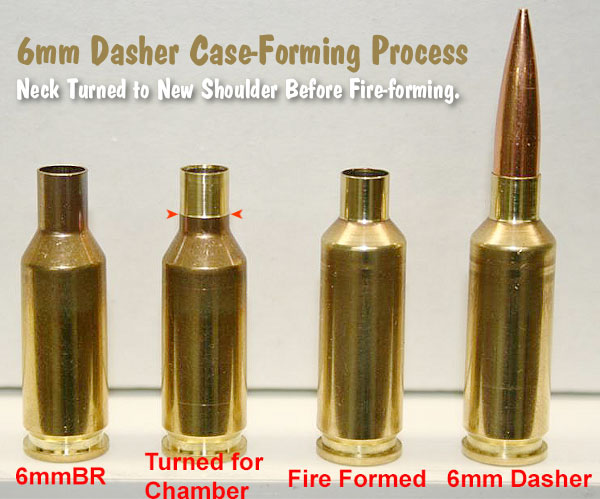

 Fire-forming all your own 6mm Dasher brass takes time, costs money (in bullets and powder), and consumes precious barrel life. Well there IS a better solution — you can have your new brass hydro-formed by DJ’s Brass to your exact specifications for a $60.00 per hundred, which includes annealing.


 Quick Tip: Try Flipping Your Bushings


