In years past, the U.S. Army Marksmanship Unit published weekly reloading “how-to” article on the USAMU Facebook page. Here is a very informative USAMU article the subject of case lubrication. Tasked with producing thousands of rounds of ammo for team members, the USAMU’s reloading staff has developed very efficient procedures for lubricating large quantities of cases. This article reveals the USAMU’s clever “big-batch” lube methods. For other helpful hand-loading tips, visit the USAMU Facebook page on upcoming Wednesdays.
Rapid, High-Volume Case Lubrication
Today’s topic covers methods for quickly applying spray lube to cartridge cases prior to sizing. A typical order for this shop may be 25,000 rounds, so [speeding up] the lubrication process can be a real time-saver. While your ammunition lots probably aren’t this large, the efficient methods discussed here may help save a considerable amount of time over your handloading career. Our case lubrication rates range from 1500-1600 cases per hour, to 2400-2500 cases per hour, depending on caliber.
This shop uses virgin brass, whereas most home handloaders use fired brass, which necessitates some small changes at times. These will be discussed as they arise. Begin with fired brass that has been tumbled clean.
Ensure as much tumbling media as possible is removed from the brass, as when it gets into a size die, it can dent cases significantly. This is a good time to round out dents in the case mouths using a tapered tool to prevent damage from the decapping stem.
First, dump the clean cases into a large box or reloading bin. Shake the bin back and forth so that many cases are oriented with the mouths up. Next, pick up as many cases as is convenient with the mouths “up”, from natural clusters of correctly-oriented cases. With 7.62mm-size cases, this is usually 3-4, and with 5.56mm cases, this can be up to 8-10. Place the cases into the rack slots, mouth-up. Doing this in groups rather than singly saves considerable time. Once these clusters have been depleted, it will be time to re-shake the bin to orient more cases “up.”.
This photo shows a case lubrication rack made by a USAMU staffer.
Naturally, adjust the spacing to best fit the calibers you reload. We have found this size … convenient for handling through the various phases of case lubrication/transfer to progressive case feeders for processing. Note that the 1/2-inch angle does not cover much of the critical case area at the base, just forward of the extractor groove, where most re-sizing force will be exerted. As the USAMU uses virgin brass, less lubrication is required for our brass than would be needed for Full Length (FL) sizing of previously-fired brass.
NOTE: The amount applied using our rack is easily enough for our purpose. If using fired brass, be sure to adequately lube this base area to avoid having cases stick in the full-length sizing die.
Using a spray lube, coat the cases adequately, but not excessively, from all sides. Be sure to get some lube into the case mouths/necks, in order to reduce expander ball drag and case stretching/headspace changes. The spray lube this shop uses does not harm primers or powder, and does not require tumbling to remove after lubing.*
Take a close look at the photo above. The USAMU shop uses a common kitchen turntable, which allows the rack to be rotated easily. We place this in a custom-made box which prevents over-spray on to floors and walls.
Angled Box Method for Smaller Cases to be Neck-Sized
A refinement of the above method which especially speeds processing of 5.56x45mm cases is as follows. A small cardboard box which holds about 100 cases is fitted with an angled “floor” secured by tape. With the smaller 5.56mm cases, usually about 8-10 cases per handful can be picked up, already correctly-oriented, and placed into the box together. This prevents having to place them into the rack slots, saving time.
HOWEVER, note that this does not allow nearly as much lube access to the case bodies as does the rack. For our purposes — neck-sizing and setting neck tension on new brass, this works well. If using this procedure with fired brass, take steps to ensure adequate lube to prevent stuck cases.
As always, we hope this will help our fellow handloaders. Good luck, and good shooting!
*A two-part test performed here involved spraying primed cases heavily, while getting more lube into the case mouth/body than even a careless handloader would likely apply. The second part of the test involved literally spraying considerable quantities of the lube directly into the cases, drenching the primers. After a several-day wait to allow the lube to penetrate the primers, they were then fired in a test barrel. All fired normally; no unusual reports were noted. This bolstered confidence that normal amounts of the lube would not adversely affect our ammunition, and we have been pleased with the results over several years.
Over time the 1911 design has evolved into many variants, including the modern “race gun” used in rapid-fire pistol competitions. Show above is an STI DVC Open model fitted with a C-More sight, and front compensator. It is chambered for the .38 Super.
This article has good tips on pistol marksmanship (grip and trigger control). In addition we offer resources on how to upgrade and accessorize 1911-type handguns.
How to Grip a 1911 Handgun Properly
World Champion pistol ace (and 18-time Bianchi Cup winner) Doug Koenig demonstrates how to grip a handgun. While the fundamentals are demonstrated on a 1911 pistol they are effective for establishing a proper grip on any handgun.
Trigger Press and Trigger Control
In this video Champion shooter Doug Koenig talks about key techniques that apply to all pistol marksmanship — not just speed shooting “on the clock”. With any handgun, Doug explains, you should focus on consistent trigger control. You want to avoid yanking the trigger or anticipating recoil.
How to Accessorize Your 1911
The Brownells YouTube Channel has a series of videos showing how to accessorize a 1911. The videos show procedures for upgrading the magazine release, slide release, hammer, guide rod, mainspring housing, and grips. There are also good videos on barrel replacement and drop-in trigger group installation. If you want to upgrade your 1911, these videos are worth watching. Below are links to three of these 1911 videos.
At the request of our readers, we provide select “Deals of the Week”. Every Sunday afternoon or Monday morning we offer our Best Bargain selections. Here are some of the best deals on firearms, hardware, reloading components, optics, and shooting accessories. Be aware that sale prices are subject to change, and once clearance inventory is sold, it’s gone for good. You snooze you lose.
NOTE: All listed products are for sale to persons 18 years of age or older. No products are intended for use by minors.
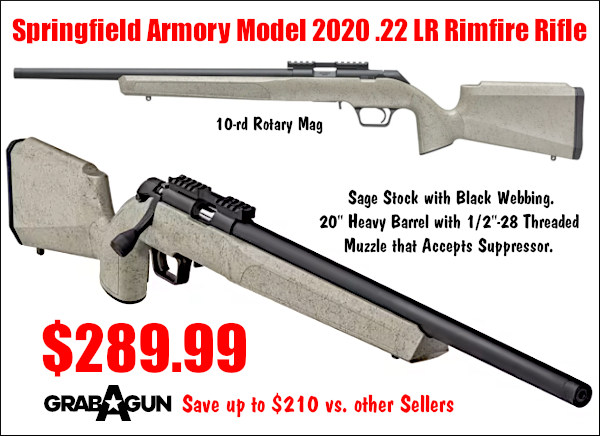
1. GrabAGun — Springfield Model 2020 .22 LR Rifle, $289.99
⏺️ » Great price on a versatile bolt-action rimfire rifle
Want an inexpensive rimfire rifle for plinking, steel matches, or NRL22 competition? Consider the Springfield Model 2020 .22LR Target rifle, now just $289.99 at GrabAGun. This rifle sells for up to $499.99 elsewhere, so you can save $210 with this deal. This rifle has a sage color stock with black webbing. This model features a 20″, heavy profile, straight taper barrel with a 1/2″ x 28 threaded muzzle. It is chambered in .22 LR and comes with a 10-round rotary magazine. The rifle is designed for accuracy, with a free-floated barrel and a Rem 700-style adjustable trigger. It has a 1″ at 50 yards accuracy guarantee.
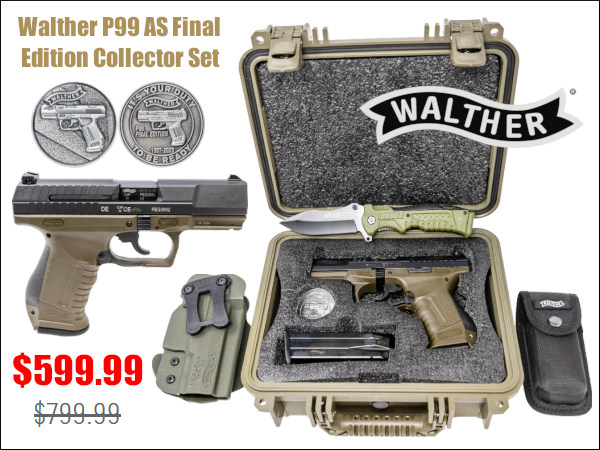
2. Palmetto SA — Walther P99 AS Pistol Collector Set, $599.99
⏺️ » Save $200 on collecter set with pistol, holster, and knife
If you need a great 9mm pistol, consider this deluxe combo kit that includes holster, knife, magazines, and carry case. This special edition P99 pistol has a polymer two-tone ODG frame and black metal slide. The kit comes with a custom case and includes (2) 15-round magazines, a P99 Final Edition knife, holster, and a commemorative collectors’ coin. This collectors kit has 100% 5-star reviews by two dozen buyers.
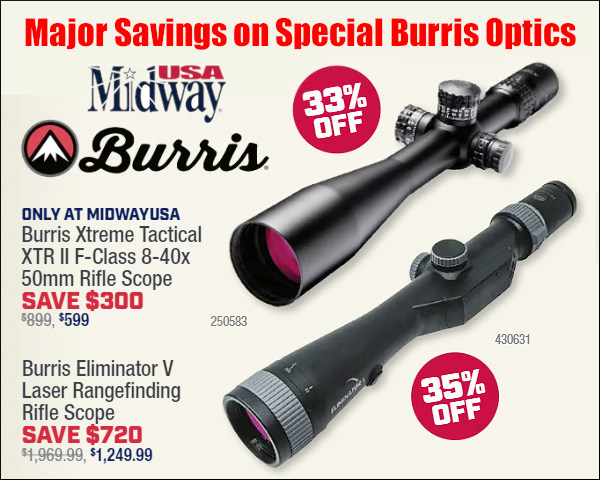
3. MidwayUSA — $300 OFF Burris XTRII F-Class or $720 Off Burris Rangefinder Scope
⏺️ » Major discounts on high-end Burris optics, save 33-35%
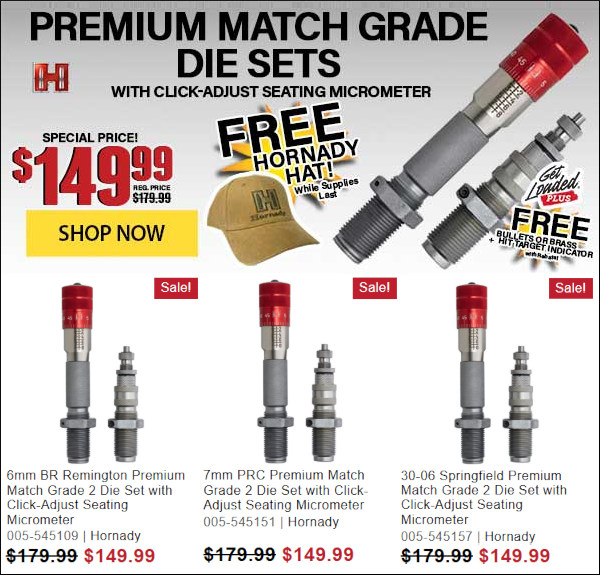
⏺️ » Save $30 on good seater & sizing die set and get 100 free bullets
With this die set you get: 1) A full-length Sizing Die that takes neck bushings; 2) a precise Click-Adjustable Seating Die. These two-die sets are now just $149.99 at Midsouth ($30 off). Available chamberings include: .223 Rem, 22 ARC, 6mmBR, 6mm ARC, 6mm Creedmoor, 25 Creedmoor, 6.5×47 Lapua, 6.5 Creedmoor, .260 Rem, 6.5 PRC, .280 Ackley, 7mm Rem SAUM, 7mm Rem Mag, 7mm PRC, .308 Win, .30-06 Sprg, .300 WSM, .300 Win Mag, 300 PRC, 300 Norma Mag, .338 Lapua Mag. You get a free hat with a die set, and this purchase qualifies for Hornady Get Loaded Plus 100 free bullets or 50 free brass cases.
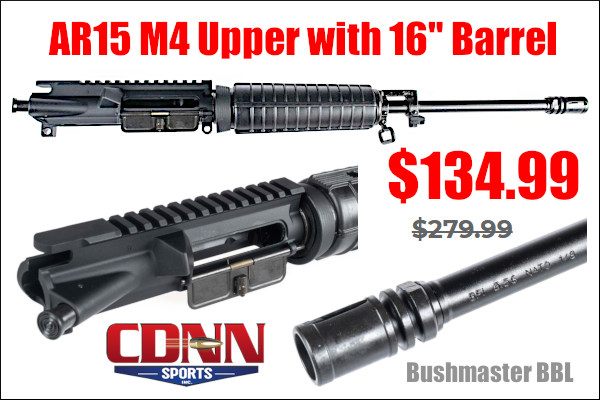
⏺️ » Incredibly low price for complete Upper with 16″ barrel
If you already have an AR15 for Service Rifle competition or varmint hunting, but want a lightweight, compact variant of your rifle for home defense, here is a great option. You can get a complete 16″-barrel upper for less than the price of a chambered barrel alone. This upper has a Picatinny rail on top, so you can easily fit a Red Dot optic for rapid target acquisition day or night. This AR15 Upper with 16″ Bushmaster barrel (M4 with A2 flash-hider) is now just $134.99 at CDNN Sports. That is an absolute STEAL!
6. MidwayUSA — Electronic Muffs with Walkie-Talkie, $59.99
⏺️ Dual-function electronic muffs — great for range communications
Electronic earmuffs protect your hearing while allowing you to hear range commands. With these Walkie-Talkie muffs you also get 2-way communication capabilities. The Walker Razor Slim Low Profile Electronic Earmuffs (NRR 23dB) with Walkie Talkie allows you to communicate with other radios. Range is 2-3 miles with 22 channels. These are now just $59.99 (40% Off). If you don’t need the two-way functionality, you can get Walker’s NRR 23 Razor Slim Electronic Muffs for $39.99 (#ad) — 50% off the list price.
7. Amazon — 52″ Double Rifle Case, $39.99
⏺️ » Good price for versatile case that can hold long-barrel rifles
Here’s a very affordable rifle case that can hold long competition rifles. The Huntsen 52″ Double Rifle Case features a removable divider that enables the carrying of one or two rifles up to 50″ OAL. This case includes a large zipper pocket, 3 magazine pouches, plus MOLLE straps for other accessories. For the same $39.99 sale price, this 52″ case is offered in black (#ad), green (#ad), or tan digital camo (#ad) colors.
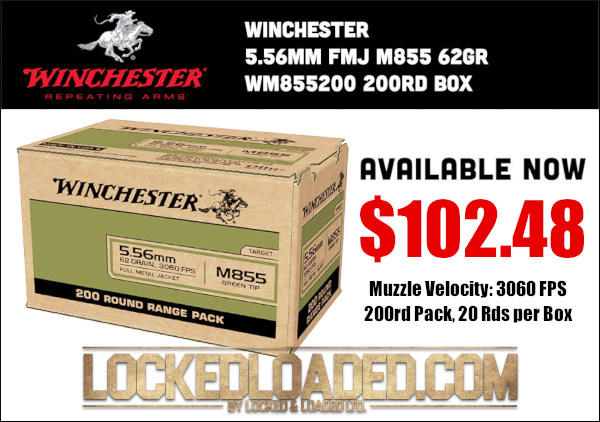
⏺️ » Amazing 200rd M855 case price — just 51 cents per round
Here’s a great deal on 5.56 NATO (.223 Rem) M855 ammo. Get 200 rounds for just $102.48 at Lockedloaded.com. These M855 cartridges feature a 62gr tipped bullet. Velocity is 3060 FPS. This ammo works well for defensive use, varminting, and target use. The Winchester brass can be reloaded after being fired, but you will have to ream the primer pockets to remove the military crimp.
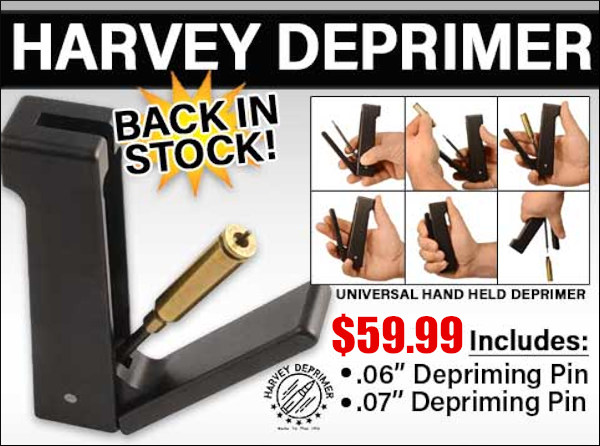
9. Midsouth — Harvey Hand Held Depriming Tool, $59.99
⏺️ » Good tool is effective, handy, and convenient
Here’s a handy, portable depriming tool. The Harvey Hand Held Deprimer ($59.99 at Midsouth) smoothly deprimes and then captures the ejected primer. No attachments, accessories, or shell holders are needed to catch spent primers. This compact tool allows you to conveniently deprime cases while watching TV. The tool can fit in a small drawer and is easy to transport. This tool is also $59.99 at MidwayUSA.
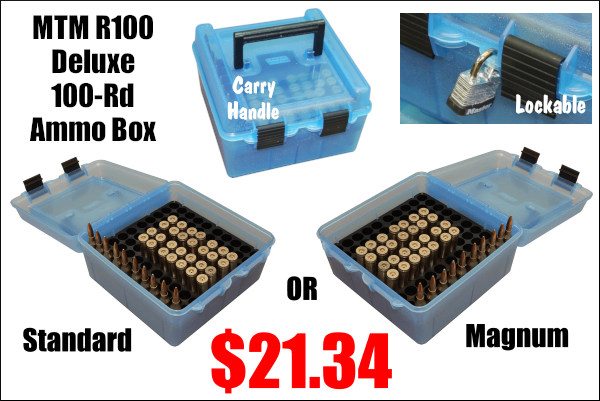
10. Amazon — MTM Large 100rd Ammo Box with Carry Handle
⏺️ » Secure, lockable 100rd ammo carrier with handle
Do you wish you could keep all 100 rounds of brass together in one box? We recommend the MTM R-100 series ammo case (#ad). Chose the version for standard size ammo or a model for magnum size cases. This is offered in rugged polypropylene in semi-translucent blue, or medium green. These stackable cases boast a large, strong handle plus a flange for locking. This is a great choice for shooting matches with multiple relays, or extended varmint adventures. Amazon price is $21.34 with FREE Shipping for orders over $35.00. NOTE: MidwayUSA also recently put R-100 cases on sale: $19.99 for transparent blue case, and $17.99 for opaque green case.
Hornady has just revealed its new products for 2026. Along with new ammo types and new bullet varieties, there is a new press, an interesting priming tool, and a variety of lock boxes and security cabinets. The video below covers the highlights.
Hornady’s New Products for 2026
Hornady announced its 2026 product lineup on October 15, 2025, revealing new ammunition, bullets, reloading tools, and storage hardware. The new ammo and bullets should offer enhanced performance for hunting and precision shooting. Below is a list of key new offerings, with descriptions based on official announcements. Products will be available through stocking dealers and retailers starting in early 2026.
New Hornady Bullet Types
Hornady will be offering a variety of new bullets this coming year. This will include pistol projectiles, hunting bullets, varmint bullets, and target bullets. Watch the video below to see the notable new-for-2026 Hornady bullet types.
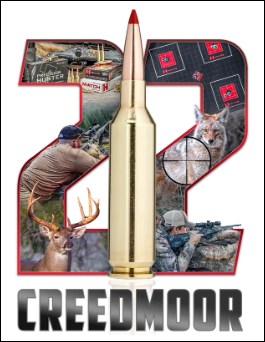
22 Creedmoor Ammunition
The most notable new cartridge for 2026 is the 22 Creedmoor. This could be a good long-range varmint round. Engineered as a high-speed .22 caliber cartridge, this new round delivers very flat trajectories, minimal wind deflection, and great hitting power on small and medium game or predators. Hornady sees the 22 Creedmoor as the “new predator hunting king,” compatible with modern rifles for varmint and hunting applications.
While this will doubtless be a good new cartridge, for small varmints we would still prefer a 22 BR or a 20 Practical, the latter simply being the .223 Rem necked down to .20 caliber. But for very long-range Groundhog hunts or varmint matches this could become popular. There’s also a possiblity of adoption by some target shooters, although Hornady brass has never really been as long-lasting and consistent as Lapua and other premium brands.
Versa-Prime™ Bench Priming Tool
Hornady will offer a new benchtop tool machined from 6061 billet aluminum with hardened steel internals. With a primer feed tube, this allows users to prime multiple cases efficiently. The handle can be switched to right or left side to fit user preference. Consistency is assured by the unit’s strength and tight tolerances. Hornady says its new priming tool “offers smooth, precise operation to streamline workflows and ensure consistent results in high-volume sessions.”
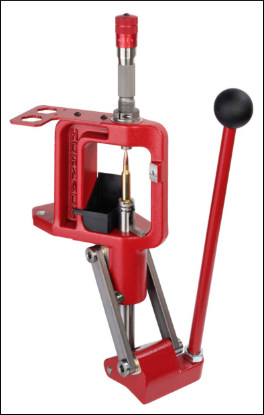
Lock‑N‑Load Classic Pro Press
Built on the solid foundation of the trusted Classic Press, the new Classic Pro features precision‑machined surfaces, linkage pins, brass bushings, and primer cups for tighter tolerances that provide a smoother feel and consistent results. This employs the Hornady Lock‑N‑Load® die bushing system for fast, easy die swaps and repeatable, consistent accuracy. The press has a cast aluminum frame and toggle with precision machined surfaces for exceptionally tight tolerances and repeatable accuracy. Smooth Operation — brass bushings and polished steel components provide a smooth, consistent press stroke.
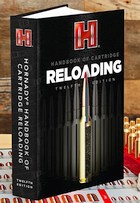
Hornady Handbook of Cartridge Reloading (12th Edition, 2026)
Hornady’s updated Reloading Handbook includes data for over 400 cartridges and 24+ calibers. The new manual introduces load data for new bullets: CX, ELD-VT (varmint), and Sub-X (subsonic), plus expanded info on ELD Match and SST. Updated propellants include Winchester’s StaBall Match.
Find More Info on the Hornady New Products Website
For the complete new product list and high-resolution images, visit Hornady’s 2026 New Products Page. The Podcast below covers many of the new products as well as new ammo and bullet types.
Hornady New Product Overview sourced from ELR Researcher.
One side of this gauge is the “go” side which quickly tells you the depth of a primer pocket, whether any crimp is properly removed, and whether the primer pocket is loose. If it feels loose on the “go” side, use the other end of the tool, the “no go” side, to test to see if the primer pocket is too loose to hold a primer. If the no-go slides into the pocket, then you know to junk that brass.
Primer Pocket Growth and Useful Case Life
Repeated firings at stout pressures can cause primer pockets to grow in diameter. This can create an unsafe condition if your primers are not seating properly. Are your primer pockets “good to go”, or have they been pushed to the point of no return? Do you really know? Many guys try to gauge primer pocket tightness by “feel”, as they seat the primer. But that method isn’t precise. Now there’s a better way…
The folks at Ballistictools.com have created a handy set of precision-machined gauges that let you quickly and accurately check your primer pockets. These gauges (aka “gages”) are offered in two sizes — for large and small primer pockets. A two-piece set of both large and small gauges costs just $25.99. These gauges let you quickly measure the depth of a primer pocket, and check if the crimp has been removed properly. Most importantly, the gauge tells you if the primer pocket has opened up too much. One side of the gauge has an enlarged diameter plug. If that “No-Go” side fits in the primer pocket, you should ditch the case — it’s toast.
Precision ground from O-1 tool steel, The Ballistic Tools primer pocket gauges serve multiple functions. The inventor of these tools explains: “I created the prototype of this tool for my own use in brass processing. I needed a way to quickly and easily measure primer pockets that was reliable and did not require wasting a primer. This tool has been indispensable for me and I would never go back to the old method of uncertainty and guessing.”
Product tip from Boyd Allen. We welcome reader submissions.
The 6.5 Creedmoor cartridge has become extremely popular in the last few years. It is a popular cartridge among PRS and tactical competitors, and has been used successfully by deer hunters and silhouette shooters. Notable major manufacturers such as Ruger and Savage are selling popular rifles chambered for this mid-sized cartridge. The availability of affordable factory rifles chambered in 6.5 Creedmoor further fuels its popularity.
To mark the popularity of the 6.5 Creedmoor, we’ve sourced five videos from YouTube. These videos cover loading for the 6.5 Creedmoor and also test accuracy in both custom and factory rifles. Enjoy this 6.5 Creedmoor Video Fest:
1. Gas Gun Shoot-Out: 6.5 Creedmoor vs. .308 Win
In this TFB TV video, testers put a 6.5 Creedmoor up against a .308 Winchester with AR-10 type rifles. The head-to-head test compares the ballistics, trajectory, recoil, and inherent accuracy of the two popular cartridge types. We can’t call this a definitive test because most 6.5 Creedmoor shooters run bolt-action rifles. The key take-aways are that the 6.5 Creedmoor has significantly less recoil, and a flatter trajectory (at least with typical factory ammo). Still, the video is a good starting point for anyone considering a gas gun in 6.5 Creedmoor.
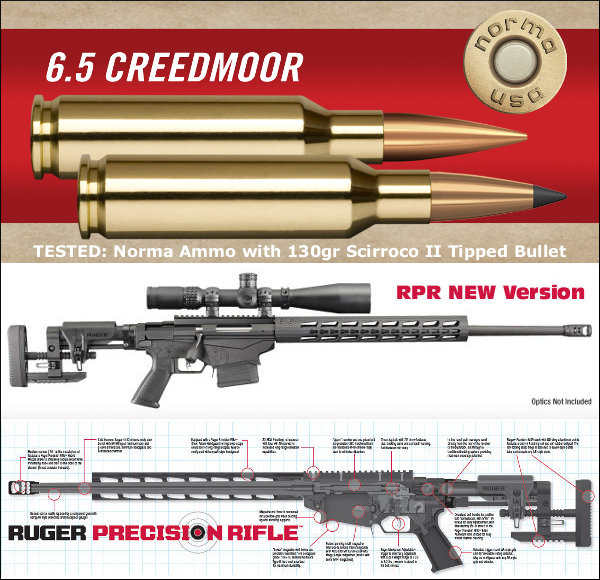
2. Ruger Precision Rifle with Norma 6.5 Creedmoor Ammo
In this video Gavin Gear tests Norma-brand factory ammo in a Ruger Precision Rifle chambered in 6.5 Creedmoor. Gavin reports: “Norma is known for its high-quality brass and ammunition. Recently, I saw that Norma had announced a new addition to their Professional Hunter lineup of ammunition: in 6.5 Creedmoor! I thought I should try some out with the Ruger Precision Rifle. As you saw in the video, this ammunition behaves more like match ammunition.”
3. 6.5 Guys Test Lapua 6.5 Creedmoor Brass in Tactical Rifles
If you have a 6.5 Creedmoor rifle, or are considering getting a gun chambered for this cartridge, we strongly recommend you watch the full 6.5 Guys Video. Ed and Steve spent a lot of time conducting this test, and the video includes helpful summaries of their findings.
4. Reloading for the 6.5 Creedmoor — Gear and Components
If you own a 6.5 Creedmoor rifle, and plan to start hand-loading for the popular cartridge, this video may help you select effective load components. The video examines a wide variety of brass, powder, and bullets options for the cartridge. In addition the reviewer looks at various reloading dies and tools suitable for 6.5 Creedmoor hand-loading.
5. The Springfield Armory M1A — Now Offered in 6.5 Creedmoor
Many folks may not realize that Springfield Armory now makes an M1A chambered in 6.5 Creedmoor. With considerably less recoil, this 6.5 CM version is easier to shoot than the classic 7.62×51 M1A: “Having a 6.5 Creedmoor caliber in the M1A lineup gives long-range shooters more choices with the precision and accuracy they require,” says Springfield Armory CEO Dennis Reese.
Here’s an entertaining video from Fog Ammunition. Starting with boxes of bullets and bags of cartridge brass, this video shows how components are bulk-sorted, then .223 Rem ammunition is produced on a modern, linear multi-stage loading machine. In assembly-line fashion, cases are primed, powder is added, bullets are placed, final seating depth is set, and then the case is crimped.
If you’ve never seen an automated loader in action you should definitely watch this video. With this kind of machine, a new round is produced every second or so (see video 1:15 to 1:55). The .223 Remington ammunition featured in this video is loaded with Sierra BlitzKing bullets. Fog offers both rifle and pistol ammo loaded with quality components.
Video Shows Automated Loading Process Start to Finish (Worth Watching):
At the request of our readers, we provide select “Deals of the Week”. Every Sunday afternoon or Monday morning we offer our Best Bargain selections. Here are some of the best deals on firearms, hardware, reloading components, optics, and shooting accessories. Be aware that sale prices are subject to change, and once clearance inventory is sold, it’s gone for good. You snooze you lose.
NOTE: All listed products are for sale to persons 18 years of age or older. No products are intended for use by minors.
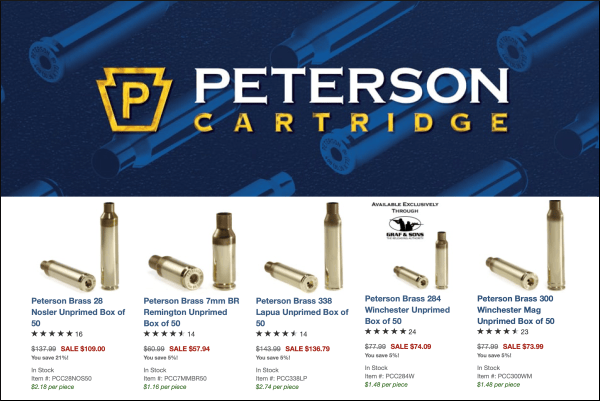
1. Graf & Sons — Peterson Brass Sale
⏺️ » Excellent brass inventory at very attractive prices
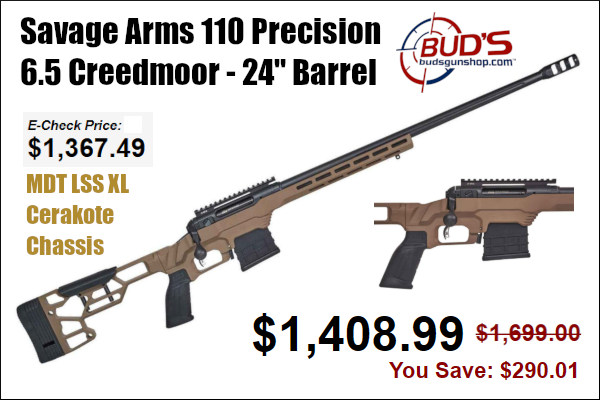
2. Bud’s Gun Shop — Savage 110 Precision 6.5 CM, $1408.99
⏺️ » Major discount on great Production Class PRS/NRL Rifle
For PRS/NRL shooting the Savage 110 Precision 6.5mm Creedmoor rifle does the job at a very affordable price. This is a smart choice for production division PRS/NRL competition. Plus, with its 6.5 Creedmoor chambering, this rifle can do double-duty as a deer hunting rifle. This is a good deal now at just $1408.99, $290 off MSRP. And if you pay with an ACH E-check the price drops to $1,367.49. If you prefer a 6mm Creedmoor PRS/NRL rig with longer forearm, Bud’s also has the Savage 110 Elite Precision starting at $1743.49 (LH). This features a MDT ACC aluminum chassis with full-length ARCA rail.
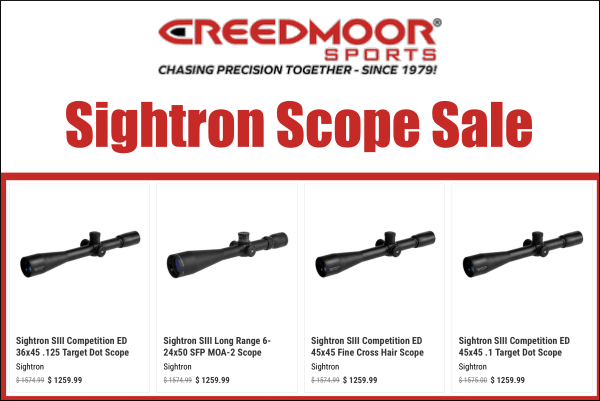
3. Creedmoor Sports — Sightron Scope Sale
⏺️ » Big selection of excellent scopes at good prices
If you need a quality scope, check out the Sightron Optics Clearance Sale at Creedmoor Sports. Sightron scopes are rugged and reliable and offer excellent performance for the price. Patented windage and elevation adjustment technology provides proper alignment even at extreme adjustment levels. Sightron scopes also now feature advanced Zact-7 Revcoat lens coating technology applied to both surfaces of the lenses. This allows maximum anti-reflection performance plus high light transmission.
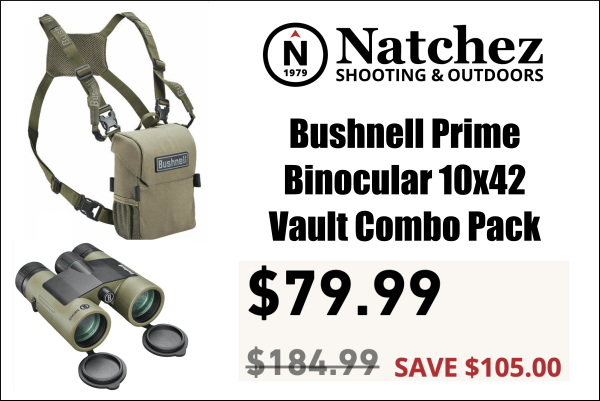
⏺️ » Save $105 on Binocs combo kit with good case and harness
The Bushnell Prime Binocular Pack is an optics carry pack combo with great features. For just $79.99 you get 10×42 binoculars, plus a case with a quiet magnetic lid, and a quality adjustable harness. This is a great set-up for hunters. The pack’s magnetic closure holds the binocs very securely while allowing rapid access. The harness lets you carry your optics securely even when holding your rifle and other gear.
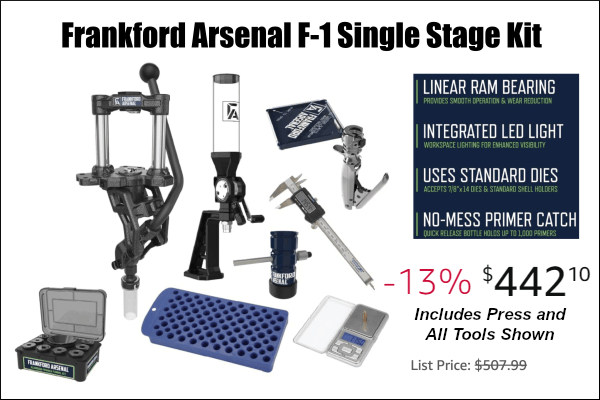
5. Amazon — Frankford Arsenal Essentials Reloading Kit, $442.10
⏺️ » Very complete reloading kit with excellent press
Need a complete reloading kit all the tools you need for precision handloading? Then check out this Frankford Arsenal F-1 Single Stage Press and Reloading Accessories Kit (#ad). On sale now for $442.10 at Amazon, this kit includes the Frankford Arsenal F-1 Single Stage Reloading Press, Benchtop Powder Measure, Hand Primer, Aluminum Powder Funnel Kit, Digital Calipers, DS-750 Powder Scale, Powder Trickler, and Universal Reloading Tray. NOTE: If you don’t need the full kit, you can also buy many of the listed items separately at great prices. For example, the F-1 Press is $129.99 by itself.
6. EuroOptic — Athlon Optics Closeout Sale, Save 20-59%
⏺️ » Massive savings on excellent scopes with great variety of magnifications
Athlon produces a wide variety of quality optics. Right now, at EuroOptic, you now you can save up to 59% on Athlon Riflescopes and optics. There are Red Dots for pistols, compact 1-6X and 1-10X tactical scopes, Medium power hunting optics (e.g. 2.5-15x50mm), and high magnification 4.5-30x50mm, 10-40x56mm, and 15-60x56mm zoom scopes for competition. There’s even an advanced Thermal Cronus ATS optic. Choose from FFP or SFP types with a variety of reticle options. If you need a new optic, this Athlon Closeout Sale offers great deals.
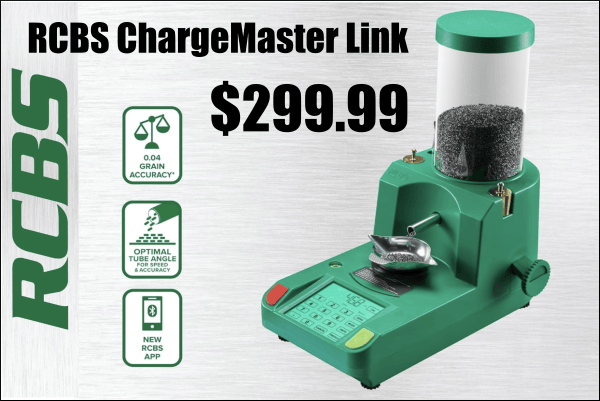
7. Amazon — RCBS ChargeMaster Link Scale/Dispenser, $299.99
⏺️ » Popular advanced, reliable Powder Dispenser
Every serious reloader should have a good electronic powder measure/dispenser. The popular RCBS ChargeMaster Link (#ad) Powder Scale/Dispenser is on sale now for $299.99 on Amazon. That’s a $50 savings off MSRP. This ChargeMaster Link offers ultra-fast dispensing and a 400-grain range, delivering up to two grains per second. This Link unit can connect with your smartphone via Bluetooth, allowing remote access and load archives for multiple cartridge types and bullet weights.
⏺️ » Good price on a very comprehensive gunsmithing kit
The Wheeler 89-Piece Gunsmithing Screwdriver Set (#ad) has tools to fit virtually any firearm ever made (Wheeler measured over 100 gun types when developing this kit). This kit boasts a durable, hinged storage case. Inside are 54 hollow-ground flat bits, 15 specialty bits, 8 Allen, 4 Phillips, and 3 Torx. In addition, the kit includes 2 non-slip plastic handles, a shaft extension, and a hex-to-square drive adapter. This kit has a great warranty — if you break or wear out a bit Wheeler will replace it for free.
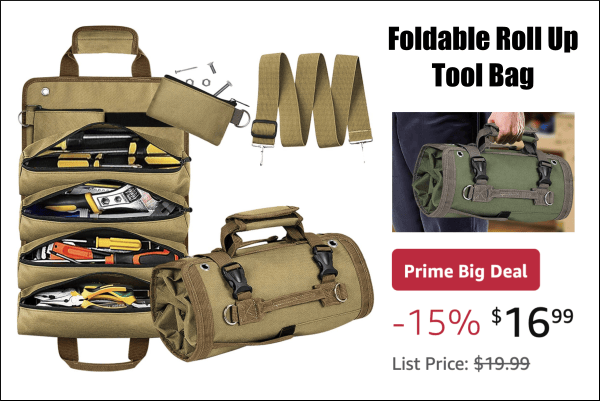
9. Amazon — Roll-Up Tool Bag, $16.99
⏺️ » Very handy back with multiple compartments
Keep your tools and accessories organized with this Foldable Roll-Up Bag Organizer (#ad) with 2 detachable pouches. This tool bag has 4 fixed large compartments, 2 small detachable pouches, and 5 pockets outside of the bag, allowing you to neatly store a variety of tools including pliers, screwdrivers, wrenches, hex key, measure tape, fasteners, utility knife and more. You’ll be impressed by how many tools fit in this small tool bag!
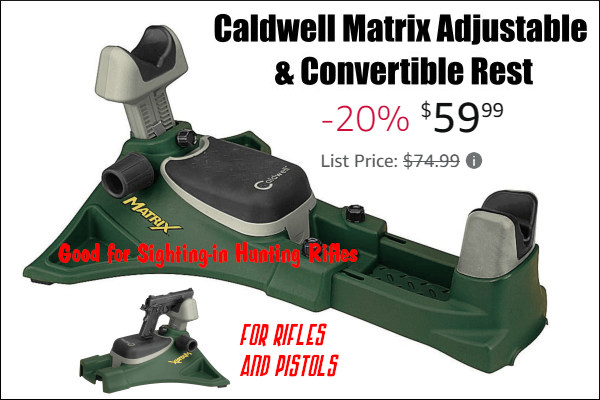
⏺️ » Versatile 2-part shooting rest for pistols and hunting rifles
For sighting-in a hunting rifle or testing pistol loads, you’ll want a good basic gun rest. The very affordable Caldwell Matrix Adjustable Rest (#ad) works with both rifles and pistols. Use the front section by itself with a handgun, then attach the rear support for sighting-in and testing a hunting rig. The spring-loaded elevation system allows for fast one-handed, no wobble adjustment.
As an Amazon affiliate, this site can earn revenues through sales commissions.
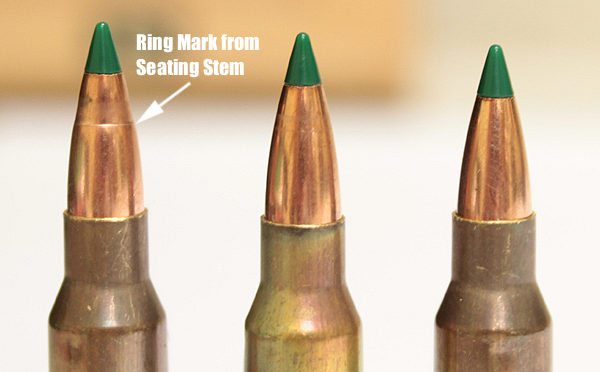
Here’s a helpful hint for hand-loaders from Sierra Bullets. While this article focuses on Sierra’s new Tipped Match-King bullets, the recommended solutions apply to other bullet types as well. The article explains how sharp edges on a seating stem can cause a ring to be pressed into the bullet jacket — especially with compressed loads that resist downward bullet movement. Here Sierra technician Rich Machholz diagnoses the problem and provides a solution.
Solutions for Ring Marks Caused by Seating Stems
by Sierra Bullets Ballistic Technician Rich Machholz
Now that the new Tipped MatchKing® (TMK) bullets are being shipped and shooters are putting them to use I have received several calls regarding marking on the bullet ogive from the seating stem.
The cause can be traced to one of several things. In the .223 and especially with the long, 77 grain TMK seated at 2.250” or even 2.260” most loads of Varget® and Reloder® 15 are compressed loads, sometimes heavily compressed. This puts a great deal of pressure on the bullet through the seating stem. The result of all this pressure is a mark of varying depth and appearance on the ogive of the bullet. [Editor: We have seen this issue with a variety of other bullet types/shapes as well, including non-tipped VLDs. The solution is profiling the internal cone of the seating stem to match your bullet shape.]
Some older seating stems might even bear against the tip of the bullet which can make a slight bulge in the jacket just below the junction of the resin tip and the copper jacket in a compressed load. If this is the case there is not a ready fix other than calling the die manufacturer and requesting a new deeper seating stem.
Polish Your Seating Stem to Remove Sharp Internal Edges
If the seating stem is of proper depth the culprit most generally is a thin sharp edge on the inside taper of the seating stem. This is an easy fix that can be accomplished by chucking a spare 77 grain bullet in your drill, coating it with valve grinding compound or even rubbing compound or in a pinch even tooth paste.* Remove the seating stem assembly from the seating die. Turn the drill on and put the seating stem recess over the spinning bullet with the polishing compound to break or smooth the sharp edge that is making the offending mark. This might take more than one application to get the proper polish depending upon what you use, but the more you polish the better the blend of angles which will [ensure the stem matches the bullet contours, not leaving a sharp ring].
If the above is a little more than you care to tackle you might try very fine emery cloth twisted to a point that can be inserted into the mouth to the seating stem and rotated to polish the inside to eliminate any sharp edges that might be present.
Load Advice for 77gr TMKs in the .223 Rem
And last but certainly not least. Actually, even though we don’t say you need additional data for the TMKs, remember you are dealing with heavily-compressed loads in some cases because of the additional bullet length. Due to the additional length of these new bullets and in the interest of gaining some room in the case you might consider trying a slightly faster extruded powder like BenchMark or the 4895s or an even more dense powder like the spherical H335®, CFE223 or TAC. The extra room will allow for trouble free bullet seating also.
Good luck and remember we are no further away than your telephone: 1-800-223-8799.
With our inflationary economy, ammo continues to go up in price every year. Smart shooters can benefit by price-shopping to get the best deals on factory-loaded ammunition, particularly for popular cartridge types such as .22 LR, 9x19mm (9mm Luger), .357 Mag, .223 Rem (5.56×45), and 6.5 Creedmoor. It this article we list 15 reliable online sources for factory-loaded ammo. You may want to bookmark this page so you can quickly scan and price-check multiple vendors. In addition, you can use a service such as AmmoSeek.com.
Why Should You Shop for Ammo Online?
By shopping online for ammo, you can save money, get a wider selection, and get bulk discounts. GunDeals.com explains: “Online purchases [can] save you a lot of money [and can] also save your time… one of the most important advantages is definitively the huge selection.” With online retailers you can quickly compare prices, and you will often get a discount on a large order (300 rounds or more) that is not available in local stores. Note, with some large vendors such as Cabela’s and Sportsman’s Warehouse you can order online then pick up in a local store.
Are There Restrictions on Online Ammo Purchasing?
In most (but not all) U.S. states is it legal to order ammunition online to be shipped to your residence. However, you MUST check your State and local laws and regulations. In some states and/or cities, it is ILLEGAL to purchase ammunition online for shipment across state lines with direct delivery. For example, in California, though there have been legal challenges, all ammo must still be purchased from a licensed ammo dealer/vendor with a state background check (so much for the Second Amendment)*. Likewise Washington DC, and Hawaii do not allow online ammunition purchases. And there are restrictions in New York City. In Alaska there are multiple shipping regulations that impact ammo deliveries from online sales so many vendors do not ship to Alaska.
*In some instances ammo can be purchased online from an out-of-state seller who will then ship to an authorized, in-state California vendor who may transfer the ammo for a fee with background checks as required by CA law.







 22 Creedmoor Ammunition
 Lock‑N‑Load Classic Pro Press
 Hornady Handbook of Cartridge Reloading (12th Edition, 2026)
 The folks at