Top Shot former Champion Dustin Ellerman likes his Volquartsens, and we can see why. With his latest 17 HMR rimfire varminter, he’s seen some outstanding accuracy with CCI ammo. On his Facebook page, Dustin reports: “Prepping for prairie dogs and I’m floored by this cold, sub-half-inch group shot with the Volquartsen Custom 17 HMR at 100 yards.” This thumbhole-stock rifle features a Bowers Group USS suppressor, and 3-12x56mm Meopta Scope. Dustin tried different types of CCI 17 HMR ammo. This small group was shot with CCI A17 ammo.
A couple years back Dustin took another Volquartsen 17 HMR on a Prairie Dog hunt in Wyoming. He was impressed with the rifle (shown below) and the little rimfire cartridge. Dustin says the effective range of the 17 HMR is farther than one might expect: “I made hits out to 300 yards. 200 yards was easy as long as the wind wasn’t too bad.”
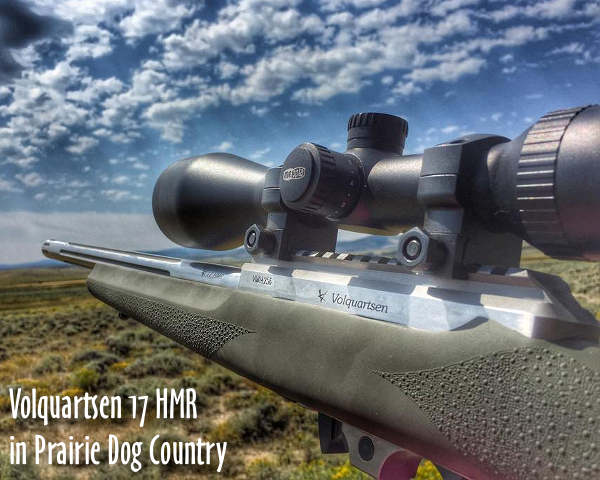
Here’s the Volquartsen 17 HMR Dustin used in Wyoming in 2015:
After that 2015 P-Dog expedition, Dustin became a fan of the 17 HMR cartridge: “Never paid it much attention before now because the ammo is five times more expensive than .22 LR and I mostly target shoot. However, for prairie dogs, the 17 HMR is amazing!” Consider this — Hornady’s 17 HMR ammo pushes a 17gr V-Max bullet at 2550 fps, twice as fast as typical .22 LR rounds.
Written by Sierra Bullets Ballistic Technician Paul Box
Judging by the calls I’ve had through the years, I think some shooters might be placing too much importance on Ballistic Coefficient (B.C.). The best example of this comes from a call I had one day. This shooter called wanting the ballistic coefficient of one of our Sierra bullets. After I told him he seemed a little disappointed, so I ask him what his application was. Long range target, deer hunting in the woods? Talk to me.
As it turned out, he hunted deer in open timber. He very rarely shot beyond 100 yards. I pointed out to him that, under 200 yards, B.C. has little impact. Let’s compare a couple of bullets.
Let’s look at the trajectory of a couple of bullets and see how they compare. The .30 caliber 180 grain Round Nose #2170 RN and the 180 grain Spitzer Boat Tail #2160 SBT. The round nose has a B.C. of .240, while the SBT is .501. Starting both bullets out of the muzzle at 2700 FPS [with a 100-yard ZERO], at 200 yards the #2170 RN impacts 4.46″ low while the #2160 SBT impacts 3.88″ low. That’s a difference of only 0.58″ in spite of a huge difference in Ballistic Coefficient. If we compare out at 500 yards, then we have a [significant drop variance] of 14.27″ between these two bullets. [Editor: That difference could mean a miss at 500 yards.]
Distance to Your Prey is the Key Consideration
In a hunting situation, under 200 yards, having a difference of only .58” isn’t going to make or break us. But when elk hunting in wide open spaces it could mean everything.
The next time you’re choosing a bullet, give some thought about the distances you will be shooting. Sometimes B.C. isn’t everything. If you have any questions, please give the Sierra Bullets technicians a call at 800-233-8799.
If you’re looking for loaded ammunition at affordable prices, WikiArms.com can help you find a good deal. WikiArms constantly searches the listings of ammo vendors across the web. Then WikiArms ranks the offerings by cost per round, low to high. This way you can instantly compare prices from multiple vendors including Ammomen, Ammunition Depot, Brownells, Cheaper Than Dirt, Lucky Gunner, Natchez, Slickguns, SG Ammo, Sportsmans Guide, and Walmart. Search bots refresh pricing constantly so listed prices are normally current within five minutes. WikiArms even displays the amount of product currently in stock for each vendor.
Using WikiArms is easy. Just click your choice of caliber (such as .22 LR, 9mm, or .308 Win) on the navigation bar, or hit the Good Deals link (bottom left column) to see a variety of cartridge types all at one time. WikiArms is fast, and it is FREE to use. Check it out.
WikiArms also tracks prices on reloading components — bullets, brass, primers, and powders. From the WikiArms Home page, look at the left column under the “Reloading” header. From there you can select the type of components you want.
There are some great deals now on quality .223 Rem ammo. Brownells is selling 800 rounds of Norma .223 Rem for $218.70 shipped with code “JNS”. That’s just $0.27 per round for very good stuff.
Wouldn’t it be nice to have a print resource at your fingertips that has hundreds of true-size cartridge illustrations, plus technical descriptions of thousands of popular cartridge types? That could be a real time-saver. It’s no wonder this book is an Amazon category best-seller.
If you’re a serious shooter, the latest 6th Edition of the Ammo Encyclopedia belongs in your library. This 1008-page book by Michael Bussard is probably the most comprehensive and up-to-date book in print covering current and obsolete cartridges and shotshells. The Ammo Encyclopedia is a massive resource work. The 6th Edition now boasts 100+ chapters, covering thousands of handgun, rifle, and shotgun cartridges from the past century and a half.
One of the best features is a full-color section depicting actual size drawings of over 320 current rimfire/centerfire cartridges and shotshells. You won’t find that many “life-size” cartridge drawings in one place even on the internet. Cartridge profiles and ballistic charts have been expanded to include many new factory cartridges. The authors have even included air rifle pellets and historical images and charts. Softcover, 1008 pages, $38.80.
Comments from guys who bought the book:
“This book contains a vast array of information on many modern and even obsolete ammunition. Definitely recommend for any modern reloader novice or experienced.” – Duggaboy460
“It’s a great reference book for individuals who reload their own ammunition. There is a lot more info in this Edition. Everyone who likes this information should have it in their library.” – Reloader
“I like the general and technical comments that are available for each and every cartridge. Information that predicts if a cartridge will stay in production for many more years or rapidly become obsolete.” – RSL1
If you haven’t visited the Norma website recently, you should click over to www.norma.cc/us. There you will find Norma’s Ammo Academy, a technical resource that provides information on Ballistics, Powder Storage, Barrel Wear, and Bullet Expansion. In addition, the Ammo Academy now links to Norma’s Reloading Data Center, where you’ll find loads for nearly 70 cartridge types including: .223 Rem, .22-250, 6mmBR Norma, 6XC, 260 Rem, 6.5-284, 6.5×55, 7mm-08, .270 Win, .284 Win, .308 Win, .30-06, 300 Win Mag, .338 Lapua Mag and dozens more.
The Ammo Academy’s Ballistics section contains some fascinating technical facts:
After the trigger is pulled, it takes around 0.005 seconds before the firing pin reaches the primer.
From the firing of the primer it takes 0.0015-0.002 seconds until the bullet exits the muzzle.
When the bullet leaves the muzzle, the hot gases surround and overtake the bullet, continuing the acceleration for a few centimeters.
Because the barrel is always angled slightly upwards, the bullet’s flight starts about 3-5 cm below the line of sight.
Norma also offers some good advice about Powder Storage:
To maintain the product quality for as long as possible, you have to keep the powder in a suitable place under suitable conditions. Where possible, store the powder at a constant temperature, ideally between 12 and 15°C (54°F to 59°F), and a relative humidity of 40–50%. If the air is too dry, it will dry out the powder, which will cause the pressure to be higher, thus affecting performance. Also make sure that you close the powder container properly afterwards. Cartridges should be stored under the same ambient conditions to maintain their quality.
At the request of our readers, we provide select “Deals of the Week”. Every Monday morning we offer our Best Bargain selections. Here are some of the best deals on firearms, hardware, reloading components, optics, and shooting accessories. Be aware that sale prices are subject to change, and once clearance inventory is sold, it’s gone for good. You snooze you lose.
1. CDNN — Savage Model 11/111 with Scope $349.99 after Rebate
Looking for a good basic hunting rifle, complete with optic? This Savage Special is hard to beat. Right now you can buy a Savage Hunter XP Model 11 (short action) or Model 111 (long action) for just $449.99 complete with 3-9x40mm Bushnell scope. But it gets even better — Savage Arms is offering a $100.00 Mail-In Rebate that lowers your net cost to a mere $349.99. That’s right — get Savage hunting rig, complete with scope, in your choice of 15 chamberings, for just $349.99.
Available Model 11 chamberings: .243 Win, 6.5 Creedmoor, .260 Rem, 7mm-08, .270 WSM, .308 Win, .300 WSM, .338 Federal
Available Model 111 chamberings: .25-06, 6.5-284 Norma, .270 Win, 7mm Rem Mag, .30-06, .300 Win Mag, .338 Win Mag
2. Grafs.com — Hornady Auto Charge, $179.99 + Free Range Bag
Here’s an excellent promo from our friends at Grafs.com. Hornady’s versatile Lock-N-Load Auto Charge™ Powder Scale and Dispenser is on sale for $179.99. And now for a limited time you get a FREE deluxe range bag ($43.99 value) with the purchase of the Hornady Scale/Dispenser. This is a good unit with a nice keypad. NOTE: You can also get the FREE Range Bag when you buy the Hornady Case Prep Center at Grafs.com for $419.99. That’s pretty pricey — getting Scale/Dispenser with the Range Bag is the better deal.
3. Natchez — Rock Chucker Supreme Reloading Kit, $249.99
Everything you see above can be yours for just $249.99, a great deal. Right now, Natchez is selling the Rock Chucker Supreme Master Reloading Kit for $249.99. That’s a great deal considering all the hardware you get. Heck, the Rock Chucker press alone is worth $150.00+. Considering all you get, this is a heck of a deal. The Natchez price is $70-$90 cheaper than many other vendors. For example, MidwayUSA’s price is $329.99 for this same kit!
4. MidwayUSA — 1500 Rounds Norma Tac-22 Ammo, $136.99
Check out those groups. That’s impressive accuracy at 50 yards. You’d expect to pay $10.00 or more per box for rimfire ammo that can shoot this well. But you can now get the Norma Tac-22 for just $4.56 per box at MidwayUSA in this package deal — 1500 rounds in Ammo Can for $136.99. This works out to just nine cents a round for good .22 LR rimfire ammo which has proved quite accurate in both bolt-action and semi-auto rimfire rifles. NOTE: The target photos come from Champion Shooters Supply, which may have gotten an exceptional lot. This vendor tells us: “We have found this to run very well in Ruger rifles, handguns, and target pistols. These are 5-shot groups at 50 yards with an Anschutz 1913 rifle. This is an incredible value.”
5. Bruno’s Everything Sale — Ends Monday, August 7 at 11:59 PM
Bullets, brass, powder, optics, dies, tools, stocks, barrels, actions — all this and more is on sale at Bruno Shooters Supply right now. You’ll find savings on pretty much everything Bruno’s sells (except MAP-price items). But you have to act quickly. This storewide sale ends TODAY, August 7th at 11:59 PM. You snooze, you loose. NOTE: You don’t need a special discount code — the sale prices are already shown online, good for today (8/7/2017) only.
6. EuroOptic.com — Huge Savings on All Sightron Scopes
EuroOptic is moving to a larger facility. To ease the transition, EuroOptic needs to reduce its large Sightron Optics inventory. Accordingly, Sightrons are marked down with very large price reductions. Our source at EuroOptic says: “All IN STOCK Sightrons are reduced to liquidate — these are going fast at these prices.” There are some great deals here for folks looking for medium-magnification tactical and hunting scopes. Along with riflescopes, Sightron spotting scopes are also on sale.
7. CDNN — Browning Stainless Buck Mark, $279.99 After Rebate
Everyone needs a good .22 LR rimfire handgun, and the Browning Buck Mark is a classic. This stainless, bull barrel version is marked down this week to $329.99. That’s a very good deal, but you can save even more with Browning’s $50 Rebate. Buck Marks, with their excellent triggers and great ergonomics, are fun to shoot and VERY accurate. This is a pistol you can keep for a life-time. Browning says: “Every Buck Mark starts out as a solid piece of aircraft-grade 7075 aluminum alloy, and then is CNC-machined to exacting tolerances. The crisp single-action trigger, hand reamed chamber, target crowned barrel and finely adjustable target sights mean the Buck Mark comes ready for fun straight from the box.” There is also a blued Buck Mark version priced at $289.99 (or $239.99 after Rebate).
8. Midsouth — All Starline Pistol Brass 15% Off
Among pistol brass options, Starline is some of the best stuff you can buy. Strong and consistent, Starline is a good choice for stout cartridges such as the 10mm Auto, .357 Magnum, .44 Magnum, and .500 S&W. We also like Starline for our .45 ACP loads. Right now you can get significant savings on Starline’s entire stock of cartridge brass (both regular and nickle-plated). Midsouth is running a 15% Off Starling Sale now through 8/8/2017. Take advantage of these 15% Off Savings before the sale ends on Tuesday, August 8, 2017 at 11:59 PM.
9. Amazon — Neiko Digital Calipers, $16.79
Even if you have a good set of calipers, you may want to get one of these Neiko 01407A Digital Calipers. The #1 best-selling digital caliper on Amazon.com, this Neiko tool features a large LCD Screen and measures up to 6.0 inches. With 2850+ customer reviews, this product has earned an overall rating of 4.4 out of 5 stars. It’s hard to go wrong for $16.79, even if you just use these as a spare set for measuring group sizes and case trim lengths.
It’s good to see an ammo-maker step up to help the shooting sports. ELEY Ltd. has recently made significant investments in .22LR rimfire benchrest and competition segments within the USA. ELEY has partnered with the American Rimfire Association (ARA) and Professional Shooting League (PSL) to help promote and expand rimfire benchrest shooting, one of the fastest growing .22 LR rimfire competition disciplines worldwide. The ARA and PSL competitions are leading rimfire benchrest organizations within the United States. ELEY’s financial and logistical support will help the ARA and PSL grow the ranks of rimfire benchrest shooters.
Here’s a record-setting rimfire benchrest rifle owned by our friend Joe Friedrich who competes in ARA matches, primarily using ELEY .22 LR Tenex ammo.
ARA was started in April 1998 by a group of .22 LR shooters who wanted an organization for competitive .22 LR benchrest competition. In 2010, ARA started to transition to what it has become today, with the unique goal of continuing the vision of the ARA founders by providing an honest competitive organization that is true to .22LR shooting.
PSL was founded as a benchrest organization for the true precision shooting professional. With the growth of rimfire benchrest, there was a need to have a professional organization to which shooters would be compensated for their hard work, training and competition success.
Image from National Rimfire Benchrest Association of Ireland (NRBAI)
Among .22 LR rimfire disciplines, benchrest shooting represents the “pinnacle of precision” — the very highest level of accuracy is needed to succeed. As such, ELEY has identified the need to help expand this growing sport. “This support by ELEY will help us bring .22 LR benchrest to the forefront of shooting competitions,” says Dan Killough, Director of ARA & PSL. “The expansion of [rimfire] benchrest … gives shooters a platform to enjoy and participate in rimfire competition that previously may not have been available to them,” stated Mike Corkish, ELEY Director of North America Sales.
Creedmoor Sports has released a series of helpful “how-to” videos in its new InfoZone web page. In the latest InfoZone video Bill Gravatt shows how to seat bullets using L.E. Wilson Hand Dies and an Arbor Press. The basic process is simple, particularly with a micrometer-top seating die. That makes it easy to adjust and set seating depth. Before you start seating bullets, you want to adjust the height of the arbor so the stroke is appropriate to the height of your die.
Bill Gravatt Shows How to Use Hand Seating Dies — Creedmoor INFOZONE
ARBOR PRESS TECHNIQUE: When using an arbor press, smooth is good. You don’t want to slam the handle down quickly. Try to repeat the same motion each time. You can also experiment by seating the bullet part way, then rotate the cartridge (in the die) and do the final seating with a second stroke. If your arbor press has a force gauge, note both the max value of the gauge needle and how it moves as you seat the bullet. If the needle spikes too rapidly, or bounces back and forth irregularly, set that cartridge aside and/or mark it. You could have neck tension issue with that case or some other fault. You might even have a bad bullet. That’s rare, but can happen. The key to success is moving the press arm in a smooth motion every time, maintaining the same down-pressure with each cartridge.
Here Bill Gravatt Offers a Simple Tip for Adjusting Wilson Seating Dies
One of our Forum readers asked “How can I get a custom in-line seater for my new rifle?”. First, we would say that, if you are not shooting an unusual Wildcat, check first to see if L.E. Wilson makes a stainless Micrometer Seater Die for your rifle. These dies are a joy to use, and we’ve found the fit to be exceptionally good with many calibers. Typically priced from $90-$100, Wilson stainless micrometer-top seaters are available for dozens of cartridge types: .204 Ruger, 20 BR, .222 Rem, .223 Rem, 22 PPC, 22 BR, .22-250, .223 WSSM, 6 PPC, 6mmBR, 6XC, 243 Win, .243 WSSM, 25 WSSM, 6.5×47 Lapua, 6.5 Creedmoor, 6.5-284, 26 Nosler, .270 WSM, 7mm-08, .284 Win, 28 Nosler, 7mm RUM, 30 BR, 30 IHMSA, .308 Win, .300 WinMag, .338 Edge (and MORE).
If you do want a custom seater die, the process is relatively simple. Purchase a die blank from Wilson and have your gunsmith run the chambering reamer in. Forum member Gunamonth explains: “I start with a Wilson seating die blank. They’re available from Sinclair and other vendors. Just run the reamer in. For some of my rifles, where I wanted the stainless die with the micrometer adjustment, I bought a smaller die and had the smith ream it with the chamber reamer. That’s how I had my 6 Dasher and 6mm AI seaters made. With the Dasher I stared with a 6mmBR Micrometer die.”
SEATER STEM TIP: If, on your seated bullets, you are seeing a sharp line around the jacket near the ogive, you may want to smooth out the leading edge of the Wilson seater stem (see above left). Do this by putting a little lapping compound on one bullet and manually spin this around in the stem. Without much effort you’ll have a smooth bullet/stem interface.
Micrometer Top Add-on
We really like micrometer tops on a seating die. But what if Wilson doesn’t make a micrometer top seater for your chambering? Don’t despair, Sinclair Int’l sells a $39.99 micrometer top that can be added to Wilson standard seaters or to a custom seater die made from a Wilson die blank.
The F-Class World Championships (FCWC) in Canada are just one week away. This August 11-17, the world’s top F-Class shooters will gather at the Connaught Ranges outside Ottawa, Ontario. The vast majority of F-Open shooters will be running some kind of 7mm (.284 Caliber) cartridge, with the .284 Winchester, .284 Win Improveds, and 7mm RSAUMs being popular.
For those of you who plan to compete but who haven’t loaded your ammo yet, you may want to consider a very good 7mm match bullet from Sierra, 183 grain MatchKing (item #1983). We have found the 183gr MK, which comes “pointed” from the factory, to be very consistent in weight and base-to ogive measurement. Top F-Open shooters have told us that these bullets shoot exceptionally well, with minimal vertical dispersion at 1000. “Holding waterline” at long range is a reliable indicator that the BC is very uniform from bullet to bullet.
Sierra’s popular 7mm 183 grain MatchKing boasts an impressive 0.707 G1 Ballistic Coefficient (BC) at 2300+ fps. These bullets also have very consistent bullet-to-bullet BC, thanks to very uniform jackets and the tips being “pointed” at the factory. Sierra explains: “A final meplat-reducing operation (pointing) provides an increased ballistic coefficient for optimal wind resistance and velocity retention.”
Insight Into Sierra’s New 7mm MatchKing® by Sierra Product Development Manager Mark Walker
In late 2015, Sierra introduced a new 7mm MatchKing® bullet with a different type of ogive. As part of the introduction, I had the opportunity to use them at the F-Class Nationals held in Phoenix with very good results. While at the match, several people had questions about what exactly was different about the ogive on this bullet as opposed to our tried and true blended tangent ogive. So with that in mind, hopefully this blog will answer those questions.
In the past, Sierra has typically used a tangent radius ogive design on our MatchKing® bullets. This is one of the most forgiving ogive designs due to its ability to shoot extremely accurately when jumped, as well as, jammed into the rifling. On rare occasions, some of our MatchKing® bullets have used a secant ogive due to design constraints. However, this ogive is much more sensitive to changes in seating depth than the tangent ogive so we tend to shy away from it. When we decided to work on this new bullet, we wanted to see if we could improve on the accuracy of even our best shooting tangent ogive bullets.
One of the main factors of what makes an accurate shooting bullet is how it aligns itself with the bore when fired. If a bullet is slightly crooked when entering the bore, it will cause inaccuracy on the target. We set out trying to think of ways to make sure that the bullet has no choice but to align itself with the bore perfectly.
The first part of the barrel to encounter the bullet is the leade in the chamber. The leade is an angle that is cut into the leading edge of the rifling which helps to guide the bullet into the bore. To illustrate how current bullets fit into the leade, picture a cone (leade) with a ball (bullet) sitting inside it. The ball can be rotated in all directions and the cone cannot force the ball to orientate itself in any particular direction. When a bullet with a radius encounters the leade, it behaves in a similar way. Now this of course is a very simple example and of course advanced shooters use tight necks and brass that is perfectly formed to the chamber to make sure the bullet is aligned as perfect as possible. However, there is always a small element of misalignment that is possible even with all this precise preparation.
This brings us to the ogive on the new 7mm MatchKing®. We thought instead of using the typical ogive radius that can allow slight misalignment, why not use the same straight angle that is used in the chamber leade on the bullet ogive to force itself to always align with the bore? Imagine the same cone as above (leade) with an identical cone (bullet) sitting inside of it. The cone inside has no choice but to align itself perfectly with the cone that it is sitting in every time. With that in mind, we designed the area of the bullet which contacts the leade in front of the bearing surface using a straight 1 1/2 degree angle instead of the typical radius. Once past that area, we use a traditional high caliber ogive radius to provide a very sleek, high BC bullet.
I hope that explains our thought process behind this new bullet. In our testing, it is one of the most forgiving high-BC bullets we have ever made.
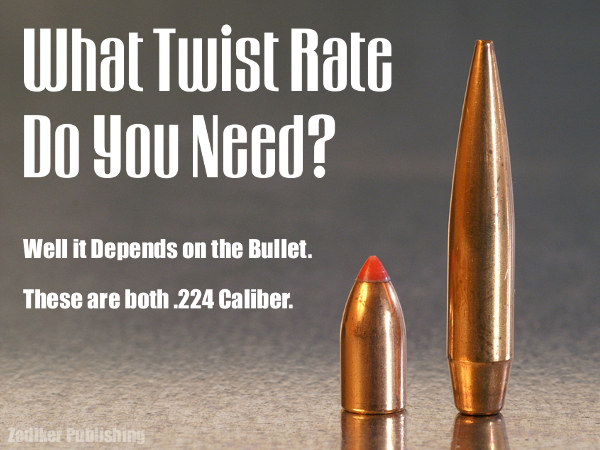
Here’s an extreme range of .224-Caliber bullets: 35gr varmint bullet and 90gr match bullet. Of course, along with bullet length/design, you need to consider MV when choosing twist rate.
Even with the same caliber (and same bullet weight), different bullet types may require different rates of spin to stabilize properly. The bullet’s initial spin rate (RPM) is a function of the bullet’s muzzle velocity and the spin imparted by the rifling in the barrel. You want to ensure your bullet is stable throughout flight. It is better to have too much spin than too little, according to many ballistics experts, including Bryan Litz of Applied Ballistics. Glen Zediker has some basic tips concerning barrel twist rates and bullet stability. These come from his latest book, Top Grade Ammo.
Choosing the Right Twist Rate
I’d always rather have a twist too fast than not fast enough. Generally… I recommend erring toward the faster side of a barrel twist decision. 1:8″ twist is becoming a “new standard” for .224 caliber, replacing 1:9″ in the process. The reason is that new bullets tend to be bigger rather than smaller. Don’t let a too-slow twist limit your capacity to [achieve] better long-range performance.
Base your next barrel twist rate decision on the longest, heaviest bullets you choose to use, and at the same time realize that the rate you choose will in turn limit your bullet choices. If the longest, heaviest bullet you’ll shoot (ever) is a 55-grain .224, then there’s honestly no reason not to use a 1:12″. Likewise true for .308-caliber: unless you’re going over 200-grain bullet weight, a 1:10″ will perform perfectly well.
Bullet Length is More Critical than Weight
Bullet length, not weight, [primarily] determines how much rotation is necessary for stability. Twist rate suggestions, though, are most usually given with respect to bullet weight, but that’s more of a generality for convenience’s sake, I think. The reason is that with the introduction of higher-ballistic-coefficient bullet designs, which are longer than conventional forms, it is easily possible to have two same-weight bullets that won’t both stabilize from the same twist rate.
Evidence of Instability
The tell-tale for an unstable (wobbling or tumbling) bullet is an oblong hole in the target paper, a “keyhole,” and that means the bullet contacted the target at some attitude other than nose-first.
Increasing Barrel Length Can Deliver More Velocity, But That May Still Not Provide Enough Stability if the Twist Rate Is Too Slow
Bullet speed and barrel length have an influence on bullet stability, and a higher muzzle velocity through a longer tube will bring on more effect from the twist, but it’s a little too edgy if a particular bullet stabilizes only when running maximum velocity.
My failed 90-grain .224 experiment is a good example of that: I could get them asleep in a 1:7″ twist, 25-inch barrel, which was chambered in .22 PPC, but could not get them stabilized in a 20-inch 1:7″ .223 Rem. The answer always is to get a twist that’s correct.
These tips were adapted from Glen’s newest book, Top-Grade Ammo, available at Midsouth. To learn more about this book and other Zediker titles, and read a host of downloadable articles, visit ZedikerPublishing.com.




 If you’re looking for loaded ammunition at affordable prices,


 It’s good to see an ammo-maker step up to help the shooting sports.


 One of our Forum readers asked “How can I get a custom in-line seater for my new rifle?”. First, we would say that, if you are not shooting an unusual Wildcat, check first to see if



 Increasing Barrel Length Can Deliver More Velocity, But That May Still Not Provide Enough Stability if the Twist Rate Is Too Slow


