MidwayUSA is running a big sale on Factory Second and Blemished Bullets. These bullets normally perform just as well as regular bullets, but they may have water spots or other cosmetic defects. MidwayUSA has a very large selection of seconds/blem bullets on sale for both rifles and pistols. Here are some of the best deals we found among the quality varmint and match rifle bullets. All these selections are discounted 30%:
There are hundreds of cartridge types capable of winning in F-Open. For F-TR you can shoot either the .223 Rem or .308 Win, but you have many load options. This article will focus on proven choices, currently used by the top F-Class shooters in the world. Our discussion will analyze cartridge selection based on the four different F-Class sub-disciplines: Open Mid-Range, Open Long-Range, F-TR Mid-Range, and F-TR Long Range.
Click image to view full-screen photo.
Mid-Range F-Open Cartridges
For starters, a .300 WSM is certainly capable of winning mid-range matches but it is not ideal. So what is ideal, and why? F-Class Mid-Range matches usually are usually shot at 300, 500, or 600 yards — or all three. At those distances the 6mm and 6.5mm cartridges rule. In moderate conditions, the 6mm Dasher is unbeatable. Its low recoil along with its super grouping ability and good ballistics make it my number one choice for Mid-Range.
Best bullets for the 6mm Dasher are: Vapor Trail 103gr, Berger 105 Hybrid, 108 BT, and 105 VLD (hunting). Best powders are: Varget, H4895, and Reloder 15.
Choices for Mid-Range in Tougher Conditions:
We all know that conditions are not always “moderate” that’s why something a little bit bigger will save you a “Nine” or two. The 6.5X47 Lapua was designed for 300-meter competition, but as soon as it was released, it was adopted by F-Class, benchrest, and tactical shooters. It offers great ballistics with very low recoil and big “accuracy window”. Lapua makes great brass for it (no surprise there) and Berger makes great bullets: 130gr VLD, 140gr VLD, 140gr Hybrids. Best powders in most barrels are Varget and H4350, I don’t use double-based powders such as Reloder 17 and the Vihtavuori N500 series because of their unpredictable performance day to day (greater temp sensitivity).
The 6.5X47 Lapua necked down to 6mm is also a great option for mid range matches. I was able to easily get 3200 fps with 105 hybrids and H4350.
Choice for Long-Range F-Open Competition
In Long-Range F-Open Class (out to 1000 yards), the big, high-BC bullets rule. If I had to pick one cartridge for F-Class (both mid- and long-range) I would pick the .284 Winchester or one of its variants. The .284 Win is currently dominating in F-Open competition. It offers great barrel life, it is super-easy to tune and its recoil is very manageable. The best bullets for it by far (in my opinion), are the Berger 180 Hybrids. But Sierra’s new 183gr MK bullet (with factory-uniformed meplats) seems to perform very well as does the Berger 180 VLD. Best powders for the .284 Win are H4350 and H4831SC.
Long-Range Only F-Open Cartridge
As much as I like the .284 Win, for long-range competitions I like the .300 WSM even more. If you look at a .300 WSM and a 6mm Dasher side by side, they appear almost identical in geometry — the .300 WSM looks like an “super-sized” Dasher. Both cartridges are currently the “darlings” of long-range benchrest due to their extraordinary grouping ability and huge “node’’ windows. Big accuracy windows allow loads to perform well in different conditions and geographical locations. That’s obviously very important if you travel to compete. The .300 WSM loaded with Berger 215gr or 230gr Hybrids is very tough to beat at long range, and it is currently my number one choice.
The 7mm RSAUM is another outstanding long-range round. It resembles a 6BR on steroids and it is almost as easy to tune. Best bullets for it are Berger 180gr Hybrids, 195gr EOLs, and Sierra’s 183gr MatchKing. Best powders for the 7mm RSAUM are: H4350, H4831SC, and VV N160.
Top Caliber/Bullet Combos for F-TR
In F-TR competition, the choice is clear — a .308 Win throated for Berger 185gr BTLRs and 200gr Hybrids will win in mid-range AND long-range comps. Many championships have been won, and many records set with those two bullets in the .308 Win. To quote Danny Biggs (a two times FTR National Champion) “The 185 BTLR is the best bullet for .308 Win ever made”.
The Berger 215gr Hybrids have been used to win many competitions including recently the 2015 F-Class Nationals. Bryan Litz won both the Mid-Range and Long-Range 2015 Championships using 215s. Bryan’s rifle is shown below:
I recommend chambers throated for the 185/200 grain projectiles over the 215/230 grain bullets. The reason is that if you have your barrel throated out for the 215s or the 230s, you could have a “slow” barrel and max out on pressure before the desired velocity is reached. Optimum freebore for the 230s is too long for the 185/200s, so you would be limited to using only 215/230gr bullets in that barrel.Furthermore, the recoil increase with heavier bullets is substantial, causing the rifle to be more difficult to shoot.
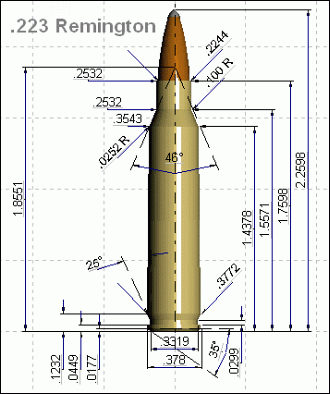
.223 Rem — Not A Competitive Option
I would stay away from the .223 Remington. On paper the 90gr VLD will shoot inside most .308 Win loads even at a 1000 yards. But in reality, on average, the .223 Rem, regardless of what powder/bullet combo is used, cannot compete with the .308 Win. [Editor: The equipment lists at major F-TR matches will confirm Kovan’s conclusion here.]
Conclusion (and Other Options)
This article covers only the (currently) most popular cartridge/bullet combos for F-Class (F-Open and F-TR). As I said in the beginning, many cartridge types are capable of winning but are not listed due to their low popularity, case design, or lack of quality components. All of the above information is based on my personal experience and it is meant to help new shooters choose the right cartridges for F-Class matches. Thanks for reading and good luck — Emil Kovan
Emil Kovan Competition History:
– 2014 F-Class Open National Champion
– 2015 F-Class Open National Championship, Silver Medal
– F-Class Open National Championship Teams, 2015, 2014, 2013, Shooting Team Member
– Over 15 wins in Regional and State Championships in Palma, F-TR, F-Open
Each Wednesday, the U.S. Army Marksmanship Unit publishes a reloading “how-to” article on the USAMU Facebook page. This week’s “Handloading Hump Day” article covers two basic case prep chores — uniforming primer pockets and deburring flash-holes. Visit the USAMU Facebook page for other tips.
Primer Pocket & Flash-Hole Conditioning
This week, we’ll address a question that frequently arises: “Do you uniform primer pockets and deburr flash-holes?” As we tailor our handloading methods to the specific needs of each instance, the answer, not surprisingly, is “Sometimes!” However, don’t flip that dial just yet, as what determines our approach may be helpful in deciding how to address one’s own techniques. Moreover, we have a buried “Easter Egg” morsel that may bring a chuckle, as well as useful safety information!
Generally, the USAMU Handloading Shop does not uniform primer pockets (PP) or deburr flash holes (FH) of our rifle brass. We’re certainly not against it… Rather, this reflects the very high volume of ammunition we load, the fact that very few cases are ever re-loaded for a second firing, and the types of brass we use. However, as a need is perceived, we DO deburr flash holes. Of interest, we have fired many very small, 1000-yard test groups and aggregates using weight-selected, domestic brass that had not had PPs uniformed or FHs deburred.
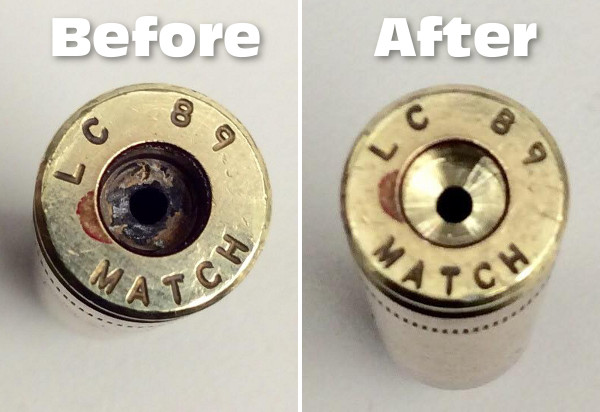
Before and After — On the left is a fired, deprimed 7.62×51 case with primer residue intact. On the right the primer pocket has been uniformed to SAAMI specs. Note the shiny finish at the bottom of the pocket — evidence of the the removal of metal when uniforming the primer pocket.
As to the type cases we use, many thousands of our long-range 5.56mm cases come to us from the arsenal with the primer of our choice pre-installed and staked-in, per usual practice. Obviously, we cannot uniform either FHs or PPs on this live, primed brass. However, after careful sorting, inspection and preparation, we do obtain match-winning results with it.
Shooters who reload their brass several times may decide to uniform PPs and deburr FHs, especially on their “300-yard and beyond” brass. Here, they will use the cases many times, while the uniforming is performed only once. Also, most handloaders only process moderate amounts of brass, compared to our multi-thousand round lots.
Having high quality Long Range (LR) brass helps. Many of the better brass manufacturers install their flash holes so that no burrs are created. Still, it does pay to inspect even THESE manufacturer’s products, as occasional slips are inevitable. Very rarely, some of the best makers will have a significant burr in, say, 1 per 1000 or 2000 cases, and it’s worth catching those.
Exceptions can always be found. Recently, we began processing a large lot of match brass from a premier manufacturer. We were startled to find that every case had a significant burr in the FH — something we’d never before seen from this maker. We then broke out the FH deburring tools and went to work.
Some observers have noted that it can be difficult to truly verify the contribution to accuracy of these procedures — particularly when firing from the shoulder, in conditions. Members of this staff, as individual rifle competitors, do often perform these operations on their privately-owned LR rifle brass. One could ascribe this to the old Highpower Rifle maxim that “if you think it helps, then it helps.”
However, a World Champion and Olympic Gold/Silver medalist here commented on his own handloading (for International competition, which demands VERY fine accuracy). He noted that he did seem to see a decline in accuracy whenever he did not uniform FHs, deburr FHs and clean primer pockets before each reloading. (One might be tempted to counter that only a truly World Class shooter could reliably detect the difference.) However, with the wisdom of decades experience, our Champion also remarked that “It could have been that I just wasn’t shooting as well that day.”
For those who do opt for these procedures, note that various tool models may have adjustable depth-stops; pay attention to the instructions. Some FH-deburring tools (which enter the case mouth, not the primer pocket) are dependent upon uniform case length for best results.
Above is a flash-hole deburring tool on an RCBS powered case-prep unit. These case prep machines can save a lot of pain and misery, helping one perform various functions quickly and efficiently.
Shooter behind the .375 Lethal Magnum. Check out the size of that suppressor!
Two-Mile ELR Training The Applied Ballistics ELR Team spent the weekend at the NRA Whittington Center in New Mexico training for the upcoming King of 2 Miles event. Former USAMU coach Emil Praslick III was on hand to help with wind calls. The results were impressive — all team members had confirmed hits at 2.05 miles on a 36″x36″ steel target. Bryan Litz even had a 3-shot group that measured 17.5″ x 22″. That’s under 0.6 MOA!
Most guys would be happy with 0.6 MOA at 300 yards. Bryan did it at 3611 yards, shooting Paul Phillips’s .375 Lethal Magnum. When you consider all the variables involved (bullet BC variance, shot velocity variance, wind changes during flight, Coriolis effect etc.), that’s phenomenal.
Report by Paul Phillips
Just got done shooting two days in New Mexico with Recoil Magazine and the Applied Ballistics ELR team. We learned a lot and had great success. Every team member made impacts on target at 2 miles. The best 3-shot group at 3611 yards (2.05 miles) was shot by Bryan Litz with my 375 Lethal Mag. The group measured 17.5 inches tall by 22 inches wide with Cutting Edge bullets. We also had Recoil’s David Merrill shoot at two miles and was laying them in there like a true pro. We had three team members make impacts on the 36-inch plate at two miles within just three attempts in a mock competition. I also increased my personal longest shot by hitting only 15 inches right of center at 3611 yards. 2.05 miles. I did it with a GSL Technology Copperhead Silencer.
Report by Emil Praslick
I participated in the Extreme Long Range training with the Applied Ballistics team at the Whittington Center in Raton, NM. All team members had confirmed hits at 2.1 miles. Components and hardware suppliers included: Berger Bullets, Cutting Edge Bullets, Nightforce Optics, Kestrel, FLIR Systems.
Q: At that distance (2.1 miles), how much do spin drift and the Coriolis effect impact bullet trajectories?
Praslick: At 3613 yards we had to adjust about 1.5 MOA/56″ of Coriolis (up), and 5 MOA/~190″ of right spin drift adjustment. You’d have to come down if facing East. The planet rotates counter-clockwise (from above), so your target would be falling away from you.
Here is a 3-round group at 1898 yards (1.08 Miles) shot with factory ABM Ammo .338 Lapua Magnum loaded with 300 grain Berger Bullets Hybrids. That’s sub-MOA elevation. (The guy calling wind didn’t do too bad, either.)
Report by Bryan Litz
Learning is my favorite part of new ventures and we learned a LOT this weekend shooting extreme range in New Mexico. I connected on a second round hit on a 3-foot square target at 2 miles in simulated match conditions under coaches Emil Praslick and Paul Phillips. In fact all five of our team shooters got on at 2 miles. The Applied Ballistics Extreme Long Range team is in good shape for the King of 2 Miles match later this month, and there is still so much to LEARN!
You need serious equipment for shooting beyond two miles. Who can identify this high-tech hardware?
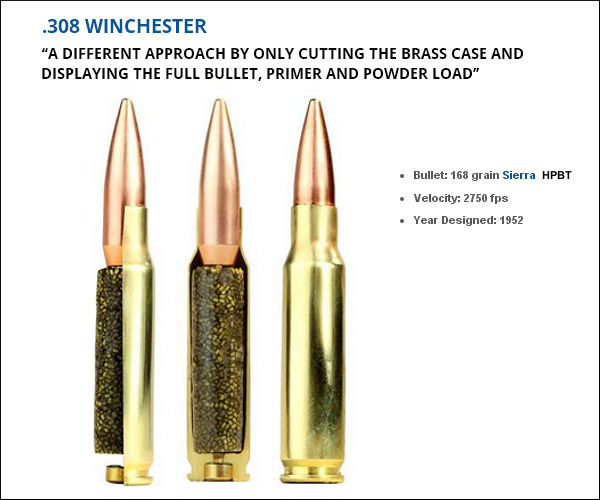
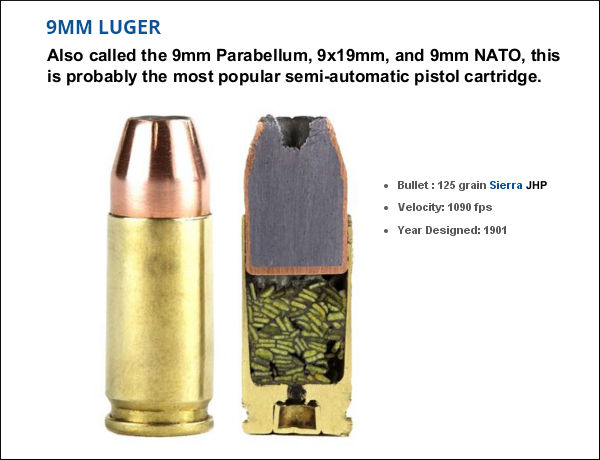
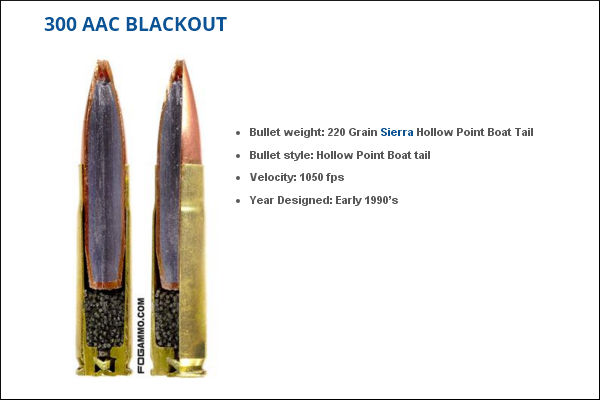
Here’s something you don’t see every day — the inside of loaded cartridges, sliced halfway through. This lets you see how bullet core, jacket, cartridge case, powder, and primer all fit together. Give credit to the folks at FOG Ammunition for creating this interesting series of cut-through ammo images. We show four cartridges here: the .308 Winchester, 9mm Luger, 300 BLK, and .50 BMG. You’ll find two more (the .223 Remington and .45 ACP) at www.FogAmmo.com.
This .308 Winchester model took on a different approach by only cutting the brass case and displaying the full bullet, primer and powder load. A spec amount of powder was used to create the model powder form. An estimated 10% volume was added during the forming process, along with an undetermined amount of air pockets.
This bisection is a 9mm Jacketed Hollow Point round with flake powder held together with super glue. After this self-defense round was cut by a trained professional the round was polished by hand. This might look like stick powder, but those are in fact flakes stacked up in cross-section. Designed in 1901 by Georg Luger, this popular cartridge is used by civilians, military, and law enforcement.
For this model of the .300 AAC Blackout (aka 300 BLK), a Dremel tool was used to create a pie cut within the bullet and brass case. A measured amount of power, roughly 65% of spec charge, was placed inside the case with super glue. This cartridge was originally optimized for subsonic use with a suppressor, so the amount of powder used is small relative to the nominal case capacity. That leaves more room for the relatively large .30-caliber bullet.
Last but definitely not least is the .50 Caliber BMG round (aka .50 Browning Machine Gun). Famed for its wartime use in the M2 Machine gun, the .50 BMG round is also used in civilian Long Range competitions. A typical .50 BMG cartridge holds over 225 grains of powder. That’s almost ten times the amount in a 5.56×45 NATO Round!
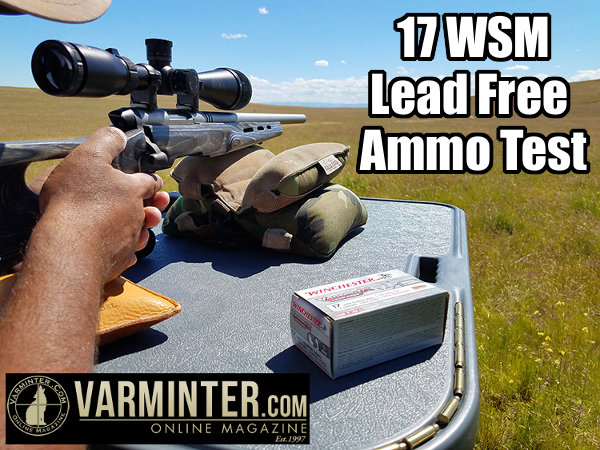
The team at Varminter.com just completed an extensive test of Winchester’s new LEAD FREE 17 WSM ammunition. During multiple sessions, Varminter.com shot the ammo using no less than nine different rifles. Four, 5-shot groups were shot with each rifle from the bench at 100 yards. Results were impressive. Average group size for a 1:9″-twist heavy barrel Savage B-Mag was a remarkable 0.5005 inches. Group size averages for seven of the eight other 17-cal rifles* ranged from 0.755 to 1.03 inches at 100 yards — pretty impressive for factory rimfire rigs. A LOT of time was invested in this test, and we recommend you read the full report on Varminter.com.
Fastest Rimfire Cartridge Ever
If you’re not familiar with this cartridge, the 17 WSM is the fastest, flattest-shooting rimfire round you can buy. It stomps the .22 LR, and even offers significantly better ballistics than the popular 17 HMR. This lead- free version is impressively flat-shooting. With a 100-yard zero, it drops only 4.3 inches at 200 yards. Compare that with a .22 LR which can drop 18 inches or more from 100 to 200 yards (based on 1150 fps MV).
Zinc Replaces Lead in Winchester’s Eco-Friendly 17 WSM
For folks who live in areas where lead ammo is restricted, such as California, the arrival of this Lead Free 17 WSM is good news. Winchester’s new 17 WSM ammunition features a Zinc-cored, polymer-tipped 15-grain bullet with 0.118 G1 BC. The ammo is rated at a speedy 3300 FPS velocity. Winchester says that the zinc core and “thin alloy jacket with engineered sidewall profile” deliver “explosive fragmentation.”
*The ninth rifle, a Savage BMAG with original thin-contour barrel, was the “odd man out”. Accuracy was mediocre, averaging 1.763 inches.
At the request of our readers, we provide select “Deals of the Week”. Every Monday morning we offer our Best Bargain selections. Here are some of the best deals on firearms, hardware, reloading components, and shooting accessories. Be aware that sale prices are subject to change, and once clearance inventory is sold, it’s gone for good. You snooze you lose.
1. Amazon — Plano Double Rifle Case with Wheels, $101.99
This Plano Double Scoped Rifle Case is an Amazon Best Seller for good reason. It offers the functionality and durability of an SKB-type hard case for HALF the money. This is now just $101.99, while the equivalent SKB is around $240.00, so you can buy two Planos for the price of one SKB. The 51.5″ interior will fit most scoped competition rifles up to about 29″ barrels (measure your own rifle to make sure). This is big enough for many F-Class and Palma rifles. The handles are convenient and beefy and the wheels make this case easy to move through airports and parking lots. A good choice for air travel, this is a very tough, roomy case for the money (plus there’s Free Shipping for Prime Members).
2. Brownells — Smith & Wesson M&P Shield 9mm, $209.99
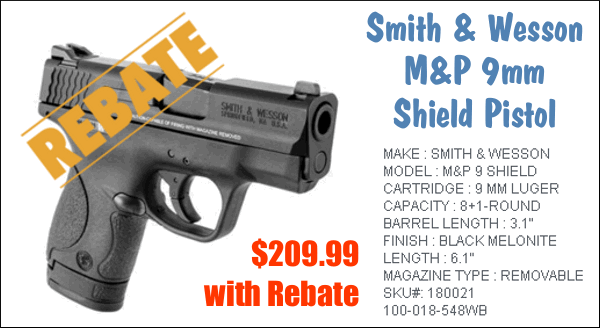
Here’s how you can get a nice Smith & Wesson 9mm (9x19mm Luger) carry pistol for just $209.99. Brownells sells this M&P Shield 9mm pistol for $314.99. Use Code L9Q during online checkout to save $30.00 and get free shipping. That knocks the Brownells price down to $284.99 delivered. But it gets better — Smith & Wesson is offering a $75.00 mail-in rebate. That lowers your net cost to just $209.99 — less than half what you’d pay for a 9mm Glock or HK. Good reason to buy American, and S&W’s warranty is rock solid. Combining Code L9Q with the $75.00 mail-in rebate, your net cost for the M&P 9mm Shield is only $209.99, not counting a $10.00 FFL processing fee.
3. Natchez Shooters Supply — 10% OFF Everything in Stock
Natchez Shooters Supply boasts very competitive “every day” pricing on ammunition, reloading tools, and optics. And now you can get 10% (ten percent) off everything Natchez sells online with no limits, no minimums. This Sitewide 10% Off deal is good through 11:59 pm ET on May 30, 2017. To get the 10% off your order(s), use code 10MEM17 during checkout. We suggest you look at reloading presses, scopes, and hunting gear. The 10% Off, combined with already low pricing, makes for some exceptional bargains. But don’t hesitate — this deal runs out soon. NOTE: Offer is available on INTERNET ORDERS ONLY. Shipping/Handling and Hazmat fees still apply.
4. Amazon — 22000 mAh 3 Port Battery Pack, $36.99
The one item your editor takes on EVERY visit to the range, every business trip, and every holiday is a battery pack with USB outputs. This handy gadget lets me keep my smart phone and other devices charged (it even runs the LabRadar chrono). This new Akeem 22000 mAh portable charger is Amazon’s top new release in this category. It can power up to 3 USB devices at once. A big plus is that it gets fully charged pretty quickly — in 1/3 the time of some other 22000 mAh battery packs. It even has its own solar charging panel. Unfortunately that solar panel is “more show than go”. To get a full internal charge you still MUST plug the Akeem into the wall. Still this is a very popular unit — read the buyer reviews on Amazon. It has a 24-month warranty.
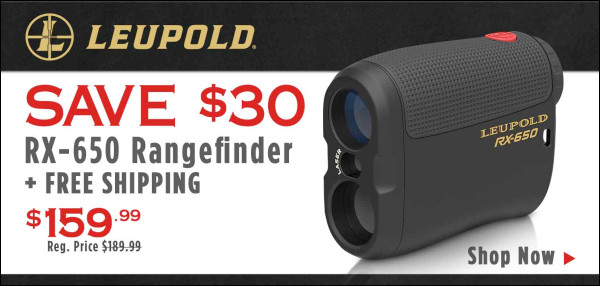
This won’t range small objects at 1000 yards like the very best rangefinders, but then it only costs $159.99. For a typical hunter, this compact little RX-650 Leupold LRF may be all you really need. The money you save (vs. a premium LRF) can buy your next hunting rifle. The unit offers 6X magnification, Scan Mode, and one-click Fast Focus. This week MidwayUSA has the RX-650 for just $159.99 with FREE Shipping. Or get it from Amazon.com for a few bucks more, $164.00 with FREE Shipping.
6. Midsouth — CCI Quiet-22 Rimfire Ammo, $3.49/50 Rounds
Name-brand rimfire ammo is once again available at very affordable prices. This CCI 40gr ammo is just $3.49 for 50 rounds, less than seven cents per round. Rated at a modest 710 fps, the CCI Quiet Ammo is a good choice for shorter-range target work and pistol plinking. The low sound signature also makes it great for shooting with a suppressor. While it should work with most semi-auto rifles, we recommend this for bolt guns. One purchaser writes: “Very quiet and very accurate. Quieter than subsonics and far more accurate than rounds like Colibri. With my CZ trainers and ultralux… they shot approx 3/4″ groups at 50 yards. The rounds drop more than High Vel at 50 yardds and beyond, but that’s pretty easy to compensate for by sighting in the rifle. If used with a suppressor, the sound of the firing pin is louder than the report.”
Here’s the best deal we’ve found on an excellent product in high demand. The Lyman BoreCam is an electro-optical borescope with a digital display. You can record “stills” on a SD card. This is one of the hottest products on the market right now — and users really like the BoreCam (although some wish the digital view-screen was larger). Amazon.com now has the Lyman BoreCam for $199.99. Grab it while you can at that price. Other vendors are charging a LOT more. For example, MidwayUSA’s price is $259.99!
8. Stocky’s Stocks — Composite Stock with Bedding Block, $179.99
Here’s a killer deal on a versatile Stocky’s Long Range Stock with aluminum V-block bedding system. For just $179.99, order this for Rem/Rem Clone long actions or short actions, with either narrow or wide (varmint/tactical) barrel channel. This would be a good choice for a varmint rifle. This is also offered with a matte black, tan, or olive baked-on textured finish for $199.99.
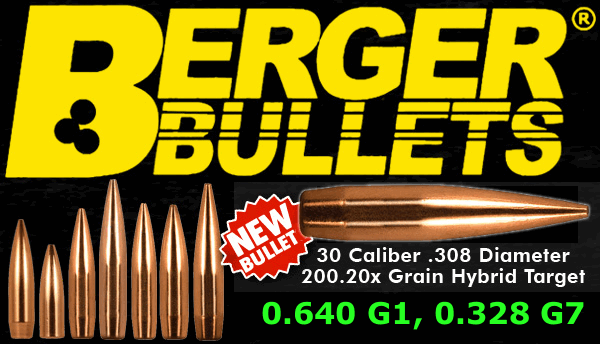
Berger Bullets’ much-awaited 200.20X bullet is now available at Midsouth Shooters Supply for $54.65 per 100*. That’s not inexpensive, but this new design could well prove to be the “bullet to beat” for F-TR competition with the .308 Win cartridge. With a high Ballistic Coefficient (0.640 G1, 0.328 G7), the new 200.20X Hybrid Target projectile (Part #30417) should have less wind drift than other .30-caliber bullets in its weight range. The new 200.20X is even more slippery than Berger’s own older 200gr Hybrid (Part #30427), which has a 0.316 G7 BC. The 200.20X bullet has a shorter bearing surface than Berger’s 200gr Hybrid, which should allow higher velocities, and (perhaps) enhanced barrel life. The shorter bearing surface also makes this bullet easy to load and shoot in standard chambers, which means you don’t need a special long-throated reamer to make it work.
The new 200.20X has a 0.328 G7 BC compared to 0.316 G7 for the older 200 grain .30 caliber Hybrid. That’s a significant, 4% reduction in drag. Recommended twist for the new bullet is 1:10″, same as with the earlier 200-grainer.
Tested and Endorsed by U.S. Rifle Team (F-TR)
Developed with extensive testing by U.S. Rifle Team members, Berger’s new 200.20X bullet is optimized for F-TR competition with the .308 Win cartridge. Compared to the standard 200 grain Hybrid Target, the 200.20X has a longer boat tail, longer nose, and a shorter bearing surface. The longer nose and tail of the 200.20X allow the bullet to fly with less drag and a higher BC, which means fewer points lost to wind. Like other Berger Hybrid designs, this bullet is more “forgiving” about seating depths that pure VLD designs. Shooters should find that the 200.20X works well at various OALs, both “jumped” and seated into the lands. Bryan Litz recommends starting with this bullet .020 or more off the lands. When the bullet is jumped a bit, the accuracy should hold pretty well even as the throat moves out.
After extensive field testing at 600-1000 yards, the U.S. Rifle Team (F-TR) has named the Berger 200.20X as the Team’s official bullet of choice. Shown above are Dan Pohlabel and Bill Litz (shooter).
*Grafs.com ($52.99/100) and PrecisionReloading.com ($53.99/100) will also sell this new bullet, but both these vendors are currently awaiting delivery. We’re told that supplies should arrive soon.
This is a very interesting development. Federal will produce a line of Federal Gold Medal ammunition loaded with Berger Bullets match projectiles and GM Match primers. The new Gold Medal Berger ammo will initially be offered for: .223 Remington, 6.5 Grendel, 6.5 Creedmoor, and .308 Winchester. We expect this ammo to attract the attention of tactical and PRS shooters — Berger projectiles are currently favored by top PRS competitors. Depending on caliber, three different high-BC bullet types will be used: BT Target, Hybrid OTM, or Juggernaut OTM. These all feature a boat-tail design with a high BC for bullet weight. The 6.5 calibers will use Berger’s popular 130gr Berger Hybrid OTM bullet while the .308 Win uses the 185gr Juggernaut.
This new Gold Medal Berger ammo uses Federal Gold Medal match primers, Federal brass, and specially-formulated propellants. All the ammo is well under SAAMI-spec max OALs to function 100% in magazines. Federal says this ammo will “adhere to Federal Premium’s strictest specifications for accuracy, pressure and velocity”. This new GM Berger ammo line could be a match-worthy alternative for guys who don’t want to hand-load. We’re going to try some in 6.5 Creedmoor and see how it performs in terms of accuracy, ES/SD, ballistics, and temp stability. Should be an interesting test…
FEATURES of Gold Medal Berger Ammo:
• Most popular bullets at Precision Rifle Series events
• High ballistic coefficient
• Less wind drift and drop (than typical factory ammo)
• Excellent long-range accuracy
• Gold Medal match primer
A unique, comprehensive Cartridge Comparison Guide is available as a 340-page, spiral-bound book. Covering over 250 cartridges, the updated Second Edition of the Cartridge Comparision Guide is the product of many years of labor by Andrew Chamberlain, a Utah-based hunter. Andrew says his $36.95 Guide “compares every factory available cartridge from the 17 calibers up to the 50 caliber cartridges”. (Sorry, most wildcat cartridges are not covered.) Chamberlain’s Guide also compiles cartridge data from major ammunition manufacturers such as Barnes, Federal, Hornady, Norma, Nosler, Remington, Sierra, Swift, Weatherby, and Winchester. It shows the optimal velocity achieved for each bullet weight and calculates bullet energy, recoil, and powder efficiency. Large color photos illustrate handgun and rifle cartridges.
The Cartridge Comparison Guide provides data for thousands of cartridge/bullet/velocity combos. Quick reference data sheets and ballistics charts cover Trajectory, Velocity, and Energy out to 500 yards. The Cartridge Comparison Guide also offers a firearms lexicon, plus Appendices covering Cartridge Selection for Game Animals, Bullet Selection/Design, Bullet Expansion, Wound Channel Characteristics and more.
New Content in Second Edition of Cartridge Comparison Guide
The Cartridge Comparison Guide (Second Edition) costs $36.95 plus shipping and tax. CLICK HERE to visit the Online Store where you can order the 340-page book. Here’s what’s new in the Second Edition:
Addition of Shotgun Ammunition (Both Slug and Shot loads).
Momentum Calculation for all Rifle, Shotgun and Handgun loads.
Integration of Shotgun Slug Ammunition with Center Fire Rifle Data Tables.
Factory Load Summary Added (Shows manufacturers and loads produced).
One factory load and one hand load for every bullet weight available in each cartridge.
Over 90 pages of additional ballistics content (roughly 35% more than in First Edition).


 .223 Rem — Not A Competitive Option
 Emil Kovan Competition History: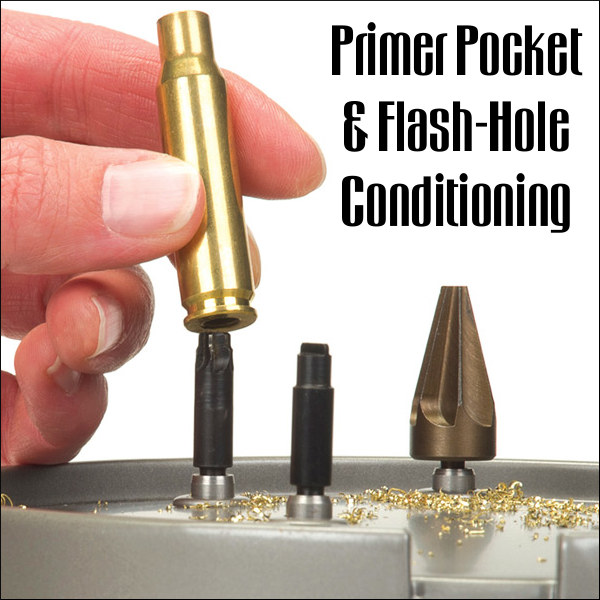

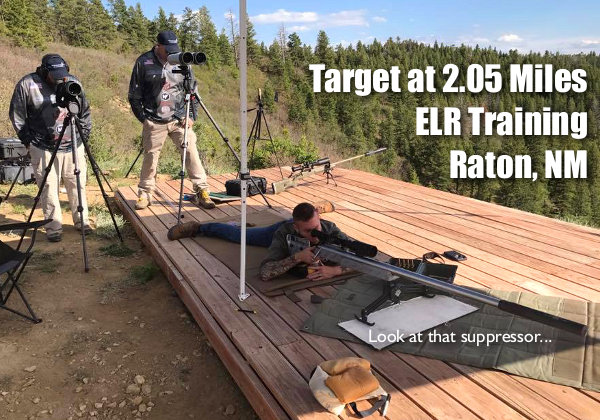
 The Applied Ballistics ELR Team spent the weekend at the NRA Whittington Center in New Mexico training for the upcoming King of 2 Miles event. Former USAMU coach Emil Praslick III was on hand to help with wind calls. The results were impressive — all team members had confirmed hits at 2.05 miles on a 36″x36″ steel target. Bryan Litz even had a 3-shot group that measured 17.5″ x 22″. That’s under 0.6 MOA!











 A unique, comprehensive


