Chart created with Ammoguide’s Visual Comparison Tool. Visit Ammoguide.com to learn more.
One of our forum members was looking for a very accurate, mid-sized 6.5mm cartridge for target working and coyote hunting. There are many great options including the 6.5 Grendel, 6.5×47 Lapua, 6.5 Creedmoor, and Remington .260 (a 6.5-08). If you are considering the 6.5×47 you should read our 6.5×47 Cartridge Guide authored by the 6.5 Guys. This and other 6.5mm cartridges are covered in this introduction to 6.5 mm cartridges prepared by Eben Brown, President of Eabco.com.
Quick Guide to 6.5mm Cartridges
by Eben Brown, EABCO.com, (E. Arthur Brown Co. Inc.)
The current popularity of 6.5mm cartridges in the USA has been a long time in coming. I won’t go into my opinions on why it took so long to catch on. The important thing is that it finally HAS caught on and we’re now so fortunate to have a wide selection of 6.5mm cartridges to choose from!
6.5mm Grendel – Developed by Alexander Arms for the AR15 and military M4 family of rifles. The Grendel fits the dimensional and functional requirements of these rifles while delivering better lethality and downrange performance. [Editor: The little 6.5 Grendel delivers a lot of performance from a small package. This is one of the most accurate cartridge options for the AR15 platform.]
6.5mm BRM – Developed by E. Arthur Brown Company to give “Big Game Performance to Small Framed Rifles” — namely our Model 97D Rifle, TC Contender, and TC Encore. Velocities of 2400-2500 fps with 140gr bullets puts it just under the original 6.5×55 Swede performance.
6.5mm x 47 Lapua – Developed by Lapua specifically for international 300m shooting competitions (with some interest in long-range benchrest as well). Case capacity, body taper, shoulder angle, and small rifle primer are all features requested by top international shooters. You can expect velocities of 2500-2600+ with 140 gr bullets.
6.5mm Creedmoor – Developed by Hornady and Creedmoor Sports, the 6.5mm Creedmoor is designed for efficiency and function. Its shape reaches high velocities while maintaining standard .308 Winchester pressures and its overall length fits well with .308 Win length magazines. You can expect velocities of 2600-2700+ fps with 140gr bullets. [Editor: Yep, we know some PRS guys are loading hotter than that in bolt guns. We recommend you try the 120-130 grain bullets also with this cartridge. That may put you in a better accuracy node.]
This video reviews 6.5 Creedmoor Cartridge Brass options:
.260 Remington – Developed by Remington to compete with the 6.5mmx55 Swedish Mauser that was (finally) gaining popularity in 1996. By necking down the 7mm-08 Remington to 6.5mm (.264 cal), the .260 Remington was created. It fit the same short-action [receivers] that fit .308 Win, .243 Win, 7mm-08 Rem, etc. You can expect velocities of 2600-2700 fps with 140gr bullets in the 260 .Remington.
[Editor’s Note: In the .260 Rem, try the Lapua 120gr Scenar-Ls and/or Berger 130gr VLDs for great accuracy and impressive speeds over 2950 fps.]
6.5mm x 55 Swedish Mauser – This was the cartridge that started the 6.5mm craze in the USA. It is famous for having mild recoil, deadly lethality on even the biggest game animals, and superb accuracy potential. Original ballistics were in the 2500 fps range with 140gr bullets. Nowadays handloaders get 2600-2700+ fps.
[Editor’s Note: Tor from Scandinavia offers this bit of 6.5x55mm history: “Contrary to common belief, the 6.5×55 was not developed by Mauser, but was constructed by a joint Norwegian and Swedish military commission in 1891 and introduced as the standard military cartridge in both countries in 1894. Sweden chose to use the cartridge in a Mauser-based rifle, while Norway used the cartridge in the Krag rifles. This led to two different cartridges the 6.5×55 Krag and 6.5×55 Mauser — the only real difference being safe operating pressure.”]
6.5-284 Norma — This comes from necking the .284 Winchester down to .264 caliber. Norma standardized it for commercial ammo sales. The 6.5mm-284 was very popular for F-Class competition and High Power at 1,000 yards. However, many F-Class competitors have switched to the straight .284 Win for improved barrel life. 6.5-284 velocities run 3000-3100+ fps with 140gr bullets.
.264 Winchester Magnum – Developed by Winchester back in 1959, the .264 Win Mag never really caught on and may have delayed the ultimate acceptance of 6.5mm cartridges by US shooters (in my opinion). It missed the whole point and original advantage of 6.5 mm cartridges.
The Original 6.5mm Advantage
The special needs of long-range competition have skewed things a little. However the original advantages of 6.5mm cartridges — how deadly the 6.5mms are on game animals, how little recoil they produce, and how easy they are to shoot well — still hold true today.
Product Review by F-Class John
Case preparation is critical for precision reloading. One must trim cases, debur/chamfer case mouths, clean necks, spruce up primer pockets and do other important tasks. Complete case prep can involve many separate processes, each requiring its own tools. With each of those tools comes additional cost as well as the need for more storage and bench space. To make case prep easier, faster, and more convenient Lyman created the Case Prep Xpress (#ad). The Case Prep Xpress, introduced a few years back, combines up to five prep stages into one well-built, stable, versatile unit. Watch this video to see the machine in action:
The Case Prep Xpress features five (5) independently-turning spindles all with the common 8/32 thread. This allows you to attach multiple tools supplied with the unit PLUS many other screw-on prep tools. For our testing we started out using a variety of the 12 included tools and found they cover the majority of case prep tasks. Lyman supplies deburr and chamfer tools, pocket uniformers, reamers and cleaners, as well as an assortment of neck brushes.
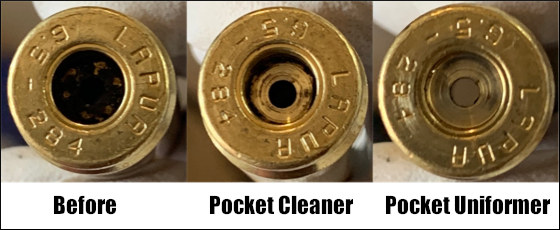
The deburr and chamfer tools worked really well, creating beautiful bevels all while leaving a nice flat edge across the top of the neck which is critical for accuracy and brass life. We found the primer pocket cleaning tool did a good job, but for truly clean pockets we recommend using the primer pocket uniforming tool, which very efficiently removes even hard residues.
The benefit of having interchangeable heads is that you can add your own accessories. We like to use a bore brush with bronze wool wrapped around it for use inside our necks. This worked perfectly once we screwed it in. In fact, we couldn’t think of any 8/32-threaded accessory that wouldn’t work well on this machine. Another great design feature is how all the accessories are oriented straight up. This allows for perfect visual alignment of your cases onto the tools which is critical — especially when performing cutting operations such as primer pocket uniforming.
Along with the five power stations there are six female-threaded storage spots on the sides where tools can be placed to ensure they don’t get lost. We like this feature since there will be more than five accessories you want to use and having them easily available is a great feature. You can keep 11 tools right on the machine (5 on top, 6 on the sides). That way you don’t have to dig through storage bins.
The Case Prep Xpress has a removable front bin to hold brass shavings, and there are two circular trays on either side of the bin. In front is a long tray that holds the provided brush. This makes it relatively easy to clean off brass shavings and other debris from case prep processes.
SUMMARY — Versatile Case Prep Xpress Is A Good Value
For the money, Lyman’s Case Prep Xpress is tough to beat. It performs multiple tasks well while being stable and easy-to-use. Yes there are some multi-spindle prep centers that offer variable or fast/slow RPM spindles while the Lyman’s spindles are all fixed RPM. (See, e.g. the RCBS Brass Boss). However those other systems don’t include all the convenient on-board storage of the Case Prep Xpress, and are typically more expensive. The Lyman Case Prep Xpress sells for about $180-$199 “street price”. It’s currently on sale for $185.85 on Amazon (#ad). This makes the Lyman Case Prep Xpress a good value — it offers great versatility while saving space and saving money compared to buying five or more separate, powered tools.
As an Amazon affiliate, this site can earn revenues through sales commissions.
Every serious shooter needs to know the muzzle velocity (MV) for his load, so he can run ballistics solvers. And very consistent MV with low Extreme Spread (ES) and Standard Deviation SD is vital for consistent long-range shooting. You need good components and reloading techniques for low ES/SD. You want a good, reliable, and consistent chronograph to record your muzzle velocity — there are many good types now, including the compact Garmin Xero C1 and the handy Magnetospeed units which attach to your rifle.
Today we feature a new 55-minute video from Bryan Litz of Applied Ballistics. In this video Bryan explains how to measure muzzle velocity with various chronograph types and then explains some methods for optimizing your ES/SD. Bryan explains: “Muzzle velocity is an important variable for long range shooters. This video covers some key concepts for beginners and also goes into some advanced topics that are not normally encountered to keep it interesting for experienced shooters as well.”
This video from the manufacturer explains how to use the excellent Garmin Xero C1 radar chronograph. This popular new unit has proven to be user-friendly and very reliable. The ultra-compact size makes it easy to transport and deploy at the range.
Get a Good Ballistics App — Consider the NEW AB Quantum App
Once you have recorded your muzzle velocity successfully you can use the MV data with your known bullet BC and range altitude to plot the trajectory of bullet flight. This will tell you the correct scope elevation setting for the distance of your target. We recommend getting a good Ballistics App for your mobile device so you can run ballistics at the range.
Definitely check out the impressive new AB Quantum App from Applied Ballistics. Consumers can now download the AB Quantum App for either iOS (Apple) or Android devices. There is a free basic version, as well as an Elite subscription, which unlocks many more features for just $2.99/month or $19.99/year (see chart below). For more information visit AppliedBallisticsllc.com/ab-quantum.
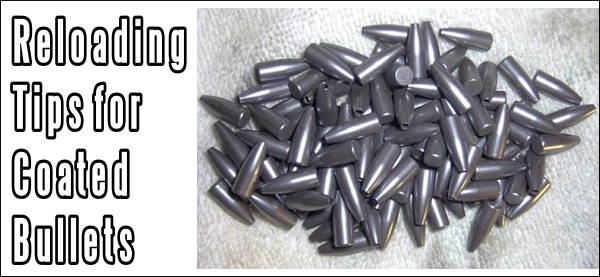
Coating bullets with a friction-reducing compound such as Molybdenum Disulfide (Moly) offers potential benefits, including reduced barrel heat, and being able to shoot longer strings of fire between bore cleanings. One of the effects of reduced friction can be the lessening of internal barrel pressures. This, in turn, means that coated bullets MAY run slower than naked bullets (with charges held equal).
To restore velocities, shooters running coated bullets are inclined to “bump up” the load — but you need to be cautious.
Be Careful When Increasing Loads for Coated Bullets
We caution shooters that when your start out with coated bullets in a “fresh barrel” you should NOT immediately raise the charge weight. It may take a couple dozen coated rounds before the anti-friction coating is distributed through the bore, and you really start to see the reduced pressures. Some guys will automatically add a grain or so to recommended “naked” bullet charge weights when they shoot coated bullets. That’s a risky undertaking.
We recommend that you use “naked” bullet loads for the first dozen coated rounds through a new barrel. Use a chronograph and monitor velocities. It may take up to 30 rounds before you see a reduction in velocity of 30-50 fps that indicates that your anti-friction coating is fully effective.
We have a friend who was recently testing moly-coated 6mm bullets in a 6-6.5×47. Moly had not been used in the barrel before. Our friend had added a grain to his “naked” bullet load, thinking that would compensate for the predicted lower pressures. What he found instead was that his loads were WAY too hot initially. It took 30+ moly-coated rounds through the bore before he saw his velocities drop — a sign that the pressure had lowered due to the moly. For the rounds fired before that point his pressures were too high, and he ended up tossing some expensive Lapua brass into the trash because the primer pockets had expanded excessively.
LESSON: Start low, even with coated bullets. Don’t increase your charge weights (over naked bullet loads) until you have clear evidence of lower pressure and reduced velocity.
Procedure After Barrel Cleaning
If you shoot Moly, and clean the barrel aggressively after a match, you may want to shoot a dozen coated “foulers” before starting your record string. Robert Whitley, who has used Moly in some of his rifles, tells us he liked to have 10-15 coated rounds through the bore before commencing record fire. In a “squeaky-clean” bore, you won’t get the full “benefits” of moly immediately.
To learn more about the properties of dry lubricants for bullets, read our Guide to Coating Bullets. This covers the three most popular bullet coatings: Molybdenum Disulfide (Moly), Tungsten Disulfide (WS2 or ‘Danzac’), and Hexagonal Boron Nitride (HBN). The article discusses the pros and cons of the different bullet coatings and offers step-by-step, illustrated instructions on how to coat your bullets using a tumbler.
At the request of our readers, we provide select “Deals of the Week”. Every Sunday afternoon or Monday morning we offer our Best Bargain selections. Here are some of the best deals on firearms, hardware, reloading components, optics, and shooting accessories. Be aware that sale prices are subject to change, and once clearance inventory is sold, it’s gone for good. You snooze you lose.
NOTE: All listed products are for sale to persons 18 years of age or older. No products are intended for use by minors.
⏺️ Buy good FFP or SFP ZeroTech scopes and get FREE binoculars
ZeroTech makes quality scopes for hunting, PRS/NRL, and general shooting. Currently when you purchase ZeroTech Thrive or Vengeance scopes you can receive a FREE set of ZeroTech Thrive HD binoculars. These 30mm-tube ZeroTech scopes are offered in both FFP and SFP versions with MIL or MOA clicks. There are a variety of reticle types, both illuminated and non-illuminated. Magnification and objective size options include 3-12x44mm, 4-16x50mm, 4-20x50mm, 4-24x50mm, 6-24x50mm, and 5-25x56mm. The FREE ZeroTech Thrive binoculars have retail values from $170 to $230.
2. Midsouth — White River Large Rifle Primers, $79.99
⏺️ Large rifle primers IN STOCK at affordable price
It’s been hard to find large rifle primers at an affordable price lately. If you’ve been waiting for the price of large rifle primers to come down here’s your chance. We found these American-made White River Large Rifle Primers on sale for just $79.99/1000 at Midsouth. These are made to tight tolerances and report from shooters and handloaders have been quite positive.
3. CDNN Sports — Walther P22 Target, $249.55
⏺️ Very good .22 LR Target/Training pistol plus 200 rds FREE Ammo
All shooters should have a quality .22 LR rimfire pistol with a good trigger, ergonomic grip, and excellent accuracy. With the Walther P22 Target Model, you can get all those things for just $249.55 at CDNN Sports, a great deal. Plus you get 200 rds (4 boxes) of FREE Federal .22 LR ammo — a $40 value. The P22 Target pistol is a very nice rimfire handgun with a 5″ barrel plus a forward ported compensator. The ergonomic grip has interchangeable backstraps.
4. Amazon — Frankford Arsenal Universal Bullet Seater, $59.99
⏺️ One affordable seater serves multiple calibers
Are you tired of buying another expensive seating die every time you try a new cartridge type? With the unique Frankford Arsenal Universal Bullet Seating Die you can have one die that loads multiple cartridge types. This clever bullet-seating system includes 3 different stems and 9 sleeves allowing you to seat .224 to .338-caliber bullets with this one multi-caliber tool. Forum members using this system have praised it. NOTE: the universal seating die comes with the .308-caliber sleeve pre-installed.
5. Graf & Sons — Caldwell Bipod Sale
⏺️ Good bipods offered at very attractive prices ($33-$52)
Bipods are useful for varminters, hunters, and tactical shooters. If you need a durable, adjustable bipod at a great price, consider Caldwell Bipods now on sale at Graf & Sons starting at just $33.14. The aluminum design adds minimal weight and deploys quickly, with legs that spring out to the shooting position with the touch of a button. The Caldwell bipod legs are notched for easy indexing to a specific height.
6. Creedmoor Sports — Custom Shooting Mat Sale, $104.95
⏺️ Very high-quality shooting mat now on sale — 30+ colors
A quality shooting mat provides vital comfort and stability when shooting prone. One of the best mats on the market is the Creedmoor Custom Mat, now $104.95 on sale at Creedmoor Sports. This features durable 1000 denier Cordura Nylon with textured non-slip pads for elbow placement. Interior jute padding in the mat provides ample protection for the shooter in all positions. There are many color choices so you can pick an unique color that’s easy to spot on the firing line.
7. Amazon — Caldwell Rock Front Rest, $72.22
⏺️ Low-priced reliable rest that’s good for sighting-in and varmint work
Need a good basic front rest to sight-in a hunting rifle or do load development? Here’s a solid, functional front rifle rest at a great price. The Caldwell The Rock Deluxe Shooting Rest (#ad) adjusts for windage and elevation and is solid and stable. Save with a low $72.22 Amazon sale price. This Caldwell Rest will more than suffice for testing a hunting rifle or basic bench-work. NOTE: REST ONLY — rear bag NOT included.
8. MidwayUSA — Wheeler Gunsmithing Tool Sale
⏺️ Large variety of specialized gun maintenance tools at good prices
When it comes to firearm maintenance it pays to have the right tools or you could damage your parts. Wheeler offers a good line of specialized Wheeler gunsmithing tools. Chose among a wide assortment of firearm tools including barrel vise kits, screwdriver sets, armorer’s kits, scope mounting devices and more. You’ll see a wide range of Wheeler tool sets on sale now at MidwayUSA.
9. Amazon — Frankford Arsenal Wet Tumbler, $78.74
⏺️ Very good smaller tumbler that is efficient and effective
Wet tumbling efficiently cleans cartridge brass inside and out. One of the best modestly-priced wet tumblers is the Frankford Arsenal Rotary Tumbler Lite. (#ad) When combined with stainless steel cleaning pins, this rotary tumbler can work faster than ultrasonic or vibratory tumbling methods. The media pins easily penetrate inside cases to deliver serious cleaning power. This 3.3-liter tumbler is ideal for cleaning small batches of brass and easily fits on any reloading bench.
10. Amazon — Lyman BrassSmith Funnel with Inserts, $31.99
⏺️ Very useful kit we use — avoids powder spills
Having a good powder funnel really helps precision reloading. The Lyman Products Brass Smith Pro Powder Funnel System (#ad) is a great little system. Unlike plastic powder funnels, the aluminum DIE cast body and CNC-turned aluminum caliber-specific inserts are static-free to eliminate powder cling. The precision fit to your case necks eliminates spilled powder. The kit includes six laser-marked, caliber-specific aluminum inserts to fit calibers 22 to 338: .22, .243/6mm, .25/6.5mm, .270/7mm, .30, and .338. The inserts can be quickly and easily interchanged when changing cartridge types.
BONUS: Get $100, $50, or $25 Rebate with Savage Rifle Purchase
Savage Sleigh Full of Savings — Purchase any A or B series Savage rifle and receive $50 Manufacturer’s REBATE. Or purchase any Rascal, 93, 93R17 and MKII and qualify for a $25 REBATE. These qualifying rifles (Promotion #R13262) must be purchased between 12/1/2024 through 12/31/2024. DEADLINE for Mail-In-Rebate (MIR) or online submission is 1/31/2025. CLICK HERE for Rebate Application Form.
There is also a $100 Rebate for Savage Impulse hunting rifles, Promotion #R13373. Purchase any Impulse rifle and receive a $100 Manufacturers REBATE. The Impulse Rifle must be purchased between 11/1/2024 through 12/31/2024, with 1/31/2025 rebate submission deadline. CLICK HERE for Impulse Rebate Form.
As an Amazon affiliate, this site can earn revenues through sales commissions.
With the skyrocketing prices of ammo, more shooters than ever are hand-loading pistol and rifle ammunition. But many novice reloaders tell us that it’s a bit overwhelming in the beginning. Just learning all the technical terms (e.g. ogive, meplat, ballistic coefficient, load density etc.) is difficult, and the task of selecting the right tools and gear can be daunting.
The first thing a new reloader should do is find an experienced reloading mentor. One can learn the basics much more quickly under the guidance of an experienced hand-loader who “knows the ropes”. We also recommend that newbies acquire a good basic reloading handbook — not just a list of load recipes, but a book that explains the processes.
Since the first edition was published in the 1970s, the ABCs of Reloading series has taught countless firearms owners safe/reliable methods for creating their own ammunition. ABCs of Reloading provides beginners what they need to know to get started in reloading. From basic topics such as “How does a cartridge work?” and “What components do I need?” to more advanced discussions of cartridge pressure, headspace, and chrono testing, this is a great resource for new handloaders.
In addition, the sections on advanced reloading and new powders make the new edition valuable for experienced handloaders. And long-range shooters will benefit from the sections on making ultra-consistent ammo and fine-tuning for precision accuracy. Massaro’s coverage of new reloading gear and components is another bonus (shown below is the new RCBS MatchMaster powder dispenser).
Review from purchaser of “The ABCs of Reloading”, 8th Edition:
“When I first got the itch to load my own ammunition, I was overwhelmed by the amount of information and terminology involved in this fascinating field/hobby. It was very difficult to take all the individual pieces of information that I had and form it into an understandable process. I was snowed in under a blizzard of data that I was piecing together through chat rooms and web sites. Phrases like ‘roll crimp’ and ‘headspace’ came at me in a blizzard. I could look up each phrase, understand each one as a piece, but still the whole picture was fuzzy. In essence, that is what this book will do for you — turn it all into a coherent, linear whole. The writing is very solid and clear, the illustrations are well-done and helpful, and the information is very complete. After reading this book, the entire process made sense to me, and more importantly, I was fully warned about the dos and don’ts of the reloading world. The coverage is very complete. Primers, powders, bullets, and … all necessary tools and accessories are discussed and explained. This is just a great book. It won’t make you an expert … but it will put you on the right road if you wish to become one.” — Mykal Banta
Close-up view of a sectioned case. This one here was “fixin’ to pop”, observed Glen Zediker.
Here are highlights from an article Glen Zediker wrote for the Midsouth Blog. In that article Glen, who sadly passed away in 2020, focused on cartridge brass. Glen identified the most common failures that appear with brass that has been shot multiple times, or which has been fired at excessive pressures. Glen explained some simple ways to check your cartridge brass to detect “early warning signs” of case failure, particularly case head separation, which can be very dangerous.
How Cases Degrade with Multiple Firings By Glen Zediker
This article explains when, and then how, to check after the progress of changes commencing with the firing on a new case. It’s the “progress of degeneration,” in a way of looking at it because the concern is getting a handle on when enough change in the brass has come about to require attention. Or abandonment. As said then, for me that’s 4 firings. That, as said last time, is when I might see changes that need attention. Also as said, that figure didn’t come out of a hat, but from my own notes in running my competition NRA High Power Rifle loads. [Editor’s Note: With Lapua brass, using moderate loads, in bolt-action rifles, we typically get about 10 good (match-worthy) firings. But if you anneal your Lapua brass, and run modest pressures, Lapua brass can perform well for 20 or more load cycles.]
The areas most affected are the case neck and case head area. Case neck walls get thicker [but] the case head area body walls get thinner. Primer pockets get shallower and larger diameter.
This case shows a cracked neck AND a crack (separation) above the case head. Zediker says it is “rare to see one case with both of the most common failures. [This case] was attacked by an M14.”
Case Head — Causes of Separation and Cracking
When a case is under pressure during firing, the brass, like water, flows where it can, where it’s more free to move. Of course, the chamber steel limits the amount it can expand. The case shoulder blows fully forward and the case base is slammed back against the bolt face. There is, therefore and in effect, a tug on both ends — it gets stretched. The shoulder area is relatively free to expand to conform to the chamber, but the other end, the case head area, is not. Since that’s the area of the case with the thickest walls, it doesn’t expand “out” much at all. What it does is stretch. The “case head area,” as I refer to it here, is the portion of the case above the web, which is just above the taper that leads in to the extractor groove. The “area” extends approximately an eighth-inch up the case body.
Here’s a “pressure ring.” You’ll see this after firing, if you see it. And, if you see it, that case is done. The bright ring indicates excessive stretching, which indicates excessive thinning. If you see a ring circling the case, noticeable because it’s lighter color than the case body, and it’s in this area, I’d say that case is done. And that’s right where a “head separation” occurs. It can crack and also blow slap in two, and that’s the “separation” part of case head separation.
Photo courtesy GS Arizona.
This is a spot to keep close watch on as cases age. It is also the area that is more “protected” by sizing with less case shoulder set-back. That is, pretty much, where the freedom for the stretching movement in this area comes from (the case shoulder creates a gap). If you’re seeing a sign that a head separation [might happen with relatively few firings], chances are the shoulder set-back is excessive, and also… the load pressure level.
Bent Paper Clip Case-Wall Gauge
Editor: You can use a bent paper clip to detect potential case wall problems. Slide the paper clip inside your case to check for thin spots. GS Arizona explains: “This simple little tool (bent paper clip) will let you check the inside of cases before you reload them. The thin spot will be immediately apparent as you run the clip up the inside of the case. If you’re seeing a shiny line on the outside and the clip is really hitting a thin spot inside, it’s time to retire the case.” Photo by GS Arizona.
Monitor Primer Pocket Dimensional Changes
Another case-head-area and pressure-related check is the primer pocket. As said, the primer pocket will get larger in diameter and shallower in depth each firing. As with many such things, the questions are “when” and “how much,” and the main thing, “how much?”
If the pocket gets excessively shallow, and that’s judged by a primer that seats fully but isn’t at least a tick below flush with the case base, there could be function issues. There’s a risk of a “slam-fire” with a semi-auto that uses a floating firing pin, and, if there is actual protrusion, that has the same effect as insufficient headspace. A primer pocket uniformer can reset the depth of a shallowed primer pocket to what it should be, but the real test for me is how easily the next primer seats into it. If it’s significantly less resistance, I’ll say that case is done. Shallower can be refurbished. That’s a primary function of a primer pocket uniformer. Larger diameter, though, can’t be fixed. I’ve mentioned in another article or two that, any more at least, my main gauge of load pressure has become how much primer pocket expansion there’s been.
Applied Ballistics has released powerful new ballistics software, the Applied Ballistics Quantum™ App. This state-of-the-art mobile App provides a complete ballistics solver plus profile management tool for long-range shooting. Featuring an all-new user interface, AB Quantum™ includes a host of new tools and features for competitive shooters and hunters.
“Ballistics can be complicated, and it is our job to simplify what’s important so that shooters can hit targets”, said Applied Ballistics Founder/Chief Ballistician Bryan Litz. “The AB Quantum platform meets this goal and more. By integrating the ballistic solver with other support tools, shooters will have a complete management system to … put rounds on target faster and easier than ever before.”
Applied Ballistics Chief Technology Officer Nick Vitalbo said that the goal was “to create the most intuitive, feature-rich ballistics application on the market, seamlessly integrating with the entire Applied Ballistics ecosystem of products. AB Quantum™ will be our flagship platform, driving the future of AB-integrated devices [and transforming] the way [customers] use their existing AB-enabled products.”
Quantum™ Ballistics App — New Features Overview
AB Quantum™ creates a new paradigm for ballistic solvers and integration with Bluetooth®-enabled devices. With a host of new features, the platform is designed to save time and add performance for users of all skill levels. The all-new user interface is designed with single-handed use in mind, putting all major features just a swipe or tap away from any screen, which allows users to rapidly obtain solutions in the field or at a match. The simplicity and versatility of the app interface creates an intuitive experience for both new and experienced users.
Two new features — AB Quantum Connect™ and AB Quantum Sync™ — enable users to quickly connect to other AB-enabled devices and sync gun profiles between them in seconds, as well as back those profiles up to an encrypted server for peace of mind and easy restoration. The new platform automatically saves changes made to rifle profiles and updates connected devices. AB Quantum™ also includes customizable Range and Multi-Target tables. After creating a range or target card, it can easily be shared via email.
AB Quantum™ platform has impressive, innovative features:
● AB Quantum™ User Interface — Take control of ballistic data and find solutions with ease using the new layout designed with one-handed operation in mind.
● New Bluetooth® Device Manager — Find and connect AB Bluetooth® devices quickly and send data
between devices using AB Quantum Connect™.
● AB Quantum Sync™ — User gun profiles are automatically uploaded to an encrypted server to allow easy access for other devices and backup, providing peace of mind and security.
● Customizable Range Card and Target Card Modes — The new expandable and customizable range and
target card modes allow users to select what data to see for each Range or Target. Use the share function to send range and data cards in just seconds.
● New Reticle Library — The AB Reticle library is hosted online and updates in AB Quantum™ automatically, providing users with up-to-date solution drawing for their favorite rifle scopes.
● Improved Truing Interface — Easy to access ballistic truing features without leaving solution screens.
● Chronograph Integration — Connect Bluetooth®-enabled chronographs – such as the Optex Systems
SpeedTracker™ – directly to the App and save the velocity data to rifle profiles.
The acclaimed Applied Ballistics Bullet Library is a good example of simplification for shooters: it includes thousands of projectile models that have been built using Doppler Radar to create a Custom Drag Model (CDM) for each bullet. This library is a core feature of the AB Quantum™ App, giving users the fastest way to create accurate and precise solutions for any environment.
Consumers can now download the AB Quantum App from iOS or Android app stores. There is a free basic version, as well as an Elite subscription, which unlocks many more features for just $2.99/month or $19.99/year (see chart below). For more information visit AppliedBallisticsllc.com/ab-quantum/.
About Applied Ballistics
Applied Ballistics provides ballistics data and software solutions for shooters, hunters and industry partners. Offering books, online training, and advanced ballistics software, Applied Ballistics is dedicated to delivering accurate, unbiased ballistics information and solutions.
Along with the 20 Monday Deals featured here, some major vendors are offering site-wide specials today, Cyber Monday, December 2, 2024. You can get FREE Shipping or FREE Hazmat. In addition, Natchez is running major discounts for the next full week through December 8, 2024. Check out these specials:
Natchez is running a major Cyber Week Sale all this week from 12/2/24 to 12/8/2024. There are discounts up to 70% Off for outdoor gear and shooting accessories. Visit NatchezSS.com for Cyber Week Savings on a vast selection of outdoor gear and shooing products — including ammo — with savings up to 70% off! NOTE: For today only, Monday December 2, 2024 you can also get FREE Shipping with orders of $99.99 or more. Use Code FS241129 for FREE Shipping.
At Sportsman’s Guide, use coupon code SG4124 at checkout to receive 15% off your entire purchase> This works for nearly everything on the site, but with these exclusions: Buyer’s Club Membership fees, Ammo, Firearms, Trolling Motors, Electronics, Night Vision Optics, Generators, Doorbusters, and Bullseye deal items. 50 maximum coupon value. The coupon cannot be combined with any other coupons and cannot be redeemed for cash. Offer expires December 3, 2024.
Get FREE HAZMAT today at Powder Valley Outdoors with an order of $99 or more. Valid Monday, December 2nd only! NOTE: This promotion excludes dealers and cannot be combined with any other offer. Order value is based on $99 of hazardous materials from the following categories: Black Powder, Powder Substitutes, Primers, and Percussion Caps.
EuroOptic is running many CyberWeek and December promotions right now. Some of the deals conclude today 12/2/2024, but other promotions run through 12/8 or even through the end of the month. If you are shopping for a premium optic or a hunting rifle, head over to EuroOptic.com today.
Today, Monday December 2, 2024, Precision Reloading is offering $5 Flat-Rate Shipping on all orders of $99 or more. Use Discount Code SHIP5 at checkout to take advantage of this one-day discount.
This is a grim tale. A man almost lost the use of his right hand, and did suffer terrible injuries to his fingers. All because he picked the wrong bottle of powder off the shelf. We have run this story before, and we will continue to run it every year, as a caution to our readers. This mistake is easy to make, but the consequences can be dire. Always, always double-check your powder labels before you start the hand-loading process. If you don’t, you may not have a hand to load with next time…
Similar Labels, Disasterous Consequences
The shooter, Denny K., was assembling some rounds for his brand new 7mm-08 Savage hunting rifle. He thought he was loading with Hodgdon Varget. Instead he had filled his powder measure with Hodgdon TiteGroup, a fast-burning pistol powder. The labels are similar, so the mistake is understandable. But the results were devastating. Here’s what 41 grains of TiteGroup can do in a 7mm-08:
Posting on the Firing Line, in a thread entitled “Lucky to Be Alive”, Denny writes:
“This is the hardest post to post. I know if I had read it a week ago my comment would have been: ‘You have no business reloading’. I had everything perfect, except pouring the wrong powder in the powder measure. I type this slowly with my left hand, embarrassed but … possibly saving someone else a tragedy or, like me, a long drive to the Emergency Room and surgery to save my finger.”
The Still-Sealed Bottle of Varget
Denny did not initially comprehend exactly why the kaboom happened. He thought maybe his new Savage rifle was at fault. Then, on his return home, he discovered something…
Denny wrote: “The seven-hour period it took to go to ER, transport to Trauma Center and surgery made me think it was a Savage rifle issue. Brand new rifle, new brass, triple-checked loading data. The next day I was humbled when I realized the Varget powder was still sealed.
I knew what powder to use. I thought [Varget] was what I used. Not until the following day did I realize the Varget was still sealed.”
At that point, Denny realized what caused the accident — “operator error”. He knew he had to warn others about using the wrong powder: “I knew I needed to share my mistake, even though it is embarrassing, just to remind people. I’ve been reloading for 30 years…”
Editor’s Comment: Denny was not a novice reloader. His experience demonstrates that this kind of mistake can be made by any hand-loader, even one with decades of experience. Be safe guys, take your time when you load your ammo. Remove powders from measures after your loading sessions (pistol powders can look very similar to rifle powders). And by all means CHECK the LABEL on the jug. As the TiteGroup label says: “A little goes a long way.”
It’s not a bad idea to separate your pistol powders from your rifle powders, or perhaps even load for pistol in a separate part of your workshop.


 .260 Remington – Developed by Remington to compete with the 6.5mmx55 Swedish Mauser that was (finally) gaining popularity in 1996. By necking down the 7mm-08 Remington to 6.5mm (.264 cal), the .260 Remington was created. It fit the same short-action [receivers] that fit .308 Win, .243 Win, 7mm-08 Rem, etc. You can expect velocities of 2600-2700 fps with 140gr bullets in the 260 .Remington.