Want to see a bullet hit a target in ultra-slow motion? Watch this video to witness some amazing things — such as a bullet jacket peeling back like a banana-skin (at time-mark 7:30). A while back, Germany’s Werner Mehl produced this remarkable 10-minute video for the NSSF SHOT Show. This video has has been watched over 15.6 million times, making it one of the most popular shooting-related videos in history. Employing cameras recording at up to 1,000,000 (one million) frames per second, Mehl’s bullet flight video has been called “astounding” and “mesmerizing”. If you haven’t seen it yet, sit back and enjoy!
Watch This Video! It’s Really Something Special…
This remarkable 1 million Frame Per Second video by Werner has over 15,600,000 YouTube Views with 77,000+ likes. It is one of the best high-speed bullet impact videos ever created.
Starline Brass offers a series of videos with helpful reloading tips. Focused primarily on pistol cartridges, these short videos can help anyone get started with metallic cartridge reloading. If you load pistol rounds on a progressive, this video series is particularly helpful. The on-camera host is Hunter Pilant, son of Carroll Pilant of Sierra Bullets.
Preventing Double Charges
Tip: Use a bulky powder that fills your case more than half way with a correct charge. This will overfill the case if it is double-charged, making it very difficult to seat a bullet.
Tumble New Brass Before Loading the First Time
Tip: Tumble new pistol cartridge brass in used media for 30 minutes before loading for the first time. This will add enough graphite (carbon residue) to smooth case entry into dies. You can also lube the case mouths with graphite, or use spray lube.
Powder Through Expander — How to Eliminate Hang-ups
Tip: When loading pistol brass with a progressive press, sometime the powder-through expander is hard to remove, especially with short cases. There are two fixes — first, try deburring the inside of the case mouth on your cases. Second, the radius of the powder through expander plug can be modified to smooth entry and exit (see photo). Starline will do this modification for free.
Have you ever expanded a .22 or 6mm cartridge all the way up to .30-caliber? If so, you know this can be a difficult procedure that stresses the case necks and neck-shoulder junction. A significant neck-size expansion done in one big jump can increase run-out, cause doughnuts, or worse yet, even split the brass. Therefore you want to proceed in increments, increasing the neck diameter in stages. One smart way to do that is to use a Progressive Press. This article explains how…
The most successful short-range benchrest-for-score cartridge is the 30 BR. That cartridge, as well as 30 BR variants such as the 30 BRX, all start with the 6mmBR Norma parent cartridge, typically with Lapua 6mmBR brass. To get a nice 30 BR case you want to expand in stages, increasing the inside neck diameter incrementally from .243 to .308.
Darrell Jones of DJ’s Brass Service creates thousands of 30 BR cases each year. He has found a clever way to speed up the process — Darrell uses a Progressive Press. He runs his 6BR brass through four (4) separate Hornady neck-sizing dies with expander mandrels. First there is a .257 die, followed by .264 (6.5mm), .284 (7mm), and then .308. Then a fifth and final K&M die provides one last, slight expansion so the newly-fashioned 30 BR cases perfectly fit the arbor of Darrell’s neck-turning tool.
So to repeat, the case starts as .243 (6mm), then moves in up stages .257, .264, .284, and .308, with a final “finishing” step prior to neck-turning. You can see the expansion in this video, which starts with 6mmBR brass that was first hydro-formed to 6 BRX:
Watch 6mm Cases Expanded to 30-Caliber (6BRX to 30 BRX)
For this demo video, Darrell expands just one case at a time. However, he can also put multiple cases in the progressive — one per station. This takes a little more effort, Darrell says, but the results are still excellent. Darrell tells us: “I do put multiple cases in the progressive to save time. The results are the same — I just wanted to show a single-step process and how it reduces run-out by not stressing the shoulder with one big expansion from 6mm straight to 30 caliber. Doing the operation in multiple stages avoids binds and helps keep the shoulders concentric.”
This same multi-stage procedure can be use to expand other cartridge types. For example you could take .221 Fireball brass in stages up to .308 to create 300 Blackout brass.
Darrell uses caliber-specific, Hornady neck-sizing-only dies with elliptical expanders. Darrell tells us: “The Hornady elliptical expander has a reduced bearing surface that puts less strain on the brass when expanding the necks to the next size.” The fitting at the bottom of the die is the Lock-N-Load die bushing that allows fast die changes.
These particular cases used in the video were first hydro-formed to 6BRX then expanded to 30 BRX before neck turning. DJ’s Brass offers hydro-forming for many popular wildcat cartridges such as 6 PPC, 6mm Dasher, and .284 Shehane.
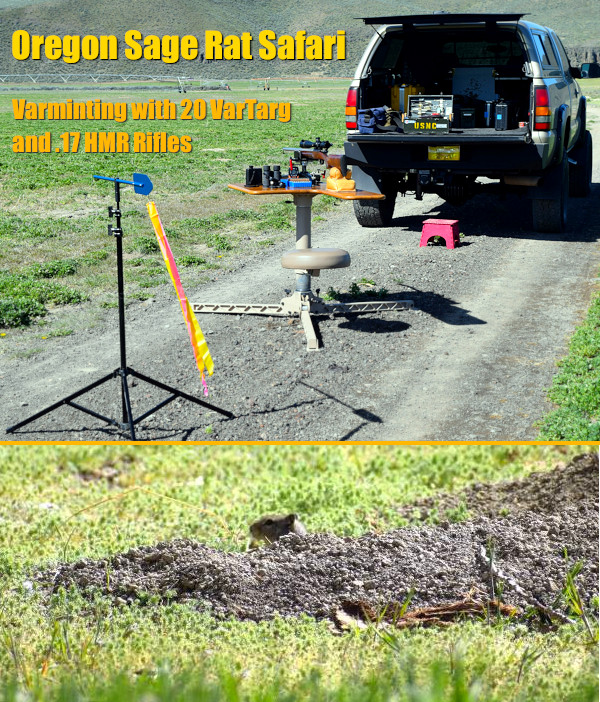
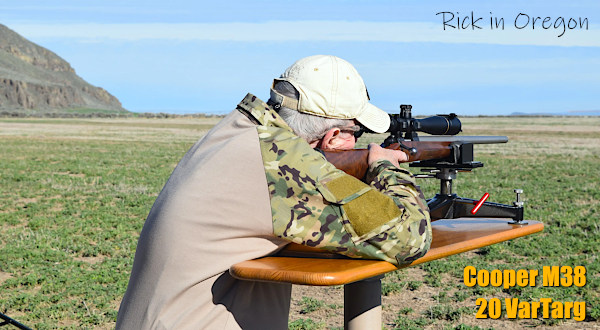
Our AccurateShooter.com Forum has an active section for hunting and varminting. One of the notable varminting threads in recent weeks was an account of a varmint hunt in Eastern Oregon. Forum member “Rick in Oregon” spent a week this past April nailing small varmints — known as “Sage Rats”, aka Belding ground squirrels (Urocitellus beldingi). Rick did most of his shooting with his handsome Cooper M38 rifle chambered for the 20 VarTarg wildcat, which is basically a .221 Fireball case necked down to .20 caliber. Here is Rick’s report on his successful Sage Rat Safari.
Forum member Rick in Oregon with his 20 VarTarg Cooper M38 rifle.
We just returned from a week-long sage rat shoot in the Orygun outback. Decent weather this time, no blowing snow, just plenty of sunshine and our buddy “Skippy the Flying Squirrel” to enhance our shooting enjoyment. Our rancher host refuses to use poison, so he welcomes us with the ability to hook our trailers to power and water, and a nice place to park them while we rid him of his sage rat problem. A true win-win situation for all. Out of respect for the rancher, we did not drive out into the fields. Instead we parked on the perimeter two-tracks, placed our portable benches, set up our windflags, then had at it.
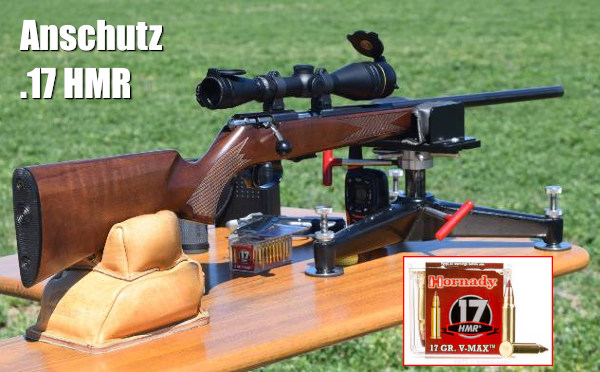
For shooting these small critters, you need accurate rifles that shoot less than 0.5 MOA. The sage rats are small and they may be partially concealed inside their relatively flat mounds. I took my custom M700 .204 Match 1:11-twist rifle, but there were no long range opportunities to justify burning over 25 grains of powder, as no elevated positions were available to take advantage of it. Shooting from the flat terrain gets much mirage, making any hits past 350 yards virtually impossible, so my 20 VarTarg got the most action out to 350 yards. Then inside of 200 yards I used my Anschutz 1715D HB in .17 HMR which did a very fine job of rat launching.
Rick is a definite 20 VarTarg devotee: “For years I thought my .223 AI was the ideal Prairie Dog cartridge. It may well be, but for sage rats, the 20 VarTarg has few equals when efficiency and performance is considered. This makes 15 years of 20 VT sage rat medicine for me, and I do not see any changes on the horizon. It also works quite well on rockchucks!”
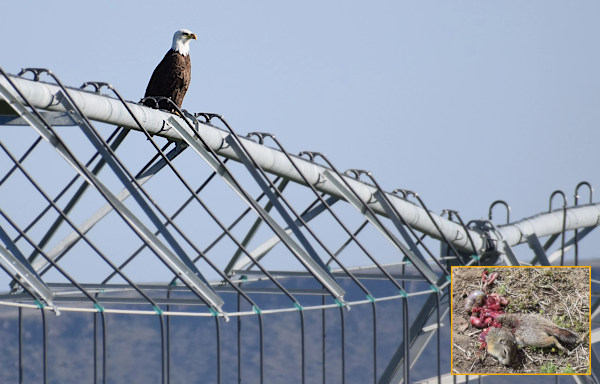
As usual when the “Eastern Oregon Raptor Feeding Society” shows up, so do the raptors. In fact bald eagles, golden eagles, hawks, and ravens all feast on the generous sage rat meals we provide. The terminal effects of the .20-Cal 32-grain bullets can’t be overstated. It sure makes it easy for the birds to do their thing. CLICK HERE for dead critter “blood and guts” close-up photo.
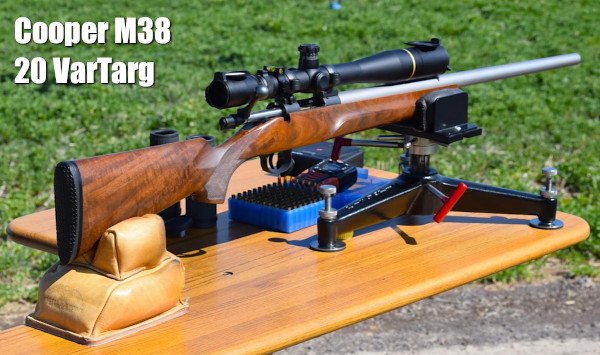
Above is Rick’s Cooper M38 chambered for the 20 VarTarg wildcat on his rotating field bench. Rick tells us: “My Cooper M38 VR 20 VarTarg is basically a stock offering from Cooper Firearms of Montana with a Jard 10 oz. trigger added. The barrel is a 1:12-twist 24″ Wilson chambered by Cooper. The bedding was perfect so I have not touched it in that regard.”
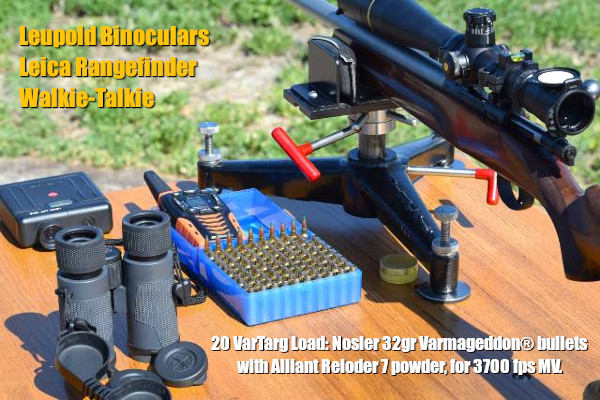
Rick’s load with Nosler 32gr Varmageddon bullets runs 3680 FPS — wicked fast. He loads Alliant Reloder 7 in Lapua or Nosler brass with Rem 7½ primers. Rick says this rig is VERY accurate, delivering groups in the sub-quarter-MOA range.
The scope is a Leupold VX3 6.5-20x40mm LR, with Varmint Hunter Reticle, factory-installed M1 elevation turret, EGW scope level, carried in Leupold rings. Rick notes: “My come-up chart in the scope’s ocular cover was developed using Sierra Infinity ballistics software based on my actual load. The chart has proven to be deadly spot-on at all suitable ranges I encounter the rats and rockchucks.”
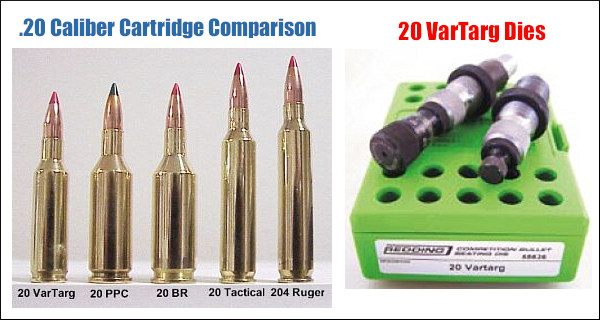
EDITOR: The 20 VarTarg cartridge is based on the .221 Fireball case, necked down to .204 and slightly modified for extra capacity. This very efficient cartridge offers low recoil and great accuracy. It’s one of our first choices for ground squirrels and P-dogs out to 300 yards.
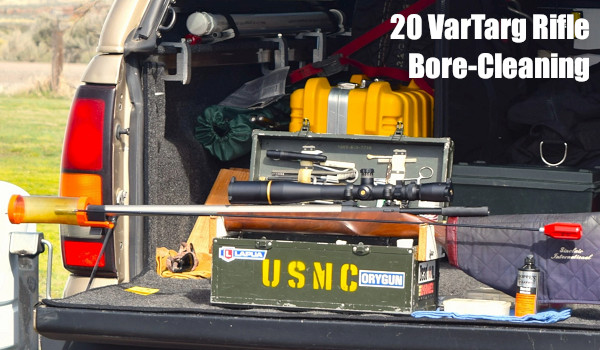
Tailgate Cleaning Set-Up — Brush That Barrel Back at Camp
Rick notes: “When the winds get up, cleaning in the field is problematic, blowing patches about, so cleaning back at camp on the tailgate is the hot setup.”
Anschutz 1715D HB in .17 HMR
For shots inside 200 yards, the .17 HMR works well. Rick notes: “The little ones were out, so inside of 200 yards, my Anschutz .17 HMR was the perfect medicine for that work. It really thumps those guys [doing] a very fine job of rat-launching.”
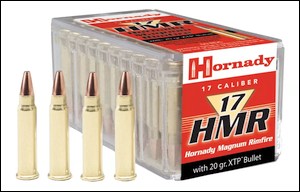
The .17 Hornady Magnum Rimfire (HMR) The .17 Hornady Magnum Rimfire (HMR) was introduced in 2002 by Hornady as a high-velocity, rimfire cartridge derived from the .22 Magnum case necked down to .17-caliber. The .17 HMR gained popularity among varmint hunters and target shooters for its good accuracy and hitting power out to 200 yards or more — all with low recoil and relatively low cost (compared to centerfire ammo).
Most .17 HMR ammo runs 17-grain or 20-grain hollow-point or plastic-tipped bullets at speeds around 2375-2550 FPS (lower for 20-grainers). Though lightweight, these small projectiles do deliver a powerful impact on small game while maintaining low recoil. Compared to the .22 LR, the .17 HMR offers superior ballistic performance, with flatter trajectories and higher energy at extended distances. It’s good for shooting prairie dogs, ground squirrels, sage rats, and other small critters.
During his sage rat safari in Oregon, Rick stayed in his trailer (see above). Rick noted that one critter “was frolicking about my trailer, so he made a good subject for a 300mm telephoto lens, shot out my dinette window. I can never get that close to them when in the field.”
The .17 Hornady Magnum Rimfire (HMR) was introduced in 2002 by Hornady as a high-velocity, rimfire cartridge derived from the .22 Magnum case necked down to .17-caliber. Designed for precision and flat trajectory, the .17 HMR gained popularity among varmint hunters and target shooters for its good accuracy and hitting power out to 200 yards or more. Standard .17 HMR ammo typically fires a 17-grain V-MAX or TNT hollow point bullet at speeds around 2550 FPS, offering explosive impact on small game while maintaining low recoil.
Compared to other rimfire cartridges like the .22 LR or .22 WMR, the .17 HMR offers superior ballistic performance, including flatter trajectories and higher energy at extended distances. It’s good for shooting prairie dogs, ground squirrels, rabbits, and even coyotes under the right conditions. While not as powerful as some centerfire varmint rounds, its blend of affordability, velocity, and accuracy makes the .17 HMR an outstanding choice for precision-minded rimfire shooters. Popular manufacturers like CCI, Hornady, Winchester, and Federal produce a wide variety of loadings, from polymer-tipped hunting rounds to jacketed hollow points, making it easy to tailor your ammo choice to your specific shooting needs.
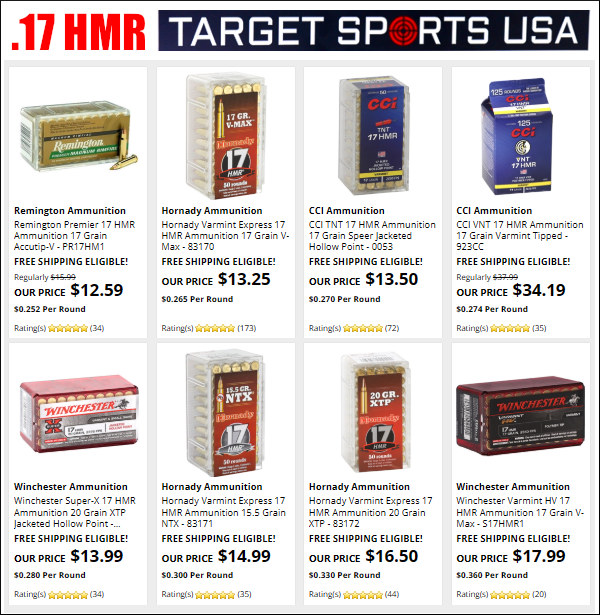
.17 HMR Ammo DEALS — CCI, Hornady, Remington, Winchester
Things to Know about .17 HMR Ammunition
Bullet Type & Weight: The standard bullet weight for .17 HMR is 17 grains, with options up to 20 grains for improved wind resistance and penetration. Polymer-tipped bullets expand rapidly on impact, while jacketed hollow points (JHP) offer deeper penetration.
Which is more powerful, .22 Mag or .17 HMR? While the .22 WMR (Magnum) may offer slightly more raw energy, .17 HMR delivers superior velocity and flatter trajectory, giving it better accuracy at long distances. For precision shooting, .17 HMR generally has the edge.
How does .17 HMR ammo compare to other rimfire cartridges? Compared to .22 LR or .22 WMR, .17 HMR shoots flatter, faster (typically 2500+ fps), and with greater accuracy at extended distances. It’s a top choice for rimfire shooters who demand high performance beyond 100 yards.
What is the effective range of .17 HMR? Good .17 HMR ammo is highly accurate up to 150–200 yards for small game and varmints. Some experienced shooters can push it beyond 200 yards with the right optics and wind conditions.
What is the best barrel length for .17 HMR rifles? A barrel length between 20–22 inches is optimal for .17 HMR, balancing velocity, maneuverability, and accuracy. Shorter barrels are lighter but may lose some velocity, while longer barrels offer slightly better ballistics at the cost of weight.
Is the .17 HMR good for beginners? Yes .17 HMR has low recoil, flat trajectory, and simple handling for new shooters. It’s an easy-shooting round that offers good performance with low recoil.
Today’s Saturday Video Showcase features informative videos about loading at the range. AccurateShooter.com contributor F-Class John shows efficient procedures for load development at the range, testing both powder charge and seating depth. And Ultimate Reloader’s Gavin Gear shows how to load in the field with a mechanical powder dispenser, small scale, and a high-tech hand press. We also include a video from a benchrest competitor in France loading his 6PPC, plus tips for loading at the range by Glen Zediker, author of the Handloading for Competition book.
Reloading at the Range with F-Class John
This excellent 25-minute video covers all aspects of loading at the range — case sizing, powder measuring/dispensing, priming, bullet seating and more. In the video, F-Class John also talks about transport of tools and how to develop loads at the range, as you test different powder charges and seating depths. Viewers have praised this video as one of F-Class John’s best ever. John employs a compact RCBS Summit press and an RCBS ChargeMaster. Highlights by time: 6:14 powder test with grain increments; 14:30 setting depth test; 16:18 test fire seating depth; 18:31 refine seating depth; 20:52 refined seating depth firing; 22:32 “take away” commentary.
Design and Function of Open Front RCBS Summit Press
Unlike other presses, the open front RCBS Summit moves the die up and down while the cartridge case remains stationary. The ambidextrous open-front design allows great access to your cases, and you can quickly change dies very quickly. The Summit has an all-steel linkage and cast iron frame. The Summit also offers compound leverage, a massive 2-inch diameter ram, full access through the front, a press adapter bushing, spent primer catcher, and wide 4.5-inch operating window for convenient access.
Ultimate Reloader Video of Loading at the Range
Sometimes the ONLY practical solution for load development is loading ammunition at the range. In this video Ultimate Reloader’s Gavin Gear demonstrates the loading process from start to finish, and covers what gear is required to “load where you shoot”. This applies to both loading at a covered range and loading in the field. In the video Gavin employs a bench-attached powder thrower and the impressive ($300) Buchanan Precision Machine (BPM) hand press.
Loading Between Matches — Precision Loading at a Pace
In this video, French benchrest competitor Carlos Pacheco loads ammo efficiently between relays at a Benchrest for Group match. He has a single-stage press clamped to a bench, and has a separate arbor press for bullet seating. 6PPC group-shooting competitors commonly tune their loads during the course of the competition, adjusting powder volumes to keep their rifles in optimal tune. Some competitors may also change bullet seating depth, but “tuning” is most commonly done with powder charge. Some benchrest-for-group competitors also believe that best accuracy is achieve with freshly-made ammo loaded before the brass necks take a set.
Loading at the Range — Then and Now
In benchrest shooting for Group, loading at the range has been de rigueur for decades. In the Score discipline, preloading is usually the custom. The main reason is that, in Score competition, only one Aggregate (warm-up match and five record targets) per day is usually shot. That would be less than 50 shots, assuming a few sighter shots. Also, the 30BR, the dominant Benchrest-for-Score cartridge, is very amenable to pre-loading.
By contrast, the Group discipline includes 21 targets (two warm-ups and twenty record targets) over a weekend, usually shot with 6PPC-chambered rifles. Many times, the 6PPC shooters may tweak their loads through the day given changing atmospheric conditions or simply trying to find the correct tune to “dot up”. This term, “Dot up”, means the shots are essentially going through the same hole, or closely so.
Loading at the range was a bit different when benchrest competition was in its infancy. The 1951 book, Modern Accuracy by Bob Wallack, is the best of the early benchrest books. Copies can be found, from time to time, on eBay or Alibris. It is a fascinating survey of benchrest as it existed more than six decades ago. In it, there is a photo of Wallack using the rear bumper of a car at the bench to clamp his reloading tools. Things have come a long way compared to the range loading set-ups of modern shooters. Here you can see Bob Wallack way back in 1950:
Good Article on Reloading at the Range by Glen Zediker
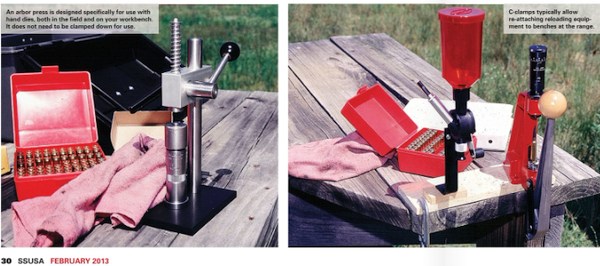
The February 2013 edition of Shooting Sports USA magazine has an interesting feature by Glen Zediker, who sadly passed away in October 2020. In this Transporting Success, Part I article, Zediker explains the advantages of loading at the range when you are developing new loads or tuning existing loads. Glen, the author of the popular Handloading for Competition book, discusses the gear you’ll need to bring and he explains his load development procedure. In discussing reloading at the range, Glen focuses on throwing powder and seating bullets, because he normally brings enough sized-and-primed brass to the range with him, so he doesn’t need to de-prime, re-size, and then re-prime his cases.
Zediker writes: “Testing at the range provides the opportunity to be thorough and flexible. You also have the opportunity to do more testing under more similar conditions and, therefore, get results that are more telling. Once you are there, you can stay there until you get the results you want. No more waiting until next time.”
Zediker starts with three-shot groups: “I usually load and fire three samples [with] a new combination. I’ll then increase propellant charge… based on the results of those three rounds, and try three more. I know that three rounds is hardly a test, but if it looks bad on that few, it’s not going to get any better.”
Glen reminds readers to record their data: “Probably the most important piece of equipment is your notebook! No kidding. Write it down. Write it all down.”
There’s More to the Story…
Editor’s Note: In Zediker’s discussion of loading at the range, he only talks about throwing powder and seating bullets. In fact, Glen opines that: “there is little or no need for sizing.” Well, maybe. Presumably, for each subsequent load series, Zediker uses fresh brass that he has previously sized and primed. Thus he doesn’t need to de-prime or resize anything.
That’s one way to develop loads, but it may be more efficient to de-prime, re-size, and load the same cases. That way you don’t need to bring 50, 80, or even 100 primed-and-sized cases to the range. If you plan to reload your fired cases, you’ll need a system for de-priming (and re-priming) the brass, and either neck-sizing or full-length sizing (as you prefer). An arbor press can handle neck-sizing. But if you plan to do full-length sizing, you’ll need to bring a press that can handle case-sizing chores. Such a press need not be large or heavy. Many benchresters use the small but sturdy RCBS Partner Press, an “O-Design” that costs about $119.99 on Amazon. You may even get by with the more basic Lee Precision Compact Reloading Press, shown in Zediker’s article. This little Lee press, Lee product #90045, retails for under $50.00.
Wind Box Shelters Scales When Reloading at Outdoor Ranges
Beat the Breezes with a Wind Box for your Scale
Forum member Boyd Allen has come up with a smart solution for reloaders who use scales outdoors — a windproof scale enclosure, aka “Wind Box”. Boyd explains: “Many guys have good set-ups for loading at the range, with clamping mounts for powder measure and press. But they lack a good enclosure for a scale. This is vitally important with beam scales because they have a lot of surface area to catch the wind. With much wind at all, the beam can oscillate to the point that is not really very usable. While a low-profile electronic scale may be less wind-sensitive, breezes DO affect weight read-outs on digital scales. And of course you always have the issue of blowing powder particles.”
Boyd Allen has used his Wind Box successfully for many seasons. He explains: “The essence of the idea is to have a scale set up in a box with a clear cover that can be opened and closed. On one side the trickler handle/control emerges through a ‘just big enough’ hole. You raise the cover, add a sub-target-weight thrown charge to the pan, and then close the cover. With the cover secure, the set-up is protected from the wind, and you can now trickle up to your desired charge. It works very well. The scale in the photo is an old Ohaus that I picked up. You can adapt this Wind Box design to any beam scale, or portable electronic scale. Simply adjust the dimensions to fit your particular scale and trickler.”
Saturday Movies range loading story concept and video links by Boyd Allen
⏺️ » Over 70 loadbook varieties — great for pistol and hunting loads
Loadbooks pack a ton of valuable load data in a single handy volume. These booklets efficiently summarize data from multiple bullet and powder manufacturers. We have used these Loadbooks for our pistol loading as well as common rifle hunting loads. Right now many of these loadbooks are discounted up to 27% at MidwayUSA, with prices as low as $5.73 (The 6.5 Creedmoor manual is $8.99, the .45 ACP book is $9.79, and the .308 Win book is $11.99). Chose from over 70 cartridge types, including .380 ACP, 9mm Luger, .357 Magnum, .40 SW/10mm, .45 ACP, .204 Ruger, .223 Rem, 22-250, 6mm Remington, 6.5 Creedmoor, 6.5×55, 7mm-08, .270 Win, .284 Win, .308 Win, .30-06, 300 WinMag, .338 LM, 12ga shotshell and many more. NOTE: On MidwayUSA’s landing page, click “Select Title” then scroll down to choose your preferred cartridge type. You an order multiple loadbook titles by adding to the shopping cart.
Are you getting started in .22 LR rimfire shooting? Or perhaps you just got a new rimfire rifle and want to find the most accurate and consistent ammo for your new rig? Well, here’s good news. ELEY has started selling 5-packs of select ammunition samples that let you easily acquire five different ammo types for testing and evaluation. This allows you to easily find optimal ammunition for their firearm. There are six different five-pack variations, created to make particular disciplines and budget levels. ELEY says: “Whether you’re an elite competitor, club shooter, or hunter, there’s a pack curated just for you.”
These 5-pack sets are offered online at Killough Shooting Sports. Three trial pack types are available currently, with the others to come very soon. Prices range from $42.00 ($8.40 per 50ct box) to $80.00 ($16.00 per 50ct box). See the current Trial Pack offerings at Killoughshootingsports.com.
TENEX Signature Pack
This premium pack features a range of velocity variants from ELEY Tenex, the world’s leading .22LR cartridge. Designed for athletes at the highest level, it allows competitors to match their firearm with the exact performance characteristics required for podium-winning precision.
Elite Pack
Premium Accuracy Showcase — This 5-pack has five of ELEY’s most trusted performance rounds: Tenex, Match, Team, Tenex Pistol, and Semi-Auto Precision. Ideal for competitive shooters seeking to refine their ammunition choice across disciplines.
Target & Club Pack
Choice for New Shooters and Clubs — This versatile 5-pack features ELEY entry-to-intermediate level ammunition at great value. Ammo types are: ELEY Club, Bullseye Pistol X, Semi-Auto Outlaw, ELEY Ultra, and ELEY Target.
Semi-Auto Precision Pack
For semi-auto firearm users — This specialized 5-pack includes ELEY Club, Force, Semi-Auto Outlaw, Contact, and Semi-Auto Precision. These ammo types are engineered for reliability and accuracy in semi-automatic platforms.
Hunting & High Energy Pack
For the field and beyond. This pack delivers good stopping power and performance, with Subsonic Hollow, High Velocity Hollow, Contact, Force, and ELEY Ultra included. These ammo types are optimized for hunters, steel shooters, and shooters seeking maximum energy transfer.
ELEY has a been a trusted rimfire provider for 198 years. “These packs were designed to give consumers an accessible way to explore all levels of the ELEY range, without committing to large case quantities,” said Michael Atkinson, Director at ELEY. “We’re confident that once a shooter finds the round that matches their firearm, they’ll experience the ELEY difference first-hand.”
At the request of our readers, we provide select “Deals of the Week”. Every Sunday afternoon or Monday morning we offer our Best Bargain selections. Here are some of the best deals on firearms, hardware, reloading components, optics, and shooting accessories. Be aware that sale prices are subject to change, and once clearance inventory is sold, it’s gone for good. You snooze you lose.
NOTE: All listed products are for sale to persons 18 years of age or older. No products are intended for use by minors.
⏺️ » Fast, reliable scale/dispenser unit with Bluetooth App connectivity
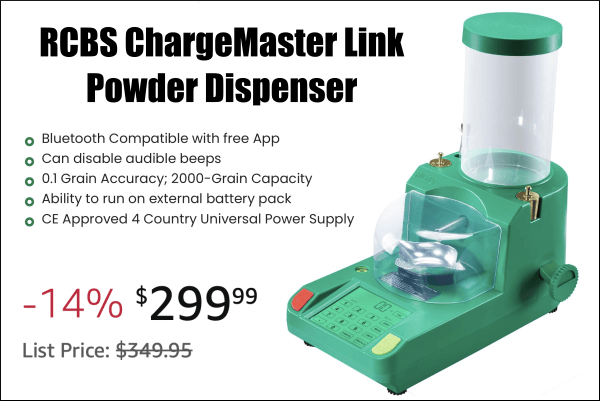
Tired of dropping powder with a manual powder measure? Want a high-tech electronic scale/dispenser? Consider the RCBS ChargeMaster Link (#ad). The modern ChargeMaster Link connects with the RCBS App via BlueTooth for fast, accurate powder dispensing. The RCBS App can customize powder settings for multiple cartridge/bullet types and can adjust flow rates. The ChargeMaster Link’s load cell and electronics are accurate, providing precise measurements and efficient dispensing.
2. Midsouth — Buy Hornady Gear, Get FREE Bullets, Brass, & More
⏺️ » Get bonus bullets, brass and more with Hornady products
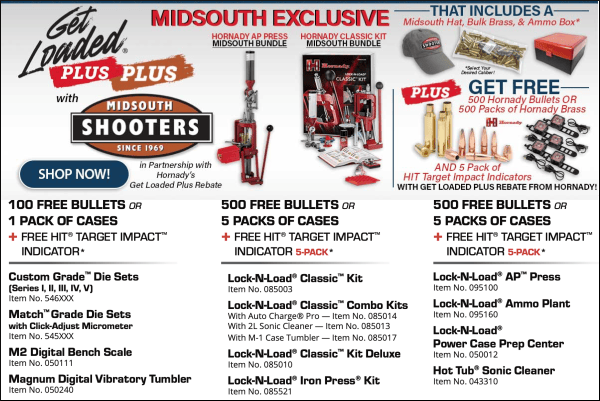
If you purchase Hornady reloading press kits and/or other products you can get FREE bullets or FREE brass PLUS target hitmarkers. Purchase products on the Hornady GET LOADED PLUS list of tools and kits and you can get up to 500 bullets or five brass packs plus hitmarkers for free. This promo is a great incentive to purchase Hornady products, and get up to $400 worth of FREE bonus bullets and/or brass. The FREE stuff comes with purchases of these products: Iron Press Kit, Ammo Plant, AP Press, Classic Kit, Classic Kit Deluxe, Power Case Prep Center, Rifle Bullet Feeder, Rotary Case Tumbler, Custom Grade Die Sets, and more. Click HERE for all qualifying products.
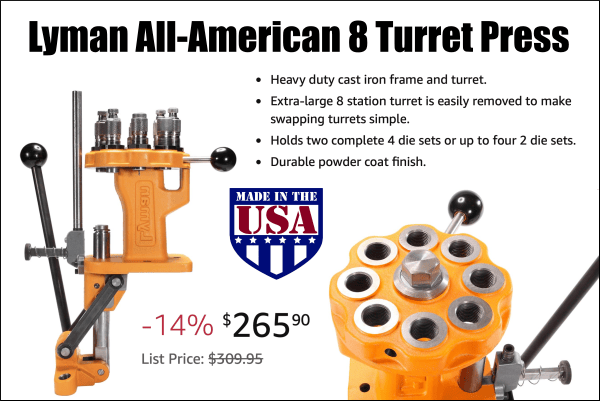
⏺️ » Highly-rated turret press with easy-change turret
The eight station Brass Smith All-American 8 Press (#ad) is a rugged and versatile turret press. The extra-large 8-station turret (made of heavy-duty cast iron) is the largest available and will hold two complete 4-die sets or up to four 2-die sets. Turrets can be swapped quickly with via the turret bolt. Below the turret is a rigid cast iron frame, housing a 1″-diameter ram and compound linkage. The frame is large enough to work with even very large rifle cartridges.
4. EuroOptic — 12% OFF All Vortex Optics Products
⏺️ » 12% savings on Vortex scopes, spotters, LRFs, and Red Dots
Vortex offers very good scopes for competition rifles, hunting rifles, and tactical rigs. Plus Vortex makes quality spotting scopes, laser rangefinders, and binoculars. For a limited time Vortex products are on sale at EuroOptic with a big 12% discount — plus some item-specific savings. From red dots to big ELR scopes there’s a Vortex optic to suit your needs. With this sale you can get a Vortex product at some of the lowest prices of the year. Use Code VTX12 to save 12%.
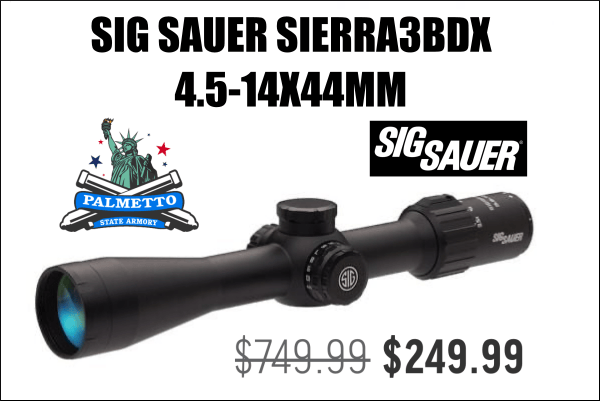
5. Palmetto SA — SIG Sauer 4.5-14x44mm Electro-Optical SIERRA3BDX Scope, $249.99
⏺️ » Save $500 on hunting scope that communicates with SIG Rangefinder
Hunters should check out this great deal on the SIG Sauer SIERRA3BDX 4.5-14X44mm scope. This optic features an illuminated reticle dot that sets the perfect holdover, based on range info received from a BDX-enabled SIG Sauer KILO rangefinder. The makes it easy to take your perfect hunting shot — range your target, look for the illuminated hold-over dot, place the dot on the target, and nail your deer or other prey. Despite its ultra-low $249.99 price, this SIERRA3BDX scope has many great features: premium SpectraCoat lenses, LevelPlex digital anti-cant functionality, and KinETHIC kinetic energy transfer indicator.
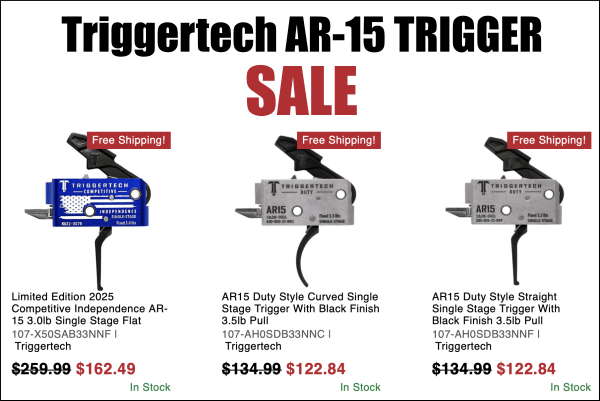
6. Midsouth — TriggerTech Trigger Sale + FREE Shipping
⏺️ » Very good triggers at major discounts — great AR option
Triggertech makes excellent triggers, with low-friction release. These are especially popular among AR shooters for good reason. TriggerTech AR Drop-In Triggers feature a crisp, single-stage pull that provides a true zero-creep break, with extremely short overtravel. Utilizing CLKR Technology, the pull weight is quickly and confidently adjusted in 2 oz. increments from a set screw with the trigger installed. These triggers have shown very good reliability even in harsh environments.
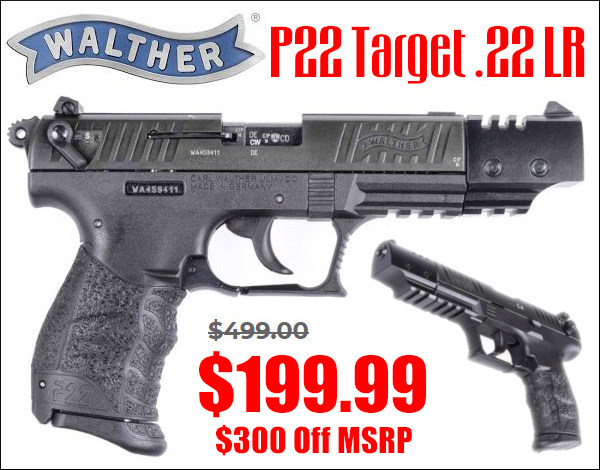
⏺️ Very good .22 LR Target/Training pistol at super-low price
All shooters should have a quality .22 LR rimfire pistol with a good trigger, ergonomic grip, and excellent accuracy. With the Walther P22 Target Model, you can get all those things for just $199.99 at CDNN Sports, a really great deal. The P22 Target pistol is a nice rimfire handgun with a 5″ barrel plus forward ported compensator. The ergonomic grip has interchangeable backstraps. The trigger is quite good compared to many other .22 LR pistols.
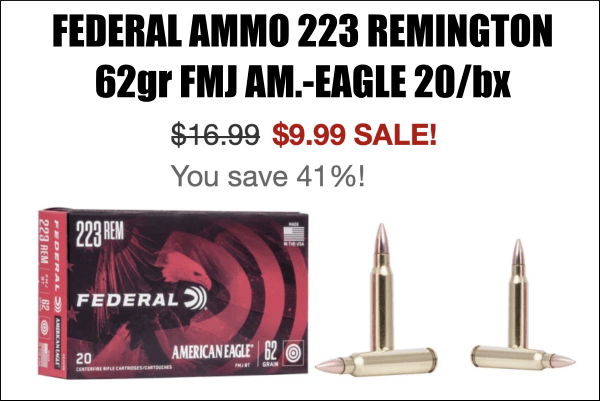
8. Graf & Sons — Federal .223 Rem 62gr Ammo, $9.99/20 rds
⏺️ » Major savings on Good .223 Rem Ammo, just $0.50/rd
Quality .223 Rem ammo has become more affordable. Right now at Graf’s you can get a 20-rd box of Federal American Eagle .223 Rem ammo for just $9.99. That works out to just 50 cents a round. American Eagle rifle ammunition offers consistent, accurate performance at an affordable price for high-volume shooting. The loads feature quality bullets, reloadable brass, and dependable primers. This is a good deal.
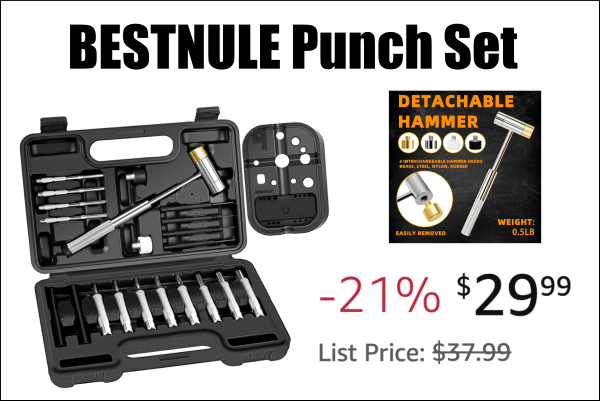
9. Amazon — BESTNULE Punch Set and Bench Block, $29.99
⏺️ » Very complete punch tool kit with 18 punches and hammer
A good set of punches will help with gun maintenance. The BESTNULE Punch Set (#ad) includes a great collection of tools. This punch kit includes eight carbon steel chrome-plated punches in sizes: 1/8″, 9/64″, 5/32″, 3/16″, 7/32″, 1/4″, 9/32″ and 5/16″. In addition, the set has four hollow-end stainless punches (1/16″, 5/64″, 3/32″, 1/8″), four black carbon steel punches, and two plastic punches. The provided hammer comes with three interchangeable hammer heads, and the kit includes a handy bench block.
10. Amazon — Lyman Brass Smith Funnel with Inserts, $31.99
⏺️ » Very useful kit we use — avoids powder spills
Having a good powder funnel really helps precision reloading. The Lyman Products Brass Smith Pro Powder Funnel System (#ad) is a great little system. Unlike plastic powder funnels, the aluminum DIE cast body and CNC-turned aluminum caliber-specific inserts are static-free to eliminate powder cling. The precision fit to your case necks eliminates spilled powder. The kit includes six laser-marked, caliber-specific aluminum inserts to fit calibers .22 to 338: .22, .243/6mm, .25/6.5mm, .270/7mm, .30, and .338. The inserts can be quickly and easily interchanged.
As an Amazon affiliate, this site can earn revenues through sales commissions.
SSG Greg Markowski of the USAMU at Camp Perry, Ohio.*
The U.S. Army Marksmanship Unit (USAMU) fields pistol teams as well as rifle and shotgun competition squads. Consequently the USAMU’s Reloading Shop loads tens of thousands of pistol rounds every year. In this article, the USAMU’s handgun experts talk about reloading for handguns — with smart tips on how to achieve superior accuracy with 100% reliability. This article, which offers important insights on COAL, primers, crimps and more.
This video shows .45 ACP centerfire pistol competitors at Camp Perry
Precision Pistol Reloading — Recommended Methods
Optimize the Taper Crimp
One often-overlooked aspect of handloading highly-accurate pistol ammunition is the amount of crimp and its effect on accuracy. Different amounts of taper crimp are used with various handloads to obtain best accuracy. The amount is based on bullet weight, powder burn rate and charge, plus other factors. It is not unusual for our Shop to vary a load’s crimp in degrees of 0.001″ and re-test for finest accuracy.
Use Consistent Brass
Brass is also important to pistol accuracy. While accurate ammunition can be loaded using brass of mixed parentage, that is not conducive to finest results, particularly at 50 yards. It is important for the serious competitor/handloader to use brass of the same headstamp and ideally one lot number, to maximize uniformity. Given the volumes of ammunition consumed by active pistol competitors, using inexpensive, mixed surplus brass for practice, particularly at the “short line” (25 yards), is understandable. However [at 50 yards], purchasing and segregating a lot of high-quality brass to be used strictly for slow-fire is a wise idea.
Importance of Uniform COAL
Uniformity of the Case Overall Length (COAL) as it comes from the factory is also important to achieving utmost accuracy. More uniform case lengths (best measured after sizing) contribute to greater consistency of crimp, neck tension, ignition/burn of powder charge, and so on. Cartridge case-length consistency varies from lot to lot, as well as by maker. Some manufacturers are more consistent in this dimension than others. [Editor’s note: It is easy to trim pistol brass to uniform length. Doing this will make your taper crimps much more consistent.]
Primers and Powders — Comparison Test for Accuracy
Pay attention to primer brands, powder types and charges. Evaluating accuracy with a Ransom or other machine rest at 50 yards can quickly reveal the effect of changes made to handload recipes.
Bullet Selection — FMJ vs. JHP
Bullets are another vital issue. First, there is the question of FMJ vs. JHP. A friend of this writer spent decades making and accuracy-testing rifle and pistol bullets during QC for a major bullet manufacturer. In his experience, making highly-accurate FMJ bullets is much more difficult than making highly-accurate JHPs, in large part due to the way the jackets are formed. Small die changes could affect accuracy of FMJ lots dramatically. The CMP now allows “safe, jacketed ammunition” in Excellence-in-Competition (EIC) Service Pistol matches, although wadcutter ammunition is prohibited. Thus, the option to use very accurate JHP designs simplifies the life of CMP Service Pistol shooters in pursuit of the prestigious Distinguished Pistol Shot badge.
This animation showing 1911 Pistol operation has over 31 million YouTube views:
Hopefully, these tips will be helpful to any pistol shooters interested in accurate handloads, not just “Bullseye” shooters. Small tweaks to one’s normal routine can pay big dividends in improved accuracy and make practice and competition more rewarding. Stay safe, and good shooting!
TOP IMAGE: SSG Greg Markowski, a shooter/instructor with the USAMU, fires his pistol during the 2018 Civilian Marksmanship Program’s National Pistol Matches at Camp Perry, Ohio. At that event, Markowski claimed the General Mellon Trophy, General Patton Trophy and the General Custer Trophy. U.S. Army photo by Maj. Michelle Lunato/released by Defense Visual Information Distribution Service.




 The .17 Hornady Magnum Rimfire (HMR) was introduced in 2002 by Hornady as a high-velocity, rimfire cartridge derived from the .22 Magnum case necked down to .17-caliber. The .17 HMR gained popularity among varmint hunters and target shooters for its good accuracy and hitting power out to 200 yards or more — all with low recoil and relatively low cost (compared to centerfire ammo).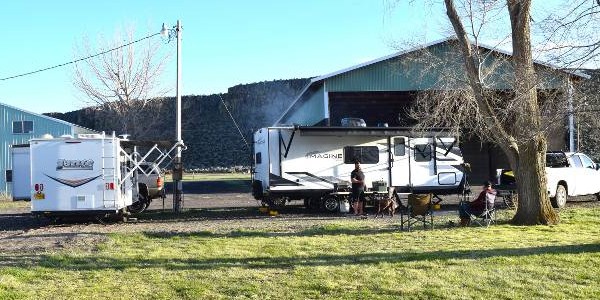





 There’s More to the Story…





 Use Consistent Brass


