For today’s Saturday Movie showcase we present six videos with .22 LR rimfire ammunition testing. Most of the videos include a wide variety of ammunition types, from bargain ammo, to high-end .22 LR match ammo. If you want to learn more about the properties of .22 LR rimfire ammo, you’ll find a good .22 LR ammo analysis on the Widener’s Blog. That article discusses .22 LR Bullet Design/Stability, Primer Ignition, Velocity Consistency, and Quality Control. In addition, 100-yard test results are provided for five (5) ammo types: Norma Xtreme LR-22, SK Rifle Match, ELEY Match, Lapua Long Range, and CCI Standard.
Big .22 LR Rimfire Ammo Comparison Test
This Backfire Channel Video features an accuracy comparison test of 13 .22 LR ammo types from multiple manufacturers. This includes low-priced ammo, such as Aquila, as well as more costly match ammo from ELEY, Lapua, and SK. Various types of ammo were tested in an outdoor range with three different NRL22-suitable rifles with slightly different chamber specs. Take note — this was NOT a benchrest rifle test conducted indoors. The most accurate ammunition overall was Lapua Center-X. NOTE: Different ammo may shoot better or worse in different rimfire guns. For example a round that works in an Anschutz rifle may not be the best choice for a .22 LR revolver. But this review can help you get started in ammo selection.
Testing Rimfire Ammo at New Whidden Gunworks Test Center
Last month Whidden Gunworks launched an impressive new Rimfire Test Center in Nashville, Georgia. In this video, long-range champion John Whidden shows the Whidden Gunworks test range developed with ELEY Ammunition. The new facility features two testing lanes — one for testing ELEY ammo and a second for testing other brands. Initially, the ELEY lane will offer 50m testing, with plans to expand to 100m in the future. On the second test lane, customers can test Lapua, SK, Norma, and RWS. Testing on this lane occurs at 50 meters and 100 meters simultaneously, registering results for BOTH distances. For more info, visit Whiddengunworks.com/ammunition-testing.
CLICK HERE to schedule a test at the Whidden facility.
.22 LR Ammo Buyers Guide
The Pursuit of Accuracy YouTube Channel has 270 videos, nearly all involving .22 LR rimfire rifles. The host tests different ammo in a variety of rimfire rifles. In this particular video, the host explains the key considerations in selecting .22 LR ammunition — how to choose the most cost-effective ammo for your rimfire rifle and discipline. You don’t need $14/box ammo to hit large steel plates at 20 yards. But you do need very consistent high-quality ammo for .22 LR Rimfire ELR Matches.
Testing Lapua Long Range Ammo at 400 Yards
With the emergence of long-range .22 LR rimfire matches, with targets at 100, 200, and 300 yards, the long-range capabilities of .22 LR have been pushed to the limits in recent years. In 2023 Lapua announced two new .22 LR rimfire ammo types — Long Range and Super Long Range. These are both specifically designed to optimize .22 LR performance past 100 yards. In this video, Gavin Gear of UltimateReloader.com tests the new Lapua ammo types on his range, with steel targets placed at 400 yards.
Subsonic vs. Supersonic .22 LR Ammunition
Here is another Pursuit of Accuracy Channel .22 LR ammo test. This specifically compares the performance of supersonic ammunition vs. subsonic ammo. What offers better accuracy? What is the best option for long range? The video addresses these questions.
Cheap .22 LR Ammo Tested with a $4000 Custom Rifle
Can relatively inexpensive ammo shoot well in $4000 rimfire rifle? This Midwest Long Range video seeks to answer that question. The results are interesting, with some surprisingly good results with CCI (8:03 time-mark) and Fiocchi (11:25 time-mark) Standard Velocity ammo. If you’re shooting NRL22 or PRS Rimfire matches on a tight budget, this video may steer you to some accurate yet affordable ammo options.
BONUS — Rimfire Ammunition Test with 31 Types
If watching today’s showcased videos has wet your appetite for .22 LR ammo comparison testing — here’s a “must-read” related article. The October 2018 issue of Shooting Sports USA (SSUSA) includes a great article with data on thirty-one (31) different types of popular .22 LR rimfire ammunition. The line-up includes low-speed, standard, and Hi-Velocity types, plus choices for plinking, varminting, and target applications. Brands tested include: Aguila, American Eagle, CCI, Federal, Fiocchi, Lapua, Remington, and Winchester. The ammo types ranged in speed from 727 FPS to 1735 FPS.
For each ammo type, SSUSA lists the bullet weight, velocity (FPS), and average of two, 5-shot groups at fifty yards. The most accurate ammo was Lapua Center-X LRN, with a 0.37″ average 50-yard group size. Second best was Lapua X-ACT LRN at 0.42″. Ammo was tested from a bench with a Cooper Model 57-M rifle fitted with 3-9x33mm Leupold VX-2 scope. The ammo offerings were grouped into three categories: (1) Varmints/Small Game; (2) Target; and (3) Plinking.
We think every gun owner should have a .22 LR rifle and .22 LR pistol for training and fun plinking. You can shoot .22 LR rimfire rounds for a tiny fraction of the cost of centerfire ammo, which can exceed $1.30 per round just for components. Today we spotlight some of the best .22 LR rimfire ammo deals on the web.
At Locked & Loaded Ltd. we found .22 LR rimfire ammo for as low as $2.68 per 50ct box, which works out to just 5.36 cents per round ($0.0536)! These deals, all under seven cents per round, are all current on the LockedLoaded.com website. CLICK HERE to access the deals. When you arrive on that web page click “Hide Out of Stock” in the left column. Everything shown below is listed as “IN STOCK” as of 10:30 am PDT on 6/4/2024.
Bonus — Big Rimfire Ammo Comparison Test
This Backfire Channel Video features an accuracy comparison test of 13 .22LR ammo types from multiple manufacturers. This includes low-priced ammo, such as Aquila, as well as more costly match ammo from ELEY, Lapua, and SK. The most accurate ammunition in the tester’s rifle was Lapua Center-X. Do note that different ammo may shoot better or worse in different rimfire guns. For example a round that works in a Ruger 10/22 may not be the best choice for a .22 LR revolver. But this review can help you get started in your ammo selection process.
At the request of our readers, we provide select “Deals of the Week”. Every Sunday afternoon or Monday morning we offer our Best Bargain selections. Here are some of the best deals on firearms, hardware, reloading components, optics, and shooting accessories. Be aware that sale prices are subject to change, and once clearance inventory is sold, it’s gone for good. You snooze you lose.
NOTE: All listed products are for sale to persons 18 years of age or older. No products are intended for use by minors.
1. Brownells — Weekly Featured Deals
⏺ Great savings on large variety of products at Brownells
⏺ Huge discounts on quality Sightron scopes — save up to $820.00
Creedmoor Sports is running a major sale on Sightron Scopes currently. Save up to $820 off MSRP. Sightron scopes are popular with varminters and competitors because they are very reliable, with clarity, sharpness, and precision that rival optics costing hundreds more. Long-range benchrest and F-Class competitors should consider the impressive Sightron SIII LR 10-50x60mm scope, now just $1479.99, a $370 savings off the regular price.
3. Precision Reloading — Major Hornady 10% Off Sale
⏺ Save 10% on ammo, brass, bullets, dies, reloading tools
Though June 7, 2024, Precision Reloading is running a big Hornady 10% Off Sale. Pretty much all Hornady brand products will be discounted 10%. CLICK HERE to see all the Hornady items currently on sale. Among the many Hornady products we like are: pistol dies, varmint bullets, hunting ammo, One-Shot Case Lube, Bullet Comparator Set, and L-N-L Iron Press.
4. Natchez — CCI, Federal, Remington Primer Sale
⏺ Good prices on primers at Natchez this week
Quality American-made primers continue to be in high demand with prices still much higher than before the pandemic. However, Natchez is now running a major primers sale. You’ll find a wide selection of rifle, pistol, and shotshell primers at good prices. Primers on sale include CCI, Federal, and Remington. Save up to $45 per 1000ct primer package.
5. Amazon — Real Avid Workstation, $159.99
⏺ Versatile gun vise/workstation, with good user reviews
Cleaning or working on rifles requires a good rest, ideally one that has strong mounts plus ample adjustment range. The Real Avid Workbench has those qualities. It will hold your rifle securely AND can do multiple tasks via Real Avid’s optional Smart-Assist accessories. These include a work light, magnifying glass, and cell phone holder, all mounted on flexible goosenecks. The basic Real Avid Gun vise/Workbench is $159.99 on Amazon (#ad), 20% off this week.
6. Al’s — Frankford Arsenal Case Trim & Prep Center, $164.99
⏺ Excellent multi-drive case prep machine with very complete tool set
Good case prep is critical to making precision loads. One of the best case prep machines on the market is the Frankford Arsenal Case Trim and Prep Center. This machine boasts a strong center motor and three accessory tool drives. This FA Case Prep unit ships with a full set of tools: inside chamfer tool, deburr tool, primer pocket cleaning tools, and a trimmer with 3 collets + 6 shoulder bushings.
7. Brownells — Sinclair and RCBS Hand Priming Tools
⏺ Two very good choices for hand priming — single and tray-feed
The Sinclair Priming Tool offers very precise primer seating with an ultra-consistent “feel”. The tool head utilizes Sinclair shellholders and locks the case head square to the priming punch. This tool has excellent leverage, yet it is extremely sensitive so you can feel the primer entering the primer pocket and bottoming out. If you want to prime larger quantities of brass more quickly, consider the RCBS Universal Hand Priming Tool. This can hold 100 primers in the attached tray. The spring-loaded gripper lets you switch quickly between small and large case rim sizes. SEE RCBS Priming Tool Video.
8. Amazon — LEE Hand Press Kit, $76.94
⏺ Versatile hand press can be used at range or at home
No matter how much reloading equipment a reloader has, it makes sense to have a portable hand press. This can help you load at the range when doing load development. And back home you can use the hand press for tasks such as decapping primers and bullet seating. Now priced at just $76.94 on Amazon the LEE Hand Press Kit (#ad) includes powder funnel, priming insert, case lube and other accessories. This versatile Hand Press Kit is well worth the money.
9. Amazon — MEIJIA 53.5″ Hard Rifle Case, $119.99
⏺ Good case for long-barreled rifle, half the cost of similar cases
In a vehicle or on a plane, hard cases are the safest way to transport your firearms, but the most rugged and protective cases usually come with a hefty price tag. Here’s an affordable hard case that still offers great protection for big, long-barreled match rifles. The 53.5″-long MEIJIA All Weather Hard Rifle Case (#ad) measures 52.2″ inside — big enough to handle 31″+ barrels. This rugged, waterproof case has nice, thick foam (pluckable to customize), and has good locking points.
As an Amazon affiliate, this site can earn revenues through sales commissions.
Congratulations to Team Vihtavuori member Doug Koenig on winning the 2024 CMP Bianchi Cup Championship, one of the world’s most prestigious pistol tournaments. Koening took the 2024 title with an impressive 1920-183X Grand Aggregate. Koenig’s 2024 Bianchi Cup title marked a major milestone. This was Koenig’s 20th time winning the prestigious pistol championship. To learn more about Doug’s accomplishments, visit KoenigShooting.com.
The 2024 CMP Bianchi Cup was hosted by the Green Valley Rifle & Pistol Club in Hallsville, Missouri on May 21-24, 2024. For the second year, the Civilian Marksmanship Program (CMP) governed the international competition. In partnering with Green Valley, the CMP seeks to grow the event with more shooters and new divisions. The Bianchi Cup, known as the gold standard in action pistol shooting, has a 40+ year history and attracts the world’s leading competitive pistol shooters.
Koenig, who loads his pistol ammo with Vihtavuori N320 powder, was in a tight race with fellow Team Vihtavuori member Bruce Piatt. Piatt finished in a close second place, followed by SSG Walter Johnson, SSG Anthony Heinauer, and Benito Martinez. The top finishers were only separated by a mere 5 bullseyes.
These two videos show Doug Koenig in action in past years at the Bianchi Cup Range.
by Sierra Bullets Ballistic Technician Paul Box
All of us who have been in reloading and shooting for any period of time have read how sectional density has been regarded as a bullet’s ability to penetrate. Back before high velocity came along and modern bullet design, the easiest way to get more “power” and penetration was by increasing the diameter and mass. After all, a bowling ball will hurt more than a golf ball, right?
Let’s take a closer look at sectional density.
The formula for calculating sectional density is pretty simple and straight forward. Take the bullet weight and divide by 7000. This number is then divided by the bullet diameter squared. Two bullets of equal weight and the same diameter will have equal sectional sectional density. No regard is given to the bullet construction. This is where the fly hits the soup in considering sectional density as far as penetration is concerned.
Section Density Formula: (Bullet Weight divided by 7000) divided by Bullet Diameter squared.
Bullet construction is the biggest factor in how it is able to penetrate. The best example I can think of here is to look at the Sierra .224 55 Gr. FMJBT GameKing #1355 compared to the 55 Gr. BlitzKing #1455. Both are .224 and weigh 55 grs. Both have a sectional density of .157. But there is a huge difference in their construction. The FMJ has a thick jacket and is designed to penetrate. The BlitzKing is designed for fast and rapid expansion with little concern for how deep they will penetrate.
The next time you’re choosing a bullet, look at the construction and less at the sectional density number. It’s all about the construction anyway. If you have any questions or would like to discuss sectional density or bullet penetration further, please give us a call at 800-223-8799 or shoot us an email at sierra@sierrabullets.com.
Sierra Bullets has published load data for the 6mm Creedmoor cartridge, a necked-down version of the popular 6.5 Creedmoor. Sierra has released very comprehensive 6mm Creedmoor load data, covering fifteen (15) different bullets from 55 to 110 grains. NOTE: Hornady-brand brass was used for Sierra’s 6mm Creedmoor load tests, not the newer, stronger Lapua 6.5 CM brass with small primer pockets. Hand-loaders using Lapua 6.5 Creedmoor brass necked to 6mm may have to adjust their loads.
Sierra writes: “As soon as the 6.5 Creedmoor was released in 2007, a 6mm version was being envisioned. After the 6mm Creedmoor demonstrated its worth at 1000 yards it began to catch the attention of Precision Rifle Series (PRS) competitors. The 6mm Creedmoor is a great fit for those looking for an AR platform-friendly cartridge. It delivers velocities very similar to the .243 Win and yet fits the AR10 magazine length[.] The 30-degree shoulder makes this a very efficient case and helps prolong case life as well. The 6mm Creedmoor works well with powders such as H4350, [RE-16], RE-17, and Ramshot Hunter for heavier long-range bullet weights. Slightly faster powders such as RE-15, Win 760, and Vihtavuori N540 work well with lighter weight bullets.”
Sierra Bullets Tested for 6mm Creedmoor Load Data
55gr BlitzKing (#1502)
60gr HP (#1500)
70gr HPBT (#1505)
70gr BlitzKing (#1507)
75gr HP (#1510)
In developing its 6mm Creedmoor load data, Sierra tested a very wide selection of propellants, two dozen overall. For the smaller bullets, fast-burning powders such as Benchmark, H4895, and CFE223 were tested. For the heavier 100+ grain bullets, Sierra tested a selection of medium-burn-rate powders including H4350, Reloder 16, Reloder 17, Varget, and Superformance. Sierra did a very thorough job. We know this information will be welcomed by 6mm Creedmoor shooters.
Don’t know what powder to try first? For the 107-110 grain bullets, if you want best accuracy and low ES/SD, our Forum members recommend Alliant Reloder 16 and Hodgdon H4350. If you are seeking max velocity with the 110-grainer, look at Hodgdon Superformance and Reloder 19.
Here are Sierra’s 6mm Creedmoor Load Data Charts for 90-95 grain bullets plus the 107gr MK and 110gr MK. There are five other tables for other bullet types.
BONUS: PRB 6mm Creedmoor and 6.5 Creedmoor Load Survey
The Precision Rifle Blog compiled Load Data from PRS Competitors, for both 6mm Creedmoor and 6.5 Creedmoor. This is a good place to start. PRB surveyed the match loads for “173 of the top-ranked precision rifle shooters in the country”. One cautionary note: These PRS guys may be loading fairly hot, so work up gradually, 0.3 grains at a time. CLICK HERE.
At the request of our readers, we provide select “Deals of the Week”. Every Sunday afternoon or Monday morning we offer our Best Bargain selections. Here are some of the best deals on firearms, hardware, reloading components, optics, and shooting accessories. Be aware that sale prices are subject to change, and once clearance inventory is sold, it’s gone for good. You snooze you lose.
NOTE: All listed products are for sale to persons 18 years of age or older. No products are intended for use by minors.
1. Brownells — Weekly Featured Deals and Memorial Day Sale
⏺ Great deals at Brownells — ammo, bullets, optics, chronos, and more
2. EuroOptic — 50% Off Vortex for Military, LE, First Responders
⏺ 50% Off MSRP for Military, police, first responders through 5/30/24
Today (5/27/24) is Memorial Day. To help mark this day, Vortex, via EuroOptic, has a special promotion with 50% off MSRP for Vortex products. This offer runs through May 30, 2024. After that a similar Military/LE/First Responder discount may be available at 40% off MSRP. CLICK HERE for more information. To qualify you must set up a user account. The offer excludes close-outs and discontinued items.
3. Primary Arms — Memorial Day Sale, Save up to 30%
⏺ Major savings on hundreds of items — great for AR components
Primary Arms is running a big Memorial Day Sale with hundreds of items on Sale. Along with the featured special, you can shop for deals by Manufacturer/Brand (e.g. Vortex, EoTech, Magpul) or by Product Category (e.g. Optics, Barrels, Ammo, AR Uppers). Shown above are four noteworthy deals, but there are over 2000 items discounted.
4. Midsouth — Peterson Brass on Sale, 24 Varieties
⏺ High quality, long lasting brass — good PRS/NRL choice
Excellent American-made Peterson brass is on sale now at Midsouth. You’ll find many 6mm options including 6mm Dasher and 6mm Creedmoor. If you shoot a Dasher, this Peterson brass will let you avoid the time and expense of fire-forming cases. Hunters will be pleased to find a number of large magnum cartridge types available including 7mm PRC, 7mm RUM, .300 WinMag, .300 Norma Mag, 33 Nosler, .338 Lapua Magnum, and more.
5. MidwayUSA — ATN Day/Night 3-14X Video Scope, $559.00
⏺ Advanced scope records video and operates daytime and night-time
Here’s a great electro-optics product for hunters. The 3-14X ATN X-Sight scope offers day/night viewing capability, PLUS it can record HD video of your hunt. This scope even has a built-in Ballistics Calculator that shows hold-overs. Right now this 3-14X optic is $559.00 at MidwayUSA, a $140.00 (20%) discount. In addition to the ATN 3-14X model, there is a 5-20X version for $639.00 on sale at Midway USA. Both models offer HD video recording, ballistics, electronic compass, multiple reticle options, and smartphone connectivity. BONUS: Both 3-14X and 5-20X ATN optics ship with 30mm Picatinny rings.
6. Creedmoor Sports — Berger 6mm, 6.5mm, 7mm Bullets Sale
⏺ Good prices on top-tier Berger match bullets
Berger bullets are favored by top competitors in many disciplines. Right now you can get significant savings on popular Berger match bullets in 6mm, 6.5mm, and 7mm calibers. F-Class shooters — take note that Berger 180gr Match Hybrid Target bullets and 184gr F-Open Hybrid Target bullets are on sale — save $10 per hundred. Along with the savings on top-tier bullets, through 5/28/24 you can get FREE Shipping with orders over $149.00. Use Creedmoor Sports discount code REMEMBER.
7. Amazon — Lyman BrassSmith Funnel, $31.99
⏺ Very useful kit we use — avoids powder spills
Having a good powder funnel really helps precision reloading. The Lyman Products Brass Smith Pro Powder Funnel System (#ad) is a great little system. Unlike plastic powder funnels, the aluminum DIE cast body and CNC-turned aluminum caliber-specific inserts are static free to eliminate powder cling. The precision fit to your case necks eliminates spilled powder. The kit includes six laser-marked aluminum inserts to fit calibers 22 to 338: .22, .243/6mm, .25/6.5mm, .270/7mm, .30, and .338.
8. Midsouth — CCI Blazer .22 LR Ammo, $32.99/500 Rounds
⏺ Very low price on good, reliable .22 LR ammunition
If you use .22 LR ammo for NRL22, varminting, or plinking, consider this CCI Blazer 40gr ammunition. Rated at 1235 fps, this CCI ammo runs pretty fast and packs a punch. Right now you can get a 500-ct brick for just $32.99. That’s just $3.29 per 50-ct box, a great value for quality American-made ammo.
9. MidwayUSA — Plano Protector Pro-Max Rifle Case, $33.99
⏺ Good price on a sturdy, 52″ interior transport case for long rifles
Do you have a long-barreled hunting or varmint rifle? With a 52″ internal size, this Plano Protector Pro-Max Rifle Case handles rifles with barrels up to 30″ (or 31″ with a thin buttplate). On the inside the case has high-density, interlocking foam padding. On the outside, the case has four clamps, padlock tabs, and a handy carry handle. NOTE: This case will work well for normal trips to the range. However, you’ll want a thicker, more sturdy TSA-approved case for airline transport.
⏺ Under $20 for versatile, multi-lens Eye Protection
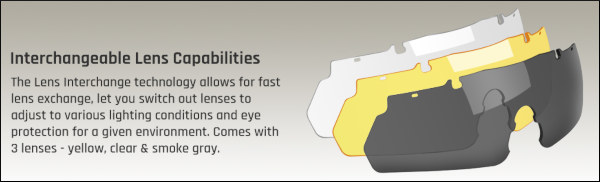
All shooters need quality eye protection when operating firearms. XAegis Tac Eyewear is a versatile and affordable option. These ANSI Z87+ rated shooting glasses come with three different interchangeable lenses (Clear, Yellow, Gray). You also get a transport case, lanyard, and cleaning cloth. Choose from three frame colors, each for $18.99: Black frame, Green Frame, or Khaki frame. For under $20 these are hard to beat. It’s nice to have the color lens options for different weather conditions, and indoors/outdoors.
As an Amazon affiliate, this site can earn revenues through sales commissions.
On the Applied Ballistics Facebook Page, there is a fascinating series of posts showing traces of bullets at various speeds from Mach 0.86 to Mach 3.0. At the slowest speed, Mach 0.86, i.e. 962 FPS, there is turbulence behind the bullet, but no clear shockwave. At the highest velocity, Mach 3.0 (3375 FPS at sea level, 68° F), there is a dramatic double nose and tail wave formation.
To learn more, visit TheScienceofAccuracy.com. On that site you’ll find exclusive video content and you can subscribe to member’s only Podcasts. And you can purchase Applied Ballistics books on the Science of Accuracy webstore.
Mach 3.00 Bullet Flight Image
At Mach 3 (3355 FPS) this bullet now has a strong and well established shock wave forming at the tip, and at the base. Unlike the transition through Mach 1.0, nothing really interesting happens to the aerodynamics or shock waves meaning the aerodynamics and stability are: continuous, easy to predict, and model. As you go faster, the shockwaves make a shallower angle because the bullet is moving forward 3X faster than the shock wave is moving away from it. So the shock wave makes an angle that has a rise/run ratio of 1/3.
If a bullet flew within 10 feet of you traveling this fast, it would be about as loud as a 22 magnum. You’d certainly want hearing protection as the energy contained in a Mach 3 shock wave is high! How high…? Well, in 10 yards, this bullet slows from 3355 FPS to 3334 FPS in a time of 0.0090 seconds. The 55 ft-lb of kinetic energy lost during this 10 yards is due to aerodynamic drag on the bullet, which is comprised of wave, base, and skin friction drag components with the majority of the drag being due to shock wave formation. Expending 55 ft-lb of energy in 0.0090 seconds requires a power output of 6111 ft-lb/sec = 11.1 horsepower, most of which goes into creating the shock wave. Remember it’s a 3-D cone that travels great distance, and it gets its energy by stealing velocity from your bullet!
Mach 1.00 Bullet Flight Image
Many shots were fired to capture an image of the transonic shockwave structure at exactly Mach 1.00. With the bullet now moving at the speed of sound, the local airflow on some parts of the bullet exceeds Mach 1.0. Anytime something is moving thru the air faster than the air can get out of the way, you get a compression wave, aka “shock wave”. That’s what’s visible in this image — the areas where the air density changes rapidly (in the compression wave) are visible as near vertical lines and a detached bow wave out front. As the bullet progresses through transonic speed, this shockwave structure develops which has strong effects on the drag (wind sensitivity) and stability of the bullet.
The exact development of the shockwaves and the resulting effects are unique and sensitive to the bullet geometry, and become very difficult to predict through the transition from subsonic (incompressible flow without shock waves) to supersonic (compressible flow with shock waves). Each bullet geometry does this differently which is why it’s difficult to determine transonic stability criteria for bullets of different shapes.
Mach 0.86 Bullet Flight Image
Here’s a bullet at Mach 0.86 (86% the speed of sound, which is 962 FPS at 61° F). As you can see, this 0.86 Mach is not fast enough to make any discernable waves but you can see turbulence in the bullet wake (right side in photo). The beginning of small shock waves can be seen on the bullet tip, and at the bearing surface/boat tail juncture. For the most part, all of the airflow around this bullet is subsonic. You wouldn’t hear a supersonic ‘crack’ from this bullet flying past the observer.
We are finally seeing prices drop on loaded ammo, and there are some notable inventories of ammunition right now at Midsouth, Palmetto State Armory, Powder Valley and Precision Reloading. We are even starting to see ample supplies of large-caliber hunting rifle ammunition — something hard to find a year ago.
Thankfully, if you shop around aggressively, you can now find many types of ammunition at reasonable prices. By using AmmoSeek.com you can instantly compare ammo prices from dozens of sellers. AmmoSeek monitors more than 180 online vendors — checking current pricing and available inventory, for pistol, rifle, and shotgun ammunition. Looking for .22 LR ammo for your rimfire trainer or .45 acp ammo for your 1911? Just select the cartridge type from the “Quick Seek” list on the right. Likewise you can find .223 Rem and .308 Win Rifle ammo with one click.
If you haven’t sourced ammo online before, note that, for nearly all jurisdictions, it IS legal to order ammunition online and have it delivered to you at home in most states. But check your state and local laws! California, for example, has prohibited direct ammo shipments to ordinary customers.
Got Ammo? Here’s just part of the vast inventory at Skagit Arms in Washington State.
Use Ammoseek.com to Find Reloading Components Too
Ammoseek.com also lets you search for reloading components, including powder, primers, brass, and bullets. This is a huge time-saver. You can instantly check a dozen or more vendors to see if a particular type of powder is in stock. Likewise, you can quickly check for primer availability. If you have a big match coming up and are short on primers — this could solve the problem. To search for components, from the AmmoSeek home page, click the gray “Reloading” Tab (see below), then select Bullets, Brass, Primers, or Powder from the pull-down menu.
AmmoSeek.com FAQ Page
If you have questions about using AmmoSeek.com, visit the AmmoSeek FAQ Page. You’ll find details on how the search engine works. Here’s one FAQ:
How often does the AmmoSeek engine process its ammunition data?
Every minute or two! AmmoSeek is constantly updating ammunition data 24 hours a day, 7 days a week, automatically. Individual retailers are updated at least hourly, most most are updated much more often. Still, however, there’s always the possibility that items can go out of stock the moment after our site is updated, so it’s not always possible to be 100% accurate.
If you are planning to shoot a PRS match with factory ammo or use factory ammo when hunting, you should definitely check the ammo velocity in YOUR rifle. Otherwise your ballistics come-up tables could be all wrong. It’s not uncommon to find that the actual velocity in YOUR gun is NOT the same as the listed velocity on the ammunition package. We explain why in today’s article…
Why You CANNOT Rely on the MV Printed on the Ammo Box!
When figuring out your come-ups with a ballistics solver or drop chart it’s “mission critical” to have an accurate muzzle velocity (MV). When shooting factory ammo, it’s tempting to use the manufacturer-provided MV which may be printed on the package. That’s not such a great idea says Bryan Litz of Applied Ballistics. Don’t rely on the MV on the box, Bryan advises — you should take out your chrono and run your own velocity tests. There are a number of reasons why the MV values on ammo packaging may be inaccurate. Below is a discussion of factory ammo MV from the Applied Ballistics Facebook Page.
Five Reasons You Cannot Trust the Velocity on a Box of Ammo:
1. You have no idea about the rifle used for the MV test.
2. You have no idea what atmospheric conditions were during testing, and yes it matters a lot.
3. You have no idea of the SD for the factory ammo, and how the manufacturer derived the MV from that SD. (Marketing plays a role here).
4. You have no idea of the precision and quality of chronograph(s) used for velocity testing.
5. You have no idea if the manufacturer used the raw velocity, or back-calculated the MV. The BC used to back track that data is also unknown.
1. The factory test rifle and your rifle are not the same. Aside from having a different chamber, and possibly barrel length some other things are important too like the barrel twist rate, and how much wear was in the barrel. Was it just recently cleaned, has it ever been cleaned? You simply don’t know anything about the rifle used in testing.
2. Temperature and Humidity conditions may be quite different (than during testing). Temperature has a physical effect on powder, which changes how it burns. Couple this with the fact that different powders can vary in temp-stability quite a bit. You just don’t know what the conditions at the time of testing were. Also a lot of factory ammunition is loaded with powder that is meter friendly. Meter friendly can often times be ball powder, which is less temperature stable than stick powder often times.
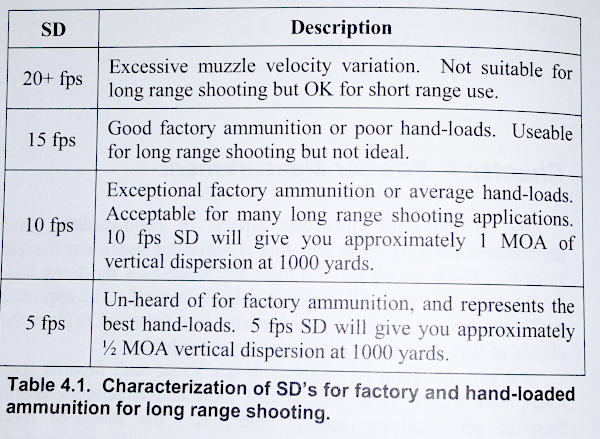
3. The ammo’s Standard Deviation (SD) is unknown. You will often notice that while MV is often listed on ammo packages, Standard Deviation (normally) is not. It is not uncommon for factory ammunition to have an SD of 18 or higher. Sometimes as high as 40+. As such is the nature of metering powder. With marketing in mind, did they pick the high, low, or average end of the SD? We really don’t know. You won’t either until you test it for yourself. For hand-loaded ammo, to be considered around 10 fps or less. Having a high SD is often the nature of metered powder and factory loads. The image below is from Modern Advancements in Long Range Shooting: Volume II.
4. You don’t know how MV was measured. What chronograph system did the manufacturer use, and how did they back track to a muzzle velocity? A chronograph does not measure true velocity at the muzzle; it simply measures velocity at the location it is sitting. So you need to back-calculate the distance from the chrono to the end of the barrel. This calculation requires a semi-accurate BC. So whose BC was used to back track to the muzzle or did the manufacturer even do that? Did they simply print the numbers displayed by the chronograph? What kind of chronograph setup did they use? We know from our Lab Testing that not all chronographs are created equal. Without knowing what chronograph was used, you have no idea the quality of the measurement.
5. The MV data may not be current. Does the manufacturer update that data for every lot? Or is it the same data from years ago? Some manufacturers rarely if ever re-test and update information. Some update it every lot (ABM Ammo is actually tested every single lot for 1% consistency). Without knowing this information, you could be using data for years ago.
CONCLUSION: Never use the printed MV off a box of ammo as anything more than a starting point, there are too many factors to account for. You must always either test for the MV with a chronograph, or use carefully obtained, live fire data. When you are using a Ballistic Solver such as the AB Apps or Devices integrated with AB, you need to know the MV to an accuracy down to 5 fps. The more reliable the MV number, the better your ballistics solutions.