Many leading shooting sports vendors are running sales for the 4th of July, with some sales extending through the 5th, 6th, or 7th of July. With some vendors, you’ll find sitewide discounts plus significant additional savings on select products. In addition some sellers are now offering FREE Shipping or FREE Hazmat (with a minimum order).
Here are TEN notable 4th of July Independence Week Sales Events from leading online retailers. With 7/4/2026 marking the 250th Anniversary of the founding of our nation, many vendors are running really significant summer promotions. This is a great time to save on guns, reloading supplies, ammo and more.
Brownells — 12% Off Products with Code FREEDOM12
Creedmoor Sports — 10% Off Products with Code USA250
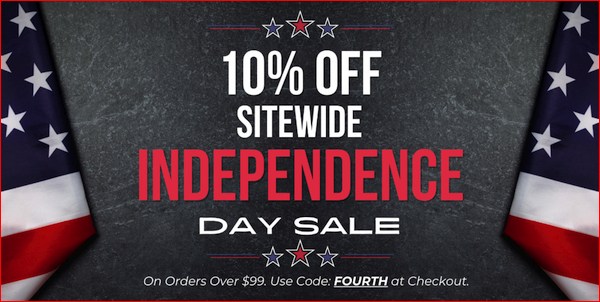
Precision Reloading — 10% Off $99+ Orders with Code FOURTH
Bullet Central — Big Savings on Actions, Stocks, Barrels & More
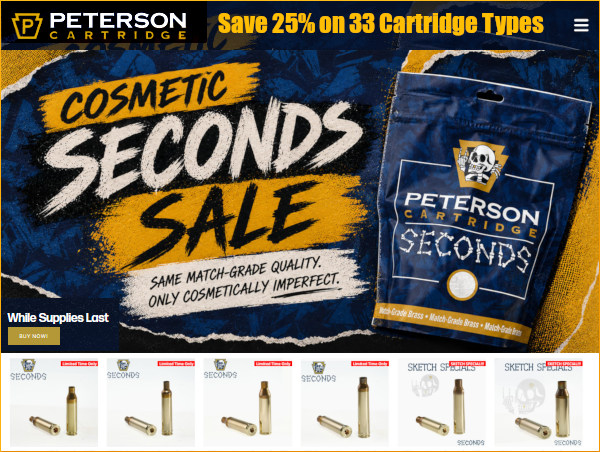
Peterson Cartridge — Save 25% on Cosmetic Seconds Brass
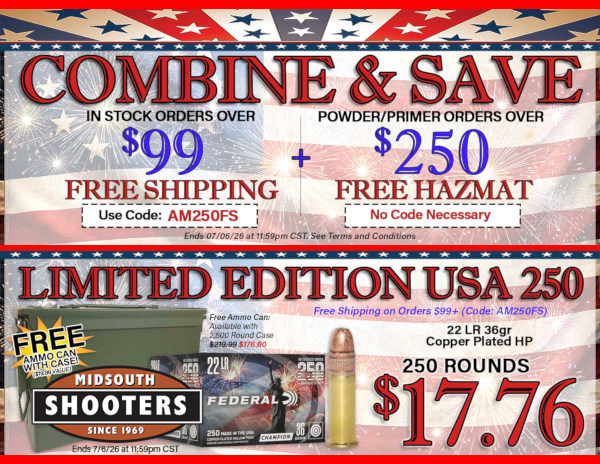
Midsouth — FREE Shipping $99+ and Free Hazmat $250+
Sportsman’s Warehouse — 10% OFF All Ammo Plus Gear Sales
Powder Valley — Major Red, White, Blue & Green RCBS Sale
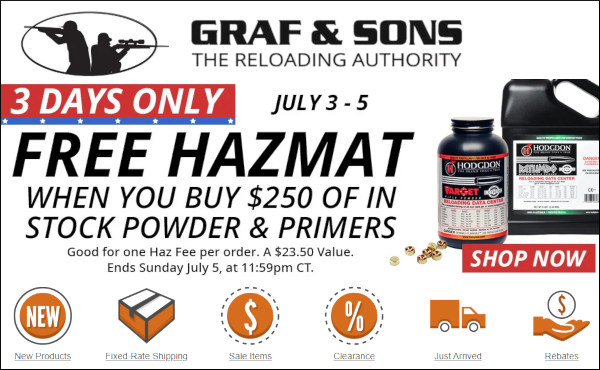
Graf & Sons — FREE Hazmat ($250+) Promotion and Specials
MidwayUSA — FREE Shipping on $100+ Orders (Plus Discounts)
As a cartridge case is reloaded multiple times, burnt powder residue and carbon builds up on the inside of the case. Unless the case interior is cleaned in some fashion, eventually you’ll see a slight reduction in case capacity. One of our Forum members from Australia wonders about the effects of reduced case capacity: “If the capacity of the case decreases as the crud builds up, then it effectively reduces the size of the cartridge (inside). Wouldn’t that change the pressure produced from that of an equivalent clean case?”
Interesting Test of Case Capacity Changes
Forum member Fred Bohl has actual test results that can help answer the above question. Fred proved that, over a 20-reload cycle, the case capacity of uncleaned cases did decline a small amount. However, surprisingly, this did not seem to affect the actual chronographed velocity of the load. Extreme Spread (ES) did increase, but Fred believes the higher ES was due to changes in case-neck tension, rather than due to the slight reduction in case capacity. Fred reports:
“Back when beginning to use ultrasonic case cleaning, part of the motivation was to get the inside clean based on the assumption that allowing burnt residue to build up inside cases would affect capacity, and, ultimately, performance. An experiment was done to test this hypothesis. The load used, 30.5 grains of RL15 behind 107gr SMKs in a 6mmBR, was selected for best group and lowest ES in prior load development. It turned out to be 92% of initial case capacity and neither “full” or compressed. (I would suspect that different powders, load weight, and total case capacity might produce very different results.)
We took 30 cases of identical initial capacity and tracked three lots of 10 each:
LOT 1: No Internal cleaning LOT 2: Cleaned with media in tumbler LOT 3: Cleaned with Ultrasound machine
Each case (in each lot) was shot and reloaded 20 times. The simplified results after 20 reloads of each lot were as follows:
Lot 1 (not cleaned) – 0.3 to 0.4 gr. loss of capacity, 5 to 8 fps greater ES.
Lot 2 (tumble cleaned) – 0.1 to 0.3 gr. loss of capacity, 4 to 6 fps greater ES.
Lot 3 (ultrasonic cleaned) – no loss of capacity, no detectable change in ES.
FINDINGS There was no detectable correlation of velocity change to the lots. An oddity was that on very hot days Lot 1 velocities were, occasionally, slightly higher. From results of another ongoing test, I believe the above differences in ES are probably due more to variance in bullet grip tension than case capacity. The ultrasound cleaned cases (LOT 3) did maintain the lowest ES, but we are not 100% sure of the reasons why. More consistent bullet seating might be the reason.”
Editor’s NOTE: Fred’s results do suggest that carbon build-up inside the uncleaned cases might cause a slight increase in pressure that shows up on hot days. Fred has posted that: “A local shooter reported doing the 20 reload, no-clean test on a .308 that gave a loss of capacity of 2.0 grains, doubled ES and significant velocity changes. However, I don’t have any details on his load weight or powder.” Obviously a lot of carbon can build up with 20 reloads. Many shooters retire their brass before then.
Ultrasonic Cleaning and Neck Lube
Some time ago, Jason Baney did a lengthy test on ultrasonic cleaning. Jason found that with his ultrasonically-cleaned cases, the inside of the necks got so “squeaky clean” that he needed to use dry lube in the necks. Jason uses the dry lube kit from Neconos.com. This applies ultra-fine Moly powder to the neck interior using small carbon steel balls.
There is an excellent article about primers on the Shooting Times website. We strongly recommend you read Mysteries And Misconceptions Of The All-Important Primer, written by Allan Jones. Mr. Jones is a bona fide expert — he served as the manager of technical publications for CCI Ammunition and Speer Bullets and Jones authored three editions of the Speer Reloading Manual.
This authoritative Shooting Times article explains the fine points of primer design and construction. Jones also reveals some little-known facts about primers and he corrects common misconceptions. Here are some highlights from the article:
Size Matters
Useful Trivia — even though Small Rifle and Small Pistol primer pockets share the same depth specification, Large Rifle and Large Pistol primers do not. The standard pocket for a Large Pistol primer is somewhat shallower than its Large Rifle counterpart, specifically, 0.008 to 0.009 inch less.
Magnum Primers
There are two ways to make a Magnum primer — either use more of the standard chemical mix to provide a longer-burning flame or change the mix to one with more aggressive burn characteristics. Prior to 1989, CCI used the first option in Magnum Rifle primers. After that, we switched to a mix optimized for spherical propellants that produced a 24% increase in flame temperature and a 16% boost in gas volume.
Foiled Again
Most component primers have a little disk of paper between the anvil and the priming mix. It is called “foil paper” not because it’s made of foil but because it replaces the true metal foil used to seal early percussion caps. The reason this little disk exists is strictly a manufacturing convenience. Wet primer pellets are smaller than the inside diameter of the cup when inserted and must be compacted to achieve their proper diameter and height. Without the foil paper, the wet mix would stick to the compaction pins and jam up the assembly process.
Widener’s Reloading & Shooting Supply has published a helpful introduction to reloading powders. Widener’s online Guide to Smokeless Powders shows the various types of powders, and explains how the differences in powder kernel/flake size and shape, and burn rate affect performance. We recommend you visit Widener’s website and read the Powder Guide in full.
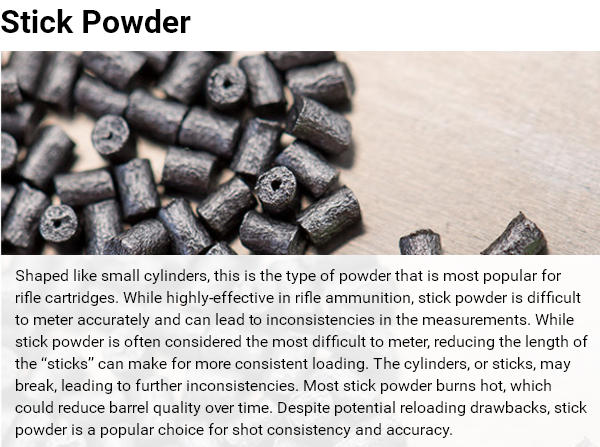
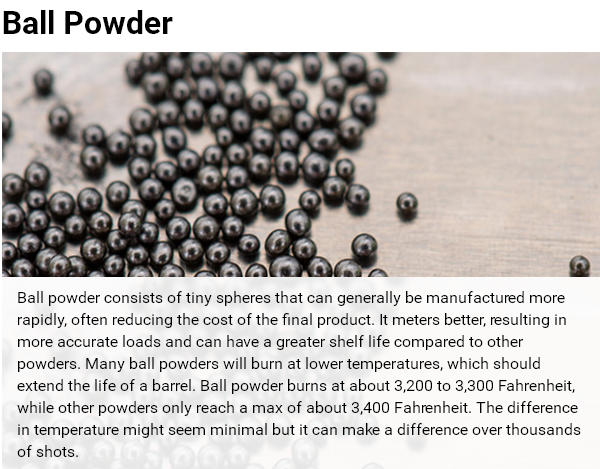
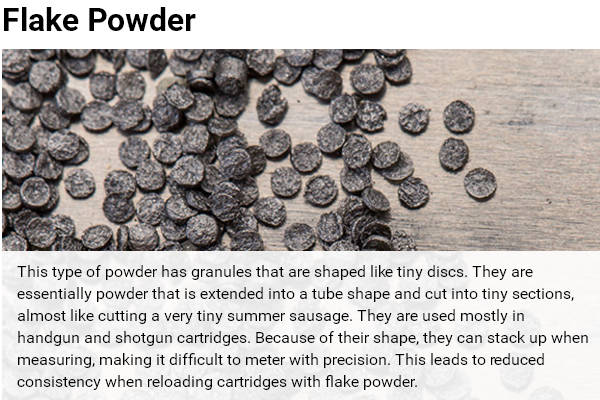
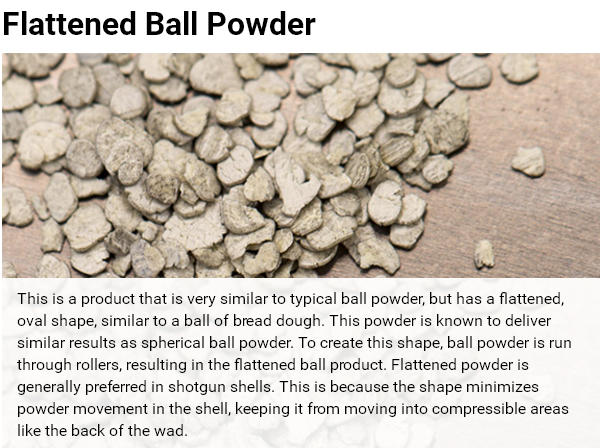
Take a close look at these illustrations which show the key differences between the four main powder types: extruded (stick) powder, ball (spherical) powder, flattened ball powder, and flake powder.
Burn Rate Basics
Widener’s Guide to Smokeless Powders also has a useful discussion of Burn Rate (a confusing topic for many hand-loaders). Wideners explains: “While a gun powder explosion in the cartridge seems instantaneous, if you slow it down you will actually find that each powder has a different ‘burn rate’, or speed at which it ignites.” This video shows powders with two very different burn rates. Watch closely.
Different burn rates suit different cartridge types notes Widener’s: “In general a fast-burning powder is used for light bullets and low-speed pistols and shotguns. Medium-rate powders are used for magnum pistols, while high-velocity, large bore rifle cartridges will need slow powders[.]
It should be noted that burn rate does not have a standardized unit of measurement. In fact, burn rate is really only discussed in comparison to other powders; there is no universal yardstick. Specifics will change by cartridge and bullet types[.]”
Ultimate Range Sweepstakes — FREE to Enter
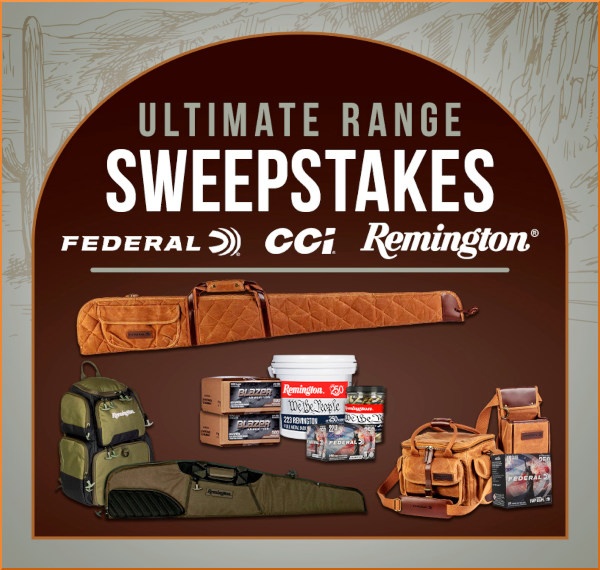
Are you feeling lucky? MidwayUSA is currently running a cool contest with nearly $2800 in prizes. This Ultimate Range Sweepstakes includes excellent range bags, gun cases, plus a large selection of rifle, pistol, and shotgun ammo. Prize products are supplied by Federal, CCI, and Remington. ENTER Here.
You don’t have to pay a penny to enter — no purchase is necessary. Simply provide your name and email address. CLICK HERE for complete contest rules. The winner(s) will be determined by a random drawing by MidwayUSA on or about August 01, 2026.
Here is the PRIZE PACKAGE with Ammo, Gun Cases, and Gear:
One (1) Remington USA 250th We The People Edition .22 LR Ammo 33gr Plated Hollow Point Case of 2500
One (1) Remington USA 250th We The People Edition .223 Remington Ammo 55gr FMJ Case of 1000
One (1) Federal Premium Champion USA 250th Edition .22 LR Ammo 36gr Plated HP Case of 2500
Two (2) Federal Premium Top Gun USA 250th Edition 12 Ga Ammo 2-3/4″ #8 Lead Shot Case of 250
Two (2) CCI Blazer Brass 500-count boxes of 9mm Luger Ammo 115 Grain FMJ Ammo
One (1) Remington First in Field Scoped Rifle Case
One (1) Federal Premium Shotgun Case
One (1) Federal Premium Shell Pouch
One (1) Federal Premium Range Bag
One (1) Remington Range Backpack
One (1) Federal Heritage Patch Hat
One (1) CCI 75th Anniversary Hat
One (1) Remington Eagle Hat
One (1) CCI Trio Can Cooler
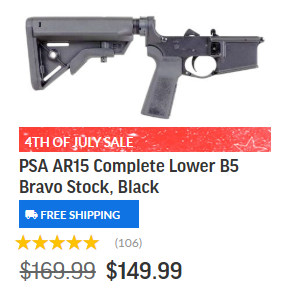
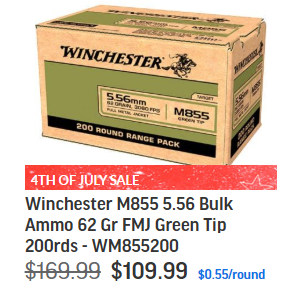
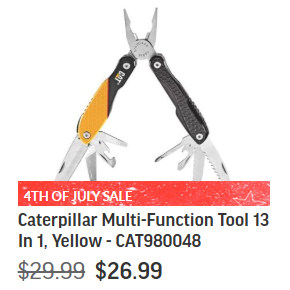
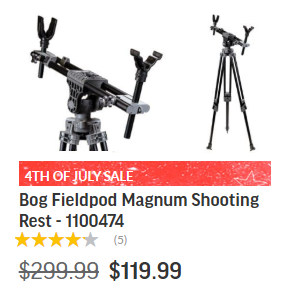
Palmetto State Armory is running an Independence Day Sale now through July 5, 2026. You’ll find major savings on popular guns, gear, and accessories. This is a great time to shop if you’re looking for ARs, tactical gear, and bulk ammo.
Palmetto State Armory Independence Day SALE Dozen Deals
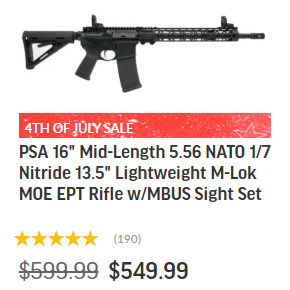
Here are 12 great deals we found, with discounts up to 63%.
Along with these spotlighted Dozen Deals, there are hundreds of other products on sale — guns, ammo, optics, actions/lowers, stocks, bipods, knives, tools, hunting gear, camping gear and more. CLICK HERE to see ALL sale items.
Serious riflemen know that Krieger makes outstanding centerfire barrels that hold world records and have won many National Championships. But did you know that Krieger makes great rimfire barrels too? Well, Krieger does make outstanding .22 LR rimfire match barrels that can deliver impressive accuracy.
Sniper’s Hide moderator “Padom” recently tested a variety of rimfire ammo types, employing five different barrels: Krieger, Bartlein, Benchmark, Lilja, and Green Mountain. He tested at both 50 yards and 100 yards. FULL Rimfire TEST REPORT HERE.
Reporting on the 50-yard test, Padom posted: “Had a virtually dead calm day today for 50-yard RimX testing (Keystone Accuracy RimX barreled action with 1:16″ Krieger 20″ barrel). A few infrequent 3 mph gusts but pretty dead [calm] and the target showed. This Krieger just barely edged out the Bartlein by 0.003″ with a 0.177″ 6×5 with SK Rifle Match. The 10×5 was 0.198″. The best lots of Center-X weren’t far behind either. This is the first Krieger rimfire [barrel] I’ve shot and it didn’t disappoint.”
Padom noted: “Winds were much calmer tonight than this morning so the 100-yard Krieger test was a success. Winds were pretty consistent [at] 3-5 mph.”
Test Results at 100 Yards
Padom then tested ammo at 100 yards, again using his Krieger rimfire barrel: “To recap, the Krieger shot the best 50-yard results of the barrels tested so far, just barely beating the Bartlein but it was so close you can call the 50-yard results equal (.005). Well the Krieger beat all the barrels tested to date at 100 yards by a pretty good margin with Center-X. The 10×5 was incredible as well at just barely over 0.6″ showing the results were very consistent. A second lot of Center-X was right there with the previous 100-yard 6×5 best results just barely over 0.6. The third lot of Center-X shot a respectable 0.75″ 6×5. This Krieger sure is shooting very nicely. I’m really looking forward to shooting it at 300 and 400 yards[.]”
Components Tested: 20″ Krieger M24 barrel, .22 LR Match Eachus chamber 0.046 headspace, Zermatt RimX Action, Bix’N Andy TacSport Pro 2-Stage Trigger, RimX 10rd magazine, XLR Envy Pro Folding Chassis, Athlon Cronus BTR 4.5-29x56mm MIL scope.
Shooting Set-up: 100 Yards Prone with Bipod and Rear Bag.
At the request of our readers, we provide select “Deals of the Week”. Every Sunday afternoon or Monday morning we offer our Best Bargain selections. Here are some of the best deals on firearms, hardware, reloading components, optics, and shooting accessories. Be aware that sale prices are subject to change, and once clearance inventory is sold, it’s gone for good. You snooze you lose.
NOTE: All listed products are for sale to persons 18 years of age or older. No products are intended for use by minors.
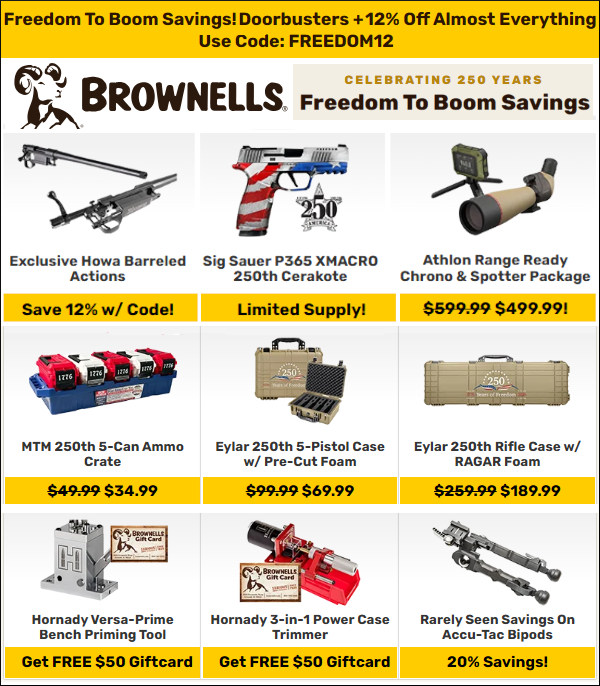
Brownells – Freedom Sale + 12% Savings with Code FREEDOM12
⏺️ » Major savings on products plus 12% OFF with CODE FREEDOM12
Brownells is running a major Freedom to Boom Sale this week in preparation for July 4 and the nation’s 250th anniversary. A wide variety of products are on sale, including Howa barreled actions, Athlon chronographs, and AccuTac bipods. PLUS you can save 12% on most products with code FREEDOM12.
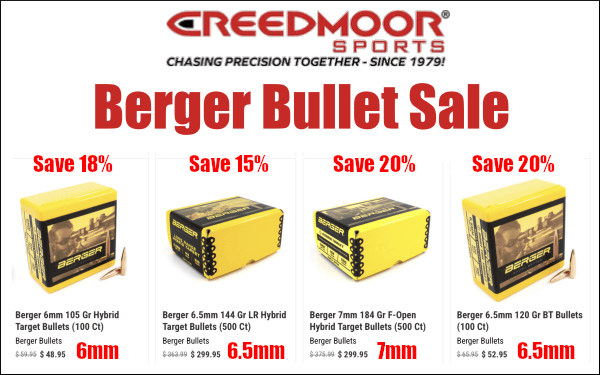
Creedmoor Sports — Berger Bullet Sale
⏺️ » Great Berger bullets for all popular calibers, 15-20% OFF
Need great match bullets? Check out the current Berger Bullets Bargain Bunker Sale at Creedmoor Sports. If you compete in PRS/NRL, Silhouette, or F-Class you probably shoot Berger Bullets and if you don’t you should probably try them. They rank among the highest quality, most consistent bullets available and have won more titles than just about any bullet out there.
As an Amazon affiliate, this site can earn revenues through sales commissions.
Here’s a cool tool for your hand-loaders, particularly if you load large quantities of bulk ammo for a variety of firearms. Lyman’s handy Ammo Checkers check the diameters of reloaded rounds and factory ammo, so you can quickly confirm that your ammo fits a standard chamber. Just drop your loaded rounds in the Ammo Checker, and if the round fits into the gauge, it will fit in the gun’s chamber.
Lyman Ammo Checkers are multi-caliber — each orange block checks six or eight different cartridge types, with each caliber/cartridge name engraved on the gauge. Ammo Checkers are machined to SAAMI minimum chamber dimensions from solid blocks of 6061 T6 aluminum. Ammo Checkers are available in three versions covering most common handgun and rifle calibers:
Handgun Ammo Checker (#7833000) $37.99 on Amazon
Fits: .380 Auto, 9mm Luger, .38 Super, .40 S&W, .45 ACP, .38/357, .44 Spl/Mag, and .45 Colt
Cheaper Multi-Cartridge Pistol Ammo Checker Blocks
There are also some cheaper multi-caliber pistol ammo checker blocks from foreign makers.
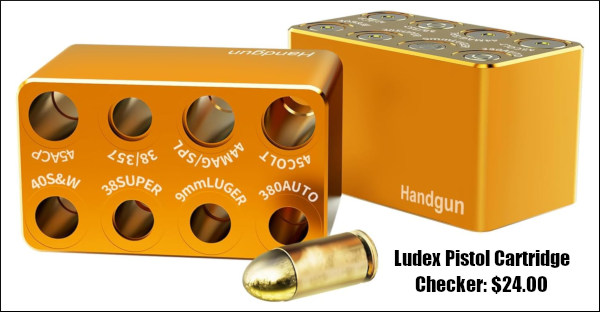
Pistol Ammo Checker — Ludex Block, $24.00 on Amazon (Orange)
Fits: .380 Auto, 9mm Luger, .38 Super, .40 S&W, .45 ACP, .38/.357, .44 Mag/Spl, and 45 Colt.
Pistol Ammo Checker — LYHgogo Block, $19.81 on Amazon (Black)
Fits: .380 Auto, 9mm Luger, .38 Super, .40 S&W, .45 ACP, .38/.357, .44 Mag/Spl, and 45 Colt.
Why Use a Case Gauge?
We find that case gauges like the Lyman Ammo Checker are particularly useful for handgun reloaders using progressive presses. The chambers of many popular semi-auto pistols are partly unsupported. This allows the case to swell in the bottom quarter. The case may not be sized adequately by your sizing die, which can lead to misfeeds or malfunctions.
Additionally, if you have loaded a large quantity of ammo for a semi-auto rifle such as an AR15, it’s not a bad idea to check your cartridges before you load them into your magazines. All you need is one mis-sized round to cause a stoppage. That will ruin your day if you are competing in a Service Rifle match or 3-Gun event.
Here’s a very useful product that should please shooters who wet-tumble their brass with stainless media, or use ultrasonic cleaning machines to clean cartridge brass (and gun parts). Employing forced hot air circulation, the Lyman Cyclone Case Dryer will dry a large quantity of brass in under two hours. Internal racks provide five drying levels.
Currently priced at $81.99 at both MidwayUSA and Amazon.com, the Lyman Cyclone Case Dryer is an affordable and effective product for folks who use an ultrasonic or rotary-tumbler brass cleaning system.
The Lyman Cyclone Case Dryer works fast. No need to wait overnight (or longer) to air-dry your brass. Lyman states that “The forced heated air circulation of the Cyclone will dry your brass inside and out within an hour or two, with no unsightly water spots.” The handy individual trays keep different types of brass separate. The dryer can also be used for gun parts that have been ultrasonically cleaned.
Lyman Cyclone Case Dryer Features:
• Holds up to 1000 .223 Rem cases or 2000 9x19mm Luger cases
• Works with cartridge brass cases or gun parts
• Fast drying time — Typically 1 to 2 hours
• Timer control can be set up to 3 hours
• Durable ABS trays with recessed handles
Watch How Cyclone Case Dryer Functions with both Cartridge Brass and Gun Parts
Cyclone Case Dryer 115V (Part #7631560) MSRP: $99.95
Cyclone Case Dryer 220V (Part #7631561) MSRP: $112.00











 Test Results at 100 Yards