Do you have a hankering to shoot Extreme Long Range (ELR)? Then you’ll want a large-caliber cartridge with plenty of boiler room. Some of the most successful ELR cartridges have been based on the CheyTac family, including the .375 CheyTac (9.5×77) and .408 CheyTac (10.36 x 77). Now brass for both these jumbo cartridges is offered by Peterson Cartridge. This Peterson Cheytac brass has proven to be tough and long-lived. And it is capable of winning — Derek Rodgers won the 2017 King of 2 Miles (K02M) event shooting a .375 Cheytac with Peterson brass. Here’s a report on how Peterson developed and tested its tough CheyTac cartridge brass.
Developing and Testing CheyTac Brass
Report by Peterson Cartridge Co.
Our president, Derek Peterson, has live-tested our most recent iteration of the .375 CheyTac (aka 9.5 X 77). He started with five casings, and did a full-body resizing after each firing. He got 17 firings out of each before he started to notice the early signs of case head separation. [Editor: Theses were with extremely high pressure loads.] He then took another set of casings and after each firing he just bumped the shoulder back, like a typical reloader would. He got 20 firings out of those casings.
Note: CheyTac® is a registered trademark of CheyTac USA, LLC. Peterson Cartridge has no affiliation.
Low MV Extreme Spread
On the first two shots the muzzle velocities were within 12 feet per second of each other. On the 3rd and 4th shots the muzzle velocities were within 6 feet per second of each other. By the 5th shot the muzzle velocities were within 1 foot per second of each other. Now that is how you can put two bullets in the same hole down range.
No SAAMI Spec for CheyTac Cartridges
As many of you probably already know there is no SAAMI spec on these calibers. So, without a SAAMI spec there is no stated maximum pressure for a service load. However, there IS an international spec on the .408 [promulgated by the] CIP (Commission International Permanente). And the CIP max pressure for this round is extremely high. Our partner in Europe tells us it is probably unnecessarily high. Our partner loads these rounds and they have a standard load for the .375s which is also quite high. So that is the pressure we did our testing at. To even achieve that pressure, we had to use a compressed load. We are explaining all this to say that you [should not use] a load that hot, and therefor you will most likely get more reloads than we did[.]
Peterson Brass Goes Through 11 Dimensional Tests
With all the casings we make in any caliber, we perform a battery of in-process, real-time dimensional checks. [We test] 11 different dimensions continuously throughout each shift. Some of these are tube cylindricity, mouth to body concentricity, primer pocket diameter, length to shoulder, overall length, and more. These measurements are automatically fed into Statistical Process Control software. If a dimension begins to drift from nominal we can catch it immediately and correct it.
Peterson is Fully Committed to CheyTac Brass Production
Peterson Cartridge purchased additional manufacturing equipment designed specifically to produce these large casings. Our capacity is 5-million casings a year. We are committed to there not being a shortage of these calibers ever again.
Derek Rodgers is the 2017 King of 2 Miles. He is also the first-ever human to ever hit the maximum distance target target at 3368 yards (1.91 miles) in competition. His cartridge choice? The .375 CheyTac. Derek ran Cutting Edge Bullets in Peterson brass with Hodgdon H50BMG powder.
Q: Why did you choose the .375 CheyTac cartridge?
Derek: When I was asked to join the Applied Ballistics Team, I needed to get an ELR rifle built in a short period of time. I was under a very tight time schedule to get the project complete. In an effort to eliminate variables, I decided to keep things standard and as simple as possible. I chose the .375 CheyTac for the ease of getting components. The larger rifles are more difficult to get components quickly and I felt like the .375 CheyTac had enough attributes to be competitive at ELR distances.
Product Tip from EdLongrange. We welcome reader submissions.
Peterson Cartridge Company (“Peterson”) has released a lengthy, authoritative guide to the 22 Creedmoor cartridge, a popular wildcat based on the 6.5 Creedmoor or 6mm Creedmoor necked down to .224 caliber. We think the .22 Creedmoor would be a great long-range varmint cartridge, similar to the .22-250 Rem, but with a more modern, efficient cartridge design. In addition, some PRS/NRL competitors may turn to the .22 Creedmoor because it has less recoil and is flatter-shooting than the 6mm Creedmoor. In addition, .224-caliber match bullets are typically less expensive than heavier 6mm and 6.5mm projectiles. Less recoil, and less cost — what’s not to like?*
Along with load data, this article has specific sections dedicated to: Primers, Rifling Twist Rates, and Reloading Supplies. If you are considering building a .22 Creedmoor, we recommend you download the full Peterson .22 Creedmoor article, which is available in PDF format.
Peterson states, “Since its inception in 2007… the 6.5 Creedmoor has seen some pretty meteoric growth in popularity. That growth continues as of this writing, as the cartridge has now gone mainstream with hunters and shooters alike. As the popularity of the 6.5 Creedmoor has increased, so has the number of wildcat cartridges based off of it. Some of those popular wildcat cartridges are the 6mm Creedmoor, the .25 Creedmoor, and now the .22 Creedmoor. This data sheet will cover the .22 Creedmoor.
To help our customers, and anyone else who shoots .22 Creedmoor, we decided to create this Data Sheet and distribute it. [In this LOAD DATA Document] you will find four (4) common bullets, and four (4) common rifle powders used when handloading the .22 Creedmoor cartridge. We then took the different bullet and powder combinations and loaded them up to the SAAMI Maximum Average Pressure (MAP) for the 6.5 Creedmoor and 6mm Creedmoor cartridges, which is 62,000 PSI. [O]ur goal was to provide a wide spectrum of bullet weights and the powders used with them.
All of the following data was gathered by our ballistician in our indoor ballistics lab located in our factory in Pennsylvania. Although we were able to gather pressure and velocity data in our lab, we have NOT tested these loads for accuracy. Again, these loads are just designed to give shooters information regarding what velocity, a given bullet and powder charge combination, will produce the SAAMI Maximum Average Pressure (MAP) of 62,000 psi.”
Sample 22 Creedmoor LOAD DATA
IMPORTANT — Pressures can vary significantly with different Cartridge Overall Lengths (COAL). In addition, ANY change to ANY load components — primers, bullets, brass, powder — can affect pressure. Always load conservatively. In addition, because of variances in bore dimensions, some barrels may show higher pressures than others. Again, always start with conservative loads, well below MAX pressures.
*Actually there IS a potential downside — reduced barrel life. We expect that a .22 Creedmoor running hot varmint loads would experience shorter useful barrel life compared to a 6.5 Creedmoor. This is based on what we’ve observed with .22-250 and .22-250 Ackley barrels compared to our 6.5 CM barrels.
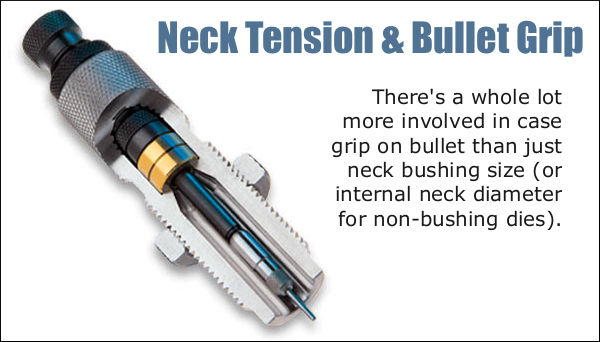
Many novice hand-loaders believe that neck bushing Inside Diameter (ID) size is the only important factor in neck tension. In fact, many different things will influence the grip on your bullet and its ability to release from the case neck. To learn more about neck tension and “case grip”, take the time to read this article carefully. We bet you’ll gain knowledge that will let you load more accurate ammo, with better ES/SD.
Editor: Guys, this is a VERY important article. You really should read it over carefully, twice. Variations in the force required to release a bullet can significantly affect accuracy and ES/SD. You really need to know how the grip on bullet can be altered by many different factors.
Neck Tension (i.e. Grip on Bullets) Is a Complex Phenomenon
While we certainly have considerable control over neck tension by using tighter or looser bushings (with smaller or bigger Inside Diameters), bushing size is only one factor at work. It’s important to understand the multiple factors that can increase or decrease the resistance to bullet release. Think in terms of overall brass-on-bullet “grip” instead of just bushing size (or the internal neck diameter in non-bushing full-length sizing dies).
Bullet grip is affected by many things, such as:
1. Neck-wall thickness.
2. Amount of bullet bearing surface (shank) in the neck.
3. Surface condition inside of neck (residual carbon can act as a lubricant; ultrasonic cleaning makes necks “grabby”).
4. Length of neck (e.g. 6mmBR neck vs. 6mm Dasher).
5. Whether or not the bullets have an anti-friction coating.
6.The springiness of the brass (which is related to degree of work-hardening; number of firings etc.)
7. The bullet jacket material.
8. The outside diameter of the bullet and whether it has a pressure ridge.
9. Time duration between bullet seating and firing (necks can stiffen with time).
10. How often the brass is annealed.
11. Amount (length) of neck sized (e.g. you can size only half the neck).
12. Interior diameter of bushing, or neck section of non-bushing die.
– and there are others…
One needs to understand that bushing size isn’t the beginning and end of neck tension questions, because, even if bushing size is held constant, the amount of bullet “grip” can change dramatically as the condition of your brass changes. Bullet “grip” can also change if you alter your seating depth, and it can even change if you ultrasonically clean your cases.
5-time U.S. National Long-Range Champion John Whidden adds: “Our tests show us that the condition of the necks in regards to lubed or not, carbon inside or not, squeaky clean or not, etc., matter even more than the size of the bushing used. An ultrasonically cleaned or brand new dry case neck make for some quite high seating force.”
In our Shooters’ Forum a reader recently asked: “How much neck tension should I use?” This prompted a Forum discussion in which other Forum members recommended a specific number based on their experience, such as .001″, .002″, or .003″. These numbers, as commonly used, correspond to the difference between case-neck OD after sizing and the neck OD of a loaded round, with bullet in place. In other words, the numbers refer to the nominal amount of interference fit (after sizing).
While these commonly-used “tension numbers” (of .001″, .002″ etc.) can be useful as starting points, neck tension is actually a fairly complex subject. The actual amount of “grip” on the bullet is a function of many factors, of which neck-OD reduction during sizing is just one. Understanding these many factors will help you maintain consistent neck tension as your brass “evolves” over the course of multiple reloadings.
Seating Depth Changes Can Increase or Decrease Grip on Bullet
You can do this simple experiment. Seat a boat-tail bullet in your sized neck with .150″ of bearing surface (shank) in the neck. Now remove the bullet with an impact hammer. Next, take another identical bullet and seat it with .300″ of bearing surface in another sized case (same bushing size/same nominal tension). You’ll find the deeper-seated bullet is gripped much harder.
Neck-Wall Thickness is Important Too
I have also found that thinner necks, particularly the very thin necks used by many PPC shooters, require more sizing to give equivalent “grip”. Again, do your own experiment. Seat a bullet in a case turned to .008″ neckwall thickness and sized down .003″. Now compare that to a case with .014″ neckwall thickness and sized down .0015″. You may find that the bullet in the thin necks actually pulls out easier, though it supposedly has more “neck tension”, if one were to consider bushing size alone.
In practical terms, because thick necks are less elastic than very thin necks, when you turn necks you may need to run tighter bushings to maintain the same amount of actual grip on the bullets (as compared to no-turn brass). Consequently, I suspect the guys using .0015″ “tension” on no-turn brass may be a lot closer to the guys using .003″ “tension” on turned necks than either group may realize.
Toward a Better Definition of Neck Tension
As a convenient short-cut, we tend to describe neck tension by bushing size alone. When a guy says, “I run .002 neck tension”, that normally means he is using a die/bushing that sizes the necks .002″ smaller than a loaded round. Well we know something about his post-sizing neck OD, but do we really have a reliable idea about how much force is required to release his bullets? Maybe not… This use of the term “neck tension” when we are really only describing the amount of neck diameter reduction with a die/bushing is really kind of incomplete.
My point here is that it is overly simplistic to ask, “should I load with .001 tension or .003?” In reality, an .001″ reduction (after springback) on a thick neck might provide MORE “grip” on a deep-seated bullet than an .003″ reduction on a very thin-walled neck holding a bullet with minimal bearing surface in the neck. Bushing ID is something we can easily measure and verify. We use bushing size as a descriptor of neck tension because it is convenient and because the other important factors are hard to quantify. But those factors shouldn’t be ignored if you want to maintain consistent neck tension for optimal accuracy.
Consistency and accuracy — that’s really what this all about isn’t it? We want to find the best neck tension for accuracy, and then maintain that amount of grip-on-bullet over time. To do that you need to look not only at your bushing size, but also at how your brass has changed (work-hardened) with time, and whether other variables (such as the amount of carbon in the neck) have changed. Ultimately, optimal neck tension must be ascertained experimentally. You have to go out and test empirically to see what works, in YOUR rifle, with YOUR bullets and YOUR brass. And you may have to change the nominal tension setting (i.e. bushing size) as your brass work-hardens or IF YOU CHANGE SEATING DEPTHS.
Remember that bushing size alone does not tell us all we need to know about the neck’s true “holding power” on a bullet, or the energy required for bullet release. True bullet grip is a more complicated phenomenon, one that is affected by numerous factors, some of which are very hard to quantify.
At the request of our readers, we provide select “Deals of the Week”. Every Sunday afternoon or Monday morning we offer our Best Bargain selections. Here are some of the best deals on firearms, hardware, reloading components, optics, and shooting accessories. Be aware that sale prices are subject to change, and once clearance inventory is sold, it’s gone for good. You snooze you lose.
NOTE: All listed products are for sale to persons 18 years of age or older. No products are intended for use by minors.
1. Palmetto State Armory — Norma Tac-22 .22 LR 500rds, $39.99
⏺ Very good .22 LR ammo at extremely low price — GREAT VALUE
If you love shooting .22 LR rimfires and want quality ammo at an ultra-low price grab some Norma TAC-22. At only $4 per 50-ct box, this is a true bargain, yet the TAC-22 is good enough for NRL22 matches as well as fun target shooting. We’ve shot this Norma ammo and been very satisfied. You’ll be hard-pressed to find better .22 LR ammo at anywhere near this price.
2. Amazon — RCBS ChargeMaster Link Dispenser, $269.99
⏺ Popular, modern Scale/Dispenser with Smartphone App functionality
The Chargemaster Link is a modern, high-tech electronic scale/dispenser from RCBS. Employing the proven load cell and electronics of the popular RCBS ChargeMaster Lite, the ChargeMaster Link adds built-in Bluetooth connectivity that pairs with an RCBS Mobile App for a customized, streamlined powder dispensing experience. The Link App can archive charge powders/weights for various cartridge types and then “talk” to the ChargeMaster Link during the powder dispensing process. The ChargeMaster Link is on sale now for $269.99 on Amazon or get one for $269.99 at Midsouth with FREE shipping!
3. Grafs.com — Harris Bipod Sale
⏺ Well-made, quality Harris bipods on sale this week
A good, reliable bipod is essential for tactical shooting and is very useful in many hunting situations. For decades, Harris Bipods have been a reliable bipod choice. And right now, Graf & Sons had Harris Bipods on Sale with significant savings. Find everything from standard version to swiveling and extended legs over at Graf’s at very attractive prices.
4. Midsouth — RCBS ChargeMaster Supreme, $379.99
⏺ Great performance, now with Bluetooth connectivity
We’ve dispensed loads for thousands of cartridges with our original RCBS ChargeMaster. The new-generation RCBS ChargeMaster Supreme Digital Powder Scale/Dispenser combines the proven reliability of previous ChargeMasters with some cool new features. The latest Chargemaster Supreme, on sale for $379.99 at Midsouth, boasts Bluetooth capability and 0.1 grain accuracy. The unit also includes the new RCBS proprietary “powder learn” process that optimizes the ChargeMaster Supreme’s dispense rate to the powder you are using, enhancing efficiency.
5. MidwayUSA — Bushnell Optics Sale
⏺ Low-cost scopes and rangefinders suitable for hunters
If you’re in the market for a budget-priced rangefinder, scope, or binoculars check out the Bushnell Sale at MidwayUSA. This is a good opportunity for hunters who need low-cost optics for that annual hunt. Bushnell prices are up to 41% off.
6. KYGUNCO — Federal Small Rifle Primers, 5000 for $449.95
⏺ Reasonable price — grab these before they sell out
Finding rifle primers is getting harder everyday. Supplies are still selling out almost instantly. Thankfully KYGUNCO obtained a large supply of 5000 FEDERAL AMMO Small Rifle Primers. The price is $449.95 for 5000 primers. That works out to $90 per thousand — not great, but if you need them, check this out. With a low hazmat and shipping fee this is one of the better primer deals we’ve seen lately.
7. Amazon — DSLEAF Tactical Range Bag, $49.99
⏺ Good, spacious bag for pistols, mags, ammo, and range safety gear
This versatile DSLEAF Tactical Gun Range Bag has plenty of room for pistols, magazines, and safety gear. The bag can carry 4 pistols in the main compartment. The front zippered pockets has 6 slots that fit most 9mm, .40 SW, and .45 ACP magazines. You can store eye and ear protection in the top compartment or side pockets, and there are MOLLE straps on the pocket flaps. Made from heavy nylon material, this Tactical Range Bag is durable and strong. The bag has earned 87% 4- or 5-star ratings from actual purchasers.
8. Brownells — Aguila .22 LR Ammo, 2000 Rounds, $164.99
⏺ Great deal — just 8 cents per round with big 2000-rd bulk pack
Rimfire shooting has been growing leaps and bounds the past few years. Right now Brownells has Aguila Super Extra .22 LR ammo on sale at great prices. This ammo works well in both .22 LR rifles and handguns. Individual 50-round boxes are just $4.r9 ($0.09/rd). If you shoot a lot, grab the huge, 2000-round case for $164.99 ($0.08/rd).
⏺ Best price we’ve found on major brand 9mm Luger ammo
The 9mm Luger (9x19mm) is the most popular centerfire pistol cartridge. Every handgunner should keep a good supply of 9mm ammo on hand for days at the range. Here’s a great deal on quality, major-manufacturer 9mm FMJ pistol ammunition. Get 1000 rounds of Fiocchi 9mm 115gr FMJ ammo for just $269.99. That works out to just $13.50 per 50 count box, or $0.27 per round — a great deal.
10. Amazon — Plano Gun Guard SE Series 2-Gun Case, $50.78
⏺ Very good price on a large, two-gun case for day trips
For carrying long guns to/from the range, we recommend a lockable case with interior padding. Some states require that guns be locked when carried in a vehicle. A good low-cost case is Plano Gun Guard SE Multi-Case, Amazon’s #1 best seller among hard rifle cases. Measuring 52.2″ overall, it will hold guns with long barrels and it is wide enough to carry two rifles. Measurements: 52.2″ W x 16″ H x 4″ D. Weight: 11 pounds. NOTE: While this $50 case will handle trips to the range, for air transport you should use a heavier, stronger case with more padding and thicker construction. Consider the $108 Plano All-Weather Case.
Here’s a late-breaking deal. If you need high-BC 6mm match bullets for benchrest, F-Class, PRS/NRL, or silhouette matches, head over to Precision Reloading. While Berger bullets have been in very high demand lately, Precision Reloading has a large inventory of Berger 6mm match bullets IN STOCK now. Chose from 90gr, 95gr, 105gr, 108gr, and 115gr 6mm bullets. PLUS there are Coupon CODES good today to save $10 Off $100, $25 Off $250, and $50 Off $500. But you better act soon, these bullets may sell out quickly, and those Coupon CODES expire tonight, 10/31/2022 at 11:59 PM CST.
Evergreen Ballistics is a shooter-owned enterprise that sells a great selection of coated lead bullets, conventional cast bullets, plus copper-plated bullets. If you currently shoot cast and/or plated bullets in your pistols and/or rifles, you should definitely check out the Evergreen Ballistics offerings. The prices are very competitive and customer service is excellent.
Evergreen Ballistics (EB) was launched in April 2020. The company soon received many customer requests to produce coated bullets. Marc McAtee, owner of Evergreen Ballistics, set to work: “I ordered several different colors of Hi-Tek Supercoat [to test]. We launched the line of coated bullets in mid-2020 and they quickly became our most desired type of bullets.” A year later Evergreen launched a line of EB-branded plated pistol bullets produced by a major North American plated-bullet manufacturer.
“I have always tried to keep the mission of Evergreen Ballistics focused and simple. Provide quality projectiles to reloaders at the best price possible. In addition, we try to treat our customers as we would want to be treated. From fast, inexpensive shipping, to taking the time to answer every email, we do our best to do right by the customer.” — Marc McAtee, Evergreen Ballistics
Evergreen Ballistics Polymer-Coated Bullets
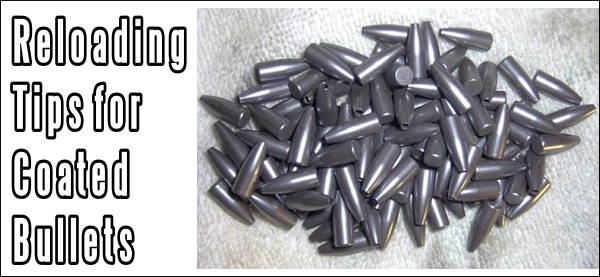
Evergreen Ballistics offers a selection of coated bullets in two styles: 1) NLG or “no lube groove” bullets; and 2) grooved bullets made from the same alloy and molds as its regular cast lead bullets. The NLG bullet molds were designed specifically to meet the increased demand for coated bullets. McAtee explains the coating process: “After casting and cooling, the bullets are weighed out onto individual wire trays. The coating is then mixed with a solvent, in our case acetone, and applied to the bullets. We apply the coating by adding it to a large mixing bowl and shaking the bullets vigorously. The bullets are then spread out on their wire trays to dry thoroughly. The bullets are then backed for approximately 10 minutes to set the coating. After cooling, we perform two tests to verify the integrity of the coating.”
This shows that the coating has cured. Next, we simply smash a bullet with a hammer. The coating should not flake off. This proves the coating is chemically bonded to the lead. We preform these tests on every tray that comes out of our ovens. After this, we repeat the process for the second coat. Once the bullets have cooled from their second coat, they are sized through carbide sizing dies. We use a small amount of fluoropolymer-based lubricant to aid in sizing the bullets. One of the questions I get asked all the time is, “Does the coating come off during sizing?”. No, it does not. If the coating is cured properly it will remain on the bullet during sizing. Just as it remains on the bullet as it travels down the barrel.
The coating is Hi-Tek Supercoat manufactured by J & M Specialized Products in Australia. This polymer coating has major advantages. The coating nearly eliminates barrel leading and significantly reduces airborne lead. In addition, with no greasy lube to vaporize, there is greatly reduced smoke.
Evergreen Ballistics Cast Lead Bullets
Along with its signature green-coated bullets, Evergreen Ballistics offers a full line of conventional lead bullets cast from an alloy containing 92% lead, 6% Antimony, and 2% Tin with a Brinell hardness (BHN) of approximately 16. This alloy delivers good performance at a range of velocities.
Marc McAtee notes: “Our molds were designed with this high-quality alloy in mind. Our lead arrives very clean, so there is minimal fluxing that we have to do, and we do not have a significant amount of dross to pull off the pot. Our lead bullets are sized using machined carbide dies and lubed with Commercial 160 from White Label Lube Company”.
Evergreen Ballistics Plated Bullets
Our plated bullets are manufactured by a leading North American bullet manufacture. The lead cores are swaged to ensure consistent starting weight. They are then electroplated which deposits a layer of copper that completely encapsulates the lead core. This copper layer is approximately 0.008″ in thickness. The bullets are then resized to ensure concentricity and appropriate diameter. The heavy plating on these bullets allows them to be pushed to higher velocity using FMJ load data.
Interview with Marc McAtee, Founder of Evergreen Bullets
Q. How and why did you start the company?
A: The idea to start the business originated in late 2018 after finding a commercial casting set-up at an estate sale. I acquired the automated casting and sizing machines along with a collection of molds. Over the next several months, I would cast and re-melt numerous batches of lead bullets to optimize the production process . In April of 2020 the Evergreen Ballistics business was formed, and I began selling cast lead bullets online. Around this time, I began to use Hi-Tek Supercoat on small batches of lead bullets, making polymer-coated bullets for myself. Shortly after I learned about the Supercoat product, customers asked if we could produce coated lead bullets. After experimenting with several colors and ratios of coating, I settled on the color and recipe we use now.
Q. What are the benefits of the polymer bullet coatings?
A. When compared to ordinary cast lead bullets you have no lead fouling and no smoke that would normally be created from burning lube. In addition, you do not get cast bullet lube on your reloading dies. Polymer coated bullets are cleaner to shoot and cleaner to load than plain lead bullets.
Q. What makes your bullets different/better than the competition?
A. In our coated bullets we use the same 92/6/2 alloy as our cast lead bullets. This keeps the cast weights consistent. Some coated bullet companies have switched to a 98/2 alloy. It’s a cheaper alloy, but the weights do not cast the same. For OUR plated bullets, the plating is 0.008″ thick. Many other plated bullets on the market range from 0.002-0.006″ in plating thickness. Our thicker plating allows the bullet to perform more like a FMJ and you have less chance of plate separation as the bullet travels down range.
Q. How are the jacketed bullets made?
A: Full disclosure: our jacketed bullets are not made in-house, they are manufactured by a contractor. With that being said, The cores of the plated bullets begin as chucks of 98% lead, 2% antimony lead wire. The cores are formed into the rough bullet shape then head into the plating process. This process involves several steps in various chemical baths. This results in strong adhesion of the copper plate to the lead core. The bullets are then reformed in a hydraulic press to ensure prefect dimensions and consistency from bullet to bullets. Finally, the bullets are polished and shipped to us in 50,000-piece crates. Upon arrival, from the contractor, several bullets from each batch are tested for weight and dimension consistency. In addition, we verify adhesion of the copper plating.
Q. Are you able to keep up with the high current bullet demand?
We are a small shop — we do not have big OEM customers or even wholesale customers. ALL the bullets we make and sell go to people who reload. This was very evident during the last big rush on ammo/bullets. While some manufactures were taking 4-6 weeks to ship orders, we were able to ship orders in less than a week. We were not backlogged with massive OEM bullet orders. All of our capacity goes to support the everyday reloader.
Q. Will any new calibers/bullet types be offered in the near future?
Our newest addition to our plated bullet line are our .458 diameter bullets. These include a 300gr and 405gr RNFP and a Spitzer design available in 350gr, 450gr, or 500gr sizes. We are currently working on a coated, 220gr .308-caliber bullet for the suppressed 300 BLK crowd.
Palmetto State Armory (PSA) is running a major Halloween Sale for the next few days. We found some very impressive deals. Save $160 on a AR15 + 9mm Pistol combo, or save 33% on .22LR rimfire ammo. And there are big savings on other products such as gun cases, magazines, rifle scopes, and more.
CLICK HERE to see all the PSA Halloween Sale Specials »
TIP: If you see a great deal on a product you need, we recommend you grab it quickly. The best deals can sell out quickly, particularly on popular types of ammo.
Coating bullets with a friction-reducing compound such as Molybdenum Disulfide (Moly) offers potential benefits, including reduced barrel heat, and being able to shoot longer strings of fire between bore cleanings. One of the effects of reduced friction can be the lessening of internal barrel pressures. This, in turn, means that coated bullets MAY run slower than naked bullets (with charges held equal).
To restore velocities, shooters running coated bullets are inclined to “bump up” the load — but you need to be cautious.
Be Careful When Increasing Loads for Coated Bullets
We caution shooters that when your start out with coated bullets in a “fresh barrel” you should NOT immediately raise the charge weight. It may take a couple dozen coated rounds before the anti-friction coating is distributed through the bore, and you really start to see the reduced pressures. Some guys will automatically add a grain or so to recommended “naked” bullet charge weights when they shoot coated bullets. That’s a risky undertaking.
We recommend that you use “naked” bullet loads for the first dozen coated rounds through a new barrel. Use a chronograph and monitor velocities. It may take up to 30 rounds before you see a reduction in velocity of 30-50 fps that indicates that your anti-friction coating is fully effective.
We have a friend who was recently testing moly-coated 6mm bullets in a 6-6.5×47. Moly had not been used in the barrel before. Our friend had added a grain to his “naked” bullet load, thinking that would compensate for the predicted lower pressures. What he found instead was that his loads were WAY too hot initially. It took 30+ moly-coated rounds through the bore before he saw his velocities drop — a sign that the pressure had lowered due to the moly. For the rounds fired before that point his pressures were too high, and he ended up tossing some expensive Lapua brass into the trash because the primer pockets had expanded excessively.
LESSON: Start low, even with coated bullets. Don’t increase your charge weights (over naked bullet loads) until you have clear evidence of lower pressure and reduced velocity.
Procedure After Barrel Cleaning
If you shoot Moly, and clean the barrel aggressively after a match, you may want to shoot a dozen coated “foulers” before starting your record string. Robert Whitley, who has used Moly in some of his rifles, tells us he liked to have 10-15 coated rounds through the bore before commencing record fire. In a “squeaky-clean” bore, you won’t get the full “benefits” of moly immediately.
To learn more about the properties of dry lubricants for bullets, read our Guide to Coating Bullets. This covers the three most popular bullet coatings: Molybdenum Disulfide (Moly), Tungsten Disulfide (WS2 or ‘Danzac’), and Hexagonal Boron Nitride (HBN). The article discusses the pros and cons of the different bullet coatings and offers step-by-step, illustrated instructions on how to coat your bullets using a tumbler.
Hornady recently unveiled a variety of new products for 2023. There are new ammo and bullet types, new firearms storage products, a new ammo storage locker, and an impressive new Precision Lab Scale with a 0.01 grain readout and hi/lo sensitivity settings. Among Hornady’s new ammo products, the new 7mm PRC is the most notable. This new 7mm magnum cartridge will initially be offered with three bullet types: 160gr CX Outfitter, 175gr ELD-X Precision Hunter, and 180gr ELD Match.
The new ammunition, bullet, reloading and security products will be available from stocking dealers, major retail sporting goods stores and their websites.
Ruger has created a helpful set of online resources for new Firearm owners. The New Firearm Owner Resources site features a Fundamentals of Firearms Ownership Video Series, Industry Resources for local “hands-on” training, as well as information on safe storage. In addition, this online Resource Center offers a full library of product instruction manuals along with suggestions for recommended safety equipment.
There are a variety of informative videos, hosted by Mark Gurney, Ruger Director of Product Management. These short (2 min. on average) videos provide key information for new gun owners. If you have friends or family members who are new gun owners, they should watch these videos.
Introduction for New Firearms Owners
Safety Rules — The FOUR Fundamental Safety Rules
Range Safety Equipment — What You Need
This video reviews essential Eye and Ear Protection for shooters.


 In our
  Neck-Wall Thickness is Important Too