The 2023 Western Hunting and Conservation EXPO opens today at the Salt Palace Convention Center in Salt Lake City, Utah. The Western Hunting and Conservation Expo is the largest hunting convention open to the public in the Western USA. The EXPO features daily seminars, waterfowl and elk calling championships, auctions, drawings and more. Exhibit halls open 10:00 AM to 7:00 PM, Thursday through Saturday and 10:00 AM to 4:00 PM on Sunday. A partnership between the Mule Deer Foundation, Sportsmen for Fish and Wildlife, and Utah Office of Tourism. With over 400 hunting and outdoor business vendors, this year’s event should attract over 55,000 attendees.
CLICK HERE to register for the EXPO. Various packages are offered. There is a basic 4-day Hall Pass, and other deluxe packages including banquets and entertainment.
New Elite Hunter Bullets from Berger Berger Bullets will attend the 2023 Western Hunting EXPO this year in Utah. Berger’s hunting bullets — VLD Hunting, Elite Hunter, and Classic Hunter –are designed for controlled expansion and extreme hydrostatic shock at both short- and long-range distances. These bullets are available for handloaders, and these bullet options are also offered used in quality factory ammo.
New for 2023, Berger has expanded its successful Elite Hunter ammunition with the following offerings: 6mm Creedmoor 108 Grain Elite Hunter, 6.5 Creedmoor 140 Grain Elite Hunter, 6.5 PRC 140 Grain Elite Hunter, and 300 PRC 245 Grain Elite Hunter.
This article, as published in AccurateShooter.com, contains copyrighted content. It shall not be republished in whole or in part without advanced permission in writing. The act of republishing constitutes legal consent to licensing fees.
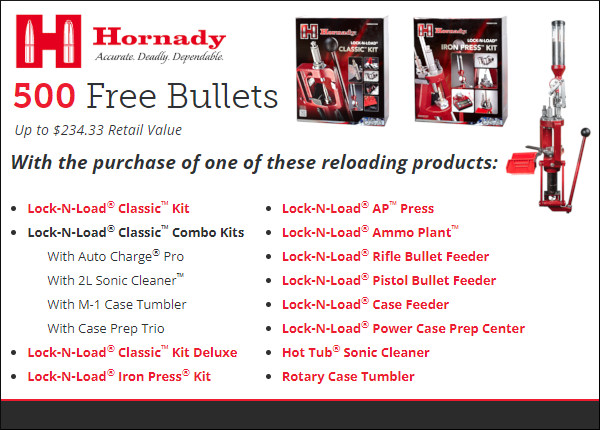
Back by popular demand, Hornady is now running its 2023 Get Loaded® promotion. With this promo you can get up to 500 FREE BULLETS with qualifying purchases of Hornady reloading products.
The 2023 Get Loaded program begins on February 1, 2023 and continues through December 31, 2023. Customers who purchase from the qualifying Hornady lineup of reloading presses and reloading tools will receive free bullets after submitting official redemption forms. Depending on the products purchased, customers can get 500 or 100 free bullets, valued up to $234.33.
The Coriolis Effect comes into play with extreme long-range shots like this (2100 yards at Raton, New Mexico). The rotation of the earth actually moves the target a small distance (in space) during the long duration of the bullet’s flight.
When you’re out at the range, the Earth seems very stable. But it is actually a big sphere zooming through space while spinning around its axis, one complete turn every 24 hours. The rotation of the earth can create problems for extreme long-range shooters. During extended bullet flight times, the rotation of the planet causes an apparent deflection of the bullet path over very long distances. This is the ballistics manifestation of the Coriolis Effect.
Bryan Litz of Applied Ballistics discusses explains the Coriolis Effect in his Ballistics Books and Seminars. Bryan notes that Coriolis is “a very subtle effect. People like to make more of it than it is because it seems mysterious.” In most common shooting situations inside 1K, Coriolis is not important. At 1000 yards, the Effect represents less than one click (for most cartridge types). Even well past 1000 yards, in windy conditions, the Coriolis Effect may well be “lost in the noise”. But in very calm conditions, when shooting at extreme ranges, Bryan says you can benefit from adjusting your ballistics solution for Coriolis.
Bryan explains: “The Coriolis Effect… has to do with the spin of the earth. You are basically shooting from one point to another on a rotating sphere, in an inertial reference frame. The consequence of that is that, if the flight time of the bullet gets significantly long, the bullet can have an apparent drift from its intended target. The amount [of apparent drift] is very small — it depends on your latitude and azimuth of fire on the planet.”
Coriolis is a very subtle effect. With typical bullet BCs and velocities, you must get to at least 1000 yards before Coriolis amounts to even one click. Accordingly, Bryan advises: “Coriolis Effect is NOT something to think about on moving targets, it is NOT something to think about in high, uncertain wind environments because there are variables that are dominating your uncertainty picture, and the Coriolis will distract you more than the correction is worth.”
“Where you could think about Coriolis, and have it be a major impact on your hit percentage, is if you are shooting at extended range, at relatively small targets, in low-wind conditions. Where you know your muzzle velocity and BC very well, [and there are] pristine conditions, that’s where you’re going to see Coriolis creep in. You’ll receive more refinement and accuracy in your ballistics solutions if you account for Coriolis on those types of shots. But in most practical long-range shooting situations, Coriolis is NOT important. What IS important is to understand is when you should think about it and when you shouldn’t, i.e. when applying it will matter and when it won’t.”
At the request of our readers, we provide select “Deals of the Week”. Every Sunday afternoon or Monday morning we offer our Best Bargain selections. Here are some of the best deals on firearms, hardware, reloading components, optics, and shooting accessories. Be aware that sale prices are subject to change, and once clearance inventory is sold, it’s gone for good. You snooze you lose.
NOTE: All listed products are for sale to persons 18 years of age or older. No products are intended for use by minors.
1. Sportsman’s WH — Gun Sale + $100 Smith & Wesson REBATE
2. Midsouth — LEE Breechlock Challenger Press Kit, $144.99
⏺ Heck of a deal on a good press and complete reloading system
For under $150 you can get pretty much everything you need to reload, except dies. This LEE Breech Lock Challenger Kit includes Press, Powder Dispenser, Scale, Hand Primer Tool, Funnel, Chamfer Tool, Primer pocket tool, and more. We like the press — the handle is adjustable and the primer-catching system sends spent primers into a receptacle for no mess cleanup. This $144.99 LEE Kit comes complete with the Breechlock Quick Change die system. If you are looking to get started in handloading, or want a back-up second press with accessories, this is a great deal.
Shooting steel is fun — you get instant gratification from hearing the “clang” and seeing the gong swing. Shooting steel is also good practice for PRS/NRL events and ground-hog matches. Right now, you can get some great deals on quality AR500 steel targets. These Dragon Target Gongs start at just $12.99 for a 4″-diameter, 3/8″-thick gong. Larger 6″, 8″, 10″, and 12″ gongs are offered in 3/8″ and 1/2″ thicknesses, and a 3-pack of 8″ gongs is available. A 6″-diameter gong is $18.99 (3/8″ thick) or $23.99 (1/2″ thick). The largest 12″-diameter gong in the heavy 1/2″ thickness is $57.99. NOTE: All these Dragon gongs have a center hole allowing more hanging options.
⏺ Complete AR-15 rifle for less than you might pay for assembled upper
You can’t beat this price for a complete AR-15 — $399.99 from KYGUNCO with Free Shipping. You could easily pay MORE for an assembled upper alone. The Radical Firearms RPR AR-15 rifle features MIL-STD upper and lower receivers along with 15″ RPR rail system. The 16″ 1:7″-twist barrel is 4140 Chrome Moly Vanadium. The lower is forged 7075 T6 aluminum with Type III anodizing. The buttstock is adjustable and there is a long rail on the top of the aluminum forearm for mounting optics and accessories.
5. Palmetto SA — CCI 9mm 115gr FMJ 1000 Rounds, $299.99
⏺ Quality, reliable CCI 9mm ammo, 1K case works out to $15 for 50 rounds
This is reliable, made-in-USA 9mm ammo, with good brass and quality CCI FMJ bullets. The $299.99 case price works out to just $15.00 per 50 rounds — a great value. This isn’t much more expensive than remanufactured 9mm ammo, and you have the assurance of NEW brass and major brand quality control. Note: This is a loose pack with all 1000 rounds in a single large, heavy-duty box.
6. Powder Valley — 500 Sierra 9mm Bullets with Can, $99.99
⏺ Great price on 9mm bullets with bonus Sierra Ammo Can
A 500-ct can of Sierra 9mm 115gr FMJ bullets is on sale now for $99.99 at Powder Valley Inc.. You get 500 FMJ bullets PLUS a sturdy polymer ammo can at a $50 savings off the normal price. Act soon as this $50 savings ends at 11:59 pm on Friday 2/03/23, or while supplies last. Replenish your 9mm bullet stock and take advantage of this Sierra Bullets + Ammo Can Sale.
7. Midsouth — A-Zoom Snap Cap Sets, $7.15 and up
⏺ Snap Caps for dry-fire training — big selection of cartridge types
All shooters can benefit from dry-fire training. And for that you definitely need Snap Caps. A-Zoom offers a wide range of Snap Cap Kits for rimfire and centerfire rifles and pistols. There is even a jumbo Snap Cap for 12ga shotguns. For semi-auto pistols we recommend the orange StrikerCaps ($7.15 2-pack). These stay in place in the chamber — just rack the slide to reset the trigger. For a large pistol collection, try the $21.96 Pistol Variety Pack with five different cartridge types: .22 LR, .380 ACP, 9mm Luger, .40 S&W, .45 ACP. There’s also a $31.37 Military/LE Variety Pack with 9mm Luger, .40 S&W, .45 ACP, .223 Rem, .308 Win, and 12 Gauge shotshell.
8. Amazon — Walkie Talkies with LED Flashlight, $23.99
⏺ Popular 22 Ch FRS radio set with built-in flashlights
Campers, hunters, and hikers can all use this budget-priced MOICO Walkie-Talkie Set, now just $23.99 on Amazon. These offer 22 FRS channels, with a max 5 mile range (in open country). These work well when communicating between the shooting line and target pits downrange. One great feature is a built-in-LED flashlight — making these Walkie-Talkies great for camping and night-time use.
9. Amazon — Real Avid 19-in-1 Multi-Tool, $39.99
⏺ Versatile Multi-Tool with great features for gun owners
We’re big fans of multi-tools and this 19-in-1 Real Avid Multi-Tool is one of the best for gun guys. This compact 19-in-1 handgun multi-tool is a “must have” for any handgun owner. This tool can handle a multitude of tasks — e.g. changing grips, mounting accessories, field disassembly, adjusting laser sights, and even gunsmithing repairs. This tool does it all.
10. Amazon — Field Dressing Kit, $69.97
⏺ Must-have kit for game hunters — very useful
For the hunters out there, here’s a nice kit to prepare game meat. The versatile Knine Outdoors Field Dressing Kit offers a great selection of tools for a low price. This very complete Dressing Kit includes: 12″ Boning Knife, 9-1/2″ Gut-Hook Skinner, 8-1/2″ Hawkbill blade knife, 8-1/2″ Caping Knife, 12″ Gut-Hook Butcher Axe, 10-1/2″ Skinning Cleaver, 8-1/2″ Bone Saw, Ribcage Spreader (7″ to 12″), 9-1/4″ Game Shear, 11-7/8″ x 7-7/8″ Cutting Board, Knife and Shear Sharpener, and Cleaning Gloves.
11. AAF Nation — T-Shirt or Hoodie, $23.95 or $39.95
⏺ Popular hoodie and/or shirt with great message for older shooters
Let’s face it, many of us are not so young anymore… but we still can shoot! That’s the message of these clothing items. Against a background of a bullseye target, the illustration reads: “Too old to fight, too slow to run, but I can still shoot pretty darn good.” Choose either a hoodie version for $39.95, a regular T-shirt for $23.95, or long sleeve shirt for $29.95. Purchasers report the items are sized properly. One hoodie buyer posted: “This hoodie is warm and comfortable. It is well-made and has a good print job!”
Instead of using the standard .223 Remington or 5.56x45mm NATO round, you have many options for an AR-15. Dozens of cartridge variants have been tried in AR-15s. Some of the most noteworthy and popular alternative chamberings for AR-15s are:
20 Practical — This is simply the .223 Rem necked down to .204 caliber. Requires new barrel. Same bolt, same magazines. Best bang for the buck. .224 Valkyrie — A necked-down version of the 6.8 SPC, the .224 Valkyrie was introduced by Federal a few seasons back. It has better ballistics than the .223 Remington, if used with a suitable barrel. 6mm ARC — Relatively new cartridge that works well for varminting, self-defense, tactical competitions, and deer hunting. Good selection of bullets and factory-loaded ammunition. 6.5 Grendel — Accurate and proven across the course, the 6.5 Grendel requires a new barrel, bolt, and magazines. Most use the 6.5 Grendel for competitive shooting and/or hunting. .300 Blackout — Moderately expensive, the .300 Blackout requires a barrel change. This is used for home defense, and hunting. WARNING — with some bullets this round can be chambered in a .223 Rem barrel, with disastrous consequences. .458 SOCOM — Pretty expensive, requires new barrel and bolt. The .458 SOCOM round is typically used for hunting though it was originally designed for Close Quarters Battle (CQB).
Of these six options, our favorite is the 20 Practical, followed by the 6mm ARC and 6.5 Grendel. The 20 Practical is a great varminting round. Check out our featured 20 Practical AR Rifle Report. This 20 Practical cartridge is highly effective on small varmints, and has shown outstanding accuracy in AR-platform rifles crafted by Robert Whitley.
20 Practical — High-Velocity, Affordable Alternative
The 20 Practical is simply a .223 Remington necked down to .204 caliber. This efficient little cartridge can launch 32-grainers at over 4200 fps, with impressive results on P-Dogs. This makes the 20 Practical a great choice for an AR-based varmint rifle.
20 Practical Ultimate Varminter
A decade ago, as a “proof-of-concept”, AccurateShooter.com created a 20 Practical AR15 Ultimate Varminter with a custom 20-caliber upper from Robert Whitley of AR-X Enterprises, LLC. That project rifle was ultra-accurate — every 5-shot group out of the gun was less than the size of a dime. That gun was auctioned off, but Robert Whitley continues to produce custom 20 Practical AR15 uppers. (The 20 Practical cartridge is simply the .223 Rem necked down to 20 caliber — you can use standard .223 brass and load with standard .223 Rem dies. Just swap in a smaller expander and use smaller neck bushings.)
6mm ARC — Popular New SAAMI Cartridge Promoted by Hornady
In June 2020, Hornady introduced the 6mm ARC, a new SAAMI cartridge optimized for AR-platform rifles*. The new 6mm ARC is basically a 6.5 Grendel necked down to 6mm, with the shoulder moved back around .030″. That pushed-back shoulder does reduce case capacity (and velocity), but we assume Hornady did that to create a shorter, proprietary chamber so people could not simply neck-down Lapua 6.5 Grendel brass, as has been done for years with Robert Whitley’s outstanding 6mm AR wildcat.
What Is the 6mm ARC Cartridge? The 6mm ARC cartridge is a modern SAAMI-spec cartridge based on the 6.5 Grendel case necked down for 6mm bullets, with the shoulder moved back 0.030. Yes it is designed to run in AR15-platform rifles. You’ll need a new barrel, bolt, and mags. If you already have an AR chambered in 6.5 Grendel, the ONLY thing you need to change is the barrel. Everything else — bolt, magazines, gas system – is compatible with 6mm ARC.
▶ Official SAAMI Cartridge (not wildcat)
▶ Fits standard AR15-platform rifles
▶ Fits Short/Mini action bolt rifles
▶ Efficient short, fat case design
▶ 30-degree case shoulder
What Do I Need To Shoot the 6mm ARC?
Faxon and Ballistic Advantage are already producing barrels, with more manufacturers sure to follow. All the other required components are already on the market for 6.5 Grendel rifles. Aero Precision already offers complete 6mm ARC uppers.
If you’re converting a standard 5.56×45 mm (.223 Rem) AR15 upper to shoot 6mm ARC, you’ll need a 6mm barrel, a Type II 6.5 Grendel bolt carrier group, and new magazines. Some folks have suggested standard AR mags will work, but trust us, you want the magazines that have been designed for 6.5 Grendel. All the hardware you need is currently available at Brownells.
While 6-6.5 Grendel shooters are known to run stout pressures, the new 6mm ARC cartridge has a relatively moderate Maximum Average Pressure (MAP) rating of 52,000 psi according to the official SAAMI specifications. For a variety of reasons, is wise to keep pressures in a semi-auto rifle moderate. Don’t chase the velocities you might get in a bolt-action gun.
The 6.5 Grendel — Accurate, Plus Good for Hunters
The 6.5 Grendel round is one of the most accurate cartridges for the AR-15 platform. The 6.5 Grendel round offers a larger-diameter, .264-caliber (6.5mm) bullet running at good velocities. This provides ample energy for smaller game and deer. The 6.5 Grendel is often used for hunting deer up to 300 yards.
History of the 6.5 Grendel Cartridge
The 6.5 Grendel originated as a 6mm PPC necked up to 6.5 mm. After Alexander Arms relinquished the “6.5 Grendel” Trademark, the 6.5 Grendel was standardized as an official SAAMI cartridge. It has become popular with target shooters and hunters alike because it is accurate, efficient, and offers modest recoil. Good for small to medium game, the 6.5 Grendel has been offered in lightweight hunting rifles, such as the Howa 1500 Mini Action.
.224 Valkyrie Cartridge — Impressive with Heavy .22-Cal Bullets
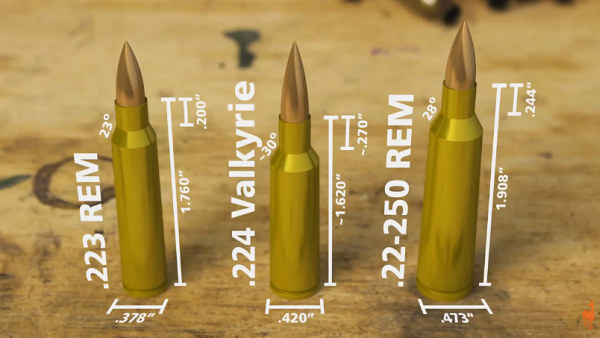
The new .224 Valkyrie was introduced in 2019 as a Hot Rod cartridge that will work in AR15s. Basically a 6.8 SPC necked down to .22 caliber, the Valkyrie has a shorter case than the .223 Remington (and 5.56×45 NATO). This allows you to load the longest, heaviest .224-caliber bullets and still feed reliably from an AR15-type magazine. Designed to rival the .22 Nosler while still running well in ARs, the .224 Valkyrie offers excellent long-range performance when loaded with modern, high-BC bullets. We expect some bolt-action PRS shooters might adopt the .224 Valkyrie. Why? Reduced recoil. With the 90gr SMK, the .224 Valkyrie offers ballistics similar to the 6.5 Creedmoor but with significantly less felt recoil. It can also be a viable alternative to a .22-250 for varminters using an AR platform.
Our friend Gavin Gear of UltimateReloader.com found a superbly accurate load with Berger 80.5gr bullets. Watch this video to learn more:
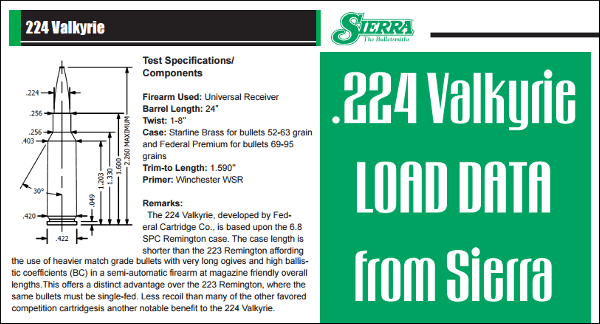
Sierra Bullets has published extensive load data for the .224 Valkyrie. This covers over a dozen powder types — many more than the Hodgdon database. Sierra’s .224 Valkyrie load data covers projectiles from 50 grain all the way up to 95 grains. With the 90 to 95 grain bullets, the little Valkyrie can give 6mm match cartridges a real run for their money — offering similar ballistics with less recoil. When selecting a barrel for the long .224-cal bullets, specify a fast enough twist rate: “Sierra recommends a 1:6.5″-twist barrel for the #9290 22 cal 90 gr HPBT bullet. However, for cartridges like the Valkyrie, that can push them over 2650 fps muzzle velocity, a 1:7″-twist barrel will stabilize the bullet correctly.”
CLICK HEREto DOWNLOAD Complete Sierra .224 Valkyrie LOAD DATA.
.224 Valkyrie vs. .22-250 Remington
The Social Regressive explains: “There are two key reasons why the .224 Valkyrie is unique and desirable. First, it is specifically designed to fit the limitations of the AR-15 platform. It does so even when loaded with gigantic bullets, like the 90-grain SMK that Federal announced. The .22-250 Rem is too long and too fat to work in the AR-15 platform; it needs an AR-10 bolt and magazine.”
The .224 Valkyrie has been marketed as a low-recoil round that can stay supersonic to 1300 yards and beyond (with 90gr Sierra MatchKings). Here a Sniper’s Hide duo shots an AR-platform .224 Valkyrie at distances out to 1550+ yards. To be honest, the accuracy wasn’t that impressive. However this test confirms that the .224 Valkyrie does launch the long, heavy projectiles at high enough velocities to prove superior to the standard .223 Rem. Frank Galli (aka “Lowlight”) teams up with Brian Whalen of Colorado Precision Rifle at the Blue Steel Ranch in New Mexico.
The .300 Blackout — Risky Business
The .300 Blackout appeals to folks who want a .30-caliber defense round. This can be loaded at various velocities. Loaded at subsonic speeds and shot with a suppressor, the .300 BLK offers very low sound levels. Unfortunately, that .300 Blackout cartridge can fit in a .223 Rem chamber. Shooting a .308-caliber bullet in .223 bore is a recipe for disaster.
The .300 AAC Blackout aka “300 BLK”, is a compact 30-caliber cartridge designed to work in AR-15 rifles. It has a shorter cartridge case to accommodate the bigger 30-caliber bullet while still fitting in a standard AR-15 magazine. Unfortunately, that’s the danger. A careless shooter can toss a .300 Blackout cartridge in with .223 Rem rounds without noting. And because the case-head size is the same as the .223 Rem (5.56×45) the rifle’s bolt assembly will happily chamber and fire the .300 BLK round. Problem is, that forces a .308 diameter bullet down an undersized .223-caliber bore. Not good!
This images were provided by Tactical Rifle Shooters on Facebook. The message was clear: “Don’t try to run 300 Blackout in your .223/5.56mm. It won’t end well. The problem is identical rifles and identical magazines but different calibers.”
Image from Accurate Shooter Forum. Cutaway shows the jammed .30-Cal bullet:
For those who MUST have a .300 Blackout, here are some things you can do:
1. Use different colored magazines for .300 Blackout vs. .223 Remington.
2. Mark .223 Rem upper handguards with the caliber in bright paint.
2. Fit all your uppers with caliber-labeled ejection port covers.
4. Mark all .300 BLK Rounds with heavy black marker.
This Saturday Movie showcase features four handguns chambered for the modern, high-velocity 5.7x28mm cartridge. In a 5″-6″ barreled pistol, the 5.7x28mm round can achieve very high velocities compared to a 9x19mm (9mm Luger) or .40 SW. The bottle-necked 5.7×28mm cartridge weighs roughly two-thirds as much as a typical 9mm Luger cartridge, allowing more rounds to be carried for the same weight. The cartridge can produce considerable muzzle flash when fired from a pistol, but it has roughly 30% less recoil than the 9mm Luger cartridge, improving controllability. Thanks to its high velocity, the 5.7×28mm has a flatter trajectory than most pistol ammo types.
Today we showcase videos of four different 5.7x28mm pistols — the new S&W M&P 5.7, the PSA 5.7 Rock, the Ruger-5.7, and the FN Five-SeveN Mk3 MRD. If you are looking for the best deal on a 5.7 pistol, check out the the PSA 5.7 Rock. You can buy one today for $599.99 including Holosun Red Dot Sight.
Smith & Wesson M&P 5.7 with 22-Rd Magazine
Chambered for the high-velocity, flat-shooting 5.7x28mm, the Smith & Wesson M&P 5.7 features S&W’s new TEMPO barrel system. This is a two-part, lock-breech barrel with a proprietary gas system for improved cycling and extraction. The new M&P 5.7 includes a 1/2×28 threaded barrel to mount a muzzle device or suppressor, optics-cut slide, flat-face trigger, and forward, frame rail for mounting accessories.
PSA 5.7 Rock — Best Value in a 5.7x28mm Handgun
The Palmetto State Armory (PSA) 5.7 Rock is the best value in a 5.7x28mm pistol. Right now PSA offers it complete with a mounted Holosun Red Dot sight for just $599.99 with two 23-rd mags. A full-sized, polymer-framed pistol, the PSA 5.7 Rock has threaded carbon steel fluted barrel and 416 stainless steel slide with QPQ finish for corrosion protection. Chambered in 5.7x28mm, the PSA 5.7 Rock is fed from a 23-round magazine and operated by a smooth, single-action, striker-fired trigger mechanism. While sold with a Holosun 407k optic, the 5.7 Rock slide accepts other Shield footprint optics.
Ruger-5.7 Pistol Review by Hickok45
In the video above, popular YouTube host Hickok45 reviews the Ruger-5.7, which was introduced in late 2019. This gun has proven reliable and when it hit the market it was much less expensive than its main competitor made by FN. Ruger’s 5.7x28mm pistol is blow-back operated with an internal hammer and ambidextrous thumb safety. The pistol is offered with a 20+1 capacity magazine and an adjustable rear sight paired with a fiber-optic front. Current MSRP is $899.00. If you’re interested in the Ruger-5.7, read the On-Target Magazine Full Review.
FN Five-SeveN Mk3 MRD Review
In this episode of TFBTV, James Reeves reviews the new FN Five-SeveN Mk3 MRD. At $1,449.00 MSRP, this is the most expensive 5.7x28mm pistol on the market, but might it also be the best? James takes the new Five-seveN Mk3 MRD to the range and to the table to tell you if FN’ lastest, high-tech 5.7x28mm pistol is worth the spend.
Ruger-5.7 vs. PSA 5.7 Rock
Ruger-5.7 vs. FN 5.7
Comparison Between 5.7x28mm and 9x19mm
In this video James Reeves compares the performance of the 5.7x28mm round with the 9mm Luger. The 5.7x28mm round certainly offers higher velocity and greater penetration than the legendary 9mm round. Plus common 5.7 magazines hold over 20 rounds. James discusses the advantages of this modern 5.7x28mm cartridge, as well as a few of its shortcomings — such as high cost per round. There is another insightful comparison between the two ammo types on the Ammo-to-Go website. Editor John Lewis notes: “5.7×28 is lighter and faster than 9mm ammo” while the 9mm had a “slight advantage in energy [and was] much better in gel”.
5.7x28mm vs 9mm Penetration Test
In this video the tester shot both 9mm and a 5.7x28mm bullets into horizontal stacks of paper plates. The smaller-diameter 5.7mm bullet penetrated about 40% more paper plates than the 9mm bullet (See video at 3:10-3:35). The 5.7mm bullet basically retained its dimensions in this test, while the hollow-point 9mm spread out slightly. Just mere horizontal penetration can’t tell you the actual effectiveness of the round based in a defensive situation. In a different test using Ballistic Gel, both rounds penetrated adequately but the 9mm created a bigger wound channel. SEE: AmmotoGo.com 5.7x28mm Test.
Short History of 5.7x28mm Guns and Ammo
The FN 5.7×28mm (designated as the 5.7×28 by the C.I.P. and FN 5.7x28mm NATO) is a small-caliber, high-velocity, rebated rim, bottle-necked centerfire cartridge designed for handgun and personal defense weapon uses. It is similar in length to the .22 WMR and somewhat similar to the .22 Hornet or .22 K-Hornet. Unlike many new cartridges, it has no parent case — it was developed from scratch by FN.
The 5.7×28mm was developed in conjunction with the FN P90 PDW and FN Five-Seven pistol in response to NATO requests for a replacement for the 9×19mm Parabellum cartridge (9mm Luger). In 2002 and 2003, NATO conducted a series of tests with the intention of standardizing a PDW cartridge as a replacement for the 9×19mm. The tests compared the relative merits of the 5.7×28mm cartridge and the 4.6×30mm cartridge, which was created by Heckler & Koch.
By 2006, FN’s 5.7×28mm firearms — the P90 PDW and Five-Seven pistol — were in service with military and police forces in over 40 nations worldwide. In the USA, 5.7×28mm firearms are currently used by many law enforcement agencies, including the U.S. Secret Service.
Along with use in military and law enforcement firearms, in recent years the 5.7×28mm cartridge has become popular for handguns in the USA. In December 2019 Ruger unveiled the Ruger-5.7 semi-automatic pistol chambered in this cartridge. In January 2021 Kel-Tec introduced its P50 handgun, which uses horizontal 50-round FN P90 magazines. In January 2021 Palmetto State Armory (PSA) introduced its Rock 5.7 pistol. And this year, Smith & Wesson has released its new M&P 5.7, featured above.
The 5.7×28mm cartridge itself is produced by multiple ammunition makers including Federal, Fiocchi, FN, and Speer. 5.7x28mm ammunition is PRICEY — the cheapest 5.7x28mm ammo we found with a quick search was 40gr Federal American Eagle at $0.77 round. By comparison, you can currently find bulk CCI 9mm Luger ammo for $0.30/round.
Some still images and text shared from Wikipedia: CC BY-SA 3.0
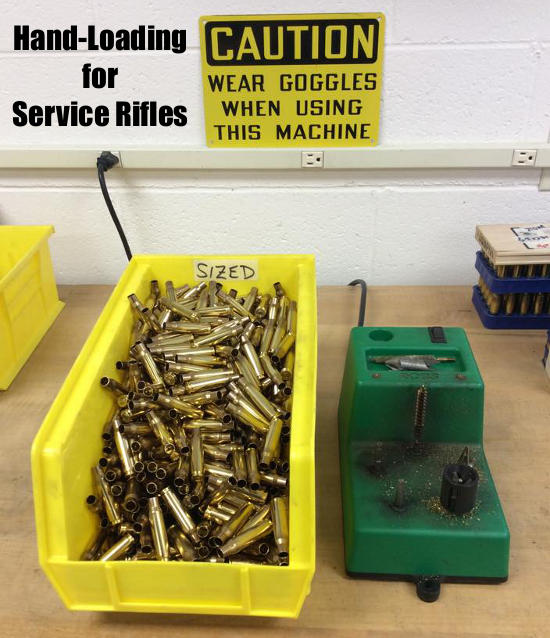
The U.S. Army Marksmanship Unit (USAMU) has published a great series of reloading “how-to” articles on its Facebook Page. This post covers key factors to consider when loading ammunition for Match Rifles and Service Rifles, with a particular focus on self-loading “gas guns”. Visit the USAMU Facebook Page regularly for other, helpful reloading and marksmanship tips.
We offer some “cardinal rules” to help new gas-gun handloaders with safety and efficiency. These address both Match Rifle and Service Rifle versions of the AR15, M1 Garand, M1A, and M110. However, they can also improve safe reloading for many other auto-loaders such as M1 Carbines, FALs, SIGs, etc. The author distilled these principles many years ago to help focus on the essential aspects of these rifles.
RULE ONE: Service Rifles Are Not Benchrest Rifles
Gas-guns require a relatively loose fit between ammunition and chamber (vs. bolt actions) for safe, smooth operation. Many techniques, such as neck sizing and keeping cartridge headspace quite tight, are popular in the extreme bolt gun accuracy realm. However, they are of little value with Service Rifles, and some could even be hazardous. Before adopting a specialized technique, seriously consider whether it is appropriate and beneficial in a gas-gun.
RULE TWO: Never Compromise Safety to Obtain Accuracy
Example: If choosing a brand of great, but ultra-sensitive match primers offers possibly better accuracy at the risk of slam-fires in your design of rifle, don’t do it! You are issued exactly two eyes and ten fingers (best-case scenario). Risking them trying to squeeze 0.25 MOA better accuracy out of an M1A, etc. simply isn’t worth it.
RULE THREE: Tailor the Precision to Your Individual Skill and Your Rifle’s Potential
This has been addressed here before, but bears repeating for newcomers. If you are struggling to break out of the Marksman Class, or using a CMP M1 “As-Issued,” then laboriously turning the necks of your 600-yard brass is a waste of time. Your scores will improve much faster by practicing or dry-firing. On the other hand, if the reigning champions anxiously check your scores each time you fire an event, a little neck-turning might not be so far-fetched.
Verifying Load Improvements — Accuracy hand-loading involves a wide variety of techniques, ranging from basic to rather precise. Carefully select those which offer a good return on investment for your time and labor. In doubt? Do a classic pilot study. Prepare ammo for at least three or four ten-shot groups with your new technique, vs. the same with your standard ammo. Then, pick a calm day and test the ammo as carefully as possible at its full distance (e.g. 200, 300, or 600 yards) to verify a significant improvement. A little testing can save much labor!
This video explains the procedure for ordering an M1 Garand from the CMP.
RULE FOUR: Be Your Own Efficiency Expert
Serious Service Rifle shooters generally think of ammunition in terms of thousands of rounds, not “boxes”, or even “hundreds”. Analyze, and WRITE DOWN each step in your reloading process. Count the number of times each case is handled. Then, see if any operations can be dropped or changed without reducing safety or accuracy. Eliminating just two operations saves 2000 steps per 1000 rounds loaded. Conversely, carefully consider any measurable benefits before adding a step to your routine.
RULE FIVE: In Searching for Greater Accuracy with Efficiency, Look for System Changes
For example, instead of marking your 300-yard rounds individually to differentiate them from your 200-yard ammo, would a simple change in primers work? If accuracy is maintained, using brass-colored primers for 200 and silver for 300 provides an indelible indicator and eliminates a step! Similarly, rather than spending hours selecting GI surplus brass for weight and neck uniformity, consider splurging on some known, high-quality imported match brass for your 600-yard loads. Results should be excellent, time is saved, and given limited shooting at 600 yards, brass life should be long.
RULE SIX: Check All Your Primers Before Packaging Your Loaded Ammo
This seems simple and even intuitive. However, many slam-fires (which were much more common when M1s and M1As were the standard) are due, at least in part, to “high” primers. Primers should be seated below flush with the case head. The USAMU has addressed this at length in a previous column, but each round should be checked for properly-seated primers before they are packaged for use.
Need some informative reading material for winter days? Here’s a vast resource available free from Sierra Bullets. Here are links to over 60 articles with information on bullets, ballistic coefficients, wind drift, up/down angles, temperature effects, tailwind effects and much more. Most of these resources come from the respected Sierra Reloading Manuals, 4th and 5th Editions. There are enough articles to read one per week for a year!
Believe it or not, here is a cartridge that makes a .338 Lapua Magnum look like a toy. The 14.5x114mm cartridge was designed as a MG and rifle-fired anti-materiel round. To translate from the metric system to caliber and inches, the round is a mammoth .57 caliber which measures 4.49 inches to the case mouth, and 6.13 inches overall. That jumbo-sized case holds a whopping 655 grains of powder. Commonly-loaded projectiles weigh 920-1030 grains. The 993gr armor-piercing projectile has a muzzle velocity of approximately 1006 meters per second (3300 fps) and can penetrate 30-32 millimeters of RHA steel at a range of 500 meters.
The top photo comes from Elardus De Lang, a Forum member who works at the Truvelo Manufacturers Armoury in South Africa. Elardus also provided an impressive video showing the massive 14.5x114mm being shot from prone with a Truvelo-built bolt-action rifle. Elardus tells us: “Here is a video, with a slow-motion ending, of our 14.5x114mm anti-materiel rifle being fired in our indoor testing facility. This caliber is a true beast! It propels a 993gr Armor-Piercing Incendiary bullet to 3300 fps, burning 480 grains of powder in the process. [This shows] that rifles of that power level can actually be shootable. The concussion indoors is something to experience……every shot feels like you are being punched in the face, and the heat from the muzzle flash actually hits you like a wave!”
14.5x114mm Cartridge Design and Dimensions
The 14.5×114mm has 42.53 ml (655 grains H2O) cartridge case capacity. The exterior shape of the case was designed to promote reliable case feeding and extraction in bolt action rifles and machine guns alike, under extreme conditions. Cartridges typically use lacquered steel cases, but some countries also use brass cases for the 14.5x115mm.
All dimensions are in millimeters (mm). Americans would define the shoulder angle at alpha/2, or 22.5 degrees. The common rifling twist rate for this cartridge is 455 mm (1:17.91″) with eight lands/grooves. According to official guidelines, the 14.5×114mm can handle up to 360 MPa (52,213 psi) piezo pressure.
14.5x114mm Cartridge History
The 14.5×114mm (.57 Cal) is a heavy machine gun and anti-materiel rifle cartridge used by the Soviet Union, the former Warsaw Pact, modern Russia, and other countries. It was originally developed for the PTRS and PTRD anti-tank rifles, but was later used as the basis for the KPV heavy machine gun that formed the basis of the ZPU series anti-aircraft guns that is also the main armament of the BTR series of armoured personnel carriers from the BTR-60 to the BTR-80 and for heavy anti-material sniper rifles. The cartridge was designed in 1939 and first issued in 1941.
Most of us own a .223 Rem rifle. Now, thanks to our friends at Rifleshooter.com we can assess exactly how velocity changes with barrel length for this popular cartridge.
Rifleshooter.com performed an interesting test, cutting the barrel of a .223 Rem rifle from 26″ all the way down to 16.5″. The cuts were made in one-inch intervals with a rotary saw. At each cut length, velocity was measured with a Magnetospeed chronograph. To make the test even more interesting, four different types of .223 Rem/5.56 ammo were chron’d at each barrel length. The Rifleshooter.com team that conducts these tests has a full-service gun shop, 782 Custom Gunworks — visit 782guns.com.
Test Barrel Lost 25.34 FPS Per Inch (.223 Rem Chambering)
How much velocity do you think was lost, on average, for each 1″ reduction in barrel length? The answer may surprise you. The average speed loss of the four types of .223/5.56 ammo, with a 9.5″ shortening of barrel length, was 240.75 fps total (from start to finish). That works out to an average loss of 25.34 fps per inch.
5.56/.223 Barrel Cut-Down Speed Test 26″ to 16.5″
Start FPS at 26″
End FPS at 16.5″
Total Loss
Average Loss Per Inch
UMC .223 55gr
3182*
2968
214
22.5 FPS
Federal M193 55gr
3431
3187
244
25.7 FPS
Win m855 62gr
3280
2992
288
30.3 FPS
Blk Hills .223 68gr
2849
2632
217
22.8 FPS
*There may have been an error. The 25″ velocity was higher at 3221 fps.
Rifleshooter.com observed: “Cutting the barrel from 26″ to 16.5″ resulted in a velocity reduction of 214 ft/sec with the UMC 223 55-grain cartridge, 244 ft/sec with the Federal M-193 cartridge, 288 ft/sec with the Winchester M855 cartridge and 217 ft/sec with the Back Hills 223 68-grain match cartridge.”
How the Test Was Done
The testers described their procedure as follows: “Ballistic data was gathered using a Magnetospeed barrel-mounted ballistic chronograph. At each barrel length, the rifle was fired from a front rest with rear bags, with five rounds of each type of ammunition. Average velocity and standard deviation were logged for each round. Once data was gathered for each cartridge at a given barrel length, the rifle was cleared and the bolt was removed. The barrel was cut off using a cold saw. The test protocol was repeated for the next length. Temperature was 45.7° F.”
See More Barrel Cut-Down Tests on Rifleshooter.com
Rifleshooter.com has performed barrel cut-down tests for many other calibers/chamberings including 6mm Creedmoor, .308 Winchester, and .338 Lapua Magnum. See these test results at Rifleshooter.com.
Much Different Results with 6mmBR and a Longer Barrel
The results from Rifleshooter.com’s .223/5.56 test are quite different than the results we recorded some years ago with a barrel chambered for the 6mmBR cartridge. When we cut our 6mmBR barrel down from 33″ to 28″ we only lost about 8 FPS per inch. Obviously this is a different cartridge type, but also our 6mmBR barrel end length was longer than Rifleshooter.com’s .223 Rem start length. Velocity loss may be more extreme with shorter barrel lengths. And, of course, different cartridge types and powder/bullet combinations will yield different results.




 When you’re out at the range, the Earth seems very stable. But it is actually a big sphere zooming through space while spinning around its axis, one complete turn every 24 hours. The rotation of the earth can create problems for extreme long-range shooters. During extended bullet flight times, the rotation of the planet causes an apparent deflection of the bullet path over very long distances. This is the ballistics manifestation of the


 20 Practical Ultimate Varminter



 The
The 

 This Saturday Movie showcase features four handguns chambered for the modern, high-velocity 5.7x28mm cartridge. In a 5″-6″ barreled pistol, the 5.7x28mm round can achieve very high velocities compared to a 9x19mm (9mm Luger) or .40 SW. The bottle-necked 5.7×28mm cartridge weighs roughly two-thirds as much as a typical 9mm Luger cartridge, allowing more rounds to be carried for the same weight. The cartridge can produce considerable muzzle flash when fired from a pistol, but it has roughly 30% less recoil than the 9mm Luger cartridge, improving controllability. Thanks to its high velocity, the 5.7×28mm has a flatter trajectory than most pistol ammo types.