A decade ago, the Editors of AccurateShooter.com and a pantheon of legendary shooters first collaborated on Voodoo Accuracy, hailed as “the definitive print resource for precision shooting”. Now to mark the new decade, we are releasing an updated 666-page, full-color “Voodoo Two”, the Voodoo Accuracy Second Edition. Voodoo Accuracy II compiles the wisdom of today’s greatest Hall of Fame and National Champion shooters. With the Voodoo knowledge of the world’s ‘top guns’ in your grasp, you can and will shoot more accurately no matter what your discipline.
Why do Voodoo? Sure you can spend hours, days, months, heck even a lifetime measuring stuff with calipers and trickling individual powder kernels, but you’re not going to win the big matches without access to the closely-guarded Voodoo secrets of the world’s master marksmen. Remember, there are more things in heaven and earth, Horatio, than are dreamt of in your reloading manuals!
Voodoo Accuracy II reveals the hidden shooting secrets of the greatest trigger-pullers of all time. Now you too can shoot like a legend! Find out how to win matches without ever practicing! Apply Voodoo reloading techniques with startling results! Voodoo Accuracy II contains chapters on all major forms of competitive shooting, from 25m air rifle to ultra-long range tactical competitions. Whatever your sport — point-blank benchrest, High Power, F-class, Silhouette, Palma, Multi-Gun, Biathlon, 1000-yard Benchrest — you’ll find invaluable Voodoo insights that will transform your shooting abilities overnight. We guarantee it!
Voodoo Accuracy II Chapter Highlights:
● Extreme Wind Calling — How to dope a hurricane.
● Barrel Break-In — Sure-fire 50-step, 1000-round method.
● Ogive Talkin’ — More incomprehensible Ballistology by Bryan Litz.
● Point-Blank Pointers — Feng Shui and the placement of Wind Flags.
● Why Weigh Charges? — How to throw perfect charges blind-folded.
● Powder Blending Basics — Have a BLAST with the Mix-Master method.
● For FTR, Size Matters — Six-foot-wide, servo-adjusting bipods by Danny Biggs.
● Hall of Fame Headgear — The effect of dorky hats on Group Size, by Tony Boyer.
● Barrel Tuning — Voodoo Methods demonstrated (results guaranteed non-repeatable).
● Tactical Gearfinder — Be the first on your block with the latest, overpriced Tacticool accessories.
● Voodoo Annealing — How to anneal by instinct (worrying about time and temperature is for sissies).
Here’s a sample from our chapter on the Joys of Abrasives: “We all learned as kids that shiny is good. Well it is. And more shiny is even better. Why settle for a bore that has anything less than a mirror finish? Just do a quick high-pressure bead-blast down your bore, followed by few thousand strokes with JB, and your bore will be perfectly slick and shiny. And you won’t have to waste any more time with those annoying lands and grooves that trap carbon and copper. They’re gone for good! Polish your bore to a mirror finish for the ultimate in barrel cleanliness.”
Order Your Own Copy of Voodoo Accuracy Voodoo Accuracy II comes in a handsome, large-format hardback edition for $49.99. There is also a special, limited-run letterbox edition signed by Hall of Famers so legendary we can’t even mention their names here. The letterbox edition, limited to 250 copies, will cost $1000.00. Think that’s too much? Well who can put a price on perfection? We guarantee that if you buy Voodoo Accuracy II you’ll win early and often, feeding your self-esteem while reducing your shooting rivals to whimpering, broken shells of their former selves. Remember, as Charlie Sheen said, it’s all about “Winning”! If you want to run with the Big Dogs, and strut your stuff on top of the podium, order your copy of Voodoo Accuracy II today!
On Monday, March 30, the National Rifle Assocation (NRA) announced the suspension of all sanctioned matches until the end of April. Here is the NRA’s official statement:
Due to the Coronavirus (Covid-19) pandemic, the NRA is unfortunately suspending all sanctioned matches through April 30, 2020. Any requests for sanctioning of new matches beyond April 30 are also suspended until further notice. As a result of this suspension, the NRA will no longer accept match fees or scores. The NRA will continue to monitor the situation and make additional statements as the Covid-19 pandemic unfolds. [For more information] Please contact the NRA Competitive Shooting Division at comphelp@nrahq.org, follow the NRA Competitive Shooting Facebook page or monitor the Competitive Shooting Division website at Competitions.nra.org.
NOTE: At this time there are no plans to cancel the NRA National Championship Matches to be held at Camp Atterbury, Indiana during July and August 2020.
NRA Smallbore Championships — July 23 – August 5, 2020
NRA High Power Rifle Championships — August 9-15, 2020
NRA Mid-Range Rifle Championships — August 16-20, 2020
NRA Long Range Rifle Championships — August 21-25, 2020
Precision Rifle Challenge on Shooting USA This Week
This week, Shooting USA TV features a show that should interest PRS/NRL fans, tactical marksmen, and long range hunters. Run in Utah’s backcountry, the Hornady Precision Rifle Challenge is a unique long range competition with serious wind and elevation changes. This isn’t a typical PRS Pro Series match by any means. Participants in this challenging Precision Rifle match will have to deal with tough conditions not typically seen in other tactical matches. The match runs in summer in Utah, just across the state line from Evanston, Wyoming. Watch the show 3/25/20 on the Outdoor Channel.
Shooting USA will air Wednesday, March 25, at 9:00 PM Eastern (8:00 PM Central) on the Outdoor Channel. If you miss that, it runs again on Thursday afternoon. Look for Shooting USA on the Outdoor Channel. In addition, you can watch all episodes of Shooting USA on the VIMEO channel by subscription. Each episode is just $0.99, about 1/10th what a movie ticket costs these days.
In addition to the Precision Rifle challenge, this week’s Shooting USA episode features to interesting rifles — one new, one historic.
Volquartsen Summit — Toggle Bolt Rimfire Precision Rifle
With the help of Volquartsen, John Scoutten has created a prototype .22 LR Rimfire Precision Rifle based on the toggle-bolt Summit action fitted in a modular chassis.
The Summit’s straight-pull toggle action is similar to the actions on competition Biathlon rifles. This allows very fast cycle times, without disturbing rifle placement. The Summit fits stocks made for the Ruger 10/22 and uses 10/22 magazines. But it’s a manual action, not blow-back semi-auto.
Enfield L42 A1 Sniper Rifle — History’s Guns
This week’s show also features a legendary WWII sniper rifle, Britain’s Enfield L42 A1. This special sniper rig was the last in a long line of military arms built on the famous Enfield .303-caliber bolt action.
More shooting match postponements caused by the Coronavirus…
The 40th Annual Hickory Groundhog Shoot was originally scheduled for Saturday, April 4, 2020. Due to “stay-at-home” public health precautions, the North Carolina event has been re-scheduled for June 6, 2020. The hugely popular match will be going ahead — just a couple months further out. Organizers still expect a highly-attended event. 2020 will mimic 2019 in rules — one man, one rifle, and it’s expected that there will be no practice week (so make sure your distance come-ups are dead-on).
This being the 40th Anniversary of the event Larry Willis and the folks at BullsEye Sporting Goods came up with a few ideas to make the 40th more like a hunt than a F-class match. We’ll provide more details later. As in recent years, we expect the Hickory Shoot to be one of the biggest events of the year in the Southeast. 2018 had over 200 shooters, and Terry Brady’s long-standing match-record 99 score was tied. Then, last year, Jeff Godfrey (shown below) shot an amazing record-breaking 101 score in 2019. It takes a great shooter and a great rifle to drill a target like that…
Relays Run Like Clock-Work
The Hickory Groundhog Shoot is run very efficiently, with one relay shooting while the next relay waits outside the shooting area, ready to go. Once a relay is done, shooters grab their items and exit on one end of the shooting platform while the next relay comes in from the other end. The relays move through in rapid succession.
You must quickly set up and get ready because as soon as the target pullers get back they are ready to shoot. When the fire command is given you have two minutes to get your three shots off at that distance. When the cease fire is called you quickly grab your gear and get off the shooting platform because the next relay is coming in.
The Civilian Marksmanship Program (CMP) is closing all its facilities and halting all scheduled activities from Monday, 3/23/2020 through Monday, 4/6/2020. During this period the CMP recommended that all CMP match sponsors “cancel their matches until some degree of normalcy returns.” The CMP issued this statement today:
Greetings. Many are facing difficult times in regard to the recent Corona virus outbreak and the CMP community is among them. We are grappling with the status of many of our current and upcoming programs, and unfortunately several events will be canceled or altered as a result.
The federal government’s Centers for Disease Control and Prevention has proclaimed that all events with attendance of 50 or more should be canceled immediately. The CMP has complied with this directive and we are notifying customers and participants accordingly.
The CMP is shutting down all of its facilities and activities for the next two weeks, beginning Monday, March 23, with plans to return Monday, April 6. During that time, the CMP will monitor conditions and will report changes to that plan as required. CLICK HERE for additional closure information.
We encourage all CMP match sponsors to cancel their matches until some degree of normalcy returns. It is in the best interest of the CMP community to take positive precautions rather than deal with potentially damaging consequences otherwise.
The CMP thanks you for your understanding during these trying conditions. We look forward to greater times ahead and getting back to the business of firearms safety and marksmanship!
This impressive 15-round group was shot by Jim See of Elite Accuracy.
Different Shooting Disciplines Demand Different Levels of Precision/Accuracy
In the rapid-fire 3-Gun game, you could probably “clean” most stages with a 2-MOA rifle. By contrast, in the short-range group benchrest game, to compete with the best, you’ll need a rifle that shoots in the “ones” (i.e. 0.1-0.19 MOA) in perfect conditions. In 1000-yard F-Class competition, the top shooters want a rifle that will hold one-third-MOA of vertical at that distance.
What is your standard of accuracy? How good is “good enough”. Jim See, a skilled gunsmith and successful PRS competitor, recently answered that question for his tactical discipline. For the kind of matches Jim shoots, he likes to have a rifle that will hold half-MOA for five (5) shots, 3/4-MOA for 15 shots, and 1 MOA for twenty shots. Remarkably, Jim’s rifle can do that with factory ammo. Above is an impressive 15-shot group shot with .260 Remington Federal Premium Ammo.
“I say it all the time, my loads need to print 5 under 1/2″, 10 under 3/4″, and 20 under 1″. It’s simple, if a hot barrel will keep 20 rounds fired in succession under my standard it will be a good barrel and load for Precision Match Shooting. Federal Premium Gold Metal Match .260 with Sierra bullets made the cut for me today. 15 consecutive shots under 3/4 MOA.” –Jim See
It’s said that you “can never have too much accuracy”, but there are acceptable standards for each discipline, and they’re not the same. A 100/200 yard Benchrest shooter will be sorely disappointed with a rifle/ammo set-up that can only deliver half-MOA. On the other hand, a PRS competitor like Jim See can achieve great success with a lesser degree of precision. This means you can save time and money. You can run your barrels longer between cleanings, and you don’t have to go “full OCD” when loading your ammo. The PRS shooter does not need to weigh-sort primers, or load powder to single-kernel standards. Proof is the performance. Jim See recently took third place at the Spearpoint Shootout, and he has been a podium finisher at other events. Learn more about Jim’s gunsmithing and training operations at EliteAccuracy.com.
Download This Load Development Target
Jim’s target seemed a bit familiar. AccurateShooter.com created this Diamond and Dot Target a few years back. On each aiming point, there are high-contrast black horizontal and vertical lines for aligning your cross-hairs. The gray circle lets you see the bullet impacts above, without obliterating the red diamond, which is quite useful for precise aiming (we put fine cross-hairs on the points of the diamond). This target sheet includes data entry tables below each of the three aim points. There are many other free targets out there, but this format is very popular. We’re pleased to see Jim using it. You can download this and dozens of other FREE Targets from the AccurateShooter.com Target Page.
A while back, our friend Vince Bottomley in the UK wrote an excellent article for Target Shooter Magazine. Vince offers “solid-gold” advice for new F-TR and F-Open shooters. Vince reviews the cartridge options, and offers suggestions for a shooter’s first (and hopefully affordable) F-Class rifle. Vince also reviews various bipod choices for F-TR and discusses optics options (from $300 to $3000).
Getting Started in F-Class by Vince Bottomley
As membership secretary of a large club, one of the questions I’m frequently asked – “What’s the best way to get started in F-Class?” My club has an F-Class shoot every couple of weeks at ranges from 300 to 1000 yards and, not surprisingly, it’s very popular.
F-TR or Open Class?
From a shaky start way back in 2004, the F-TR Class is now proving as popular as Open Class and, at GBFCA League shoots and club shoots, many shooters choose to start with a 308, shooting off a bi-pod – in other words F-TR. In Open Class, the 7mm WSM soon established itself as the “must have” cartridge – if you wanted to win but, the WSM’s appetite for barrels eventually brought another 7mm cartridge into play – the 284 Winchester. This 50-year-old stalwart was revived a decade or so ago as the 6.5-284 and indeed this cartridge found some favor with F-Class pioneers – before the potency of the WSM was discovered. If you don’t mind shelling out for a couple of barrels per year (barrel life is about 750 rounds with the WSM) go for the 7mm WSM but, if you require a decent round-count, then opt for the .284 Win and learn to read the wind a bit better!
Scopes for F-Class
If you will be shooting 1000 yards then I would recommend at least 32 power and preferably a variable – like the 8-32. The cheapest “usable” scope in this range is the Sightron. It’s a great scope for the money and at under $900 (in the USA) it’s half the price of its nearest competitor. It’s also light – at 1.5 lbs – and there are some great reticles for the F-Class shooter – like the LRMOA.
In response to current public health concerns, and “out of abundance of caution”, the USPSA has rescheduled many major 2020 National Championship matches. Competitors should adjust their schedules accordingly. First, the upcoming USPSA Multi-gun National Championship hosted by Universal Shooting Academy in Frostproof, Florida, originally slated for April 1-5, 2020, has been moved to June 13-14, 2020.
Next, the USPSA PCC National Championship originally scheduled for April 8-11, 2020 has been moved to June 20-21, 2020. This will also be held in Frostproof, Florida.
Third, the Steel Challenge World Speed Shooting Championship, originally set for May 20-24 at the CMP Talladega Marksmanship Park, in Talladega, Alabama, has been rescheduled for September 24-27, 2020.
In addition the USPSA Single Stack National Championship has been pushed out to September 3-5, 2020 while the USPSA Revolver/Limited 10 National Championship has been moved to September 6, 2020. Both events will be held at the CMP Talladega Marksmanship Park in Alabama.
Public Health Tips for Shooting Matches
The USPSA has stated: “We have been advised that behavioral risk mitigation strategies are the best option for slowing the spread of this disease, and the Centers for Disease Control and Prevention (CDC) have published recommendations and guidelines for mass gatherings which can be found here: CDC Health Advice for Gatherings.
USPSA and Steel Challenge affiliates, members, and match directors are encouraged to use the information available from CDC, the federal government, state governments, and local governments, coupled with their own risk tolerance levels and good judgement to guide them in what is best for matches at all levels. USPSA realizes that some matches will decide to cancel, while others may not.”
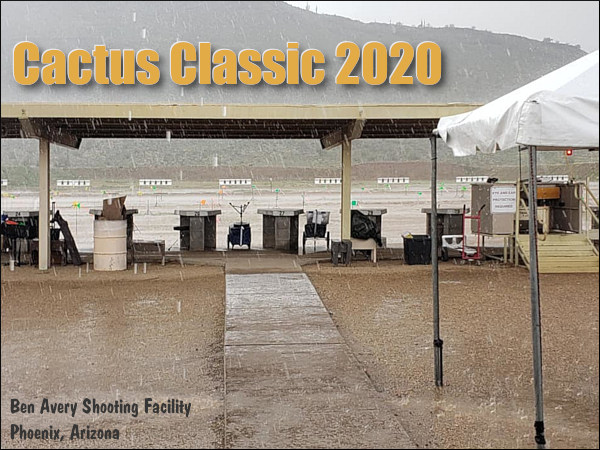
Arizona is warm, dry, and sunny right? Well not always. This past weekend, rain fell in droves on the Friday practice day for the 2020 Cactus Classic 100/200 yard Benchrest event. Yes, it was Friday the 13th! But then the rain clouds receded, and visitors were greeted to a stunning rainbow.
Rainbow photo by Michelle Gallagher.
The two-day match got underway on March 14th in relatively dry but windy conditions. That created challenging conditions for the competitors — even with windflags set up to show wind velocity and angles.
One of the best matches of the year, the Cactus Classic attracts many of the nation’s top “point-blank” shooters. These aces compete with 10.5-lb Light Varmint and 13.5-lb Heavy Varmint rifles, nearly all chambered for the 6PPC cartridge. Many shooters run their LVs in HV classes as well, for simplicity (and to save money — one rifle costs less than two). In this game, the vast majority of shooters load at the range between relays. That lets them tune their loads to the condition — something that can help when you’re trying to shoot tiny dots.
With all the interest in F-Class, PRS, and ELR, we sometimes forget that plenty of folks are still competiting in Short-Range Benchrest disciplines, with standards of accuracy we can only envy. For a PRS shooter, a good 100-yard, five-shot group would be half-MOA. For a benchrest shooter, a good group at 100 would be in the “Ones”. That’s smaller than 0.200″ center to center for five shots. And the small group of a Relay is often in the “Zeros”.
Conditions were wet on Friday the 13th before the 2020 Cactus Classic.
This story, from our Gun of the Week Archives, offers a good intro to the 30 BR cartridge, which is still the leading chambering for short-range Score Benchrest.
What’s better than one custom-built 30 BR with gorgeous wood and top-shelf components? A matching pair of course. Just ask Australian shooter Greg Roche (“Caduceus” in our Forum). A decade ago, Greg spent two years living and working in the USA. While in America, he commissioned two matched custom rifles to bring back to Australia for Hunter Class BR matches. Though the look-alike rigs are both chambered in 30 BR, one is designed for the Australian “Traditional” centerfire Hunter Class (10-lb limit), while the other is purpose-built for the “Custom” centerfire Hunter Class (14-lb limit). The 10-lb Traditional rifle features a fully-functioning two-round magazine and a 6-power scope. In contrast the Custom Class rifle is a single-shot action, with a 45X Leupold scope. The Custom weighs 13.5 pounds so it can also be used in traditional Heavy Varmint Benchrest matches if desired.
Tale of Two Rifles Story and Photos by Greg Roche (“Caduceus”)
The USA boasts some of the finest precision rifle-builders and Benchrest parts suppliers in the world. Before returning to Australia after two years in the States, I decided to have two special BR rifles built using American components and skilled labor. I wanted a matched pair — twin guns that would be as handsome as they were accurate. The heavier gun of the pair, the 13.5-lb Custom Class rifle, features top-of-the-line (but well-proven) technologies and components. With the 10.5-lb Traditional Class rifle, we had to develop new solutions to allow the 30 BR cartridge to feed from a functional two-round magazine. Here is my saga of how my twin 30 BRs were conceived and built, and how they have performed in competition.
BACKGROUND — The 30 BR for Score Competition
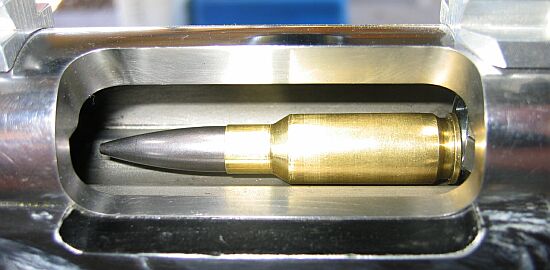
The 30 BR is a wildcat cartridge based on a necked-up version of the 6mmBR Norma case. It originated in U.S. Benchrest circles where it found its niche in Varmint For Score (VFS) matches. Unlike traditional Benchrest, where group size determines the winner, VFS matches are shot on a target with multiple, concentric-ringed bullseyes. Point total is based on “best edge” shot location (one shot per bull). In score competition, the 30 BR’s “supersized” .308-diameter hole offers an advantage over the 6mm hole created by a 6 PPC, the dominant group BR chambering.
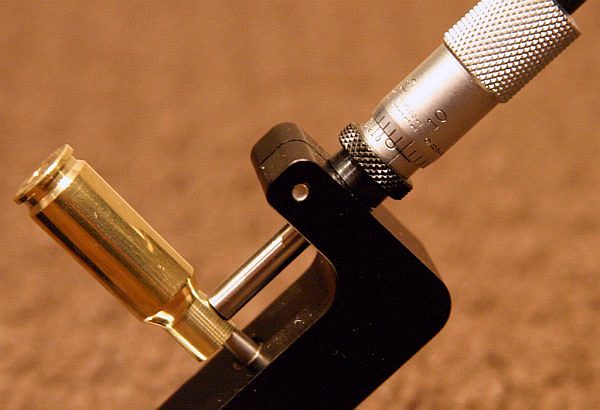
The starting point for loading the 30 BR wildcat is Lapua 6mmBR brass. These are necked up as a single-step operation using a .30 caliber tapered expander ball (or dedicated expander mandrel). This will leave a bulge in the neck, so the expanded case neck is normally turned to bring the thickness down to the correct dimension for the chamber. I turned these necks down to .010″ wall thickness using a Stiller neck-turning tool. It features an eccentric mandrel similar to the Nielson “Pumpkin”. Loaded rounds measure .328″ neck diameter. This gives minimum clearance in my .330″ neck chamber, so very little neck resizing is needed after firing. Cases are trimmed to 1.500″ prior to turning to ensure consistency since the Stiller tool indexes the length of cut off the case mouth. Other than that, cases are just chamfered, loaded and made ready to shoot. No special fire-forming is required.
17-Twist Barrels for Both Rifles
Texan gunsmith Mike Bryant chambered both barrels. Mike also polished both barrels to a high-gloss to match the receivers. In this game, barrels are consumables, much like powder and primers, so most owners wouldn’t bother to polish their barrels. However a 30 BR barrel can provide up to 5000 rounds of accurate life (unlike a 6PPC barrel which might be tossed after 800-1000 rounds.) So, these barrels are likely to be on the rifles for many seasons. Given the high-gloss finish of the Grizzly actions and the beauty of the Red Cedar stocks, it would have been an injustice to leave a dull finish on the barrels.
The chambers were both cut with the same reamer supplied by Dave Kiff of Pacific Tool and Gauge. Randy Robinett, one of the originators of the 30 BR wildcat, specified the reamer dimensions. Randy’s 118gr, 10-ogive custom BIB bullets and the 30 BR cartridge enjoy a winning track record in the USA. The 30 BR Robinette reamer has zero free-bore and a .330″ neck, and is optimized for the BIB 118s. The bullets perform best when seated far enough out to jam firmly into the rifling as the bolt is closed. The long ogive means the bullet’s bearing surface is very short.
Slow Twists for Maximum Accuracy
You may note the unusually slow twist rate of both barrels. In most .30-caliber chamberings, the barrel twist rate is 1:11 or 1:12 to stabilize 150gr to 200gr bullets. The 30 BR is optimized for 115gr to 118gr flat-base bullets and 1:17 provides sufficient stability at muzzle velocities around 2900-3000 fps. In competitive Benchrest, where every thousandth of an inch counts, over-stabilization of projectiles can hurt accuracy, so “just stable enough” is the goal; hence the 1:17 twist.
Case Forming, Case Prep, and Reloading Methods
A Sinclair case neck micrometer indicates neck thickness of 0.010″ after neck turning.
30 BR dies are readily available from a number of manufacturers. I personally use Wilson neck and seating dies with a Sinclair Arbor press, but Redding and Forster both supply high-quality threaded dies for use in a conventional press. For under $100.00 US, custom full-length dies can be obtained from Hornady and CH Tool & Die by sending them reamer prints or a couple of fired cases. Harrell’s Precision offers “semi-custom” dies. Just send them some fired cases and they select a pre-made CNC-cut die that ideally fits your chamber. You can ask the Harrell brothers for a die that’s tighter at the shoulder or base, or otherwise customized to your preferences.
Load Development and Accuracy Testing
With cases formed and bullets selected, load development is simply a matter of choosing the right primer, powder and charge weight, and loading the most consistent ammunition possible. The Lapua BR cases use a small rifle primer. The choice here was Federal 205 Match primers vs. CCI BR4 Benchrest primers. Some shooters have also had success using CCI 450 Magnum primers but it is very unlikely the small case needs this much spark to light off regular extruded powders. In my case, I selected Federal primers because availability tends to be better in Australia.
The relatively large bore-to-capacity ratio of the 30 BR case means that fast burning powders are the order of the day. Once again, US experience suggests H4198 (the Hodgdon equivalent of ADI AR2207) is the choice of match winners. The fact that H4198/AR2207 is an Australian-made product is an added bonus. So, I loaded up test rounds with AR2207 from 32.5 grains to 35.0 grains in approximately 0.3 grain increments. All bullets were seated to jam +0.010″ into the lands. This places the bullet base about two-thirds of the way down the neck and well short of the neck-shoulder junction.


 Order Your Own Copy of Voodoo Accuracy


 Volquartsen Summit — Toggle Bolt Rimfire Precision Rifle


 Relays Run Like Clock-Work




 30 BR dies are readily available from a number of manufacturers. I personally use Wilson neck and seating dies with a Sinclair Arbor press, but Redding and Forster both supply high-quality threaded dies for use in a conventional press. For under $100.00 US, custom full-length dies can be obtained from


