Army of Minis getting ready to conquer the world (well at least the world of shooting).
The Minis are Coming! The Minis are Coming!
Good new for fans of the SEB Mini coaxial tripod rest. This superb compact joystick rest has been in high demand, creating a long waiting period. Now scores of bright new Minis are being readied for shipment to the USA, Canada, and other nations. On Monday, July 13, Sebastian (“Seb”) Lambang posted a Facebook photo of Minis getting ready to ship. That inspired scores of “likes” from Seb’s Facebook fans including action-maker Jim Borden and past F-Class National Champ James Crofts. Larry Bartholome, another former F-Class Champion, wrote: “Hey SEB — people are looking forward to more Mini Mondays!”
Sebastian (“Seb”) Lambang’s SEBRests.com team is shipping these out worldwide to meet demand. The great thing about the Mini is that it folds up into a small package, making it much easier to transport than a conventional coaxial front rest such as the Seb NEO or Farley.
Responding to Seb’s Facebook post, Todd Banks posted this photo with the comment “Love my Mini!”:
SEB Mini in Action at Berger Southwest Nationals
Even though the Mini is compact and relatively light weight, it is very stable and gives up very little in performance to a full-sized joystick front rest such as the SEB NEO. Our Systems Admin Jay Christopherson uses a SEB Mini. In the 2017 Berger SWN, Jay finished Second in F-Open Class just one point behind winner David Gosnell, thereby proving the SEB Mini is “competition ready”. Jay reports: “I’m glad I had the SEB Mini — it worked great and was much easier to transport and carry from position to position.” Here’s Jay using the SEB Mini to drill a string of Xs with his .284 Winchester F-Open rifle.
Carry Bag for SEB Mini
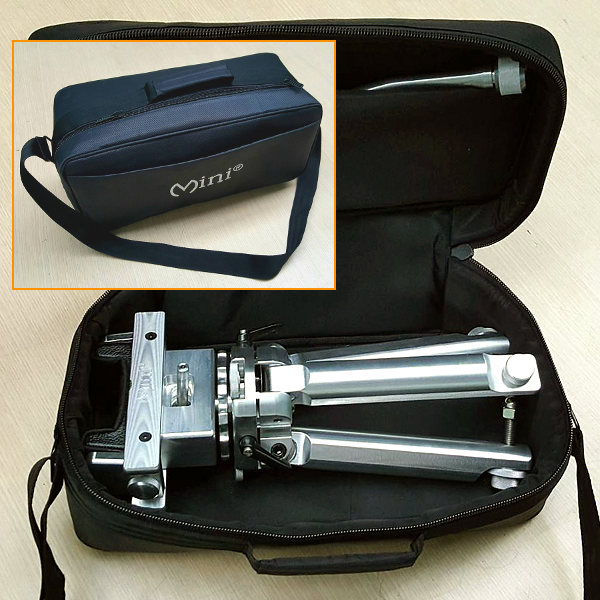
With the success of the SEB Mini, Seb Lambang has designed some accessories. Here is a prototype carry package, the Mini Transporter. This compact bag will hold a Mini even with big F-Class feet attached.
The CMP National Rimfire Sporter Match is a fun competition with affordable smallbore rifles with either scopes or iron sights. All you need are a .22 LR rifle, sling, and ammo.
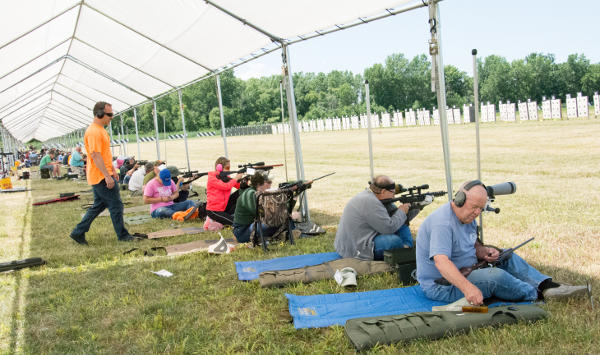
Each year, the Rimfire Sporter Match attracts hundreds of shooters to the shores of Lake Erie. If there is a single CMP event at Camp Perry that offers the most diverse group of competitors (of all ages), and the lowest cost of entry, that would be the annual Rimfire Sporter Match. This year’s match will be held on Sunday, July 21, 2019 on the Viale Range. The Rimfire Sporter Match is for smallbore rifles that weigh 7 1/2 pounds or less with sights. Firing is done at 25 and 50 yards in prone, sitting and standing positions, in slow and rapid fire modes. The CMP has a special smart-phone App that will help speed up scoring.
Hundreds of shooters will compete in the Rimfire Sporter Match today at Camp Perry.
On Saturday July 20th, Rimfire Sporter Competitors will check-in, have their rifles weighed, triggers checked, and receive their squad assignment. Also on Saturday there will be a free Rimfire Sporter Seminar held at the Gary Anderson CMP Competition Center. More INFO HERE.
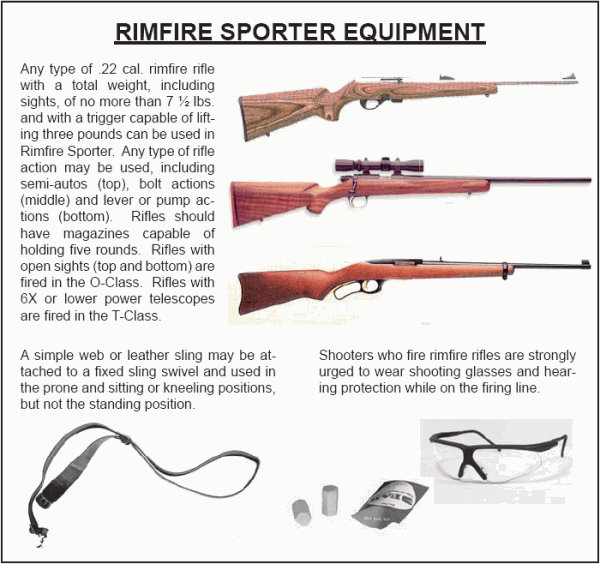
Rifles may be manually operated or semi-automatic, in three classes: the standard “O Class” for open-sighted rifles, “T-Class” for telescope-sighted rifles, and the “Tactical Rimfire” Class. Firing is done at 50 and 25 yards on a target with a 1.78″ ten-ring. The target is simple enough for a beginner to hit, yet challenging enough that only one competitor in the history of the match has ever fired a perfect 600 score.
Rimfire Sporter Course of Fire
Competitors will complete slow fire prone, rapid fire prone, slow fire sitting or kneeling, rapid fire sitting or kneeling, slow fire standing, and rapid fire standing shot sequences.
FREE Ammo from SK (One 50rd Box per Entrant):
SK Ammunition will provide 50 rounds of SK .22 LR smallbore ammunition for each competitor in the National Rimfire Sporter Match, but this ammunition will not be enough to shoot the entire match. Competitors will need a total of 60 rounds to fire the Rimfire Sporter Match plus any sighters or range alibis. CPM Programs Chief, Christie Sewell stated, “The CMP is excited to announce SK as the Official Ammunition Sponsor for our 2019 National Rimfire Sporter Match. Participants will receive a complimentary 50-round box of SK ammunition at check-in.”
Getting Ready for the 2019 Rimfire Sporter Match
Competitors need to bring their own .22 cal. Rimfire rifle(s) and ammunition. Special target shooting equipment, shooting jackets, or shooting gloves are not permitted, but feel free to bring a spotting telescope and ground cloth or shooting mat. You will be shooting on a grass firing point. Competitors are strongly urged to wear hearing and eye protection. Assistance for disabled competitors will be provided.
A free Shooters’ Clinic will be held Saturday, July 20, from 4:00-6:00 PM.The Clinic covers Rimfire Sporter rules, safety instructions, course of fire, and competition procedures. Shooters who have not previously attended a CMP Rimfire Sporter Match are strongly encouraged to attend.
Do you want to see more match photos? CLICK HERE to view the CMP Zenfolio Archive with 500+ photos from 2016 National Rimfire Sporter Match.
The bar is raised yet again — the standards for long-range accuracy keep improving. Two talented Montana shooters have both gone sub-four inches for a 1K 10-Match Aggregate. What that means is that over TEN matches, these guys have averaged under 0.4 MOA at 1000 yards. Think about that. Most shooters will be happy with half-MOA at ONE HUNDRED yards. These guys are beating that by a significant margin at ONE THOUSAND yards, and they have done it for a whole season.
1000 Yard Multi-Match IBS Records Fall at Deep Creek
David Torgerson and Tom Mousel both broke the 10-match Light Gun Group Aggregate (Agg) record. Tom also broke the 6-Match Light Gun Group Agg record. Prior to these brilliant performances, the existing IBS 10-Match Agg record was 4.3155″. David crushed that with a 3.7946″, as did Tom with a 3.8734″. The existing IBS 6-Match Agg Record was 3.072″ and Tom shot a 2.954″, which will be a new record.
This is the first time in history that anyone has Agg’d in the threes for the 10-Match and in the twos for the 6-Match! For those not familiar with 1000-yard IBS matches, the Season Aggregate is based on ten matches. All ten are averaged for the 10-match Agg and the best six are averaged for the 6-Match Agg.
Shooters Established New Records with Multiple Guns and Multiple Barrels
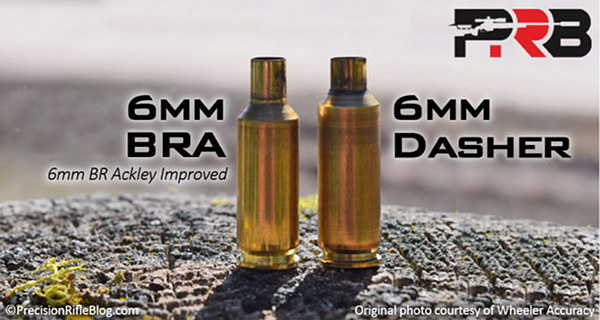
David shot the majority of his targets with a Bat B action and Broughton 5C barrel. But he also shot his BAT SV and Borden BRM with Krieger and Lilja barrels. David’s 1K rifles feature Deep Creek Tracker stocks and March scopes. He shot Vapor Trail 103gr bullets in the all the rigs, and all his barrels are chambered in 6BRA — a 40° wildcat based on the 6mmBR Norma. The 6BRA retains the long neck of the parent case, but has more case capacity. Some people say the 6BRA is a bit easier to tune than the 6mm Dasher, but it still achieves that ultra-accurate 2920-2960 FPS velocity node.
Tom Mousel shot his 6- and 10-match Aggs with two rifles, splitting time between his BAT Neuvo LR and Borden BRM. Both are chambered in 6BRA and he shot multiple Krieger barrels. Tom told us: “Thanks everyone. David was pretty steady all year, while I took more of an up-and-down route. At one point early on I thought there’s no way this would be salvaged.”
The Neuvo-actioned gun (shown below) features a McMillan/Wheeler LRB stock, with a March scope on top. In that rifle, Tom shot 103gr Vapor Trails. Mousel’s Borden BRM gun features a Deep Creek Tracker stock and Sightron scope. In that 6BRA rifle he shot 103gr Roy Hunter bullets.
Tom Mousel Rifle with BAT Neuvo LR action. This action is a Left-loading Drop Port — cartridges eject out the bottom of the action.
COMMENT by Alex Wheeler
If this doesn’t make you give up the idea you need that one hummer barrel to win I don’t know what will. Yes, you need the best equipment, but you also need the best tune and knowledge to stay on top of it. These two guys are some of the most dedicated tuners and testers I know. Well done! And well deserved!
It IS noteworthy that multiple rigs were used. Posting on Facebook, Alex H. said: “Holy ****! Tom did it not only with multiple barrels, but with two rifles AND multiple barrels? That is some outstanding performance! And Glenn K observed: “It was an awesome season to watch unfold. Congrats guys!”
Shooters from across the nation and many foreign competitors competed last month at the CAAFTC held at the Rochester Brooks Int’l Skeet and Trap Club.
For nearly 10 years, dedicated air gun competitors from around the globe have taken part in the Crosman All-American Field Target Championship. This year was no different. In late June, 85 competitors participated in the popular 3-day event. “The Crosman All-American Field Target Championship is one of the must-attend events for Field Target airgunners”, said Mark DeBoard of Velocity Outdoor.
The winner of the All-Around prize for the highest score over all three days in 2019 was Bill Rabbit. Bill topped both the Hunter PCP and Hunter Piston Divisions. That’s Bill (left below) receiving his prize from Mark DeBoard, the Shooting Services Manager of Velocity Outdoor. Greg Shirhall won the Open PCP Division while Paul Porch won the WFTF PCP class.
Big Airgun Event in Upstate New York
The Crosman All-American Field Target Championship (CAAFTC) is the largest field target event in the USA. This very popular airgun event took place June 21-23, 2019 in upstate New York at the Rochester Brooks International Skeet and Trap Club in Rush, New York. This event attracted top Airgunners from across the nation (and some foreign countries). Along with regular Field Target matches, there were specialty side matches, plus a factory tour.
This Video Explains the Basics of Field Target Competition:
The 3-day competition featured multiple shooting matches including the main 2-day rifle event. There were four divisions for competitors: Open, Hunter, WFTF, and Pistol. In addition to the main rifle event, there was a pistol match, the Pyramyd Air Gunslinger match, and the popular Quigley Bucket Match. This Bucket match re-creates a famous scene in the movie Quigley Down Under in which the lead character shoots a bucket at 700 yards. Here the distances are scaled down a wee bit (wink-wink). Competitors, using iron sights only, got 5 shots at a 1.75″ bucket placed at 55 yards.
Tech Talk: Why the Big Side-Wheels on the Scopes?
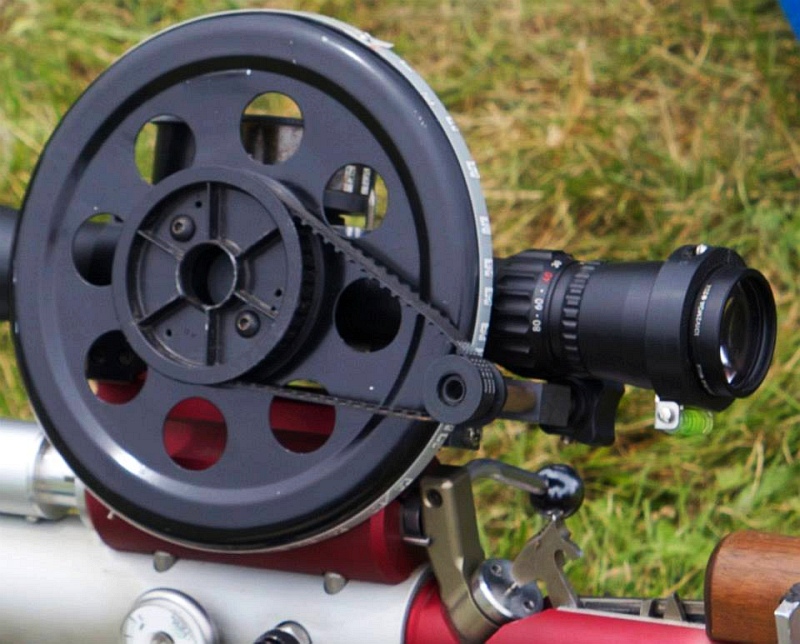
Field Target rifles shoot pellets propelled by compressed air. These light-weight, low-BC projectiles drop very quickly, with a looping trajectory. In order to hit targets at distances out to 50 yards or so, you have to adjust your scope to compensate for pellet drop. But you can’t set the scope correctly without knowing the precise range to the target.
This is the function of the big wheels on the side of the scope. Field Target Competitors use the parallax adjustment on high-magnification scopes to determine target range. The big wheel allows quick, yet precise parallax adjustment. Markings on the wheel show the shooter the scope settings required for the distance “dialed-in” via the over-size parallax wheel.
The CAAFTC, sanctioned by the American Airgun Field Target Association, is a featured AAFTA Grand Prix event. The 120-shot match had four rifle divisions based on allowable gun and support equipment, along with a Hunter Pistol class. Here are the main air rifle classifications:
Hunter PCP Division – Rifle fires at a maximum 20 foot pounds of energy (FPE), shooter may use a non-attached bipod, non-restrictive clothing, and sitting stool. Hunter Piston Division – Like Hunter PCP but with piston charging. Open Division – Maximum 20 FPE rifle, shooter may wear a body harness, no bipod, 6″ max height seat. World Field Target Federation (WFTF) – Similar to Open but shooters compete according to international standard of maximum 12 FPE for rifles.
Set aside some TV time tomorrow folks. On Wednesday, July 17th, there’s a GREAT episode of Shooting USA on the Outdoor Channel. Over the course of Wednesday’s hour-long broadcast there are FOUR notable features well worth watching. Show times are 8:00 pm Eastern and Pacific; 9:00 pm Central.
FOUR FEATURES Worth Watch on Wednesday!
1. Fort Benning Multi-Gun Challenge. This is one of the best 3-Gun events of the year. If you like fast action, with rifles, pistols, and shotguns, you’ll love this Shooting USA sequence. The U.S. Army Marksmanship Unit at Fort Benning, Georgia hosts one of the toughest and most challenging multi-gun matches. Watch top competitors move through difficult stages that test strength and agility as well as marksmanship.
Multi-gun competition tests shooters’ skills with rifle, pistol, and shotgun, running stages “on the clock”. You must be fast AND accurate to successfully complete a course of fire.
2. Rimfire Challenge World Championship (RCWC). This is a great family event. The Rimfire Challenge is a timed, short-range event for .22 LR handguns and rifles. In recent years, the RCWC has been held in Alabama with 16 stages, 8 for rifle and 8 for pistol. This major match attracts hundreds of competitors from around the nation. It’s fast and fun with instant feedback from ringing steel plates. The RCWC is family-friendly event that’s great for all skill/experience levels.
3. Classic Arms — The U.S. Army’s Model of 1917 Rifle. The Model 1903 Springfield is perhaps more famous, but more Model 1917 rifles were actually issued to American troops in World War I. This sequence covers the history of this important American battle rifle.
4. AR-Platform 6.5 Creedmoor Precision Rifle. In this segment John Scoutten works with JP Enterprises on a 6.5 Creedmoor semi-auto precision rig using JP’s LRP-07 components. This sequence showcases the AR10-type platform’s abilities with mid-sized cartridges.
Jason Cohen’s “We the People” patriotic .284 Shehane F-Class rifle. It has already demonstrated great promise, scoring second place in its very first match, a 3×20 at 1000 yards in Wyoming.
Rifle Report by Jason Cohen
The rifle began its life as a Will McClosky Cerus stock. I approached Will at the Berger SW Nationals about a rifle I wanted to build. I wanted to do something different — PAINT it. He said he had just the stock that I could use, and sent that to Bryan Blake at Blake Machine. I chose Bryan for two reasons — first, I have shot with him a few times at National matches and he is approachable and very helpful. Second I visited his shop during the SWN in February and liked what I observed and how he approached things. Bryan never seems to be happy with the status quo. He is always trying new ideas.
I noticed that Bryan had been adding aluminum rails to the front of Cerus stocks to lower the center of gravity and improve tracking. I asked him to modify my stock and fit it with the new forearm rails, shown in the photo below. I sent him a Panda F-Class action with a +20 MOA Picatinny rail. Bryan did all the stock work and fitted the action, rails, and RAD recoil pad. Everything turned out flawless.
The barrel is a Blake Machine 1:8″-twist finished at 32 inches. It was fitted to my action by Dale Woolum of Woolum Accuracy. Dale chambers all my barrels on all my rifles. Dale also threaded the barrel for a Woolum Accuracy tuner. This has proven to be a valuable tool in my load development. On this build, I am trying a Bix’N Andy trigger for the first time.
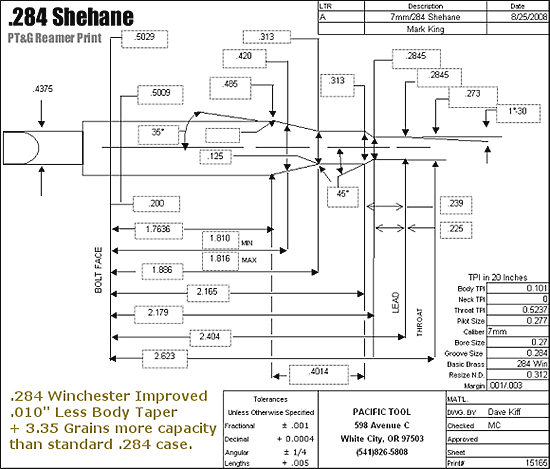
The 284 Shehane has a proven record of accomplishments and that is why I have chosen it. I use Lapua brass (6.5-284 necked-up), CCI BR-2 primers, Hodgdon H4350 powder, and Berger 184gr bullets. All these components have been a successful combination that has worked flawlessly in my other rifle.
.284 Shehane Load Development
Load development for me starts with each new barrel. I screw on the new barrel, fire 25 rounds of whatever I have left over and then clean it. I push out to 600 yds and do a ladder test in round-robin format. I start 0.6 grains lower than my last charge that worked. I work up from that reduced charge weight in increments of 0.3 grains. The paper tells the rest of the story. Once I get something that works well at 600 yards I go back in work around that by 0.1 grains. After that I play a little with seating depth and look for a change. I will occasionally mess with the tuner and tighten things up if possible.
About the Patriotic Paint Job
So I had the idea of painting the stock because there are so many wood stocks with clear coat these days. Unless you really get some exotic woods they all seem to blend together. I have nothing against clear-coated wood, but I wanted something different, as this was my first all-wood rifle. (For short-range benchrest, I was shooting a Bob Scoville carbon stock and Terry Leonard laminate).
We started with all white on the stock and came up with the idea of an American Flag on the buttstock. I was thinking of ribbons on the front in red and blue but we could not get the layout right. Then the idea of “We the People” popped into the head. My painter said “awesome!” and he was able to airbrush the stock with a little yellow and brown to give it that vintage paper look.
The front rest is a SEB Max (see above). I chose the Max because I was shooting Group Benchrest first then made the transition to F-Class. This rest proves to be versatile in all my shooting — Short- and Long-Range Benchrest AND F-Class. The rear bag is a Edgewood EDGEbag Gator. The gun gets transported in a Pelican Hard case when I travel. Locally, I use a Champions Choice soft bag.
Jason Jumped to Open Class after Starting with F-TR
This “We the People” rifle will be one of my primary rifles for F-Open competition. I will run it through its paces shortly and see how well it does. I have high hopes of it being an great gun. I shoot primarily local and regional matches — Colorado, Wyoming, and possibly Nebraska this summer. I will travel to the F-Class Nationals in Raton as well. I used to shoot F-TR before this and made the transition to Open last season. This is my second season shooting F-Open. 2018 was my first National event and was a learning experience for me. But I was hooked after that match.
Tips for F-Class Competitors
Get some good equipment and eliminate having issues that can be caused by budget builds. It’s OK to be frugal, but sometimes cutting corners will cause you more problems and have you chasing your tail. If you’re looking for the “recipe for success”, get a good action plus a top-tier barrel and great glass.
The .284 Shehane — Accurate and Forgiving Wildcat
The 284 Shehane is amazing, very forgiving and not temperamental. I choose this because I really did not know otherwise and was steered to the Shehane by a friend. Its proven track record helped as well. Straight .284 or Shehane — you cannot go wrong. I run a 184gr Berger at about 2850 FPS and get great brass life in my other rifles. I usually start to consider tossing the brass around 15 firings. Primer pockets start to get a little looser and the brass seems to need more sizing than the newer brass with less firings.
Shooting Sports USA has a fascinating article about the Perpetual Trophies awarded in national-level NRA matches. The story recounts the history behind the elaborate trophies, some from the 1870s. SSUSA’s Jennifer Pearsall writes: “The pieces of wood, stone and precious metal … are more than just instant recognition of achievement. They are the link of the American shooter’s present to his or her patriotic past. As you read this legacy of the NRA ranges, their founders, and the long list of cups, bowls, and plaques, realize that the history of competitive shooting is undeniably a significant part of the foundation of this country”. Read Full Trophy Story HERE.
Stunners in silver. Above are the NRA Leech Cup (left) and Wimbledon Cup (right).
The NRA was co-founded by Col. William Church and Gen. George Wood Wingate (ranked Captain at the time). Both Church and Wingate hoped to improved the marksmanship skills of American soldiers. One of the newly-formed NRA’s first actions was to issue: “An Act to Establish a Rifle Range and Promote Skill in Marksmanship”. That led to the opening of the famed Creedmoor Range, with a special inaugural match in June of 1873.
Many of the awards presented in the first NRA matches were cash or firearms. Some of these firearms were heavily embellished works of art. In the very first match, a member of the 22nd New York Regiment took home a gold-mounted Winchester Model 1866 valued at $100 — big money for the time.
In the 1870s shooting competitions were social as well as sporting events. Ladies and gentlemen came to watch and cheer the winners. This illustration, originally from Harpers Weekly, portrays the shooters and the viewing gallery at the 1876 Grand Centennial Championship—the “Palma” Match.
The Leech Cup — A Gift from Ireland
The Leech Cup was created for the first meeting of the American and Irish shooting teams. The elaborate cup was presented by Major Arthur Leech, captain of the the Irish team, to the Amateur Rifle Club of New York. This masterpiece of Irish silver-smithing was later given to the NRA in 1901 by the New York Club. Today, the Leech Cup is the oldest trophy offered in overall NRA competitive target shooting, awarded through the National High Power Long Range Championships.
The Wimbledon Cup
The Wimbledon Trophy was a gift from the NRA of Great Britain. It was given, as a gesture of sportsmanship, after the the U.S. Team was denied the ability to compete in England’s Elcho Shield match, then limited to Britain, Scotland, and Ireland. To maintain friendly competitive relations, the British presented the Americans with a large, engraved, lion-footed tankard trophy to be awarded each year to the Champion U.S. long-distance rifleman.
The Palma Team Trophy
Originally named the Centennial Trophy, in honor of the Centennial celebration of the independence of the United States of America, the Palma Trophy was commissioned from Tiffany’s at a cost of $1,500. The trophy was a full-sized replica of a Roman Legion standard, executed in bronze with silver and gold inlay. On the banner of the standard was the legend, “In the name of the United States of America to the Riflemen of the world”. Above the banner was an eagle, bearing in its talons a wreath of palm leaves and a plaque on which was the single word, “PALMA”, the Latin word for palm tree, which was used by the Romans to signify victory, or the ultimate in excellence.
Because the word Palma was so easily seen, the trophy soon became known as the “Palma Trophy”, and by 1878 was referred to officially by that name. The original seven and one-half foot trophy is now lost, having not been seen since at least 1954. Serving in its place is a copy which was commissioned by Dr. Herbert M. Aitken of Eau Claire, WI. The copy was made from the original Tiffany blue-prints at a cost of $32,500. Dr. Aitken has given this copy of the Palma Trophy to the NRA for use in the Palma Match. The trophy is retained by the winning team until the next Palma Match.
In 2008, the Palma Trophy was returned to the NRA, and it was decided that the trophy, once refurbished, will travel to the host nation for the match every four years, then returned to the NRA for safekeeping.
The first competition for the Palma Team was a challenge match for which the British Commonwealth nations were invited. The match was fired in 1876 at the old Creedmoor Range on Long Island as part of the Centennial celebration of the United States. Teams representing Scotland, Ireland, Canada, Australia, and the United States took part. The match is currently fired on a four-year interval.
Emil Praslick III is widely recognized as one of the greatest wind wizards on the planet — a master at identifying wind value and direction, and predicting wind cycles. As coach of the USAMU and top civilian teams, Emil has helped win many high-level championships. In the three videos we feature today, Emil, who works with Capstone Precision Group (Berger, Lapua, SK, Vihtavuori) and Team Applied Ballistics, explains how to determine wind direction and velocity using a variety of indicators. Praslick, now retired from the U.S. Army, was an 18-time National and 2-time World Champion coach with the USAMU.
Video ONE: Wind Theory Basics — Understanding “Wind Values”
In this video from UltimateReloader.com, Emil explains the basics of modern wind theory. To properly understand the effect of the wind you need to know both the velocity of the wind and its angle. The combination of those variables translates to the wind value. Emil also explains that the wind value may not be constant — it can cycle both in speed and velocity. Emil also explains some of the environmental conditions such as mirage that can reveal wind conditions.
Video TWO: Determining the Direction of the Wind
Key Point in Video — Find the Boil
Emil explains how to determine wind direction using optic. The method is to use spotting scope, riflescope, or binoculars to look for the “Boil” — the condition in mirage when the light waves rising straight up. The wind will generate that straight-up, vertical boil in your optics when it is blowing directly at you, or directly from your rear. To identify this, traverse your scope or optics until you see the boil running straight up. When you see that vertical boil, the direction your optic is pointing is aligned with the wind flow (either blowing towards you or from directly behind you).
Video THREE: The No Wind Zero Setting
In this second video, Emil defines the “No-Wind Zero”, and explains why competitive shooters must understand the no-wind zero and have their sights or optics set for a no-wind zero starting point before heading to a match. In order to hit your target, after determining wind speed and direction, says Emil, “you have to have your scope setting dialed to ‘no wind zero’ first.”
Coach of Champions — Emil Praslick III
SFC Emil Praslick III, (U.S. Army, retired) works with Berger Bullets and Applied Ballistics. Emil served as the Head Coach of the U.S. National Long Range Rifle Team and Head Coach of the USAMU for several years. Teams coached by Emil have won 33 Inter-Service Rifle Championships. On top of that, teams he coached set 18 National records and 2 World Records. Overall, in the role of coach, Praslick can be credited with the most team wins of any coach in U.S. Military history.
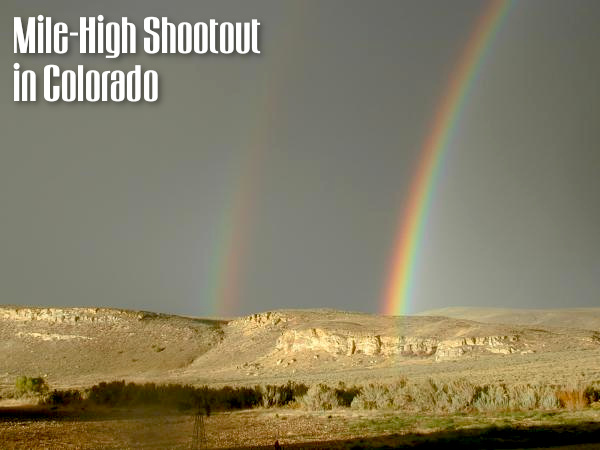
Look carefully at this Colorado double rainbow. Note that the color spectra are reversed — sort of a mirror image. This is true of ALL double rainbows.
A great practical/tactical shooting match is happening this weekend in scenic Colorado. The High Country Precison Mile-High Shootout will be held July 12-14 at the Rio Ro Mo Ranch outside of Craig, Colorado. The match will include a mix of long-range and positional shooting on natural terrain. A 200- to 250-round course of fire can be expected for the competition.
The Mile-High Shootout starts on Friday, July 12 with check-in and open targets out to 1,300 yards. Saturday will be an all-day match. Sunday, the competition shooting will conclude mid-day, followed by an awards ceremony after lunch.
McMillan Fiberglass Stocks will co-sponsor the Mile-High Shootout, the 12th match of the 2019 National Rifle League series. McMillan supports the National Rifle League in the goal of expanding practical rifle competition. McMillan notes: “Events such as these are important to help bring new shooters into the long-range shooting sports and are activities that are enjoyed by the entire family.”
This 2018 Mile-High Shootout Teaser Is Really Worth Watching — Plenty of Action!
South Dakota Steel Classic, August 16-18
Another great NRL Match is set for mid-August in South Dakota. The 2-day South Dakota Steel Classic will take place August 16-18, 2019 in St. Orient, South Dakota. This is a very popular match, and all 110 competitor slots have sold out. But check with Match Director Michael Kane for last-minute openings.
The South Dakota Steel Classic features multi-position precision shooting with targets from 25-1300 yards. Nearly all of the shots are practical in nature having a hunting or military-type application. CLICK HERE to learn more about this major NRL match in August.
Many of our Forum members who shoot F-Class and Long Range Benchrest have asked: “Is there a reliable high-magnification zoom scope under $1100?” The answer is yes — the Sightron SIII 10-50x60mm scope will do the job, and you can buy one now for under $1100.00. In fact, at the 2017 IBS 600-yard Nationals, four of the Top 10 shooters (including the 2nd-place finisher) used Sightron 10-50x60mm scopes. This quality 10-50x60mm optic is definitely good enough to win long-range benchrest and F-Class matches. Here is a review by James Mock. Note James tested a version with 1/4-MOA clicks. Sightron also offers versions of this scope with 1/8-MOA clicks.
Sightron 10-50x60mm Riflescope Field Test Review by James Mock
Mr. Allen Orr of Sightron was kind enough to loan me one of their fine SIII riflescopes for testing. Since I shoot 600-yard score matches more than anything else, I requested the 10-50x60mm model with MOA-2 reticle. This is a premium scope in every way and it may be the very best buy for a long range scope today. Real world price for this scope is around $1100 ($1089.99 on Amazon.com). This represents a good value considering the scope’s build quality and features: 50X max magnification, 1/4-MOA adjustments with 10 MOA per revolution, ExactTrack windage and elevation system, Zack-7 lens coating, 60mm objective lens, target knobs with zero stop, and lifetime warranty. The MOA-2 reticle’s hash marks span 2 MOA at 24X and 1 MOA at 48X. Eye Relief is ample: 4.5″ at 10X and 3.8″ at 50X. Field of view at 100 yards is 9.6′ at 10X, 2.2′ at 50X.
NOTE: Sightron also offers this scope with 1/8-MOA clicks with a Fine Cross-Hair Reticle, Target Dot Reticle, and Mil-Dot Reticle. There are also multiple Sightron SIII 10-50x60mm models with illuminated reticles.
Sightron SIII 10-50x60mm Shows Excellent Repeatability
After receiving the scope, I mounted it on my BAT 6mm Dasher and did my “standard tests”. I shot the “square” and the adjustments were spot on and the repeatability was faultless. I also shot a group at two powers (24X and 50X) and the point of impact was the same.
In our August 600-yard match, I used the scope and was favorably impressed. I did not have the opportunity to shoot 600 yards prior to the match but I do have a 100-meter range at my house. From past experience, after zeroing my Dasher at 100 I simply dial up 11 MOA to shoot at 600 yards. The weather in Louisiana has been something that I have never seen before and the August 20th match was moved to August 27th, but there was still standing water in front of the targets. Also, the fog was so heavy that the start of the match was delayed for 45 minutes.
Sightron Nails a 50 Score on First-ever Match Target
When the match started, the Sightron with 11 MOA dialed in was perfect for elevation and a little right. After a couple of clicks I was ready to shoot. My first target was a pleasant surprise — scoring a 50-1X. I was very impressed with this scope and I shot it at 48X all day in the heavy mirage. I ended up finishing third, two points behind the winner.
This video is from Europe, but it does a good job explaining the 10-50x60mm Sightron’s features:
With its 60mm objective lens, this is a large scope. It is 16.9″ long and weighs 30.1 ounces. If you can tolerate that weight in the discipline you shoot this scope represents a great value for the long-range shooter. I am favorably impressed with it. For you varmint shooters, this scope with its wide range of power would make a superb addition to you favorite prairie dog rig. Do note, as we explained above, there are other versions of this scope with 1/8-MOA clicks if that is your preference. Good shooting — James Mock














 The Palma Team Trophy