Gliding to the ground with SFC Bowman will also be an incredible 60-foot American flag.
The 2019 CMP National Matches event at Camp Perry commences today, July 8, with the First Shot Ceremony at 10:00 a.m. on Camp Perry’s Rodriguez Range. Firing the ceremonial First Shot will be CMP Vice Chairman E.C. “Chris” Stone. While a West Point Cadet, he shot in the All-Army Matches at Camp Perry. He was commissioned in the Infantry and completed Army Airborne, Ranger, and Jungle Schools. Mr. Stone served in Vietnam and Iran, with awards for service and valor in combat.
The National Trophy Pistol and Rifle Matches have been held at Camp Perry since 1907.
The 2019 First Shot celebration features former U.S. Army Golden Knights skydiver, SFC (R) Dana Bowman. SFC Bowman lost both of his legs in 1994 after an in-air collision that also took the life of one of his Golden Knights teammates. SFC Bowman became the first double amputee to re-enlist in the U.S. Army. He will descend from the sky with a 60-foot American flag in tow. This 2019 Opening Day at Perry will also include free rides in Model T Ford automobiles and a static display of military vehicles.
Year 2019 Camp Perry NM Competition activities begin with NRA/CMP pistol matches on July 8-14, 2019. The CMP Junior Rifle Camp, USAMU SAFS, and Smallbore matches run the next week, with the hugely popular Rimfire Sporter Match on July 21. High Power Rifle events kick off on July 23 with the 4-Man Team Match and rifle events run continuously for the next two and a half weeks.
Here are some key dates for RIFLE events:
July 27 – CMP/USAMU Rifle SAFS
July 29 – President’s 100 Rifle Match
July 30 – National Trophy Individual Rifle Match
July 31 – National Junior Team Match
August 1 – National Trophy Team Match, National Carbine Match
August 2 – National Trophy Infantry Team Match (“Rattle Battle”)
August 3 – M1 Garand Match, Springfield/Vintage Bolt Rifle Match
August 4 – M1A Match, Springfield/Vintage Bolt Rifle Match
August 5 – CMP Vintage Sniper Rifle Match
August 5-8 – CMP Long Range Individual Matches
August 9 – Camp Perry Palma Match
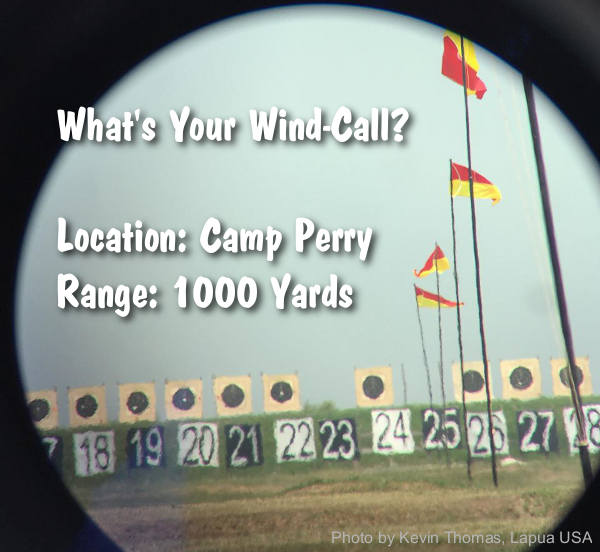
“The pessimist complains about the wind; the optimist expects it to change; the realist adjusts the sails.” — William Arthur Ward
Readers often ask us: “Is there a decent, easy-to-comprehend book that can help my wind-reading?” Many of our Forum members have recommended The Wind Book for Rifle Shooters by Linda Miller and Keith Cunningham.
New Hardback Edition Releases February 19th
A NEW hardback edition of The Wind Book will released on February 19, 2019. This 152-page book, first published in 2007, is a very informative resource. But you don’t have to take our word for it. If you click this link, you can read book excerpts and decide for yourself. When the Amazon page opens, click the book cover (labeled “Look Inside”) and another screen will appear. This lets you preview the first few chapters, and see some illustrations. Along with the new hardback edition ($21.99) Amazon offers a Kindle (eBook) edition for $14.99.
Other books cover wind reading in a broader discussion of ballistics or long-range shooting, such as Applied Ballistics for Long-Range Shooting by Bryan Litz. But the Miller & Cunningham book is ALL about wind reading from cover to cover, and that is its strength. The book focuses on real world skills that can help you accurately gauge wind angle, wind velocity, and wind cycles.
All other factors being equal, it is your ability to read the wind that will make the most difference in your shooting accuracy. The better you understand the behavior of the wind, the better you will understand the behavior of your bullet. — Wind Book for Rifle Shooters
The Wind Book for Rifle Shooters covers techniques and tactics used by expert wind-readers. There are numerous charts and illustrations. The authors show you how to put together a simple wind-reading “toolbox” for calculating wind speed, direction, deflection and drift. Then they explain how to use these tools to read flags and mirage, record and interpret your observations, and time your shots to compensate for wind. Here are two reviews from actual book buyers:
I believe this is a must-have book if you are a long-range sport shooter. I compete in F-Class Open and when I first purchased this book and read it from cover to cover, it helped me understand wind reading and making accurate scope corrections. Buy this book, read it, put into practice what it tells you, you will not be disappointed. — P. Janzso
If you have one book for wind reading, this should be it. Whether you’re a novice or experienced wind shooter this book has something for you. It covers how to get wind speed and direction from flags, mirage, and natural phenomenon. In my opinion this is the best book for learning to read wind speed and direction. — Muddler
Would you like to become a respected gun journalist/editor — and work with the nation’s most talented benchrest shooters (from 100 to 1000 yards). Do you enjoy photography, and like to see images of beautiful ranges and the world’s most accurate rifles? Then here is a great opportunity…
The International Benchrest Shooters (IBS) is looking for a new Match Reports Editor. This individual will work with AccurateShooter.com to deliver photo-illustrated reports on important IBS matches around the country. These match reports can appear here in the Daily Bulletin, on the main Accurateshooter.com site, and on the IBS website (in modified format).
IBS Match Report Editor Job Opportunity
IBS seeks a part-time Editor to manage reports on the IBS Nationals and Featured Matches on Accurateshooter.com. The duties include communicating with match organizers, receiving match reports and equipment lists, and managing digital images. In addition, the Editor will help with some special IBS features and equipment articles. Salary is negotiable, based on experience and work output.
Contact IBS President, Jeff Stover at: ibsprez @ yahoo.com
No Expert Skills Required — Just Enthusiasm for the Sport
You don’t need to be a computer whiz — no programming is involved. If you can use a basic writing program and can email photos then you’ve got the skill set needed. Basically the IBS is looking for someone who enjoys benchrest shooting and would like to help the sport by showcasing the fun and camaraderie of IBS matches. Here are some images from past IBS match reports:
Hail the King — Paul Phillips wears crown as the new 2019 King of Two Miles.
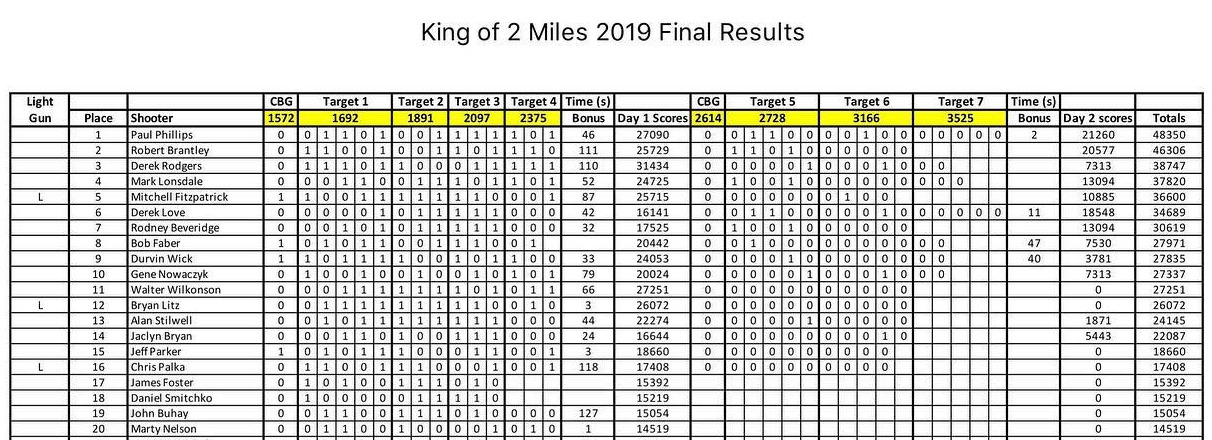
Paul Phillips, Captain of Team Global Precision Group (GPG), is the 2019 King of 2 Miles. Hail the new King! Paul won the event with a score of 48350, beating runner-up Robert Brantley who scored 46306. Fellow GPG shooter and 2017 K02M winner Derek Rodgers finished third with 38747. Phillips secured his K02M crown with good shooting in Raton, NM on both Day 1 and Day 2. On the final day, Paul had two hits at 2728 yards and one at 3166 yards. No competitor scored more than one hit at 3166 yards (1.799 miles), and no competitor scored even a single hit at the farthest target, placed at 3525 yards (2.0028 miles). So the actual 2-Mile target was never hit during the event.
Here are the target locations and yardages for K02M Day 2 Finals.
Team GPG members Derek Rodgers, Paul Phillips (center), and Mark Lonsdale with KO2M-winning rifle, K02M Trophy, $5000 Winner’s Prize from McMillan, and Nightforce Certificate.
Team Global Precision Dominates with Three of Top Four Places
Team Global Precision Group was top team overall with Paul Phillips in First Place, Derek Rodgers in Third, and Mark Lonsdale in Fourth. Team GPG, in its first world-level match together, dominated the field of 80 of the best ELR shooters in the world. First, Third, and Fourth — that’s mighty impressive gentlemen!
2019 KO2M Top 20 Results. Click on the table to see full-screen version:
Paul Phillips, who recently competed in the European K02M match in France, gave credit to his sponsors and team-mates: “Team GPG is honored to be … King of 2 Mile Champions. I’ve always wondered what it would feel like to be carried around on the King chair. I am humbled to be added to the list of great shooters that have been crowned before me.”
Paul added: “Big shout-out to all our sponsors, the match organizers, Eduardo, FCSA, and the volunteers who work so hard to make these ELR matches a major success. We’ll definitely be back in 2020!”
“Paul Phillips your win in this match is yet another example of the value of hard work paying off. I can honestly say that I don’t know anyone who works harder at ELR competition and promotion than you do. You deserve this win!” — Bryan Litz, Applied Ballistics
Equipment List for .416 Barrett 2019 KO2M-Winning Rifle
Paul’s massive KO2M rig features a BAT EX .50-Cal action with a 38″ Bartlein 1:9″-twist 5R barrel chambered for the standard .416 Barrett cartridge. The stock is a McMillan Beast One model. To tame recoil, Paul runs a T5 Terminator muzzle brake. The scope is a Nightforce 7-35x56mm ATACR F1 with MOAR Reticle. Up front is a Phoenix Precision Bipod, with an Edgewood Mini-Gator Bag in the rear. Paul is running a Bix’N Andy Comp Trigger with a 4-ounce, single-stage pull.
The complete rifle weighs 40 pounds. Bartlein did the .416 Barrett chambering using a Dave Manson reamer. Alex Sitman bedded the action in the McMillan stock as he did for the other GPG rifles. In fact, all three Team GPG rifles are essentially identical.
Load Details: Standard .416 Barrett cartridge, running .416 Caliber 550gr solid Cutting Edge Bullets at 3000 fps. The powder is Vihtavuori 20N29 ignited by RWS .50 Caliber primers. The cartridge brass is Barrett brand, produced by RUAG.
Support Gear: Ballistics are calculated with Applied Ballistics Software using velocity data from a LabRadar chronograph. Swarovski provided Team GPG with two big BTX 95 binocular spotting scopes. Phillips says “these BTX 95s really help us follow trace, spot impacts, and get on target quickly.”
Here are Team Applied Ballistics competitors at the 2019 KO2M event in Raton, NM. Applied Ballistics’ Mitchell Fitzpatrick posted: “[There were] some unique challenges this year, but I managed to finish in 5th place running a sub-25 pound rifle. That’s the result of a lot of our ESSO research.”
$5000 KO2M Winner’s Prize from McMillan Fiberglass Stocks
McMillan Fiberglass Stocks is a strong supporter of the shooting sports. Here Kelly McMillan presents Paul Phillips with a $5,000 check from McMillan Fiberglass Stocks for winning the 2019 King of 2 Mile while shooting a McMillan stock. Teammates Derek Rodgers and Mark Lonsdale also used McMillan stocks in the 2019 K02M Finals. Along with the McMillan check, Paul Phillips received $5000 from Nightforce Optics, and $1200 from Cutting Edge Bullets. Paul told us he will divide all the winnings with his team-mates because: “I won with my team — we won together.”
The National Rifle League (NRL) started off sponsoring major centerfire tactical matches, similar to PRS competitions. That proved successful and the NRL added a .22 LR Rimfire series, called NRL22. The NRL22 rimfire discipline has been a success, as rimfire guns are fun to shoot and ammo is very affordable. The most popular NRL22 matches have drawn up to 150 rimfire competitors.
With the success of the NRL22 series, the NRL is adding an Air Rifle class to NRL22 matches in the upcoming 2019/2010 competition season. NRL President Travis Ishida stated: “We are proud to now offer an Air Rifle classification to the monthly NRL22 matches that take place nationwide, and in several other countries.” The accuracy and performance of modern air rifles are impressive, so Ishida says it makes sense to “include them in the same Course of Fire” along with other NRL 22 Classes.
If the NRL’s Airgun class catches on, there may be a stand-alone NRL Airgun series in the future. Tyler Frehner, NRL’s Director of Match Operations stated. “If this class of shooters grows… the Air Rifle class will become a stand-alone entity; a future division of NRL.” Justin Jacobson of Utah Airguns added, “This is going to open the door for Airguns like never before. Finally, Airgun hobbyists everywhere can compete near their hometown in a similar format to rimfires with the NRL.”
About NRL22 Tactical/Practical Competition The goal of NRL 22 is to make Precision Rifle competitions more available to every community. However, nearly all localities have access to 100-yard ranges and most shooters own a .22 LR rifle. The NRL22 program is designed so any facility with a 100-yard range can host matches. Participants at local NRL22 events can then attend a National Championship. NRL22 currently has four classifications: Open, Base, Ladies, and Young Guns (8-16 age). Air Rifle will be the new fifth class. For the 2018/2019 Competition Season, over 700 shooters attended NRL22 matches. In the 2019/2020 Competition Season, the NRL22 expects significanct growth and is excited to welcome new members and clubs.
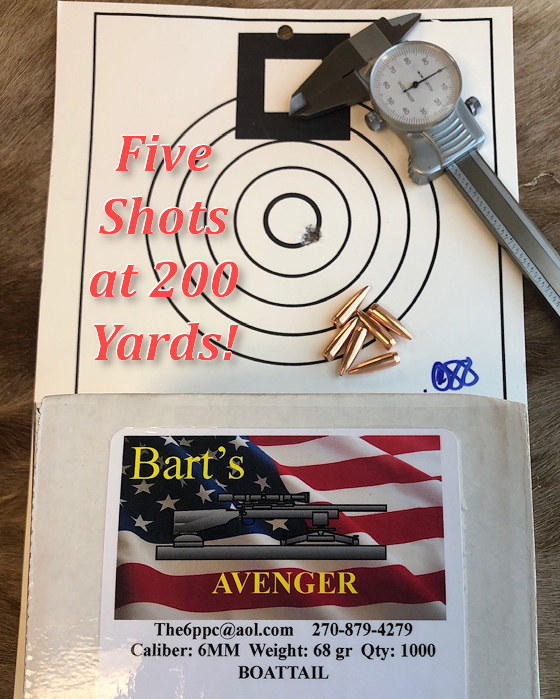
This would be an amazing group at 100 yards. But this 5-shot bughole was shot at TWO HUNDRED yards in competition by Bart Sauter of Bart’s Custom Bullets. And he did it with a borrowed barrel!
Be amazed. This five-shot group was shot at 200 yards in competition by bullet-maker Bart Sauter. Bart shot this astounding group with his 10.5-lb Light Varmint benchrest rifle at the recent East-West Match in St. Louis, Missouri. Had Bart been shooting an IBS match, this would have been a new IBS World Record, beating the .091″ by David Farrar in 2006. This .088″ group missed the NBRSA 200-yard 5-shot group record by a whisker — .013″ (thirteen thousandths). The listed NBRSA LV 200-yard Group record is 0.075″ shot by Johnnie Stewart a decade ago.
New record or not, this is one remarkably impressive group, shot by one very talented shooter and bullet-maker. Bart tells us he initially “held center” for the first three shots in the group. Then, watching his wind flags he noticed slight increase in the left-to-right condition, so he held 0.200″ to the left on shot 4 and it worked. Before shot 5, Bart detected another slight change, so he held 0.300″ left for the fifth and final shot. He explained: “If I had not held off for those last two shots, this group would have been about a flat four (0.400″).” Well done Bart!
“First three … bang bang bang … all went in one hole. Then I held left on shot 4 and it worked. On the last shot I held a little more, got lucky and it went in.” — Bart Sauter
In our Shooter’s Forum, Bart posted “This is my personal best-ever 5-shot group at 200 yards. I knew it was small, but was shocked to see it was a Zero! This will be a range record and record for the East/West match. Last group of the day! A nice way to end the match!”
Here is the 6PPC LV rifle that shot the .088″ group. Yes that’s a concrete shooting bench inside a pretty nice cabin with hunting trophies on the walls. Bart explained: “We reload and shoot out of the Monkey Hut, especially during the winter. Most of the time we shoot outside at 100/200 from a a three-bench range.
Amazing Group Shot with Borrowed Krieger Barrel!
There’s a very interesting side-note to this story. You see Bart doesn’t even own the Krieger barrel that delivered this amazing .088″ 200-yard group. That’s right this superb barrel was a “loaner” — borrowed from Bart’s buddy Gary Sullivan. [Editor: Oh that we could all be so lucky with borrowed components.] With Sullivan’s blessing, Bart has since loaned the barrel yet again to ace Billy Stevens, who will be using it at the World Benchrest Championship in Canada, July 14-21, 2019.
This photo shots Bart on the right and his good friend Billy Stevens on the left. Bart notes: “Billy is a 2-time Super Shoot Winner and 3-time USA World Benchrest Team member!”
Bart Sauter’s LV 6PPC Rifle Specifications
Chambering/Caliber: 6PPC
Gunsmith: Stevens Accuracy
Action: BAT DS RBLP Right Eject
Trigger: Jewell
Stock: Scarborough Carbon Fiber over Wood Skeleton
Barrel: Krieger — and it was borrowed!
Tuner: Bukys TSI Tuner
Optic: 40x45mm IOR-Valdada 30mm tube
Rings: Benchsource Double Rings
Front Rest: Farley Joystick
Rear Bag: Edgewood Bunny Ear, very soft, gray leather — special order from Bruno’s.
Front Bag: Edgewood — same soft gray leather.
Here is Bart’s target with a bullet removed. Bart was shooting his own 6mm 68gr Avenger bullets, a double-radius ogive design. The Avengers were seated about .004″ away from the lands: “I tried going into the lands and that didn’t seem to work, then I backed it off four thousandths [from contact] and the rifle liked that.” Bart drove those 68gr Avengers with a stout load of Accurate LT30 powder running 3407 FPS.
Bart’s Comments on His Components and Accessories
OPTICS — Bart likes his new 40x45mm IOR-Valdada Benchrest Scope. He says that, so far, it has proved very reliable and holds zero exceptionally well. This new design features a worm drive side-focus, oversized ocular with true +/- diopter adjustment, long eye relief, and fast-focusing reticle. The 40X Valdada also boasts superb HD “double-compressed” Schott glass from Germany.
TUNER — Bart says the Bukys TSI Tuner definitely helps. He notes that once he finds the “sweet spot” for his barrel he can normally leave it alone: “With that type of tuner, I have to be in a very dire straight to move it. Normally I will set it for the lifetime of the barrel.”
REAR BAG — Bart’s rear bag is an unusual Edgewood with softer gray leather. He says this was a special order by Bruno Shooters Supply. Bart likes how the rear bag works with his carbon-stocked 10.5-lb rifle: “With PPCs we ‘ride on the ears’ — this older bag just seems to work really well for that style.”
SUPER FEET — Bart told us he uses Benchsource Super Feet for his front rest: “The bench tops at St Louis are very slick. Before I set up I’ll use a spray bottle with water and wet the bench where the Super feet and rear bag will go. This really helps to keep things from sliding around!”
Tiff Dew, the founder of the UK’s Precision Rifle League (PRL) has posted: “I have dedicated the last dozen or so years of my life to establishing and developing the sport of precision rifle shooting over here in the UK. Having launched the Precision Rifle League, it is finally starting to take shape at a national level!”
Tiff added: “Maybe next year there might be a few more British shooters heading across the pond and perhaps a few US/International shooters might like to shoot the PRL over here?”
Well, after seeing these great photos, we definitely think some American shooters would like to shot a PRL match in the UK. And we welcome United Kingdom shooters to our PRS and NRL matches in the USA.
PRL Orion Mountain Challenge in Cambrian Mountains
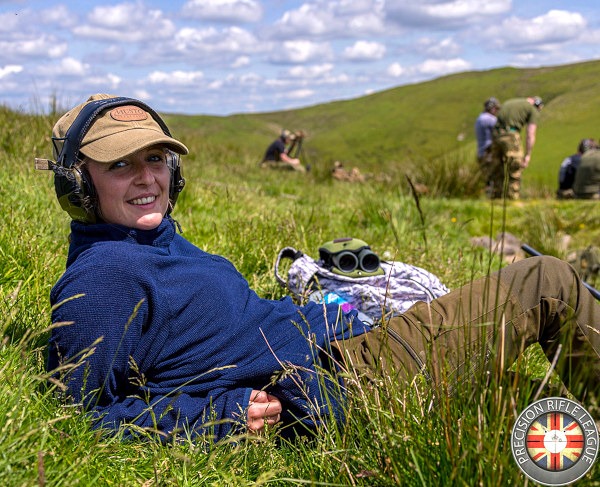
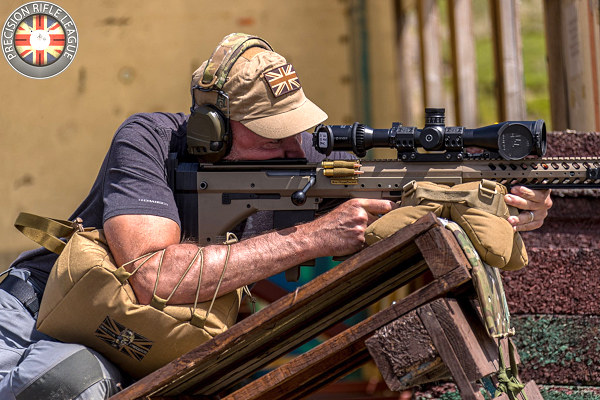
The Orion Mountain Challenge, the PRL’s third match of the year, was outstanding, as you can see from the photos. Nestled high amongst the Cambrian Mountains, Orion Firearms Training Limited’s facility provided the perfect venue for round three of the Precision Rifle League series. Forty-two shooters registered for the event. Participants reported: “The scenery was breathtaking and the weather simply sublime! Combined with excellent RCOs and a suitably complex course of fire, a very enjoyable weekend ensued.” NOTE: For these great images, Credit Philip Rowland Photography.
The United Kingdom’s PRL is not just for guys. Ladies enjoy the Challenge too!
About the UK’s Precision Rifle League
The Precision Rifle League hosts events throughout the United Kingdom. PRS Matches or “Challenges” as they are better known, take place from Scotland to Cornwall. Individuals can enter as many Challenges as desired. The PRL’s primary aim is to provide a positive resource for fellow shooters, helping to develop and expand precision rifle shooting in the UK.
There are several precision rifle events across the UK. However until now, there has been no single point of reference for all these great shoots. The league is designed to address this, promoting these events and enabling shooters to see their progress on a national level.
The PRL currently has two main classes: Open Division and Factory Division. After the final Challenge Match of the year is fired, trophies and prizes will be awarded to the top three in each division. In addition, there are sub-classes including International, Ladies, Parasport and others.
The PRL Challenge Calendar for 2019:
May 4-5 – Spring Roundhouse Rifle Challenge
May 25-26 – Gardners Guns Challenge
June 15-16 – Orion Mountain Challenge
July 13-14 – Summer Roundhouse Rifle Challenge
September 7-8 – Orion Mountain Challenge & Sponsors Raffle
“The National Smallbore Outdoor Rifle Championships, born in the aftermath of World War I, celebrates its Centennial this year. Since 1919, smallbore competitors have gathered 94 times at seven locations to contest for the champion’s laurels.” (Hap Rocketto for Shooting Sports USA). 2019 marks the 100-year anniversary of the NRA Smallbore Championships — the Centennial of this historic rifle competition.
Over the past 100 years many things have changed including the course of fire. In the 1920s, “The shooting program would have modern-day competitors scratching their heads. There was an à la carte menu of matches, which were shot at 50 and 100 yards and with re-entry matches a regular feature. There was a good deal of long-range shooting at 150, 175 and 200 yards. On occasion there was a position match but, by and large, the courses-of-fire were all prone.” READ History of Smallbore Championships.
The Championships are limited to 200 competitors per Championship (Metric 3-P, Conventional 3-P and Conventional Prone). Competitors MUST have a current NRA Classification Card. Competitors will receive squadding after registration and payment of entry fee; a confirmation will be sent confirming registration and squadding. Shooters who wish to shoot near each other must register together.
Situated just 10 miles away from Elkhart, Indiana, the Wa-Ke’-De Rifle Range is located on Highway 120 just a mile and a half east of Bristol. Nestled among pine trees, the range boasts 100 covered firing points laid out on an asphalt firing line.
The 2019 Smallbore Rifle Championship will be held at the Wa-Ke’-De Range in Bristol, Indiana.
Recent Move from Camp Perry to Indiana
After many years at Camp Perry, Ohio, the Smallbore Championships event was relocated to Indiana to accommodate the World Long Range Shooting Championships at Perry. The move was made in 2014 to the St. Joseph Valley Rifle and Pistol Association’s Wa-Ke’-De Range, Bristol, Indiana. There will be yet another move in 2020 — the NRA smallbore championship will be held in Camp Atterbury Indiana. So, in 2020 the Smallbore Championship will once again be held alongside the High Power Rifle and Pistol National Championships, with three events at Camp Atterbury.
2019 NRA National Pistol Championships
The National Pistol Championships have been conducted at Camp Perry for over 100 years. For 2019, the Camp Perry Joint Training Center in Port Clinton, Ohio will host the NRA National Pistol Championships from July 7-12, 2019.
Important Registration Requirements
for 2019 Pistol Competitors
This year, competitors will be required to create a login on the Competitive Shooting Web Portal before registering for any NRA Championship Match. The NRA claims “This new feature will enhance the competitor experience moving forward, by streamlining event scorekeeping, contact management, and more.” If you don’t do this on or before July 9, 2019, you won’t be able to compete. Got that?
Competitor registration for the NRA National Pistol Championships will close on July 9, 2019. For more information regarding registration for this event, email pistol@nrahq.org or call 703-267-1468.
Learn from Brian “Gunny” Zins, 12-Time Nat’l Champion
Want to be a better pistol shooter? This video provides expert advice from 12-time NRA Pistol Champion Brian Zins who explains how to correct anticipation errors in bullseye pistol shooting.
Like that video? CLICK HERE to access five more pistol marksmanship training videos featuring Brian Zins.
Want to see the details?CLICK HERE to view full-screen photo.
Five targets, each with FIVE shots in essentially one hole. The events of this story happened two years ago. We are reprising our report because this five-target Aggregate arguably represents the most impressive feat of 100-yard accuracy in the history of marksmanship on this planet.
Check out those five targets. The Aggregate (average) of all five targets is a tiny 0.0840 inches! These were shot by Gary Ocock at 100 yards in a California benchrest match on August 6, 2017. Though Gary’s 0.0840 Agg beats existing records, this was not a “sanctioned” match, so Gary’s killer Agg will NOT be submitted for IBS or NBRSA records. So, sadly, the Agg won’t appear in the record books, but this remains a spectacular, verified feat of rifle accuracy, accomplished in competition.
The argument can be made that this is the Most Accurate Gun Ever Built. As far as we can determine, no one has ever shot a smaller 5-target Agg anywhere, at any time.
The Unlimited Benchrest Record That Will Never Be (Official)
Report by Boyd Allen
Gary Ocock’s stunning unlimited Aggregate is beyond amazing. That’s an average of five, 5-shot groups of .0840. Shot under sanctioned match rules, but at an unsanctioned 100-yard fun match, this Aggregate is well under the current 100-yard official records of the IBS (.1386), and the NBRSA (.1242). The fourth of the five groups measured a minuscule .018, less than half the size of the existing NBRSA Unlimited record of .049 (also shot by Gary). Check it out:
When the top 15 shooters all post teen Aggs, conditions must be pretty favorable. However there were some light switchy winds — Gary said that he shot better in the left to right condition.
GUN SPECIFICATIONS
Ocock’s red Jay Young Unlimited Railgun features one major difference from Young’s typical Railgun designs. The bottom of the barrel block is integral with the top (moving part), of the gun. The barrel is Ocock’s usual 1:13.5″-twist Krieger chambered for the 6 PPC. The BAT Neuvo action* is unusual in that its lugs are horizontal at lock-up instead of the usual vertical. With horizontal lugs, both lugs maintain contact with their abutments when the action is cocked. In the more normal configuration when cocked the top lug is forced off of its seat by a combination of the angle of the trigger cocking piece interface, the pressure of the striker spring, and bolt clearance at the rear of the action.
LOAD SPECIFICATIONS
Gary shot this remarkable Agg with well-used brass, Vihtavuori N133 powder, and self-made 66gr BT bullets** seated at “jam”. This amazing Agg was shot on the second day of a 2-day Unlimited Benchrest match. On Day 1 Gary had experimented with various loads using both surplus IMR 8208 and Vihtavuori N133, but was not satisfied with the results. For his first group on Day 2, Gary tried a light load of N133. After seeing the result, however, he decided to go to the other extreme — a super stout N133 load — with the same powder. As you can see, Gary’s willingness to experiment paid off.
Notably, Gary used light neck tension. Ocock found that for these bullets and this barrel, light neck tension worked best (contrary to “normal” N133 benchrest practice). Ocock used a bushing that only produces .001″ difference between the diameters of sized and loaded case necks.
Comment on Ocock’s Achievement
Congratulations to Gary Ocock for superb shooting (and smart loading). Even though the match was not sanctioned (so the Agg will never be a record), Ocock has raised the bar very high, and given us a new standard of ultimate accuracy.
Though this 0.0840 Aggregate and 0.018 group will never go into the record group, they are still noteworthy. There’s virtually no doubt that they would have survived inspection by any record committee. Except for the lack of fixed backers, an IBS requirement (for detecting cross-fires), all other conditions were met for an officially-sanctioned match.
*The new BAT Neuvo actions are the result of a collaboration between Dwight Scott, and Bruce Thom, featuring Dwight’s ideas and BAT’s proven manufacturing expertise.
** Ocock shot his own, boat-tail match bullets, made with George Ulrich-crafted dies using Hood cores. Although he said that it had been a while since he had weighed any, his best guess was that they weigh something around 66.5 grains.






 The goal of NRL 22 is to make Precision Rifle competitions more available to every community. However, nearly all localities have access to 100-yard ranges and most shooters own a .22 LR rifle. The NRL22 program is designed so any facility with a 100-yard range can host matches. Participants at local NRL22 events can then attend a National Championship. NRL22 currently has four classifications: Open, Base, Ladies, and Young Guns (8-16 age). Air Rifle will be the new fifth class. For the 2018/2019 Competition Season, over 700 shooters attended NRL22 matches. In the 2019/2020 Competition Season, the NRL22 expects significanct growth and is excited to welcome new members and clubs.









 The PRL Challenge Calendar for 2019:


