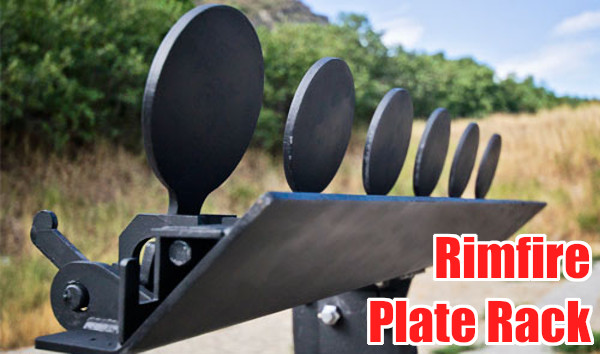
The Action Target Sport Plate Rack is specifically designed for .22 LR Rimfire shooting. This rack features six 4″-diameter plates that reset with a provided cable.
Shooting plates is fun. You get immediate feedback — “instant gratification” when you make a hit. When shooting steel inside 100 yards, we like to use .22 LR rimfire guns. The ammo is inexpensive, noise levels are lower (though you still need ear protection), and at close ranges there are fewer issue with ricochets and bullet splash-back. Additionally, for busy folks who don’t have time to reload, you can pick up a .22 LR rifle or pistol, grab a couple $5 boxes of ammo, and get to the range in a few minutes. The convenience means it is easier to shoot every week if you like.
SFC Joel Turner from the USAMU’s Action Shooting Team offers a few pointers on how to shoot plates quickly and accurately. He’s using a centerfire pistol, but the same principles apply for rimfire handguns. Click speaker icon to activate audio.
New .22 LR CP33 Pistol is Great for Plates
If you like shooting plates, one of the better new handguns for the job is Kel-Tec’s CP33. We tested this interesting handgun at the 2019 SHOT Show Media Day at the Range, and were impressed. The pistol is big, but balances well. The sights are easy to see, and the full-length rail lets you easily mount a variety of optics. The trigger is surprisingly good — better than 90% of rimfire handguns out there. For the plates game, this “quad-stack” gun can handle long stages without mag changes. The standard clear-sided CP33 magazine holds 33 rounds of .22 LR ammo.
If you are interested in an affordable, but very accurate, high-capacity semi-auto rimfire pistol you should consider Kel-Tec’s new CP33. Shooting Sports USA (SSUSA) notes: “The rapid growth of rimfire competition in Steel Challenge has prompted some gun makers to enter the fray. Kel-Tec is one, and their new CP33 .22 LR pistol has a lot of potential.” Watch 22 Plinkster’s video review below. He reports: “This handgun has been 100% reliable IF I load the magazine the right way… and it’s pretty dog-gone accurate.”
SSUSA’s testers tried the pistol with a variety of ammo and it consistently shot about one-half-inch for five shots “from a 25-yard sandbag bench rest using the iron sights.” SSUSA noted that the gun disassembles quickly and easily by removing one central pin. That’s a nice feature.
Overall SSUSA’s tester, Chris Christian, was impressed with the gun, saying it balanced well and the sights aligned naturally: “…the neutral-balance-point grip produced an almost instinctive sight alignment.”
Christian used the CP33 in a 6-stage Steel Challenge Match, and did well: “I decided to shoot Rimfire Pistol Iron (RFPI) and used the CCI Mini-Mag. The high-speed ammo ran perfectly. [T]he bright sights and handling qualities let me finish top among iron-sight shooters and even hold my own with C and B class rimfire pistol shooters using optical sights. It would be interesting to put a reflex sight on the gun, and maybe even shoot some Bullseye with it.”
The competition was founded in 1981 by Mike Dalton and Mike Fichman, in Southern California. The two Mikes wanted an exciting alternative to paper targets and came up with the all-steel format. The Steel Challenge World Speed Shooting Championships have grown to one of the largest professional pistol competitions in America. In 2018, hundredes of competitors from the United States and around the world competed at the Talladega Marksmanship Park for glory and huge cash prizes. The Steel Challenge is governed by the Steel Challenge Shooting Association (SCSA) that consists of eight standardized stages with three types of steel targets: small circle, big circle, and square. Here is a steel challenge layout in Germany.
Steel Challenge is similar to IPSC, but has simpler rules and more consistent stage designs. Up until 2011 the annual Steel Challenge World Championship was held in Piru, California every year. Then, as renamed the World Speed Shooting Championships (WSSC), the Championship was held in Frostproof, Florida (2012, 2013), St. George, Utah (2014), San Luis Obispo, California (2015-2017), and Talladega, Alabama (2018, 2019). There are also over 100 Steel Challenge Regional Matches held around the country.
This Video Shows the Steel Challenge Rimfire Rifle Optics Divison. These guys are FAST!
Want to shoot better scores at your next match? Here’s a smart, inexpensive do-it-yourself project from the good folks at Criterion Barrels. For less than one dollar in materials, in just a few minutes you can create a handy, effective mirage shield, custom-fitted to your favorite rifle.
All precision shooters should be familiar with mirage, a form of optical distortion caused primarily by variations in air temperature. Savvy shooters will use mirage as a valuable tool when gauging wind speed and direction. Natural mirage is unavoidable, but there are many techniques designed to limit its influence in long-range marksmanship.
A form of mirage can be produced by the barrel itself. Heat rising from the barrel may distort sight picture through your optics, leading to erratic results. Mirage caused by barrel heat can be reduced dramatically by a simple, light-weight mirage shield.
How to Make a Mirage Shield
A mirage shield is an extremely cost-effective way to eliminate a commonly-encountered problem. Making your own mirage shield is easy. Using old venetian blind strips and common household materials and tools, you can construct your own mirage shield for under one dollar.
Materials Required:
1. Vertical PVC Venetian blind panel
2. Three 1”x1” pieces adhesive-backed Velcro
3. Ruler or tape measure
4. Scissors or box cutter
5. Pencil or marker
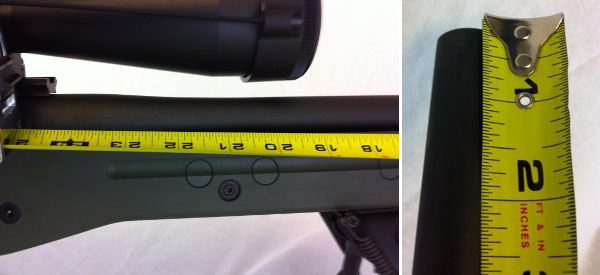
1. Measure the distance from the end of the receiver or rail to the crown of the barrel.
2. Using a pencil and ruler, measure the same distance and mark an even line across the blind.
3. Cut across the line using scissors or a box cutter, shortening the blind to the required length. (Remember, measure twice, cut once!)
4. Expose the adhesive backing on the loop side of the Velcro. Center and apply the Velcro strips on the barrel at regular intervals.
5. Expose the adhesive backing of the fuzzy side of the Velcro.
6. Place the blind on the upper side of the barrel. Apply downward pressure. Once the Velcro has secured itself to the barrel, separate the two sides. Proceed to mold both sides of the Velcro to fit the contour of their respective surfaces.
7. Reaffix the blind. Barrel related mirage is now a thing of the past!
NOTE: You can attach the Velcro on the opposite side of the blind if you want the blind to curve upwards. Some folks thinks that aids barrel cooling — it’s worth a try.
How to Remove and Re-Attach the Mirage Shield
Removal of your mirage shield is accomplished by simply removing the blind. You can un-install the Velcro by pulling off the strips and then gently removing any adhesive residue left behind using an appropriate solvent. (Simple cooking oil may do the job.) Caution: With fine, high-polish blued barrels, test any solvent on a non-visible section of the barrel. Before storing the gun, re-oil the barrel to remove active solvents and residual fingerprints.
Alpha Unknown, which had two shooters in the match, reported “This was the coolest place we’ve ever shot from… we’ll see you next year.”
Joe Burdick, owner of Rock Solid Shooting Solutions, provides this report from Wyoming: “I’m having a blast at the Nightforce ELR Steel Challenge at the Q Creek Ranch south of Casper, WY. Made my longest hits ever in competition at 1800 and some change. This 300 Winchester Magnum is absolutely PUNISHING the steel. The short targets here are at a thousand yards. I had multiple hits and clean runs on stages with targets from 1200-1800 yards. I missed the longest target of the match (2100 yards) by about 0.2 Mils.”
All photos by Joe Burdick other than as indicated by Alpha Unknown and Mitchell Fitzpatrick.
Target locations are indicated with red dots.
Burdick had high praise for the match and the venue: “This is a super cool match in an incredible location. It is remote but the size and beauty of the venue make it well worth the trip. The range is covered with life-size elk, wolf, ram, antelope, and even kangaroo targets with plenty of circles and squares as well.” The vast Q Creek Ranch encompasses 560,000 acres of scenic Wyoming landscape.
Burdick, whose company Rock Solid Shooting Solutions runs matches and sells custom gun covers, wanted to acknowledge his sponsors and equipment suppliers: Bushnell, Kelbly’s, WildEar, Precision Rifle & Tool, Huber Concepts, The Heritage Flag Company, Armageddon Gear, MasterPiece Arms, Kahntrol Solutions, BEST Targets, and Patriot Cases.
“Incredible location. It is remote but the size and beauty of the venue make it well worth the trip.”
Confirming Elevation Dope Is Essential for ELR Competition
Prior to the match, Joe verified his long-range “dope” at the Q-Creek Ranch shooting at distant targets. Joe reports: “Shooting my 300 Winchester Magnum, I made my longest hit ever with any rifle at 2086 yards.”
The 2086-yard target is marked with the red dot on the photo. The yellow dots represent the location of the 1000, 1409, 1725, and 1816 yard targets for reference.
And the Winners Are…
Chris Gittings and Brent Wood tied for Overall and Hunter Class honors at 115 points with Brent taking the tie-breaker. Notably, Brent’s son Tyler won the Junior Division. With 114 points, Mitchell Fitzpatrick took First Place in Open Division at the Nightforce ELR Steel Challenge. Congrats to all four marksmen on their great shooting! Fitzpatrick works with Applied Ballistics in the AB Weapons Division. He was shooting an AB Weapons Division M30TS rifle chambered for AB’s new .338 EnABELR cartridge, running 300gr Berger Hybrid OTM bullets at 3160 FPS. The scope was a 5-25x56mm NF ATACR with T3 reticle.
Think you can shoot fast with a bolt gun? Bet you can’t beat these Norwegian speed-demons. Inge Hvitås recently set a new Mad Minute World Record, putting 39 rounds inside a 16″ circle at 200 meters, all in a single minute. Another Norwegian ace fired 48 rounds in a minute, with 38 in the bullseye. Now that’s spectacular speed and accuracy.
Watch Inge Hvitås Set New Mad Minute World Record:
New Mad Minute World Record — 39 Hits in One Minute (60 seconds)
At the Haga shooting range in Norway, spectators witnessed spectacular speed shooting earlier this month. On June 4th, Norwegian shooter Inge Hvitås set a new Mad Minute Challenge World Record with 39 hits in ONE MINUTE at 200m. The target was a 40cm (15.75″) bullseye placed at 200m (218 yards). Fellow Norwegian Jesper Nilsstua also shot brilliantly, sending 48 rounds down-range in one minute. Jesper had 38 hits, missing the record by just one. Both shooters were using iron-sighted Sauer 200 STR target rifles, which are normally chambered for the 6.5×55 cartridge. For this event, magazines are limited to 5 rounds and shooters may use slings but no bipods or other support.
Amazing Bolt-Gun Cycling Speed — 48 Rounds in One Minute
Another Norwegian ace, Jesper Nilsstua, missed the Mad Minute Challenge record (by one hit), but boy was he fast. Dennis Santiago (who has done his own Mad Minute drill), was dazzled: “This dude didn’t get the new world’s record of 39 hits in 60 seconds. He ‘only’ got 38 hits after getting off an amazing 48 shots in 60 seconds. Watch the smoothness of his shooting. It’s amazing.”
For the Mad Minute Challenge in Norway, a standard 200m DFS target was used, with 1 point per hit within the black area which is 40cm (15.75″, or 6.9 MOA) in diameter.
Norwegian Mad Minute Challenge — Event Rules
The organizers of the event posted: “The Mad Minute Challenge [is] a modern edition of a old military drill. This is a place for sport shooters to … share experiences on the subject of speed shooting with bolt-action rifles. The Mad Minute Challenge is all about the sport! To make a attempt for the record everyone must follow these five simple rules:”
About the Original MAD MINUTE
“Mad Minute” was a pre-World War I term used by British Army riflemen during training at the Hythe School of Musketry to describe scoring a minimum of 15 hits on a target at 300 yards within one minute using a bolt-action rifle (usually a Lee-Enfield or Lee-Metford rifle). It was not uncommon during the First World War for riflemen to greatly exceed this score. The record, set in 1914 by Sergeant Instructor Alfred Snoxall, was 38 hits.
Listed as “Practice number 22, Rapid Fire” of The Musketry Regulations, Part I, 1909, this drill required at least 15 shots on the Second Class target at 300 yards. The exercise was just one of several annual tests to classify a soldier as a sharpshooter, first or second class shooter depending on the points achieved.
Research indicates the Second Class target was a 48″ x 48″ square with 24″ inner circle and 36″ outer circle. The sight mark was a central 12″ x 12″ shape representing a soldier. ALL hits scored points (3 for center circle, 2 for outer circle, 1 for outer square). NOTE: Though some sources say the Mad Minute drill used a 12″-diameter round target, this appears to be a mistake from Ian Hogg’s book “The Encyclopedia of Weaponry”. No other source mentions a 12″ circle, which would be a mere 3.82 MOA. In reality the true drill target was a 48″ x 48″ square, roughly 15 times larger. (From No.WikiPedia.)
34th Annual Fifty Caliber Championship Coming Soon
The 34th Annual Fifty Caliber Shooters Association (FCSA) 1000/600 Yard World Championship will be held July 4, 5 and 6, 2019 at the Whittington Center in Raton, New Mexico, a beautiful facility. The FCSA Championship takes place right after the 2019 King of 2 Miles event, running June 29 – July 1, 2019.
Looking downrange at the 1000-yard line. Note the fan and air hose for cooling the barrel.
Competitor’s POV perspective from a FCSA Match. Note the mirage.
By James Patterson This article first appeared in Sinclair International’s Reloading Press Blog
For a number of years I drooled over every .50 BMG caliber rifle that I came across, I read every article I could find and determined that ‘Someday’ I was going to have one. Well I finally took the plunge and in 2002 I purchased my first ‘Big 50’. Almost immediately I joined the Fifty Caliber Shooters Association (FCSA) and I have since come to immensely enjoy shooting this challenging cartridge and associating with some of the best people on earth.
FCSA Founded in 1985 The FCSA, started in 1985, is an international organization with members in 22 countries. Headquartered in Monroe, Utah, the FCSA has a membership of approximately 4000. While the FCSA provides a service to military and law enforcement with research and instruction as well as an active liaison in both communities, the primary charter of the FCSA is the promotion of the sporting use of the 50 BMG cartridge and its wildcat derivatives. It has been the FCSA and its members who have lead the way in refining .50-caliber cartridges, rifles, and 1000-yard plus shooting know-how. Members enjoy a quarterly magazine, a suppliers directory, an active website with great photo galleries, and access to literally the best repository of 50 BMG information on the planet. If you are interested in Mr. John Browning’s big 50, you should seriously consider joining the FCSA.
This interesting .50 Cal rig features a liquid-cooled barrel and unusual scope mounting arrangement.
While all aspects of the 50 BMG are promoted by the FCSA, the primary sport is 1000-yard competition. In 2010, there were 16 separate official matches scheduled across the USA, and many more ‘fun-shoots’. This sport is an incredible mix of the science, skill, and art of extreme long range accuracy. I had been actively shooting rifles and hunting for well over 40 years and had always considered myself a “rifle man”. But I had no idea of the learning curve that [faced me] when I first joined the FCSA.
Historically, 1000-yard shooting has been primarily a benchrest activity but in the past several years we have seen a tremendous interest in ‘Hunter Class’ competition; this is shot prone using a bipod. This form of long range match shooting is excellent preparation for long range hunting. The required skill set [for ultra-long-range hunting] is guaranteed to humble even the most experienced rifleman.
Cost of Big-Bore Shooting
Is owning and shooting a 50 BMG caliber rifle expensive? Relatively speaking yes, but one must put it into perspective. Rifles may run from $2500 to $8000, maybe even more for a top of the line custom rifle. A premium long-range scope will set you back $1800 to $3500. And while excellent .50 BMG commercial ammo is available, it runs $5 to $6 per round! Most serious shooters start reloading for the rifle as soon as practical, not only for the economics of reloading but also for the ability to fine tune custom ammo for their specific rifle. It’s a very rare match that is won shooting commercial ammo.
“I have molested that rifle on several different occasions over the years. It is more beautiful in person if that is possible. Fine craftsmanship in every aspect.” — Forum Member Matt K.
Today’s Sunday GunDay feature is a “blast from the past”, part of our big Guns of the Week archive. Some years back, Forum member Corbin Shell told us he had a new, full-custom 1000-yard prone rifle. When he sent some photos of the maple-stocked masterpiece, our collective jaws dropped. Check it out — this is truly a “Maple Marvel”.
Corbin’s GunDay rig is an eye-catcher for sure. This is one handsome rifle, built with all-premium components and a stunning Curly Maple thumbhole stock with adjustable cheekpiece. The rifle is chambered in .243 Winchester. It features a custom stainless RBRP action Nesika R action, with keycuts in the bottom instead of recoil lug. A Grünig & Elmiger trigger has been specially modified (milled and pinned) to work with the Nesika action. The primary barrel is a 30″ Broughton 5R Palma-contour tube. Interestingly, Corbin has a second 30″ Broughton barrel chambered in 6mmBR for use at shorter ranges.
The trigger guard, fore-arm rail, cheek adjuster, and 4-way adjustable butt assembly are all custom metal, designed by Dan Gleason. The stock is cut from exhibition-grade fiddleback maple (from Cecil Fredi Gunstocks in Las Vegas) with a Gaboon Ebony tip wood and butt-plate spacer.
Fast and Accurate
Corbin tells us the gun will put five shots into the size of a quarter at 300 yards “when he does his part.” Corbin shoots pointed Berger 105gr VLDs and 45.5 grains of H4831SC. That load runs 3180 fps. He can push it faster, but “that’s where the node was and where it shoots best”, according to Corbin.
Forum member Jim Hardy has seen (and shot against) this beautiful rifle. Jim reports: “A casual observer might think that the trigger guard, cheek plate and butt plate hardware are Anschutz — as the stock takes on the Anschutz prone pattern. However, this is ALL custom metal. The G&E trigger breaks like a glass rod and will makes my BR triggers feel inferior at best. I had the pleasure of holding, shouldering, and lusting over this gun at Camp Perry last year, and it is even more impressive in person. The killer is that there is yet ANOTHER one in a beautiful, dark figured walnut owned by Corbin’s shooting partner. BTW, both guns will hammer at 1000 yards prone.”
Long Range Prone Shooting with the .243 Winchester
Is the .243 Winchester capable at 1000 yards? Absolutely. John Whidden has used the .243 Win to capture multiple NRA National Long-Range Championships. John selected the .243 Win because it offers excellent ballistics with manageable recoil. John says that, at least for a sling shooter, the .243 Win is hard to beat at long range. John explains that, while you CAN get somewhat better ballistics with a .284 Win or .300 WSM, you’ll pay a heavy price in increased recoil with those bigger cartridges.
Running at an impressive 3275 FPS from his .243 Win, Berger 6mm 105 grain Hybrids are hard to beat, according to Whidden: “My .243 Win shoots inside a 6.5-284 with 142-grainers. Nothing out there is really ahead of [the .243], in 1000-yard ballistics unless you get into the short magnums or .284s and those carry a very significant recoil penalty.” John has tried bigger cases: “In the past I did shoot the 6.5-284. I went to the .243 Win because it had similar ballistics but had much less recoil. It doesn’t beat me up as much and is not as fatiguing.” READ Whidden .243 Winchester Report.
The digital archives of Shooting Sports USA contain many interesting articles. A few seasons back, Shooting Sports USA featured a “must-read” expert Symposium on Eye Dominance, as it affects both rifle and pistol shooting. No matter whether you have normal dominance (i.e. your dominant eye is on the same side as your dominant hand), or if you have cross-dominance, you’ll benefit by reading this excellent article. The physiology and science of eye dominance is explained by Dr. Norman Wong, a noted optometrist. In addition, expert advice is provided by champion shooters such as David Tubb, Lones Wigger, Dennis DeMille, Julie Golob, Jessie Harrison, and Phil Hemphill.
EDITOR: We highly recommend you read this article, particularly if you think you may be cross-dominant — meaning your dominant eye is on the opposite side as your dominant hand. For example, this Editor is right-handed, but my left eye is dominant.
Competing at the Camp Perry National Matches is a “bucket list” item for every serious marksman. The National Matches were first held in 1903, moved to Camp Perry, Ohio, in 1907 and continue to take place every summer at Camp Perry. The National Matches have become a huge, national shooting sports festival with well over 6,000 annual participants.
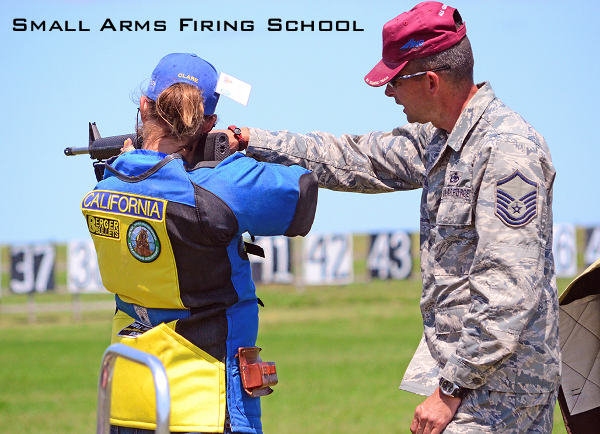
Year 2019 Camp Perry NM Competition activities begin with NRA/CMP pistol matches on July 8-14, 2019. The CMP Junior Rifle Camp, USAMU SAFS, and Smallbore matches run the next week, with the hugely popular Rimfire Sporter Match on July 21. High Power Rifle events kick off on July 23 with the 4-Man Team Match and rifle events run continuously for the next two and a half weeks.
Here are some key dates for RIFLE events:
July 27 – CMP/USAMU Rifle SAFS
July 29 – President’s 100 Rifle Match
July 30 – National Trophy Individual Rifle Match
July 31 – National Junior Team Match
August 1 – National Trophy Team Match, National Carbine Match
August 2 – National Trophy Infantry Team Match (“Rattle Battle”)
August 3 – M1 Garand Match, Springfield/Vintage Bolt Rifle Match
August 4 – M1A Match, Springfield/Vintage Bolt Rifle Match
August 5 – CMP Vintage Sniper Rifle Match
August 5-8 – CMP Long Range Individual Matches
August 9 – Camp Perry Palma Match
Larry Medler has come up with a smart little invention — a simple, inexpensive Empty Chamber Indicator for rimfire rifles. It is made from a section of plastic “weed-wacker” line and a wooden ball from a hobby shop. Larry says he was inspired by Juniors who used something similar for their 17-Caliber Air Rifles.
At a Rimfire Sporter match like this, all shooters must have an Empty Chamber Indicator.
Construction Method: First, drill a 7/64″ diameter hole all the way through the 1″-diameter wooden ball. Then enlarge half of that 1″-long hole using a 13/64” diameter drill. Next insert an 8″ piece of heavy duty (0.095″ diameter) weed wacker line through the ball, leaving about 2″ on the side with the bigger-diameter hole. Then, with the short end of the line, fold over the last half-inch so the line is doubled-over on itself. Then slide the line into the ball, stuffing the doubled-over section through the 13/64″ (large) hole. Finally, pull the longer end of the line until the doubled-over section is flush with the outside of the ball. This gives you a sturdy line attachment without messy adhesives. When the assembly’s complete, hold the ECI by the tail and dip the ball in yellow paint. If you’re making more than one ECI, you can drill horizontal holes in a spare block of wood and use that as a drying rack.
The Empty Chamber Indicator for Smallbore Rifles
Larry explains: “At all Highpower rifle matches, silhouette matches, and other shooting events I have attended, Open Bore Indicators (OBI), or what are now called Empty Chamber Indicators (ECI) have been mandatory. The NRA’s yellow ECI for Highpower rifles is easy to use and has been well-received by the shooters. However, I had not seen a truly workable ECI for 22 rimfire rifles — until I visited Michigan’s Washtenaw Sportsman’s Club where I saw juniors using ECIs for their 17 Caliber Air Rifles. Someone at the club made the empty chamber indicators by attaching an 8″ piece of weed wacker line to a 1″-diameter wooden ball, painted bright yellow. I now make similar ECIs for the 22 rimfire silhouette matches I run.”
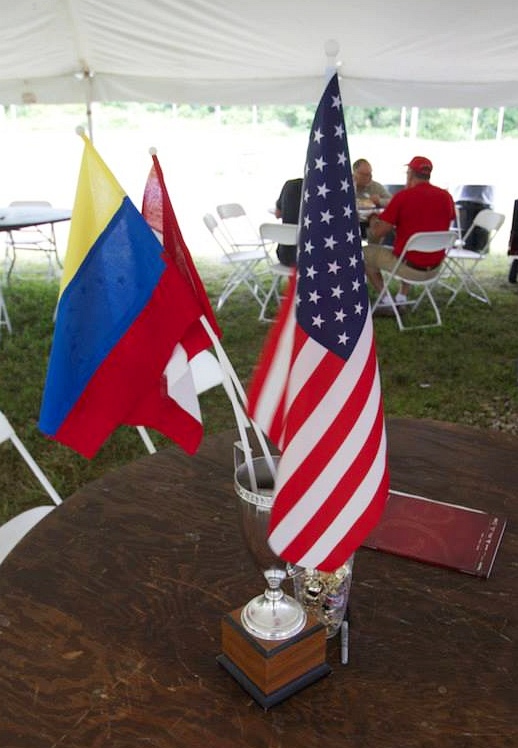
Shooters from across the nation and many foreign competitors will compete this year at the CAAFTC held at the Rochester Brooks Int’l Skeet and Trap Club.
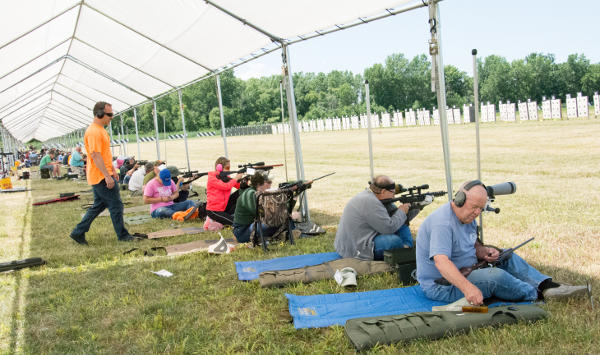
Upstate New York heats up in the summer with the largest field target event in the country — the Crosman All-American Field Target Championship (CAAFTC). This very popular airgun event takes place June 21-23, 2019 in upstate New Yorkat the Rochester Brooks International Skeet and Trap Club in Rush, New York. 0ver 100 air rifle and air pistol competitors will participate in the big event hosted by Crosman. This event attracts top Airgunners from across the nation (and some foreign countries). Along with regular Field Target matches, there will be specialty side matches, plus a factory tour. The event is free to the public.If you are a Field Target Shooter and want to attend, don’t hesitate — registration closes soon.
After getting squared away with check-in and some practice rounds on Friday, take part in the pistol match and the Quigley Bucket Challenge (see video below). For the Quigley Bucket Challenge, competitors must try to hit a 1.75″ target from 55 yards away, using open sights (no scopes).
The three-day competition features multiple shooting matches including the main two-day rifle event. There are four divisions for competitors: Open, Hunter, WFTF, and Pistol. In addition to the main rifle event, this year will also feature a pistol match, the Quigley Bucket Match and the Pyramyd Air Gunslinger match. The Bucket match re-creates famous scene in the movie Quigley Down Under in which the lead character shoots a bucket at 700 yards. Here the distances are scaled down a wee bit (wink). Competitors, using iron sights only, get 5 shots at a 1.75″ bucket placed at 55 yards.
Tech Talk: Why the Big Side-Wheels on the Scopes?
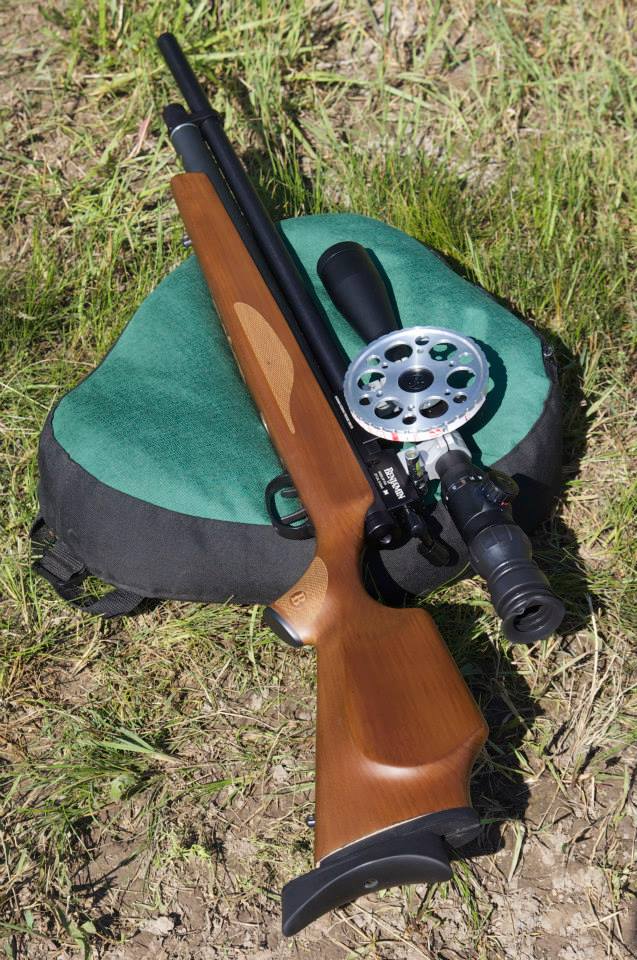
Field Target rifles shoot pellets propelled by compressed air. These light-weight, low-BC projectiles drop very quickly, with a looping trajectory. In order to hit targets at distances out to 50 yards or so, you have to adjust your scope to compensate for pellet drop. But you can’t set the scope correctly without knowing the precise range to the target. This is the function of the big wheels on the side of the scope. Field Target Competitors use the parallax adjustment on high-magnification scopes to determine target range. The big wheel allows quick, yet precise parallax adjustment. Markings on the wheel show the shooter the scope settings required for the distance “dialed-in” via the over-size parallax wheel.
The CAAFTC is sanctioned by the American Airgun Field Target Association and is a featured AAFTA Grand Prix event. The 120-shot match has competitive rifle divisions based on allowable gun and support equipment. Here are the main air rifle classifications:
Hunter Division – rifle fires at a maximum 20 foot pounds of energy (FPE), shooter may use a non-attached bipod, non-restrictive clothing, and sitting stool. Open Division - maximum 20 FPE maximum rifle, shooter may wear a body harness, no bipod, 6″ maximum height seat. World Field Target Federation (WFTF) – similar to Open but shooters compete according to international standard of maximum 12 fpe for rifles. Freestyle Division – 20 FPE maximum rifle, no other restrictions. (This is new for 2016).
The pistol competition includes similar divisions based on shooting styles. Both rifle and pistol divisions include sub-classes based on the air rifle powerplant: piston driven or pre-charged pneumatic.
“If you want to see some of the country’s finest airgun shooters, this is the hottest event of the summer and it’s free for the public,” says Chip Hunnicutt, Marketing Manager for Crosman. “Alongside the world-class shooters, we’ll have enthusiasts simply having a good time and even parents bringing their kids for some good fun outdoors.” (NOTE: Click framed images below to zoom.)








 Joe Burdick, owner of


 Burdick, whose company


 Research indicates the Second Class target was a 48″ x 48″ square with 24″ inner circle and 36″ outer circle. The sight mark was a central 12″ x 12″ shape representing a soldier. ALL hits scored points (3 for center circle, 2 for outer circle, 1 for outer square). NOTE: Though some sources say the Mad Minute drill used a 12″-diameter round target, this appears to be a mistake from Ian Hogg’s book “The Encyclopedia of Weaponry”. No other source mentions a 12″ circle, which would be a mere 3.82 MOA. In reality the true drill target was a 48″ x 48″ square, roughly 15 times larger. (From


 The FCSA, started in 1985, is an international organization with members in 22 countries. Headquartered in Monroe, Utah, the FCSA has a membership of approximately 4000. While the FCSA provides a service to military and law enforcement with research and instruction as well as an active liaison in both communities, the primary charter of the FCSA is the promotion of the sporting use of the 50 BMG cartridge and its wildcat derivatives. It has been the FCSA and its members who have lead the way in refining .50-caliber cartridges, rifles, and 1000-yard plus shooting know-how. Members enjoy a quarterly magazine, a suppliers directory, an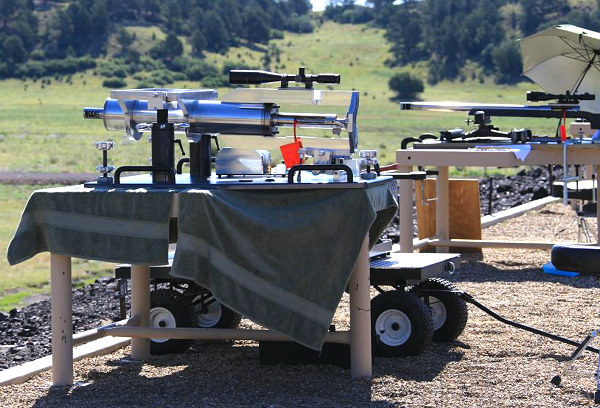


 Today’s Sunday GunDay feature is a “blast from the past”, part of our big





 Upstate New York heats up in the summer with the largest field target event in the country — the Crosman All-American Field Target Championship (CAAFTC). This very popular airgun event takes place June 21-23, 2019 in upstate New Yorkat the Rochester Brooks International Skeet and Trap Club in Rush, New York. 0ver 100 air rifle and air pistol competitors will participate in the big event hosted by Crosman. This event attracts top Airgunners from across the nation (and some foreign countries). Along with regular Field Target matches, there will be specialty side matches, plus a factory tour. The event is free to the public.If you are a Field Target Shooter and want to attend, don’t hesitate — registration closes soon.